
淺析簽署海峽兩岸共同打擊犯罪及司法互助協議之影響 - 政大學術集成
106
0
0
全文
(2) 淺析簽署海峽兩岸共同打擊犯罪及司法互助協議之影響 The Study of Consequences of Signing “the Agreement on Cross-Strait Cooperation in Combating Crimes and Mutual Legal Assistance between Taiwan and China”. 研究生: 董裕光. Student: Yu-kuang Tung. 指導教授: 陳陸輝博士. 學. 國立政治大學. 亞太研究英語碩士學位學程. Nat. A Thesis. sit er. io. al. y. 碩士論文. ‧. ‧ 國. 立. Advisor: Dr. Lu-huei Chen 政 治 大. n. iv n C h e nProgram Submitted to International Master’s g c h i Uin Asia-Pacific Studies National Chengchi University In partial fulfillment of the Requirement For the degree of Master in China Studies. 中華民國九十九年七月 July 2010 i.
(3) Abstract. This study focuses on the impact of signing " the Agreement on cross-Strait cooperation in combating crimes and mutual legal assistance" between Taiwan and mainland China. It intends to explore motivation and necessity of signing this agreement, the legal issues and operational process of this agreement, the history of cross-Strait cooperation of fighting against crimes and mutual legal assistance, and current status and problems.. 政 治 大. There are three major parts in this thesis. First, this study defines. 立. cross-Strait mutual legal assistance and of cross-Strait crime, confirms its. ‧ 國. 學. meaning and scope, and then introduces judicial mutual assistance and cooperation in the international society of both sides. It analyzes the situation. ‧. and trend of cross-Strait crimes, history of cross-Strait cooperation in. y. Nat. io. sit. combating crimes, the existing legal provisions on mutual legal assistance,. n. al. er. and difficulties before the signing of the agreement. Secondly, this study. Ch. i Un. v. introduces the content and effects of this agreement, includes the provisions,. engchi. the actual operation, the laws related to it, the impact, and follow-up legislation as well as negative criticism. Finally, this study compares the situation before and after the signing of the agreement, understands the real benefits and finding the existing problems, and make evaluations on this agreement.. Keyword: cross-Strait cooperation in combating crimes, mutual legal assistance.. ii.
(4) TABLE OF CONTENTS 1. INTRODUCTION………………………..….……………….……………...……1 1.1 Background……………………………………………………………..…….…...……1 1.2 Motivation and Purpose……………...………..……………………………………...5 1.3 Literature Review……………...……………………………………….………..........7 1.4 Research Approaches and Methods…………………………..………………….....12 1.5 Research Hypotheses………………………………………………………………….12 1.6 Research Scope and Limitations………………………………..…….…….……... 13. 治 政 大 AND 2. EXPLORATION OF MUTUAL LEGAL ASSISTANCE 立 CROSS-STRAIT CRIMES……………………………..………………..……...15 ‧ 國. 學. 2.1 Implications of International Mutual Legal Assistance in Criminal Matters….15. ‧. 2.2 Scope of Mutual Legal Assistance and Basic Principles………………….……..16. sit. y. Nat. 2.3 Characteristics and Legal Status of Cross-Strait Mutual Legal Assistance…..20. io. er. 2.4 Implications of Cross-Strait Crimes………………………………………...……...23. al. n. iv n C 3. HISTORY OF PARTICIPATING INTERNATIONAL MUTUAL LEGAL h eIN ngchi U ASSISTANCE OF TAIWAN AND MAINLAND CHINA….………….…..….26 3.1 International Mutual Legal Assistance of Taiwan ……….……….…….….........26 3.2 International Mutual Legal Assistance of Mainland China……………...……...32. 4. CROSS-STRAIT COOPERATION IN COMBATING CRIMES AND MUTUAL LEGAL ASSISTANCE BEFORE SIGNING "NANJING AGREEMENT"…………………………………………………….….…...……37 4.1 Patterns of Cross-Strait Crimes...………………………………………………..…37 4.2 Review of Cross-Strait Mutual Legal Assistance……………………….…..……47 iii.
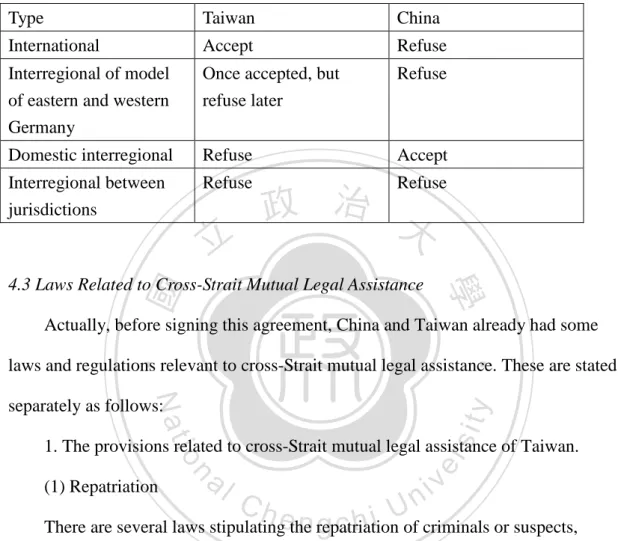
(5) 4.3 Laws Related to Cross-Strait Mutual Legal Assistance……...…………………52 4.4 Cross-Strait Cooperation in Combating Crimes…………………….……….….56. 5. CONTENTS AND IMPACTS OF "NANJING AGREEMENT"…..……...…64 5.1 Main Contents and the Actual Operational Processes………..………..…......…64 5.2 Characteristics and Legal Status ……………………..………….............….….…70 5.3 Impacts of "Nanjing Agreement"…………………...…………..…….…….….…...72 5.4 Follow-up Legislation…………………………...…………………...…………....…74 5.5 Negative Comments……………………………..………………..………..……....…75. 立. 政 治 大. 6. ACHIEVEMENT AND EXISTING PROBLEMS…………………...….….….79. ‧ 國. 學. 6.1 Achievement of Cooperation in Combating Crimes………….….............………79. ‧. 6.2 Achievement of Mutual Legal Assistance…………….………...…….……...…….80. al. er. io. sit. y. Nat. 6.3 Existing Problems………………………………………………….…….……….…...83. n. 7. CONCLUSION………………..……………………………………..…………...87. Ch. engchi. i Un. v. REFERENCES………………………………………………………….…………..90. APPENDIX…………………………………………………………….……………95. iv.
(6) 1. INTRODUCTION 1.1 Background. China has been divided into two political entities since 1949, and the two parts are governed by ROC (Republic of China) and PRC (People's Republic of China) separately. The ROC rules Taiwan, Penghu, Kinmen and Matsu, and the ROC is the one who has real governing power over mainland China. Both sides of the Taiwan Strait were in a state of confrontation and isolation for almost 40 years, from 1949 to 1987.. 立. 政 治 大. The Republic of China executed martial law in November of 1949.With the. ‧ 國. 學. passing of time, hostilities have gradually eased across the Taiwan Strait. The Republic of China repealed martial law in July 1987. "National Unification. ‧. Guidelines" were activated in March 1991, and the announcement of the end of. y. Nat. sit. Period of Communist Rebellion was made in May 1991.The possibility of using force. er. io. to deal with the issue of national reunification was officially ruled out.1. al. n. iv n C In June of 1983, Deng Xiaoping programs for the peaceful h esubmitted i U n g c hsix reunification of mainland China and Taiwan, and announced 2 basic principles of future cross-Strait relations--"one country, two systems" and" peaceful reunification ".2. Taiwan allowed people to visit their relatives in mainland China on November 2,. 1987. After 1988, Taiwan adopted other measures, allowing some mainland residents to visit Taiwan, and the barriers of Taiwan Strait were broken down. People living on different sides of the Taiwan Strait started interacting, and cross-Strait 1. 2. Zhong De-Xun(2003), Research of Cooperation on Criminal and Judicial Issues and the Cooperation in Combating Crimes across the Strait, master's thesis of National Institute of Public Administration, Dong Hwa University, p. 1 Editorial Committee of the CPC Central Committee documents(1993), Selected Works of Deng Xiaoping, Beijing People's Publishing House, p.p.58-61 1.
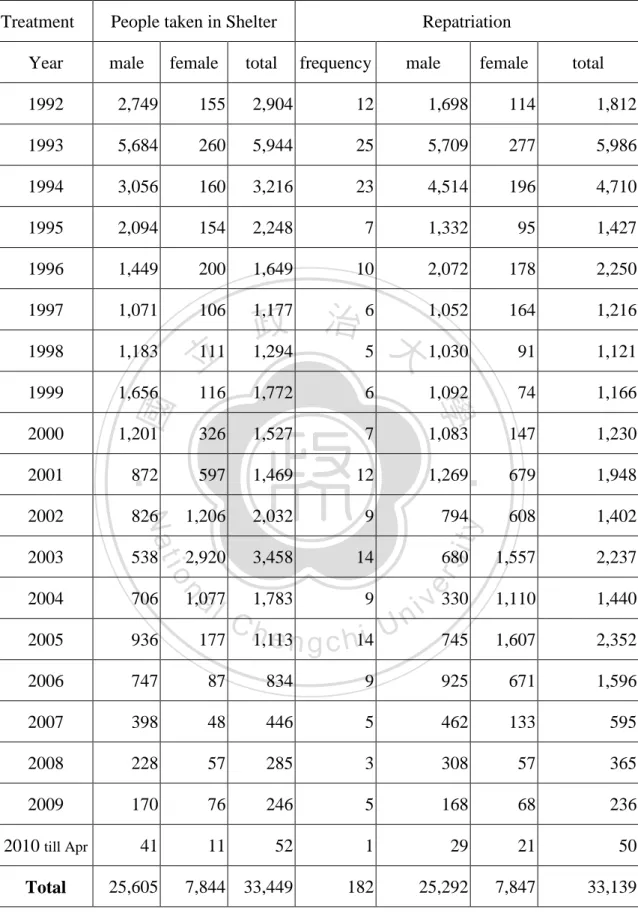
(7) relative-visiting, travel and economic, cultural and academic activities were increasing. At the same time, cross-Strait crimes frequently occurred, especially hijacking, piracy, illegal immigration, and smuggling. Some of these cross-Strait crimes are the result of collusion between criminals on both sides of the Taiwan Strait. Sometimes, people commit crimes on one side and later on flee to the other.. Some. people the other side illegally. To solve these problems, both sides must construct a proper mechanism to reduce these criminal activities, protect the common interests of the people on both sides, and promote development of cross-Strait relations. Since the two sides belong to different jurisdictions, and since there is no mutual legal. 治 政 assistance mechanism, investigation and prosecution of大 cross-Strait crimes and 立 arresting of fugitives fleeing to the other side are all difficult assignments. ‧ 國. 學. To resolve the problem of mutual repatriation of offenders, Red Cross. ‧. representatives from both sides went to Kimen and signed the "Kimen Accord" on. y. Nat. The "Kimen Accord" set the mode of repatriation operations,. sit. September 12, 1990.. n. al. er. io. sending criminals back to their home country between Matsu and Mawei, or between. i Un. v. Kinmen and Xiamen. Criminals who are repatriated are mostly illegal immigrants. Ch. engchi. coming from the mainland to Taiwan, and Taiwanese who have committed crimes and then fled to the mainland. According to this accord, Taiwan and China executed their first repatriation in the same year on Oct. 13.3. The Kinmen agreement is not a formal official agreement. Neither side can be punished for violating the agreement. There is no real binding force. Actually, there are a large number of illegal immigrants coming from mainland China to Taiwan, and repatriations have to be made once about every three months. But in practice,. 3. Jia Qing-Jun(2008), “Study on Mutual Legal Assistance on Criminal Matters Related to Taiwan”, Journal of Beijing’s People Police College, No. 4, p. 44 2.
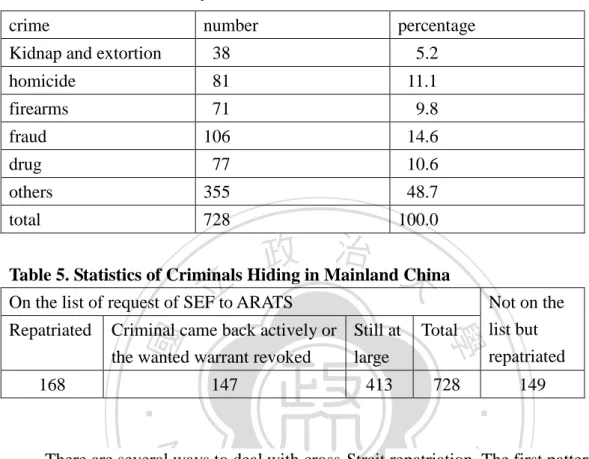
(8) repatriation can not be carried out, because bilateral talk between the two Red Cross goups was sometimes stopped. For example, repatriation was interrupted for half a year in April of 1998.4. Furthermore, mainland China investigates cases requested by Taiwan very slowly, especially in areas outside of Fujian Province. Also, the "Kinmen agreement" content is limited to the repatriation of criminals; it does not include cooperation in combating crimes, assistant investigations, service of document-sending, evidence collection, or other items of mutual legal assistance. In other words, the effect of the. 政 治 大. "Kinmen agreement" for fighting cross-Strait crimes is quite limited.. 立. In April 1993, the Straits Exchange Foundation, which is authorized by the. ‧ 國. 學. Taiwan Government, and its counterpart, the Association for Relations Across the. ‧. Taiwan Strait, held the first "Koo-Wang talks" in Singapore, and signed the. sit. y. Nat. "Koo-Wang agreement". Several agreements were made in "Koo-Wang agreement".. io. er. The first one, "this year's negotiation issues", stipulated the following: the two sides. al. would negotiate on these issues this year, including "repatriation of illegal. n. iv n C immigrants", "fighting against marine U and other criminal h esmuggling n g c h, irobbery activities "," negotiation of intellectual property rights (IPR Protection) "," cross-Strait mutual assistance in the judiciary (the cross-Strait links between the courts) "and other topics for consultations. However, the consensus of the talks has not yet translated into real action, and attempts at cooperation in combating crimes between two sides of the Taiwan Strait are still in vain.5. In May 2008, the KMT returned to power. Unlike the Democratic Progressive Party administration, which adopted a rivalry policy towards China, the KMT 4 5. United Daily News(October 12,1998), p.13 Aforementioned footnote 1, p.3 3.
(9) government re-established good relations with China and contributed to the meeting of “Straits Exchange Foundation” (SEF) Chairman Chiang Pin-Kung and mainland China Association for Relations Across the Taiwan Straits (ARATS) chairman Chen Yun-Lin.. They negotiated a number of bilateral agreements. Cross-Strait relations. developed rapidly.. In March 2009, the Ministry of Justice Attorney Director Chen Wenqi discreetly flew to the mainland twice, to consult with the relevant authorities on combating crime, and on drafting articles. In mid-April, ARATS vice chairman Zheng Lizhong. 政 治 大. visited Taiwan, and did final text scrutiny with his Taiwanese counterpart.. 立. On April 26, 2009, Chiang Pin-Kung and Chen Yun-Lin, representing SEF and. ‧ 國. 學. ARATS respectively, signed "Agreement on Cross-Strait Cooperation in Combating. ‧. Crimes and Mutual Legal Assistance" (hereinafter referred to as the “Nanjing. sit. y. Nat. Agreement”) in Nanjing. The “Nanjing Agreement” took effect on June 25, opening. io. n. al. er. the new era for cross-Strait mutual legal assistance.6. i Un. v. Taiwan and China successfully signed the "Nanjing Agreement". People of two. Ch. engchi. sides anticipate that action against cross-Strait crimes and repatriation of criminals could progress smoothly from now on. But some are still highly suspicious of the motive behind the signing of the "Nanjing Agreement", giving a negative assessment of this agreement. What is more, so far some notorious Taiwanese fugitives who have fled to mainland China have not been repatriated yet. Cross-Strait criminality is still rampant. As a result, people still pay attention to the achievement of “Nanjing Agreement” over combating cross-Strait crimes.. 6. Chen Wen-Qi(2009), Opening a New Era of Cross-Strait Mutual Legal Assistance-- Brief Introduction of Cross-Strait Cooperation in Combating Crimes and Mutual Legal Assistance Agreement, October 30, 2009, speech in Investigation Bureau, Taipei. 4.
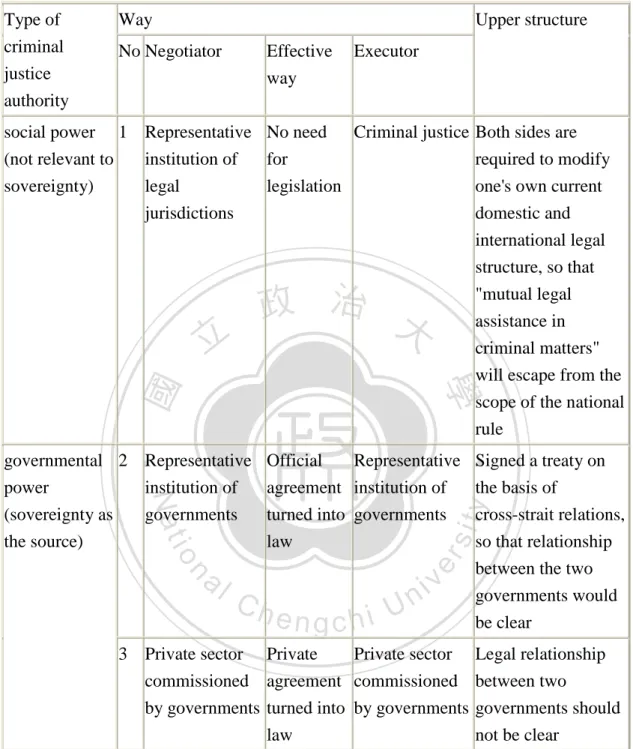
(10) 1.2 Motivation and Purpose. I have been working in government for the judiciary for more than 10 years. I have participated in cross-Strait repatriation several times. I am very curious about different views of this agreement. As a result, I hope to know more about this agreement and the effect of it. According to “Nanjing Agreement”, important criminal cases, including murder, robbery, kidnapping, smuggling, drug trafficking, hijacking airplanes and ships,. 治 政 大 are the focus of trust, fraud, money laundering, forgery or altering the currency, 立. terrorist activities and economic crimes, such as corruption, encroachment, breach of. cross-Strait cooperation in combating crimes. In addition to cooperation in combating. ‧ 國. 學. various types of crime, mechanisms for cooperation on surveillance, information. ‧. exchange, repatriation of prisoners, civil and criminal legal assistance and other. sit. y. Nat. cooperation mechanisms would be all normalized. People who hold a positive view of. io. al. er. the agreement would expect it to improve Taiwan's security and reduce economic and. n. financial crimes, so that the judiciary is able to arrest fleeing mainland criminals and bring them to justice.. 7. Ch. engchi. i Un. v. Under the agreement, Ministry of Justice is the only conduit between Taiwan and China. On the other hand, China has four different means of contacting Taiwan, including public security, the prosecutorial system, courts and judicial administration.. In the past, because there were no legalized cross-Strait mutual assistance channels, many intelligence agencies had to find their own ways to solve their problems of fighting cross-Strait crimes. Like the Bureau of Investigation, Coast 7. Liu Ming-Te(2009), http://www.cdnews.com.tw/cdnews_site/docDetail.jsp?coluid=110&docid=100749661,Central Network News. Date of logging on: Mar/30/2011. 5.
(11) Guard, National Police Administration, over the years they built their own pipelines with mainland public security and armed police, contacting in private in order to bridge the private channels, hoping that they would help arrest wanted persons. But since they are all one-way operations using non-official channels, there is no integration. Sometimes on important cases, two or three units are in the hunt. Both time and manpower are wasted.. For example, many years ago someone nicknamed "Pangolin" Chan Lung-Lan, was arrested in Yunnan.. Because of poor integration, the Chinese public security. 政 治 大. forces almost refused to turn him over to Taiwan.. 立. Chan Lung-Lan was arrested and has been working heavily through various. ‧ 國. 學. channels to get release, even with money. At the same time, the Criminal. ‧. Investigation Bureau (CIB) of Taiwan had negotiated with the China’s authorities. sit. y. Nat. several times, hoping that China would return Chan Lung-Lan to Taiwan as soon as. io. er. possible. Finally China’s authorities agreed to send Chan to Macao International. al. Airport, and then CIB could take him back. But CIB Secretary General Kau. n. iv n C Chen-shen worried about whether or officers could arrive in Macao on time, h not e nCIB gchi U so he asked Macao police to detain Chan before CIB officers arrive.. Unexpectedly, Macao the police officer immediately reported this to his boss, PRC Ministry of Public Security, and then Ministry of Public Security notified the ARATS; as the ARATS knew nothing about this case in advance, they refused the repatriation. This repatriation almost failed.8. Former SEF Secretary-General You Ying-Lung quoted polling data that more than 70 percent of people agree that the mainland China is " paradise of Taiwan 8. Yang Su-Min, Zhang Xiao-Yi(2009), Times Weekly, May 11, 2009. 6.
(12) criminals", saying that China takes a "selective" arrest policy towards Taiwan criminals; another statistics says 96 percent of people think that the two sides should sign an agreement to combat crime, and 80 percent of people think that cross-Strait relations would be affected if China does not crack down on cross-Strait crimes.9. Although Taiwan and China successfully signed the "Nanjing Agreement", not everybody takes positive viewpoint towards this agreement. The Democratic Progressive Party believes that the quality of the cross-Strait judicial system and culture are very different. According to the agreement, if Taiwan businessmen face. 政 治 大. lawsuits in China, and they have to oppose Chinese authorities in court, they often. 立. become lambs to the slaughter. If this agreement is implemented, the Chinese court's. 學. ‧ 國. decision will also have res judicata (legal example of judgment) in Taiwan. Taiwan court must recognize the China court's judgments, and then Taiwanese courts may. ‧. become "Executive Office" of China courts. Taiwan would help China prosecute. Nat. sit. y. Taiwan businessman.10 In addition, the most notorious Taiwan fugitives hiding in. n. al. er. io. mainland China, such as former Tuntex Group President Chen Yu-Hao, and former. i Un. v. Legislative Yuan speaker Liu Sung-Fan, have not been extradited. The DPP. Ch. engchi. questioned the sincerity of China and the necessity of signing this agreement.. 1.3 Literature Review. Because the "Nanjing Agreement" has existed for just over a year so far, not too much literature discussing this agreement is available. Most discussions of 9. Hsieh Li-Kung(2008), “the Establishment of the Mechanism of Cross-Strait Cooperation in Combating Crimes and Amendment of Kinmen Agreement”, Police Science and Security Management Seminar, p. 385. 10 Available at: http://www.libertytimes.com.tw/2009/new/apr/30/today-p4.htm. Date of logging on: Mar/30/2011. 7.
(13) cross-Strait mutual legal assistance focus on possible models. National Taiwan University Law professor Tsai Tun-Ming, National Police University Professor Hsieh Li-Kung, Taiwan Police College president Liu Qin-Zhang, have all written some articles about the possible cross-Strait mutual legal assistance model according to status quo of cross-Strait relations. They all mentioned that we need to create a fuzzy space to national identity issues, shelving sovereignty disputes, avoiding the use of any sensitive words relevant to transnational affairs. That is the only way to sign the agreement.. 政 治 大. Liu Qin-Zhang published the article " cross-Strait mechanism of cross-functional. 立. analysis of crime prevention" in "Police Studies and Security Management 2008. 學. ‧ 國. Conference". He asserts that the " cross-Strait crime prevention mechanism" in the justice field should include cooperation in the whole procedure of investigation and. ‧. trial; namely, the mechanism should be broad-sense mutual assistance in criminal. y. Nat. sit. justice. There are 3 different ways to set up mutual legal assistance between the two. n. al. er. io. sides of Taiwan Strait. Negotiation enforced by civil institutions commissioned by the. i Un. v. governments would be more accessible. After that, the agreement should be put into legislation.11. 11. Ch. engchi. Liu Qin-Zhang(2009), “Functional Analysis on Cross-Strait Crime Prevention- Study on the re-Construction of Cross-Strait Mutual Legal Assistance in Criminal Matters”, 2008 Police Studies and Security Management Seminar, p. 379. 8.
(14) Table 1: different ways of constructing cross-Strait mutual legal assistance Type of criminal justice authority. Way. Upper structure. No Negotiator. Effective way. social power 1 Representative No need (not relevant to institution of for legal jurisdictions. Criminal justice Both sides are required to modify. legislation. 政 治 大. 立. n. y. Official Representative Signed a treaty on agreement institution of the basis of turned into governments cross-strait relations, law so that relationship between the two governments would. er. io. al. scope of the national rule. ‧. ‧ 國. 學. Nat. governmental 2 Representative power institution of (sovereignty as governments the source). one's own current domestic and international legal structure, so that "mutual legal assistance in criminal matters" will escape from the. sit. sovereignty). Executor. Ch. engchi. i Un. v. 3 Private sector Private Private sector commissioned agreement commissioned by governments turned into by governments law. be clear Legal relationship between two governments should not be clear. Hsieh Li-Kung wrote the article "Blue Print of Cross-Strait Mutual Legal Assistance ─Draft of Agreement on Mutual Legal Assistance”.12 Actually, the draft. 12. Hsieh Li-Kung(2003), " Blue Print of Cross-Strait Mutual Legal Assistance ─Draft of Agreement on Mutual Legal Assistance ", Exploration of Regional Criminal Judicial Assistance in China, Beijing: Publishing House of Chinese People's Public Security University, p.p.287-293. 9.
(15) he proposed is very similar to the “Nanjing Agreement”. He asserts that the broad mutual legal assistance, including the transfer of criminal legal claim and foreign enforcement of criminal judgments, are long-term goals of both institutions of justice. Concerning the atmosphere of cross-Strait relations, the short term prospects of signing the agreement with broad mutual legal assistance is not easy. If the two sides of the Taiwan Strait can sign an agreement which stipulates narrow mutual legal assistance, such as helping the other side searching evidence, sending documents and intelligence exchange, it will be more accessible.. 政 治 大. Hsieh also wrote another article "Establishing the Mechanism of Cross-Strait. 立. Cooperation in Fighting Crimes - On the Kinmen Agreement Amendment" in the. 學. ‧ 國. "2008 Police Studies and Security Management Seminar". He announced that the “Kinmen Agreement” provides only repatriation of criminal suspects. It is like an. ‧. international extradition treaty. Because extradition to some extent means the. Nat. sit. y. concession of jurisdiction, the “Kinmen Agreement” has deeper legal implications. n. al. er. io. than agreements with only investigation, document delivery and evidence collection.. i Un. v. In theory, both sides of Taiwan Strait should be able to sign an agreement with narrow. Ch. mutual legal assistance agreement.13. engchi. In "Study on Mutual Legal Assistance between Taiwan Strait”, Jian Jian-Zhang points out that if the two sides can sign an agreement on a specific criminal issue, such as agreement on fighting drug crime, and gradually extend the scope of the criminal legal assistance, then establishment two-way of the "quasi-international mutual assistance in criminal justice" model is just around the corner.14. 13 14. Aforementioned footnote 9, p. 390. Jian Jian–Zhang(2001), "Study on Mutual Legal Assistance between Taiwan Strait”, Police Science Series, Vol. 32, No.1, p. 189. 10.
(16) Many mainland China scholars discuss the issue of cross-Strait mutual legal assistance, but they all insist on "one China" framework of the negotiations. In "Cross-Strait Cooperation in Fighting Crime Problems and Countermeasures", Liu Dao-Lun asserts that cross-Strait mutual legal assistance in criminal matters is different from international ones. He says that in the negotiations, both sides of the Taiwan Strait should insist on the one-China principle and the "1992 Consensus" under the premise of protecting the fundamental interests of the Chinese people and safeguarding the legitimate interests of compatriots on both sides.15. 政 治 大. Huang Shao-Ze wrote in the article "Police Cooperation across the Taiwan Strait. 立. and Hong Kong and Macao" that cross-Strait police cooperation system must be. 學. ‧ 國. established on a one-country basis. He asserts that we should not treat this as transnational affairs;16 Jia Qing-Jun asserts in "Study on Mutual Legal Assistance on. ‧. Criminal Matters Related to Taiwan” that the cross-Strait police cooperation must. y. Nat. sit. follow the interests and the principle of safeguarding national sovereignty, that is, ". n. al. er. io. one country, two systems " is the only and most important principle to resolve the. i Un. v. Taiwan-related issue.17We can see from the above articles that for mainland China. Ch. engchi. scholars, the "one China" principle takes precedence over real content of mutual legal assistance agreement. Due to the insistence of issue of sovereignty in both sides, cross-Strait agreement on mutual legal assistance is very hard to create. On the other hand, we know that there is substantial concession coming from mainland China because the "Nanjing Agreement" has been signed. China does not insist on their “principles” in this agreement.. 15. 16. 17. Liu Dao-Lun(2009) , "Cross-Strait Cooperation in Fighting Crime Problems and Countermeasures", Fujian Laws, No. 1, overall No. 97, p. 64. Huang Shao-Ze(2008) , "Police Cooperation across the Taiwan Strait and Hong Kong and Macao", People's Procuratorate Semimonthly, No.19, p. 58. Aforementioned footnote 3, p. 43 11.
(17) 1.4 Research Approaches and Methods. This study adopts a historical approach and a legal research approach on the "Nanjing Agreement". The historical approach will include the history of signing the agreement on mutual legal assistance of China and Taiwan, and mutual legal assistance between the two sides and history of cooperation in combating crimes. The legal research approach is analysis of the legal context of the provisions of "Nanjing Agreement", trying to know the impact of provision of cross-Strait mutual legal assistance and cooperation in combating crimes.. 治 政 This study employs the literature review method, 大 researching the quality of 立. cross-Strait mutual legal assistance and the “Nanjing Agreement”; also, this study will. ‧ 國. 學. compare the "Nanjing Agreement" with other legal assistant agreements signed by. ‧. Taiwan and China in the past. Moreover, this study explores the differences of. sit. y. Nat. cooperation in combating crimes and mutual legal assistance related to “Nanjing. io. n. al. er. Agreement”, so that the real influence brought by the agreement will be found.. Ch. engchi. i Un. v. 1.5 Research Hypotheses. The evaluation of the "Nanjing Agreement" is bi-polarized. Positive evaluation announces that the agreement will contribute to the fight against cross-Strait crime; meanwhile those who hold negative views think that the "Nanjing Agreement" is only on paper. China will not follow the rules, and it has no real binding force, but Taiwan is probably dwarfed to an executive department because civil judgments made by China courts should be recognized by Taiwan Courts. Because of different views on all sides, the research hypotheses are set as follows: Taiwan and China signed the 12.
(18) “Nanjing Agreement” because cross-Strait crimes between the two sides are rampant. Both governments will benefit from the signing of this agreement. Neither Taiwan nor China would be dwarfed, and Taiwanese businessmen working in China would not be persecuted due to the “Nanjing Agreement”.. 1.6 Research Scope and Limitations. After reviewing the literature related to "cross-Strait cooperation in fighting. 政 治 大. crime strategies and operations", we can find that:. 立. 1. There is not too much literature discussing the "Nanjing Agreement". ‧ 國. 學. The "Nanjing Agreement" took effect on 25, June, 2009. That was only one year. ‧. ago. So research discussing cross-Strait cooperation in combating crimes and. y. Nat. sit. cross-Strait mutual legal assistance agreements were mainly written before the. n. al. er. io. "Nanjing Agreement" was signed. Literature analyzing the "Nanjing Agreement" is very rare.. Ch. engchi. i Un. v. 2. There is little literature discussing strategy and practice of cross-Strait cooperation in combating crime.. Most literature written by scholars of mainland China focuses on political ideology when discussing cross-Strait cooperation in combating crimes. Most Taiwan scholars focus on analysis of legal systems when they discuss this issue. They both lack analysis of practical implementation.. 13.
(19) 3. Taiwan administrations of judicial police do not have integrated data on cross-Strait cooperation in combating crimes. Before the signing of "Nanjing Agreement", the Red Cross was the authorized window of cross-Strait cooperation. But actually, data for cross-Strait cooperation in combating crime and mutual repatriation of criminals is not complete. Our judiciary police administrations, including National Police Agency, Investigation Bureau and Coast Guard, do not have mechanisms for cooperation with Chinese counterparts to combat crime. They can only seek cooperation in their own way. As a result, the data. 政 治 大. for cross-Strait cooperation in combating crime and the repatriation has not been. 立. integrated. We can only obtain a fragmented one.. ‧ 國. 學. 4. Mainland China’s data is incomplete. ‧. Most Taiwanese criminals fleeing to China do not use official channels to enter. y. Nat. sit. mainland; instead, they enter mainland China illegally. This way,. they will not have. n. al. er. io. entry and exit information, and statistics of the accurate number of offenders living in. i Un. v. China cannot be obtained. Moreover, data on Taiwanese who are sentenced and. Ch. engchi. detained in mainland jails is not provided by China. It has also been a problem for statistics.. 14.
(20) 2. CROSS-STRAIT CRIMES AND INTERNATIONAL MUTUAL LEGAL ASSISTANCE Before discussing the content and effect of the “Nanjing Agreement”, this study will clear the meanings and definitions of different terms of cross-Strait affairs related to legal issues, such as “cross-Strait mutual legal assistance” and “cross-Strait crimes”. We will look deep into the characteristics of different kinds of mutual legal assistance, knowing the relations of mutual legal assistance between the two sides of Taiwan Strait. After doing that, we can make sure which kind of agreement the “Nanjing. 政 治 大. Agreement” should be considered with, confirming why some articles of this. 立. agreement are stipulated in certain ways, and avoiding unnecessary disputes over it.. ‧ 國. 學. 2.1 Implications of Mutual Legal Assistance. ‧. Mutual legal assistance refers to courts or other judiciary institutions of different. y. Nat. sit. jurisdiction that provide assistance with each other or conduct cooperation. In other. n. al. er. io. words, mutual legal assistance in criminal matters means one jurisdiction executes. i Un. v. some judicial behavior in criminal matters in order to fight against crime. There are. Ch. engchi. two premises of mutual legal assistance in criminal matters. First, there are at least two different jurisdictions. Second, each one has the need for striking crimes.18. International mutual legal assistance in criminal matters happens among different countries. Extradition is its first thing to occur. "Peace Treaty", signed in 1280 BC in Egypt for repatriation of criminals, is the world’s first treaty on extradition. In AD 1624 Grotius put forward the judicial principle "extradition or punishment" to. 18. Mu Hong-Yu(2003), “ Thesis of the Nature and Content of Criminal Judicial Assistance in China”, Exploration of Regional Criminal Judicial Assistance in China, Beijing: Publishing House of Chinese People's Public Security University, p.40.. 15.
(21) international crimes in his book "War and Peace". It set up the theoretical basis for modern mutual legal assistance in criminal matters. When it comes to China, in the Zhou Dynasty, extradition of fugitive offenders between feudal countries was very common. Extradition of fugitives at that time (mainly politicians) was political deal between the princes. In the Tang Dynasty, the law clearly stated in specific provisions relating to punishment of foreigners, including extradition, deportation and other compulsory acts.19 Before the Middle Ages, most forms of mutual legal assistance were focused on extradition, both in China and other countries.20 Some scholars believe that international mutual legal assistance in criminal matters means according. 治 政 to bilateral treaties or multilateral conventions, different 大countries provide reciprocal 立 assistance to each other and help each other execute mutual assistance in criminal ‧ 國. 學. proceedings on behalf of the other party, such as arrest, extradition of fugitives,. ‧. service of judicial documents, calling witnesses, collection and transfer of evidence,. er. io. sit. y. Nat. providing intelligence, recognition and enforcement of foreign criminal judgments. 21. al. n. iv n C 2.2 Scope and Principles of International Legal Assistance in Criminal h e nMutual gchi U Matters. There are several types of international mutual legal assistance in criminal matters. They include the following:. 1. Extradition: prisoners transferred from one country to another to face trial.. 19. 20. 21. Hsieh Li-Kung(2002), “Study on Agreement on Mutual Legal Assistance in Criminal Matters between USA and Taiwan and it's Impact to Anti-Transnational Crime”, Journal of Border Police, Central Police University, No. 1, p. 4. Zhao Yong-Chen(1994), International Criminal Law and Mutual Legal Assistance, Beijing: Legal Publishing House, p.p. 159-160 André Bossard(1990), Transnational Crime and Criminal Law, The University of Illinois, p.142. 16.
(22) 2. Narrow-sense mutual legal assistance. It may be called a small mutual legal assistance. It refers to assistance such as interrogation of witnesses, experts, the implementation of search, seizure, validation, transfer of evidence, service of documents, and providing intelligence.. 22. 3. Transfer of criminal indictment: also known as the transfer of jurisdiction of criminal lawsuit. This means that a state entrusts another state to conduct a criminal lawsuit, which should be the jurisdiction of the original state.23 It refers to the state transfer the case to another jurisdiction because it can not conduct the criminal. 政 治 大. lawsuit.24 For example, the criminal with nationality of A state commits a crime in B. 立. state, and then flees to C state. B state can make the request to A state or C state, to. ‧ 國. 學. indict or sentence the criminal.25 The essence of meaning is the requester gives up jurisdiction over criminal cases, totally trusting the requested one and approving. ‧. punishment on the absconded made by the requested party. But the requesting State. y. Nat. al. er. io. Generally, few countries adopt this method.. sit. has to give up the right to pursue judicial appeal in such a cooperation model.. n. iv n C 4. Recognition and enforcement of foreign criminal he n g c h i U judgments. That means the recognition and enforcement of criminal judgments made by other countries.. The former two can be collectively referred to as generalized mutual legal assistance. If the assistance includes all four types, it is the broadest sense of mutual legal assistance. Extradition and narrow-sense mutual legal assistance are preliminary types of mutual legal assistance, so they are called classical types of mutual legal 22. 23 24. 25. Wu Jing-Fang(1998)," Practice of Cooperation in Combating Crimes of Taiwan and China ─ Facilitation for the Interregional Mutual Legal Assistance in Criminal Matters between the Two Sides ," Chung-Shing Monthly of Law ", No. 44, p. 32. Aforementioned footnote 20, p. 273 Zhang Zhi-Hui(1999), International Criminal Law Theory (supplement) ,Beijing: Publishing House of China University of Politics and Law, p. 369. Aforementioned footnote 22 17.
(23) assistance. Because in such mutual legal assistance, the implementation of investigation and trial will still be implemented by the requesting state, and the requested state provides assistance only. So it is called the second-time mutual legal assistance.. Regardless of whether legal assistance is in civil, criminal, or commercial matters, equality, mutual benefit, and national sovereignty are basic principles. Also, there are still other principles adopted in narrow-sense mutual legal assistance, such as the “dual criminality” principle, the “to prosecute or extradite” principle and other specific principles.26. 立. 政 治 大. 1. Principle of national sovereignty: the sovereignty of justice is an important. ‧ 國. 學. part of national sovereignty. A country's judicial institution should carry out mutual. ‧. legal assistance activities independently in its territory, and also respect foreign. sit. y. Nat. jurisdiction. Without the consent of the other state, he can not intervene in the foreign. io. er. jurisdiction. When implementing mutual legal assistance, one country should provide. al. assistance to the other based on her criminal law, but she must also consider each. n. iv n C other's legal system, legal relationship h ebetween h itwoUsides for a compromise and n g cthe the elimination of conflict of laws, as well as conducting some compromise over diplomatic relations. The principle of national sovereignty, in fact, is the basic principle highlighted by international criminal law - principle of sovereign equality. Sovereign equality is the first principle in the Charter of the United Nation. The meaning is: all states are legally equal; states have sovereign power internally; national personality, territorial integrity, political independence should be respected;. 26. Zhao Yong-Chen(2000), Countermeasure for Transnational Crimes, Jilin People’s Publishing House, p.p. 344-350 18.
(24) states must respect international law, and be faithful to their international obligations.27. 2. Principle of equality and mutual benefit: this means every country has the same legal rights and obligations. Judicial authorities of both sides, according to the provisions of the treaty or by equal consultations, have the same rights and convenience over activities and specific requirements of cooperation. However, this principle does not mean that the two sides must be exactly the same on mutual legal assistance issues. Different states have different legal systems. If one state is forced. 政 治 大. by international standards to achieve the same standard, respect for the law would be. 立. undermined, and the judicial sovereignty would face intervention.. ‧ 國. 學. 3. Dual criminality: this principle refers to eclectic dual criminality principle of the. ‧. mutual legal assistance. If the requesting state and the requested state both consider an. sit. y. Nat. act as criminal behavior, the requested state can provide mutual legal assistance. If the. io. er. behavior is not considered as a crime in requested state, then no judicial assistance. al. would be provided. The principle of dual criminality was originally a principle for. n. iv n C extradition. As time goes by, this principle h e n ghascbeen h i aUcommon one in many different agreements of mutual legal assistance.28. 4. Prosecution or extradition: this principle is one of the most important in international mutual legal assistance in criminal matters. It is used to prevent, suppress and punish international crime, and has been widely used in the relevant international conventions. According to the requirements of this principle, each state has her obligation that if she does not extradite the criminal to the requesting country, 27. Clause 1, article 2, Charter of United Nation;Liu Ya-Ping(1992),Science of International Criminal Law, Beijing, China Political and Legal Publishing House, p.83 28 Ker Ger-Zhuang(1999), Study on Foreign and Hong Kong, Macao and Taiwan Criminal Law, Publishing House of Shanghai Social Science College, p. 56 19.
(25) she should prosecute the criminal domestically. This principle can be said to take the principle of concept of universal jurisdiction. No matter where the crime occurs and what kind of right the crime is against, crimes stipulated in relevant international conventions shall be regarded as a hazard for all mankind, regardless of the nationality of the perpetrator. Regardless of which country the perpetrator is in, each country has to execute criminal jurisdiction.29 But this principle is usually subject to certain restrictions; political prisoners, military prisoners, and nationals are not extraditable. Moreover, if the crime is related to religion, nationality and other factors, or the suspects will face unfair trial, torture, or inhumane treatment, the requested country may refuse to extradite. .30. 立. 政 治 大. 學. ‧ 國. 5. Specific principles: the requesting country can only sentence or punish the defendant in terms of the reasons for extradition after the requested country extradites. ‧. the fugitive. This principle is meant to guarantee absolute implementation of "the. y. Nat. sit. principle of dual criminality" , to prevent the extradition of the other country used in. n. al. er. io. political persecution on non-ordinary criminal or those who are not in accordance to. i Un. v. dual criminality. For example, Switzerland insists that evidence, documents and. Ch. engchi. intelligence acquired by mutual legal assistance may not be used as evidence for accusing crimes other than those stated in the request in mutual legal assistance.. 2.3 Characteristics and Legal status of Cross-Strait Mutual Legal Assistance. 29. Zhao Shi-Chen(1996), “Study on International Mutual Legal Assistance in Criminal Matters”, Research on Mutual Legal Assistance, Beijing, Legal Publishing House, p.95 30 Article 4 and 5, Model Treaty on Extradition, Convention of United Nations, resolution no. 45/116, 14/12/1990 20.
(26) When mutual legal assistance in criminal matters occurs between different states, it is known as "International Mutual Assistance in Criminal Matters". If it occurs in the same country but between different jurisdictions, it is called "Interregional Mutual Legal Assistance in Criminal Matters".31 The former one happens between countries, and it is also executed according to the provisions of international treaties or bilateral reciprocity, directly under the coordination of international organizations.32 The latter one refers to the different jurisdictions in one country that execute criminal justice cooperation and mutual legal assistance.33 In order to prevent and punish common crimes, each region must perform on behalf of judicial behavior within its jurisdiction and satisfy the requested region.. 立. 34. 政 治 大. 學. ‧ 國. This study claims that from the legal point of view of Taiwan, cross-Strait mutual legal assistance in criminal matters is not simply "international mutual legal. ‧. assistance in criminal matters" or simply the "interregional mutual legal assistance in. y. Nat. However, Article 11 of “Constitutional. n. al. 35. er. io. should be considered an international issue.. sit. criminal matters." Some scholars believe that cross-Strait mutual legal assistance. i Un. v. Amendments” states: "relations of rights and obligations of people between free area. Ch. engchi. and the mainland area should be handled on the basis of other specific laws." Also, the “Act Governing Relations between the People of the Taiwan Area and the Mainland Area” to some extent has adopted “Interregional Legislation" as a solution 31. 32. 33. 34. 35. Wang Zhi-Wen(1996), “Theory of International Civil Legal Assistance and Regional One”, Hua Gang Law Monthly, No. 24, p. 243. Ma Jin-Bao(1996), International Crime and International Criminal Judicial Assistance, Beijing: Legal Publishing House, p. 4. Mu Hong-Yu(2003), “ Thesis of the Nature and Content of Criminal Judicial Assistance in China”, Exploration of Regional Criminal Judicial Assistance in China, Beijing: Publishing House of Chinese People's Public Security University, p. 40. Gao Ming-Xuan, Wang Xiu-Mei(2000), “Discussion on Content of Conflict over Interregional Jurisdiction of Criminal Matters and Principles of Resolution in China", Research on Chinese Regional Criminal Law and Criminal Mutual Legal Assistance, Beijing: Legal Publishing House, p. 22. Wang Tai-Quan, Chen Yueh-Duan(2000), Laws Related to Cross-Strait Relation", Taipei: The Chinese Book Co. Ltd., p.p. 96-97. 21.
(27) for relevant legal issues. Therefore, according to legal status quo, the mutual legal assistance across the Taiwan Strait is not just "international criminal legal assistance." Some scholars consider mutual legal assistance across the Straits as "interregional and mutual legal assistance". For instance, mainland China scholars stick to the "one country, two systems" principle. They all think of cross-Strait mutual legal assistance as interregional, regardless of the partition and separation of the two sides of Taiwan Strait. Some Taiwan scholars think “Act Governing Relations between the People of the Taiwan Area and the Mainland Area” has adopted "one country, two zones" theory, so they agree with the notion of mainland China scholars. Actually, that is not totally. 治 政 correct. We argue that the “Act Governing Relations between 大 the People of the 立 Taiwan Area and the Mainland Area” has adopted "one country, two zones" theory, ‧ 國. 學. but the legislators do not acknowledge that the legal relations across the Straits are. ‧. fully recognized interregional ones. They only adopted the way of “interregional legal. sit. y. Nat. relation” to solve cross-Strait legal issues. For example, article 41 of “Act Governing. io. er. Relations between the People of the Taiwan Area and the Mainland Area” states: “Civil matters between the people of the Taiwan Area and the Mainland Area shall be. al. n. iv n C subject to the laws of the Taiwan Area otherwise provided for in this Act. Civil h eexcept ngchi U matters between different residents of the Mainland Area, and between residents of the Mainland Area and any foreign national, shall be subject to the provisions of the Mainland Area except otherwise provided for in this Act.” When it mentions Taiwan laws, it uses the term " law”; when it comes to mainland China, then it is “provision”. You can see the difference between them, and it seems to violate the principle of equality in interregional law relation. This status quo of legal relationship between the Taiwan Area and the Mainland Area is absolutely different from that between general states; and the relationship is different from the "one country, two laws" phenomenon of interregional legal relation. Above all, cross-Strait mutual legal assistance in 22.
(28) criminal matters should be considered a special interregional one.36 To sum up, cross-Strait mutual legal assistance in criminal matters has its own characteristics. It has both the "international" and "interregional" features. So we are supposed to be "inclusive" rather than just use a single "international" or "interregional" point of view to consider this issue.. 2.4 Implications of Cross-Strait Crime. 政 治 大. Because of the impact of globalization, different countries, regions and people. 立. become closer and closer. Transnational crimes, cross-border crimes and interregional. ‧ 國. 學. crimes happen frequently. What kind of crime is cross-Strait crime? How can we sort it out? Its outcome will determine the legal status of the "Nanjing Agreement". So we. ‧. have to confirm the definition of cross-strait crime before further discussion.. sit. y. Nat. io. n. al. er. 1. Transnational crime. Ch. i Un. v. Transnational crime means crime across national borders. The so-called. engchi. transnational crime means the behavior, the result of crime, or the perpetrator is involved in different countries.37 Former Secretary-General of Interpol, André Bossard pointed out: "The so-called transnational crime is an anti-social behavior. The preparation, implementation or result crosses at least two or more national borders, making at least two or more countries have rights to carry out their criminal punishment on it. "38 According to Clause 2, Article 3 of “the United Nations Convention against Transnational Organized Crime”, organized and transnational 36 37. 38. Aforementioned footnote 18, p. 176 Qi Wen-Yuan and Liu Dai-Hua (2004), Research on International Crime and Transnational Crime, Beijing University Publishing House, p. 66 Aforementioned footnote 21, p.142 23.
(29) crime are these types as follow: 1. implemented in more than one country; 2. implemented in one country, but its preparation, planning, command or control occurs in another country; 3. committed in one country but involves in more than one country; 4. committed in one country but has a significant impact in another country.39. 2. Interregional Crime Interregional crime means that the crime’s preparation, implementation or results. 治 政 大 their legal penalties on the makes two or more courts of different jurisdictions conduct 立 of criminal behavior is beyond two or more different jurisdictions in one country; this. perpetrator respectively.40 From China's domestic legal scholars’ point of view,. ‧ 國. 學. China’s territory includes mainland China, Hong Kong, Macao and Taiwan, and they. ‧. are four different regions (or jurisdiction). So they say China has "one country. sit. y. Nat. (China), two systems (capitalist and the socialist system), three legal systems (Hong. io. al. n. China adopts socialist legal system), four jurisdictions.". 3. Cross-border Crime. Ch. engchi. er. Kong adopts common law system, Taiwan and Macao adopt Euro legal system, and. i Un. v. Cross-border crime refers to preparation, implementation or results of criminal behavior that is across national or regional borders, meaning at least two or more countries or regions can impose criminal penalties for the behavior. In other words, the offender has crossed at least one border of the state or region in the duration of crime. The pattern can be divided into narrow one and broad one. If any one of the subjects, behavior, objects, and results cross the border, it is called a narrow 39 40. Aforementioned footnote 11, p. 380 Zhao Bin-Chi, Qian, Yi, and He Shin-Wan(1996), Punishment and Prevention of Transnational and Regional Crime , Beijing: China Founder Publishing House, p.p. 3-4 24.
(30) cross-border crime. Broad cross-border has a narrower definition, in which perpetrators commit s crime in one place and later on flee to another place. Cross-border crime has a broader range. It can refer to crossing a national border, provincial border, or regional border. So transnational crime and interregional crime should be included.41To sum up, if "cross-border crime" refers to cross-Strait crime, its connotation would be the "broad cross-border crime ". That would be acceptable to both sides of Taiwan Strait. Actually, signing the “Nanjing Agreement” is very difficult for both sides of. 政 治 大. Taiwan Strait. As this study mentioned above, both sides have their own principles,. 立. and have to make some concessions. After that, the “Nanjing Agreement” can be. ‧ 國. 學. signed. For both sides of Taiwan Strait, signing “Nanjing Agreement” can facilitate measures of combating cross-Strait crimes, and combating crimes is much more. ‧. important than sticking to some rules. We can say that “Nanjing Agreement” is the. y. Nat. sit. fruit of compromise of Taiwan and mainland China, and this agreement is the. n. al. er. io. evidence that both sides of the Taiwan Strait have adopted a pragmatic way for solving cross-Strait crimes.. 41. Ch. engchi. Aforementioned footnote 9, p.p. 385-386 25. i Un. v.
(31) 3. HISTORY OF PARTICIPATING IN INTERNATIONAL MUTUAL LEGAL ASSISTANCE OF TAIWAN AND MAINLAND CHINA. Globalization makes every country connect and cooperate with each other, and transnational cooperation against crimes is very important for all countries, including Taiwan and mainland China. In this chapter we will explore the situation and history of signing different agreements and treaties with different countries of Taiwan and mainland China, knowing the trend of aspiration of global cooperation over mutual legal assistance. After exploring the whole situation, we will know the similarities and. 政 治 大. differences between those agreements and the “Nanjing Agreement” . In later chapters,. 立. we can discuss the content of “Nanjing Agreement” article by article.. Nat. sit. y. ‧. ‧ 國. 學. 3.1 International Mutual Legal Assistance of Taiwan. io. er. Taiwan is also affected by globalization, and has to face the invasion of. al. transnational crime. Therefore, Taiwan has to seek necessary international. n. iv n C cooperation against crime. However, h due e ntoginternational c h i U pressure from China, many countries are not willing to take the risk of offending the Chinese by signing any treaty with Taiwan, or let Taiwan join the multilateral judicial cooperation mechanisms. As a result, Taiwan always fails to participate in international judicial cooperation mechanisms.. At present, the achievements of Taiwan in cooperation in combating crimes and international mutual legal assistance are stated separately as follows:. 26.
(32) 1. International Criminal Police Organization (Interpol): Interpol was founded in 1923, and Taiwan was former member of the organization. In 1984, during the 53rd annual meeting held in Luxembourg, Taiwan was forced to change its name to "China Taiwan" and become a non-member participant because of China's accession. Taiwan's international status and interests in Interpol were replaced by China. Although Taiwan still keeps in touch with Interpol, Taiwan is no longer a formal member. Taiwan receives much less intelligence than formal members do.. 2. Mutual Legal Assistance Agreement:. 治 政 大 Matters between USA (1) "Agreement on Mutual Legal Assistance in Criminal 立. and Taiwan": "Agreement on Mutual Legal Assistance in Criminal Matters between. ‧ 國. 學. USA and Taiwan" is the first agreement on mutual legal assistance in criminal matters. ‧. signed by Taiwan. One of the reasons why Taiwan and the USA signed the agreement. sit. y. Nat. is due to the Huang Guangjie case. Huang Guangjie has dual nationality, and is. io. er. identified by the U.S. judiciary the important member of the syndicate. He was in jail. al. in Taiwan then, facing a criminal sentence. The United States asked Taiwan to. n. iv n C extradite Huang. But according to "Extradition of Taiwan, the government h e n g cLaw" hi U should not extradite her own nationals. For strong aspiration of signing treaties of extradition or mutual legal assistance with USA, Taiwan was willing to make an exception to allow the extradition of citizens conditionally, but it was ultimately in vain.42. Another reason Taiwan and the United States signed the agreement was to fight drug crime. In 1992 Taiwan and the United States, mainly for curbing drug crime,. 42. Song Yaw-Ming(2009), “The Execution of International Legal Assistance on Criminal Matters-Cross-Strait Cooperation in Combating Crimes”, Perspective and Exploration, Vol. 7, No. 2, p.p.87-88. 27.
(33) signed the "Memorandum of Understanding of Cooperation on Criminal Investigation of North American Affairs Commission and the American Institute in Taiwan ". But since then there has been no progress. In early August 2001, the representatives of law enforcement of Taiwan, including Ministry of Justice, Investigation Bureau, and Criminal Investigation Bureau, went to the United States to discuss matters of bilateral mutual legal assistance agreements. The two sides got consensus on exchange of information gathering, investigation of evidence, questioning of witnesses, assistance of searching, seizure and verification, delivery of documents, confiscation of property, income and other items of cooperation. As for extradition,. 治 政 exchange of prisoners, repatriation of criminals and other 大parts, due to highly 立 mandatory rules, and sensitive issues as national sovereignty and protection of human ‧ 國. 學. rights, there has not been consensus yet. On January 16, 2002, the Legislative Yuan. ‧. passed the "Agreement on Mutual Legal Assistance in Criminal Matters between USA. sit. y. Nat. and Taiwan ", and the agreement was formally signed in March 2002.43. n. al. er. io. The agreement Taiwan and the United States signed should be classified as. i Un. v. narrow mutual legal assistance in criminal matters. According to the provisions of the. Ch. engchi. agreement, each one should provide assistance with investigation, prosecution, crime prevention and relevant criminal justice processes with each other, but excluding such things as extradition and transfer of criminal jurisdiction. According to the statistics of the Ministry of Justice, from 2001 to January 2010, during a nearly 8-year period, only 30 or so cases of bilateral mutual request have been submitted. The bilateral cooperation of two countries is not as smooth as expected.44 The US has the largest number of Taiwanese fugitives. In the beginning, Taiwan hoped to execute the. 43 44. Aforementioned footnote 19, p. 5 Available at: http://www.moj.gov.tw/public/Data/0123152159765.pdf. Date of logging on: 04/02/2011. 28.
(34) extradition of criminals by the effectiveness of the agreement, but it turned out to be in vain. Because the United States adopts common law, she is not willing to sign extradition treaties with foreign countries. Furthermore, the subject for extradition treaties should be a recognized country. Since the United States still adheres to the "one China" principle, Taiwan is not regarded as a state. Under these circumstances, extradition can not be included in the agreement. Mutual legal assistance agreements can not be effective for extradition.. (2) Taiwan-Vietnam Agreement on Mutual Legal Assistance: "Taiwan-Vietnam. 政 治 大. Agreement on Mutual Legal Assistance" was signed on April 12, 2010, and approved. 立. on May 21 by the Legislative Yuan. However, Vietnam is still worrying about mutual. 學. ‧ 國. legal assistance in criminal matters. Therefore, this agreement is limited to civil litigation. This development may not meet the expectations of the Taiwan government.. ‧. In the future, adding the content of criminal justice into the agreement is the goal of. Nat. er. io. sit. y. law enforcement of Taiwan.45. al. (3) Nanjing Agreement: On April 26, 2009, Chiang Pin-Kung and Chen Yun-Lin,. n. iv n C representing SEF and ARATS respectively, the “Nanjing Agreement”. The h e n gsigned chi U. content and influence of “Nanjing Agreement” would be discussed in latter chapters.. 3. Extradition treaty. Generally, the extradition of prisoners from abroad must be in accordance with bilateral agreements or treaties. If no agreement, treaty, or extradition is stipulated in the agreement or treaty, the government should follow the "Law of Extradition". Seven countries have signed extradition treaties with Taiwan: Dominica, Dominican 45. Available at: http://udn.com/NEWS/FOCUSNEWS/BREAKINGNEWS1/5612671.shtml. Date of logging on: 07/31/2010. 29.
(35) Republic, the Republic of Paraguay, South Africa, Swaziland Republic, Republic of Malawi, and the Republic of Costa Rica. Theoretically, Taiwan can ask those countries to repatriate Taiwanese criminals back to Taiwan on the basis of the provisions of the extradition treaty.46 However, Taiwan criminals rarely flee to those countries. Therefore, the treaties of extradition are not so effective.. In theory, for effectively combating transnational or cross-border crime, all countries need a modern and comprehensive law on mutual legal assistance and extradition, as well as an extensive network of bilateral or multilateral treaties.. 政 治 大. However, due to the lack of formal diplomatic relations with other countries, Taiwan. 立. can not participate in international conferences held by UN, and can not join in. ‧ 國. 學. multilateral or bilateral cooperation.. ‧. As mentioned earlier, before the “Nanjing Agreement”, the US was the only. sit. y. Nat. country which signed the mutual legal assistance in criminal matters with Taiwan.. io. er. Taiwan has submitted some requests for judicial assistance to foreign countries, but. al. the result is subject to the law of the requested country. Many countries have. n. iv n C provisions on mutual legal assistance. countries, mutual U h eEven h inon-signatory n gforc the legal assistance agreements may also be provided assistance pursuant to the provisions. But the provided subject should be a “state". In the international society, most countries insist on the "one China" principle. Under this circumstance, Taiwan has little chance to be recognized as a "state". As a result, requests of Taiwan for judicial assistance are still difficult to attain.. However, the recent development of some cases has gone better. Although the laws of Switzerland and Singapore both stipulate that the subject to launch requests 46. Ching Chi-Ren(2003), “Review and Prospect of Implementation of Taiwan-US Mutual Legal Assistance Agreement”, Law Series, No. 129, p.p.135-143 30.
(36) for judicial assistance shall be a "state", in the case of Warship Lafayette and the former President Chen's money-laundering case, Taiwan actually obtained judicial assistance from Switzerland, acquiring information on a specific account at Swiss bank; in the Papua New Guinea financial aid case, Singapore has also provided assistance to Taiwan. Undoubtedly, this development is very favorable for Taiwan’s foreign judicial assistance.47. 4 Informal ways to arrest fugitives fleeing abroad. 治 政 大 seven ones, we can not countries. If the fugitives flee to countries other than those 立. As mentioned earlier, our country has only signed extradition treaties with seven. extradite them back. To solve this problem, we developed a pragmatic method. In this. ‧ 國. 學. method, judicial or military authorities will inform the Ministry of Foreign Affairs to. ‧. revoke the passport of the wanted person(s), according to the "Passport Ordinance".. sit. y. Nat. This will make their residence in the foreign country illegal. Then, the local law. io. er. enforcement agencies will cooperate to deport the wanted criminal, and inform the police authorities in Taiwan.48 Then the criminal will be placed on the plane, and our. al. n. iv n C law enforcement personnel will go h to the plane to arrest e n g c h i U him. This pattern is. sometimes used with countries friendly to Taiwan, to help combat transnational crime. Sometimes China adopts the so-called deportation towards Taiwan illegal immigrants and criminals, avoiding the cumbersome extradition procedures, to save judicial resources. Generally speaking, China tends to deport the criminal after conviction. Deporting criminals does not mean exemption of prosecution. That is, China yields the court's power to the country of the criminal.. 47 48. Aforementioned footnote 43, p. 90 Aforementioned footnote 47, p.p. 135-143 31.
(37) Currently, this informal mode of cooperation is the common way to arrest fugitives fleeing aboard from Taiwan. However, there are still restrictions. If the fugitives have legitimate right of abode in the local countries or dual nationality, and we have no diplomatic relations with the their residing countries, or the crime type is not significant enough to cause malignant effect, then the cooperation of repatriating criminals back to Taiwan becomes very difficult.49. We can find that establishing mutual legal assistance with foreign countries is a common goal of Taiwan and mainland China. For fighting against transnational. 政 治 大. crimes, signing treaties and agreements with other countries is very important, and it. 立. is also an inevitable method that both Taiwan and mainland China should adopt. Since. 學. ‧ 國. China is a main destination for Taiwanese fugitives fleeing abroad, we have no reason why China should be excluded from the list of countries which Taiwan would like to. ‧. sign the agreement of mutual legal assistance with. Therefore we can assert that. Nat. sit. n. al. er. io. Taiwan.. y. signing the “Nanjing Agreement” with mainland China is a necessary decision for. Ch. engchi. i Un. v. 3.2 International Mutual Legal Assistance of Mainland China. After Deng Xiaoping returned to power in 1978, China started to adopt economic-oriented policies. Although the economy was gradually modernized, China inevitably faced the intrusion of globalization of crime. With accelerated economic globalization, the international community started to pay more attention to combating transnational crime by means of judicial cooperation. The need for judicial. 49. Chen Guang-Chi(2002), "Regional Cooperation in the Fight against Corruption”, Study on Regional Criminal Judicial Assistance , Macao Institute of Justice Prosecutors, p.p. 358-368. 32.
(38) cooperation between countries continued to elevate. To satisfy this need, China has also been seeking international cooperation to expand the range of fighting against transnational crime.. According to statistics from Department of Treaty and Law under the Chinese Foreign Ministry, as of January 2010, China has signed 106 judicial cooperation treaties with 68 countries, including 32 extradition treaties, 16 civil and commercial judicial assistance treaties, 19 civil and criminal judicial assistance treaties, 27 criminal judicial assistance treaties, 6 transfer of sentenced persons treaties, and 6. 政 治 大. agreements related to combat terrorism, separatism and extremist forces. In addition,. 立. China also joined more than 20 international conventions which are relevant to mutual. ‧ 國. 學. legal assistance and provisions of extradition.50 International cooperation in combating transnational crimes participated by China can be divided into the. ‧. following four categories. They are as follows:. sit. y. Nat. io. n. al. er. 1. Extradition treaties.. i Un. v. Up to May 2010, China has signed extradition treaties with 32 countries. On. Ch. engchi. August 26, 1993, China and Thailand signed "Extradition Treaty of the People's Republic of China and the Kingdom of Thailand ". That was the first bilateral extradition treaty signed by China. The extradition treaties mainly stipulate obligation to extradite, extraditable crimes, the situation and the reasons for accepting or refusing extradition, extradition requests and the accompanying files, use of language, temporary custody, the transfer of extradited persons, property transfer, transit, costs and so on. Up to now, China has signed extradition treaties with these countries:. 50. Available at: http://www.legaldaily.com.cn/zmbm/content/2010-01/21/content_2032122.htm?node=7578. Date of logging on: 04/02/2011. 33.
(39) Thailand, United Arab Emirates, the Philippines, Mongolia, Indonesia, Korea, Pakistan, Laos, Azerbaijan, Kazakhstan, Kyrgyzstan, Cambodia, Uzbekistan Stein, Lithuania, Russian Federation, Belarus, Bulgaria, Romania, Algeria, France, Spain, Ukraine, Portugal, Lesotho, South Africa, Angola, Tunisia, Namibia, Peru, Mexico, Brazil, and Australia.51 In the past decades, China did not sign many extradition treaties with western countries. Those countries signing treaties with China were not the principal destination of the fugitives. As a result, the real effect of extradition was limited. In 2005, China successfully signed an extradition treaty with Spain. Later on France and Australia followed suit. For the time being, signing extradition treaties. 治 政 with United States and Canada, the most common destinations 大 of fugitives, is the 立 main goal of law enforcement in China. ‧ 國. 學. 2. Bilateral mutual legal assistance treaties.. ‧. sit. y. Nat. In 1987, China and France signed "Agreement on Judicial Assistance in Civil. io. al. er. and Commercial Matters", which is the first bilateral judicial assistance treaty that. n. China has signed with another country. Since then, China actively strived to sign judicial cooperation treaties.. Ch. engchi. i Un. v. "Agreement of China and the Canadian Criminal Judicial Assistance", signed in 1994, is the first mutual legal assistance treaty in criminal matters. In June 2000, China and US signed the "Mutual Legal Assistance Agreement". That is a major breakthrough for China, because US is the main state where Chinese fugitives escape and hide.. 51. Available at: http:// www.legaldaily.com.cn/zmbm/content/2010-01/21/content_2032122.htm?node=7578. Date of logging on: 04/02/2011. 34.
(40) Generally speaking, the above provisions of bilateral treaties on judicial assistance in criminal matters stipulate the scope of assistance, the rejection of assistance, the way of assistance, usage of language, legal assistance fees, requests for assistance and certification, and so on. The scope of assistance means criminal investigation, prosecution and other criminal procedures, including delivery of documents, investigation and evidence gathering (including the questioning of witnesses and suspects, evidence identification, judicial inquests, etc.) , the provision and exchange of legal information, communication outcome of criminal proceedings, request for the execution of search and seizure, confiscation of proceeds and. 治 政 instruments of crime and transfer of illicit money, and 大 so on. 立 ‧ 國. 學. 3. Participation in international treaties.. 52. ‧. China has joined" U.N. “Convention against Transnational Organized Crime".. sit. y. Nat. The convention, the first international criminal law convention, was drawn up by the. io. er. U.N. on November 15, 2000. Its purpose was to combat transnational organized crime.. al. Also, China has signed other international conventions related to the punishment of. n. iv n C international crimes, such as: "Suppression h e n gandc Punishment h i U of the Crime of Apartheid International Convention", signed in 1976; " Convention on the Suppression of Unlawful Seizure of Aircraft", signed in 1971; " Convention on the Suppression of Unlawful Acts of Civil Aviation Safety ", signed in 1973; " United Nations Convention against Illicit Traffic in Narcotic Drugs and Psychotropic Substances Convention", signed in 1990; "Convention Against the Taking of Hostages", signed in 1983;. "International Convention for the Suppression of Terrorist Bombings",. signed in 2001; " International Convention on Suppression of the Financing of. 52. Wang Jun-Xiang (2008), “Exploration of China-ASEAN Cooperation Mechanisms to Combat Transnational Crime”, Vol. 26, No. 12, Hebei Law Science, p.p.173-174 35.
數據
+3

Outline
Literature Review
Research Scope and Limitations
Characteristics and Legal Status of Cross-Strait Mutual Legal Assistance…
Laws Related to Cross-Strait Mutual Legal Assistance
Cross-Strait Cooperation in Combating Crimes
Characteristics and Legal Status
Negative Comments
Achievement of Mutual Legal Assistance
Existing Problems
CONCLUSION
相關文件
符合下列情況之一者,出口商或生產商可在貨 物出口報關之日起 90 天內申請補發 ECFA 原產
It has been well-known that, if △ABC is a plane triangle, then there exists a unique point P (known as the Fermat point of the triangle △ABC) in the same plane such that it
• One technique for determining empirical formulas in the laboratory is combustion analysis, commonly used for compounds containing principally carbon and
In the presence of inexact arithmetic cancelation in statement 3 can cause it to fail to produce orthogonal vectors. The cure is process
If x or F is a vector, then the condition number is defined in a similar way using norms and it measures the maximum relative change, which is attained for some, but not all
11/03/2019, 24/05/2019 EI0020180468 IT in Education Subject-related Series: Using IT Tools to Enhance Learning and Teaching Effectiveness in General Studies Lessons in
An algorithm is called stable if it satisfies the property that small changes in the initial data produce correspondingly small changes in the final results. (初始資料的微小變動
By correcting for the speed of individual test takers, it is possible to reveal systematic differences between the items in a test, which were modeled by item discrimination and
