Second-harmonic generation from regeneratively
amplified femtosecond laser
pulses in BBO and LBO crystals
Jing-yuan ZhangDepartment of Physics, Georgia Southern University, Ladrum Box 8031, Statesboro, Georgia 30460 Jung Y. Huang
Institute of Electro-optical Engineering, National Chiao Tung University, Taiwan H. Wang, K. S. Wong, and G. K. Wong
Department of Physics, Hong Kong University of Science and Technology, Kowloon, Hong Kong
Received May 12, 1997; revised manuscript received September 3, 1997
The spectral and temporal characteristics and optical-conversion efficiency of;150-fs laser pulses at 400 nm generated by second-harmonic generation (SHG) of a regeneratively amplified mode-locked Ti:sapphire laser were investigated both theoretically and experimentally. The theoretical investigation was done by taking into account cubic nonlinearity, pulse walk-off, group-velocity dispersion, Kerr nonlinearity, quadratic broad-ening, frequency chirping of the fundamental pulse, and higher-order nonlinear mixing such as backconversion and optical parametric processing. The experimental studies of the effects of crystal length and pumping in-tensity on the pulse duration, the spectrum, and the optical-conversion efficiency of the SHG were carried out in BBO and LBO crystals of various thicknesses and compared with the theory. It was found that in a non-transform-limited pulse, the most significant contribution to the temporal and spectral distortion of the ;150-fs SHG pulses is mainly due to the chirping of the fundamental beam and self-phase modulation at high pumping intensity and long crystal length. The optimum crystal length and pumping intensity for obtaining a high optical-conversion efficiency and a pure spectrum in SHG are also calculated and experimentally inves-tigated. It was found that a transform-limited fundamental pulse is essential to obtain a high conversion efficiency and to preserve the temporal profile of the second-harmonic pulse. It is also found that for a non-transform-limited;150-fs pulse, a 0.5–0.6-mm BBO crystal and a modest pumping intensity of ;40 GW/cm2
are the most suitable for SHG. © 1998 Optical Society of America [S0740-3224(98)02001-3]
OCIS codes: 190.0190, 190.4160, 320.2250.
1. INTRODUCTION
Recent advances in ultrashort-pulse generation and am-plification have resulted in near-IR pulses directly from a mode-locked Ti:sapphire laser and regenerative amplifier with output energy ranging from microjoules to a few tens of millijoules and pulse duration of the order of 10–100 fs, tunable from 720 nm to 950 nm.1–4 It is of considerable interest to extend the tuning range of the Ti:sapphire la-ser to the visible and UV regions with equally short pulse durations without significant spectral distortion. For ex-ample, one can convert the tunable output of a Ti:sap-phire laser into the blue or the UV by second-harmonic generation (SHG), or more generally, by sum-frequency generation (SFG). The ultrashort pulses in the blue or in the UV can then be used as the pumping source for other nonlinear optical-frequency extension devices, such as the optical parametric oscillator, the optical parametric gen-erator (OPG), the optical parametric amplifier, and the difference-frequency generator. The outputs from SHG and the above-mentioned devices are continuously tun-able from the UV to the mid IR. SHG (or SFG) is an es-sential step to convert ultrashort laser pulses from the
visible and the near-IR regions to shorter wavelength range. The most important issue in SHG (or SFG) of the ultrashort pulses is the preservation of the pulse dura-tion, bandwidth, and simultaneous achievement of a rea-sonable optical efficiency. Frequency-conversion pro-cesses often lead to pulse broadening and frequency chirping. These effects are even worse inside a laser cav-ity where a light pulse travels through a cavcav-ity several times. Fortunately, these effects can be removed with an insertion of a wavelength-dependent optical delay line (e.g., a prism or grating pair) in the laser cavity. Even so, in a mode-locked laser or a regenerative amplifier, asymmetric, double-peaked, and other distorted spectra have still been observed and predicted.5–6 The above-mentioned technique, however, does not work properly for an amplified ultrashort laser with low (;10 Hz) to me-dium repetition rate (;1 kHz). The frequency conver-sion in these cases is normally implemented with a single-pass traveling wave scheme where the peak power of laser pulses is usually high enough to generate nonnegli-gible frequency chirping, pulse broadening, and other nonlinear optical effects. These side effects cannot be easily removed without introducing extra energy loss.
To achieve high efficiency conversion in SHG (or SFG) without significant degradation in the spectral and tem-poral characteristics of the converted pulses, a detailed analysis is required.
Some theoretical work has been done recently to inves-tigate the effects of group-velocity dispersion,7–10
intra-pulse group-velocity dispersion, and various orders of nonlinear phases11–12 to the pulse duration of the
frequency-doubled pulses. Some experimental work has involved the study of the optical efficiency of SHG of ul-trashort pulses13,14 and the optical-conversion limits.8,10 Experimental and theoretical studies of various effects, which affect the optical-conversion efficiency, pulse width, especially the distortion of spectral distribution, are of great importance and have not been done in detail so far, to our knowledge. In this paper, we present systematic theoretical and experimental studies of the effects that cause significant pulse broadening (or shortening), distor-tion of the spectrum, and the limit of optical-conversion efficiency in the SHG of;150-fs pulses.
This paper is organized as follows: In Section 2 we give a numerical model by taking into account some es-sential effects such as cubic nonlinearity, pulse walk-off group-velocity dispersion, quadratic broadening, and fre-quency chirping in the SHG processes. In Section 3, we first present the data of theoretical calculations on the temporal characteristics of the second harmonic (SH) pulse from transform-limited and non-transform-limited fundamental pulses by taking into account group-velocity dispersion, pulse walk-off, self-phase modulation, fre-quency chirping of input pulse, and quadratic broadening, and we then make comparisons with the experimental SH pulse shapes measured by cross correction between the SH pulse and the fundamental pulse. The studies are then focused on the spectral distortion of the SH output by considering higher-order nonlinear mixing, quadratic broadening, and self-phase modulation with transform-limited and non-transform-transform-limited pulses. The compari-sons are then made between the theoretical results and the experimental SH spectra measured in several crystals at various pumping intensities. The optical effects that affect the optical-conversion efficiency are then investi-gated by considering all the above-mentioned effects in-cluding Kerr nonlinearity. The experimental measure-ments were made in BBO and LBO crystals with various crystal lengths to find suitable crystal lengths and pump-ing intensities to achieve high conversion without signifi-cant temporal and spectral degradation. Finally, the conclusion, with some discussions on optimizing crystal length and pumping intensity, are given in Section 4.
2. NUMERICAL MODEL
To understand the essential effects of cubic nonlinearity, pulse walk-off, and group-velocity dispersion on frequency conversion of ultrashort laser pulses, we start with the scalar wave equations governing the propagation of the drive wave and its second harmonic through a nonlinear crystal with second- and third-order nonlinearities:
]2E ]z2 2m0e0 ]2E ]t2 2m0 ]2P L ]t2 5m0 ]2P NL ]t2 , (1)
where E 5 E11 E2 with E1 and E2 being the electric
fields of the fundamental and the second-harmonic pulses, respectively. The linear and the nonlinear polar-izations are denoted by PL5e0x(1)E(1) and PNL
5 e0x(2)E(2)1e0x(3)E3, respectively. Under the
plane-wave approximation, E1and E2 then can be written as
E1~z, t! 5 1 2 E¯1 exp@i~v1t2 k1z!# 1 c.c., E2~z, t! 5 1 2 E¯2 exp@i~2v1t2 k2z!# 1 c.c.. (2) By substituting Eq. (2) into Eq. (1) and then invoking the slowly varying amplitude approximation, we can obtain coupled-wave equations that have the following expres-sions: ]E¯ 1 ]z 1 1 v1g ]E¯ 1 ]t 1 igv ]2E¯ 1 ]t2 5 ivx ~2! 2nvc E¯1*E¯21 ivx~3! 2nvc
F
3 4 uE¯1u 21 3 2 uE¯2u 2G
E¯ 1, ]E¯ 2 ]z 1 1 v2g ]E¯ 2 ]t 1 ig2v ]2E¯ 2 ]t2 5 i2nvx~2! 2vc E ¯ 121 ivx~3! n2vcF
3 2 uE ¯ 1u21 3 4 uE ¯ 2u2G
E¯2, (3)where vig5 c/nig with nig5 ni1vi(]n/]v)uvi is the
group velocity and gn5 0.5(]2k/]v2)uvnis the
dispersion-spreading coefficient. The pulse distortion caused by the self-phase modulation (x(3)uEiu2Ei) and the cross-phase
modulation (x(3)uE
iu2Ej) have been properly taken into
account by the second and third terms of Eq. (3). Since the photon energies of the fundamental and the second-harmonic pulses are much smaller than the electronic bandgap of BBO and LBO, the third-order nonlinear re-sponse should be much faster than the pulse duration and therefore can be neglected. This also allows us to express the nonlinear of refraction n2 of material as n2(v)
5 x(3)/(2n
v) and n2(2v) 5 x(3)/(2n2v) in terms of a
non-dispersive third-order nonlinearity.
It is convenient to transform Eq. (3) into a pulse-moving frame and then convert it into a dimensional form by properly choosing normalization parameters that in-clude nonlinear interaction length zi5 2nvc/(vx(2)E10),
input electric amplitude E10, and pulse duration t0.
The resulting equations have the following forms of ]E˜ 1 ]l 1 zI lw ]E˜ 1 ]t¯ 1 izI 4ld1 ]2E˜ 1 ]t¯2 5 iE˜ 1 *E˜21 2pi~n2E102!~zI/l!
F
3 4U
E˜1U
21 3 2U
E˜2U
2G
E¯1,]E˜ 2 ]l 1 izI 4ld2 ]2E˜ 2 ]t¯2 5 i nnv 2v E ˜ 121 4pi~n2E102!~zI/l! 3
F
34 uE˜ 2u21 3 2 uE˜1u 2G
E˜ 2, (38) where E˜i5 E¯i/E¯10, l 5 z/zI, and t¯ 5 t/t0, lw5 ct0/(n1g2 n2g) is the pulse walk-off distance, and
ld5 t02/(4g) denotes the pulse-spreading distance.
Equation (3) needs to be solved numerically. We use a symmetric split-step beam-propagation method to obtain general solutions for these equations. In this approach, nonlinear coupled Eqs. (3) are divided into a dispersion part, ]E˜ 1 ]l 1 zI lw ]E˜ 1 ]t¯ 1 izI 4ld1 ]2E˜ 1 ]t¯2 5 0, ]E˜ 2 ]l 1 izI 4ld2 ]2E˜ 2 ]t¯2 5 0, (4)
and a nonlinear part, ]E˜ 1 ]l 5iE˜1*E˜21 2pi~n2E102!~zI/l! 3
F
34 uE˜ 1u21 3 2U
E˜2U
2G
E˜ 1, ]E˜ 2 ]l 5i nv n2v E˜1 21 4pi~n 2E102!~zI/l! 3F
34 uE˜ 2u21 3 2 uE˜1u2G
E˜2, (5)to govern pulse evolution inside each distance increment (l, l 1 dl). Inside each distance increment, we need three steps to obtain the output pulse envelopes at
l 1 dl from their values at l. During step 1 in (l, l 1 dl/2), a fourth-order Runge–Kutta algorithm is applied to solve Eqs. (4) with initial values of E˜1(l) and
E˜2(l). For step 2 at l1 dl/2, Eq. (5) is then solved with
a fast Fourier transform technique through E& (l, f ) 5 *E˜ (l, t¯)exp(2pift¯)dt¯ to yield
E&1~l 1 dl, f ! 5 E&1~l, f !exp
F
2pifS
zI
lw 1
pfzI
2ld1
D
dl
G
,E&2~l 1 dl, f ! 5 E&2~l, f !exp
F
2pifS
pfzI
2ld2
D
dl
G
. (6) The solutions account for the pulse walk-off and pulse-spreading effects from the crystal slice of (l, l 1 dl). The resulting spectra are then inverse transformed back to the time domain. In step 3, step one is repeated with the new envelopes obtained in step 2 as the initial values, which evolve into pulse envelopes from l1 dl/2 tol 1 dl. These three steps are sequentially repeated until
the whole crystal is propagated through. Such an
imple-mentation yields a numerical model of frequency conver-sion with ultrashort pulses that is mathematically simple and numerically efficient.
An amplified ultrashort pulse from a nonideal pulse compressor often exhibits a non-transform-limited enve-lope. To investigate the frequency-conversion processes with a non-transform-limited pulse, we model the input-pulse envelope with an expression of
E ¯ 1~0,t¯! 5 E10exp
F
2 t¯2 ~1 1 i4f2!G
. (7) This envelope form implies a pulse with a duration– bandwidth product of one of the following:t0DfB5 2 ln 2 p
A
11 ~4f2!2, t0 Dl l0 5 2l0 ln 2 cpA
11 ~4f2! 2. (8)Note that, for a non-transform-limited 150-fs laser pulse that has a central wavelength of 800 nm and a full width at half-maximum of the spectrum, Dl 5 8 nm can then be modeled with a quadratic spectral broadening of
f25 0.2.
3. THEORETICAL CALCULATIONS AND
EXPERIMENTAL RESULTS
A. Experimental Arrangement
The experimental arrangement is shown in Fig. 1. Briefly, an Ar-ion laser is used to pump a mode-locked Ti:sapphire laser (Coherent Mira 900) whose output is amplified by a YLF-laser-pumped Ti:sapphire regenera-tive amplifier (made by Quantronix) operating at 1 kHz. The output of the regenerative amplifier is ;400 mW, corresponding to 400mJ per pulse, at a wavelength of ap-proximately 800 nm with a pulse duration of 150 fs and a FWHM bandwidth of;8 nm. Roughly 20% of the output of the regenerative amplifier is used for cross correlation to measure the pulse duration of the SH pulses, and the residual output is telescoped down by a 1:103 telescope to reach a maximum power density of more than 150 GW/cm2. The beam cross section is elliptical with di-mensions 0.705 mm (horizontal)3 0.445 mm (vertical).
Fig. 1. Experimental arrangement for the study of temporal and spectral characteristics of the SHG of ultrashort pulses.
The pumping intensity is adjusted by inserting a continu-ously adjustable neutral-density filter. BBO and LBO crystals with various thicknesses are used as the nonlin-ear media for SHG. The output of SHG, after removing the residual pump beam with two dichroic mirrors, is then measured by a powermeter to find the conversion ef-ficiency or spectrally analyzed by a CCD spectrometer (SPEX HR-500 and Spectrum One) to monitor the change of the spectrum. Pulse duration of the SHG is measured by cross correlation between the pulses from the funda-mental beam at 800 nm and the pulses from the output of SHG in a 1-mm BBO crystal.
B. Comparison of the Theoretical Calculation with the Experimental Results
1. Temporal Characteristics of Second-Harmonic Pulse
The preservation of the temporal and spectral character-istics of a femtosecond laser pulse is one of the important issues in frequency conversion, including for SHG, SFG, DFG, and OPG. For time-resolved spectroscopic applica-tions, laser pulses with well-defined temporal and spec-tral characteristics are needed. With this point of view in mind, we numerically investigate the temporal and spectral properties of SH pulse from type I BBO crystals pumped by 150-fs pulses at 800 nm.
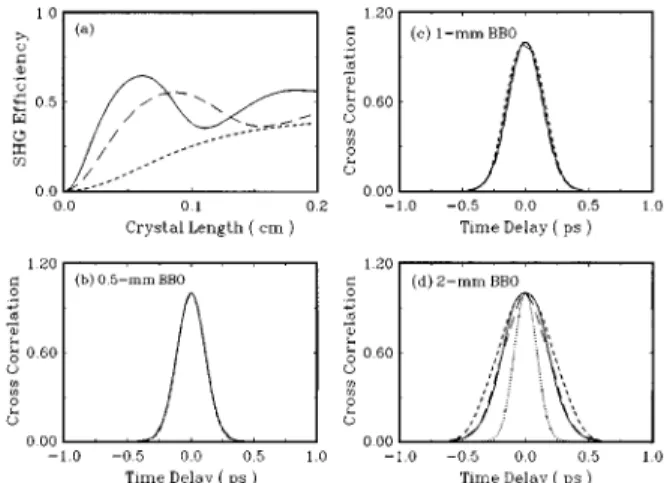
Figure 2 presents the theoretical cross-correlation pro-files of the output SH field with the input fundamental pulse by use of varying thicknesses of BBO and the effi-ciency of SHG as a function of crystal length. The input fundamental pulse is transform limited (f25 0). In
each figure panel, the solid, dashed, and short-dashed curves denote the results with the pump intensity being chosen at very high (120 GW/cm2), medium (40 GW/cm2),
and low (7 GW/cm2) levels, respectively. For
compari-son, the autocorrelation profile of the input fundamental pulse is also shown with a dotted curve in Fig. 2(b), where a 0.5-mm BBO is assumed in the calculation, and in other theoretical pulse shapes with longer crystals [1.0-mm BBO in Fig. 2(c) and 2.0-mm BBO in Fig. 2(d)]. The pulse-spreading distance at the second harmonic ld is as
long as 4.3 cm; thus with the crystal lengths used the pulse broadening from group-velocity dispersion can be neglected. Figure 2(a) shows the optical-conversion effi-ciency of SHG as a function of crystal length at various pumping intensities. Since the nonlinear interaction length zl5 0.02 cm at a high pumping level (for example,
at Ip5 120 GW/cm2) is shorter than the pulse walk-off
distance (lw5 0.07 cm), the fundamental pulse is
de-pleted significantly within the first 0.07-cm crystal slice near the entrance surface of BBO. No parametric back-conversion is possible for a transform-limited pulse. Therefore at a high excitation level the BBO crystals gen-erate SH pulses with nearly the same pulse profile as that of the pumping laser pulse at the fundamental frequency. When the nonlinear interaction length zI is longer than
the pulse walk-off distance (for example, zI5 0.09 cm at
a low pumping level of 7 GW/cm2), the group-velocity
dif-ference between the second-harmonic and the fundamen-tal wave broadens the second-harmonic pulse profile if the crystal length is longer than the pulse walk-off dis-tance [see Figs. 2(c) and 2(d)]. In this case, as can be
seen from Fig. 2(a), the conversion efficiency increases monotonically with crystal length, but this is done at the price of degradation of the temporal characteristics of the SH pulse. The calculation indicates that, for a transform-limited pulse, a shorter crystal length with a high pumping level is desirable if higher-order nonlinear optical processes (e.g., self- and cross-phase modulation and optical parametric processes) have not been set in. With the measured value of n25 0.45 3 10215cm2/GW
for BBO, we estimate the nonlinear phase shift in a 1-mm-long BBO crystal at a pumping level of 120 GW/cm2 to be less that 45°. Thus the effects of self-phase modu-lation and cross-phase modumodu-lation are negligible under these experimental conditions.
The situation changes when frequency chirping ap-pears in an amplified ultrashort pulse, which may origi-nate from the use of an imperfect pulse compressor. To
Fig. 2. Calculated results of optical-conversion efficiency as a function of (a) crystal length and cross-correlation profiles of the SHG pulse with a transform-limited femtosecond laser with a pulse duration of 150 fs at three pumping intensities: 7 GW/cm2
(short-dashed curve), 40 GW/cm2 (dashed curve), and
120 GW/cm2(solid curve) in (b) 0.5-mm BBO, (c) 1.0-mm BBO,
and (d) 2.0-mm BBO.
Fig. 3. Calculated results of optical-conversion efficiency as a function of (a) crystal length and cross-correlation profiles of SHG pulse with a non-transform-limited femtosecond laser with a pulse duration of 150 fs at three pumping intensities: 7 GW/cm2(short-dashed curve), 40 GW/cm2(dashed curve), and
120 GW/cm2(solid curve) in (b) 0.5-mm BBO, (c) 1.0-mm BBO,
reveal the effect of frequency chirping on the pulse dura-tion, we perform a calculation by using a non-transform-limited pulse with quadratic spectral broadening f2
5 0.2. The results are shown in Fig. 3. Figure 3(a) shows the optical-conversion efficiency of SHG as a func-tion of crystal length. Instead of a monotonic increase with crystal length as shown in the transform-limited case [see Fig. 2(a)], the optical-conversion efficiency oscil-lates as the crystal length increases, especially when the pumping intensity is high. The details will be discussed later. The calculated pulse profiles of the SHG under various conditions are shown in Figs. 3(b)–3(d), where three pumping levels are chosen, with the short-dashed curve representing 7 GW/cm2, the dashed curve
repre-senting 50 GW/cm2, and the solid curve representing 120 GW/cm2. The dotted curve indicates the
autocorre-lation profile of the input fundamental pulse. Similar to the situation in Fig. 2, longer crystals and higher pump intensities lead to shorter SH pulses. However, the pres-ervation of a SH temporal profile at high pump intensities is not as effective as that with a transform-limited pulse. Also, the use of high pumping intensity would create spec-tral distortion and broaden the spectrum of the SH pulse, as will be discussed next.
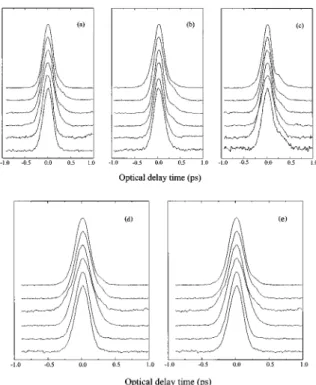
The experimental cross-correlation profiles of the SHG pulse at various pumping intensities in BBO crystals with thicknesses of 0.5 mm, 1.0 mm, and 2.0 mm are shown in Figs. 4(a)–4(c), while the corresponding profiles for LBO crystals with thicknesses of 1 mm and 3 mm are shown in
Figs. 4(d) and 4(e). The cross-correlation profiles show that there is indeed no significant change in the pulse du-ration in the shortest 0.5-mm BBO crystal when the pumping intensity is increased from 8.6 GW/cm2to more than 130 GW/cm2. However, for the longest 2-mm BBO,
the pulse duration of the generated SH pulse at a higher pumping intensity is shorter than that at a lower pump-ing intensity. On the other hand, the duration of the SH pulse at a low pumping intensity (8.6 GW/cm2) from a
long crystal (for example, a 2-mm BBO) is longer than that from a thin (0.5 mm) BBO at the same pumping in-tensity. Also, severe degradation in the temporal char-acteristics of the SH pulse can be readily seen from the pulse profiles generated from a longer crystal at various pumping intensity, indicating that the self- and cross-phase modulation have been set in. All these experimen-tal results agree well with the theoretical calculations shown in Fig. 3.
It is clear that to preserve the temporal profile of the SH pulse it is easier to use a transform-limited pulse than a non-transform-limited pulse. In the latter case, a short crystal and a moderate intensity is preferred.
2. Spectral Characteristics of the Second-Harmonic Pulse
The calculated spectral profiles of the SH pulses with a transform-limited fundamental beam at three pumping intensities in three crystals lengths are shown in Fig. 5, with the short-dashed curve denoting 7 GW/cm2, the dashed curve denoting 50 GW/cm2, and the solid curve
denoting 120 GW/cm2. Since the spectral bandwidth for the SHG process is inversely proportional to crystal length, the spectral width of the SH pulse becomes nar-rower in a longer crystal at low pumping level, for ex-ample, for FWHM bandwidths of 3.23 nm, 2.55 nm, and 1.57 nm for the 0.5-, 1.0-, and 2.0-mm BBO’s, respectively [see the short-dashed curves in Fig. 5(a)–5(c)]. However, at high pump intensity, the spectral wings of the SH pulse from a 2-mm BBO increase with the pumping inten-sity and finally achieve a spectral bandwidth similar to that from the 0.5-mm crystal; thus the output SH pulse from the 2-mm crystal retains a spectral bandwidth simi-lar to that from the 0.5-mm crystal. Note that the spec-tral peak of the output SH pulse at high and low pump intensity are located at the same wavelength.
With a non-transform-limited fundamental input pulse properly described by f25 0.2, the calculated spectral
profile of the SH output from a crystal (longer than 1 mm) excited at a high pump intensity was found to be signifi-cantly different from that excited at a low pump intensity, as shown in Fig. 6. In addition to the much broader and complicated spectral profile, the spectral peak shifts to a longer wavelength region, indicating that complicated parametric backconversion and sum-frequency-mixing processes occur among the spectral components during the pulses propagation through the nonlinear optical crystal. These complicated optical processes, which oc-cur at high intensity and long crystal length, cause an en-ergy redistribution of all the frequency components in-volved and shift the spectral peak of the SH pulse to the red. It is noted that some smaller peaks on both sides of the central wavelength of SH pulse can be seen at high
Fig. 4. Experimental cross-correlation profiles of SHG pulses at various pumping intensities obtained from a BBO crystal with various thicknesses: (a) 0.5 mm, (b) 1.0 mm, and (c) 2.0 mm. The pumping intensities (from bottom up) are 8.6, 14.9, 45.6, 81.6, 110, and 132 GW/cm2. Also shown are experimental
cross-correlation profiles of SHG pulses obtained at various pumping intensities from LBO crystal with different thickness: (d) 1.0 mm and (e) 3.0 mm. The pumping intensities (from bottom up) are 8.6, 14.9, 45.6, 81.6, 110, and 132 GW/cm2.
pumping intensities, especially in a long crystal. The ap-pearance of side peaks can also be understood as spectral redistribution that is due to the higher-order nonlinear interaction. Therefore it is expected that when a 0.5-mm crystal (shorter than the pulse walk-off distance) is used, a clean spectral profile of the SH pulse can be obtained even at high pump intensities. By comparing Figs. 5 and 6, it is clearly seen that the frequency chirping of the fun-damental pulse plays an important role in generating these extra frequency components, especially at high pumping intensities, at which the higher-order nonlinear optical interactions become significant, and in a long crys-tal, in which phase modulation takes place.
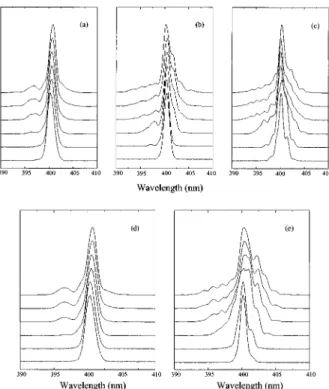
The experimental measurements of the SHG spectra obtained from BBO crystals with various crystal thick-nesses as a function of the pumping intensity are shown in Figs. 7(a)–7(c). It is seen from these figures that the spectral behavior of SH pulses from BBO crystals follows
the predictions of the theoretical calculations fairly well: First, the spectrum generated from a longer crystal is narrower than that generated from a shorter crystal, es-pecially at a low pumping intensity, where no further spectral complication is introduced by self-phase modula-tion. Second, the spectra are much broader and compli-cated at high pumping intensities than at low pumping intensities, especially when a long crystal is used. The spectral distortion and broadening indicate that signifi-cant self-phase modulation occurs in the frequency-conversion processes of ultrashort pulses. To preserve the spectral characteristics of the fundamental beam in the SH beam, neither a long crystal nor a high pumping intensity is recommended. Finally, as predicted in the theoretical calculation, the red shift of the SHG peak at high pumping intensities is indeed observable experimen-tally from the SH spectra measured. The red shift be-comes significant as the pumping intensity increases.
Fig. 5. Calculated spectral profiles of SHG obtained by a transform-limited femtosecond laser at 800 nm at various pump-ing intensities: (a) 7 GW/cm2 (short-dashed curve), (b) 40
GW/cm2(dashed curve), and (c) 120 GW/cm2(solid curve).
Fig. 6. Calculated spectral profiles of SHG obtained by a non-transform-limited femtosecond laser at 800 nm at various pump-ing intensities: (a) 7 GW/cm2(short-dashed curve), (b) 40 GW/
This indicates that the red shift is a higher-order nonlin-ear effect that is due probably to the strong frequency mixing appearing at high pumping intensities, and the spectral redistribution caused by the self-phase modula-tion during the pulses propagates through the nonlinear optical crystal, as mentioned earlier. Similar SHG spec-tra are also seen from the LBO crystals at high pumping intensities. The details are shown in Figs. 7(d) and 7(e). It is clear from Fig. 7 that significant asymmetric spectral distortions occur with pumping intensities higher than 45 GW/cm2in all three crystals used. The side peaks in the SH spectra, as predicted in the calculation shown in Fig. 6, are readily observable at high pumping intensities in all three BBO and two LBO crystals.
To avoid spectral distortion in the SH pulse, it is desir-able to use transform-limited pulses. With non-transform-limited pulses, a short BBO (0.5–0.6 mm) and a pumping intensity of less than 45 GW/cm2work well.
3. Some Optical Effects that Affect the Optical-Conversion Efficiency
Optical-conversion efficiency is one of the most important issues in SHG. High optical-conversion efficiency in SHG of femtosecond pulses can be achieved by selecting appropriate crystals and pumping intensity. In a previ-ous work, we have achieved;40% optical-conversion ef-ficiency in a 0.5-mm BBO by frequency doubling the out-put of a 10-Hz Ti:sapphire regenerative amplifier with a fundamental output of;2.5 mJ per pulse.15 A 35%
con-version efficiency was also reached by Rodriquez et al.14 in a 1.5-mm KDP crystal by frequency doubling a low-repetition regenerative Ti:sapphire laser, which produces an output energy of 100 mJ. A recent work by Krylov
et al.10 demonstrated an optical efficiency of ;50% in
KDP crystals with thicknesses of 5 mm and 10 mm by means of a ;150-fs Ti:sapphire regenerative amplifier system with energy of 0.6 mJ operating at 1 kHz. In the following, we discuss some optical effects that affect the optical-conversion efficiency of SHG of;150-fs pulses.
Dependence of SH conversion efficiency on pumping
in-tensity and crystal length: Effects of frequency chirping
and quadratic broadening on SHG of transform- and
non-transform-limited pulses. Considering the case of SHG
in a type I BBO crystal with an amplified Ti:sapphire la-ser, the calculated SH conversion efficiency as a function of crystal length and pump intensity is presented in Fig. 8, in which the fundamental laser pulse at 800 nm is non transform limited with a quadratic spectral broadening of
f25 0.2. The crystal can achieve collinear phase
match-ing atu 5 29.03° and w 5 30° with an effective second-order nonlinearity of deff5 1.38 pm/V. As can be seen
from Fig. 8, at low pump intensity (,10 GW/cm2), the
SH-conversion efficiency increases monotonically as the crystal length increases. At a higher pumping intensity, an optimum crystal length, at which the conversion effi-ciency is maximized, can be seen. The conversion effi-ciency shows an oscillatory behavior as the crystal length increases. This is expected because a reversal in energy conversion from the SHG back to the fundamental in a non-transform-limited pulse would occur if the SHG pulse becomes sufficiently strong. Owing to the spatial and temporal intensity variations of the fundamental pulse and the phase modulation across the envelope of the elec-tric field of the fundamental beam, parameelec-tric backcon-version from the SH pulse to the fundamental wave, non-linear parametric processes and frequency mixings occur. Energy conversion is expected to be different for different parts of the beam, so that the contrast of maxima and minima in the oscillation of the output or conversion effi-ciency as shown in Fig. 8 is highly smeared. At high pumping intensity, for example, at a pump intensity higher than 100 GW/cm2, a SH-conversion peak at a crys-tal length of 0.06 cm is found. This optimum crystal length matches the pulse walk-off length lw5 0.068 cm
for 150-fs pulse and is clearly seen in Fig. 8 at high pump intensity.
Fig. 7. Experimental spectra of SHG obtained at various pump-ing intensities from BBO crystals with various thicknesses: (a) 0.5 mm, (b) 1.0 mm, and (c) 2.0 mm. The pumping intensities (from bottom up) are 8.6, 14.9, 45.6, 81.6, 110, and 132 GW/cm2,
respectively. Also shown are experimentally measured spectra of SHG obtained at various pumping intensities from LBO crys-tals with different thicknesses: (d) 1.0 mm and (e) 3.0 mm. The pumping intensities (from bottom up) are 8.6, 14.9, 45.6, 81.6, 110, and 132 GW/cm2.
Fig. 8. Theoretical calculation of optical-conversion efficiency of SHG as a function of the crystal length and the laser pumping intensity with a non-transform-limited laser pulse with f2 5 0.2.
The influence of frequency chirping in a non-transform-limited fundamental pulse on SH conversion can be more clearly observed from the theoretical calculation shown in Fig. 9, where the SH-conversion efficiency as a function of crystal length with varying degrees of quadratic spectral broadening f2is shown. In the calculations, the pump
in-tensity and the optical Kerr nonlinearity (which will be discussed next) are fixed to be 120 GW/cm2 and n
2
5 0.45 3 10215cm2/W. With a transform-limited pump
pulse ( f25 0), the SH-conversion efficiency
monoto-nously increases with crystal length. However, by in-cluding frequency chirping in the pump pulse (f2Þ 0),
parametric backconversion is generated. The shortest crystal length for a SH-conversion peak is mainly deter-mined by the pulse walk-off distance.
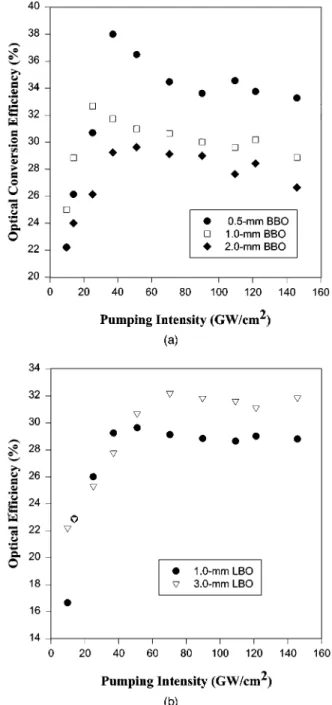
Owing to the limited nonlinear crystals available, we were unable to carry out a detailed study of the effect of crystal length on optical conversion. We experimentally studied the conversion efficiencies in BBO crystals with three different lengths (0.5 mm, 1.0 mm, and 2.0 mm) at various pumping intensity. It was found that at low pumping intensities (for example, Ip ; 10 GW/cm2), the
conversion efficiency increases monotonically with the crystal length: the 2.0-mm BBO yields the highest effi-ciency (25%), the 0.5-mm BBO gives the lowest effieffi-ciency (21%), and the efficiency from the 1.0-mm BBO falls above the latter (22%). It is similar to what is predicted by the calculated results as shown in Fig. 8. At suffi-ciently high pumping intensity (I' 120 GW/cm2), at
which optimum crystal length is expected to be;0.6 mm, the shortest BBO (0.5 mm) has the highest SH energy (34%), the 1.0 mm BBO has an efficiency of 30%, and the longest BBO (2.0 mm) produces the lowest efficiency (27%), indicating that the outputs from three crystal lengths fall into the oscillatory behavior as mentioned earlier.
The detailed experimental results on the dependence of the conversion efficiency as a function of pumping inten-sity measured in the above-mentioned BBO are shown in Fig. 10(a). It can be found from Fig. 10(a) that the optical-conversion efficiency increases monotonically with the pumping intensity when the intensity is between 10 and 25 GW/cm2. For the case in which the pumping
in-tensity is lower than 10 GW/cm2, although the data are
not presented in Fig. 10(a), it was found that the longer crystal generates higher efficiency and that the SHG effi-ciency is almost a quadratic function of pumping inten-sity. The efficiency reaches its maximum at 25– 40 GW/cm2, depending on the thickness of the BBO
crystal, and then decreases toward higher intensities. The decrease of efficiency at high intensity is due to the conversion of the SH signal back to the fundamental and to other nonlinear optical effects, such as parametric su-perfluorescence (see the discussion below). Strong para-metric superfluorescence can be seen in all three crystals when the pumping intensity is higher than 50 GW/cm2.
The threshold intensity, at which the superfluorescence
Fig. 9. Theoretical prediction of optical-conversion efficiency of SHG in BBO as a function of the crystal length at various de-grees of frequency chirping.
Fig. 10. (a) Experimental measurement of optical-conversion ef-ficiency of SHG in three BBO crystals with different thicknesses as a function of laser pumping intensity. (b) Experimental mea-surement of optical-conversion efficiency of SHG in LBO as a function of laser pumping intensity.
can be seen, depends on the crystal length. A shorter crystal has a higher threshold intensity. The highest op-tical efficiency of 38% is achieved in the 0.5-mm BBO at a pumping intensity of ;40 GW/cm2. Such a high effi-ciency is achieved without causing significant pulse broadening and degrading of the spectrum. Therefore the optimal crystal length for BBO is;0.5 mm, which is in accordance with the walk-off limit of the pulses in the crystal as predicted in Figs. 8 and 9. Similar results are also observed in two LBO crystals (1.0 mm and 3.0 mm) as shown in Fig. 10(b). It is seen that the experimental results agree qualitatively with the theoretical calcula-tions: The quantitative discrepancy between the theory and the experiment is probably because the calculation has taken into account the backconversion, but it does not include optical parametric generation, which becomes very strong at high intensities, as will be shown later. It may also be because the estimated parameter of qua-dratic broadening, f25 0.2, used in the calculation may
not exactly reveal the real value of f2. The latter is
sup-ported by experimental results of the conversion efficien-cies of the three BBO crystals pumped at;40 GW/cm2, at
which the 1.0-mm BBO is expected to be more efficient than the 0.5-mm BBO, according to the calculated results of Fig. 8, in which f25 0.2 is used in the calculation.
However, the experimental results show that the effi-ciency of the 0.5-mm BBO is obviously higher than the other two crystals at such an intensity.
Effect of backconversion, optical parametric processes, and other nonlinear mixings. As mentioned above, when
the pumping intensity reaches a certain level, bright and multicolored parametric superfluorescence can be gener-ated in the forward direction within a conical angle. The threshold for generating parametric superfluorescence de-pends on the crystal length, because the threshold for a crystal decreases as the length of the crystal increases. The conical parametric superfluorescence at high pump-ing intensity is due to the above-mentioned downconver-sion and parametric generation, and the spectra are shown in Fig. 11. The spectra was taken by blocking the pump beam and the generated SH beam, which are lo-cated at the center of the beam, collecting only the conical emission, and analyzing the spectrum by a CCD spec-trometer. One can see clearly from the spectrum that the superfluorescence is mainly formed around two wave-lengths: One is due to optical parametric generation in
the crystal with the generated SH pulse at 400 nm be-cause the pump and the radiation are mainly distributed in the red side of the pump (400 nm), covering from 405 nm to more than 460 nm and with a peak wavelength of ;420 nm. The other, near 800 nm, is due to the down-conversion of the SH beam from 400 nm back to 800 nm and broadband radiation covering from the visible to the near IR, due presumably to the nonlinear mixing with other components from optical parametric generation. In addition, the beam quality and the spectrum of the gen-erated SH pulses degrade when the above-mentioned higher order nonlinear effects occurred.
Effect of Kerr nonlinearity on the conversion. Since a
collimated pump beam with an intensity as high as 150 GW/cm2 can be readily generated from an amplified
ultrashort laser pulse, the self-phase modulation result-ing from the optical Kerr effect may affect SH conversion. Figure 12 presents the calculated spectral profiles of the SH wave from a 1-mm-long BBO crystal excited by a 150-fs pulse at 800 nm with different nonlinear indices of refraction and frequency chirping f2and with an intensity
of 120 GW/cm2. The filled symbols represent the result with n25 0 and f25 0, the dashed curve indicates the
result with n25 0.45 3 10215cm2/W and f25 0, and the
solid curve denotes the result with n25 0.45
3 10215cm2/W and f
25 0.2. As can be clearly seen, the
path of the filled symbols, where n25 0, f25 0, and no
Kerr nonlinearity is considered, is almost identical to the dashed curve, where n25 0.45 3 10215cm2/W, f25 0,
and a severe Kerr effect has been taken into account. It is clear from Fig. 11 that Kerr nonlinearity has very little effect on the output of SHG. On the other hand, the fre-quency chirping in the fundamental wave plays a much more important role in the SH-conversion process with BBO than that from the optical Kerr nonlinearity, as can be seen by comparing the solid curve with the dashed curve, where both curves have same Kerr nonlinearity (n25 0.45 3 10215cm2/W), whereas the former includes Fig. 11. Experimental spectra of conical parametric
superfluo-rescence in (a) the high-frequency region and in (b) the low-frequency region. The fundamental pumping beam and the gen-erated SHG are spatially filtered out.
Fig. 12. Calculated SHG spectral profile from a 1-mm BBO at very high pumping intensity with different nonlinear indices of refraction n2 showing the effect of Kerr nonlinearity. Filled
symbols are the result with n25 0 and f25 0, the dashed curve
indicates the result with n25 0.45 3 10215 cm2/W and f2
5 0, and the solid curve denotes the result with n25 0.45
3 10215cm2/W and f 25 0.2.
a frequency chirping of f25 0.2. This is understandable
considering that in BBO the nonlinear phase variation across the envelope of the fundamental electric field is es-timated to be only 0.1p and considering the significant frequency chirping at the pumping intensity used.
From the theoretical and experimental results shown above, one can find that a BBO crystal with a thickness of ;0.5 mm and a medium pumping intensity of ;40 GW/cm2 are the most favorable to generate SH for
;150-fs pulses. Although it is possible to generate a higher conversion efficiency by use of a longer crystal length (5–10 mm) at a lower pumping intensity, the high efficiency, however, is the price of degradation of temporal and spectral characteristics of the SH output. As has been shown earlier, when the nonlinear interaction length at low pumping level is longer than the pulse walk-off distance, the group-velocity dispersion between the SH and the fundamental waves broadens the SH pulse pro-file. Therefore when a crystal length longer than the pulse walk-off distance is used, the conversion efficiency increases monotonically with crystal length, but the tem-poral profile of the generated beam would be broadened. In addition, a thiner crystal, such as a 0.5-mm BBO, also produces a purer SHG spectrum than that of a longer crystal length. High pumping intensity is not recom-mended because it causes spectral complication that is due to downconversion processes such as DFG and OPG and other nonlinear processes, such as frequency chirping and phase modulation.
4. CONCLUSION
In conclusion, the second-harmonic generation of;150-fs pulses generated by a commercial regenerative Ti:sap-phire laser of;800 nm in BBO and LBO crystals is inves-tigated both theoretically and experimentally. With a pulse duration of;150 fs, it was found that the chirping of the fundamental beam and self-phase modulation in the crystal play the most important roles in creating the temporal and spectral degradation and complication in the generated SH pulses. To obtain a high optical-conversion efficiency and to preserve the temporal and spectral characteristics in the generated SH pulses, a thin crystal (for example, a BBO crystal with a thickness of 0.5–0.6 mm, limited mainly by the walk-off) and a mod-erate pumping intensity (;40 GW/cm2), at which no
parametric superfluorescence is generated, are recom-mended. A long crystal would result in temporal degra-dation in the SH pulse because of group-velocity walk-off between the pump and the generated SH pulses and self-phase modulation, while high pumping intensity would create a spectral distortion and complication in the gen-erated SH pulses owing to higher-order nonlinear fre-quency mixings and other nonlinear effects, such as self-phase modulation and frequency chirping.
5. ACKNOWLEDGMENTS
The experimental work herein was carried out in the Joyce M. Kuok Laser and Photonics Laboratory at Hong Kong University of Science and Technology. This work is sponsored by National Science Foundation under grant PHY-9601922 and the Lightwave Technology Research Programme of the Hong Kong Telecom Institute of Infor-mation Technology, and partly by the K. C. Wong Educa-tion FoundaEduca-tion of Hong Kong.
REFERENCES
1. W. H. Knox, M. C. Downer, R. L. Fork, and C. V. Shank, ‘‘Amplified femtosecond optical pulses and continuum gen-eration at a 5-kHz repetition rate,’’ Opt. Lett. 9, 552 (1984). 2. P. F. Curley, Ch. Spielmann, T. Brabec, F. Krausz, E. Wint-ner, and J. Schmidt, ‘‘Operation of a femtosecond Ti-sapphire solitary laser in vicinity of zero group-delay dis-persion,’’ Opt. Lett. 18, 54 (1993).
3. M. T. Asaki, C. P. Huang, D. Garvey, J. P. Zhou, H. C. Kapteyn, and M. M. Murnane, ‘‘Generation of 11-fs pulses from a self-mode-locked Ti-sapphire laser,’’ Opt. Lett. 18, 977 (1993).
4. A. Stingl, C. Spiemann, F. Krausz, and R. Szipocs, ‘‘Genera-tion of 11-fs pulses from a Ti:sapphire laser without the use of prisms,’’ Opt. Lett. 19, 204 (1994).
5. J. P. Zhou, G. Taft, C. P. Huang, M. M. Murnane, and H. C. Kapteyn, ‘‘Pulse evolution in broadband Ti:sapphire laser,’’ Opt. Lett. 19, 1149 (1994).
6. J. D. Harvey, J. M. Dudley, P. F. Curley, C. Spiemann, and F. Krausz, ‘‘Coherent effects in a self-mode-locked Ti:sap-phire laser,’’ Opt. Lett. 19, 972 (1994).
7. T. R. Zhang, H. R. Choo, and M. C. Downer, ‘‘Phase and group velocity matching for second harmonic generation of femtosecond pulses,’’ Appl. Opt. 29, 3927 (1990).
8. J. Shen, H. He, Y. Liu, Y. Zhang, Z. Wang, and B. Wu, ‘‘Sec-ond harmonic generation by femtosec‘‘Sec-ond optical pulses: theory and experiment,’’ Chin. Phys. 12, 413 (1992). 9. A. V. Smith and M. S. Bowers, ‘‘Phase distortions in
sum-and difference-frequency mixing in crystals,’’ J. Opt. Soc. Am. B 12, 49 (1995).
10. V. Krylov, A. Rebane, A. G. Kalintsev, H. Schwoerer, and U. Wild, ‘‘Second-harmonic generation of amplified femtosec-ond Ti:sapphire laser pulses,’’ Opt. Lett. 20, 198 (1995). 11. E. Sidick, A. Knoesen, and A. Dienes, ‘‘Ultrashort-pulse
second-harmonic generation. I. Transform-limited fun-damental pulses,’’ J. Opt. Soc. Am. B 12, 1704 (1995). 12. E. Sidick, A. Knoesen, and A. Dienes, ‘‘Ultrashort-pulse
second-harmonic generation. II. Non-transform-limited fundamental pulses,’’ J. Opt. Soc. Am. B 12, 1713 (1995). 13. D. C. Edelstein, E. S. Washman, L. K. Cheng, W. R.
Bosen-berg, and C. L. Tang, ‘‘Femtosecond ultraviolet pulse gen-eration inb– BaB2O4,’’ Appl. Phys. Lett. 52, 2211 (1988).
14. G. Rodriguez, J. P. Roberts, and A. J. Taylor, ‘‘Ultraviolet ultrafast pump-probe laser based on a Ti:sapphire laser system,’’ Opt. Lett. 19, 1146 (1994).
15. J. Y. Zhang, Z. Xu, Y. Kong, C. Yu, and Y. Wu, ‘‘10-HZ, 241 mJ widely tunable parametric generation and amplification in BBO, LBO, and CBO pumped by frequency-doubled fem-tosecond Ti:sapphire laser pulses,’’ Appl. Opt. (to be pub-lished).