行政院國家科學委員會專題研究計畫 成果報告
利用二維光子晶體波導結構所設計之多通道分波多工器及
全光式光開關之研究
研究成果報告(精簡版)
計 畫 類 別 : 個別型 計 畫 編 號 : NSC 97-2221-E-151-007- 執 行 期 間 : 97 年 08 月 01 日至 98 年 07 月 31 日 執 行 單 位 : 國立高雄應用科技大學電子工程系 計 畫 主 持 人 : 吳曜東 計畫參與人員: 碩士班研究生-兼任助理人員:李建樟 碩士班研究生-兼任助理人員:王唯任 碩士班研究生-兼任助理人員:林益生 碩士班研究生-兼任助理人員:游鎮嘉 碩士班研究生-兼任助理人員:陳信昌 報 告 附 件 : 出席國際會議研究心得報告及發表論文 處 理 方 式 : 本計畫涉及專利或其他智慧財產權,2 年後可公開查詢中 華 民 國 98 年 10 月 16 日
行政院國家科學委員會補助專題研究計畫
■ 成 果 報 告
□期中進度報告
利用二維光子晶體波導結構所設計之多通道分波多工器及全
光式光開關之研究
計畫類別:■ 個別型計畫 □ 整合型計畫
計畫編號:NSC 97-2221-E-151-007-
執行期間: 97 年 8 月 1 日至 98 年 7 月 31 日
計畫主持人:吳曜東
共同主持人:
計畫參與人員: 博士班研究生:李建樟
研士班研究生:游鎮嘉、林益生、陳信昌、王唯任
成果報告類型(依經費核定清單規定繳交):■精簡報告 □完整報告
本成果報告包括以下應繳交之附件:
□赴國外出差或研習心得報告一份
□赴大陸地區出差或研習心得報告一份
■出席國際學術會議心得報告及發表之論文各一份
□國際合作研究計畫國外研究報告書一份
處理方式:除產學合作研究計畫、提升產業技術及人才培育研究計畫、
列管計畫及下列情形者外,得立即公開查詢
□涉及專利或其他智慧財產權,□一年□二年後可公開查詢
執行單位:國立高雄應用科技大學電子工程研究所
中 華 民 國 98 年 9 月 30 日
附件一可供推廣之研發成果資料表
□ 可申請專利 □ 可技術移轉 日期:98 年 8 月 5 日國科會補助計畫
計畫名稱:利用二維光子晶體波導結構所設計之多通道分波多工器 及全光式光開關之研究 計畫主持人:吳曜東 計畫編號:NSC-97-2221-E-151-007 學門領域:光纖通訊與波導光學技術/創作名稱
二維光子晶體環形共振腔濾波器發明人/創作人
吳曜東、李建樟 中文:該二維光子晶體環形共振腔濾波器是設計於具方形晶格排列 的高折射圓柱。這個選擇是為了模擬光子晶體環形共振腔於 SOI 結 構現象。在這光子晶體環形共振腔,我們導入了四個色散點在每個 角落並且調整這波導寬度匹配這輸入模態。由於尺寸的線性,這光 子晶體環形共振腔透過調整內部環的半徑能任意波長調變。這一個 新穎的技術適合建立平面傳播型式的高品質因素濾波器。技術說明
英文:The two-dimensional photonic crystal ring resonator (PCRR) filter was made of a square lattice of high index dielectric rods. This choice is meant to simulate the behavior of a silicon-on-insulator (SOI) structure. In this PCRR filter, we introduction four scatters at each corner of the PCRR and modulate the waveguide width to match the input mode. Due to the scales linearly, the PCRR filter can be tuned to any wavelength by adjusting the radii of the inner-ring. The approach represents a novel technique for creating high-Q filters of the in-plane type.
可利用之產業
及
可開發之產品
可應用於光電通訊產業,並可進一步開發成 200G DWDM 元件技術特點
低插入損耗、低串音干擾、高品質因素推廣及運用的價值
利用光子晶體設計成可達 200G DWDM 標準的元件,目前就我們所知 還無文獻提出。該元件除了具有尺寸線形上的優點外,同時保有低 插入損耗、低串音干擾、高品質因素等特點。 附件二利用二維光子晶體波導結構所設計之多通道分波多工器及全光式
光開關之研究
The Study of Multichannel Wavelength Division Multiplexers and
All-optical Switches by using Two-dimensional Photonic Crystals
Waveguide Structures
Abstract:We have proposed a new design of optical filter based on a two-dimensional photonic crystal ring resonator (2D PCRR) structure with N-channel model. The numerical results show the proposed design with low insertion loss, high quality factor, and excellent channel expansion characteristics.
中文摘要
我們提出一種新的 N 通道光濾波器設計,基於二維光子晶體環形共振腔結構。數值 結果顯示我們的提出的設計,具有低插入損失、高品質因素和好的通道延展特性。
Key words: photonic crystal, ring resonator
I. Introduction
Micro ring resonators are of great interest filters. They are potential candidates for large-scale photonic integrated circuits for applications such as wavelength division multiplexing (WDM), all-optical switches, and all-optical logic gates [1-5]. This is due to their potential for being used in complex and flexible configurations that make these devices particularly attractive for photonic applications.In general, micro ring resonator couplers are credited for their potential performances on high-order micro ring resonator and narrow linewidth [6]. Several groups have demonstrated the micro ring resonators in silicon-on-insulator (SOI) structure with the characteristic of high confinement [7-10]. The fabricated device was measured to have a wide free spectral range (FSR) if the ring radius had been made less than 5μm in silicon [10]. Using a periodic photonic crystal (PC) significantly reduces the device size, and therefore the relation ring resonators are proposed [11, 12]. It is expected to increase the device packing density due to their nanometer feature scale. One of the most unique properties of PCs is photonic bandgap (PBG). It inhibits the existence of optical modes for certain regions in the frequency spectrum. They have many potential applications because of their unique characteristics and are widely used in optical communication fields, such as multiplexers [13-18], power splitter [19], interleaver [20], and switch [21]. To meet the rapid increase in the demand for multiterabit-per-second transmission
capacities, PC based on dense wavelength division multiplexing (DWDM) is becoming a next generation large capacity system. Expansion of wavelength division multiplexing (WDM) channels results in an increase in the complexity of the optical cross-connect. A cascade structure with thirtytwo-channel dropping in out-of-plane type is reported [14], the corresponding 100G DWDM device with the wavelength spacing of 0.8nm. The device is mainly determined by the vertical loss and the radiation along the normal direction to bring interferes destructively.To the best of our knowledge, DWDM devices based on PCs in-plane type have not been proposed before.
As described in previous, the micro ring resonator is very useful as optical filters in-plane type. We believe that the concept realizes the same narrow linewidth property by building PC ring resonator (PCRR). Therefore, it is a realizable compact and high-resolution optical filter for DWDM system.
II. Analysis of photonic crystal ring resonator filter
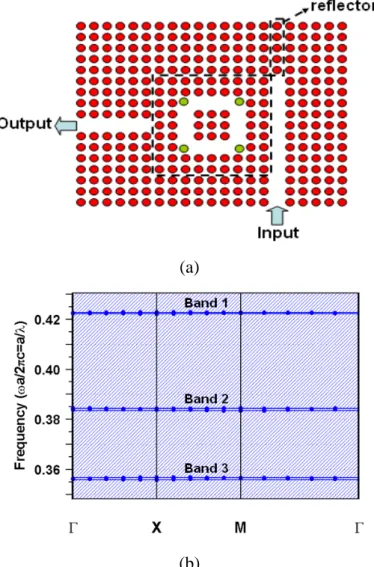
The coupled-mode theory (CMT) [22-24] has been proposed for the study of PCRRs. We adopt the concept of micro ring resonator to design the PCRR filter. First, we remove one column of rods to induce straight bus waveguide, and then remove the row of rods from the side of the ring resonator, as shown in Fig. 1(a), where green color points indicate scatters at each corner of the PCRR at half of the lattice constant. In our PCRR structure, the end of the bus waveguides is blocked as a reflector to improve the transmission efficiency. When the bus waveguide is blocked, the light will be scattered and induce the back reflection, which uses a highly efficient coherent scatters of trapped light by the PCRR. Thus the spectrum is obtained resonance frequencies with narrow linewidth. Besides, the four scatters can reduce the back-reflection, improving the transmission efficiency. The output waveguide is changed to perpendicular to the side of the ring resonator.It influences a change of the light propagation direction for 90 degrees without oblique grating structures.The silicon material was chosen for the PCRR filter and was made of a square lattice of high index dielectric-rods with a refractive index of 3.4, a lattice constant of 550nm, and a radius of 0.17a, where a is the lattice constant. This choice is meant to simulate the behavior of a SOI structure operation at communication regions. The structure is simulated by plane wave expansion (PWE) [25] and has a PBG for transverse magnetic (TM) polarization which extends from 0.317 to 0.453 (a/λ). For transverse electric (TE) polarization no band gaps are observed. This is explained by considering the polarization of a dielectric-rod induced by an external electric field. The N×N supercell are applicable for calculation the resonance frequency of micro-cavity [16]. The dispersion relation of a 9×9 supercell indeed exhibits resonance frequencies with narrow bandwidths extending from 0.42223 to 0.42273 (a/λ), 0.38352 to 0.38436 (a/λ), and 0.35596 to 0.3568 (a/λ), respectively, as shown in Fig. 1(b). When the frequency of PBG is the same in the common band, the resonance frequency is dropped out from the PCRR. The performance of the designed PCRR filter has been calculated by using the two-dimensional finite-difference time-domain (2D FDTD) method [26].
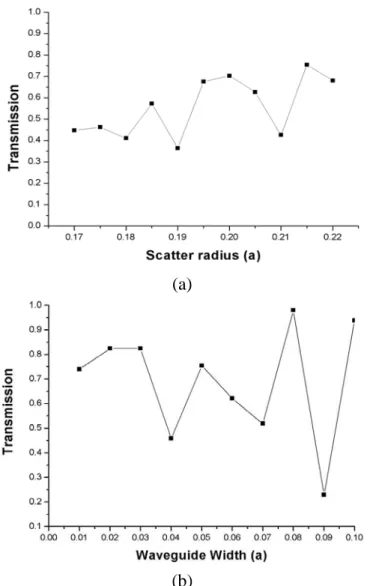
To demonstrate our proposed design, we show the plots of the transmission efficiency and the scatter radius both for calculated results, as shown in Fig. 2(a). We take steps to further
improve the maximum transmission efficiency, by adjusting the waveguide width at the output port. The method is special for the mode mismatch problem by reducing the waveguide width at the output port. The numerical results show that 100% transmission efficiency can be obtained by adjusting the waveguide width, as shown in Fig. 2(b).
(a)
(b)
Fig. 1. (a) Single-channel PCRR filter with four scatters in each corner, where green points are scatters. (b) The dotted line illustrates the band structure of the line-defect waveguide with an embedded 9×9 supercell ring resonator.
We have fixed these parameters, including the scatter radius and the waveguide width, which are 0.215a and 1.84a, respectively. Also the inner-ring has a great circular shape, permitting light to be confined effectively. The spectrum obtained at output port is shown in Fig. 3, where the inset shows the magnified plot of one channel. It is clearly seen that the drop wavelengths exist within the wavelengths of 1250nm to 1600nm. The PCRR filter is obtained a wide FSR of 113nm, which is defined the wavelength separation between adjacent fringes. With the quasi-ring shape, the high quality factor can be realized in the PCRR. The quality factor Q can also be used as an absolute measure for the wavelength selectively of the PCRR filter according to:
Q=
Δ
λ
λ
=Δ
ω
ω
(1) where ω is the angular frequency and Δω is the bandwidth. The numerical results show thatthe PCRR filter is available for DWDM devices, which can connect other optical devices to take the advantage of their common use of nano-scale silicon.
(a)
(b)
Fig. 2. Description of the PCRR filter as function of the transmission efficiency by varying (a) scatters radius and (b) waveguide width.
Fig. 3. Transmission spectra of the single-channel PCRR filter shows a wide FSR of 113nm, which allows more wavelengths of utilizing within this range. The 1549.4nm drop wavelength corresponds to the Q value of 3800. Insets graphically illustrate plotted terms.
III. Design multi-channel photonic crystal ring resonator filters
As described in the previous section, the silicon-based structure consists of a ring resonator coupled to a perpendicular waveguide of the side. It is possible to fabricate on SOI substrate by using semiconductor process technology for SiO2 cladding deposition [27]. The silicon
waveguides forming the structure have a good confinement in vertical direction by large refractive index contrast between the material silicon and SiO2. Single-channel PCRR filter is
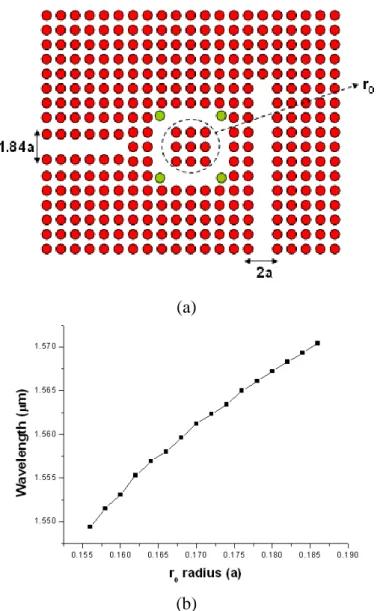
successfully to demonstrate a wide FSR, high transmission performance, and high quality factor. Figure 4(a) shows that the PCRR filter is the optimized shape with the scatter radius of 0.215a and the waveguide width of 1.84a, where the dotted line includes 3×3 rods and is defined as r0. The relation between the radius r0 and the wavelength was simulated, as shown
in Fig. 4(b).The central wavelength of the PCRR filter shifted to long-wavelength, with the increase of the radius r0.
(a)
(b)
Fig. 4. (a) The waveguide width of single-channel PCRR filter is 1.84a in the output port, where green points are scatters 0.215a. (b) The relation between the radius r0 and the
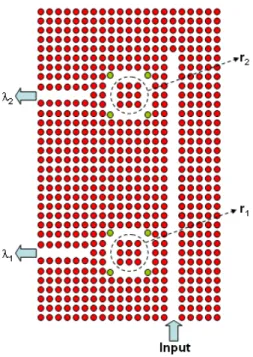
Fig. 5. The PC waveguide consists of two ring resonators that with different radii r1 and r2,
were set as 0.156a and 0.158a, respectively.
The PCRR filter has been calculated by adding an extra ring resonator, where λ1 and λ2 are the
resonance wavelengths, respectively, as shown in Fig. 5. The distance between two ring resonators is the key of the PCRR filter. The two-channel PCRR filter for both radii of r1 and r2
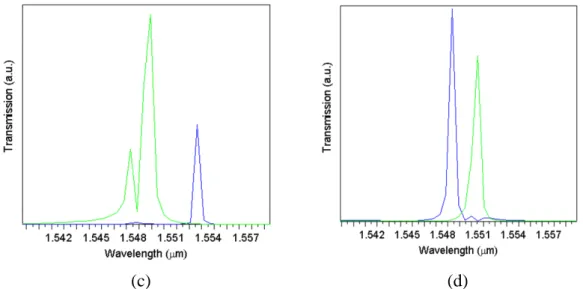
were 0.156a and 0.158a, respectively. The transmission efficiency is calculated from different distances of ring resonators, as shown in Fig. 6(a)-(d). However, the distance extends from 5a to 8a. The excellent isolated performance is exhibited at the distance of 8a, dropping the wavelengths of λ1=1549.4nm and λ2 =1551.5nm. This means that the PCRR filter can be
cascaded from the end of the bus waveguide, and then achieve even more wavelengths to drop out from each channel. These numerical results provide a PCRR filter model to assist us in developing a practical DWDM device.
(c) (d)
Fig. 6. Intensity spectrum of the two-channel PCRR filter is calculated for distances (a) 5a, (b) 6a, (c) 7a, and (d) 8a, respectively.
The previous results show that the PCRR filter varying the scatters and the waveguide width was better than the original PCRR filter. Therefore, the PCRR filter of the multi-channel model can be used for DWDM devices with high transmission performance and high quality factor levels, as shown in Fig. 7. By the channel build up, the PCRR filter has the capability of making DWDM standard. In the following design example, the distance of ring resonator is considered to be 8a.
Fig. 7. The PC waveguide consists of N-channel ring resonators with the distance 8a, scatters 0.215a, and waveguide width 1.84a.
In order to demonstrate the feasibility, we propose sixteen-channel PCRR filter by cascading in the end of the bus waveguide, as shown in Fig. 8. The number of rods in x- and y-directions are 23 and 214, respectively. The radii of the inner-rings are chosen asr1=0.1402a,
r10=0.1507a, r11=0.1520a, r12=0.1536a, r13=0.1549a, r14=0.1565a, r15=0.1583a, and r16=0.1598a,
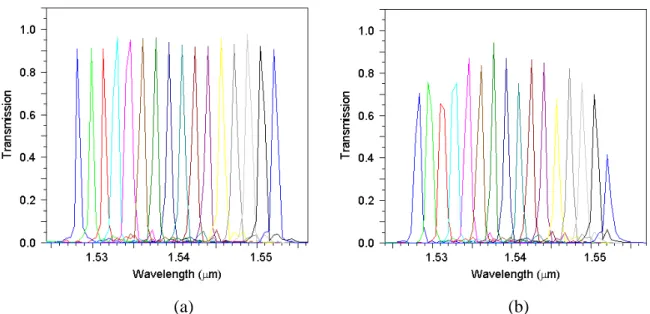
respectively. Figure 9(a) shows that the transmission efficiency which is measured from each output port, all the designed wavelengths of 1528.1nm, 1529.7nm, 1531.3nm, 1532.9nm, 1534.5nm, 1536.1nm, 1537.7nm, 1539.3nm, 1540.9nm, 1542.5nm, 1544.1nm, 1545.7nm, 1547.3nm, 1548.9nm, 1550.5nm, and 1552.1nm are showed clearly. Comparing to the PCRR filter without reflector, the transmission efficiency is acutely decreased by 10%~60%, as shown in Fig. 9(b). One of the most important considerations in designing PCRR is the fabrication tolerance. When the geometrical size deviates from the designed values, the transmission performance will decrease and the wavelength will shift. The dynamical tenability of PCRR filter was studied in detail, as shown in Tab 1. The PCRR filter can be tuned to any wavelength by adjusting the radii of the inner-ring. As the channel number increases, sixteen-channel PCRR filter is demonstrated, with the advantages of the low crosstalk (≤-17.89dB) and high quality factor 6125. Besides, the PCRR filter maintains excellent filtering properties, such as good wavelength resolution, compact configuration, and high transmission efficiency.
Fig. 8. The PC waveguide consists of sixteen PCRRs. The radii of inner-ring r1~r16 are 0.1402a,
0.1412a, 0.1423a, 0.1434a, 0.1445a, 0.1457a, 0.1468a, 0.1480a, 0.1494a, 0.1507a, 0.1520a, 0.1536a, 0.1549a, 0.1565a, 0.1583a, and 0.1598a, respectively.
(a) (b)
Fig. 9. Intensity spectrum of the transmission efficiency in the sixteen-channel PCRR filter with the distance 8a between the PCRRs, scatter radius 0.215a, and waveguide width 0.184a for (a) with reflector and (b) without reflector.
TABLE I
The characteristics of the sixteen-channel PCRR filters
Crosstalk Insertion loss Quality factor
λ1 (1528.1nm) ≤ -20.13 dB 0.416 dB 3820 λ2 (1529.7nm) ≤ -18.71 dB 0.387 dB 5100 λ3 (1531.3nm) ≤ -18.36 dB 0.418 dB 6125 λ4 (1532.9nm) ≤ -17.89 dB 0.162 dB 2191 λ5 (1534.5nm) ≤ -18.56 dB 0.217 dB 1705 λ6 (1536.1nm) ≤ -19.35 dB 0.191 dB 2560 λ7 (1537.7nm) ≤ -21.63 dB 0.176 dB 3076 λ8 (1539.3nm) ≤ -19.07 dB 0.274 dB 4398 λ9 (1540.9nm) ≤ -18.85 dB 0.331 dB 3852 λ10 (1542.5nm) ≤ -18.89dB 0.373 dB 3955 λ11 (1544.1nm) ≤ -22.38 dB 0.344 dB 3766 λ12 (1545.7nm) ≤ -22.35 dB 0.190 dB 3091 λ13 (1547.3nm) ≤ -20.04 dB 0.331 dB 3095 λ14 (1548.9nm) ≤ -18.31 dB 0.108 dB 2383 λ15 (1550.5nm) ≤ -18.36 dB 0.359 dB 2067 λ16 (1552.1nm) ≤ -16.96 dB 0.416 dB 2217
IV. Conclusions
In this paper, we have proposed a new design of optical filter based on a two-dimensional photonic crystal ring resonator structure with N-channel model. This device resolves the challenge of the narrow wavelength spacing for the in-plane type light propagation. Furthermore, we have also developed a sixteen-channel filter to demonstrate the feasibility. The transmission efficiency is larger than 90% and the inter-channel crosstalk is less than -17.89dB. The PCRR filter has a spectral resolution of 1.6nm due to its high quality factor (Q~6000), which makes it suitable for 200G DWDM applications. This approach represents a novel technique for creating high-Q filters of the in-plane type that furthermore opens the possibility of the photonic integrated circuits (PICs).
References
[1] T. A. Ibrahim, R. Grover, L. C. Kuo, S. Kanakaraju, L. C. Calhoun, and P. T. Ho, “All-optical AND/NAND logic gates using semiconductor microresonators,” IEEE Photon. Technol. Lett., vol. 15, no. 10, pp. 1422-1424, Oct. 2003.
[2] L. Y. Mario Desmond C. S. Lim, and M. K. Chin, “Proposal for an ultranarrow passband using two coupled rings,” IEEE Photon. Technol. Lett., vol. 19, no. 19, pp. 1688-1690, Mar. 2007.
[3] S. T. Chu, B. E. Little, W. Pan, T. Kaneko, S. Sato, and Y. Kokubun, “An eight-channel add-drop filter using vertically coupled microring resonators over a cross grid,” IEEE Photon.
Technol. Lett., vol. 11, no. 11, pp. 691-693, Mar. 1999.
[4] P. Dong, S. F. Preble, and M. Lipson, “All-optical compact silicon comb switch,” Opt.
Express., vol. 15, no. 15, pp. 9600-9605, Jul. 2007.
[5] Q. Xu and M. Lipson, “All-optical logic based on silicon micro-ring resonators,” Opt.
Express., vol. 15, no. 3, pp. 924-929, Feb. 2007.
[6] B. E. Little, S. T. Chu, P. P. Absil, J. V. Hryniewicz, F. G. Johnson, F. Seiferth, D. Gill, V. Van, O. King, and M. Trakalo, “Very high-order microring resonator filters for WDM
applications,” IEEE Photon. Technol. Lett., vol. 16, no. 10, pp. 2263-2265, Jun. 2004.
[7] V. R. Almeida, C. A. Barrios, P. R. panepucci, M. Lipson, M. A. Foster, D. G. Ouzonnov, and A. L. Gaeta, “All-optical switching on a silicon chip,” Opt. Lett., vol. 29, no. 24, pp.
2867-2869, Oct. 2004.
[8] T. Baehr-Jones, M. Hochberg, C. Walker, and A. Scherer, “High-Q ring resonators in thin silicon-on-insulator,” Appl. Phys. Lett., vol. 85, no. 16, pp. 3346-3347, Oct. 2004.
[9] J. Niehusmann, A. Vorckel, P. H. Bolivar, T. Wahlbrink, W. Henschel, and H. Kurz,
“Ultrahigh-quality-factor silicon-on-insulator microring resonator,” Opt. Lett., vol. 29, no. 24, pp. 2861-2863, Dec. 2004.
[10] B. E. Little, J. S. Foresi, G. Steminmeyer, E. R. Thoen, S. T. Chu, H. A. Haus, E. P. Ippen, L. C. Kimerling, and W. Greene, “Ultra-compact Si-SiO2 microring resonator optical channel dropping filters,” IEEE Photon. Technol. Lett., vol. 10, no. 4, pp. 549-551, Apr. 1998.
[11] S. John, “Strong localization of phonics in certain disordered dielectric Superlattices,” Phys.
[12] E. Yablonovitch, “Inhibited spontaneous emission in solid-state physics electronics,” Phys.
Rev. Lett., vol. 58, no. 20, pp. 2059-2062, May. 1987.
[13] Y. Akahane, T. Asano, B. S. Song, and S. Noda, “Investigation of high-Q channel filters using donor-type defects in two-dimensional photonic crystal slabs,” Appl. Phys. Lett., vol. 83, pp. 1512-1514, 2003.
[14] Y. D. Wu, K. W. Hsu, and T. T. Shih, “Thirty-two-channels dense-wavelength-division multiplexer based on cascade two-dimensional photonic crystals waveguide structure,” J. Opt. Soc. Am. B vol. 24, no. 9, pp. 2075-2080, Jul. 2007.
[15] S. Fan, P. R. Villeneuve, and J. D. Joannopoulos, “Channel drop filters in photonic crystals,”
Opt. Express. vol. 3, no. 1, pp. 4-11, Jul. 1998.
[16] C. W. Kuo, C. F. Chang, M. H. Chen, S. Y. Chen, and Y. D. Wu, “A new approach of planar multi-channel wavelength division multiplexing system using asymmetric super-cell photonic crystal structures,” Opt. Express. vol. 15, no. 1, pp. 198-206, Jan. 2007.
[17] K. H. Hwang, and G. H. Song, “Design of a high-Q channel-drop multiplexer based on the two-dimensional photonic-crystal membrane structure,” Opt. Express. vol. 13, no. 6, pp. 1948-1957, Mar. 2005.
[18] T. T. Shih, Y. D. Wu, and J. J. Lee, “Proposal for compact optical triplexer filter using 2-D photonic crystals,” IEEE Photon. Technol. Lett., vol. 21, no. 1, pp. 18-20, Jan. 2009.
[19] I. Park, H. S. Lee, H. J. Kim, K. M. Moon, S. G. Lee, B. H. O, S. G. Park, and E. H. Lee, “Photonic crystal power-splitter based on directional coupling,” Opt Express. vol. 12, no. 15, pp. 3599-3604, Jul. 2004.
[20] Y. D. Wu, M. L. Huang, and T. T. Shih, “Optical interleavers based on two-dimensional photonic crystals,” Appl. Optics. vol. 46, no. 29, pp. 7212-7217, Oct. 2007.
[21] E. A. Camargo, Harold M. H. Chong, and Richard M. De La Rue, “2D photonic crystal thermo-optic switch based on AlGaAs/GaAs epitaxial structure,” Opt Express. vol. 12, no. 4, pp. 588-592, Feb. 2004.
[22] S. Fan, W. Suh, and J. D. Joannopoulos, “Temporal coupled-mode theory for the Fano resonance in optical resonators,” J. Opt. Soc. Am. A., vol. 20, no. 3, pp. 569-572, Mar. 2003. [23] B. Maes, P. Bienstman, and R. Baets, “Switching in coupled nonlinear photonic-crystal
resonators,” J. Opt. Soc. Am. B., vol. 22, no. 8, pp. 1778-1784, Aug. 2005.
[24] H. A. Haus and Y. Lai, “Theory of cascaded quarter wave shifted distributed feedback resonators,” J. Quantum Electron., vol. 28, no. 1, pp. 205-213, Jan. 1992.
[25] K. M. Leung and Y. F. Liu, “Photon band structures: The plane-wave method,” Phys. Rev. B., vol. 41, pp. 10188-10190, 1990.
[26] A. Taflove, “Application of the finite-difference time-domain method to sinusoidal steady electromagnetic-penetration problems,” IEEE Trans. Electromagnetic Compatibility., vol. 22, pp. 191-202, 1980.
[27] W. Y. Chiu, T. W. Huang, Y. H. Wu, Y. J. Chan, C. H. Hou, H. T. Chien, and C. C. Chen, “A photonic crystal ring resonator formed by SOI nano-rods,” Opt Express., vol. 15, no. 23, pp. 15500-15506, Nov. 2007.
行政院國家科學委員會補助國內專家學者出席國際學術會議報告
98 年 09月 30 日 報告人姓名 吳曜東 服務機構 及職稱 國立高雄應用科技大學 電子工程系教授 時間 會議 地點 98/03/22~98/03/26 美國聖地牙哥市 本會核定 補助文號 97-2221-E-151-007 會議 名稱 2009 年光纖通訊會議2009 Optical Fiber Communication Conference
發表 論文 題目
利用二維光子晶體結構的光通道下載濾波器
Optical Channel Drop Filter Based on Two-Dimensional Photonic Crystals
一、參加會議經過
第三十四屆光纖通訊會議(Optical Fiber communication ,OFC)於2009年三月二十 二日到二十六日在美國南加州聖地牙哥市舉辦。本人於三月二十一日星期六抵達美國聖地 牙哥市,論文發表於三月二十六日星期四進行,而於三月二十七日星期五離開。本次研討 會共進行五天,Plenary session 安排於三月二十四日星期二舉行,Postdeadline論文發表則 安排於三月二十六日星期四進行。研討會中的光纖通訊展則在三月二十四日星期二至三月 二十六日星期四共展覽三天。
二、與會心得
印 度 最 大 電 信 公 司 (BSNL, India) 主 席Shri Kuldeep Goyal進 行 大 會 第 一 場報告。Shri Kuldeep Goyal指出印度近三年內行動電話每年成長多達一億戶,可見印度通訊產業成長力道 十分強勁。目前以印度與中國的光纖到家市場需求度最大,BSNL為了提供影像電話、視訊會 議、高速網路接取、隨選頻寬、遠距教學、等數位網路時代的服務,將採用GPON及GEPON的 架構實現新世代光纖到家的系統。北 電 都 會 型 乙 太 網 路 事 業 群 (Metro Ethernet Networks, Nortel)總裁 Philippe Morin進行 大會第二場報告,Mr. Morin指出新經濟時代與商業模式改變將 導致通訊頻寬的快速成長,因此光纖網路即將蓬勃發展。為迎接更高的頻寬需求,通訊技術發 展也有巨幅的提升,在80年代初期電信技術因為分時多工技術而從 Mb/s等級晉階為Gb/s,在90 年代中期從Gb/s等級晉階至 Tb/s,爾後則將因同調技術而從 Tb/s等級晉階為 Pb/s等級。
本 次 研 討 會 舉 辦 13場Workshop提 供 與 會 人 士 討 論 最 新 的 技 術 發 展 與 成 果 , 依 次 為 :
(1) Electronic Signal Processing and the Design of Optical Transport Systems。 (2) Energy Footprint of ICT: Forecast and Network Solutions。
(3) Present and Future Applications of Analog Microwave Photonics。 (4) Migration Scenarios Toward Future Access Networks I。
(5) Can integrated Photonics Enable Optical Interconnection Networks in Advanced Computing and Network Systems?
(6) Optical and Packet Control Planes: Convergence or Divergence。 (7) 100Gb/sfor $100。
(8) Single-Carrier vs. Multiple-Carrier Modulation Formats for WDM systems。
(9) Grid vs. Cloud Computing and Why This Should Concern the Optical Networking Community。 (10) Migration Scenarios toward Future Access Network II。
(11) Fibers for FTTx。
(12) Size Matters--Breaking the Limits of Hig-Power Fiber Lasers。 (13) Automated Fiber Optic Cross-Connects。
三、建議
可能受全球金融風暴之影響,今年參觀及參展人數比往年少,若要看到光通訊市場回 溫,需等待全球經濟復甦。建議有關單位鼓勵相關研究人員及廠商踴躍參與光纖通訊相關之 會議,才能迎頭趕上,以免錯失良機。光子晶體利用週期性結構,其技術與應用已可當作光 纖通訊,目前可應用於photon integration、sensing、nonlinear optics。光子晶體技術 已邁向應用方面,爾後最好需有光通訊相關應用及前瞻性創新等光子晶體相關論文發表,才 有機會被接受。
四、攜回資料名稱及內容
1. 論文集(CD-ROM)一片 2. 會議議程一本
五、其他