1
WP-(5)-13
i
BANDWIDTH
ANALYSIS OF THIRD-HARMONIC GENERATION
IN OPTICAL THIN
FILMS
Gia-Wei Chem, Tzu-Min Liu, Shi-Wei Chu, Chi-Kuang
Sun
Graduate Institute of Electro-Optical Engineering, National Taiwan University,
Taipei 10617, Taiwan
Phone: 886-2-2363525
1x3
19,
Fax: 886-2-23677467, E-Mail: [email protected]
Abstract
--
We have studied the dependence af the THG bandwidth on various laser and material paramefers.If
is found that the bandwidfh of a THG signal is strongly dependent on the relative distance oflaser focal plane to the material inferfaces and laser numerical apertures. The results are important to obtain a high-yield and broad bandwidth THG signal for applications such as characterizations af ultrashort optical pulses.
INTRODUCTION
Third-harmonic generation (THG) has now been an important tool for applications such as THG microscopy and short-pulse characterization. Unlike second-order processes such as second-harmonic generation, which vanish in isotropic media, THG can be obtained in practically all kinds of material as long as the materials are transparent at the wavelengths involved. In order to enhance yield and resolution (e.g. in microscopy), ultrashort pulses with tightly focused Laser beams are often used in THG applications. However, the generation of THG with such strongly focused beains is a complicated issue. For example, in bulk materials, the harmonic signal produced before the focus is reabsorbed coherently behind the focus as a result of Gouy phase shift. In addition, it is well known that, sample interface provides the necessary phase-matching for the THG process. On the other hand, the advances in techniques for generating ultrashort pulses (e.g. < 5 fs) have raised another important issue about the bandwidth limitations of THG processes. Here we present a detailed bandwidth analysis of THG in optical thin films. Here we use the method of Ward and New [l] for modeling THG with a focused laser beam. The details of the theory can be found in Ref. I.
We first study the dependence of the THG yield on relative position of focal plane to the thin film interface. Here we let
F
be the distance from the focal plane (seen from the incident medium) to the first interface of the thin films. A negative value ofF
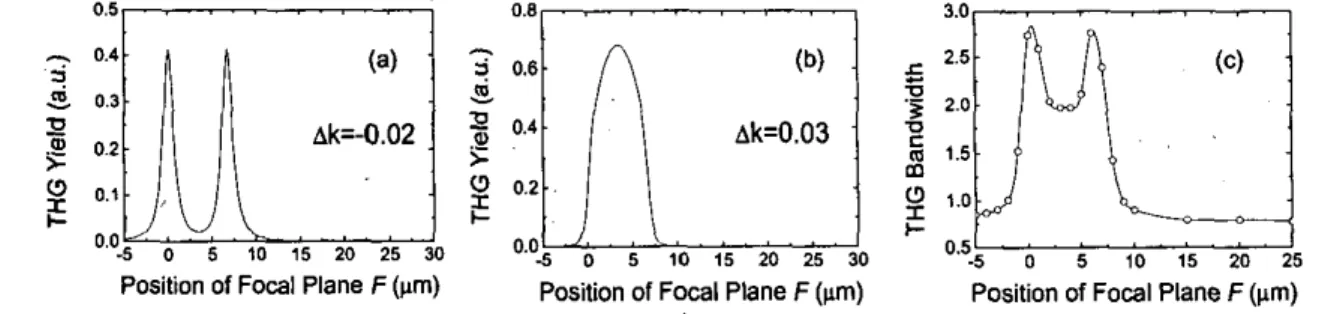
means the focal point is on the left side of the first interface. It is found, that the THG yield depends strongly on detuning parameter Ah = 3k, - k , h , here k , and k,,, are the wave, vectors of fundamental and TH beams, respectively. In summary, the THG signal has peaks at interfaces of films when the detuning is negative [Fig. ](a)]. However, when the detuning is positive, the THG signal has a central peaks within the film[Fig.
l(b)]. We also used the theory to study the bandwidth dependence of the THG yield. In figure 1, we show the dependence of THG bandwidth Akk,,,, on the position of focal plane. It is found that a broader THG bandwidth is also obtained at the sample interfaces, [Fig. l(c)] in addition to a larger THG yield. The results may help to find the optimal position for performing THG experiment with ultrashort pulses, in which larger bandwidth is required. We shall leave other details in the oral presentation.'
-
:::ri
;:::ri
3.0 2.5e
g
1.0E
&- 0.3'3
2.0 0 m 0.2 Ak=-0.02%
o 4 ~ k = 0 . 0 3g
1,5 U 0.2F
m (3 0.1 , O'O-5 0 5 10 15 20 25 30 '"6 0 5 10 15 20 25 30 OS -5 0 5 10 15 20 25Position of Focal Plane F (pm) Position of Focal Plane F (pm) Position of Focal Plane F (pm)
Fig. 1. Dependence of THG yield on focal plane for (a) negative and (b) positive detunings. (c) THG bandwidth dependence on the focal plane.
[l] J. F. Ward and G. H. C. New, "Optical third harmonic generation in gases by a focused laser beam," Phys Rev., 185, pp. 57 (1969).
0-7803-7766-4/03/s17.00 02003 IEEE