Effects of electroacupuncture on benign prostate hyperplasia patients with lower urinary tract
symptoms: A single-blinded, randomized controlled trial
Jung-Sheng Yu
a,b, Kun-Hung Shen
c, Wen-Chi Chen
b, Jiann-Shyan Her
b, Ching-Liang Hsieh
d,e,f*a
Department of Chinese Medicine, Chi Mei Medical Center, Tainan, Taiwan
b
Graduate institute of Integrated Medicine, China Medical University, Taichung, Taiwan
c
Section of Urology, Department of Surgery, Chi Mei Medical Center, Tainan, Taiwan
d
Graduate Institute of Acupuncture Science, China Medical University, Taichung, Taiwan
e
Acupuncture Research Center, China Medical University, Taichung, Taiwan
f
Department of Chinese Medicine, China Medical University Hospital, Taichung, Taiwan
Running title: Electroacupuncture improves symptoms of benign prostate hyperplasia
*Correspondence: Ching-Liang Hsieh M.D., Ph.D. Graduate Institute of Acupuncture Science,
China Medical University. 91 Hsueh-Shih Road, Taichung, 40402, Taiwan
TEL: 886-4-22053366 (ext. 3600); Fax: 886-4-22035191
Abstract
We tested the effect of electroacupuncture (EA) on lower urinary tract symptoms (LUTS) in benign
prostatic hyperplasia (BPH) patients. A total of 42 BPH patients with LUTS were randomly assigned
to either the EA group (EG), received 2 Hz EA for 20 min twice/week for a total of twelve treatments;
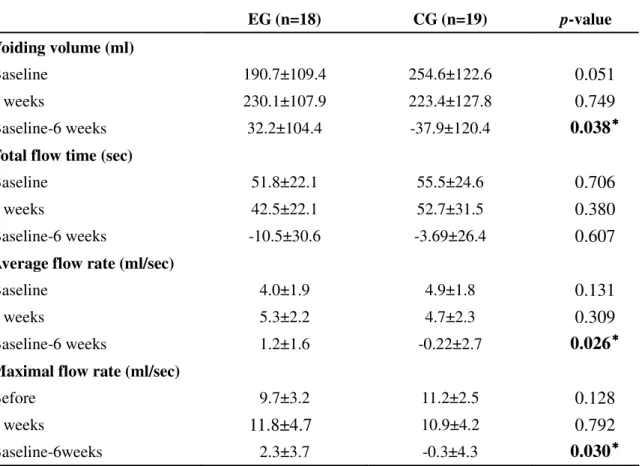
or a sham EA group (CG), received sham EA. The increase of voiding volume, average flow rate and
maximal flow rate in the EG were 32.2±104.4 ml, 1.2±1.6 ml/sec and 2.3±3.7 ml/sec, respectively,
from baseline value (before EA) using the measurement of an uroflowmetry. These increase were
greater than -37.9±120.4, -0.22±2.7 and -0.3±4.3, respectively, in the CG (P=0.038, 0.026, 0.030,
respectively). The changes of prostate special antigen and internal prostatic symptom score were not
significantly difference between two groups (p=0.573, 0.175, respectively)
suggesting
the clinical
improvement of 2 Hz EA was quite limited to the LUTS of patients with BPH.
Introduction
Benign prostate hyperplasia (BPH) is a common condition in men over 50 years of age. BPH and
prostate size increase continuously with age (1). Sommer et al. (1990) found that the prevalence and
the severity of voiding symptoms including obstructive and irritative symptoms increased in men
between 50 and 60 years of age, suggesting a relationship to BPH (2). The prevalence BPH is 20.2%
in men 40-64 years of age, and 42.8% in men 65-79 years of age in the community in central Scotland
(3). The symptoms of BPH includes obstructive symptoms of weak urinary stream force; hesitancy;
intermittent, terminal dribbling and incomplete bladder emptying; and irritative symptoms of
frequency, nocturia and urgency. These symptoms may affect quality of life (3, 4, 5). The symptoms
of BPH are increase with age in Japanese men as they do in men in the United States (6). It has been
observed that prostate size does not correspond to the severity of obstruction and other symptoms (7).
The international prostate symptom score (IPSS) scoring system has been developed by the American
Urological Association (8). This scores system, from 0 to 35, covers mild, moderate, and severe lower
urinary symptoms, and includes seven questions relating to voiding and filling symptoms in the
scoring system. The IPSS is a sensible and reliable system clinically (8), and has been used widely in
the clinic for the evaluation of the severity of lower urinary tract symptoms (LUTS) in patients with
BPH (5, 9,10). Uroflowmetry is one of the simplest urodynamic methods and is noninvasive, and thus,
plays a critical role in the assessment of obstructive LUTS in patients with BPH (11). Uroflowmetry
together with symptomatology constitute a reliable method for preoperative evaluation in patients
urine are lower in patients with BPH, and the total flow time, and time to start voiding are longer than
those of healthy men has been reported in a study using uroflowmetry. (13). Therefore, uroflowmetry
may be used as a index to evaluate the severity of symptoms in patients with BPH. Prostate specific
antigen (PSA) is an important tumor marker of prostate cancer, and has been widely used in the early
diagnosis and management of patients with BPH or with prostate cancer (14,15).
Although nonselective alpha blockers such as Doxaosin or Prazosin, and selective alpha blocker
such as Tamsulosin can mitigate LUTS in patients with BPH, these drugs may cause side effect of
postural hypotension fatigue and dizziness, (5, 16). Finasteride as an alpha reductase inhibitor may
decrease the volume of BPH, and also may decrease the rate of hematuria and prostate cancer, but it
may result in sexual dysfunction (5, 17). Acupuncture has been used to treat LUTS for thousands of
years. Acupuncture treatment achieves greater reduction in frequency and urgency, and results in
greater increase in functional bladder capacity and greater improvement in the score of an
incontinence impact questionnaire than does placebo treatment in women with overactive bladder (18).
Acupuncture also may reduce the National Institutes of Health chronic prostatitis symptom index
(NIH-CPSI) in total score and pain score, as well as urinary and quality of life scores in patients with
chronic prostatitis /chronic pelvic pain syndrome (19). Johnstone et al. (2003) reported that
acupuncture cannot relieve LUTS and PSA in BPH patients (20). In contrast, others have found that
electroacupuncture (EA) at Zhongji (CV3) may significant improve Qmax, frequency of nocturia, and
urine (22). Therefore, the effect of EA on the LUTS in BPH patients needed further study. We
designed a single-blinded, randomized pilot study, and used uroflowmetry, IPSS, and PSA as indices.
Material and methods
Subjects
A total of 91 men with BPH, who suffered from LUTS including incomplete empting, frequency,
intermittency, urgency, straining, and nocturia were enrolled from December 2008 to December 2009
at Chi Mei Medical Center (Tainan, Taiwan). Forty-seven patients were excluded, and two patients
refused to participate in the trial. Forty-two men with BPH participated in the present study. The study
protocol was approved by the institutional review board of Chi Mei Medical Center (IRB No.
09712-001). The procedures of the trial were in accord with the ethical principles dictated in the
Declaration of Helsinki
, and the informed consent form was signed by each participant after detailed
explanation of the trial purpose and procedure.
BPH was confirmed by a urology specialist using the trans-rectal sonography survey, and PSA
also was measured for exclusion of prostate cancer. The inclusion criteria included: 1) age > 40; 2)
BPH in the absence of any previous anti-BPH treatment such as alpha blocker medications, or
surgical operation; 3) IPSS > 8; 4) Qmax < 15 ml/sec. The exclusion criteria were: 1) finding that the
lower urinary symptoms were due to interstitial cystitis, prostate cancer, urinary stone, or urinary tract
beta-blockers,
arrhythmia with or without cardiac pacemaker, chronic pulmonary obstructive disease,
hepatic failure; 3) inability of the potential participant to comply with the schedule of the trial.
Randomization and blinding
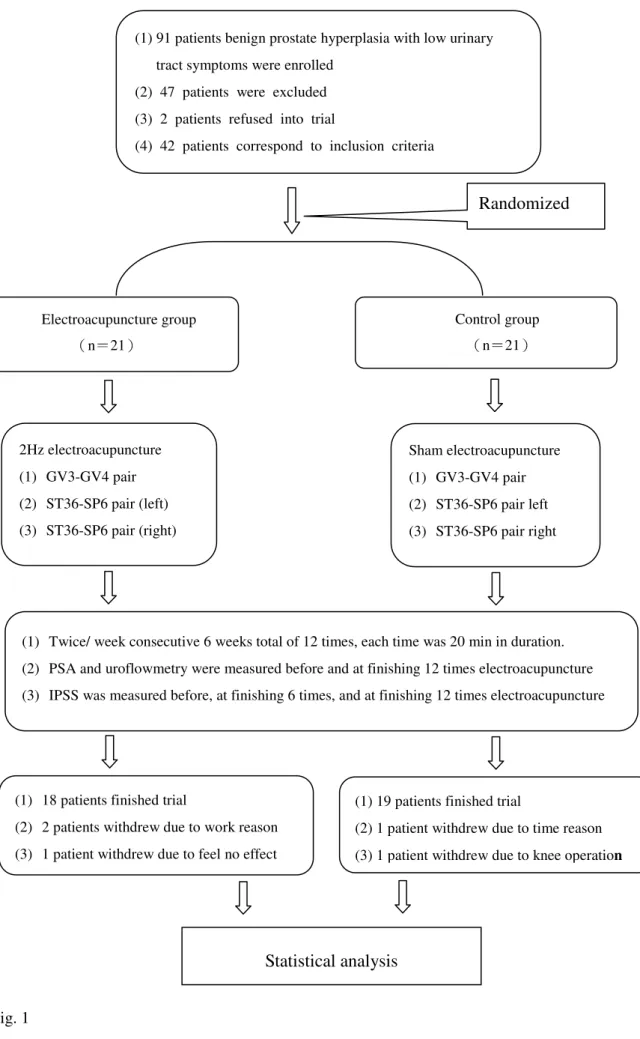
Forty-two patients were randomized by lottery to the EA group (EG), which received EA, or to the
control group (CG), which received sham EA. Each group had 21 subjects (Figure 1).
Study design and sample size
The present study was a pilot study of a single-blind randomized controlled trial. The sample size
was calculated according to Koseoglu et al. (2006) (23) and Loh et al. (2009) (9). We predicted a
dropout rate of 15%, therefore, twenty-one subjects would be sufficient.
EA
EA was performed by a Chinese medical doctor with more than 4 years of acupuncture experience.
In the EG, the subjects were treated with stainless steel acupuncture disposable needles
(2 cun in
length, gauge #30, Yu Kuang, Taiwan) inserted bilaterally into the Zhongji (CV3), Guanyuan (CV4),
and bilateral Zusanli (ST36) and Sanyinjiao (SP6) acupoints. The acupuncture needles were twisted
manually
3-5 times
to obtain qi (in which the acupuncturist has the sensation of fish biting on bait;
needles were connected to electroacupuncture apparatus (HC-0501, Hung-Tai Co., Taiwan)
.
Three pairs of EA were designed as Zhongji and Guanyuan, ipsilateral Zusanli and Sanyinjiao.
These acupoints were chosen according to the selection of local points, and according to meridian
theory of Traditional Chinese Medicine. Zhongji and Guanyuan acupoints are located in the midline
of the low abdomen, and 4 cun and 3 cun, respectively, inferior to the umbilicus, and belong to the
conception vessel near the urinary bladder. Both acupoints may treat urinary disease including
frequency, urgency, and dribbling (24). The Zusanli acupoint is located 3 cun below the knee,
belongs to the stomach meridian, and the acupoint may treat difficult urination (25). The Sanyijiao
acupoint is located 3 cun above the medial malleolus, belongs to the spleen meridian, and the
acupoint may treat uroschesis and stranguria (26).
The frequency of EA was 2 Hz. The intensity of electrical stimulation was adjusted to obtain
visible twitching of muscle about 2–2.5 mA. The subject did not feel pain or dyscomfort. The
duration of electrical stimulation was 20 min, and was performed two times per week for 6
consecutive weeks for a total of twelve sessions.
In the CG, the methods were identical to those in the
EG, except that the acupuncture needles were inserted into the subcutaneous tissue to a depth of 2 mm,
the location was 1 cm lateral to the above-mentioned acupoints, respectively, without manual
twisting or any electrical stimulation.
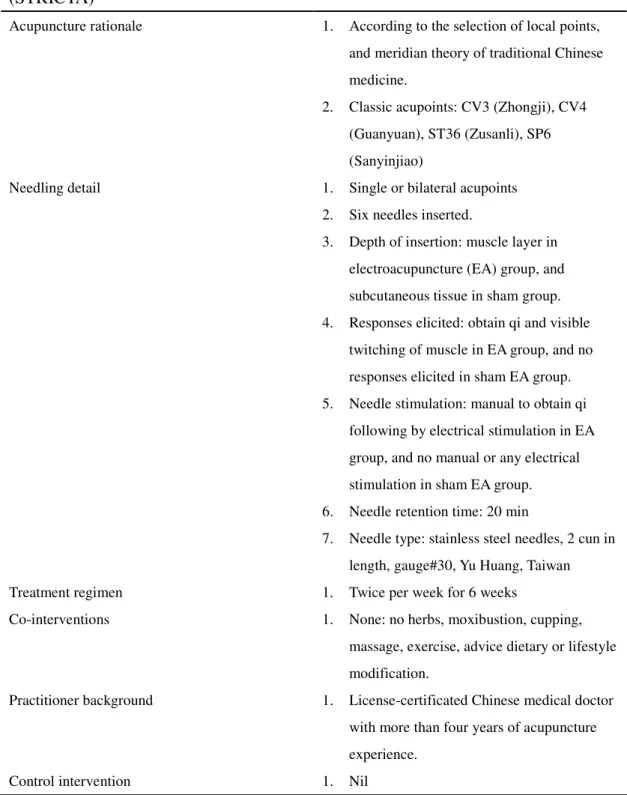
The checklist of Consolidated Standards of Reporting
Trials (CONSORT) was completed (27) and complete details of the intervention are
controlled trial of acupuncture (28).
Outcome measures
The primary outcome measures were the differences of Qmax, average flow rate (Qave), total flow
time, and void volume from baseline (before EA) to after completion of twelve rounds of EA (F2).
Those indices were measured using uroflowmetry (UROCOMPACT 6000, LABORIE, ENCORE).
The secondary outcome measures were the change of serum PSA concentration measured
baseline and at F2; and the differences of IPSS including incomplete empting, intermittency, weak
stream, straining, frequency, urgency, and nocturia from baseline to after completion of six rounds of
EA (F1), and from baseline to F2.
Statistical analysis
The data are presented as mean ± standard deviation (SD) and are analyzed by SPSS for Windows,
version 17.0 (SPSS Inc., Illinois, USA). Mann-Whitney U test was used to assess the differences
between two groups. The significance level was set at α= 0.05. P < 0.05 was considered to indicate a
statistically significant difference.
Results
Forty-two BPH patients with LUTS participated in this trial. Three patients withdrew in the EG, two
patients withdrew because of work, and one patient because he felt no effect. Two patients withdrew
in the CG, one patient withdrew because of the time commitment, and one patient because of a knee
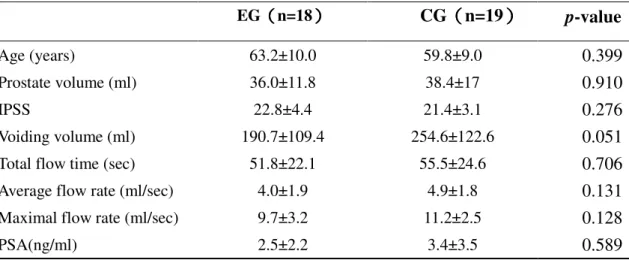
operation. Therefore, a total of 37 subjects completed the trial (Figure 1). No significant differences
were found between the EG and CG in basic characteristics including age, prostate volume, IPSS,
voiding volume, total flow time, Qave, Qmax, and serum PSA levels (Table
2
).
Three patients in the EG developed subcutaneous ecchymosis in the lower abdominal region.
These ecchymoses were all less than 3 cm in diameter, and disappeared spontaneously without any
treatment. No one withdrew from the trial for this reason.
Effect of EA on voiding symptoms in BPH patients
The increases in void volume, Qave, and Qmax from baseline to F2 were greater in the EG than in the
CG (P=0.038, 0.026, 0.030, respectively; Table 2), while the increase of total flow time was not
significantly different between EG and CG (P=0.607; Table
3
).
Effect of EA on LUTS and PSA in BPH patients
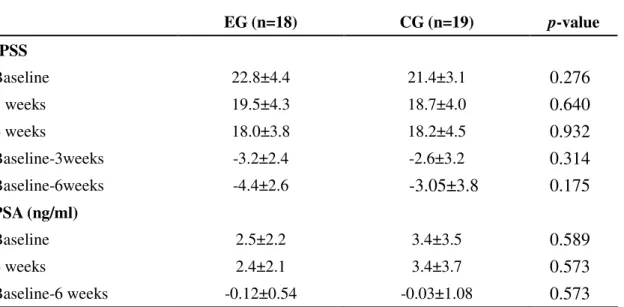
The changes of IPSS from baseline to F1, and from baseline to F2 were not significantly different
between EG and CG (P= 0.314, 0.175, respectively; Table
4)
.
The changes of serum PSA levels from baseline to F2 was not significantly different between EG
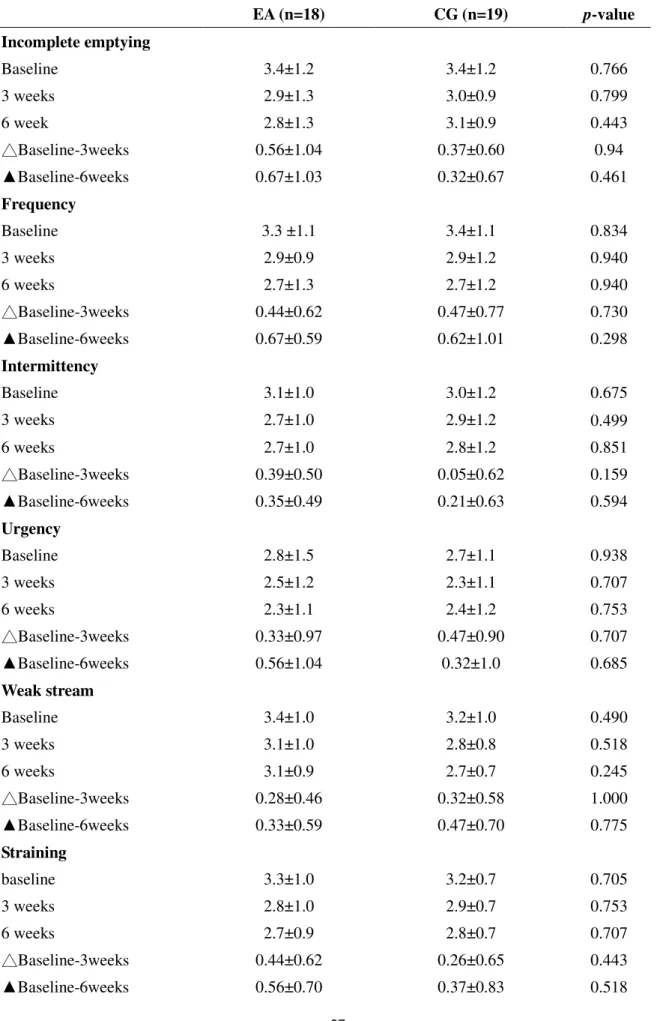
The changes of subscore of IPSS including incomplete empting, frequency, intermittency,
urgency, weak stream, straining, and nocturia from baseline to F1, and from baseline to F2 were not
significantly different between EG and CG (Table
5
).
Discussion
The results in the present study indicated that increases in voiding volume, Qave, and Qmax were
greater in the EG than in the CG in BPH patients with LUTS, whereas total flow time, and IPSS and
subscore of IPSS in the EG was similar to that in the CG. These results suggested that the clinical
improvement of 2 Hz EA was quite limited to the LUTS of patients with BPH. The 2 Hz EA may
enhance the release of enkephalin, β-endorphin and endomorphin release, whereas 100 Hz EA
increase the release of dynorphin. A combination of 2 Hz and 100 Hz EA may induce simultaneous
release of all four opioid peptides produce maximal therapeutic effect (29,30). Therefore, how to
increase therapeutic effect of EA, further study is need.
Basic characteristics of age, prostate size,
voiding volume, total flow time, Qave, and Qmax were not significantly different between two
groups.
Uroflowmetry may be used for preoperative routine assessment of BPH patients (12). The Qmax
may predict the degree of obstruction in patients with BPH because there is a negative correlation
between Qmax and prostate volume (31). The Qmax is a reliable and objective measurement to
International Continence Society-BPH (ICS-BPH) symptom score (32). The ICS-BPH symptom score
is obtained by using an ICSmale questionnaire, and has a high level of psychometric validity and
reliability (33). Our results also indicated that IPSS and its subscore and PSA were not significantly
different between the EG and the CG. The IPSS is a sensible and reliable method to assess LUTS
including emptying symptoms: incomplete emptying, intermittency, weak stream, and straining; and
storage symptoms: frequency, urgency, and nocturia in BPH patients (8), whereas subscores of IPSS
consist of the emptying symptoms score and the storage symptoms score (34).
One report finds that with the IPSS, it is difficult to predict the severity of the symptoms in China
(35). Other reports demonstrate that the correlation is poor between total IPSS and bladder outlet
obstruction (36, 37). Because of bladder outlet obstruction is related to the dysfunction of detrusor
(38). The prostate size is a very weak determinant factor of the severity of symptoms and bladder
outlet obstruction because the bladder outlet obstruction of BPH included both static and dynamic
factors that have a relationship to the tension of the prostate smooth muscle (39). The LUTS are
induced by BPH due to obstruction causing detrusor dysfunction, resulting in neural alteration of the
bladder and prostate (40). PSA is important tumor marker of prostate cancer that is used for early
detection in patients with BPH, and in the management of patients with prostate cancer (15). EA may
partly improve voiding function of patients with BPH. Acupuncture is about twice as effective as
sham acupuncture in the treatment of patients with prostatitis/chronic pelvis pain (41). Acupuncture
acupuncture in the abdomen, which excites sympathetic nerves through a spinal reflex, reduces gastric
motility. Acupuncture in the hind limbs, which excites the vagus nerve via a supraspinal reflex,
increases gastric motility (42). Acupuncture or electrical stimulation may increase the production of
endorphins and analgesic effects to generate a neuromodulation to decrease the high tone of the pelvic
floor which is induced by bladder dysfunction (43). The reflexotherapy of EA can improve sensory
urgency in BPH patients with transurethral resection (44). To sum up, EA
increase the voiding volume,
Qave, and Qmax of BPH patients with LUTS
, possibly through many pathways. The neuromodulation
of the bladder induced by acupuncture appears to play a critical role.
Although the results of the present study indicated that 2 Hz EA of Zhongji and Guanyuan,
ipsilateral Zusanli and Sanyinjiao might increase the voiding volume, Qave, and Qmax of BPH
patients with LUTS, the study still is unclear that these acupoints are essential or stimulation of
others acupoints also effective or not. Therefore, further the examination of some other acupoints
effect is needs. Acupuncture apply to
CV1 (Huiyin), Guanyuan, Sanyinjiao and SP9
(Yinlingquan) 2 weekly sessions for 10 weeks may improve chronic prostatitis/chronic
pelvis pain symptoms of adult men (41). Electrostimulation of Huiyin, CV2 (Qugu), CV4,
CV5 (Shimen), BL21 (Weishu), BL23 (Shenshu), BL32 (Ciliao), and auricular points of
prostate and external genitalia also can improve LUTS in patients with transurethral
resection of the prostate (44).
of statistically significant differences between two groups in the IPSS and its subscore; 2) acupuncture
needles were inserted in the subcutaneous region to
a depth of 2 mm
in the control group, and
therefore, we could not exclude the production of different subliminal effect (45, 46). The adoption of
a larger sample size and different study design might have eliminated the two above-mentioned
limitations. Although three patients developed ecchymosis in the present study, this ecchymosed
disappeared completely, and these patients did not withdraw, form the study. We consider EA to be
safe.
In conclusion, the clinical improvement of 2 Hz EA was quite limited to the LUTS of
patients with BPH, how to increase the therapeutic effect of EA for the LUTS treatment of
patient with BPH needs further study.
Acknowledgments
This study
is
supported in part by Taiwan Department of Health Clinical Trial and Research Center
References
1.
Berry SJ, Coffey DS, Walsh PC, Ewing LL. The development of human benign prostatic
hyperplasia with age. J Urol 1984;132(3):474-9
2.
Sommer P, Nielsen KK, Bauer T, Kristensen ES, Hermann GG, Steven K, Nordling J.
Voiding patterns in men evaluated by a questionnaire survey. Br J Urol 1990;
65(2):155-60.
3.
Garraway WM, Russell EB, Lee RJ, Collins GN, McKelvie GB, Hehir M, Rogers AC,
Simpson RJ. Impact of previously unrecognized benign prostatic hyperplasia on the
daily activities of middle-aged and elderly men. Br J Gen Pract 1993; 43(373):318-21.
4.
Christensen MM, Bruskewitz RC. Clinical manifestations of benign prostatic
hyperplasia and indications for therapeutic intervention. Urol Clin North Am
1990;17(3):509-16.
5.
Dull P, Reagan RW Jr, Bahnson RR. Managing benign prostatic hyperplasia. Am Fam
Physician
2002;1;66(1):77-84.
6.
Tsukamoto T, Kumamoto Y, Masumori N, Miyake H, Rhodes T, Girman CJ, Guess HA,
Jacobsen SJ, Lieber MM. Prevalence of prostatism in Japanese men in a
community-based study with comparison to a similar American study. J Urol
7.
Ezz el Din K, Kiemeney LA, de Wildt MJ, Debruyne FM, de la Rosette JJ. Correlation
between uroflowmetry, prostate volume, postvoid residue, and lower urinary tract
symptoms as measured by the International Prostate Symptom Score. Urology
1996;48(3):393-7.
8.
Barry MJ, Fowler FJ Jr, O'Leary MP, Bruskewitz RC, Holtgrewe HL, Mebust WK,
Cockett AT. The American Urological Association symptom index for benign prostatic
hyperplasia. The Measurement Committee of the American Urological Association. J
Urol
1992;148(5):1549-57.
9.
Loh AH, Ng KK, Ng FC. Presentation and progression of benign prostatic hyperplasia: a
Singapore experience profiling ethnic differences in a multiracial study cohort. Ann
Acad Med Singapore
2009;38(5):451-6.
10.
Li S, Lu A, Wang Y. Symptomatic comparison in efficacy on patients with benign
prostatic hyperplasia treated with two therapeutic approaches. Complement Ther Med
2009;18(1):21-7.
11.
Malik MA, Khan JH, Gondal WS, Bajwa IA. Role of uroflowmetry in lower urinary
tract symptoms evaluation due to benign prostatic hyperplasia (BPH). special edition
annals
2010;16(1):34-38.
12.
de Lima ML, Netto NR Jr. Urodynamic studies in the surgical treatment of benign
13.
Aghamir SM, Mohseni M, Arasteh S. The effect of voiding position on uroflowmetry
findings of healthy men and patients with benign prostatic hyperplasia. Urol J
2005;2(4):216-21.
14.
Wong WY, Chen SC, Chueh SC, Chen J. The trend of managing prostate cancer in
Taiwan. Int J Urol 2004;11(7):510-4.
15.
Malati T, Kumari GR, P.V.L.N. Murthy, Reddy CR, Prakash BS. Prostate specific
antigen in patients of benign prostate hypertrophy and carcinoma prostate. Indian J Clin
Biochem
2006;21(1):34-40.
16.
Wilt TJ, MacDonald R. Doxazosin in the treatment of benign prostatic hypertrophy: an
update. Clin Interv Aging 2006;1(4):389-401.
17.
Smith AB, Carson CC. Finasteride in the treatment of patients with benign prostatic
hyperplasia: a review. Ther Clin Risk Manag 2009;5(3):535-45.
18.
Emmons SL, Otto L. Acupuncture for overactive bladder: a randomized controlled trial.
Obstet Gynecol
2005;106(1):138-43.
19.
Chen R, Nickel JC. Acupuncture ameliorates symptoms in men with chronic
prostatitis/chronic pelvic pain syndrome. Urology 2003;61(6):1156-9
20.
Johnstone PA, Bloom TL, Niemtzow RC, Crain D, Riffenburgh RH, Amling CL. A
prospective, randomized pilot trial of acupuncture of the kidney-bladder distinct
21.
Liu QG, Wang CY, Jiao S, Tang LX, Peng MH, Tian LF, Ding WX, Zhao X, Lu SK, Fu
YJ, Tan WL, Qin Y. Electroacupuncture at Zhongi (CV3) for treatment of benign
hyperplasia of prostate: a multi-central randomized study. Chin Acup & Moxib (Chinese)
2008;28(8):555-559.
22.
Yang T, Zhang XQ, Feng YW,Hsu HJ, Liu CS, Chao H, Yeh YM, Wang J, Liu WS.
Effect of electroacupuncture in treating 93 patients with benign prostate hyperplasia.
Chin J Integ Tadit and West (Chinese)
2008;28(11):998-1000.
23.
Koseoglu H, Aslan G,Ozdemir I, Esen A. Noctural polyuria in patients with lower
urinary tract syndromes and response to alpha-blocker therapy. Urology 2006;
67(6):1188-1192.
24.
Liu G. A complement work of present acupuncture and moxibustion. Acupoints &
Meridians. HuaXia Publishing House. Beijing. First edition. (1996a); pp.138-139.
25.
Liu G. A complement work of present acupuncture and moxibustion. Acupoints &
Meridians. HuaXia Publishing House. Beijing. First edition. (1996b); pp.353.
26.
Liu G. A complement work of present acupuncture and moxibustion. Acupoints &
Meridians. HuaXia Publishing House. Beijing. First edition. (1996c); pp.267.
27.
CONSORT Web site. Available at http://www.consort-statement.org. Accessed March
28.
MacPherson H, White A, Cummings M, Jobst K, Rose K, Niemtzow.Standards for
reporting interventions in controlled trials of acupuncture: the STRICTA
recommendations. J Atern Complement Med 2002;8:85-89.
29.
Wang Y, Zhang Y, Wang W, Cao Y, Han JS. New evidence for synergistic
analgesiaproduced by endomorphin and dynorphin. Chin J Pain Med 2002;8:118-119.
30.
Han JS. Acupuncture and endorphins. Neuroscience Letters 2004;361:258-261.
31.
Mohammed N, Ansari MA, Sharma U, Pradhan S. Comparative Study of Prostatic
Volume And Uroflowmetry In Benign Prostatic Hyperplasia Patients With Lower
Urinary Tract Symptoms. The Internet J of Radiol http://www.ispub.com/journal/the
internet journal of radiology/volume 6 number 2 2010.
32.
Porru D, Scarpa RM, Prezioso D, Bertaccini A, Rizzi CA; HOUSE Study Group. Home
and office uroflowmetry for evaluation of LUTS from benign prostatic enlargement.
Prostate Cancer Prostatic Dis
2005;8(1):45-9.
33.
Donovan JL, Abrams P, Peters TJ, Kay HE, Reynard J, Chapple C, De La Rosette JJ,
Kondo A. The ICS-'BPH' Study: the psychometric validity and reliability of the ICSmale
questionnaire. Br J Urol 1996;77(4):554-62.
34.
Liao CH, Kuo HC. Measurement of internal prostate symptom score in male lower
35.
Wang JY, Liu M, Zhang YG, Zeng P, Ding Q, Huang J, He DL, Song B, Kong CZ, Pang
J. Relationship between lower urinary tract symptoms and objective measures of benign
prostatic hyperplasia: a Chinese survey. Chin Med J (Engl) 2008; 20;121(20):2042-5.
36.
Oelke M, Baard J, Wijkstra H, de la Rosette JJ, Jonas U, Höfner K. Age and bladder
outlet obstruction are independently associated with detrusor overactivity in patients
with benign prostatic hyperplasia. Eur Urol 2008; 54(2):419-26.
37.
Agrawal CS, Chalise PR, Bhandari BB. Correlation of prostate volume with
international prostate symptom score and quality of life in men with benign prostatic
hyperplasia. Nepal Med Coll J 2008;10(2):104-7.
38.
Kang MY, Ku JH, Oh SJ. Non-invasive parameters predicting bladder outlet obstruction
in Korean men with lower urinary tract symptoms. J Korean Med Sci 2010; 25(2):272-5.
39.
Lepor H. Pathophysiology of benign prostatic hyperplasia in the aging male population.
Rev Urol
2005;7(Suppl 4):S3-S12.
40.
McConnell JD.The pathophysiology of benign prostatic hyperplasia. J Androl,
1991;12(6):356-363.
41.
Huey Lee SW, Liong ML, Yuen KH, Leong WS, Chee C, Cheah PY, Choong WP, Wu
Y, Khan N, Choong WL, Yap HW, Krieger JN. Acupuncture versus sham acupuncture
42.
Noguchi E. Mechanism of reflex regulation of the gastroduodenal function by
acupuncture. eCAM 2008; 5(3): 251-6.
43.
Whitmore KE. Complementary and alternative therapies as treatment approaches for
interstitial cystitis. Rev Urol 2002; 4 (Suppl 1):S28-35.
44.
Ricci L, Minardi D, Romoli M, Galosi AB, Muzzonigro G. Acupuncture reflexotherapy
in the treatment of sensory urgency that persists after transurethral resection of the
prostate: a preliminary report. Neurourol Urodyn 2004;23(1):58-62.
45.
Svensson P, Minoshima S, Beydoun A, Morrow TJ, Casey KL. Cerebral processing of
acute skin and muscle pain in humans. J Neurophysiol 1997; 78(1):450-60.
46.
Ceccherelli F, Rigoni MT, Gagliardi G, Ruzzante L. Comparison of superficial and deep
acupuncture in the treatment of lumbar myofascial pain: a double-blind randomized
Legend
Fig. 1
Randomized
Electroacupuncture group (n=21) Control group (n=21) 2Hz electroacupuncture (1) GV3-GV4 pair (2) ST36-SP6 pair (left) (3) ST36-SP6 pair (right)(1) 91 patients benign prostate hyperplasia with low urinary tract symptoms were enrolled
(2) 47 patients were excluded (3) 2 patients refused into trial
(4) 42 patients correspond to inclusion criteria
Sham electroacupuncture (1) GV3-GV4 pair (2) ST36-SP6 pair left (3) ST36-SP6 pair right
(1) Twice/ week consecutive 6 weeks total of 12 times, each time was 20 min in duration. (2) PSA and uroflowmetry were measured before and at finishing 12 times electroacupuncture (3) IPSS was measured before, at finishing 6 times, and at finishing 12 times electroacupuncture
(1) 18 patients finished trial
(2) 2 patients withdrew due to work reason (3) 1 patient withdrew due to feel no effect
(1) 19 patients finished trial
(2) 1 patient withdrew due to time reason (3) 1 patient withdrew due to knee operation
Table 1. Standards for Reporting Interventions in Controlled Trials of Acupuncture
(STRICTA)
Acupuncture rationale 1. According to the selection of local points, and meridian theory of traditional Chinese medicine.
2. Classic acupoints: CV3 (Zhongji), CV4 (Guanyuan), ST36 (Zusanli), SP6 (Sanyinjiao)
Needling detail 1. Single or bilateral acupoints 2. Six needles inserted.
3. Depth of insertion: muscle layer in electroacupuncture (EA) group, and subcutaneous tissue in sham group. 4. Responses elicited: obtain qi and visible
twitching of muscle in EA group, and no responses elicited in sham EA group. 5. Needle stimulation: manual to obtain qi
following by electrical stimulation in EA group, and no manual or any electrical stimulation in sham EA group. 6. Needle retention time: 20 min
7. Needle type: stainless steel needles, 2 cun in length, gauge#30, Yu Huang, Taiwan Treatment regimen 1. Twice per week for 6 weeks
Co-interventions 1. None: no herbs, moxibustion, cupping, massage, exercise, advice dietary or lifestyle modification.
Practitioner background 1. License-certificated Chinese medical doctor with more than four years of acupuncture experience.