Phosphorescence of red Os ( fptz ) 2 ( P Ph 2 Me ) 2 doped organic light-emitting
devices with n and p hosts
Tswen-Hsin Liu, Shih-Feng Hsu, Meng-Hung Ho, Chi-Hung Liao, Yao-Shan Wu, Chin H. Chen, Yung-Liang Tung
, Pei-Chi Wu, and Yun Chi
Citation: Applied Physics Letters 88, 063508 (2006); doi: 10.1063/1.2172405 View online: http://dx.doi.org/10.1063/1.2172405
View Table of Contents: http://scitation.aip.org/content/aip/journal/apl/88/6?ver=pdfcov
Published by the AIP Publishing
Articles you may be interested in
High spontaneous polarization in Pb Ti O 3 – Bi Me O 3 systems with enhanced tetragonality
Appl. Phys. Lett. 91, 171907 (2007); 10.1063/1.2794742
Cumulative contributions of 3 s – n p ( n 3 ) transitions in comparing O atom densities in low-pressure Ar – O 2 and He – O 2 glow discharges
Appl. Phys. Lett. 89, 171501 (2006); 10.1063/1.2364464
Electronic structures and spectroscopic properties of nitrido-osmium(VI) complexes with acetylide ligands [ Os N ( C C R ) 4 ] R H , C H 3 , and Ph by density functional theory calculation
J. Chem. Phys. 124, 144309 (2006); 10.1063/1.2189220
Theoretical study of the effects of F to Cl chemical substitution on the electronic structure and the luminescence properties of Cs 2 Ge F 6 : Os 4 + and Cs 2 Zr Cl 6 : Os 4 + materials
J. Chem. Phys. 124, 124315 (2006); 10.1063/1.2180772
Classification of transition temperature behavior in ferroelectric Pb Ti O 3 – Bi ( Me Me ) O 3 solid solutions
J. Appl. Phys. 99, 024106 (2006); 10.1063/1.2163986
This article is copyrighted as indicated in the article. Reuse of AIP content is subject to the terms at: http://scitation.aip.org/termsconditions. Downloaded to IP: 140.113.38.11 On: Thu, 01 May 2014 02:08:21
Phosphorescence of red Os
„fptz…
2„PPh
2Me
…
2doped organic light-emitting
devices with n and p hosts
Tswen-Hsin Liu,a兲Shih-Feng Hsu,b兲Meng-Hung Ho,b兲Chi-Hung Liao,b兲Yao-Shan Wu,b兲 and Chin H. Chenc兲
Department of Photonics and Institute of Electro-Optical Engineering, National Chiao Tung University, Hsinchu 300, Taiwan, Republic of China, and AU Optronics Corporation, Hsinchu 300, Taiwan, Republic of China
Yung-Liang Tung, Pei-Chi Wu, and Yun Chi
Department of Chemistry, National Tsing Hua University, Hsinchu 300, Taiwan, Republic of China
共Received 14 March 2005; accepted 19 December 2005; published online 8 February 2006兲 We have applied a stericly-hindered red phosphorescent dopant Os共fptz兲2共PPh2Me兲2 关fptz=3-trifluoromethyl-5-共2-pyridyl兲-1,2,4-triazole, PPh2Me= phosphine ligand兴 in p-type 4,4
⬘
-N , -N⬘
-dicarbazole-biphenyl or n-type bis共2-methyl-8-quinolinolato兲共p-phenylphenolato兲 aluminumhost and found that the latter produced higher luminance efficiency at lower doping concentration. We present a model to rationalize this phenomenon in which the n-type host impedes hole transport, which leads to narrower recombination zone near the hole transport layer/emission layer interface than the p-type host, hence, more effective recombination. © 2006 American Institute of Physics. 关DOI:10.1063/1.2172405兴
One of the key developments in the advance of modern organic light-emitting devices 共OLEDs兲 technology is the discovery of electrophosphorescence which lifts the upper limit of the internal quantum efficiency of the usual fluores-cent dopant-based devices from 25% to nearly 100%.1,2To ensure effective proximity for complete energy transfer, the dopant concentration in phosphorescent OLEDs is always higher than that of the fluorescent OLEDs.3–5 A short-distance Dexter Energy transfer共⬃10 Å兲 between the phos-phorescent host and dopant has been often used to rationalize this phenomenon.6Nevertheless, a high doping concentration of phosphorescent dopants can also provide better overlap of ligand orbitals, which will promote the direct recombina-tion of electron-hole pairs on dopants.7In this case, the role of the host will not be the dominant excitation energy source as in the energy transfer model, rather a mere medium for carrier transport.
In this study, we used a highly stericly hindered red phosphorescent dye Os共fptz兲2共PPh2Me兲2 关fptz=3-trifluoromethyl-5-共2-pyridyl兲-1,2,4-triazole,
PPh2Me= phosphine ligand兴 as the dopant together with a
p-type host 4,4
⬘
-N , N⬘
-Dicarbazole-biphenyl 共CBP兲 orn-type host bis共2-methyl-8-quinolinolato兲 共p-phenylphenolato兲 aluminum 共BAlq兲 for our emission layer. By studying the electroluminescence共EL兲 characteris-tics of the dopant in the hosts of different charge transport natures, we expect to provide more insights about the rela-tionship between phosphorescent dopant and host and at-tempt to elucidate the emissive mechanism.
The structure, purity, chemical, energy levels, and opti-cal properties of Os共fptz兲2共PPh2Me兲2 has been verified and disclosed in other publication.8 Figure 1 depicts the absorp-tion and luminance spectrum of Os共fptz兲2共PPh2Me兲2 in
CH2Cl2. The strong absorption in the UV region are assigned to the spin-allowed1*transition of fptz ligands, owing to their spectral similarity to the free fptz anion. The next lower energy absorption can be ascribed to a typical spin-allowed metal to ligand charge transfer 共1MLCT兲 transition, while two absorption bands extending into visible region are asso-ciated with the spin-orbit coupling enhanced 3* and 3
MLCT transitions. Further luminance properties共vide infra兲 support 3MLCT to be in the lowest triplet state with peak wavelength at 540 nm.
Figure 2 shows our experimental results of the device structure: indium tin oxide 共75 nm兲/copper phthalocyanine 共CuPc兲 共15
nm兲/1,4-bis关N-共1-naphthyl兲-N
⬘
-phenylamino兴biphenyl-4,4⬘
diamine 共NPB兲, 共60 nm兲/host: x% Os共fptz兲2共PPh2Me兲2 共40 nm兲/BAlq 共15 nm兲/tris共8-hydroxyquinolinato兲aluminum 共Alq3兲, 共20 nm兲/LiF 共1 nm兲/Al共200 nm兲. The CuPc, NPB, BAlq, and Alq3were used as the hole injection, hole transport, hole blocking material,9 and electron transport material,respec-a兲Author to whom correspondence should be addressed; electronic mail:
b兲Also at: Department of Applied Chemistry. c兲Also at: Display Institute.
FIG. 1. UV-visible absorption共䊏兲 and normalized emission spectrum 共䊊兲 of Os共fptz兲2共PPh2Me兲2 in CH2Cl2 at room temperature. Inset: molecular
structure of Os共fptz兲2共PPh2Me兲2.
APPLIED PHYSICS LETTERS 88, 063508共2006兲
0003-6951/2006/88共6兲/063508/3/$23.00 88, 063508-1 © 2006 American Institute of Physics This article is copyrighted as indicated in the article. Reuse of AIP content is subject to the terms at: http://scitation.aip.org/termsconditions. Downloaded to IP:
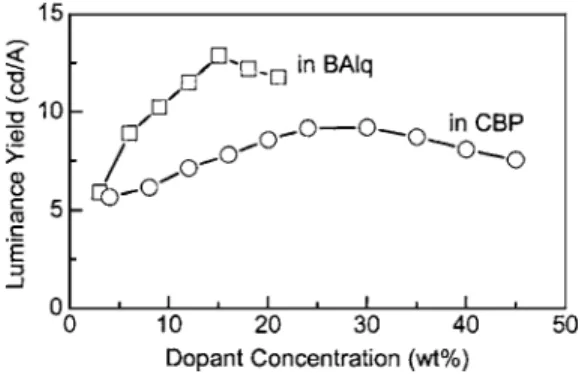
tively. It is apparent from Fig. 2 that when Os共fptz兲2共PPh2Me兲2 is doped in CBP 共device A兲, Os共fptz兲2共PPh2Me兲2has the property of resistance to concen-tration quenching and the sustaining of its EL luminance efficiency共⬎8.5 cd/A兲 over a wide range of doping concen-tration from 20% to 35%. However, when doped in n-type BAlq共device B兲, the luminance efficiency can reach as high as 12.8 cd/ A at the current density of 20 mA/ cm2, which is obviously higher than that with CBP as the host. Further-more, a much lowered doping concentration of 15% is re-quired for reaching the maximum luminance efficiency when using BAlq as the host as compared to that of 30% in CBP. In terms of color and operation voltage, both devices show a Commission Internationale d’Eclairage共CIE兲 coordinates of 共0.65, 0.35兲, but the operation voltage of the CBP-based de-vice is approximately 1 V lower than that of the BAlq-based device.
The photoluminescence spectra of BAlq and CBP under room and low temperature are illustrated in Fig. 3. By look-ing at Fig. 3, there appears a small shoulder under low tem-perature at 430– 580 nm which is the triplet energy peak of CBP in addition to the singlet energy peak at ⬃360 nm which will blue shift under low temperature.5,9Moreover, the
fluorescent spectrum of CBP overlaps with the two spin-allowed absorption transitions of Os共fptz兲2共PPh2Me兲2at 290 and 400 nm. According to the energy transfer model, the 25% singlet energy of CBPs excitons could effectively trans-form into the singlet energy of Os共fptz兲2共PPh2Me兲2, which then generates phosphorescence via internal system crossing process. Not only that, the triplet energy of CBPs excitons is higher than the transition energy due to 3MLCT in Os共fptz兲2共PPh2Me兲2. Therefore, the triplet energy of CBPs excitons can successfully transform into that of Os共fptz兲2共PPh2Me兲2as well. On the other hand, the situation is totally different in the case of BAlq. First, the fluorescent spectrum of BAlq at 490 nm has shown poor overlap with the spin-allowed singlet transition of Os共fptz兲2共PPh2Me兲2. Second, the photoluminescent spectra of BAlq under room and low temperatures seem to be identical 共even at 22 K兲. We believe this is attributed to the very weak triplet energy of BAlq, which gives signal that is undetectable by the in-strument. If this is the case, the energy transfer from the host to dopant mentioned previously will not be applicable to explain the observation depicted in Fig. 2 since CBP obvi-ously has higher probability to undergo energy transfer but inconsequently has lower luminance efficiency.
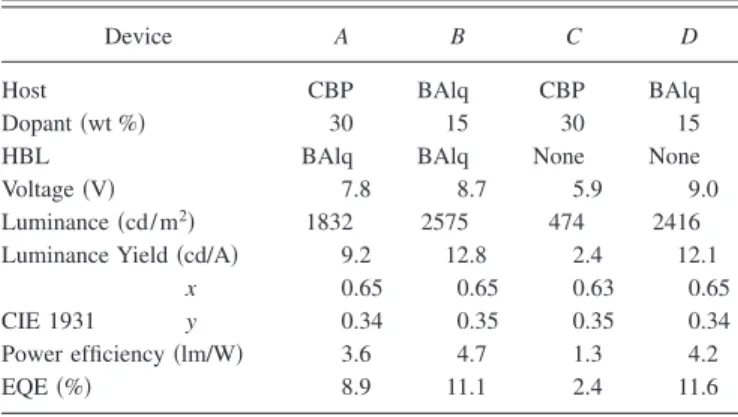
In order to clarify the emission mechanism of doped OLEDs, we have designed the devices without hole blocking layer共devices C and D兲. The hole-blocking layer of 15 nm BAlq was removed and replaced by Alq3of the same thick-ness. The doping concentrations for both devices are opti-mized for achieving the highest luminance efficiency. The EL spectra and detailed EL performance of the devices are shown in Fig. 4 and Table I, respectively.
From Fig. 4, the Alq3 emission at⬃520 nm can be ob-served besides the Os共fptz兲2共PPh2Me兲2 emission at 624 nm for the CBP-based device without hole-blocking layer, there-fore, the CIE coordinates of device C were blueshifted to 共0.63, 0.36兲. Significant drop in luminance efficiency to 2.4 cd/ A can be seen as well from Table I for the CBP-based device without hole-blocking layer and the operation voltage is ⬃2 V lower than that of the device with hole-blocking layer. But these phenomena do not exist in the case of BAlq-based devices. The luminance efficiency of device D is well above 12 cd/ A at 20 mA/ cm2 and the color saturation re-mains unchanged at CIE=共0.65,0.34兲 due to no Alq3 emis-sion was observed. The operation voltages of the BAlq-based devices are very similar. Based on these evidences, it is clearly shown that the removal of the hole-blocking layer
FIG. 2. Efficiency dependency on Os共fptz兲2共PPh2Me兲2 concentration in
CBP共䊐兲 and BAlq 共䊊兲 hosts.
FIG. 3. The photoluminescent spectra of CBP共top figure兲 and BAlq 共bottom figure兲 under room and low temperatures. CBP: 293 K 共䊏兲, 77 K 共䊊兲, am-plified phosphorescent signals at 77 K共䉭兲; BAlq: 293 K 共䊏兲, 77 K 共䊊兲, 22 K共䉭兲.
FIG. 4. EL spectra of Os共fptz兲2共PPh2Me兲2 doped devices driven at
20 mA/ cm2. The spectrum of CBP-based device without hole-blocking
layer共device D兲 reveals Alq3emission at⬃520 nm.
063508-2 Liu et al. Appl. Phys. Lett. 88, 063508共2006兲
This article is copyrighted as indicated in the article. Reuse of AIP content is subject to the terms at: http://scitation.aip.org/termsconditions. Downloaded to IP: 140.113.38.11 On: Thu, 01 May 2014 02:08:21
will cause the holes to diffuse/drift into Alq3/cathode without recombining radiatively in the emission layer and the formed triplet excitons also have a chance to diffuse into Alq3layer, which will then transfer to the irradiative Alq3triplet energy level. On the contrary, the removal of the hole-blocking layer did not have much impact on the efficiency of the BAlq-based device since the recombination zone is narrower and near the hole transport/emission layer interface.
We conclude that the direct recombination of electron-hole pairs on dopants may be the dominate electrolumines-cent mechanism in red Os共fptz兲2共PPh2Me兲2 doped devices. Our rationalization is that the n-type host will impede hole transport, which leads to a narrow recombination zone near the hole transport layer/emission layer interface. The
con-finement of the holes leads to narrow recombination zone, hence, more effective recombination. On the contrary, the
p-type host will assist holes to transport deeper in the
emis-sion layer, which makes less restrain for carrier recombina-tion. As the result, reactivity of recombination is reduced in the emission layer, hence lower efficiency.
This work was supported by the Ministry of Education under a Grant from the PPAEU共No. 91-E-FA04-2-4-B兲 and the National Science Council of Taiwan, Republic of China. The authors thank e-Ray Optoelectronics Technology Co., Ltd., Chungli, Taiwan for generously supplying most of the OLED materials used in this study.
1M. A. Baldo, D. F. O’Brien, Y. You, A. Shoustikov, S. Sibley, M. E.
Thompson, and S. R. Forrest, Nature共London兲 395, 151 共1998兲.
2A. Köhler, J. S. Wilson, and R. H. Friend, Adv. Mater.共Weinheim, Ger.兲
14, 701共2002兲.
3M. A. Baldo, S. Lamansky, P. E. Burrows, M. E. Thompson, and S. R.
Forrest, Appl. Phys. Lett. 75, 4共1999兲.
4C. Adachi, M. A. Baldo, S. R. Forrest, S. Lamansky, M. E. Thompson,
and R. C. Kwong, Appl. Phys. Lett. 78, 1622共2001兲.
5C. Adachi, R. C. Kwong, P. Djurovich, V. Adamovich, M. A. Baldo, M. E.
Thompson, and S. R. Forrest, Appl. Phys. Lett. 79, 2082共2001兲.
6M. Pope and C. E. Swenberg, Electronic Processes in Organic Crystals
共Oxford University Press, Oxford, 1982兲.
7K. Yamashita, J. Futenma, T. Mori, and T. Mizutani, Synth. Met. 111, 87
共2000兲.
8Y. L. Tung, P. C. Wu, C. S. Liu, Y. Chi, J. K. Yu, Y. H. Hu, P. T. Chou, S.
M. Peng, G. H. Lee, Y. Tao, A. J. Carty, C. F. Shu, and F. I. Wu, Orga-nometallics 23, 3745共2004兲.
9M. A. Baldo and S. R. Forrest, Phys. Rev. B 62, 10958共2000兲.
TABLE I. EL performance of Os共fptz兲2共PPh2Me兲2doped devices driven at
20 mA/ cm2.
Device A B C D
Host CBP BAlq CBP BAlq
Dopant共wt %兲 30 15 30 15
HBL BAlq BAlq None None
Voltage共V兲 7.8 8.7 5.9 9.0
Luminance共cd/m2兲 1832 2575 474 2416
Luminance Yield共cd/A兲 9.2 12.8 2.4 12.1 CIE 1931
x 0.65 0.65 0.63 0.65
y 0.34 0.35 0.35 0.34
Power efficiency共lm/W兲 3.6 4.7 1.3 4.2
EQE共%兲 8.9 11.1 2.4 11.6
063508-3 Liu et al. Appl. Phys. Lett. 88, 063508共2006兲
This article is copyrighted as indicated in the article. Reuse of AIP content is subject to the terms at: http://scitation.aip.org/termsconditions. Downloaded to IP: 140.113.38.11 On: Thu, 01 May 2014 02:08:21