PHYSICAL REVIEWB VOLUME 48, NUMBER 16 15OCTOBER 1993-II
Polaron
efFect on
the
binding energy
of
a
hydrogenic
impurity
in
a
quantum
well
C.
S.
Han andT.
M.
PerngDepartment ofElectrophysics, National Chiao Tung University, Hsin C-hu, Taiwan, Republic
of
China (Received 26 November 1991;revised manuscript received 14June 1993}We have studied the polaron effect on the binding energy ofa hydrogenic impurity in aquantum-well
structure. The interactions ofan electron with both the confined bulk phonon and the interface phonon are taken into account. The competition between these two phonon modes isdiscussed. We have also extended the calculation for the case ofafinite quantum well. Itisfound that the polaronic correction becomes bigger as the potential barrier gets higher.
I.
INTRODUCTIONIn recent years many theoretical and experimental in-vestigations have been performed on the issue
of
the "hy-drogenic" bindingof
an electron to a donor impurity in a semiconductor quantum well or heterostructure. Bas-tard' proposed a variational approach to calculate the binding energiesof
donor levels in termsof
the well thickness and impurity positions in the quantum well as-suming the potential barrier at the interface to be infinitely high. Mailhiot, Chang, and McGill, Greene and Bajaj, and Liu and Quinn extended the work to cal-culate the binding energiesof
the ground state and several excited statesof
hydrogenic donors inGaAs-Ga& Al As quantum well with finite barrier height. Later, Chaudhuri and Lane and Greene studied the hy-drogenic impurity states in multiple-quantum-well struc-tures. The effects
of
a finite-width barrier upon the bind-ing energies are discussed. Recently, the anisotropic effect and the quantum-confined Stark effect ' on the hydrogenic impurities in the quantum well have also been reported.Since the
III-V
materials used in producing typical quantum-well structures are polar in nature, an electron weakly bound to a hydrogenic impurity in this system will interact with the longitudinal-optical phononsof
the host semiconductor and tend toincrease the donor bind-ing energy. In the caseof
a bulk semiconductor, this po-laron effect is reasonably well understood on the basisof
the Frohlich model."
The situation in a confined geometry, such as a quantum well, is considerably less clear. In the past several years, a numberof
works have been carried out to investigate the polaron effect in a quantum well system. Ercelebi and Tomak' studied the effectof
electron-phonon coupling on the binding ener-giesof
a hydrogenic impurity in a GaAs-Ga,„Al
As quantum well and found that the correction becomes siz-able as the electron gets more deeply bound. Later, De-gani and Hipolito' calculated the polaron effect on the ground state as a functionof
electron density. The screening effectof
the impurity potential is discussed. Mason and Das Sarma' have calculated the phonon-induced shift in the impurity binding energy due to electron-phonon interaction in a two-dimensionalquantum-well system.
It
is found that the polaron shifts in donor energy levels areof
the orderof
10%%uo in theGaAs-Ga&
Al„As
system. However, in all the calcula-tions mentioned above, the electron-phonon interaction is taken tobeof
Frohlich type asin the bulk case. The pho-non confinement effect and the interface phonon are ig-nored. This is an oversimplification; indeed, several ex-periments' carried out recently indicate that the opti-cal phonon in the GaAs-Ga& Al As quantum-well sys-tem is confined,i.e.
, the z-polarized (z perpendicular to the surface) optical phonons are equivalent to those vi-brations in the infinite crystal whose wave vector is given by mm/L, whereL
is the thicknessof
the well and m is an integer. The seriesof
phonons labeled by m are termed confined phonons and also sometimes called"folded"
phonons.It
has been pointed out in various investiga-tions that phonon confinement effects lead to important modifications in the transport properties. Therefore in studying the polaron effect in a quantum-well structure, the confined bulk phonon should be taken into account. There is, however, another typeof
phonon which isalso quite important in the quantum-well system. This is the interface mode. Recently, the interactionof
an electron with the interface phonon mode has been theoretically es-tablished for two-dimensional semiconductor heterojunc-tions.'
Degani and Farias studied the exciton prob-lem in an AlAs/GaAs system and found that the inter-face phonon has significant effect on the exciton binding energy. Experimental observationsof
these interface modes are reported by Sood etal.
' in backscattering Raman spectra, by Lambin et a/. in high-resolution electron-energy-loss spectra, by Meynadier etal.
in Ra-man scatteringof
high order at the resonance with the lowest optical transition, and by Gammon, Merlin, and Markoc in magnetic-field-enhanced Raman scattering. The purposeof
this paper is to investigate the polaron effect on the hydrogenic impurity states in a quantum well by including both the interactionsof
the electron with the confined bulk phonon and the interface phonon. The competition between these two phonon modes and the correction on the binding energyof
the hydrogenic impurity in the GaAs-Ga& Al As quantum well will be studied.We shall also extend the calculation to the case
of
the1993
finite quantum well.
It
has been pointed out recently''
that as the binding energy increases the localizationof
an electron becomes more pronounced, and this in turn in-creases the importanceof
electron-phonon coupling. Thus the polaron effect is expected to be smaller for the finite potential barrier where the binding would beweak-er.
However, this important behavior has been only briefly speculated upon in previous works, and no calcu-lation was given since they considered only the caseof
the infinite quantum well.II.
THEORYH,
=
2m
2+
2i/2+
( )2]1/2
(2) where p
=x
+y
is the distance in the layer plane mea-sured from the impurity site, and z, is the coordinateof
the impurity site along the superlattice axis. We first as-sume, for the sakeof
simplicity, that the barrier potentialV(z) has infinite height.
ized
)L/2
0,
Izl&L/2.
Later, we shall extend the calculations forthe finite quan-tum well. HIQ and
H,
Io are the Hamiltonians for the free interface phonon and its interaction with the elec-tron, respectively: Hgo—
gftco s s q (4) —ql~ L/21+ —ql~+L/—2I)( —qp ++H
e—IO~
q q ~ ~ q (5) where sq (sq)denotes the creation (annihilation) operator
for the IOphonon with the two-dimensional wave vector
q. For
a heterostructure, the frequenciesof
the interface modes, co+are determined by e,(co)=
—
e2(co),with GaAs as medium 1 and Gai„Al
As as medium2.
The frequency-dependent dielectric function. isgiven ass
e(co)
=e„+
1
—
e)'/ATLet us consider a hydrogenic donor impurity atom lo-cated in a quantum well
of
thicknessL.
Within the frameworkof
the effective-mass approximation, the Hamiltonianof
this system contains five parts: electron-ic; free interface phonon (IO); electron —IO-phonon in-teraction; free bulk optical phonon (BO); and electron —BO-phonon interaction.He
+
HIO+
He—IO+
HBO+
He—BOThe electronic Hamiltonian operator
H,
can be expressed as2
where
e,
and e are the static and high-frequency dielec-tric constants, respectively. cuT is the transverseoptical-phonon frequency. The electron —IO-phonon interaction strength
I
is defined as 'I
=
[2~a,
(A/2mco, )']'
qA (7a)
where
3
is the areaof
the surface and the electron —IO-phonon coupling constant1/2
e m 1
2vre,
2'
co,p,
(co,)+p2
(co,)(7b) with p(co)
=
1 2 COg CO COT 2 2 2 CO COL—
COT (7c) The Hamiltonians HBO and He BQ for the free BOphonon and the electron —BO-phonon interaction can be written as
AcoL
W„=
—
[4rca (fi/2m co )']'
(10)Here Vis the volume and the electron —BO-phonon cou-pling constant
ab=e
[(I/e
)—
(1/e,
)](m/2A coL )'/ .We shall use the variational method proposed by Lee, Low, and Pines to treat our problem. In order to calcu-late the ground-state energy, we choose a trial wave func-tion as
ie&=i@,
&[N,N,
&,
where ~
P, )
is the electronic partof
the wave function forthe impurity in the infinite quantum well, which is taken the form as used in Bastard model
HBQ
Q~~Lbk
bkk
—ik p
H
BQg
Wk sin(k,z)(e bk+H.
c.
) kwhere AcoL isthe BO-phonon energy. bk and bk are, re-spectively, the creation and annihilation operators for the
BO
phonon with wave vectork=(k,
k,
).For
the confined bulk phonon, only limited values for the zwave vector are allowed, given byk, =nor/L,
where n is an in-teger, since these phonons are confined within the quan-tum well. Recently Ren, Chu, and Chang studied the anisotropyof
the optical phonon and the interface mode in a superlattice, and found that the interface mode and the confined mode with zero node (n=1)
do not coexist in a quantum well for afixed valueof
in-plane wave vec-tor q. Therefore, the electron —BO-phonon interaction for the n=1
mode should be excluded to avoid doubled counting. The interaction strength W& is given as~y)=.
Ncos(k,
'z)
exp—
7,
—
[p
+(z
—
z;)
]'/,
~z~&L/2
48 POLARON EFFECTON THEBINDING ENERGY OF
A.
. .
11967Ui
=exp
iP
—gs
s fiqg—
bi+,bi,A'k p (13)N isthe normalization constant, A,is avariational
param-eter, and
k,
=ir/L.
N&Ni, & is the phonon wavefunc-tion, with Nq and Nk the number
of IO
andBO
phonons, respectively. In the low-lying state, N&Ni, &can be takenas IO&oi,&,the phonon vacuum state.
First, we make the unitary transformation
Taking the expectation value
of H'
with the trial wave function given inEq. (11), i.
e.,E=&y,
;O,
O„IH
Iy,;o,
o„&
.The variational parameters
F
and Gk are determined by the variational conditions5E/5Fq
=5E/5Gk
=0,
which yieldwhere
P
isthe two-dimensional momentum defined asg2q2 AP
.
qF,
=
—
r, r~+
~+
'
(g+g,
')-
(19a)P
=p
+giriqs+s
+giiik
bi+, bi,.
q k
The Hamiltonian istransformed into H1
=
U1+HU1p2
+
V(z)+
P
—
gAqs+s
—
girik b„+bi,2m 2m
L
+a~,
ys,
+s,
+yr,
(s,
++s,
)q q
+ficol
/bi,
bi,+/8'J,
(bi,+bi,
) .k k
(14)
(15)
Ak
AP kHere
g,
and gb are defined by QiiiqF=i),
P
q
QAk Gi,
=ribs
k
r~=rq&&,
lexp( qlzL/2I)
+
exp(—
qlz+I
/2I )I&,&(19b)
(20a) (20b)
(21a)
The Hamiltonian finally becomes
H'=
U2+H1U2 . (17)Interms
of
the second Lee-Low-Pines transformation,U,
=exp
g(F,
s, +F,
's,
)+g(G„b„++G„*b„)
.
(16)re,
=
IV/,&y,
Isin(k,
z)Iy,
&.
(21b)With the trial wave function IP,& given in
Eq.
(12),theclosed forms
of rq
and 8'k can be obtained. Substituting Eqs. (19a)and (19b)intoEq.
(18),the ground-state energyE
isobtained as 2 N2g2E=
+
2m 2E'cos(2k,
z,)1+
1+k1A,
k1k. 2z1+k
A, cosh exp g2 g2 2 g2+
",
Il
—
(„,
+„,
) j—
yr',
r,
+'&
+
"&(„,
+„)
2m'
2m mXAk
A'k—
g
Wq ficoi+
+
(r), +r)b')
k Zm mk
(22)
For
slow electrons, Eqs. (19)and (20)yield 2x9s
1+2x,
+2xb
(23a)E~
=Eo
—
E,
(25)The binding energy
of
the hydrogenic impurity is given by where 2xb1+2x,
+2xb
AP.
qx,
=
P
Qr
m 2 g2 2+
2m —3 (23b) (24a)where Eo is the ground-state energy for an infinite quan-tum well without impurity. Minimizing
E
with respect toA,,we obtain the binding energy as a function
of
the wellwidth
L
and impurity positionz;.
Next, we shall consider the case
of
finite quantum well. The potential well isgiven as2 m AP
k
xb=,
XIV''
p
m /2k 2 P flML+
2m (24b)Vo,
Iz &L
/2.
(26) 'III.
RESULTSAND DISCUSSION A. Infinite quantum wellWe first give the resu1ts o
f
the infinite quantum well for efine Al As system.It
isconvenient to de ne/
dth
fft
ber
R
*=e
/2eoa'.
The material parameters use in the calculation are given in a eof
the binding energies as a function o ay-the variations ot
e in 'd on-ed e impurities. er thickness for the on-center anu on-e ge im
TABLE
I.
The matenal paramrameters for GaAs andGal—xAlxAsused inthe calculations.
GaAs Ga& Al As Ep 12.9 10.9 0.14 12.04 10.57 0.30 11.18 10.16 0.36 10.89 10.04 (cm ') 293 285 278 275 coT (cm ~) 269 267 265 264 a Al As heterostructure is distributeded about GaAs-Ga&
„A
s e e60/
the conduction40%%uo on the valence band and o on
ce AE between band with thee total band-gap difference e w
the Al con-GaAs and Gaa) Al As given as a function
of
tIt
is well known that when the potential well is ni e,e - not be solved for assimply as
the bound-state energies canno
ne has tosolve ecase
of
the infinite quantum well. One has toso ve.
W h 11use a general per-tal e uations. es ab
hodp
rooposed by Lee an ei ofini'te potential-well problems.
It
is foun a hen one is intereste h d is sufficiently accurate w-enmet o is su
Recently, this
ap-1 in the low-lying bound states.
as pp d
t
d the anisotropic effectas been appliea to s u y
cessful results have been obtained. ' In
t
is me o-state ener ies o
f
thefinite quantum well can be ap-the ei enenergies of
the infinite quantume proximated by 'g'
n which de ends on the
11with a perturbative correction w ic epe inverse square root
of t
e po en i11which must wave function o
f
the infinite' quantum we w ict e hard wall, the actual wave function wilill
11 th
enetrate a distancee 5 into the so t
wa,
ction
of
e sizeof
the wave function by a frac iono ld
ob'o
1 b26/L.
However, this increase cou1 shifting the infinite wall farther away
y
py
~6A
h m the original position by a distance.
s e from eor'g'd with the eigenenergies
of
the tial height islarge compare wilow-lying sta es,
t
the penetration depth 6is given by(0) 1/2
2m ( Vo
E)—
g2
where
E'
' represents the ground-state energyof
thecor-h a well width
L
can be considered the same as well with a we wiwell with a broadened well that in an infinite quantum we wi a
width
L
+26.
{a)
rity 3 UJ I I I I I I 4 1 0 I 2 3 L/a"
I i I 8 9 10(b)
3 LLj ge impurity 2 I i I i I I i I i I 0 I I I I i I I 5 6 7 8 9 0 1 2 3 4L/a"
10E/R*
as a function ofthe FIG~ 1.~ Reduced binding energyE/
uced well width
L/a
for (a)the on-center impurit' yand (b) e - ' ' curve 1 (2) corresponds to the case the on-edge impurity. The curve corwith (without) electron-phonon interactions.
'
h ut the electron-phonon interactions are n in the figure for comparison.
It
can e seen also shown in eh th olaron effects on the binding energ
t
att
epoa
For
the on-center impurity the effecects ares about portant. or ereduce to about
1.
8%
22%%u for the small well widths, and reduce
as the well width increases to
L/a
=20,
andand eventually a roaches the valueof
the bulk.For
the on-edgeimpur-it,
the polaron effect is arger an in the bulk limit to a out oin ' b 23%%uo for very narrow well size.
ola-1bi and Tomak' have calculated the po
a-ron effec
t
foror the on-center impurity, and o aine in the bulk case and15%
for the smamall well size. 3/oint
e uA ehave mentioned before, in these previous cal-ness. As we ave m
th honon confinement effects is ig culations e p
e is also neglected. This is
of
the interface phonon mode is also neg ec e ~course an oversimplification.
.
In our calculations, bot t e k n phonon confinementon and the 'interface Phonon are ta en obe more re i-10
t.
Therefore, our result seems to into accoun.
able than the others. We have also studied the corn eti-p bulk honon and the interface tion between the confined p
d
F'
re 2 gives the variation o in ing Pf
'n
of
well width, including ony energy as a unctioPOLARON EFFECTON THEBINDING ENERGY OF
A.
. .
11969(a)
ter impurity
Gal
„Al
As have been obtained with a different Al con-centrationx
from the Kramers-Kronig dispersion analysisof
the infrared reAectivity spectra. TableI
lists the values that are used in our calculations. We have used the general perturbative methodof
Lee and Mei to study the finite quantum-well problem. In order to check the validityof
this method for our problem, apreliminary calculation is first performed for the case without theI ~ l & I I I i I l l i l ) I ( I 0 1 2 3 4 5 6 7 8 9 10 L/a X=0.36 on-edge impurity 0 I I t 1 I I 0 1 2 3 4 5 6 7 8 9 10
L/a
0 a l s l t I ) l l I I I ~ I t l I I 0 1 2 3 4 5 6 7 8 9 10L/a"
3-
X=0.30FIG.
2. Reduced binding energyE/R
*as a function ofthe reduced well widthL/a*
with the confined bulk phonon (curve1)orthe interface phonon (curve 2)for an impurity located (a)
at the center or(b)on the edge ofthe well.
Ct
2-LU
found that the competition between these two modes in-dicates that in the case
of
small well thickness the inter-face phonon plays the dominant role and the confined bulk phonon makes little contribution. As the well width increases, the interface phonon contribution decreases and eventually the bulk phonon becomes the important one asL
)
10a*.
This is in accordance with our expecta-tion. Since the bulk phonon is confined in the longitudi-nal direction (i.e.
,the z axis) there should be no bulk pho-non effect as the well widthI,
approaches zero.It
is worth to note that this result is different from the previ-ous calculations where the usual Frohlich interaction was used and the phonon confinement effect was neglected so that the main contribution still came from the bulk pho-non even asI
—
+0. In our calculations, it isthe interface phonon which makes the main contribution as the well width gets smaller. Tatham etal.
have recently report-ed a significant increase in the relaxation rate for a very narrow well (25 A), which we believe is responsible for the interface modes.B.
Finite quantum wellIn this section, we present the results for the case
of
the The
TO
LO forp 0 1 I 1 I I I 2 3 4 5 6 7 8 9 10 L/a~ X =0.14 CL
2-LU 0 I t I I I I I I l 0 1 2 3 4 5 6 7 8 9 1Q L/a~FIG.
3. The variation ofthe reduced binding energyE/R*
without the electron-phonon interactions as a function ofthe
well width
L/a*
using the general perturbative method (dottedline) and the exact method of Liu and Quinn (solid line) for several values of the barrier heights (a) Vo(x
=
0.36), (b)Vo(x
=0.
30), and (c) Vo(x=0.
14). The impurity is at the of2.7 2. 6-2. 5-2.4 2. 3-2. 2-2. 1-2 CL lg-LU1. 8-1.7— 1, 6-1. 5-1. 4-1. 3- 12-1, 1-I I I I I 2 4 6 L/a" (a) I I 8 10 3,1 3.2— 2. 8-1. 8-1.2— 1 0 I i 1 I I I I I 2 4 6 8 10 L/a" 2.8 2. 6-2. 4-2. 2-1. 8- ~1.6-LU1. 4-1. 2-0. 8-0. 6- 04-02' (a) I I I I 2 4 6 8 10 L/a" 3.4, 3. 2-2.8— 2.6 2g-2.2 2-lZ 1. 8-LU1.6 1. 4-1. 2-1. 1-0.8 0.6 0.4 0.2 I I I I I I I 2 4 6 8 10 L/a" 3. 4-3. 2-2.8 CL 2.2 LU 2 1.8 1.2 1 0 2 4 6 L/a" (c) 10 3.6 3. 4-3. 2- 3-2.8 2.6 2.4 2.2 CL LU 1. 8-1. 6-1. 4-1. 2-0.8 0.6 0. 4-0.2 (c) I I I I 2 4 6 8 10 L/a"
FIG.
4. Reduced binding energyE/R
*as a function ofthe re uced well widthL/a
for an impurity located at the centerin the fin'ite quantum well. Curve 1 (2)correspon s o
with (without) electron-phonon interactions or Vo(x
=0.
14),(b) Vo(x=0.
30),and (c)Vo(x=0.
36).FIG.
5. Same asin Fig. 5but forthe impurity located on theedge ofthe well.
0.5(
Q.4—
electron-phonon interaction, andd the results are com-d to those
of
the exact calculation using the methodpare o o
of
Liu and Quinn as shown in Fig.3.
It is clear y n as the well widtht
hat
the agreemente is quite good even as td s to
L
/a *-0.
3 for the caseof x
=
=0.
36 reduces to ar
x
=0.
14.L/a*-0.
4 forx
=0.
30, andL/a*-0.
65 forx
=
Therefore, our method is reasonably applicable to the problem when the well size is greater than the above re-gions. This method is then used to study the case with the electron-phonon interactions taken into account.
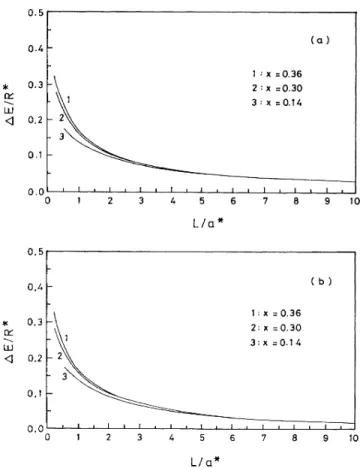
We have calculated the binding energy as a function o well thickness for different potential barrier heights
d
t
=0.
140.
30, and0.
36.
The results corresponding tox
=
~
F
0are shown in
Fi
.
4forthe on-center impurity and in ig. 5 for the on-edge impurity. Figure 6gives the correction tions. Our results show that the polaronic shift is a so quite impor antt
for the caseof
the finite quantum we.
For
the GaAs-Ga07Alo 3As system(x
=0.
3),
which cor-res onds to the potential-well heightV0=36R
*,
the po-respon s olaronic shift ranges from about 13%%uo forsmal1weell size to
8/ f
the bulk limit.It
is interesting to note fromFi
. 6 that the polaron effect becomes bigger as e p-tentialig. barrier gets higher. This isbecauset
'ga
~ ~ ~
he hi her the barrier' the larger the bindinge energy, the localization
of
the electron becomes more pronounce~ an us creases the importancee 'of
the electron-phonon interac-tion. As we have pointed out before, this impor an behavior has only been briefly speculated upon inprevi-LLI 0,2— :x =0.36 :x =0.30 :x=0.14 0.1 1 s I r I i I i I s 1 l I i I s I 6 7 8 9 10 0 1 2 0.5, Q4— 0.3— Ii) &j 0.2— 0.36 0.30 0.14 0 1— 0.0 0 I I i I I I ss I i l i I s l 1 3 4 5 6 7 8 9 0
L/a"
FIG.
6. The shifts ofbinding energy due to the electron-phonon interactions for (a)on-center and b) on-ed e impurities- g in the finite quantum well, with different Vo corresponding to x=0.
36(curve 1),0.30(curve 2), and 0.14 (curve 3).POLARON EFFECTON THEBINDING ENERGY OF
A.
. .
11971ous works, '
'
but no calculation was given since they only considered the caseof
the infinite quantum well. Our work is an explicit calculation and presents the re-sults for different potential barrier heights.For
example, for the on-center impurity withI. =a*,
the percentageof
polaronic correction is
10%
for the barrier height Vo(x=0.
36),
and decreases to about7%
for Vo(x=0.
14).
It
is clear to see that, in general, for a lower quantum-well height where the binding energy is smaller, the polaron effect becomes weaker.It
is also worth noting that the tendencyof
decreasing polaron effect as the barrier is lowered is quite fast for smaller well thicknesses. As the well width becomes larger, the polaronic correction is almost the same for different bar-rier heights, and approaches the limiting bulk value.IV. CONCLUSION
We have studied the polaron effect on the hydrogenic impurity in the GaAs-Ga& Al As quantum-well sys-tem.
It
is found that the shiftsof
binding energy due to electron-phonon couplings are quite important for both the on-center and on-edge impurities. The polaronic correction can be as large as 23%%uo for the small wellthickness. In this work both the interactions
of
the elec-tron with the confined bulk phonon and interface phonon are taken into account. Therefore, our result seems tobe more reliable than thoseof
previous calculations where the phonon confinement effect and the interface phonon mode are neglected. The competition between the inter-face and confined bulk phonons is also investigated. Our results show that the dominant contribution comes from the interface mode in the caseof
thin layers, and the bulk phonon is more important as the well thickness becomes larger than10a*.
We have extended the work for the caseof
the finite quantum well with different potential barrier heights.It
is found that the higher the quantum-well barrier where the binding energy is larger, the larger the polaronic correction due tothe increasing importanceof
the electron-phonon interaction. We also find that the polaron effect decreases very quickly as the barrier height is lowered, for asmall well width and approaches the lim-iting bulk result forthe large well size.ACKNOWLEDGMENT
The work was supported by the National Science Council
of
Taiwan.~G. Bastard, Phys. Rev.B24,4714(1981).
~C. Mailhiot, Y. C.Chang, and
T.
C.McGill, Phys. Rev. B26, 4449(1982).R.
L.Greene andK. K.
Bajaj, Solid State Commun. 45, 825 (1983).4W.M.Liu and
J. J.
Quinn, Phys. Rev.B 31,2348 (198S). 5S. Chaudhuri, Phys. Rev.B28,4480(1983).P.Lane and
R.
L.Greene, Phys. Rev.B33,5871(1986). 7W. C.Chou, W.J.
Huang, P. Y.Chu, C. S.Han, and D. S.Chu, Physica B150,361(1988).
~D.A.
B.
Miller,D.
S.Chemla,T.
C.Damen, A. C.Gossard, W. Wiegmann,T.
H. Wood, and C. A. Burrus, Phys. Rev. Lett. 53, 2173 (1984);Phys. Rev.B32,1043(1985).J.
A. Brum, C.Priester, andG.
Allan, Phys. Rev. B32,2378 (1985).C.S.Han and
Y.
C.Hsieh, Physica B179,355(1992). H.Frohlich, Proc.R.
Soc.London 215, 291 (1952).A. Ercelebi and M. Tomak, Solid State Commun. 54, 883 (1985).
~3M.H.Degani and O.Hipolito, Phys. Rev.B33, 4090 (1986).
~4B.A.Mason and S.Das Sarma, Phys. Rev.B33, 8379 (1986).
~~A.Lassnig, Phys. Rev.B30, 7132 (1984).
F.
A.Riddoch andB.
K.
Ridley, Physica 134,342(1985). A.K.
Sood,J.
Menendez, M.Cardona, andK.
Ploog, Phys.Rev.Lett. 54,2111 (1985).
N.Sawaki,
J.
Phys. C19,4965(1986).B. K.
Ridley, Phys. Rev.B39,5282(1989).S.Rudin and
T.
L.Reinecke, Phys. Rev.B 41,7713 (1990). N. Mori andT.
Ando, Phys. Rev.B40,6175 (1989).M.H. Degani and O.Hipolito, Phys. Rev.B35, 7717 (1987); Surf. Sci. 196, 459 (1988).
M. H. Degani and G. A. Fanas, Phys. Rev. B 42, 11701 (1990).
P. Lambin,
J.
P. Vigneron, A. A. Lucas, P. A. Thiry, M. Liehr,J.
J.
Pireaux,R.
Candano, andT.
J.
Kuech, Phys. Rev. Lett.56, 1842(1986).M.H.Meynadier,
E.
Finkman, M.D.
Sturge,J.
M. Worlock, and M.C.Tamargo, Phys. Rev.B35, 2517 (1987).D.
Gammon,R.
Merlin, and H. Morkoc, Phys. Rev. B35, 2552(1987).S.
F.
Ren, H. Chu, andY.
C.Chang, Phys. Rev. B37, 8899 (1988).T.
D.Lee,F. E.
Low, and D.Pines, Phys. Rev. 90,297(1953).R.
C.Miller, D.A.Kleinman, and A. C.Gossard, Phys. Rev.B29,7085(1984).
W. Wang,
E. E.
Mendez, andF.
Stern, Appl. Phys. Lett. 45, 639 (1984).H.C.Casey, Jr.,