Mei-Chun Tseng Yet-Ran Chen Guor-Rong Her
Department of Chemistry, National Taiwan University, Taipei, Taiwan, R.O.C
A beveled tip sheath liquid interface for capillary
electrophoresis-electrospray ionization-mass
spectrometry
A simple and durable sheath liquid interface for capillary zone electrophoresis-electro-spray ionization-mass spectrometry (CZE-ESI-MS) has been developed. This interface utilized a beveled tip emitter and was found to be more sensitive than the conventional sheath liquid interface. The use of a beveled tip reduces the optimal flow rate and therefore decreases sample dilution. The interface utilized a 380 mm inner diameter and 400 mm outer diameter beveled tapered tip. Because of the large inner diameter and outer diameter of the tip, the interface is robust and can be easily implemented. The performance of this interface for CZE-ESI-MS and micelle electrokinetic capillary electrophoresis-electrospray-mass spectrometry, as demonstrated by the analysis of synthetic drugs and triazine mixtures, was significantly better than results obtained using a conventional sheath liquid interface.
Keywords: Capillary zone electrophoresis / Low-flow interface / Mass spectrometry / Micellar electrokinetic chromatography DOI 10.1002/elps.200305907
1 Introduction
The combination of liquid-based separation systems and mass spectrometry (MS) has great potential, because it combines efficient separation with selective mass identi-fication [1]. Due to its ability to provide fast, highly efficient separations using extremely small sample quantities, the coupling of electrospray ionization mass-spectrometry (ESI-MS) with capillary electrophoresis (CE) represents one of the most powerful on-line combinations involving chromatography and MS detection. While several inter-facing methods have been reported for CE-ESI-MS, two interface types, sheath liquid and sheathless, have gained general acceptance [2, 3]. The sheath liquid is the most widely used interface because of its relative ease of im-plementation and versatility [4]. The interface is config-ured with a fused-silica separation capillary inside a co-axial liquid sheath tube or needle, which often resides within a second coaxial tube supplying sheath gas. The sheath liquid provides electrical contact with the outlet end of the separation capillary [5]. More importantly, the mixing of the running buffer with the sheath liquid before electrospray allows CE-ESI-MS operation using a wide range of buffer conditions [6]. The major disadvantage of using a sheath liquid is the reduction in sensitivity due to dilution of the sample as it elutes from the capillary. It is
a well-known phenomenon that the optimal flow rate in ESI depends on the ID of the emitter [7, 8]. Above the opti-mal flow rate, the ESI emitter behaves as a concentration-sensitive detector. The ID of the conventional sheath liquid emitter is about 400 mm and the optimal flow rate is about 4–5 mL/min. This flow rate is much higher than the flow rate of the CE separation column (about 50– 300 nL/min). Thus, the analyte is diluted considerably by the sheath liquid.
In the sheathless interface, several approaches have been proposed to maintain the electrical continuity of the electrophoresis circuit, including the application of a con-ductive coating, connecting to a stainless steel tip and the use of a liquid junction [8–15]. An important consequence of the sheathless design is that the sample bands are not diluted. Thus, significant gains in sensitivity (25–50-fold) have been reported [16]. However, this interface has sev-eral disadvantages, e.g., the limitation in the selection of running buffer. In sheathless operation, it is often difficult to find a buffer solution optimized for both CE separation and ESI efficiency. Furthermore, as mentioned earlier, the optimal flow rate in ESI depends on the ID of the sprayer. Therefore, to accommodate the flow rate of conventional CZE (about 50–300 nL/min), the size at one end of the CE capillary is often reduced to about 10–25 mm [8–11, 13–15]. In addition to the difficulty of emitter fabrication, the susceptibility to breaking or clogging of the tapered tip during coating or cleaning represents another problem of the sheathless interface.
Correspondence: Dr. Guor-Rong Her, Department of Chemistry,
National Taiwan University, Taipei, Taiwan, R.O.C
E-mail: [email protected] Fax: 1886-2-23638058
Considering the merits and limitations of the two inter-faces, a more ideal interface would combine the versatility of the sheath liquid design with the sensitivity of the sheathless format. Recently, we have developed a low-flow sheath liquid interface using a sprayer with an orifice of 25 mm [17]. With a 25 mm sprayer, the optimal flow rate was found to be about 400 nL/min. This flow rate is much smaller than that of conventional sheath liquid and is therefore beneficial for reducing sample dilution. More-over, the mixing of running buffer with sheath liquid be-fore spraying allows for selection of a variety of running buffers. However, because the size of the orifice (25 mm) was rather small, the interface was still prone to practical problems associated with sprayer tip breaking and block-age. Furthermore, to avoid band broadening, the separa-tion capillary had to be tapered down to ,40 mm OD to minimize the dead volume between the tip of CE capillary and the orifice of the sprayer.
In the development of a sheathless interface, we have shown that the optimal flow rate of a 75 mm ID beveled tip is similar to that of a 25 mm ID flat tip [8]. While main-taining similar sensitivity (similar optimal flow rate), the beveled tip interface is more rugged than the flat tip be-cause of the larger OD and ID. As part of a continuous effort to improve the interface between CE and MS, the concept of beveled tip is adopted in the design of a robust and highly sensitive sheath liquid interface. The interface utilized a 380 mm ID beveled tip instead of the 400 mm ID flat tip used in a commercial sheath liquid interface. This interface is expected to provide better sensitivity than a conventional sheath liquid interface because the optimal flow rate of a 380 mm beveled tip would be significantly smaller than that of a 400 mm flat tip. The tip is also less likely to be clogged because of its larger orifice. The potential and limitations of this interface for coupling CZE and MEKC to ESI-MS are addressed.
2 Materials and methods
2.1 ReagentsTriazine standards were obtained from Supelco (Belle-fonte, PA, USA). Ketoprofen, mefenamic acid, niflumic acid, oxyphenbutazone, phenylbutazone, sulindac, and sodium dodecyl sulfate (SDS) were obtained from Sigma (St. Louis, MO, USA). Ammonium acetate, methanol, acetic acid, and formic acid of HPLC grade were pur-chased from J. T. Baker (Phillipsburg, NJ, USA) and used without further purification. Ammonium hydroxide was obtained from Janssen (Belgium). Deionized water (Milli-Q water system; Millipore, Bedford, MA, USA) was used in the preparation of the samples and buffer solution.
2.2 Fabrication of the beveled tip sheath liquid CE-ESI-MS interface
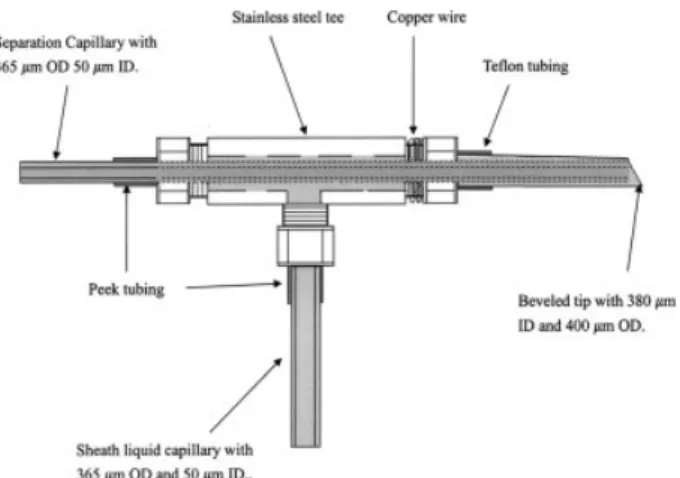
Figure 1 is a schematic illustration of the low-flow inter-face. The beveled tapered tip was fabricated using a 530 mm ID and 690 mm OD capillary (Restek, USA). The capillary was drawn manually using a vertically suspend-ed section of capillary to which a small weight (45 g) had been attached. The capillary was slowly heated to the melting stage using a butane/oxygen microtorch (Pro-Iroda Industries, Taiwan) and then quickly withdrawn. A tip of 400 mm OD and 380 mm ID was obtained by removing the end of the tip using a ceramic cutter aided by visual inspection with a microscope. The tip was then wrapped with cellophane adhesive tape and then ground with a rasp to about 457. After grinding, the tape was removed from the tip before connecting the tip to a stain-less steel tee. The beveled tapered tip was sealed within a 1/16 inch stainless steel tee (Valco, Houston, TX, USA) using a Teflon tubing (0.030 inch ID, 1/16 inch OD; Alltech, Deerfield, IL, USA) and a stainless steel ferrule. Two unmod-ified 50 mm ID and 365 mm OD fused-silica capillaries (Polymicro Technologies, Phoenix, AZ, USA) were insert-ed into the stainless steel tee using a small piece of PEEK tubing (0.020 inch ID, 1/16 inch OD; Upchurch Scientific, Oak Harbor, WA, USA) and a stainless steel ferrule. One was used as the separation column and the other was used to deliver a sheath liquid. The separation capillary was passed through the stainless tee and inserted to the very end of the sprayer. Before use, the separation capil-lary was conditioned with 1M NaOH, followed by 0.1M
NaOH, and deionizied water. In this interface, running buf-fer was driven by electroosmotic flow (EOF) within the capillary, whereas the flow rate of sheath liquid was con-trolled by a syringe pump (Cole-Parmer, Vernon Hill, IL, USA). Electrical contact was achieved by winding a cop-per wire around the tee.
Figure 1. Schematic representation of the beveled tip interface.
CE
and
2.3 Commercial sheath liquid CE-ESI-MS interface
The CE-MS interface equipped with the LCQ ion-trap mass spectrometer (Finnigan MAT, San Jose, CA, USA) was used for all the comparison experiments. The inter-face utilizes a triaxial flow arrangement whereby CE elu-ent is mixed with a suitable sheath liquid at the tip and nebulized by nitrogen gas. The sheath liquid was deliv-ered at a flow rate of 5 mL /min by a syringe pump and the nebulization gas flow rate was set to 20 (an arbitrary unit). The dimension of the sprayer was 400 mm ID and 700 mm OD.
2.4 CZE
The CZE instrument was configured in-house. Briefly, the setup consisted of a 1000 R high-voltage power supply (Spellman, Plainview, NY, USA) connected to a platinum electrode in a vial containing CE buffer and operated at constant-voltage mode. One end of separation capillary was inserted into the CE buffer, and the other end was connected to the CE-ESI-MS interface. CE separations were achieved by applying 120 kV to the injection end of the capillary. The EOF was measured by injection of acetonitrile using UV as the detector. The EOF was deter-mined to be ,230 nL/min for CZE and ,200 nL/min for MEKC.
2.5 ESI-MS
All MS experiments were conducted on a LCQ ion-trap mass spectrometer (Finnigan MAT), and the CE-ESI-MS electropherograms were acquired in selected ion moni-toring (SIM) mode. A commercial x-y-z translation stage for LCQ API source (Protana, Odense, Denmark) was used for mounting the beveled tip sheath liquid CE-ESI-MS interface. The position of the interface could be ad-justed via the micrometer screws of the translation stage. The heated capillary was kept at a temperature of 2007C. The ESI potential for commercial CE/MS interface was 14.5 kV and the potential for beveled tip interface was 12.5 kV.
2.6 CZE-ESI-MS analysis of medicines
The CZE running buffer consisted of 40 mM ammonium
acetate in water at pH 9. The pH of the solution was adjusted to 9.0 with ammonia. The solution of a synthetic drug mixture (25 ppm) was hydrodynamically injected to the capillary using a 10 mbar pressure differential for a duration of 10 s. The separation capillary was 90 cm in
total length. The coaxial sheath liquid solution consisted of methanol, water and formic acid (70:30:0.2 v/v/v) and was delivered to the tee at a flow rate of 800 nL/min by a syringe pump. The mass spectrometer was operated in positive ion mode, and data were collected in SIM mode.
2.7 MEKC-ESI-MS analysis of triazines
The MEKC running buffers consisted of 20 mM
ammo-nium acetate and 25 mMSDS in water at pH 7. The pH
of the solution was adjusted to 7.0 with ammonia. The solution of triazine mixture (20 ppm) was hydrodynami-cally injected to the capillary using a 10 mbar pressure differential for a duration of 10 s. The separation capillary was 70 cm in total length. The coaxial sheath liquid solu-tion consisted of methanol, water and acetic acid (70:30:1 v/v/v) and was delivered to the tee at a flow rate of 800 nL/ min by a syringe pump. The mass spectrometer was operated in positive ion mode, and data were collected in SIM mode.
3 Results and discussion
3.1 Beveled tip sheath liquid CE/MS interface To achieve better sensitivity (less sample dilution) than the conventional sheath liquid interface, the optimal flow rate of the emitter must be reduced. The most common means to reduce the optimal flow rate is to reduce the size of the ESI emitter by tapering the end of the column. However, if the orifice is too small, the tip is prone to breaking or clogging during cleaning or hydrodynamic injection. An ideal interface would be one with a low optimal flow rate but without the problem of tip breakage or clogging. To reduce the optimal flow rate, a tip with a beveled edge is proposed because it has been shown that the optimal flow rate of a beveled tip is smaller than that of a flat tip [8]. Furthermore, to make the interface robust and easy to implement, the ID of the interface should be large enough so that no special treatment or preparation of the separation capillary is required. Based on these criteria and to accommodate the popular 365 mm OD separation column, a tip with 380 mm ID (the OD of the tip would be slightly larger than 380 mm) and with beveled edge is proposed to make a sensitive and robust CE-MS interface.
The optimal flow rates of a 400 mm flat tip and a 380 mm beveled tip emitter were studied by continuous infusion of 1 ppm reserpine solution using a syringe pump. The plot of ion intensity versus flow rate is shown in Fig. 2. For the 400 mm flat tip from a commercial sheath liquid interface, the MS detector was flow-sensitive at a flow rate below
Figure 2. Ion intensity versus flow rate (1 ppm reserpine in 80% methanol with 0.1% acetic acid) using (a) a 400 mm flat tip, (b) 380 mm beveled tip.
4000 nL/min (Fig. 2a). The signal exhibited a plateau at a flow rate over 4000 nL/min, thus achieving a concentra-tion-sensitive response. This optimal flow rate was much higher than the flow rate of CE (about 50–300 nL/min). Consequently, to operate the emitter at the optimal flow rate, a sheath liquid flow rate of 5 mL/min is often used. As can be expected, the sensitivity is degraded because the analyte is diluted considerably by the sheath liquid. For a 380 mm ID beveled tip, the plateau region was ob-served at a flow rate . 800 nL/min (Fig. 2b). Therefore, to operate the emitter at the optimal flow rate, in addition to the flow of the separation column (about 200 nL/min), a sheath flow of 600 nL/min is adequate to achieve the 800 nL/min optimal flow rate. The 600 nL/min sheath liquid flow is about three times the EOF of a 50 mm ID cap-illary (about 200 nL/min), and as can be expected, sample dilution is significantly reduced in comparison with that of a 400 mm flat tip.
3.2 Performance of the interface in CZE-ESI-MS To evaluate the performance of the interface in the cou-pling of CZE with ESI-MS, a 25 ppm synthetic mixture was hydrodynamically injected into the capillary using a
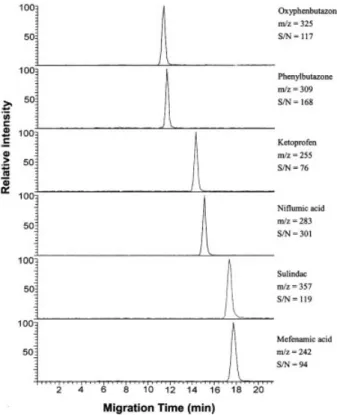
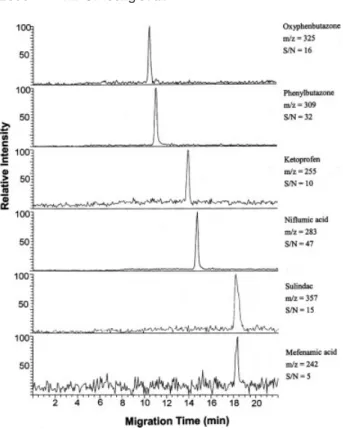
10 mbar pressure differential for 10 s. The mass electro-pherograms obtained with the beveled tip sheath liquid interface are shown in Fig. 3. All compounds were re-solved and detected in , 20 min. For comparison, the same solution was also analyzed using a commercial sheath liquid interface (Fig. 4). A comparison of Figs. 3 and 4 indicates that the beveled interface exhibited sig-nificantly higher S/N ratios than the conventional sheath liquid interface. The bandwidth of the peaks from this interface is similar to that obtained from a conventional sheath liquid interface. The interface was found to func-tion properly up to 36 h (the longest time tested).
Figure 3. Mass electropherograms of a 25 ppm synthetic drug mixture using the beveled tip interface in positive ion mode. The sheath liquid (70% methanol with 0.2% formic acid) was delivered at a flow rate of 800 nL/min. The potential applied to the buffer reservoir was 122.5 kV, and the ESI voltage was set at 12.5 kV.
3.3 Performance of the interface in MEKC-ESI-MS
MEKC is known for its excellent resolving power in the separation of charged as well as neutral compounds [18]. Although direct coupling of MEKC with ESI-MS has been reported [19, 20], it is generally considered difficult because nonvolatile surfactants, such as SDS, are known to reduce ionization efficiency and lead to ion source con-tamination [21]. A number of approaches to overcome
Figure 4. Mass electropherograms of a 25 ppm synthetic drug mixture using the commercial sheath liquid CE-ESI-MS interface in positive ion mode. The sheath liquid (70% methanol with 0.2% formic acid) was delivered by a syringe pump at a flow rate of 5000 nL/min. The poten-tial applied to the buffer reservoir was 1 24.5 kV, and the ESI voltage was set at 1 4.5 kV.
this problem have been reported [17, 22–26]. Unfortu-nately, none of the approaches are practical. Smaller droplets have been proposed to have better sensitivity and higher resistance to ionization suppression [27, 28]. Although the ID of the proposed beveled tip interface is similar to the conventional interface, the size of the drop-let is expected to be smaller than those from a conven-tional interface. This is because the apex of the interface is much smaller than the orifice of the beveled tip. To evaluate the performance of the interface in the cou-pling of MEKC with ESI-MS using SDS as the surfactant, a 20 ppm triazine mixture was hydrodynamically injected into the capillary using a 10 mbar pressure differential for 10 s. Figure 5 shows the mass electropherograms of triazines using the beveled tip interface. The quality of the data was found to be significantly better than that obtained using a conventional sheath liquid interface [17]. The improved sensitivity is more likely due to the low dilution factor and smaller initial droplet size. The higher surface charge density of the initial droplet results in early fissions without extensive evaporation, thereby decreasing the relative concentration of nonvolatile salts
Figure 5. Mass electropherograms of a 20 ppm triazine mixture using the beveled tip interface in positive ion mode. The sheath liquid (70% methanol with 1% acetic acid) was delivered at a flow rate of 800 nL/min. The potential applied to the buffer reservoir was 122.5 kV, and the ESI voltage was set at 12.5 kV.
[28]. Although the performance of the interface is better than that of a commercial flat tip interface, the repeat-ability of the interface in MEKC-MS is not as good as in CZE-MS operation. The precision in CZE-MS is about 6% (n = 3) and the precision in MEKC-MS is about 23% (n = 3).
4 Concluding remarks
A simple, inexpensive and durable beveled tip interface has been developed for capillary CE-ESI-MS. This inter-face utilizes a 380 mm ID beveled tip to reduce the re-quired sheath flow rate and thus decreases sample dilu-tion. In addition, this interface was also found to be more tolerant to the presence of nonvolatile surfactant SDS and therefore more suitable for direct MEKC-ESI-MS analysis. The performance of the interface is better than the con-ventional sheath liquid interface but not quite as good as the 25 mm low-flow interface [17]. There are two possible
reasons for the relatively poor performance in comparison with the 25 mm interface. First, the optimal flow rate of the beveled tip interface is higher than that of the 25 mm low-flow interface. Second, the size of the droplet from the interface is very likely larger than those from a 25 mm flat tip. Despite the fact that the sensitivity of this interface is inferior to the 25 mm low-flow interface, this interface is superior to the 25 mm interface in terms of ease of imple-mentation, operation, and robustness.
This work was supported by the National Research Coun-cil of the Republic of China.
Received December 8, 2003
5 References
[1] Beale, S. C., Anal. Chem. 1998, 70, 279R–300R. [2] Henion, J. D., Anal. Chem. 1997, 69, 2901–2907.
[3] Von Brocke, A., Nicholson, G., Bayer, E., Electrophoresis 2001, 22, 1251–1266.
[4] Pleasance, S., Thibault, P., Kelly, J., J. Chromatogr. 1992,
591, 325–339.
[5] Smith, R. D., Barinaga, C. J., Udseth, H. R., Anal. Chem. 1988, 60, 1948–1952.
[6] Chu, Y. H., Dunayevskiy, Y. M., Kirby, D. P., Vouros, P., Karger, B. L., J. Am. Chem. Soc. Mass Spectrom. 1996, 118, 7827– 7835.
[7] Tetler, L. W., Cooper, P. A., Powell, B., J. Chromatogr. A 1995,
700, 21–26.
[8] Chang, Y. Z., Chen, Y. R., Her, G. R., Anal. Chem. 2001, 73, 5083–5087.
[9] Chang, Y. Z., Her, G. R., Anal. Chem. 2000, 2, 626–630.
[10] Chen, Y. R., Her, G. R., Rapid Commun. Mass Spectrom. 2003, 17, 437–441.
[11] Wetterhall, M., Nilsson, S., Markides, K. E., Bergquist, J.,
Anal. Chem. 2002, 74, 239–245.
[12] Moini, M. A., nal. Chem. 2001, 73, 3497–3501.
[13] Petersson, M. A., Hulthe, G., Fogelqvist, E., J. Chromatogr.
A 1999, 854, 141–154.
[14] Barroso, M. B., de Jong, A. P., J. Am. Soc. Mass Spectrom. 1999, 10, 1271–1278.
[15] Janini, G. M., Conrads, T. P., Wilkens, K. L., Issaq, H. J., Veenstra, T. D., Anal. Chem. 2003, 75, 1615–1619.
[16] Wahl, J. H., Goodlett, D. R., Udseth, H. R., Smith, R. D.,
Electrophoresis 1993, 14, 448–457.
[17] Chen, Y. R., Tseng, M. C., Chang, Y. Z., Her, G. R., Anal.
Chem. 2003, 75, 503–508.
[18] Terabe, S., Otsuka, K., Ichikawa, K., Tsuchikya, A., Ando, T.,
Anal. Chem. 1984, 56, 111–113.
[19] Tanaka, Y., Kishimoto, Y., Otsuka, K., Terabe, S., J.
Chroma-togr. A 1998, 817, 49–57.
[20] Cheng, H. L., Tseng, M. C., Tsai, P. L., Her, G. R., Rapid
Com-mun. Mass Spectrom. 2001, 15, 1473–1480.
[21] Rundlett, K. L., Armstrong, D. W., Anal. Chem. 1996, 68, 3493–3497.
[22] Takada, Y., Sakairi, M., Koizumi, H., Rapid Commun. Mass
Spectrom. 1995, 9, 488–490.
[23] Lamoree, M. H., Tjaden, U. R., van der Greef, J. Chromatogr.
A 1995, 712, 219–225.
[24] Ozaki, H., Itou, N., Terabe, S., Takada, Y., Sakairi, M., Koi-zumi, H., J. Chromatogr. A 1995, 716, 69–79.
[25] Nelson, W. M., Tang, Q., Harrata, A. K., Lee, C. S., J.
Chro-matogr. A 1996, 749, 219–226.
[26] Yang, L., Harrata, A. K., Lee, C. S., Anal. Chem. 1997, 69, 1820–1826.
[27] Wilm, M., Mann, M., Anal. Chem. 1996, 68, 1–8.
[28] Juraschek, R., Dulcks, T., Karas, M., J. Am. Soc. Mass