Effects of phase transformation on the microstructures and magnetostriction
of Fe-Ga and Fe-Ga-Zn ferromagnetic shape memory alloys
Yin-Chih Lina)
Department of Mold and Die Engineering, National Kaohsiung University of Applied Sciences, Kaohsiung, 807 Taiwan
The Fe–Ga (Galfenol) FSM alloy systems have received much attention because they exhibit both magnetic field induced strain and the magnetic shape memory effect. In addition, Fe–Ga alloys have high saturation magnetostriction in low applied magnetic fields, so the alloys have a potential application in magnetostrictive actuators and sensors. For bulk polycrystalline multiphase Fe–Ga alloys, A2, D03 and L12 structures have been reported to coexist in rapidly quenched alloys1as well as in mechanically alloyed systems.2In the case of arc-melted alloys, a mixture of only two phases (A2 and D03-type) has been observed.3-5 From the above review, it is clear that the degree of ordering is likely to be very sensitive to the details of alloy production.6,7 In this work, TEM study confirms that in Fe73Ga27 FSM alloy solution-treated at 1100 ℃ for 4 h and quenched in ice brine (as-quenched), APBs of the D03 domain were present in the A2 matrix. When the Fe73Ga27FSM alloy was as-quenched and aged at 700 ℃ for 24 h (as-quenched and aged), the D03nanoclusters underwent phase transformation to an intermediate tetragonal phase (L10 -like martensite) via Bain distortion, and finally L12structures precipitated, as demonstrated by TEM and XRD analyses. The L10-like martensite and L12structures in the aged Fe73Ga27 FSM alloy drastically decreased the magnetostriction from positive to negative, as also confirmed by experimental magnetostriction measurements.
The essential TEM images of the as-quenched Fe73Ga27 FSM alloy are shown in Figs. 1(a)-1(f). Shown in Fig. 1(a) is the selected area diffraction (SAD) pattern of zone axis [113]A2(hkl denotes the A2 structure with a lattice parameter of a = 2.931 Å). In this SAD, some faint satellites around the {110}A2 reflection can be seen. This suggests that micromodulated structures existed in the alloy.8 The Fe-rich and Ga-rich micromodulated structures originate from spinodal decomposition of the Fe and Ga compositions, which
a)Author to whom correspondence should be addressed. Electronic mail:
[email protected]. TEL:+886-73814526. FAX:+886-73835015.
FIG. 1. TEM images of the as-quenched Fe73Ga27(at.%) FSM alloy: (a) SAD
of zone axis [113]A2, (b) DF image of g = [110]A2, (c) BF image, (d) HRTEM
image showing d spacing of the (110)A2and (110)D03, (e) BF image taken from
another area of the same sample, showing APBs and needle-like precipitates, and (f) nano beam diffraction (NBD) demonstrating that the needle-like precipitates have an L12crystal structure.
is closely related to the difference in the atomic size of Fe and Ga.8The dark field (DF) micrograph of Fig. 1(b) was obtained with the diffraction vector g = [110]A2 corresponding to Fig. 1(a). In this DF image, the bright contrast is the disordered A2 structure. The smoothly curved antiphase boundary segment (APBs) of the D03 domains, indicated by an arrow, appears very sharp. It seems the antiphase domain structure of the D03 phase appears first, after which the ordered D03 structure develops along the APBs.9 Figure 1(c) is a bright field (BF) image revealing the APBs of D03and A2 structures. Shown in Fig. 1(d) is a high resolution TEM (HRTEM) image with the corresponding fast Fourier transformation (FFT) pattern. Careful measurement of the lattice space revealed that the d spacing of the D03 structure was 0.295 nm, and that of the disordered A2 matrix was 0.207 nm; therefore, the plane (Fig. 1(d)) can be reasonably inferred to be (110)D03 and (110)A2. Figure 1(e) is a BF image taken from another area of the same sample, showing APBs and needle-like precipitates. In order to The phase transformation and magnetostriction of bulk Fe73Ga27and Fe73Ga18Zn9(at.%) ferromagnetic shape memory alloys (FSMAs) were investigated by transmission electron microscopy (TEM), x-ray diffraction (XRD), and a magnetostrictive-meter setup. For the Fe73Ga27FSM alloy solution treated (ST) at 1100 ℃ for 4 h and quenched in ice brine, the antiphase boundary segments (APBs) of the D03domain were observed in the A2 (disordered) matrix, and the Fe73Ga27FSM alloy had an optimal magnetostriction (λ║s= 7110−6;λs= −31×10−6). In Fe73Ga27FSM alloy as-quenched, aged at 700 ℃ for 24 h, and furnace cooled, D03nanoclusters underwent phase transformation to an intermediate tetragonal phase (i.e., L10-like martensite) via Bain distortion, and finally L12(Fe3Ga) structures precipitated, as observed by TEM and XRD. The L10-like martensite and L12 phases in the aged Fe73Ga27 FSM alloy drastically decreased the magnetostriction from positive to negative (λ║s= −20×10−6;λ
s= −8×10⁻⁶). However, in Fe73Ga18Zn9FSM alloy as-quenched and aged, the phase transformation of D03to an intermediate tetragonal martensite phase and precipitation of L12structures were not found. The results indicate that the aged Fe73Ga18Zn9 FSM alloy maintained stable magnetostriction (λ║s= 3610−6; λs= −31×10−6). Adding Zn can improve the ferromagnetic shape memory effect (FSME) of aged Fe73Ga18Zn9alloy, which may be useful in application of the alloy in high temperature environments. © 2014 American Institute of Physics.
identify the crystal structure of the needle-like precipitates, a higher magnification image with nano beam diffraction (NBD) was taken from the needle-like precipitates and is shown in Fig. 1(f). Careful analysis of the NBD reveals that the needle-like precipitate is an L12 structure, which has a zone axis of [011]L12, as revealed in Fig. 1(f). The result is consistent with the above-mentioned report that A2, D03 and L12structures coexist in rapidly quenched alloys.1,2
Figures 2(a)-2(f) are a series of TEM images taken from the Fe73Ga27 alloy as-quenched and aged at 700 ℃ for 24 h. Shown in Fig. 2(a) is the BF image; the tetragonal L10-like martensite and L12structures are indicated by arrows. Figure 2(b) is an SAD taken from the area of Fig. 2(a) marked with circle A, revealing zone axes of [0 11]M (hkl denotes tetragonal L10-like martensite, which has lattice parameters of a = 4.542 Å, c = 4.178 Å, and c/a = 0.9198). A superlattice spot can be seen in Fig. 2(b). This suggests that the L10-like martensite is an ordered structure. Shown in Fig. 2(c) is a DF image of (2 0 0)Mreflection, corresponding to Fig. 2(b). The bright contrast is L10-like martensite, in which can be observed microtwin plates with Bain distortion. This tetragonal L10-like martensite (M) with a twinned structure has never before been observed in the various Fe-Ga alloy systems. In the circle A area of the same sample, carefully tilted, an SAD containing two phases (A2+M) is shown in Fig. 2(d), revealing zone axes of [1 0 0]M//[111]A2. Bain distortion forms the product lattice from the parent lattice, but in general does not yield an undistorted plane, which can be associated with the habit plane of the deformation. Bain suggested that any simple homogeneous pure distortion, which converts one lattice into another by expansion or contraction along the crystallographic axes, belongs to a class known as Bain distortion.10Shown in Fig. 2(e) is an SAD taken from the area of Fig. 2(a) marked with circle B, revealing zone axes of [013]L12(hkl denotes L12structure with a lattice parameter of
aL12 = 3.681 Å). Figure 2(f) is a DF image of the (2 0 0)L12 reflection corresponding to Fig. 2(e). The bright contrast is L12 structures. A comparison of the DF micrographs in Fig. 2(c)
FIG. 2. TEM images of the as-quenched Fe73Ga27FSM alloy aged at 700 ℃
for 24 h: (a) BF image showing tetragonal L10-like martensite and L12(Fe3Ga)
structures, (b) SAD of zone axis [0 11 ]Mtetragonal L10-like martensite, (c)
DF image of g = [200]M, revealing twinned structure, (d) SAD of zone axis
[100]M//[111]A2(hkl denotes tetragonal L10-like martensite; hkl denotes A2
structure), (e) SAD of zone axis [01 3]L12, (f) DF image of g = [200]L12.
and Fig. 2(f) reveals distinct differences in the microstructures of L10-like martensite and L12 structures; the L10-like martensite and L12 phases drastically decrease the magnetostriction of the aged Fe73Ga27FSM alloy, as shown in Fig. 7(c). From Figs. 2(a)-2(f), a series of TEM image investigations, it is confirmed that in the aged Fe73Ga27alloy, the D03 nanoclusters undergo phase transformation into an intermediate tetragonal phase (L10-like martensite + A2) via Bain distortion, and finally L12structures precipitate.
Figures 3(a)-(f) are TEM images taken from alloy doped with Zn, Fe73Ga18Zn9 FSM alloy, as-quenched in ice brine. Shown in Fig. 3(a) is an SAD with zone axis [6 11]D03//[013]A2 (hkl denotes D03 reflection with a lattice parameter of a = 4.123 Å; hkl denotes A2 phase with a lattice parameter of a = 2.906 Å). In this SAD, a faint superlattice spot can be seen. This suggests an ordered structure in the alloy. In this study, it is found that when Zn is added to the Fe73Ga27alloy system to produce Fe73Ga18Zn9, all SAD can be identified as A2 and D03structures. The reason is unclear. The DF image of Fig. 3(b) was obtained with the diffraction vector g = [0 31]A2corresponding to Fig. 3(a). In this DF image, the bright contrast is the disordered A2 structure. Figure 3(c) is a DF image of the (15 1)D03 reflection, corresponding to Fig. 3(a); the bright contrast is ordered D03structures. Figure 3 (d) is a BF image. Shown in Fig. 3(e) is a nano beam diffraction (NBD) pattern of zone axis [4 11]D03//[012]A2, in which a superlattice spot is very sharp, consistently confirming the ordered structure in the sample. An HRTEM image with a corresponding FFT pattern taken from Fig. 3(d) is shown in Fig. 3(f). The lattice d spacing with 0.206 nm and 0.291 nm are clearly revealed by measuring the HRTEM image, indicating the (200)D03and (100)A2, respectively.
FIG. 3. TEM micrographs of the as-quenched Fe73Ga18Zn9 FSM alloy: (a)
SAD showing zone axis [6 11]D03//[013]A2, (b) DF image of g = [0 31]A2, (c)
DF image of g = [15 1]D03, (d) BF image, (e) NBD of zone axis [4
11]D03//[012]A2, and (f) HRTEM image showing d spacing of the (200)D03and
(100)A2.
Shown in Figs. 4(a)-4(f) are a series of TEM images taken from the as-quenched Fe73Ga18Zn9FSM alloy aged at 700 ℃ for 24 h. Figure 4(a) is the SAD of zone axis [100]D03//[100]A2 (hkl denotes D03reflection; hkl denotes A2 phase). Figure 4(b) is a DF image using (011)A2 or (002)D03 reflection corresponding to Fig. 4(a). In this DF image, the bright contrast is the ordered D03structure+A2 phase. The DF image
FIG. 4. TEM micrographs of the as-quenched Fe73Ga18Zn9FSM alloy aged at
700 ℃ for 24 h: (a) SAD showing zone axis [100]D03//[100]A2(hkl denotes D03
reflection; hkl denotes A2 structure), (b) DF image of g = [011]A2or g =
[002]D03, (c) DF image of g = [0 11]A2or g = [020]D03, (d) BF image, (e) NBD
of zone axis [101]D03//[31 3]A2, and (f) HRTEM image showing d spacing of
the (200)D03; (110)D03, and (100)A2.
of Fig. 4(c) was obtained with the diffraction vector g = [0 11]A2or g = [0 2 0]D03corresponding to Fig. 4(a). In the DF image, the bright contrast is also the ordered D03 phase+A2 structure. Figure 4 (d) is a BF image. In this BF image, many micro-modulated structures can be seen. It is inferred that these micro-modulated structures come from two phases (A2+D03), which are closely related to the difference in the two lattice parameters in the matrix. Shown in Fig. 4(e) is an NBD of the [101]D03//[31 3]A2. In this SAD, a faint superlattice spot can be seen, indicating that the D03phase is an ordered structure. An HRTEM image with a corresponding FFT pattern taken from Fig. 4(d) is shown in Fig. 4(f). The d spacings of the lattice images were estimated to be 0.208 nm and 0.291 nm, consistent with the planes of (200)D03, (110)D03, and (100)A2, respectively. An FFT pattern taken from this HRTEM image is also shown in Fig. 4(f), confirming the [001]D03//[001]A2.
Figures 5(a)-5(b) present x-ray diffraction (XRD) patterns of the as-quenched Fe73Ga27 alloy and the as-quenched and aged alloy. In Fig. 5(a), the reflections of the as-quenched alloy condition are comprised of disordered A2 (BCC) phase and sideband ordered D03 structures, in which the A2 phase has a lattice parameter of aA2 = 2.931 Å, and the main diffraction peak is the reflection of (110)A2 appearing at a diffraction angle of 2θ = 43.63°. D03 sidebands are also observed around the (200)A2 and (211)A2 peaks. These sidebands are related to D03precipitates, which are identified as (220)D03 and (222)D03 (the D03 has a lattice parameter of
aD03 = 4.178 Å). The A2 and D03structures existed in the Fe73Ga27alloy in the as-quenched condition, as confirmed by TEM and XRD, all of which showed consistent results. The XRD for the as-quenched and aged Fe73Ga27alloy is shown in Fig. 5(b). Careful analysis of the XRD pattern reveals an intermediate tetragonal phase (L10-like martensite with lattice parameters of aM= 4.542 Å; cM= 4.178 Å, and c/a = 0.9198) and precipitation of L12structures (L12-Fe3Ga with a lattice parameter of aL12= 3.681 Å). It is interesting to note that the XRD patterns have no D03peaks. This result suggests that all
FIG. 5. X-ray diffraction (XRD) patterns of Fe73Ga27 FSM alloy: (a)
as-quenched in ice brine, (b) as-as-quenched, aged at 700 ℃ for 24 h, and furnace cooled (43.63º denotes 2θ= 43.63º).
the D03 nanoclusters were transformed into an intermediate tetragonal phase (L10-like martensite) and L12structures. The same result was confirmed by TEM analysis (Fig. 2), as mentioned above.
Figures 6(a)-6(b) illustrate the XRD patterns of the as-quenched Fe73Ga18Zn9 alloy and the as-quenched and aged alloy. In Fig. 6(a), the XRD patterns of the alloy in the as-quenched condition reveal that the reflections are also comprised of disordered A2 (BCC) and sideband D03phases, in which the A2 has a lattice parameter of aA2= 2.906 Å, and the main diffraction peak is the reflection of (110)A2appearing at a diffraction angle of 2θ= 44.00°. The D03sidebands are also visible around the (200)A2and (211)A2peaks. These
FIG. 6. XRD patterns of the Fe73Ga18Zn9FSM alloy: (a) as-quenched in ice
sidebands are related to D03precipitates, which are identified as (220)D03 and (222)D03. The D03has a lattice parameter of
aD03= 4.123 Å. Figure 6(b) is the XRD of the as-quenched and aged Fe73Ga18Zn9alloy. Careful analysis of the XRD patterns reveals no L10-like martensite or L12structures. All the XRD patterns reveal only the A2 and D03structures, and there is no evidence of phase transformation in the as-quenched and aged Fe73Ga18Zn9 FSM alloy sample. A comparison of Fig. 5(b) with Fig. 6(b) demonstrates a distinct difference in the XRD patterns of the as-quenched and aged Fe73Ga27 and Fe73Ga18Zn9 alloy samples. This result demonstrates that adding Zn (9 at.%) into the Fe73Ga27alloy system to produce Fe73Ga18Zn9 can suppress the phase transformation of D03 nanoclusters to an intermediate tetragonal martensite via Bain distortion and the subsequent precipitation of L12structures.
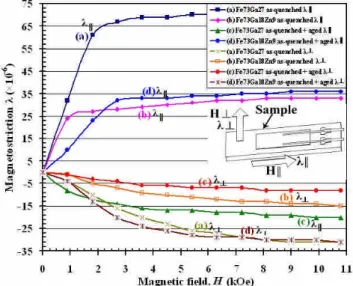
Figures 7(a)-7(d) show the magnetostrictive strains of the as-quenched Fe73Ga27 and Fe73Ga18Zn9 alloys and the as-quenched and aged alloys. In Fig. 7, λ║denotes(∆L/L)║with a magnetic field applied parallelto thesample’slongitude,and λdenotes(∆L/L)with a magnetic field applied normal to the sample’s longitude (i.e., the direction of the perpendicular field:along thesample’swidth (5mm)). Fig. 7 presents two typicalλ║and λcurves as a function of the applied magnetic field. The magnetostriction λ║sand λswith magnetostrictive susceptibility (λ║s/H) are plotted as a function of the applied field (H) at RT (300 K) for both of the alloys in the as-quenched condition, indicating the following: λ║s = 7110−6; λs= −31×10−6for the Fe73Ga27alloy, and λ║s= 3310−6,λs= −15×10−6
for the Fe73Ga18Zn9alloy. It is obvious that doping the Fe73Ga27 alloy system with Zn to produce Fe73Ga18Zn9 does not result in higher magnetostriction of the Fe73Ga18Zn9 alloy at RT. The reason is unclear. However, when both alloys are as-quenched and aged at 700 ℃ for 24 h, the magnetostrictivestrainsλ║sand λsindicate the following: λ║s = −2010−6
, λs= −8×10⁻⁶for the aged Fe73Ga27alloy, and λ║s = 3610−6, λ
s = −31×10−6 for the aged Fe73Ga18Zn9 alloy, respectively. The magnetostrictive strains of the Fe73Ga27alloy
FIG. 7. The linear magnetostriction (×10–6)atRT (300 K)in parallel(λ║) and
normal(λ) applied field (H (kOe))to sample’slongitude ofthe as-quenched and aged Fe73Ga27and Fe73Ga18Zn9FSM alloy samples.
after aging at 700 ℃ for 24 h, with drastically decreased magnetostriction and magnetostrictivesusceptibility (∆λ║s/∆H), are shown in Fig. 7(c). The TEM and XRD analyses of the aged Fe73Ga27alloy reveal the A2 phase as well as the phase transformation of D03 nanoclusters to an intermediate tetragonal phase (L10-like martensite) and L12 structures, as shown in Fig. 2 and Fig. 5(b). The L10-like martensite and L12 phases drastically decrease the magnetostriction of the aged Fe73Ga27FSM alloy from positive to negative (λ║s= −20×10−6; λs= −8×10⁻⁶), as shown in Fig. 7(c). However, after aging at 700 ℃ for 24 h, the magnetostrictive strains of the Fe73Ga18Zn9alloy improve to a higher magnetostriction (λ║s= 36×10−6; λs = −31×10−6). The reason is that after the Fe73Ga18Zn9FSM alloy is aged at 700 ℃ for 24 h, the phase transformation of D03 nanoclusters to an intermediate tetragonal martensite and precipitation of L12 structures is suppressed, as confirmed by the TEM and XRD analyses shown in Fig. 4 and Fig. 6(b).
In Fe73Ga27 FSM alloy as-quenched in ice brine, the antiphase boundary segments (APBs) of the D03domain were observed in the A2 (disordered) matrix, and the alloy had an optimal magnetostriction (λ║s = 7110−6; λs = −31×10−6). After the alloy was as-quenched and aged at 700 ℃ for 24 h, the D03 nanoclusters underwent phase transformation to an intermediate tetragonal phase (i.e., L10-like martensite) via Bain distortion, and finally L12(Fe3Ga) structures precipitated, as observed by TEM and XRD. The L10-like martensite and L12 phases drastically decreased the magnetostriction of the aged Fe73Ga27 FSM alloy from positive to negative. TEM selected area diffraction (SAD) patterns demonstrated that the orientation relationships of L10-like martensite and A2 structure were [100]M//[111]A2. This tetragonal L10-like martensite (M) has never before been observed in the various Fe-Ga alloy systems. This study also reveals that adding Zn (9 at.%) into the Fe73Ga27 alloy system to produce Fe73Ga18Zn9, can improve the magnetostriction after the alloy is as-quenched and aged at 700 ℃ for 24 h.
The author would like to express his sincere appreciation to the Ministry of Science and Technology (MOST) of Taiwan, ROC, for supporting this study (under Grant-in-Aid for MOST 103-2221-E-151-016). The author also wishes to thank Mr. Hsueh-Yen Yao of National Cheng Kung University for his help in operation the TEM.
1
R. A. Dunlap, J. D. McGraw, S. P. Farrell, J. Magn. Magn. Mater. 305, 315 (2006).
2J. M. Gaudet, T. D. Hatchard, S. P. Farrell, R. A. Dunlap, J. Magn. Magn.
Mater. 320, 821 (2008).
3J. M. Borrego, J. S. Blazquez, C. F. Conde, A. Conde, S. Roth, Intermeta. 15,
193 (2007).
4Q. Xing, Y. Du, R. J. McQueeney, and T. A. Lograsso, Acta Mater. 56, 4536
(2008).
5C. B. Nunes, R. S. Turtelli, R. Grössinger, H. Müller, and H. Sassik, J. Magn.
Magn. Mater. 322, 1605 (2010).
6Q. Xing and T. A. Lograsso, Scrip. Mater. 65, 359 (2011).
7A. Javed, T. Szumiata, N. A. Morley, and M. R. J. Gibbs, Acta Mater. 58,
4003 (2010).
8H. R. Zhang and G. H. Wu, Acta Mater. 59, 1249 (2011). 9Y. C. Lin, J. Appl. Phys. 113, 17A303 (2013).
10R. E. Reed-Hill and R. Abbaschian, Physical Metallurgy Principles.
寄件者: [email protected]
寄件日期: 2014 年 12 月 4 日 星期四 上午 3:37 收件者: [email protected]
主旨: MMM: MS #140119GQ-09R Decision Letter Dear Prof. Lin,
I am pleased to inform you that your manuscript, referenced below, has been accepted for publication in the Journal of Applied Physics and is tentatively scheduled for publication in the May 2015 issue. Your article will not be composed until after the MMM Conference in November 2014. Only presented papers will be published. Once it is verified that the paper was presented by a designated author it will sent to production for composition.
"Effects of phase transformation on the microstructures and magnetostriction of Fe-Ga and Fe-Ga-Zn ferromagnetic shape memory alloys"
When your page proofs are ready for your review, you will receive an e-mail from AIP Production Services which will inform you of the AIP Production Number assigned to your submission. Direct all questions pertaining to papers in the production process to the contact information supplied in that e-mail. Be sure to include the AIP Production Number on all correspondence. During the production process, authors may access information about their accepted manuscript by visiting the AMSIS website at:
http://www.aip.org/msinq/status.html
To support the cost of wide dissemination of research results through publication of journal pages and production of a database of articles, the author's institution is requested to pay a page charge of $60 per page (with a one-page minimum) and an article charge of $20 per article. A link to the Rightslink service for payment of applicable publication charges and ordering reprints will be provided when proofs are ready for review.
Thank you for your contribution to the Journal. If you have any questions, feel free to contact us at [email protected]. Sincerely,
MMM Conference Editorial Office AIP Publishing LLC
1305 Walt Whitman Road Suite 300 Melville, NY 11747-4300 516 576-2616 ph [email protected] >>>>>>>>>>>>>>>>>>>>>>>>>>>>>> Manuscript #140119GQ-09R: Editor's Comments: Reviewer Comments: Reviewer #1 Evaluations: RECOMMENDATION: Publish as is Sufficient Interest: Yes
Relevant Citings: Yes Good Scientific Quality: Yes Good Experimental Evidence: Yes Well Organized: N/A
Good Abstract: Yes Grammar and Spelling: Yes Good Length: Yes
Clear Figures: Yes
Useful To Other Researchers: Average TECHNICAL QUALITY : Good PRESENTATION: Average Reviewer #1 (Remarks):
The authors have satisfactorily addressed my previous comments and improved the flow of the manuscript and the presentation of the technical content. The revised version of the manuscript is acceptable for publication.
![FIG. 1. TEM images of the as-quenched Fe 73 Ga 27 (at.%) FSM alloy: (a) SAD of zone axis [113] A2 , (b) DF image of g = [110] A2 , (c) BF image, (d) HRTEM image showing d spacing of the (110) A2 and (110) D03 , (e) BF image taken from another area of the](https://thumb-ap.123doks.com/thumbv2/9libinfo/8766747.210044/1.892.473.821.473.704/images-quenched-alloy-hrtem-image-showing-spacing-image.webp)
![FIG. 2. TEM images of the as-quenched Fe 73 Ga 27 FSM alloy aged at 700 ℃ for 24 h: (a) BF image showing tetragonal L1 0 -like martensite and L1 2 (Fe 3 Ga) structures, (b) SAD of zone axis [0 11 ] M tetragonal L1 0 -like martensite, (c) DF image of g = [](https://thumb-ap.123doks.com/thumbv2/9libinfo/8766747.210044/2.892.467.823.684.917/images-quenched-showing-tetragonal-martensite-structures-tetragonal-martensite.webp)
![FIG. 4. TEM micrographs of the as-quenched Fe 73 Ga 18 Zn 9 FSM alloy aged at 700 ℃ for 24 h: (a) SAD showing zone axis [100] D03 //[100] A2 (hkl denotes D0 3](https://thumb-ap.123doks.com/thumbv2/9libinfo/8766747.210044/3.892.502.789.124.453/tem-micrographs-quenched-alloy-showing-zone-axis-denotes.webp)