Magnetic hardening mechanism study in FePt thin films
C. M. Kuo, P. C. Kuo, and H. C. Wu
Institute of Materials Science and Engineering, National Taiwan University, Taipei 107, Taiwan
Y. D. Yaoa)
Institute of Physics, Academia Sinica, Taipei 115, Taiwan
C. H. Lin
Department of Materials Science and Engineering, National Tsing Hua University, Hsinchu 300, Taiwan Fe1002xPtx alloy thin films with x525– 67 at. % were prepared by dc magnetron sputtering on
naturally oxidized Si substrates. Effects of film composition, annealing temperature~300–650 °C!, annealing time~5–120 min!, and cooling rate ~furnace cooling or ice water quench cooling! on the magnetic properties were investigated. Optimum conditions for saturation magnetization and coercivity of the Fe1002xPtxalloy films were found with x550 at.%, annealed at 600 °C for 30 min
and cooled by ice water quenching. Our experimental data suggests that the magnetic hardening in Fe1002xPtx alloy thin films is mainly due to the fct g1-FePt phase and the domain wall pinning effect. The domain nucleation mechanism is dominated in samples with furnace cooling; the domain wall pinning mechanism dominates in samples cooled with ice water quenching. © 1999 American Institute of Physics. @S0021-8979~99!60108-6#
I. INTRODUCTION
Recently, considerable attention has been focused on the magnetic properties of the FePt alloy because it has very high magnetocrystalline anisotropy energy (Ku>73107 ergs/cm3), high coercivity, good corrosion resistance, and large energy products (BH)max.1–3It is well-suited applica-tion in magnetic recording media and various micromagnetic devices. Zhang et al.2has indicated that the magnetic prop-erties of the FePt alloy strongly depend on its composition, as well as heat-treatment conditions.
II. EXPERIMENT
Fe1002xPtx(x525– 67 at. %) alloy thin films were
de-posited on a naturally-oxidized silicon wafer substrate at room temperature by dc magnetron sputtering. The substrate was rotated in order to get uniform composition. A mosaic target consisting of a high purity iron disk~99.99%! overlaid with high purity platinum pieces ~99.99%! was used. This arrangement provides a wide range of effective target com-positions and therefore a wide range of film comcom-positions. The deposition rate was about 0.3 nm/s. The base pressure in the sputtering chamber was 531027Torr, and the argon pressure was fixed at 5 mTorr. Film thickness was kept at 200 nm. For annealing studies, the as-deposited films were sealed in quartz capsules and heat-treated in a vacuum of 1 31026Torr.
Magnetic properties of the films were measured with a vibrating sample magnometer~VSM! and a superconducting quantum interference device~SQUID!. The microstructure of the films was characterized by a JOEL 100 CX transmission electron microscopy~TEM!, and the phases of the film were examined by an x-ray diffractometer with Cu Ka radiation. The average grain size of the film was measured by the TEM
bright field image. Composition and homogeneity of the films were determined by energy disperse x-ray diffracto-meter. The thicknesses of the films were measured by an a step.
III. RESULTS AND DISCUSSION
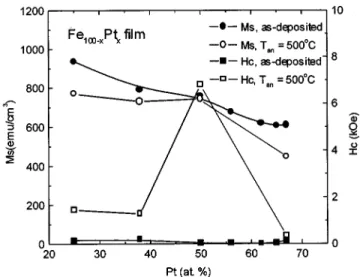
Figure 1 shows the saturation magnetization Msand the
coercivity Hc at room temperature for as-deposited and
500 °C-annealed Fe1002xPtxfilms as functions of Pt content x
between 25 and 67 at. %. A soft magneticg-FePt phase and low Hcnear 20 Oe were observed in as-deposited films. The
Msdecreases with increasing Pt content. After annealing, we
observed that only the Fe1002xPtx films with x550 showed
that Ms decreased very little and Hc increased abruptly. In
general, the decrease in Ms after annealing for samples
ex-a!Electronic mail: [email protected]
FIG. 1. Ms and Hc at room temperature for as-deposited and 500
°C-annealed Fe1002xPtxfilms as a function of Pt concentration x between 25 and
67 at %. The film thickness is 200 nm.
JOURNAL OF APPLIED PHYSICS VOLUME 85, NUMBER 8 15 APRIL 1999
4886
0021-8979/99/85(8)/4886/3/$15.00 © 1999 American Institute of Physics
cept that with x550 is attributed to the formation of either ordered FePt3 or Fe3Pt phases, which show lower Ms than
g-FePt phase.4However, for the sample with x550, it can be explained due to the existence of bothg- andg1-FePt phases in the sample. From the optimum treatment, we have ob-tained that the difference of the saturation magnetization be-tween pure fct g1-FePt phase ( Ms5680 emu/cm3) and pure
g-FePt phase ( Ms5750 emu/cm3) is within 10%. Figure 2
shows the relationships between Ms, Hc, and annealing
temperature Tan for ice water quenched Fe50Pt50 film. The annealing time tan was kept at 30 min. Hc increased with
increasing Tanfor Tan,600 °C, and decreased abruptly with
Tan above 600 °C. Ms value of the film always decreases
with increasing Tan, and it decreases abruptly as Tan
.600 °C. The abrupt decrease of both Hcand Ms is due to
the chemical interaction of FePt layer with a Si substrate. Figure 3 plots Ms and Hc as functions of annealing time at
Tan5600 °C for the ice water quenched Fe50Pt50 film. It is clear that both Ms and Hc decrease abruptly above 30 min. Figure 4 shows the Auger electron spectroscopy ~AES! sig-nal as a function of sputter etching time for Fe50Pt50 films with ~a! as-deposited, ~b! Tan5300 °C ~30 min!, ~c! Tan
5600 °C ~30 min!, and ~d! Tan5650 °C ~30 min!, respec-tively. It is evident that for Tanabove 650 °C, both Fe and Pt atoms chemically interact with the Si substrate heavily. This explains why both Ms and Hc decrease abruptly above 30
min, as shown in Fig. 3.
According to Yung et al.1 and Watanabe,3 the origin of the high coercivity of the FePt alloy is related to the degree of the imperfection of the fctg1-FePt phase. It is well known that the phase transformation mechanism of g-FePt to
g1-FePt is belong to martensitic phase transformation
@A1(fcc)→L10(fct)# which occurs via a nucleation and
FIG. 2. Msand Hcas functions of the annealing temperature for Fe50Pt50
films with the annealing time of 30 min. The film thickness is 200 nm.
FIG. 3. Msand Hcas functions of annealing time for Fe50Pt50films with Tan5600 °C and annealing time530 min.
FIG. 4. AES signal as a function of sputter time for Fe50Pt50films with~a!
as-deposited, ~b! Tan5300 °C ~30
min!, ~c! Tan5600 °C ~30 min!, and
~d! Tan5650 °C ~30 min!,
respec-tively.
4887
J. Appl. Phys., Vol. 85, No. 8, 15 April 1999 Kuoet al.
growth process. If cooling rate is infinitely slow, the marten-sitic phase transformation will not occur. This means that nucleation is dependent on the cooling rate~i.e., it offers the driving force to the nuclei! and it affects the degree of im-perfection~i.e., twins, antiphase boundaries etc.!. The imper-fection of the fctg1-FePt phase will cause pinning of mag-netic domain wall motion. In order to clarify the origin of high Hcin the FePt films, both furnace cooling and ice water
quench cooling were studied for Fe50Pt50 films. Figure 5 shows the x-ray diffraction patterns of Fe50Pt50 films that were~a! furnace cooled and ~b! ice water quenched. By com-paring the intensities and nonsymmetry of the fct~001! and the~110! peaks in Figs. 5~a! and 5~b!, it is revealed that the high coercivity of the ice water quenched film comes from the increased amount of imperfect fctg1-FePt phase, which transformed from the fcc g-FePt matrix. From the SQUID M – H loop study the Fe50Pt50film after annealing at 600 °C for 30 min, the ‘‘two shoulder’’ shape in the M – H loop in low fields shows evidence of exchange coupling between the magnetically hard fctg1-FePt phase and the soft fccg-FePt phase.5 This indicates that a small amount of the soft fcc
g-FePt phase in films becomes the pinning center of domain wall motion. (BH)max value of this film is calculated to be about 14 MGOe.
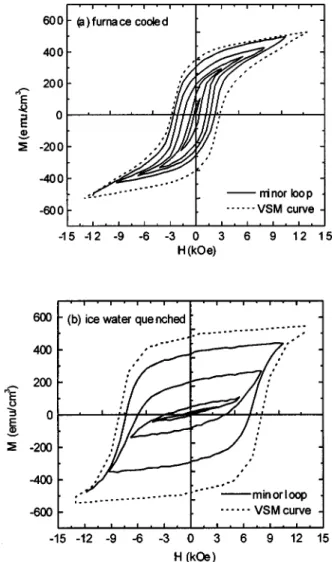
Figures 6~a! and 6~b! show the continuous minor loops of the Fe50Pt50 films annealed at 600 °C for 30 min with~a! furnace cooled and ~b! quenched in ice water. These minor loops are obtained from VSM with Ha varied from 600 to 12 000 Oe. It is clear that the Fe50Pt50 film quenched in ice water exhibits the domain wall pinning mechanism, and the Fe50Pt50 film that was slowly cooled in a furnace ~cooling rate is about 4 °C/min! exhibits the domain nucleation mechanism.6
1
S. W. Yung, Y. H. Chang, T. J. Lin, and M. H. Hung, J. Magn. Magn. Mater. 116, 411~1992!.
2B. Zhang, M. Lelovic, and W. A. Soffa, Scr. Metall. Mater. 25, 1577
~1991!.
3
K. Watanabe, Mater. Trans., JIM 32, 292~1991!.
4A. Z. Men’shikov, Yu. A. Dorofeyev, V. A. Kazantsev, and S. K. Sidorov,
Fiz. Met. Metalloved. 38, 505~1974!.
5J. P. Liu, C. P. Luo, Y. Liu, and D. J. Sellmyer, Appl. Phys. Lett. 72, 483
~1998!.
6
M. Watanabe, T. Nakayama, K. Watanabe, and K. Hiraga, IEEE Transl. J. Magn. Jpn. 8, 875~1993!.
FIG. 5. X-ray diffraction patterns of annealed Fe50Pt50films that were~a!
furnace cooled and~b! quenched in ice water.
FIG. 6. The continuous minor loops of the Fe50Pt50films annealed at 600 °C
for 30 min.~a! is the minor loops of the Fe50Pt50film that was slowly cooled
in a furnace and~b! is the minor loops of the Fe50Pt50film quenched in ice
water.
4888 J. Appl. Phys., Vol. 85, No. 8, 15 April 1999 Kuoet al.