Circular flow on signed graphs
Andre Raspaud and Xuding Zhu
∗Abstract
The circular flow number Φc(G, σ) of a signed graph (G, σ) is the
minimum r for which an orientation of (G, σ) admits a circular r-flow. We prove that the circular flow number of a signed graph (G, σ) is equal to the minimum imbalance ratio of an orientation of (G, σ). We then use this result to prove that if G is 4-edge connected and (G, σ) has a nowhere zero flow, then Φc(G, σ) (as well as Φ(G, σ)) is at most 4. If G is 6-edge
connected and (G, σ) has a nowhere zero flow, then Φc(G, σ) is strictly
less than 4.
1
Introduction
All graphs in this paper are finite and loopless, but may have parallel edges. In a graph G, an edge e = xy is viewed as two half edges: one half edge incident with x, and the other half edge incident with y. Denote by E(G) the set of all edges of G, and by H(G) the set of all half edges of G. If there is no confusion, E(G) and H(G) are abbreviated to E and H, respectively. For h ∈ H, let eh
be the edge containing h, let vh be the vertex incident with h, and let ¯h be the
other half edge of eh. If e = xy, then we let hxebe the half edge of e incident with
x. For a vertex v, HG(v) (abbreviated H(v)) is the set of half edges incident
with v, and EG(v) (abbreviated E(v)) is the set of edges incident with v.
Suppose G is a graph and σ : E(G) → {1, −1} is a mapping. Then the pair (G, σ) is called a signed graph. An edge e is called a positive edge (or a negative edge) if σ(e) = 1 (or σ(e) = −1). Given a signed graph (G, σ), an orientation of (G, σ) is a mapping τ : H(G) → {1, −1} such that for each edge e, if h, ¯h are the two half edges of e, then τ (h)τ (¯h) = −σ(e). We view τ as an assignment of directions to the half edges of G. If τ (h) = 1, then the half edge h is oriented away from vh; if τ (h) = −1, then the half edge is oriented towards vh. The
pair (G, τ ) is called a bidirected graph. The signed graph (G, σ) is called the underlying signed graph of (G, τ ), and the mapping σ is called the signature of τ . Observe that given a bidirected graph (G, τ ), its underlying signed graph is uniquely determined. On the other hand, a signed graph (G, σ) have many distinct orientations. An edge e is called a positive edge or negative edge in
∗Department of Applied Mathematics, National Sun Yat-sen University, and National
a bidirected graph (G, τ ) if it is a positive or negative edge in its underlying signed graph.
If all the edges of (G, τ ) are positive, then (G, τ ) is an orientation of G which assigns to each edge a direction: For an edge e = xy, if τ (hx
e) = 1 and
τ (hy
e) = −1, then the edge e is oriented from x to y. A bidirected graph (G, τ )
with all edges positive is also called a directed graph; and a signed graph (G, σ) with all edges positive is a graph. In this sense, the class of graphs is a subclass of signed graphs, and the class of directed graphs is a subclass of bidirected graphs.
If e = xy is an edge of a bidirected graph (G, τ ) for which τ (hx
e) = τ (hye) = 1,
then the edge is oriented away from both x and y. If τ (hx
e) = τ (hye) = −1, then
the edge is oriented towards both x and y. This may seem a little strange. However, such a bi-orientation arose naturally when one considers surface dual of oriented graphs embedded in non-orientable surfaces.
An important concept associated with directed graphs is nowhere zero k-flow, which is naturally extended to bidirected graphs [1]. Suppose (G, τ ) is a bidirected graph. For a mapping f : E → IR, the boundary of f is the map ∂f : V (G) → IR defined as
∂f (v) = X
h∈H(v)
τ (h)f (eh)
for each vertex v. If ∂f = 0 then f is an flow in (G, τ ). The support of a flow f in (G, σ) is the set supp(f ) = {e : f (e) 6= 0}. If f is an integer flow (i.e., f (e) is an integer for each e) in (G, τ ) and 1 ≤ |f (e)| ≤ k − 1 for each edge e, then f is a nowhere zero k-flow in (G, τ ). The problem of interest is whether a given bidirected graph (or a directed graph) admits a nowhere zero k-flow.
For a bidirected graph (G, τ ), the existence or non-existence of a nowhere zero k-flow is determined by the signature of τ : If bidirected graphs (G, τ ) and (G, τ0) have the same signature, then (G, τ ) has a nowhere zero k-flow if and
only if (G, τ0) has a nowhere zero k-flow. Indeed, if f is a flow in (G, τ ), then
f0 defined as f0(e) = f (e)τ (hx
e)τ0(hxe) (for e = xy) is a flow in (G, τ0). We say
a signed graph (G, σ) admits a nowhere zero k-flow if an orientation (G, τ ) of (G, σ) (and hence every orientation of (G, σ)) admits a nowhere zero k-flow. For a signed graph (G, σ), the flow number Φ(G, σ) is defined as
Φ(G, σ) = min{k : (G, σ) admits a nowhere zero k-flow}.
In case (G, σ) does not admit a nowhere zero k-flow for any k, then let Φ(G, σ) = ∞.
The study of flow number of graphs is an important and active branch of graph theory. Most of the research in this area are motivated by Tutte’s three flow conjectures: (1) Every bridgeless graph has a nowhere zero 5-flow. (2) Every bridgeless graph without 3-edge cut has a nowhere zero 3-flow. (3) Every bridgeless graph containing no Petersen minor has a nowhere zero 4-flow. Many interesting results are obtained in the study of these conjectures, although all the three conjectures are still open.
Nowhere zero k-flow in signed graphs was first studied by Bouchet [1]. It was proved in [1] that if a signed graph G admits a nowhere-zero k-flow for some integer k, then it admits a nowhere zero 216-flow. Bouchet then proposed the following conjecture:
Conjecture 1 If a signed graph G admits a nowhere zero k-flow for some k, then it admits a nowhere zero 6-flow.
Conjecture 1 remains open, although there are improvements on Bouchet’s result. It was proved in [17] that if a signed graph G admits a nowhere zero k-flow for some k, then it admits a nowhere zero 30-flow. It was proved in [8] that if G is 4-edge connected and the signed graph (G, σ) admits a nowhere zero flow for some integer k, then G admits a nowhere-zero 18-flow. Recently Xiu and Zhang proved the following if a G is 6 edge-connected and the signed graph (G, σ) admits a nowhere k-flow for some integer k, then (G, σ) admits a nowhere-zero 6-flow.
Nowhere zero flow of directed graphs is extended to circular r-flows of di-rected graphs [5, 15], which can also be defined for bididi-rected graphs. Suppose (G, τ ) is a bidirected graph and r ≥ 2 is a real number. A mapping f : E → IR is called a circular r-flow in (G, τ ) if the boundary of f is zero (i.e., for each vertex v, ∂f (v) =Ph∈H(v)τ (h)f (eh) = 0), and 1 ≤ |f (e)| ≤ r − 1 for each edge e.
Similarly the existence or non-existence of a circular r-flow of a bidirected graph is determined by its underlying signed graph. We say a signed graph (G, σ) ad-mits a circular r-flow if an orientation of (G, σ) (and hence every orientation of (G, σ)) admits a circular r-flow.
The circular flow number Φc(G, σ) of a signed graph (G, σ) is defined as
Φc(G, σ) = inf{r : (G, σ) admits a circular r-flow}.
In case (G, σ) does not admit a circular r-flow for any r, then let Φc(G, σ) = ∞.
It follows from the definition that for any positive integer k, a nowhere zero k-flow in a bidirected graph (G, τ ) is also a circular k-flow in (G, τ ). Therefore for any signed graph (G, σ),
Φc(G, σ) ≤ Φ(G, σ).
We shall prove that for any signed graph (G, σ), Φ(G, σ) ≤ 2dΦ(G, σ)e − 1.
Given an orientation (G, τ ) of a signed graph (G, σ), we introduce the con-cept of imbalance ratio of (G, τ ) (see Section 2 for the definition). Then we prove that
Φc(G, σ) = min{r : (G, σ) has an orientation whose imbalance ratio is r}.
Then we study the circular flow number of highly edge-connected signed graphs. The following theorem is the main result of this paper:
Theorem 1 Suppose (G, σ) is a signed graph and (G, σ) admits a nowhere zero k-flow for some integer k.
1. If G is 4-edge connected, then Φc(G, σ) ≤ Φ(G) ≤ 4.
2. If G is 6-edge connected, then Φc(G, σ) < 4.
An unpublished manuscript [2] of M. DeVos contains a theorem which says that if G is 4-edge connected and (G, σ) is a signed graph which admits a nowhere zero k-flow for some integer k, then (G, σ) admits a nowhere zero 4-flow. This theorem would imply the first part of Theorem 1. However, the proof in [2] contains an error. The proof presented here corrects that error. The second part is a generalization of a result of Gallucio and Goddyn [4], who proved that 6-edge connected graphs G have Φc(G) < 4.
2
Notation and preliminary results
Given a signed graph (G, σ) and a subset E0 of edges of G, we also denote by
E0 (respectively, (E0, σ)) the subgraph (respectively, the signed subgraph) of G
induced by the edges in E0. If X is subset of V (G), then G[X] (respectively,
(G[X], σ)) denote the subgraph (respectively, the signed subgraph) of G induced by X.
A circuit in a signed graph (G, σ) is a connected 2-regular subgraph of G. If C is a circuit, then (C, σ) is balanced (respectively, unbalanced) if it contains an even number (respectively, an odd number) of negative edges.
A signed graph (H, σ) is called a barbell if either
• H consists of two unbalanced circuits C1, C2 with |V (C1) ∩ V (C2)| = 1,
or
• H consists of two vertex disjoint unbalanced circuits C1, C2 and a path
P , which has one end in V (C1) and one end in V (C2) and has no interior
vertices in V (C1) ∪ V (C2).
A signed graph (H, σ) is called a signed circuit if (H, σ) is either a balanced circuit or a barbell. A signed graph is signed bridgeless if every edge of G is contained in an signed-circuit.
Suppose (H, σ) a signed circuit, and (H, τ ) is an orientation of (H, σ). We define a characteristic flow f of (H, σ) as follows:
Assume (H, σ) is a balanced circuit, say H = (v0, e0, v1, e1, · · · , vn−1, en−1, v0).
Let hi be the half edge of ei incident to vi. Let f be defined as f (ei) =
τ (hi)
Qi−1
j=0σ(ej) for i = 0, 1, · · · , n − 1 (by convention, f (e0) = τ (h0)). Then it
is easy to verify that f is a flow with support E(H). Both f and −f are called characteristic flows of (H, σ).
Suppose (H, σ) is a barbell with two unbalanced circuits C1, C2 and a path
P (possibly empty) connecting C1 and C2. Assume that
C2 = (v00, e00, v01, e10, · · · , vn00−1, e0n0−1, v0)
P = (v0= u0, e000, u1, e100, · · · , ut−1, e00t−1, v00= ut).
In case P is empty, then v0= v00. Let hi be the half edge of eiincident to vi, h0i
be the half edge of e0
i incident to vi0, and h00i be the half edge of e00i incident with
ui. Let f be defined as follows:
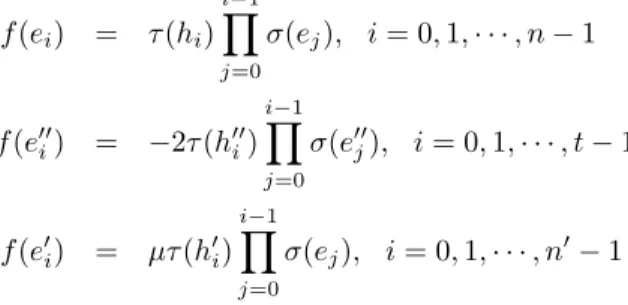
f (ei) = τ (hi) i−1Y j=0 σ(ej), i = 0, 1, · · · , n − 1 f (e00i) = −2τ (h00i) i−1 Y j=0 σ(e00j), i = 0, 1, · · · , t − 1 f (e0i) = µτ (h0i) i−1Y j=0 σ(ej), i = 0, 1, · · · , n0− 1
where µ = 1 or −1, depending on the flow from P to v0
0 is positive or negative,
i.e., µ = 1
2f (e00t−1)τ (h00t−1)σ(e00t−1). Note that f (e0) = τ (h0), f (e000) = −2τ (h000)
and f (e0
0) = µτ (h0). Again, it is easy to verify that f is a flow with support
E(H). Both f and −f are called characteristic flows of (H, σ).
−1 1 1 −1 −1 1 1 −1 2 2 −1 1
Figure 1: Example of signed circuits and characteristic flows
If each edge of (G, σ) is contained in a signed circuit, then appropriate linear combination of the characteristic flows of the signed circuits of (G, σ) will be nowhere zero k-flow in (G, σ). Conversely, it is known [1] that if a signed graph (G, σ) has a nowhere zero k-flow for some integer k then every edge of G is contained in some signed circuit, i.e, (G, σ) is signed bridgeless. So Bouchet conjecture is equivalent to say that every signed bridgeless signed graph admits a nowhere zero 6-flow.
Suppose (G, σ) is a signed graph and v ∈ V (G) is a vertex of G. Let σ0(e) =
½
−σ(e), if e ∈ E(v) σ(e), otherwise.
Then we say σ0 is obtained from σ by a switch at v. Two signed graphs are
equivalent if one can be obtained from the other by a sequence of switches. Assume (G, σ0) is obtained from (G, σ) by a switch at a vertex v and (G, τ ) is
an orientation of (G, σ). Let τ0 : H(G) → {−1, 1} be defined as
τ0(h) =
½
−τ (h), if h ∈ HG(v),
Then τ0 is an orientation of (G, σ0). Moreover, if f is a flow in (G, τ ), then f is
also a flow in (G, τ0). So equivalent signed graphs have the same flow number
and circular flow number.
A signed graph (G, σ) is called a balanced signed graph if each circuit of (G, σ) is balanced. If (G, σ) is a balanced signed graph, then there is a mapping c : V (G) → {1, 2} such that the following holds: If e = xy is a negative edge, then c(x) 6= c(y); if e = xy is a positive edge, then c(x) = c(y). By switching at all the vertices in c−1(1), we obtain a signed graph (G, σ0) in which all edges are
positive, i.e., (G, σ0) is a graph. It is easy to see that the converse is also true.
So a signed graph (G, σ) is balanced if and only if it is equivalent to a graph, i.e., a signed graph in which all edges are positive. The following characterization of signed bridgeless signed graphs was proved in [1].
Lemma 1 (Bouchet) A connected signed graph (G, σ) is signed bridgeless (and hence admits a nowhere zero k-flow for some integer k) if and only if the fol-lowing hold:
• (G, σ) is not equivalent to a signed graph (G, σ0) with exactly one negative
edge.
• If e is a cut-edge of G and H is a component of G − e, then (H, σ) is not balanced.
Another important concept in the study of flows in bidirected graphs is the matroid of the underlying signed graphs. Suppose G is a bidirected graph. Let B be the matrix {bve: v ∈ V (G), e ∈ E(G)} defined by the formula
bve=
X
h
τ (h)
where the summation is over those half edges h of e that are incident with v. The matroid M (G, σ) of its underlying signed graph (G, σ) is the matroid of the linear dependencies on the columns of B. The matroid M (G, σ) was first studied by Zaslavaky [13, 14]. We shall only need the properties of the matroid described in the following two Theorems, each of which can also be treated as a definition of the matroid.
Theorem 2 (Zaslavsky) Let (G, σ) be a signed graph, a set B of edges of M (G, σ) is a circuit if (B, σ) is an signed circuit, i.e., (B, σ) is either a balanced circuit C, or a barbell.
Theorem 3 (Zaslavsky) Given a connected signed graph (G, σ). If (G, σ) is balanced, then B is a base of M (G, σ) if and only if B is a signed spanning tree. If (G, σ) is not balanced, then B is a base of M (G, σ) if and only if each component of B contains a unique circuit and the circuit is unbalanced.
Suppose (G, σ) is a connected signed graph. We say a base B of M (G, σ) is connected if B has only one component. If (G, σ) is balanced, then every base of M (G, σ) is connected. If (G, σ) is unbalanced, then a base B is connected if B is a spanning tree with one extra edge making a unique unbalanced circuit.
3
Relation between Φ
c(G, σ) and Φ(G, σ)
It follows from the definition that Φc(G, σ) ≤ Φ(G, σ) for any signed graph
(G, σ). If (G, σ) is balanced (i.e., if (G, σ) is equivalent to a graph), then we know that Φ(G) = dΦc(G)e. For arbitrary signed graphs G, it is unknown if
the equality Φ(G) = dΦc(G)e still holds. In this section, we prove the following
result.
Theorem 4 For any signed bridgeless signed graph G, Φ(G) ≤ 2dΦc(G)e − 1.
Proof. Let k = dΦc(G)e. Let (G, τ ) be an orientation of (G, σ). By definition,
(G, τ ) has a circular k-flow (if r0 ≥ r then a circular r-flow in (G, τ ) is also a
circular r0-flow in (G, τ )). Given a circular k-flow f of (G, τ ), let
E(f ) = {e ∈ E(G) : f (e) is not an integer}.
Choose a circular k-flow f of (G, τ ) for which E(f ) has minimum cardinality. For each vertex v, asPh∈H(v)τ (h)f (eh) = 0 we conclude that
X
h∈H(v),eh∈E(f )
τ (h)f (eh) ∼= 0 (mod 1).
I.e., Ph∈H(v),eh∈E(f )τ (h)f (eh) is an integer. In particular, v is incident to
either 0 edges of E(f ) or at least two edges of E(f ). If (E(f ), σ) contains a signed circuit (H, σ). Then let g be a characteristic flow of (H, τ ). Let δ > 0 be the maxim real number such that for each edge e of H,
bf (e)c ≤ f (e) − δg(e), f (e) + δg(e) ≤ df (e)e.
Then both f + δg, f − δg are circular k-flows in (G, τ ) and either E(f + δg) or E(f − δg) is a proper subset of E(f ), in contrary to the choice of f .
So E(f ) contains no signed circuits. As observed above, no vertex of G is incident to exactly one edge of E(f ). If there is a vertex incident with at least three edges of E(f ), then E(f ) would contain two circuits that either intersect each other or connected by a path. In either case, it is easy to see that E(f ) contains a signed circuit, in contrary to the first sentence of this paragraph. Thus each vertex of G is incident to 0 or 2 edges of E(f ). Therefore each non-empty component of (E(f ), σ) is an unbalanced circuit.
Let (C, σ) be a component of (E(f ), σ) which is an unbalanced circuit. As-sume C = (v0, e0, v1, e1, · · · , vn−1, en−1, v0). Let hibe the half edge of eiincident
with vi. For each vi, f (ei)τ (hi) + f (ei−1)τ (¯hi−1) is an integer (calculation in
indices modulo n). This implies that there is a 0 < δ < 1 such that the frac-tional part of f (ei) = ±δ for all i. Since C is unbalanced, it follows that there is
a vertex vi such that the fractional part of f (ei)τ (hi) + f (ei−1)τ (¯hi−1) is equal
to 2δ. Since f (ei)τ (hi) + f (ei−1)τ (¯hi−1) is an integer, we conclude that 2δ = 1.
Hence δ = 1/2. Therefore for any edge e of G, 2f (e) is an integer, i.e., 2f (e) is an integer flow. As 2 ≤ |2f (e)| ≤ 2k − 2 for each edge e, we conclude that 2f is a nowhere zero (2k − 1)-flow.
4
Imbalance ratio of orientations
Suppose (G, σ) is a directed graph and X is a subset of V (G). Denote by ∂(X) the set of edges with exactly one end vertex in X, by ∂+(X) the set of edges in
∂(X) oriented from X to ¯X, and by ∂−(X) the set of edges in ∂(X) oriented
from ¯X to X. It follows from Hoffman’s theorem [6] (see also [5]) that a graph G has a circular r-flow if and only if G has an orientation (G, τ ) such that for each subset X of V (G), |∂+(X)| ≤ (r − 1)|∂−(X)| and |∂−(X)| ≤ (r − 1)|∂+(X)|.
This section generalizes this result to signed graphs. First we need the corresponding notation of X, ∂(X), ∂+(X) and ∂−(X) for signed graphs.
Suppose (G, σ) is a signed graph. A signed subset of V (G) is a pair (X, θ), where X is a subset of V (G) and θ : X → {1, −1} is a mapping. In other words, a signed subset is a subset X together with a partition X = X+∪ X−, where
X+= {x ∈ X : θ(x) = 1} and X− = {x ∈ X : θ(x) = −1}. If the mapping θ is
clear from the context (or is insignificant), we may write X for (X, θ). Given a signed subset (X, θ) of (G, σ), let
∂G,σ(X, θ) = {h ∈ H(G) : vh∈ Xand v¯h6∈ X
or vh∈ X, v¯h∈ X and θ(vh)θ(v¯h)σ(eh) = −1}.
E(∂G,σ(X, θ)) = {eh: h ∈ ∂G,σ(X, θ)}.
Lemma 2 Suppose (G, σ) is a signed graph and (X, θ) is a signed subset of V (G). If ∂G,σ(X, θ) 6= ∅, then E(∂G,σ(X, θ)) intersects every base of M (G, σ).
In other words, E(∂G,σ(X, θ)) contains a cocircuit of the matroid M (G, σ).
Proof. Let B be a base of M (G, σ). If there is a component (T, σ) of (B, σ) which contains both vertices of X and vertices of ¯X, then T contains an edge connecting a vertex of X and a vertex of ¯X. Therefore B ∩ E(∂G,σ(X, θ)) 6= ∅.
Assume for each component of (B, σ), its vertex set is either contained in X or disjoint from X. Let T be a component with V (T ) ⊆ X.
If (G, σ) is balanced, then B is a spanning tree, and hence V (T ) = V (G). So X = V (G). Let Z = (Y ∩ X−) ∪ (X+− Y ). Then it is straightforward to verify
that E(∂G,σ(X, θ)) contains all edges between Z and V \ Z. Moreover, if Z = ∅
or Z = V , then ∂G,σ(X, θ)} = ∅, in contrary to our assumption. Therefore
E(∂G,σ(X, θ)) ∩ B 6= ∅.
Assume (G, σ) is unbalanced. Then T contains a unique unbalanced circuit C. By contracting all positive edges of C, we obtain an odd circuit. Therefore, either there is a positive edge e = xy of C such that θ(x)θ(y) = −1 or there is a negative edge e = xy of C such that θ(x)θ(y) = 1. In any case, e ∈ E(∂G,σ(X, θ)) and hence E(∂G,σ(X, θ)) ∩ B 6= ∅. This completes the proof of
the lemma.
The set ∂G,σ(X, θ) = {eh: h ∈ ∂G,σ(X, θ)}} is not necessarily a cocircuit of
M (G, σ), but instead the union of cocircuits of M (G, σ).
Suppose (G, τ ) is an orientation of a signed graph (G, σ) and (X, θ) is a signed subset of V (G). Let
∂G,τ− (X, θ) = {h ∈ ∂G,σ(X, θ)} : θ(vh)τ (h) = −1}.
If there is no confusion, we usually write ∂+X for ∂+
G,τ(X, θ) and ∂−X for
∂−G,τ(X, θ).
We say a signed graph is k-unbalanced if for any signed subset X of V (G), |E(∂X)| ≥ k. Equivalently, G is k-unbalanced if for any balanced subgraph G0
of G, |E(G) − E(G0)| ≥ k.
Lemma 3 A signed graph (G, σ) has a circular r-flow if and only if (G, σ) has an orientation (G, τ ) such that for any signed subset (X, θ) of G for which E(∂G,σ(X, θ)}) 6= ∅,
1/(r − 1) ≤ |∂+X|/|∂−X| ≤ r − 1.
Proof. ⇒) We assume that (G, σ) has a circular r-flow. Then there is an orientation (G, τ ) of (G, σ) which has a circular r-flow f with f (e) > 0 for all edge e. Let X be a signed subset of V (G). Then
0 = X v∈X+ ( X h∈E(v) τ (h)f (eh)) and 0 = X v∈X− ( X h∈E(v) τ (h)f (eh)). Hence 0 = X v∈X+ ( X h∈E(v) τ (h)f (eh)) − X v∈X− ( X h∈E(v) τ (h)f (eh)) = X v∈X+ ( X h∈E(v),τ (h)=1 f (eh)) − X v∈X+ ( X h∈E(v),τ (h)=−1 f (eh)) − X v∈X− ( X h∈E(v),τ (h)=1 f (eh)) + X v∈X− ( X h∈E(v),τ (h)=−1 f (eh)) = X h∈∂+X f (eh) − X h∈∂−X f (eh)
Since f is a circular r-flow we have |∂+X| ≤ X h∈∂+X f (eh) = X h∈∂−X f (eh) ≤ (r − 1)|∂−X|. Similarly, we have |∂−X| ≤ (r − 1)|∂+X|.
This gives the asked inequalities.
⇐) Let τ be an orientation of (G, σ) such that for any signed subset X of V (G) we have :
1/(r − 1) ≤ |∂+X|/|∂−X| ≤ r − 1.
1. 0 ≤ f (eh) ≤ r − 1 for any h ∈ H(G).
2. Subject to (1),Ph:f (e
h)<1(1 − f (eh)) is minimum.
Observe that a flow f satisfying (1) exists, because f (e) = 0 for all edges e is such a flow. If f (e) ≥ 1 for all edges e, then f is a circular r-flow and we are done. Assume this is not the case, i.e., there exists an edge e with f (e) < 1.
A signed circuit (H, σ) in (G, τ ) and is called augmentable with respect to f if the following hold: There is a characteristic flow g of (H, τ ) such that (1) for any edge e ∈ E(H), if g(e) > 0, then f (e) < r − 1; (2) if g(e) < 0, then f (e) > 1; (3) there is an edge e with f (e) < 1.
Observe that if (G, τ ) has an augmentable signed circuit (H, σ), then if δ > 0 is sufficiently small, then f (e) + δg(e) ≤ r − 1 and f (e) + δg(e) < 1 only if f (e) < 1. But for those edges e for which f (e) < 1, since g(e) > 0, we have f (e) + δg(e) > f (e). This is in contrary to the choice of f . Thus we assume that (G, τ ) has no augmentable signed circuits.
In the remainder of the proof, let e∗= xy be a fixed edge of G with f (e∗) < 1.
We may assume that σ(e∗) = 1 (the case σ(e∗) = −1 is considered in a similar
way). Moreover without loss of generality, we assume that τ (hye∗) = −1. Suppose P = (v0, v1, . . . , vk−1, vk) is a walk in G − e∗. Let ej = vjvj+1 for
j = 0, 1, . . . , k − 1, and let θ : V (P ) → {1, −1} satisfies θ(vj+1) = θ(vj)σ(ej) for
j = 0, 1, . . . , k − 2 and θ(vk−1)θ(vk)σ(ek−1) = −1. If
• the vertices v0, v1, . . . , vk−1are distinct,
• and vk = vk0 for some k0≤ k − 2, then we say P is a tadpole starting from v0.
Claim 1 Assume P = (v0, v1, . . . , vk−1, vk) is a tadpole, where vk = vk0 for some k0≤ k − 2 and e
j= vjvj+1. For the mapping φ : E(G) → {−2, −1, 0, 1, 2}
defined as φ(e) = 2θ(vj)τ (hvejj), if e = ej for j = 0, 1, . . . , k 0− 1, θ(vj)τ (hvejj), if e = ej for j = k 0, k0+ 1, . . . , k − 1, 0, otherwise,
we have ∂φ(v0) = 2θ(v0) and ∂φ(u) = 0 for u 6= v.
This claim can be verified directly from the definition. For example, by definition, ∂φ(v0) = X h∈H(v0) τ (h)φ(eh) = τ (hve00)2θ(v0)τ (h v0 e0) = 2θ(v0) and ∂φ(vk0) = X h∈H(v0) τ (h)φ(eh) = τ (hevk0 k0−1 )φ(ek0−1) + τ (hvek0 k0)φ(ek0) + τ (h vk ek−1)φ(ek−1).
Since φ(ek0−1) = 2θ(vk0−1)τ (hvek0−1 k0−1) σ(ek0−1) = −τ (hvek0−1 k0−1)τ (h vk0 ek0−1) θ(vk0) = θ(vk0−1)σ(ek0−1), it follows that τ (hvk0
ek0−1)φ(ek0−1) = −2θ(vk0). Similarly, it can be shown that τ (hvk0
ek0)φ(ek0) = τ (h
vk
ek−1)φ(ek−1) = θ(vk0). Hence ∂φ(vk0) = 0.
Suppose P = (v0, v1, . . . , vk−1, vk) is a tadpole. If θ(v0) = 1 then it is called
a positive tadpole, otherwise it is called a negative tadpole. If the following hold: • If θ(vj)τ (hvejj) = 1 then f (ej) < r − 1, if θ(vj)τ (h
vj
ej) = −1 then f (ej) > 1. Then we say the tadpole P is augmentable (with respect to f ).
Assume there is a positive tadpole P = (v0, v1, . . . , vk−1, vk), with vk = vk0 for some k0≤ k−2, starting from y and a negative tadpole P0= (v0
0, v01, . . . , vm−10 , v0m),
with v0
m = vm0 0 for some m0 ≤ m − 2, starting from x, and both tadpoles are augmentable. The two tadpoles may have nonempty intersection. It is straight-forward to verify that if P and P0 have an edge in common then the union
P ∪ P0 contains an augmentable balanced circuit. If P and P0 have no edges
in common, then P ∪ P0 is an augmentable barbell. In any case, we obtain an
augmentable signed circuits of (G, τ ). This is in contrary to our assumption. So either (G, τ ) has no positive augmentable tadpole starting from y or (G, τ ) has no negative augmentable tadpole starting from x. Without loss of generality, we assume that G has no positive augmentable tadpole starting from y.
We then recursively construct a signed subset (X, θ) of V (G) by the following rules:
1. Initially X = {y} and θ(y) = 1.
2. Assume e = wt is an edge of G−e∗with w ∈ X and t /∈ X. If θ(w)τ (hw e) =
1 and f (e) < r − 1, then we add t to X. If θ(w)τ (hw
e) = −1 and f (e) > 1,
then we add t to X. In any case, we let θ(t) = θ(w)σ(e).
The above process will terminate as G is a finite graph, and we obtain a signed subset X of V (G). It follows from the definition that for each vertex v ∈ X, there is a y-v-path Pv = (v0, v1, . . . , vk) such that v0 = y, vk = v, and for
ej = vjvj+1, if θ(vj)τ (hevjj) = 1, then f (ej) < r − 1; if θ(vj)τ (h
vj
ej) = −1, then f (ej) > 1.
If x ∈ X and θ(x) = 1, then Px+ e∗ = (v0, v1, . . . , vk, v0), with v0 = y
and vk = x, is an augmentable circuit with respect to f , in contrary to our
assumption. Thus we assume that either x 6∈ X or x ∈ X but θ(x) = −1. Therefore e∗∈ ∂−X.
If the following hold: • ∀h ∈ ∂+X, f (e
• ∀h ∈ ∂−X, f (e h) ≤ 1
then, since hye∗∈ ∂−X and f (e∗) < 1, we have
(r − 1)|∂+X| = X h∈∂+X f (eh) = X h∈∂−X f (eh) < |∂−X|.
This implies that
1/(r − 1) > |∂+X|/|∂−X|,
in contrary to our assumption.
Thus we may assume that there exists either an h ∈ ∂+X with f (e
h) < r − 1
or an h ∈ ∂−X with f (e
h) > 1. Assume eh= wt, and without loss of generality,
assume that w ∈ X. By the construction, we should have put t to X. Thus both vertices w, t are in X. Thus by definition of ∂X, we have θ(w)θ(t)σ(eh) = −1.
Let Pw = (v0, v1, . . . , vk) be the y-w-path and Pt= (u0, u1, . . . , vm) be the
y-t-path defined as before. Thus v0= u0= y and vk= w, um= t. Let i be the
largest index such that vi∈ Pt, say vi= ui0. Let T be the subgraph of G induced by the edges of Pwand the edges of Pt0 = (ui0, ui0+1, . . . , um). Then T is a tree. Other than v0, T has two leaves w and t. Let P be obtained from T by adding
the edge wt. We view P as a walk (v0, v1, . . . , vk, um, um−1, . . . , ui0+1, ui0), where all the vertices v0, v1, . . . , vk, um, um−1, . . . , ui0+1are distinct and ui0 = vi. Since θ(w)θ(t)σ(eh) = −1, by letting θ0(vj) = θ(vj) and θ0(uj) = −θ(uj), we can see
that P is indeed a tadpole. Moreover, it follows from the construction that P is a positive tadpole, augmentable with respect to f . This is in contrary to our assumption.
5
Connected disjoint bases of M (G, σ)
It is proved by Tutte [11] and Nash-Williams [10] that G is a 2k-edge connected, then G has k-edge disjoint spanning trees. This result is extended to matroid by Edmonds [3]: A matroid M has k disjoint bases if and only if for every subset X of E(M ), kr(X) + |E(M ) − X| ≥ kr(M ).
In this section, we shall prove that if G is 2k-edge connected and k-unbalanced, then M (G, σ) has k disjoint connected bases.
Since G is 2k-edge connected, we know that G has k edge disjoint spanning trees. Each spanning tree of G is an independent set in M (G, σ). A family F = {F1, F2, · · · , Fk} of disjoint independent set is called optimal, if each Fi
contains a spanning tree of G and the total number of edges in the Fi’s is
maximum.
Suppose F = {F1, F2, · · · , Fk} is a family of optimal disjoint independent
sets of M (G, σ). We define a sequence of sets E0(F), E1(F), · · · , as follows: Let
Suppose Ej−1(F) is defined. For each e ∈ Ej−1(F), for each Fi ∈ F, let
C(Fi, e) =
C, if Fi+ e contains a balanced cycle C;
C1∪ C2, if Fi+ e contains a barbell in which C1, C2 are the two unbalanced circuits;
{e}, if e ∈ Fi.
Let
Ej(F) = ∪e∈Ej−1(F),Fi∈FC(Fi, e).
Lemma 4 Suppose (G, σ) is a signed graph and F = {F1, F2, · · · , Fk} is a
family of optimal disjoint independent sets. Then for any j ≥ 0, for any e ∈ Ej(F), for any Fi∈ F, either e ∈ Fi or Fi+ e contains a signed circuit.
Proof. Assume the lemma is not true. Let j be the minimum integer for which the following holds:
There is a family of optimal disjoint independent sets F = {F1, F2, · · · , Fk},
an edge e ∈ Ej−1(F) and an Fi∈ F such that Fi+ e contains no signed circuit.
First we observe that j 6= 0, for otherwise, by replacing Fi with Fi+ e in F,
we obtain a family of k disjoint independent sets that contains one more edge. This is in contrary to the definition of family of optimal disjoint independent sets. So j ≥ 1. By definition, there is an edge e0 ∈ E
j−1(F) − Ej−2(F) and an
Fs∈ F such that e ∈ C(Fs, e0). Let Fi0 = Fi+ e and Fs0 = Fs− e. Replace Fi
with F0
i and Fs with Fs0 in F, we obtain another family F0 of optimal disjoint
independent sets. It follows from the definition that that for h = 0, 1, · · · , j − 1, Eh(F0) = Eh(F). In particular, e0 ∈ Ej−1(F0). However, Fs0+ e0 contains no
signed circuit. This is in contrary to the choice of j.
Lemma 5 If G is 2k-edge connected and (G, σ) is k-unbalanced, then M (G, σ) has k disjoint connected bases.
Proof. Let F = {F1, F2, · · · , Fk} be a family of optimal disjoint independent
sets. If each Fi is a base, then we are done. Assume that F1 is not a base,
i.e., F1 is a spanning tree of G. The other Fi’s is either a spanning tree or a
spanning tree with one edge added making a unique unbalanced circuit. Let Ej(F) be defined as above. As G is finite and Ej(F) ⊆ Ej+1(F), there
is an index j∗ such that E
j∗(F) = Ej+1(F).
Contract all the edges in Ej∗(F), we obtain a graph H (parallel edges re-sulting from the contraction are retained, and loops are removed). If e ∈ Ej∗ is a contracted edge, then for any Fi ∈ F, Fi+ e contains a signed circuit. This
implies that Fi+ e contains a circuit C such that e ∈ C and C ⊆ Ej∗(F). This means that Fi has a path connecting the two ends of e and this path is
con-tracted. Denote by F0
i the graph obtained from Fi by contracting all the edges
in Ej∗(F). Since each contracted part is connected subgraph of Fi, it follows that if Fi is a spanning tree of G, then Fi0 is a spanning tree of H; if Fi is a
spanning tree of G with one edge added, then F0
i is a spanning tree of H with
one edge added. In particular, F0 has either |V (H)| edges or |V (H)| − 1 edges.
If there is an Fi∈ F which is not a base of M (G, σ), then the total number of
edges in F0
If |V (H)| ≥ 2, then since H is 2k-edge connected, each vertex in H has degree at least 2k, and hence H has at least k|V (H)| edges, which is a contradiction. Thus H has only one vertex. It follows that for any two points x, y of G, for any Fi∈ F, there is a path P in Fi connecting x and y and E(P ) ⊆ Ej∗(F). If e is an edge of Fi which is not contained in a circuit, then e ∈ Ej∗(F). If e ∈ E(Fi) is contained in a circuit C, then either e ∈ Ej∗(F) or C − e ⊆ Ej∗(F) or both. Therefore if Fihas a circuit, then it has at most one edge not in Ej∗(F). Assume there are t < k of the Fi’s which contains a circuit. Then there are at most
t edges of G not in Ej∗(F). Let G0 be obtained from G by removing all the edges of G not in Ej∗(F). By our assumption, G is k-unbalanced. So G0 is not balanced and contains an unbalanced circuit C. By Lemma 4, for each edge e of C, F1+ e contains a unique balanced circuit Ce. This is a contradiction, as
the symmetric difference of {Ce: e ∈ C} = C is unbalanced.
6
Graphs with high edge connectivity
The following lemma is proved in [12, 2]:
Lemma 6 A connected signed graph G has Φc(G) = 2 if and only if G is
eulerian and σ(G) = 1.
Lemma 7 If a signed graph (G, σ) has two spanning subgraphs G1and G2 such
that each (Gi, σ) has a nowhere zero 2-flow and E(G1) ∪ E(G2) = E(G), then
Φc(G, σ) ≤ Φ(G, σ) ≤ 4. If moreover, E(G)−E(G2) contains a base of M (G, σ),
then Φc(G, σ) < 4.
Proof. Assume G has two subgraphs G1, G2 such that each (Gi, σ) has a
nowhere zero 2-flow and E(G1) ∪ E(G2) = E(G). Let τ be an orientation of
(G, σ). Let φi be a nowhere zero 2-flow in (Gi, τ ). Then φ1+ 2φ2 is a nowhere
zero 4-flow of (G, τ ).
For the moreover part, we assume that E(G) − E(G2) contains a base of
M (G, σ). By Lemma 3, for each i = 1, 2, there is an orientation τi of Gi such
that for any signed subsets (X, θ) of V (Gi), |∂+Gi,τi(X, θ)| = |∂
−
Gi,τi(X, θ)|. Let τ be the orientation of G defined as
τ (h) = ½
τ1(h), if h ∈ H(G1)
τ2(h), otherwise.
Let X be an arbitrary signed subsets of V (G). Let a = |∂G+1,τ1(X, θ)| = |∂G−1,τ1(X, θ)|, b = |∂+ G2,τ2(X, θ)| = |∂ − G2,τ2(X, θ)|, c = |∂+ G2,τ2(X, θ) ∩ ∂G1,τ1(X, θ) ≤ b, d = |∂G−2,τ2(X, θ) ∩ ∂G1,τ1(X, θ)| ≤ b.
Then |∂G,τ+ (X, θ)| = a + (b − c) and |∂−G,τ(X, θ)| = a + (b − d). So
|∂G,τ− (X, θ)| − |∂G,τ+ (X, θ)| = c − d ≤ c.
Since E(G) − E(G2) contains a base of M (G, σ), by Lemma 2, for any signed
set X with ∂G,σ(X, θ) 6= ∅, ∂G,σ(X, θ) ∩ (H(G) − H(G2)) 6= ∅. This implies that
∂G1,τ1(X, θ) 6⊆ ∂G2,τ2(X, θ).
Therefore
c < |∂G1,τ1(X, θ)| = 2a.
Therefore
|∂−G,τ(X, θ)| < |∂G,τ+ (X, θ)| + 2a ≤ 3|∂G,τ+ (X, θ)|. (1) By symmetry, we also have
|∂G,τ+ (X, θ)| < 3|∂G,τ− (X, θ)|.
By Lemma 3, Φc(G) < 4.
Lemma 8 Suppose (G, σ) is a signed bridgeless signed graph.
1 If M (G, σ) has two disjoint connected bases, then Φc(G, σ) ≤ Φ(G, σ) ≤ 4.
2 If M (G, σ) has three disjoint bases, two of them are connected, then Φc(G, σ) <
4.
Proof. We shall only consider the case that (G, σ) is unbalanced (the balanced case is proved similarly but easier).
By Lemma 7, to prove (1), it suffices to find two subgraphs G1, G2such that
each (Gi, σ) has Φ(Gi) = 2. To prove (2), we need to find two subgraphs G1, G2
such that each (Gi, σ) has Φ(Gi) = 2 and E(G) − E(G2) contains a base of
M (G, σ).
Assume (G, σ) has two disjoint connected bases F1, F2. As (G, σ) is
un-balanced, each of Fi is a spanning tree with an edge added making a unique
unbalanced circuit.
For each e ∈ E(G) − Fi, Fi+ e contains a signed circuit, which is either
a balanced circuit C of (G, σ) or a barbell Q of (G, σ), consisting of two edge disjoint unbalanced circuits C1, C2and a path P (possibly of length 0, in which
case V (C1) ∩ V (C2) 6= ∅) connecting the two circuits. In the former case, let
Ci(e) = C, in the latter case, let Ci(e) = C1∪ C2. In any case, Ci(e) is an even
subgraph (i.e., each vertex has even degree) with σ(Ci(e)) = 1.
Let G1= ∆e∈(E(G)−F1)C1(e) and let G2= ∆e∈F1C2(e). Then Gi(i = 1, 2) is
connected (because F3−iis contained in Gi) and dGi(x) is even for x ∈ V (G), i = 1, 2 and σ(Gi) = 1. Therefore each (Gi, σ) has a nowhere zero 2-flow. In case
(G, σ) has base F3 disjoint from F1 and F2, then by the construction, we know
Theorem 5 Suppose (G, σ) is a signed bridgeless signed graph. If G is 4-edge connected, then Φc(G, σ) ≤ Φ(G, σ) ≤ 4. If G is a 6-edge connected, then
Φc(G, σ) < 4.
Proof. Assume G is 4-edge connected and (G, σ) is signed bridgeless. Then (G, σ) is 2-unbalanced. By Lemma 5, (G, σ) has two disjoint connected bases. By Lemma 8, Φc(G, σ) ≤ Φ(G, σ) ≤ 4.
Assume G is 6-edge connected and (G, σ) is signed bridgeless. If (G, σ) is 3-unbalanced, then by Lemma 5, (G, σ) has three disjoint connected bases. By Lemma 8, Φc(G, σ) < 4.
Assume (G, σ) is not 3-unbalanced. Then (G, σ) is equivalent to a signed graph with exactly two unbalanced edges. Without loss of generality, we assume that (G, σ) has exactly two unbalanced edges e1, e2. Let G0be a graph obtained
from G by adding an arbitrary unbalanced edge e3. Since G0is 6-edge connected,
and switching at vertices in a subset V0of V (G0) will change the sign of all the
edges in the cut E[V0, ¯V0] (the edges between V0and ¯V0), we conclude that any
signed graph equivalent to G0 contains at least 3 unbalanced edges, i.e., G0 is
3-unbalanced. By Lemma 5, M (G0, σ) has three disjoint bases F
1, F2, F3. Each
Fi is a spanning subgraph with one edge added making a unique unbalanced
circuit. Since (G0, σ) has exactly three unbalanced edges, each base contains
exactly one of the three unbalanced edges. Thus we may assume that ei ∈ Fi
and F0
i = Fi− {ei} is a spanning tree of G. Note that F30+ e1 is also a base of
M (G, σ).
For each i = 1, 2, and for each e ∈ (E(G) − Fi), let Ci(e) be defined as in
the proof Lemma 8. Let G1 = ∆e∈E(G)−F1C1(e) and let G2 = ∆e∈F10C2(e).
Then Gi(i = 1, 2) is connected (because F3−i0 is contained in both Gi) and even
and has σ(Gi) = 1. By Lemma 6, we have Φc(Gi) = 2 for i = 1, 2. Moreover,
the base F0
3+ e1 of M (G, σ) is contained in E(G) − E(G2). We claim that
E(G1) ∪ E(G2) = E(G). It is obvious that if e 6∈ B1, then e ∈ E(G1), and if
e ∈ F0
1, then e ∈ E(G2). Thus we only need to show that e1∈ E(G1). For any
edge e ∈ E(G) − B1, if e 6= e2, then C1(e) cannot contain e1, for otherwise e1
is the only unbalanced edge of C1(e), in contrary to the fact that σ(C1(e)) = 1.
On the other hand, e1 must be contained in C1(e2), for otherwise e2is the only
unbalanced edge of C1(e2), in contrary to the fact that σ(C1(e2)) = 1. Thus
e1∈ ∆e∈E(G)−F1C1(e). By Lemma 7, we have Φc(G) < 4.
References
[1] A. Bouchet, Nowhere-zero integral flows on bidirected graph, J. Combin. Theory Ser. B 34 (1983), 279-292.
[2] M. DeVos, Flows on bidirected graphs, manuscript, 2004?
[3] J. Edmonds, Minimum partition of a matroid into independent sets, J. Res. Nat. Bur. Standards Sect. B 69 B, 67-72.
[4] A. Galluccio and L. Goddyn, The circular flow number of a 6-edge con-nected graph is less than four, Combinatorica 22 (2002), no. 3, 455-459. [5] L. A. Goddyn, M. Tarsi and C. Q. Zhang, On (k, d)-colorings and fractional
nowhere zero flows, J. Graph Theory, 28(1998), 155-161.
[6] A.J.Hoffman, Some recent applications of the theorem of linear inequalities to extremal combinatorial analysis, Proc. Symp. Appl. Math., 10 (1960), 113-127.
[7] F. Jaeger, On circular flows in graphs. Proceedings of the 6th Hungarian Colloquium on Combinatorics, Eger, Hungary, 1981.
[8] A. Khellady, Nowhere-zero integer chains and flows in bidirected graphs in bidirected graphs, J. Combin. Theory Ser. B. 43 (1987) 95-115.
[9] F. Jaeger, Nowhere-zero flow Problems, Selected topics in Graph Theory 3 Academic Press, London 1988, pp. 71-95.
[10] C.S.J.A. Nash-Williams, Edge disjoint spanning trees of finite graphs, J. London Math. Soc. 36(1961), 445-450.
[11] W.T.Tutte, On the problem of decomposing a graph into n connected fac-tors, J. London Math.Soc. 36(1961), 221-230.
[12] R. Xu and C. Zhang, On flows in bidirected graphs, Discrete Mathematics, 299(2005) 335-343.
[13] T. Zaslavsky, Signed graphs, Discrete Applied Mathematics, 4 (1982), 47-74.
[14] T. Zaslavsky, Orientation of signed graphs, European Journal of Combina-torics, 12 (1991), 361 - 375.
[15] X. Zhu, Circular chromaic number - a survey, Discrete Mathematics, 229 (2001), no. 1-3, 371-410.
[16] X. Zhu, Recent developments in circular colouring of graphs Topics in Discrete Mathematics, 2006, 497-550.
[17] O. Z´yka, Nowhere-zero 30-flow on bidirected graphs, Thesis, Charles Uni-versiy, Pragua,1 87, KAM-DIMATIA Seris 87-26.