國 立 交 通 大 學
資訊科學與工程研究所
碩
士
論
文
以主要功能需求導引臨摹學習
網路應用系統的軟體架構設計
Major-Requirement-First Imitating Learning for
Software Architecture Design of Web Based System
研 究 生:薛祖淵
指導教授:曾憲雄 博士
以主要功能需求導引臨摹學習
網路應用系統的軟體架構設計
Major-Requirement-First Imitating Learning for Software
Architecture Design of Web Based System
研 究 生:薛祖淵 Student:Tsu-Yuan Hsueh
指導教授:曾憲雄 Advisor:Dr. Shian-Shyong Tseng
國 立 交 通 大 學
資 訊 科 學 與 工 程 研 究 所
碩 士 論 文
A Thesis
Submitted to Institute of Computer Science and Engineering College of Computer Science
National Chiao Tung University In partial Fulfillment of the Requirements
for the Degree of Master
In
Computer Science
July 2009
Hsinchu, Taiwan, Republic of China
以主要功能需求導引臨摹學習
網路應用系統的軟體架構設計
學生:薛祖淵 指導教授:曾憲雄 博士國立交通大學資訊學院
資訊科學與工程研究所
摘 要
軟體架構設計對於把設計概念應用在實作能力上,並且透過解構、抽象和封 裝等概念去簡化整個系統功能需求的複雜度是非常重要的議題。在本篇論文中, 我們以「錄影帶租借管理系統」當作我們教學網路應用系統邏輯層設計的教材, 來教導學生軟體架構設計的概念。我們主要的教學策略導入了鷹架式教學的理 論,導引學生從系統的主要功能需求往細部的元件一一去臨摹,並且在過程中提 供必要的鷹架作為輔助。依照這個想法我們發展了一套臨摹式學習系統,我們定 義了一個系統需求的知識本體去維護教材的知識架構,並且設計了一套對話式問 答的機制去擷取老師設計教材的知識,然後產生出知識本體。接下來,根據我們 的教學策略去規劃出臨摹的流程,然後透過教學專家系統去呈現教材內容和提供 個人化的學習。最後,實驗結果顯示我們提出的教學策略對於學習軟體架構設計 是有效的,而且我們會在未來的研究上加入適性化學習以提供更合適的教學。 關鍵字:軟體架構設計, 物件導向程式設計, 臨摹式學習, 網路應用系統, 鷹架 式教學Major-Requirement-First Imitating Learning for
Software Architecture Design of Web Based System
Student: Tsu-Yuan Hsueh Advisor: Dr. Shian-Shyong Tseng
Department of Computer Science National Chiao Tung University
Abstract
Software architecture design is an important issue to transform design concepts into implementation ability, where the ideas of decomposition, abstraction, and encapsulation of functionality are usually used to simplify the complexity of the system’s requirements. This thesis focusing on the logic tier of web-based system uses “Video Rental Management System (VRMS)” as our teaching case to teach learners how to design the software architecture. Major-Requirement-First strategy (MRFS), the main idea of this thesis, applies scaffolding instruction theory to guide learners imitating the system architecture design from major functionalities of VRMS to detailed components by providing all the necessary scaffolds. Based upon MRFS, we develop the Major-Requirement-First Imitating Learning System (MRFILS), where a knowledge structure of VRMS is constructed and maintained according to System Requirement Ontology (SRO), and the Recursive Descent Dialog Approach (RDDA) is proposed to acquire the teacher’s knowledge of teaching cases and generate the SRO. Accordingly, the schedule of an imitating procedure can present the learning materials and provide personalized learning for learners with guidance using an Object-Oriented Learning Activity (OOLA) System. Finally, the experimental results show that our teaching approach is useful for learners to gain the software architecture design concepts of VRMS, and we will add adaptive learning in MRFILS for the future work.
Keywords: Software architecture design, object-oriented programming, imitating
致謝
在交大碩士班的兩年中,首先誠摯的感謝指導教授:曾憲雄博士。無論是在 學術研究或是為人處世方面,皆讓我受益匪淺,尤其是我學到了對一個知識領域 的研究方法、邏輯思考及表達能力的訓練,這將使我終生受用不盡,特別要在這 對教授獻上十二萬分的感謝。同時也要特地感謝我的口試委員,賀嘉生教授、孫 春在教授、廖岳祥教授和葉耀明教授,他們給了我相當多的寶貴意見,讓本論文 更有意義與價值。 再來要感謝的是實驗室的林喚宇學長、劉怡利學姊、翁瑞峰學長、蘇俊銘學 長、曲衍旭學長,在論文研究期間,不厭其煩的給予我非常多的建議及協助,讓 我的論文更加完整。此外,我也從他們身上學到了不少生活態度以及系統實作上 的技巧和經驗,在此深表感激。同時也要非常感謝實驗室的同窗夥伴們,惠君、 靖雅、啟珺、士緯和世恒以及學弟妹們:金龍、嘉祥、國彰、杰峰、紹宜和佳榕, 也要特別謝謝你們這段期間的互相鼓勵及支持,我才能堅持努力完成這篇碩士論 文,謝謝你們。 祖淵Table of Content
Page
Table of Content ... vi
List of Figures ... viii
List of Tables ... ix
List of Definitions ... x
List of Algorithms ... xi
List of Examples ... xii
Chapter 1. Introduction ... 1
Chapter 2. Related Work ... 5
2.1 Web-Based System Design Learning ... 6
2.1.1 Traditional Teaching Approaches ... 6
2.1.2 Design Methodologies ... 6
2.2 Programming Learning in e-Learning ... 8
2.2.1 Object-Oriented Programming Learning ... 8
2.2.1 Other Programming Learning Issues ... 10
Chapter 3. Imitating Learning Guidance Approach ... 12
3.1 General Program Assignments ... 12
3.2 Major-Requirement-First Strategy (MRFS) ... 13
Chapter 4. Major-Requirement-First Imitating Learning System (MRFILS) ... 17
4.1 Knowledge Acquisition Phase ... 19
4.1.1 System Requirement Ontology (SRO) ... 19
4.1.2 Recursive Descent Dialog Approach (RDDA) ... 21
4.2.1 Algorithm of Major-Requirement-First Strategy ... 25
4.2.2 Major-Requirement-First Guidance Transformation System ... 28
4.3 Learning Phase ... 31
4.3.1 Object-Oriented Learning Activity (OOLA) System ... 31
Chapter 5. System Implementation and Experiment ... 32
5.1 System Implementation ... 32
5.1.1 Teaching Materials Construction Phase ... 32
5.1.2 Software Architecture Design Learning Phase ... 34
5.2 Experiment ... 36
5.3 Discussion ... 38
Chapter 6. Conclusion and Future Work ... 39
List of Figures
Page
Figure 1. Typical catalogs of Computer Science curriculums ... 5
Figure 2. Three-tier architecture ... 7
Figure 3. Traditional program assignment ... 12
Figure 4. Progressive program assignment ... 13
Figure 5. Top-down program assignment ... 15
Figure 6. The class diagram of Video Rental Management System (VRMS) ... 16
Figure 7. The system architecture of MRFILS ... 17
Figure 8. The examples of VRMS_SRO ... 21
Figure 9. Object-oriented design process ... 22
Figure 10. The example of VRMS_SRO construction process ... 24
Figure 11. The flowchart of Major-Requirement-First Strategy (MRFS) ... 27
Figure 12. Major-Requirement-First Guidance Transformation System ... 28
Figure 13. The example of MRFS Scheduler ... 29
Figure 14. The example of OOLA Transformer ... 30
Figure 15. The system architecture of OOLA System ... 31
Figure 16. The snapshot of teaching materials construction phase ... 33
Figure 17. The snapshot of software architecture design learning phase ... 35
List of Tables
Page
Table 1. The detailed information of program scaffolds ... 14
Table 2. Question templates ... 22
Table 3. Learning guidance templates ... 30
Table 4. The questionnaire items ... 36
List of Definitions
Page Definition 1. System Requirement Ontology (SRO) ... 19
List of Algorithms
Page Algorithm 1. Recursive Descent Dialog Approach (RDDA) ... 23 Algorithm 2. Major-Requirement-First Strategy (MRFS) ... 26
List of Examples
Page
Example 1. Major-requirement-first strategy for program assignments ... 15
Example 2. Parts of VRMS_SRO ... 20
Example 3. RDDA Scaffolds Constructing System ... 24
Example 4. MRFS Scheduler ... 28
Chapter 1. Introduction
With the growth of Internet, many Internet service providers, such as Google, Yahoo, etc., who have provided a huge amount of web applications for various web services. In order to develop such web applications, the system architecture design becomes a crucial task. Currently, the most popular web system architecture design mechanism, named Three-Tier Architecture [1], consists of presentation tier, logic tier, and data tier to implement user interface, business logic, and data I/O, respectively. Among these three tiers, logic tier is responsible to handle complicated computations and program control-flows, so it usually becomes a bottleneck when novice programmers who just begin to learn web application design. In the construction process of web application logic tier, designers are supposed to clearly understand the system requirements, and then the concepts of decomposition, abstraction, and encapsulation of functionality [1-4] are usually used to transform the requirements into the system design and simplify the complexity of requirements to each program component. We take a web application “Video Rental
Management System (VRMS)“ as an example, whose logic tier design contains various
requirements of member management, video management, online item management and data passing, and this teaching case is simple and suitable for novice learners to learn the software architecture design. Thus, a learner, who wants to construct a VRMS, needs to consider the following design problems: How to divide the requirements into different components to simplify the individual computation logics? How to merge the computation results from different components to generate the final outputs? How to cope with data encapsulation and passing? In other words, the
concept of software architecture design [3, 4] is a very important learning objective for constructing web application.
In the traditional software architecture design learning, lectures and imitating learning are the major methods for learners to gain the design idea. Among them, lecturers can teach learners the abstract concept of software architecture design, but learners usually can not easily apply the concepts to a real software design. As we know, imitating learning lets learners imitate the design of teaching cases [5] or class diagrams [1-3] to learn the real design experience, but it is still difficult to help learners understanding the major idea of the previous design from the detailed component implementation without any guidance and explanation. Another researches use project-based learning [6, 7] to teach learners software architecture design, where teachers guide learners to construct the main program in the project and gain the real design concepts and construction experience. This teaching approach can contribute significant learning efficacy, but it is very time consuming for teachers to run a project.
Most computer-assisted programming learning systems [8-11] aim to assist learners learning the syntax and semantic rules of programming language, but software architecture design is still inadequate for learning because the abstract design concepts are difficult to be implemented as the fixed learning rules in learning system. Therefore we propose a learning system, which can guide learners to imitate the design of a given learning project case to reduce teachers’ loading of guiding learners to complete a project.
In order to help learners understanding why and how the software architecture design can satisfy the abstract requirements, Major-Requirement-First Strategy
functionalities of the system to detailed components. According to scaffolding
instruction theory [12, 13], all the required scaffolds, including usable library
packages and suggestions, are provided for learners to assist them completing the imitating tasks in the top-down imitating manner. This teaching approach can make learners understand the overall configuration of the system first, so they will easily comprehend the task and the design of each detailed component. Accordingly, we develop the Major-Requirement-First Imitating Learning System (MRFILS), where a knowledge structure of our teaching case, Video Rental Management System
(VRMS), is constructed and maintained based on System Requirement Ontology
(SRO), and the Recursive Descent Dialog Approach (RDDA) is proposed to acquire
the teacher’s knowledge of teaching cases to generate the SRO by a series of dialogues. Based upon SRO, an imitating procedure which is scheduled by MRFS can present the learning materials and provide personalized learning for learners using an
Object-Oriented Learning Activity (OOLA) System [14], which guides the learners to
learn the software architecture design of VRMS.
Finally, we have done a real experiment to evaluate the learning efficacy and satisfaction of learners. The experimental results show that most of learners think this top-down imitating learning can make them understand the software architecture design effectively, and implementing the task with library packages supporting will easily comprehend how to design these used objects afterward.
The remainder of this thesis is organized as follows. In Chapter 2, we introduce some related works about the web-based system design learning and programming learning in e-learning. Chapter 3 describes our main idea, Major-Requirement-First Strategy (MRFS), and we propose a Major-Requirement-First Imitating Learning
System (MRFILS) in Chapter 4. Next, Chapter 5 discusses the system implementation and experiment. Finally, we give the conclusion and future works in Chapter 6.
Chapter 2. Related Work
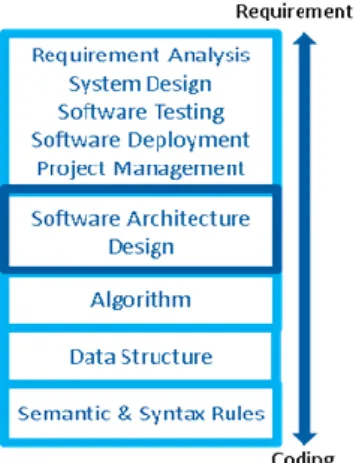
In general Computer Science curriculums, computer programming and practical techniques for implementation and application in computer system are important abilities for students. Figure 1 shows the typical catalogs of Computer Science curriculums [15]. From the coding’s aspects such as semantic and syntax rules of programming language, data structure and algorithm, to the requirement’ aspects like requirement analysis, system design, testing and deployment, the learners can gain the software development ability through taking lessons in a series of Computer Science curriculums.
However, as a result of the difficulty for learners to combine design concepts with implementation ability in construction phase [16], there still exists a gap between basic programming skills and software engineering abilities. Thus, the software
architecture design learning [3, 4] aims to solve the issues about how to design the
program architecture from requirement’s aspects to coding’s aspects. And in this thesis, we focus on the software architecture design learning of web-based system. The following sections will introduce related studies about present programming learning.
6
2.1 Web-Based System Design Learning
2.1.1 Traditional Teaching Approaches
General programming capability on web-based system design can be learned by lectures, case study, or project-based learning. Lecturer gives lessons about basic concepts of web-based system development to learners, but the concept may be too abstract to link the concept with their implementation ability. Case study [1-3] is to consult relevant books, such as codes tracing to imitate related design concepts or use class diagram to figure out the whole system architecture. These imitating learning approaches are very difficult for helping learners understanding the design procedure and the physical meaning of the whole system architecture design without the ability of guidance and explanation. In project-based learning [6, 7], learners who explore real-world problems and challenges can be inspired to obtain a deeper knowledge of the subjects they're studying, but the teachers usually can not afford one-on-one instruction.
Therefore, there are some issues which are required to be proved in this thesis as follows: combine learner’s implementation ability with design concepts, provide an appropriate guiding mechanism, make teaching cases contain semantic meaning, and reduce the teacher’s loading for one-on-one instruction.
2.1.2 Design Methodologies
In web-based system design [17], there are many methodologies such as Client-Server Architecture [18], Model-View-Controller Architecture, Component Based Methodology [19], and Model Driven Architecture [20], etc. Among these methodologies, three-tier architecture is a popular way for web-based system design [1]. Apart from the usual advantages of modular software with well defined interfaces,
three-tier architecture also allows any of the three tiers to be upgraded or replaced independently as requirements or technology change.
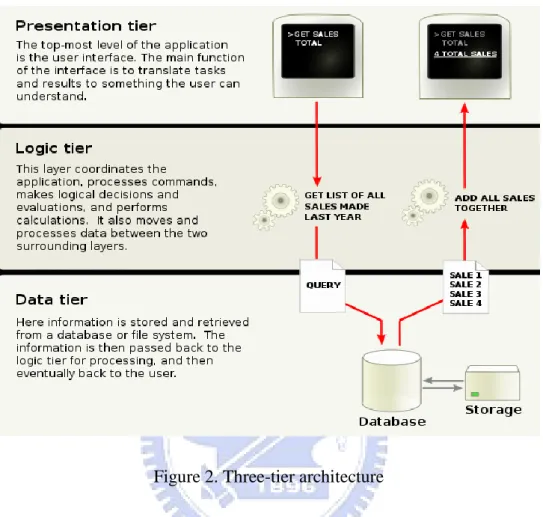
Figure 2. Three-tier architecture
Three-tier architecture is composed of presentation tier, logic tier and data tier. Figure 2 briefly describes the utility of each tier. Presentation tier converts and displays application data into a human-legible form, and it also provides an application’s user controls. Logic tier implements business logic and translates the reality into programming objects. Data tier provides data storage and data access mechanisms to the application. Except for the user interface of presentation tier and the data I/O of data tier, the logic tier is responsible to handle complicated computations and program control-flows. For novice programmers who just begin to learn web application design, the logic tier design usually becomes a bottleneck for them. Thus, in this thesis we focus on the software architecture design of logic tier.
8
2.1.3 Software Architecture Design
Designing, developing, and evolving complex software systems require a mastery of analytical and technical skills, as well as knowledge of appropriate processes, architectures and design patterns. Software architects building complex systems must create the illusion of simplicity through decomposition, abstraction, and encapsulation of functionality. The following issues will be discussed in software architecture design learning: the way to distribute the functionalities of software into different components, the components design to handle the logic computation, the responsibility of each component, the data and logic encapsulations, and the program control-flow, etc.
Surveying the researches about software architecture design learning, most researches adopt project-based learning to teach the design concepts by implementation. For example, Woei-Kae Chen and Yu Chin Cheng [6] designed an object-oriented programming (OOP) laboratory course where the students are required to implement a small-to-medium scale interactive computer game with framework-assisted. The students use the pre-define objects and source codes from teachers to modify and re-design the game scenario. The teaching assistants need to give all the students one-on-one instructions for guiding them to complete the lab, and it is a very time-consuming job.
2.2 Programming Learning in e-Learning
2.2.1 Object-Oriented Programming Learning
Object-oriented programming (OOP) is a programming paradigm which uses objects and their interactions to design applications and computer programs, and it is very popular to be used in web-based system development. In the OOP learning
researches of e-learning domain, most issues are relevant to teach the basic coding abilities and OO concepts such as inheritance, abstraction, encapsulation and polymorphism. The followings are relevant literature reviews about OOP learning
Stelios Xinogalos et al. [11] proposed a programming environment, objectKarel, which incorporates e-lessons, hands-on activities, an easy to use structure editor for developing and editing programs, program animation, explanatory visualization, highly informative and friendly error messages for novice programmers to develop programs.
J.Baltasar Garcia Perez-Schofield et al. [8] developed an interactive object-oriented environment, Visual Zero, which allows learners to concentrate on objects and their relationships from the very beginning, and thus helps the learners achieving a high degree of knowledge about the object-oriented programming paradigm.
Matthew Conway et al. [10] developed a 3D programming environment, Alice, to teach entry level Computer Science students basic programming concepts without exposing them to all the intricate details of a full-blown programming language. Using Alice, students accomplish their programming tasks by a series of mouse clicks and drag-and-drop maneuvers, and it eliminates from syntax and logical errors of programming.
The Lifelong Kindergarten research group at the MIT Media Lab [21] developed a new programming language, Scratch, to help the learners creating their own interactive stories, animations, games, music and arts. The learners can learn important mathematical and computational ideas, while also learn to think creatively, reason systematically, and work collaboratively.
10
2.2.1 Other Programming Learning Issues
In addition to basic coding ability, there are some researches about data structure, algorithm, structured query language (SQL) and design pattern.
Jaime Galvez et al. [22] presented a blended e-learning experience consisting of supplying an undergraduate student population with a learning tool called OOPS and a testing system called SIETTE to teach data structure.
Maria Kordaki et al. [9] presented a modeling, student-centered methodology for the design of a constructivist computer environment, the SORTING environment, for the learning of sorting algorithms, within a context consisting of interactive, multiple and linked representation systems.
Claus Pahl and Clair Kenny [23] presented an automated learning and skills training system for a database programming environment that promotes procedural knowledge acquisition and skills training. The system provides meaningful knowledge-level feedback such as correction of student solutions and personalized guidance through recommendations.
Zoran Jeremic et al. [24] presented the evaluation of DEPTHS (Design Patterns Teaching Help System), an intelligent tutoring system (ITS) for teaching software design patterns. Furthermore, there are other studies of software development in general showing that adherence to common software design principles, guidelines, and rules [25].
However, most of the aforementioned researches provide computer-assisted programming learning systems or assisting tools to help learners learning the basic coding abilities of object-oriented programming, but there is no research providing the learning system to assist the software architecture design learning. In order to provide
the learners one-on-one instruction in a cost effective manner and reduce the teacher’s loading, we decide to construct an intelligent tutoring system for software architecture design learning.
Chapter 3. Imitating Learning Guidance Approach
3.1 General Program Assignments
Generally, after a series of lectures in the programming course, the teacher usually assigns homework to make learners obtain a deeper knowledge of the design concepts they have learned. Figures 3 ~ 5 show three different implementation processes of program assignment, where the teacher uses the Video Rental
Management System (VRMS) project as an example to make the students think how to
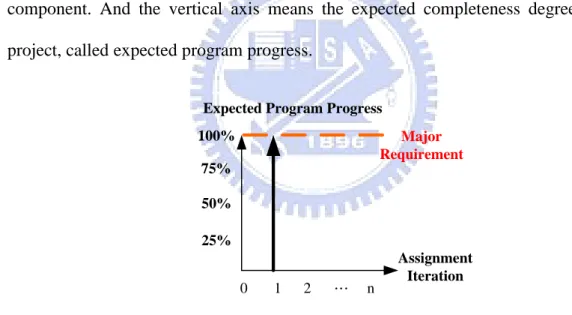
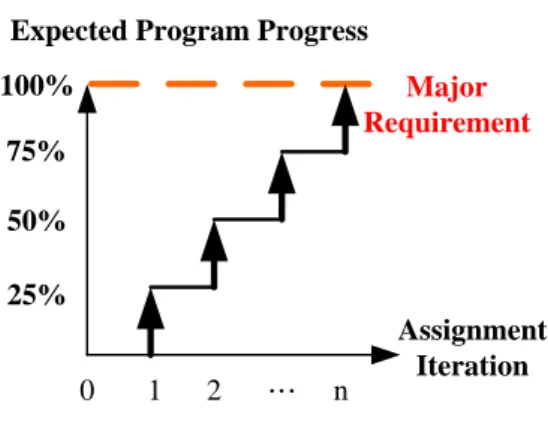
design this project. The horizontal axis means the assignment iteration, which is set by teacher according to the project’s features like the amount of functionality or component. And the vertical axis means the expected completeness degree of the project, called expected program progress.
Major Requirement Assignment Iteration 100% 25% 50% 75%
Expected Program Progress
0 1 2 … n
Figure 3. Traditional program assignment
Figure 3 shows that traditional program assignment assigns a whole VRMS project to students in one time. The teacher requests students to apply the knowledge which have been learned from the course to accomplish this project, but the scope of VRMS project is too big for students to know how to start implementing it. Hence, the students usually have trouble with this wide-scope assignment.
Major Requirement Assignment Iteration 100% 0 1 2 … n 25% 50% 75%
Expected Program Progress
Figure 4. Progressive program assignment
Figure 4 shows that in progressive program assignment, the teacher segments the VRMS project into several assignments according to the constructing procedure from basic components to major requirements, and the learners are asked to complete parts of programs progressively. This bottom-up manner can make learners understand the constructing process, but they have no idea about why and how the design of basic components and its details.
3.2 Major-Requirement-First Strategy (MRFS)
Hence, we propose a teaching strategy named Major-Requirement-First
Strategy (MRFS) to help learners easily understanding how to design the VRMS
project. This teaching strategy adopts a top-down imitating learning mechanism which guides the learners from the major requirements of VRMS to basic components and apply the ideas of Scaffolding Instruction Theory [12, 13].
As mentioned in scaffolding instruction theory, the Zone of Proximal
Development (ZPD) [12, 13] noted that it is also very efficient for learners to use their
prerequisite knowledge to help themselves developing new knowledge. So we intend to combine the learners’ implementation ability and request them to complete the
14
project by imitating the software architecture which is designed by teachers in advance.
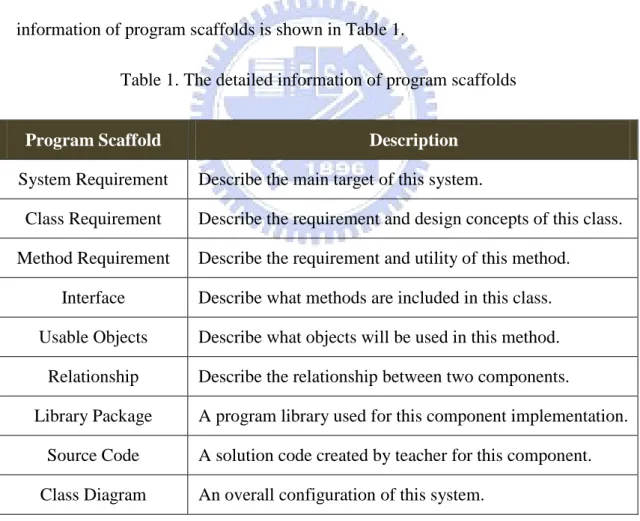
Moreover, scaffolding instruction theory also mentioned that building some scaffolds for learners and assisting them to complete the target they can’t accomplish before, and then gradually dismantling the scaffolds they have learned, is an effective way to get the learning objectives. So we provide the necessary scaffold which called program scaffolds, such as component requirements, interface and usable objects of each component, relationships between the components, library packages and source codes to assist learners to implement from the major requirements with these imitating information and library supporting. The detailed information of program scaffolds is shown in Table 1.
Table 1. The detailed information of program scaffolds
Program Scaffold Description
System Requirement Describe the main target of this system.
Class Requirement Describe the requirement and design concepts of this class. Method Requirement Describe the requirement and utility of this method.
Interface Describe what methods are included in this class. Usable Objects Describe what objects will be used in this method.
Relationship Describe the relationship between two components.
Library Package A program library used for this component implementation. Source Code A solution code created by teacher for this component. Class Diagram An overall configuration of this system.
Therefore, based on scaffolding instruction theory, MRFS guides learners to imitate the program architectures from major functionalities of system to detailed
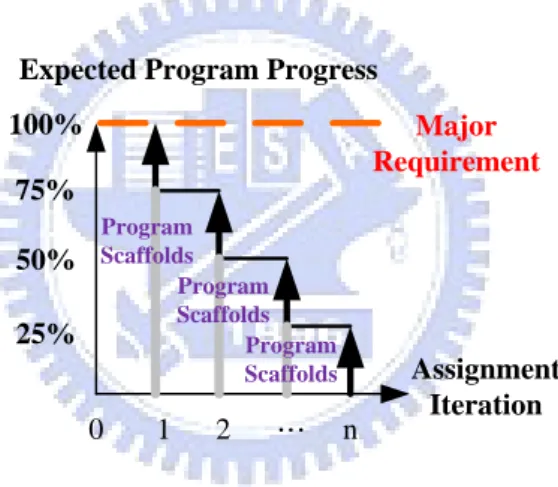
components through a series of implementations with program scaffolds supporting. As shown in Figure 5, top-down program assignment applies the idea of MRFS, where the teachers have to construct the necessary program scaffolds and segment the VRMS project into progressive assignments in advance, and then assign a task which is the major functionality of VRMS to students. After the students finish the assignment with program scaffolds supporting like library, they will continue to finish the detailed components of major functionality. Consequently, the learners can figure out the overall configuration of VRMS first, and then they will easily comprehend the design concepts of each detailed component. The learning efficacy of MRFS will be compared with general program assignments in our experiment in Chapter 5.
Major Requirement Assignment Iteration 100% 0 1 2 … n 25% 50% 75%
Expected Program Progress
Program Scaffolds Program Scaffolds Program Scaffolds
Figure 5. Top-down program assignment
Example 1. Major-requirement-first strategy for program assignments
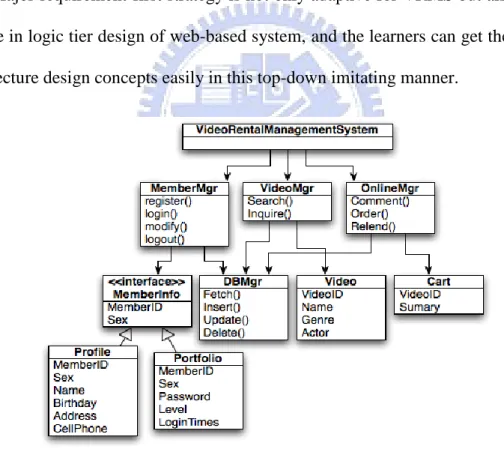
Figure 6 shows our teaching case in this thesis, Video Rental Management
System (VRMS), which is represented by class diagram. VRMS is a common
web-based system which can offer user convenient services about online video rental, such as video introduction, video search, popular video recommendation, subscribe and relend for video, online comment and member management, etc. Besides the user interface and database I/O, the learners are supposed to focus on logic tier design of
16
The teacher will segment the project into several assignments, and ask the learners to complete the assignments from “MemberMgr”, “VideoMgr” or “OnlineMgr”, the major functionalities of VRMS, to detailed components. If the “MemberMgr” task is assigned to learners, all the information about the task like design concepts, component requirements, interface, usable objects and library packages like “DBMgr”, “MemberInfo”, etc. should also be provided to assist learners implementing this class. The learners can imitate the software architecture design of VRMS through a sequence of implementations with guidance and program scaffolds supporting in this top-down imitating manner.
Major-requirement-first strategy is not only adaptive for VRMS but also suitable for use in logic tier design of web-based system, and the learners can get the software architecture design concepts easily in this top-down imitating manner.
Chapter 4. Major-Requirement-First Imitating
Learning System (MRFILS)
For the purpose to provide the learners one-on-one instruction in a cost effective manner and reduce the teacher’s loading, we develop the Major-Requirement-First
Imitating Learning System (MRFILS). MRFILS provides guidance and necessary
assistance for learners and assists them imitating the software architecture design of teaching cases which are constructed by teachers.
In order to apply MRFILS, the teachers have to construct necessary teaching materials for learners to imitate the software architecture design, and the learners need to have enough coding ability of object-oriented programming for implementation. The goal for this intelligent tutoring system is to help teachers constructing a knowledge structure of teaching case, and then applying a guiding mechanism to generate an imitating procedure, next guiding learners to imitate the software architecture design of teaching case through a series of implementations with program scaffolds supporting.
18
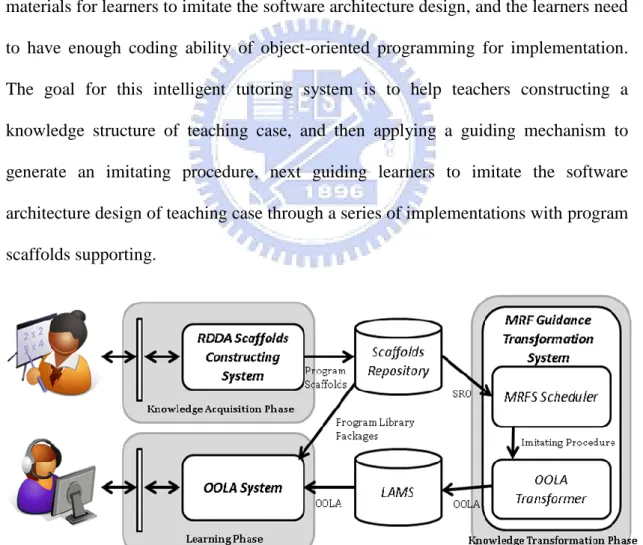
The MRFILS is composed of three phases, including knowledge acquisition
phase, knowledge transformation phase and learning phase. The overall picture of
system architecture is shown in Figure 7.
Firstly, in knowledge acquisition phase, the teachers construct the program scaffolds by the RDDA Scaffolds Constructing System, which applies the Recursive
Descent Dialog Approach (RDDA) to acquire the teacher’s knowledge of teaching
case through a series of dialogues. After the construction, the program scaffolds that are stored in scaffolds repository will be composed into a knowledge structure of teaching case, named System Requirement Ontology (SRO).
Next, in knowledge transformation phase, MRFS scheduler applies
Major-Requirement-First Strategy (MRFS) on SRO to schedule an imitating
procedure, and then OOLA Transformer arranges different learning guidance
templates for imitating procedure to transform an Object-Oriented Learning Activity (OOLA) [14].
At last, in learning phase, Object-Oriented Learning Activity (OOLA) System retrieves learning activities and necessary program library packages from Learning
Activity Management System (LAMS) [14] and scaffolds repository to present the
guiding information and learning contents for learners. The following sections will introduce the detail of each phase in MRFILS.
4.1 Knowledge Acquisition Phase
4.1.1 System Requirement Ontology (SRO)
For imitating learning, we need to construct teaching cases in advance. According to the features of logic tier design of web-based system, we define a knowledge structure named System Requirement Ontology (SRO) to maintain our teaching case, Video Rental Management System (VRMS).
Traditional learning content of programming case doesn’t take the physical meanings of components and the relationships between components into account, so it’s difficult for learners to get the design concepts of system. Thus, we think the SRO should contain semantic meanings like component’s utility and physical meaning of interaction, and then we can apply MRFS to schedule an appropriate imitating procedure based on the information. Accordingly, the knowledge representation of SRO is defined as Definition 1, where p means the total number of node set and q means the total number of relationship set.
Definition 1. System Requirement Ontology (SRO)
SRO = (N, R) : Composed of a set of nodes denoting to N and a set of relationships denoting to R.
N = {n1, n2, n3,…, np} : A set of nodes denoting the downstream nodes of n.
R = {r1, r2, r3,…, rq} : A set of relationships denoting the downstream
relationships of r.
ni = (nTypei, Namei, Requirementi, Interfacei, ClassQuantityi, UsableObjecti) :
20
component interface, the quantity of class under the component, and the names of usable objects, accordingly.
ri = (rTypei, Fromi, Toi) : Composed of relationship type, relationship original
node, relationship terminal node, accordingly. nTypei{System, Class, Method} :
System node is the root of SRO.
Class node is the class name of system.
Method node is the method name of class.
rTypei{ Be-composed-of, Contain, Use-data, Use-function, Such-as} :
Be-composed-of relationship describes what major functional classes constitute System node.
Contain relation describes what Method nodes are included in Class node.
Use-data relation indicates which data-storage Class node is used by Method node.
Use-function relation indicates which functional Class node is used by
Method node.
Such-as relation is similar to inheritance, and it is connected with two Class nodes.
Example 2. Parts of VRMS_SRO
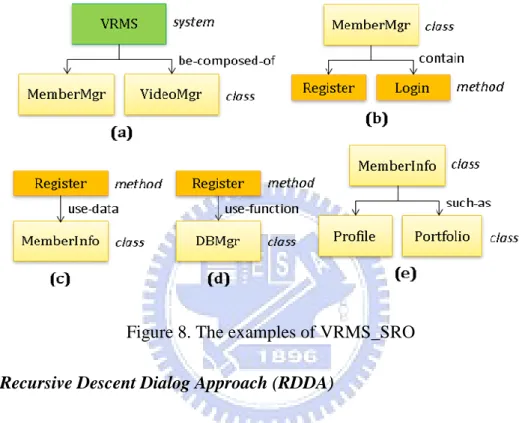
Figure 8 presents the utilities of three types of nodes and five types of relationships in VRMS_SRO, which is instantiated from SRO and used to maintain the knowledge structure of VRMS. Figure 8 (a) shows that VRMS is composed of major functionalities like “MemberMgr” class and “VideoMgr” class. Figure 8 (b) shows that “MemberMgr” class contains the interface such as “Register” method and “Login” method. Figure 8 (c) shows that “Register” method uses a data-storage object
called “MemberInfo” which stores the information about member to handle data encapsulation. Figure 8 (d) shows that “Register” method uses a functional object called “DBMgr” which communicates with database to handle logic computation. And Figure 8 (e) shows that “Profile” class and “Portfolio” class inherit from “MemberInfo” class.
Figure 8. The examples of VRMS_SRO
4.1.2 Recursive Descent Dialog Approach (RDDA)
After defining the SRO, we have to help teachers constructing this ontology. We propose the Recursive Descent Dialog Approach (RDDA), which is a systematic procedure to allow teachers to input relevant program scaffolds of VRMS. RDDA adopts a top-down dialogue mechanism built from a set of mutually-recursive procedures to construct SRO from major functionalities of VRMS to basic components by asking a series of questions about teacher’s design concepts of VRMS. The question templates described in Table 2 are defined based upon basic object-oriented design (OOD) process [5], which is shown in Figure 9. And the detailed algorithm of RDDA is shown in Algorithm 1.
22
Table 2. Question templates
Node Type Question Template
System 請輸入這套系統的名稱和主要的功能需求 請輸入這套系統主要功能的類別名稱 Class 請問這個類別主要的功能需求以及Interface為何 Method 請問這個方法的功能需求、會使用到的物件和使用的關係為何 請問在這個方法所使用到的物件中,會使用到哪些方法
Figure 9. Object-oriented design process Define system requirements
Define major requirements
Define interface
Define method requirements
Define usable objects & relationships Decompose to objects
Algorithm 1: Recursive Descent Dialog Approach (RDDA) Denotation :
S : The stack which is used for Depth-First Search (DFS)
Input: The program scaffolds of teaching case, Question Templates (QT) Output: System Requirement Ontology (SRO)
While (There exists node ni which needs to be constructed for teacher) {
Push node ni into S. While (S is not empty) {
Pop a node ni from S.
Based on ni type, use the corresponding QT to compose the dialogue and ask all necessary information about node ni from teacher.
Acquire the teacher’s answer and construct a node
ni = (nTypei, Namei, Requirementi, Interfacei, 0, UsableObjecti). Add ni to N.
For each relationship rj
{ The output relationships of ni } {Based on ni type, use the corresponding QT to compose the dialogue and ask all necessary information about rj from teacher.
Acquire the teacher’s answer and construct a relationship
rj = (rTypej, Fromj, Toj). Add rj to R. Push Toj into S. } } Construct a SRO = (N, R). For each node nk
N {According to the relationships and nodes of SRO to compute the class quantity under node nk, and then modify ClassQuantityk.
}
24
Example 3. RDDA Scaffolds Constructing System
RDDA Scaffolds Constructing System adopts a series of dialogues to acquire the knowledge from the teacher and construct a SRO of teaching case. Figure 10 shows the example of VRMS_SRO construction process, where VRMS_SRO is an instance of SRO. Firstly, RDDA Scaffolds Constructing System asks the system name, system requirement and major functionalities from the teacher. And then according to major functionalities, where we use “MemberMgr” for example to ask the class requirement, class interface and their relationships. Next, based upon the interface of “MemberMgr”, we choose a method “Register” for example to ask the method requirement, usable objects like “MemberInfo” and “DBMgr” and their relationships like “use-data” and “use-function”, accordingly. Rules like that, at last RDDA Scaffolds Constructing System will request the teacher to upload the library package, source codes and class diagram. According to this constructing process, the teacher can construct a complete VRMS_SRO by RDDA Scaffolds Constructing System.
4.2 Knowledge Acquisition Phase
4.2.1 Algorithm of Major-Requirement-First Strategy
The algorithm of MRFS is shown in Algorithm 2 and represented by the flowchart in Figure 11. The main algorithm of MRFS is Depth-First-Search (DFS) with heuristic functions to determine the search path. DFS needs a stack to store temporal nodes, and a queue to store the imitating procedure as output. The heuristic functions are based on the class quantity under each node and the weight of each relationship type, where we define the weight of “Use-function” relationship is 2, the weight of “Use-data” relationship is 1, and the others are 0 to schedule the priority of imitation. We think that imitating the functional components first will easily comprehend what is supposed to do in next step, so we set “Use-function” with high priority than “Use-data”. If the relationship types are equal, we will compare the class quantity under the node, where the larger quantity possesses the higher priority.
26
Algorithm 2: Major-Requirement-First Strategy (MRFS) Denotation :
S : The stack which is used for Depth-First Search (DFS) A : The array which is used for heuristic computation Q : The queue which stores the imitating procedure Input: System Requirement Ontology (SRO) Output: Q (Imitating Procedure)
If (There exists a root node ni of SRO) {
Push ni to Q.
While (ni contains any output relationship) {
Do {
For each relationship rj
{ The output relationships of ni } {Insert the relationship rj into A.
Compare the rTypej with the type of relationships in A, and sort these relationships according to relationship type from max to min. (“Use-function” = 2, “Use-data” = 1, others = 0)
If (A contains relationships r[] whose type is equal to rTypej) Compare ClassQuantityj with the class quantity of nodes which
are terminal nodes of relationships in r[], and sort these relationships according to class quantity from max to min. }
For each relationship rj in A Push Toj into S.
}While (S is not empty) Pop one node nk from S. Get a node ni = nk. Push nk to Q. }
}
Return Q.
Yes
No Input System Requirement
Ontology (SRO)
Get the root of SRO as present node
Does present node contain any
output relation?
Is S empty? Insert all output nodes of
present node into A
Push all nodes of A to S from min to max
Pop one node from S as present node and push it
to Q
Output Q Yes
No
Sort A according to output relationships’ type of
present node
Sort A according to output nodes’ class quantity of present node where the output relationships’ type
28
4.2.2 Major-Requirement-First Guidance Transformation System (MRFGTS)
In knowledge transformation phase, MRFGTS is composed of MRFS Scheduler and OOLA Transformer. MRFS Scheduler uses the SRO which constructed by RDDA
Scaffolding Constructing System to apply MRFS to schedule an imitating procedure,
and then OOLA Transformer transform this imitating procedure into a learning activity of OOLA system [14]. The internal procedure of MRFGTS is shown in Figure 12.
Figure 12. Major-Requirement-First Guidance Transformation System
Example 4. MRFS Scheduler
Figure 13 presents the example of MRFS Scheduler. Based upon the MRFS algorithm, we get the “VRMS” node which is the root of VRMS_SRO at first and push it into the imitating procedure. And then we check the output nodes and output relationships of “VRMS” node, where the three major functional nodes “MemberMgr”, “VideoMgr” and “OnlineMgr” contain the same relationships “be-composed-of”. So we will check the class quantity of these output nodes, and find out the largest one. Suppose that “MemberMgr” node has the largest class quantity of the three output nodes, we push it into the learning precedure, and check the output nodes and relationships again. Suppose there exists “Register” and “Login” method nodes and the relationships are as same as “Contain” relationship, and the “Register” node has large class quantity than “Login” node, so we push the “Register” node into
the imitating procedure. Accordingly, there are two objects will be used in the “Register” method, so we choose the “use-function” relationship which has high priority than “use-data” relationship and push “DBMgr” node into the imitating procedure. Rules like that, then we will push “InsertProfile”, “InsertPortfolio”, “MemberInfo”, “Profile”, “Portfolio” nodes and so on into the learning queue sequentially based on MRFS.
Figure 13. The example of MRFS Scheduler
Example 5. OOLA Transformer
In order to use OOLA System to present the learning contents, we need to transform the imitating procedure into an Object-Oriented Learning Activity (OOLA) in advance. As shown in Figure 14, after getting the imitating procedure from MRFS Scheduler, we arrange different learning guidance templates which are presented in Table 3 according to the type of nodes. The imitating procedure will attach different learning contents and learning resources which are constructed in knowledge acquisition phase to create the learning units, and then transform the imitating
30
Afterwards, OOLA Transformer can generate an OOLA based on learning units and OOLA rules.
Figure 14. The example of OOLA Transformer Table 3. Learning guidance templates
Node Type Learning Guidance Template
System
Learning Content
Introduction, system requirement analysis, major functionality requirements, and guiding
information. Learning
Resource Class diagram.
Class
Learning Content
Class requirement, interface, method requirements, impending method tasks, complete method list, guiding information, and task information. Learning
Resource Class diagram, source code, library package.
Method
Learning Content
Method requirement, usable object interface, usable object requirements, guiding information, and task information.
Learning
4.3 Learning Phase
4.3.1 Object-Oriented Learning Activity (OOLA) System
Object-Oriented Learning Activity (OOLA) System [14] is an expert system
with a graphical authoring tool, which can assist teachers to design adaptive learning activity, and a web based learning system, which can steer learners learning using a rule inference engine. The teacher can arrange learning sequence, edit learning contents and manage the learning resources to provide a learning activity to learners.
Figure 15. The system architecture of OOLA System
Figure 15 shows designing phase and executing phase in OOLA System. In the designing phase, an adaptive learning activity can be designed via the graphical authoring process to teachers easily integrating various learning resources, which are provided by learning resource repositories, and a rule class generating method is also proposed to generate the rule class of learning sequencing controls. In the executing phase, the learning sequencing graph and the rule class are used in rule based adaptive learning method to conduct an adaptive learning to learners.
Therefore, in the learning phase of MRFILS, an OOLA which is already attached necessary learning contents and learning resources will guide the learners to learn the
32
Chapter 5. System Implementation and Experiment
5.1 System Implementation
We have implemented a Major-Requirement-First Imitating Learning System (MRFILS) on web-based environment to evaluate the proposed ideas. The following sections will demonstrate the Teaching Materials Construction Phase and the
Software Architecture Design Learning Phase.
5.1.1 Teaching Materials Construction Phase
This phase we use a dialogue mechanism to acquire teachers’ design knowledge of Video Renal Management System (VRMS). MRFILS will ask teachers a series of questions and request them to input the program scaffolds by a systematic process.
As shown in Figure 16, these pictures present the construction process for the teaching materials of VRMS. At first, the teacher is requested to input the system name, system requirement (see Figure 16 (a)), and names of major functionalities (see Figure 16 (b)). Based upon one of major functionalities, MRFILS continues to ask this class requirement, interfaces and relationships (see Figure 16 (c)). Next, choosing one method among the interfaces to ask the method requirement, usable objects, relationships (see Figure 16 (d)), and usable methods (see Figure 16 (e)). And then keeping on asking the questions about the class requirement, interfaces and relationships of usable objects (see Figure 16 (f)). After a series of questions, the teacher is demanded to commit the source codes, and MRFILS will compile them to library packages automatically.
Figure 16. The snapshot of teaching materials construction phase (a) (b) (c) (d) (e) (f) (g)
34
5.1.2 Software Architecture Design Learning Phase
This phase we use Object-Oriented Learning Activity (OOLA) System to present the learning target “VRMS”, which is constructed by teacher in Teaching Materials Construction Phase. OOLA System will provide necessary learning contents and learning resources for learners and guide them to design the system architecture by imitating the compositions of each component and component’s design.
Figure 17 shows the learning process, where OOLA System offers guiding information to instruct the learners why and how the component design is in each step. First of all, the learning system provides the introduction about this imitating learning approach and a task to create a project (see Figure 17 (a)). And then the learners can get the system requirement analysis (see Figure 17 (b)), one of major functional classes introduction with a task and a library download link for learners to start implementing this class with library package supporting (see Figure 17 (c)). After that, the OOLA System provides the method information of this class and a task (see Figure 17 (d)) for learners to complete this method. Next, it continues to provide the class information which was used by previous method and a library package for task implementation (see Figure 17 (e)). Such as this top-down imitating learning procedure, the learners can gain these software architecture design concepts through a sequence of implementations.
(b)
(e) (d) (a)
36
5.2 Experiment
To evaluate the efficacy of Major-Requirement-First Strategy (MRFS) in software architecture design learning, we choose 10 graduate students who have enough coding ability of object-oriented programming (C#) from Computer Science in National Chiao Tung University. We design the Video Rental Management System (VRMS) as the teaching case and use Major-Requirement-First Imitating Learning System (MRFILS) to teach software architecture design. After a series of guidance by MRFILS, we use a questionnaire which is shown in Table 4 to evaluate the learning efficacy and satisfaction of learners. We apply the five-level Likert Scale which is the most widely used scale in survey research and it rates from 1 to 5 to specify the respondent’s agreement level to a statement. The five-level Likert degree is shown in Table 5 and the results for learning efficacy and satisfaction is shown in Figure 18.
Table 4. The questionnaire items
Questionnaire Items
Q1. Is the guiding procedure useful to construct the VRMS?
Q2. Is the information provided in each implementation process sufficient to construct the task?
Q3. Do you think that the library provided in each implementation process is useful to complete the task?
Q4. Do you think that using the library first and then construct these objects later will easily comprehend what should be considered in these objects? Q5. Do you think that this top-down imitating manner will easily understand why and how the software architecture design is than traditional bottom-up implementation?
Q6. Do you think that the learning efficacy of this system is better than other learning approaches such as lectures or case study?
Table 5. The format of a typical five-level Likert degree
Degree Meaning
1 Strongly disagree
2 Disagree
3 Neither agree nor disagree
4 Agree
5 Strongly agree
Figure 18. The results for learning efficacy and satisfaction
The results show that most of learners think this top-down imitating learning can help them understanding the software architecture design effectively than bottom-up implementation and traditional learning approaches like lectures or case study. And implement the programs with library packages supporting will easily comprehend how to design these used objects. Otherwise, some learners think the information of learning contents need to be more sufficient, and some learners don’t agree with the guiding procedure where the system provided.
38
5.3 Discussion
Finally, we also interview the learners and ask the impressions for MRFILS, there are some comments on this system as below:
Major-Requirement-First Strategy (MRFS)
Several learners think that this top-down imitating manner is a good idea for learning system design. Because traditional implementation manner is bottom-up, even they have the system requirements, architectural blue print, and UML diagrams for reference, it is still difficult to understand how to implement the system for learners who just begin to learn the web-based system design. Learning contents
Several learners think that we should provide more UML diagrams rather than only one Class Diagram, such as Use Case Diagram, Activity Diagram, and Sequence Diagram, etc., and point out the present status and what they have done. The learners believe that the information of UML diagrams will make themselves clearly understand the complete degree of system and the design procedure.
Guiding procedure
Because the guiding procedure is scheduled by MRFILS, where we design some heuristic algorithms to prioritize the imitating sequence, several learners think that we can provide more imitating sequences for them to choose rather than only one choice.
The above comments are very significant for improving this computer-assisted learning system, and we will take these comments into account in the future work.
Chapter 6. Conclusion and Future Work
In this thesis, we propose a top-down imitating learning manner named Major-Requirement-First Strategy (MRFS) and apply this teaching approach to construct an intelligent tutoring system named Major-Requirement-First Imitating Learning System (MRFILS) to teach software architecture design of logic tier in web-based system. The teachers can use MRFILS to construct teaching materials, where we adopt a web-based system called “Video Rental Management System (VRMS)” as our teaching case. MRFILS provides learners one-on-one instruction and assistance to guide them imitating the software architecture design of VRMS through a series of implementations with scaffolding instruction, and it will significantly reduce the loading of teachers. Finally, we have done a real experiment to evaluate the learning efficacy and satisfaction of learners. The experimental results show that MRFILS can help learners gaining the software architecture design concepts of VRMS effectively.
In the near future, we would like to embed diagnostic tests in the guiding process to evaluate the learning performance and learning status, and add some imitating learning guidance rules to provide adaptive learning for learners. Thus, the learners can get more flexible guiding procedure and more appropriate learning contents in the learning process.
40
References
1. Grady Booch, Building Web Applications with UML. 2000: Addison Wesley. 2. Grady Booch, Visual Modeling With Rational Rose 2002 AND UML. 2003:
Addison Wesley.
3. Jeff Garland, Richard Anthony, Large-Scale Software Architecture: A Practical
Guide using UML. 2003: Wiley.
4. David Garlan, Mary Shaw, An Introduction to Software Architecture. Advances in Software Engineering and Knowledge Engineering, January 1994.
5. Grady Booch, Robert A.Maksichuk, Object-Oriented Analysis And Design With
Applications. 2007: Addison Wesley.
6. Woei-Kae Chen, Yu-Chin Cheng, Teaching Object-Oriented Programming
Laboratory With Computer Game Programming. IEEE Transactions on
Education, AUGUST 2007. VOL.50, NO.3.
7. Liang-Yi Li, Gwo-Dong Chen, A Coursework Support System for Offering
Challenges and Assistance by Analyzing Students’ Web Portfolios. Educational
Technology & Society, 2009. Vol. 12: p. 205-221.
8. J. Baltasar Garcia Perez-Schofield, Emilio Garcia Rosello, Francisco Ortin Soler, Manuel Perez Cota, Visual Zero: A persistent and interactive object-oriented
programming environment. Journal of Visual Languages and Computing 2008.
Vol. 19 p. 380-398.
9. Maria Kordaki, Micael Miatidis, George Kapsampelis, A Computer Environment
For Beginners’ Learning of Sorting Algorithms: Design and pilot Evaluation.
10. Matthew Conway, Steve Audia, Tommy Burnette et al., Alice: Lessons Learned
From Building A 3D System For Novices, in Proceedings of the SIGCHI Conference on Human Factors in Computing Systems. April 2000: The Hague,
The Netherlands. p. 486-493.
11. Stelios Xinogalos, Maya Satratzemi, Vassilios Dagdilelis, An Introduction to
Object-Oriented Programming with A Didactic Microworld: ObjectKarel.
Computers & Education, 2006. Vol. 47: p. 148-171.
12. Rachel Van Der Stuyf, November 2002: Scaffolding As A Teaching Strategy. 13. Lev Semenovich Vygotskiĭ, Michael Cole, Vera John-Steiner, Sylvia Scribner,
Mind in Society: The Development of Higher Psychological Processes. 1978:
Harvard University Press.
14. Huan-Yu Lin, Shian-Shyong Tseng, Jun-Ming Su, Jui-Feng Weng, Design and
Implementation of an Object Oriented Learning Activity System, in Proc. of the 10th World Multi-Conference on Systemics, Cybernetics and Informatics (WMSCI). July, 2006: Orlando, Florida, USA.
15. Computer Science (Catalog). 2006; Available from:
http://beloit.edu/~huss/cs/CS%20Catalog.html.
16. Jungwoo Ryoo, Frederico Fonseca, David S.Janzen, Teaching Object-Oriented
Software Engineering through Problem-Based Learning in the Context of Game Design, in 21st Conference on Software Engineering Education and Training, IEEE Computer Society. 2008.
17. Michael Lang, Brian Fitzgerald, Web-based Systems Design: A Study of
42
18. Robert Orfali, Dan Harkey, Client/Server Programming with Java and CORBA. 2nd ed. 1998: John Wiley & Sons, Inc.
19. Seung C. Lee, Ashraf I. Shirani, A Component Based Methodology for Web
Application Development. Systems and Software, 2004. Vol. 71.
20. Dimitrios A. Kateros, Georgia M. Kapitsaki, Nikolaos D. Tselikas and Iakovos S. Venieris, A Methodology for Model-Driven Web Application Composition, in
IEEE International Conference on Services Computing. 2008.
21. Lab, T.L.K.R.G.a.t.M.M. SCRATCH. Available from: http://llk.media.mit.edu.
22. Jaime Galvez, Eduardo Guzman, Ricardo Conejo, A Blended E-Learning
Experience in A Course of Object Oriented Programming Fundamentals.
Knowledge-Based Systems, 2009.
23. Claus Pahl, Claire Kenny, Interactive Correction and Recommendation for
Computer Language Learning and Training. IEEE Transactions on Education
and Data Engineering, June 2009. Vol. 21.
24. Zoran Jeremić, Jelena Jovanović, Dragan Gašević, Evaluating an Intelligent
Tutoring System for Design Patterns: the DEPTHS Experience. Educational
Technology & Society, 2009. Vol. 12: p. 111-130.
25. L. Briand, C. Bunse, and J. Daly, A controlled experiment for evaluating quality
guidelines on the maintainability of object-oriented designs. IEEE Transactions