Thermally stimulated current and
DSC studies of the dual
glass transitions in side-chain liquid crystalline
copolysiloxanes containing
44
(S)-2-methylbutoxy]phenyl
3-chloro-4-alkenyloxybenzoate
side groups
Huey-Ling Chang, Chain-Shu Hsu
*
Department of Applied Chemistry, National Chiao Tung University, Hsinchu, Taiwan, 30050, R. 0. C.
(Received: November 25, 1996; revised mansuscript of January 27, 1997)
SUMMARY
The synthesis of side-chain liquid crystalline copolysiloxanes containing 0-[4-[4-[(S- 2-methylbutoxy]phenoxycarbonyl]-2-chlorophenoxy]alkyl side groups is presented. Dif- ferential scanning calorimetry, optical polarizing microscopy and X-ray diffractometry reveal smectic mesomorphism for most of the obtained polymers. The copolysiloxane with three methylene units in the spacer is the only one showing no mesomorphic prop- erty. The other four copolysiloxanes, containing four, five, six or eleven methylene units in the spacer, display a smectic A phase. All of the obtained polymers present dual glass transition behavior by both DSC and thermally stimulated current (TSC) techniques. The first glass transition (Tgl) at lower temperature is due to the segmental motions of the polysiloxane backbone, while the second glass transition (Tg2) is due to the cooperative relaxation motions of spacers and mesogenic units.
Introduction
Systematic investigation on the synthesis and characterization of side-chain liquid crystalline polymers (LCPs) became possible only after Finkelmann and Rings- dorf'.*) proposed that a flexible spacer has to be inserted between the main chain and the mesogens to decouple the motions of the polymer main chain and of the side groups in the liquid crystalline state. Recently, we and Percec et al. have suggested that highly or even completely decoupled side-chain LCPs would be realizable for systems in which the mesogenic groups and the polymer backbone are microphase separated3-@. These side-chain LCPs exhibit two glass transition temperatures, i. e., one due to the independent motion of the main-chain, and the other due to the coop- erative but independent motion of the side groups.
The molecular dynamics behavior of side-chain LCPs has been extensively stu- died by dielectric relaxation spectros~opy~-'~). But the correlation of the motions of the main chain with those of the pendant mesogenic units is not clearly understood yet. The thermally stimulated current (TSC) technique is another very suitable method for study of the molecular dynamics behavior of side-chain LCPs. The first TSC study of a side-chain LCP was published by SimonI3) in 1989, and since then several pieces of work have also been reported on this subjectI4-I8).
The goal of this study is to present the synthesis and characterization of a series of side-chain LC copolysiloxanes containing 0-[4-[4-[(S)-2-methylbutoxy]phenoxy- Macromol. Chem. Phys. 198, No. 10, October 1997
carbonyl]-2-chlorophenoxy]alkyl side groups. These polymers were characterized by differential scanning calorimetry (DSC), optical polarizing microscopy, X-ray diffraction and thermally stimulated current (TSC). The dual glass transition beha- vior of the synthesized copolysiloxanes is discussed.
Experimental part Materials
Poly(methylsi1oxane-co-dimethylsiloxane) [(30-35) : (65-70) mol-%)]
(M,
= 2000- 2 100) and divinyltetramethyldisiloxane platinum catalyst were obtained from Patrarch Systems Inc. (Bristol, PA, USA) and used as received. 3-Chloro-4-hydroxybenzoic acid (from Janssen, Belgium), (S)-(-)-2-methyl- 1-butanol ([a]:: = -5.8" (neat)) and all other reagents (from Aldrich, Milwaukee, USA) were used as received. Dichloromethane used in the esterification was refluxed over calcium hydride and then distilled under nitrogen. Toluene used in the hydrosilation reaction was first refluxed over sodium and then dis- tilled under nitrogen. 4-[(S)-2-Methylbutoxy]phenol and 10-undecen-1-yl tosylate were synthesized according to the literature procedures'932o).Techniques
'H NMR spectra (400 MHz) were recorded on a Varian VXR-300 spectrometer. FT-IR spectra were measured on a Nicolet 520 FT-IR spectrometer. Thermal transitions and thermodynamic parameters were determined by using a Seiko SSC/5200 differential scanning calorimeter (DSC) equipped with a liquid nitrogen cooling accessory. Heating and cooling rates were 10 "C/min. Thermal transitions reported were collected during the second heating and cooling scans. A Carl-Zeiss Axiophot optical polarized microscope equipped with a Mettler FP 82 hot stage and an FP 80 central processor was used to observe the thermal transitions and to analyze the anisotropic textures. Preparative gel permeation chromatography (GPC) was run on a Waters 510 LC instrument equipped with a 410 differential refractometer and a preparative GPC column (22.5 mm x 60 cm) supplied by American Polymer Standard Co. X-ray diffraction measurements were per- formed with nickel-filtered Cu K , radiation with a Rigaku powder diffractometer. Optical rotation was measured on a Jasco DIP - 140 polarimeter.
TSC experiments were carried out with a TSC/RMA spectrometer (Solomat Instru- ments, Stamford, CT, USA) covering the range -170 to 400°C. In each experiment, the sample was polarized for several minutes by a polarization voltage Vp at a temperature
Tp, and the polarization was frozen-in by cooling down to a temperature To
<
T,, in thepresence of an electric field. with the field off, the depolarization current was then mea- sured as the sample was heated up at a constant rate to Tf (Tf > Tp).
3-Chloro-4-alkenyloxybenzoic acids (1 -5)
The compounds 1-5 were prepared by the etherification of alkenyl bromides or unde- cenyl tosylate with 3-chloro-4-hydroxybenzoic acid, respectively. 3-Chloro-4-allyloxy- benzoic acid (1) was synthesized similarly to 4-alkoxybenzoate2*), and recrystallized
from MeOH/H20 (112 vol. ratio) to yield white crystals (96.2%). 'H NMR (CDCI,, TMS): 6 = 4.65 (d, 2H, <&O-), 5.34 (m, 2H, --CH=C€&, 6.04 (m, 1 H, -CH=), -
Synthesis of monomers 1 M-5 M
All olefinic monomers (1 M-5M) were prepared by the same method via esterification of the acid chlorides2'). The obtained crude product of monomer 1 M was dissolved in methylene chloride and passed through silica gel acid, then recrystallized from ethanol to yield white crystals (87.4%). 'HNMR (CDC13, TMS): 6 = 0.92-1.86 (m, 9H, --CH(CF3)13&), 3.76 (d, 2H, --Cg20-), 4.80 (d, 2H, =CH-CH,-), - 5.42 (m, 2H, =€I&), 6.02 (m, 1 H,
--Cc=),
6.92-8.19 (m, 7 aromatic protons).Synthesis of copolysiloxanes 1 P-5P
The copolymers were obtained by hydrosilylation of poly(methylsi1oxane-co-dimethyl-
siloxane) [(30-35) : (65-70) mol-%] with olefinic monomers 1 M-5M using divinylte- tramethyldisiloxane platinum catalyst (0.1 mol-% to SiH group)2ox21). The polymers were separated and purified by several reprecipitations from tetrahydrofuran solution into methanol, further pruified by preparative GPC, and then dried under vacuum.
Results and discussion
Tab. 1 summarizes the phase transition temperatures of monomers 1 M - 5 M . All
obtained monomers show n o mesomorphic property. The reason could be due to the
Tab. 1. Phase transitions of monomers 1 M - 5 M
Monomer m Phase transition in 'Ca)
1 M 2 M 3 M 4 M 5 M 3 4 5 6 11 ~ K 77.1 I K 52.9 I K 82.0 I K 79.7 I K 47.1 I a) K = crystalline, I = isotropic.
Fig. 1. DSC curve (lO°C/ min) of copolysiloxane 4 P
f--
1 1 1 1 1 1 ' ' ' 1
57.2
bulky lateral chloro-substituent that impedes the mesogenic side group to form a mesophase.
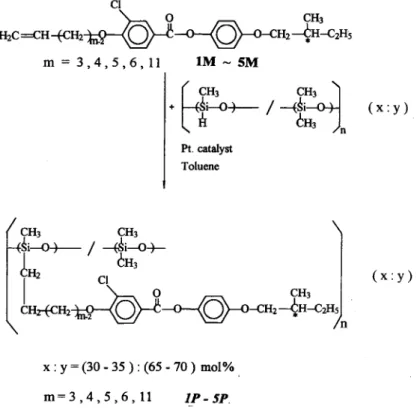
The synthesis of side-chain LC copolysiloxanes is outlined in Scheme 1. An excess amount of olefinic monomers was usually used to carry the hydrosilylation reaction to completion. The unreacted monomers and poly(methylsi1oxane-co- dimethylsiloxane) [(30-35) : (65-70) mol-%] were removed by several reprecipita- tions from tetrahydrofuran solution into methanol and by preparative GPC, and the copolysiloxanes 1 P-5P were isolated with high purities.
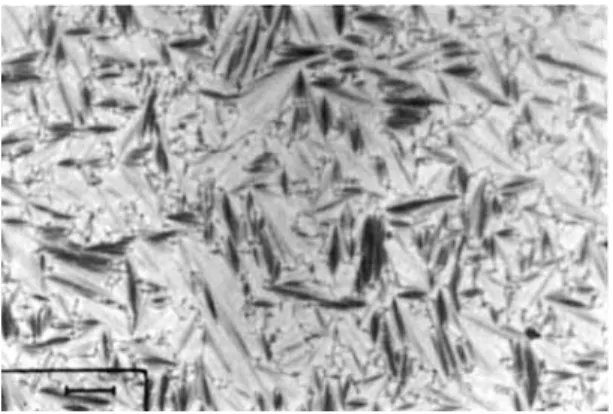
Fig. 1 depicts a representative DSC curve of 4P. It presents two glass transition temperatures at -98 and -16.4 "C and an SA to isotropic phase transition at 57.2 "C. Fig. 2 presents the typical SA texture exhibited by 4P. Tab. 2 summarizes the phase transition temperatures of copolysiloxanes 1 P-5 P. Copolysiloxane 1 P, which con- tains 3 methylene units in the spacers, shows no liquid crystalline behavior. Copoly- siloxanes 2P-4P, which contain 4-6 methylene units in the spacers, reveal SA phase, while copolysiloxane 5P, which contains 11 methylene units in the spacer, exhibits an SA and a crystalline phase.
Scheme 1: Synthesis of copolysiloxane 1 P
-
5 Pm = 3,4,5,6,11 1M
-
5M ~+@-
/
+Edn
( x : y > Pt. catalyst Toluene x : y = ( 3 0-
35 ) : (65-
70) mol% m=3,4,5,6,11 113-513.Fig. 2. Optical polariz-
ing micrograph displayed by 4P: SA texture obtained at 50 "C
(H:
25p-4
SP 34.2K
L
R
I I I I 1 I 5 10 15 20 2s so 28 (degree) Fig. 3. 60 "C, (B) 50 "C and ( C ) 25 "CFig. 3 presents the temperature-dependent X-ray diffraction diagrams obtained from powder sample of 5P at 65,55 and 25 "C. Curve A presents a diffuse reflection at about 5.8
A,
which corresponds to lateral spacing of two mesogenic side groups, and a sharp diffraction at 34.2A
which corresponds to the spacing of smectic layers. Optical polarizing micrograph exhibits a focal-conic fan texture for polymer 5P at this temperature. Both results are consistent with an SA structure. When the measur- ing temperature was lowered from 65 to 55"C, the X-ray diffraction curve also reveals an SA structure (curve B). On further cooling to 25 "C, a series of diffraction peaks at 35.0, 17.3, 6.9, 4.7, 4.2, 4.0 and 3.4A
were observed (curve C), indicating the formation of a crystalline phase.Side-chain liquid crystalline polymers constitute a major class of LCPs in which mesogenic units are attached laterally to the main chain via a flexible spacer. In prin- ciple, the main chain has the tendency to form a random coil conformation and the mesogenic side groups tend to self-orient into an anisotropic mesophase'). In order to balance the competition between the backbone's random-coil conformation and the mesogenic side groups, a flexible spacer is inserted between the polymer back- bone and the mesogenic side group. The spacer thus causes a dynamic decoupling of the motions of the main chain and side groups. Consequently, the most accurate visualization of a side-chain LCP is the interaction of two semi-independent thermo- dynamic subsystems through the flexible spacer; i. e., a section of the spacer plasti- cizes the main-chain, while another section of the spacer stabilizes the mesogenic units. According to Percec et al.3-7), a highly decoupled side-chain LCP can be rea- lized for a system in which the polymer backbone and side groups are microphase separated. These side-chain LCPs exhibit two glass transition temperatures by DSC. One of the glass transitions is assigned to the independent motions of the main chain. The other is due to the cooperative (but independent from the main chain) motions of the side groups.
As can be seen from the DSC trace (Fig. 1) and data listed in Tab. 2, all copoly- siloxanes 1 P-5 P exhibit two glass transitions by DSC. The first glass transition at low temperature ( T g l ) is due to the independent motion of polysiloxane backbone, while the second glass transition (Tg2) is due to the cooperative motion of the side groups.
The thermally stimulated current (TSC) technique is a dielectric technique which is also a very suitable tool for study of the molecular motions of a side-chain LCP.
Tab. 2. Thermal transitions of copolysiloxanes 1P-5P determined by DSC
Polymer m Thermal transition in Ta)
1P 3 GI -86.0 G2 -15.6 I
2P 4 GI -86.0 G2 -10.8 S A 41.7 I
3P 5 GI -86.3 G2 -15.3 S A 61.8 I
4P 6 GI -98.0 G2 -16.4 S A 57.2 I
5P 11 GI -98.0 G2 -14.4 K 49.3 S A 69.5 I a) G = glassy state, SA = smectic A, K = crystalline, I = isotropic.
Thermally stimulated current and DSC studies of the dual glass transitions in side-chain ... 2991 h hl 7 8.0
5?
~~.oi
ii
E
C 6 - os
2.0 0.0 -150 -100 -50 0 50T q .
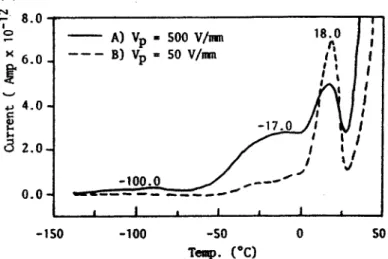
("C)Fig. 4. TSC traces of copolysiloxane 1P obtained at (A) Vp = 500 V/mm, (B) Vp = 50 V/mm. The experimental conditions were: Tp = 6 0 ° C To = -140°C Tf = 100°C and heating rate = 7 "C/min
1.15 - 1
.so-
1.25- 1.oo-
0.75- 0.50--
A) Vp-
500 V/mB)
Vp = 50 V / m- - -
-150 -100-so
0 50 Temp. ("C)Fig. 5. TSC traces of copolysiloxane 4P obtained at (A) Vp = 500 V/mm, (B) Vp = 50 V/mm. The experimental conditions were: Tp = 60°C, To = -140°C Tf = 100°C and heating rate = 7 "C/min
The TSC global spectra of polymer 1P with two different polarization voltages are shown in Fig. 4. Three peaks are observed: a high intensity peak with temperature of maximum at 18.0"C and two low intensity peaks at -100.0 and -17.0"C. In compar- ison with the DSC results listed in Tab. 2, it is thus reasonable to believe that both
peaks at -100°C and -17.0"C belong to the dual glass transition relaxations of poly- mer 1P. Besides dual glass transitions, polymer 1 P shows no mesophase transition
by DSC. However, it shows a relaxation peak at 18.0”C. According to Mano et al.’@, this peak is attributed to the motions of the longitudinal component of the dipole moment of the mesogenic side groups. The TSC global spectra of copoly- siloxane 4 P with two different polarization voltages are shown in Fig. 5. Copoly- siloxane 4 P shows a high intensity peak at 173°C and two glass transition peaks at -101.1 and -18.5”C, and copolysiloxane 5 P displays a similar behavior.
In conclusion, dual glass transitions are observed by both DSC and TSC for a ser- ies of side-chain liquid crystalline copolysiloxanes containing 0-[4-[4-[(S)-2- methylbutoxy]phenyloxycarbonyl]-2-chlorophenoxy]alkyl side groups. The first glass transition (Tgl) at lower temperature is due to the segmental motions of the polysiloxane backbone, while the second glass transition (Tg2) is due to the coopera- tive relaxation motions of spacer and mesogenic units. A high intensity upper T .
relaxation is also observed on each of the TSC curves. The peak is attributed to the motions of the longitudinal component of the dipole moment of the mesogenic side groups. Comparison of the DSC and TSC results confirms the TSC technique as a powerful tool to study the molecular dynamics behavior of a side-chain LCP.
Acknowledgment: The authors are grateful to the National Science Council of the
Republic of China for financial support of this work (Grant NSC 84-2216-E009-011).
H. Finkelmann, H. Ringsdorf, J. H. Wendorff, Makromol. Chem. 179,273 (1978) (1978)
2, H. Finkelmann, M. Happ, M. Portugal, H. Ringsdorf, Makromol. Chem. 179, 2541 3, C. S. Hsu, V. Percec, Makromol. Chem., Rapid Commun. 8,331 (1987)
4, C. S. Hsu, V. Percec, Polym. Bull. 17,49 (1987)
5 , C.
S.
Hsu, V. Percec, Polym. Bull. 18,91 (1987)6, B. Hahn, V. Percec, Macromolecules 20,2961 (1987)
’) B. Hahn, V. Percec, Mol. Cryst. Liq. Cryst. 157, 125 (1988)
*) V. Percec, C. Pugh in “Side Chain Liquid Crystal Polymers”, C. B. McArdle, Ed.,
9, G. S. Attard, K. Araki, J. J. Moura Ramos, G. Williams, Liq. Cryst. 3,861 (1988)
lo) J. P. Pameix, R. Njeumo, C. Legrand, P. LeBamy, J. C. Dubois, Liq. Cryst. 2, 167
I I ) F. J. Bormuth, W. Haase, R. Zentel, Mol. Cryst. Liq. Cryst. 148, 1 (1987)
12) C. M. Haws, M. G. Clark, G. S. Attard, in “Side Chain Liquid Crystals Polymers”,
13) G. P. Simon, Polymer 30,2227 (1989)
14) F. Faubert, J. M. Gilli, P. Sixou, J. Dandurant, C. Lacabanne, Mol. Cryst. Liq. Cryst. 15) W. Kohler, D. R. Robello, P. T. Dao, C. S. Willand, J. Chem. Phys. 93,9157 (1990)
16) J. F. Mano, N. T. Correia, J. J. Moura Ramos, Polymer 35, 3561 (1994)
17) J. F. Mano, J. J. Moura Ramos, A. Femandes, G. Willams, Polymer 35,5170 (1994) 18) J. F. Mano, N. T. Correia, J. J. Moura Ramos, A. C. Femandes, J. Polym. Sci., Part B: 19) V. Percec, C . S. Hsu, D. Tamazos, J. Polym. Sci., Part A: Polym. Chem. 26, 2047
20) C. S. Hsu, J. H. Lin, L. R. Chou, G. H. Hsiue, Macromolecules 25,7126 (1992)
21) C. S. Hsu, L. J. Shih, J. Polym. Res. 3, 185 (1996)
Blakie, Glasgow and London 1989, p. 30
(1987)
C. B. McArdle, Ed., Blackie, Glasgow and London 1989, p. 196
178,133 (1990)
Polym. Phys. 33,296 (1995)