Sr 3 B 2 O 6 : Ce 3 + , Eu 2 + : A potential single-phased white-emitting borate phosphor
for ultraviolet light-emitting diodes
Chun-Kuei Chang and Teng-Ming Chen
Citation: Applied Physics Letters 91, 081902 (2007); doi: 10.1063/1.2772195
View online: http://dx.doi.org/10.1063/1.2772195
View Table of Contents: http://scitation.aip.org/content/aip/journal/apl/91/8?ver=pdfcov Published by the AIP Publishing
Articles you may be interested in
Sr 3 Al 2 O 5 Cl 2 : Ce 3 + , Eu 2 + : A potential tunable yellow-to-white-emitting phosphor for ultraviolet light emitting diodes
Appl. Phys. Lett. 94, 091902 (2009); 10.1063/1.3094753
Vacuum ultraviolet spectroscopic properties of rare earth ( RE = Ce , Tb , Eu , Tm , Sm ) -doped hexagonal K Ca Gd ( P O 4 ) 2 phosphate
J. Appl. Phys. 102, 093514 (2007); 10.1063/1.2800172
Enhanced luminescence of Sr Si 2 O 2 N 2 : Eu 2 + phosphors by codoping with Ce 3 + , Mn 2 + , and Dy 3 + ions
Appl. Phys. Lett. 91, 061119 (2007); 10.1063/1.2768916
Ce 3 + Eu 2 + codoped Ba 2 Zn S 3 : A blue radiation-converting phosphor for white light-emitting diodes Appl. Phys. Lett. 90, 171908 (2007); 10.1063/1.2731685
On Ba Mg Al 10 O 17 : Eu 2 + phosphor degradation mechanism by vacuum-ultraviolet excitation J. Appl. Phys. 98, 113528 (2005); 10.1063/1.2132094
This article is copyrighted as indicated in the article. Reuse of AIP content is subject to the terms at: http://scitation.aip.org/termsconditions. Downloaded to IP: 140.113.38.11 On: Wed, 30 Apr 2014 07:08:51
Sr
3B
2O
6: Ce
3+, Eu
2+: A potential single-phased white-emitting borate
phosphor for ultraviolet light-emitting diodes
Chun-Kuei Chang and Teng-Ming Chena兲
Phosphors Research Laboratory, National Chiao Tung University, Hsinchu 30010, Taiwan and Department of Applied Chemistry, National Chiao Tung University, Hsinchu 30010, Taiwan
共Received 1 May 2007; accepted 25 July 2007; published online 20 August 2007兲 The Ce3+/ Eu2+ coactivated Sr
3B2O6 phosphors exhibit varied hues from blue through white and
eventually to yellow-orange by resonance-type energy transfer from Ce3+ to Eu2+ and tuning the
relative proportion of Ce3+/ Eu2+properly. The authors have demonstrated that electric dipole-dipole
interaction dominates the energy transfer mechanism in Sr3B2O6: Ce3+, Eu2+ phosphor, and the
critical distance of energy transfer has been estimated to be about 30 Å by both spectral overlap and concentration quenching methods. They have also shown that under the excitation of UV radiation, white light is generated by coupling 434 and 574 nm emission bands attributed to Ce3+ and Eu2+
radiations, respectively. © 2007 American Institute of Physics. 关DOI:10.1063/1.2772195兴
A primitive white LED lamp consisting of three LED dices of red, green as well as blue is easy to fabricate, but some disadvantages exist:共1兲 high cost, 共2兲 drive voltages are different to each other, and 共3兲 thermal properties and degradation trends are also different, and, thus, restrict its wide application. A good choice to assemble white LEDs in low cost is to couple a blue or near-ultraviolet 共UV兲 LED with a downconverting phosphor. For example, the commer-cial YAG 共yttrium aluminum garnet兲:Ce 共Ref. 1兲 yellow
phosphor excited by a blue GaN LED results in two-band white light emission. In spite of white light that is easily achieved in YAG:Ce based system, the individual degrada-tion rate between the blue LED and yellow phosphor will cause chromatic aberration and poor white light performance after long period of working. Developing a single-phased white-emitting phosphor using the principle of energy trans-fer共ET兲 from a sensitizer 共energy donor兲 to an activator 共en-ergy accepter兲 in a single host lattice for UV LEDs is an excellent option to replace YAG:Ce based white-emitting system. The ions possessing f-d or d-d electron configura-tions are good candidates to be selected as activators in phos-phors because they could emit visible and broadband light under the influence of crystal-field and nephelauxectic effects.2Moreover, white light can be produced by codoping these ions together under effective resonance-type ET in a single host, such as Eu2+/ Mn2+ coactivated systems.3–10
Al-though there were sweeping studies on Eu2+/ Mn2+ codoped
white-emitting phosphors in the past years, yet, investiga-tions on Ce3+/ Eu2+codoping white-emitting phosphors were
rarely reported. In certain Eu2+-doped oxide matrices, the
yellow-orange emission and UV to blue-light excitation are commonly observed through the strong crystal-field splitting and the lower energy of centroid of 5d level. Hence, Eu2+ can be sensitized by a well-known blue-emitting Ce3+ in
such oxide lattices because of the spectral overlap between emission band of Ce3+ and excitation band of Eu2+. Conse-quently, white light with blue and yellow-orange irradiations can be produced in this kind of Ce3+/ Eu2+-codoped
single-composition oxide host.
The crystal structure of Sr3B2O6 was first determined
and reported by Richter and Muller11in 1980; the lumines-cence of Sr3B2O6: Ce3+ and Sr3B2O6: Eu2+ was reported to
exhibit blue and yellow-orange emissions, respectively, at 4.2 K by Schipper et al. in 1993.12 However, the lumines-cence properties of Ce3+/ Eu2+-codoped Sr
3B2O6 have not
been reported in the literature. Therefore, according to the design principles discussed above, we have explored and dis-covered a single-composition Sr3B2O6: Ce3+, Eu2+
共SB-O:Ce,Eu兲 white phosphor and investigated its luminescence properties as well as ET phenomenon between the sensitizer and activator for potential application in white LEDs.
SBO:Ce,Eu phosphors studied in this work were synthe-sized by a solid-state reaction route. The reactants SrO, H3BO3, CeO2, and Eu2O3 with high purity of 99.99% were mixed in the requisite proportions and calcined at 900– 1000 ° C under 15% H2/ Ar atmosphere. The detailed
measurements of photoluminescence 共PL兲, photolumines-cence excitation 共PLE兲, Commission International de I’Eclairage共CIE兲 chromaticity, and diffuse reflectance 共DR兲 spectra have been carried out at room temperature and de-tailed in our previous work.6
The PL, PLE, and DR spectra for solely Ce3+ 共or
Eu2+兲-doped and Ce3+/ Eu2+-codoped Sr3B2O6 are
repre-sented in Fig.1. As shown in Fig.1共a兲, under UV of 351 nm excitation, a broad asymmetric blue emission band centering at 434 nm, which is attributed to the 5d1→4f1 transition of Ce3+, is observed in the PL spectrum. The asymmetry of the
emission band of Sr3B2O6: Ce3+ results from the spin-orbit
coupling into two levels of ground state, and it can be de-convoluted into two Gaussians centering at 427 and 470 nm that originated from the lowest 5d level to 2F5/2and 2F7/2, respectively. The energy difference between spin-orbit split-ting of 4f ground state in Sr3B2O6: Ce3+ is about 2142 cm−1
which is in good agreement with the theoretical value13 of 2000 cm−1. As depicted in Fig. 1共b兲, the PL spectrum of
Sr3B2O6: Eu2+ shows a broad yellow-orange emission band
centering at 574 nm attributed to the typical 4f65d1→4f7共8S
7/2兲 transition of Eu2+, and the PLE spectrum
shows a broad absorption from UV to blue region with a maximum at 377 nm. The low energy of Eu2+emission band
in Sr3B2O6: Eu2+is due to the strong crystal-field and
nephe-a兲Author to whom correspondence should be addressed; electronic mail:
APPLIED PHYSICS LETTERS 91, 081902共2007兲
0003-6951/2007/91共8兲/081902/3/$23.00 91, 081902-1 © 2007 American Institute of Physics
This article is copyrighted as indicated in the article. Reuse of AIP content is subject to the terms at: http://scitation.aip.org/termsconditions. Downloaded to IP: 140.113.38.11 On: Wed, 30 Apr 2014 07:08:51
lauxetic effects originated from the dodecahedral activator center and the crystal structure of anticorundum,14 respec-tively. A good evidence of absorption from activator ions is obtained through comparison of the DR spectra of host and activators doped Sr3B2O6; on the other hand, high
lumines-cent efficiency is expected in all samples because of the high reflectance in emissive regions, all observations are depicted in Fig.1. Moreover, a conspicuous spectral overlap between the emission band of Ce3+ and the excitation band of Eu2+ was observed clearly in Figs.1共a兲and1共b兲 and the effective resonance-type ET from a sensitizer Ce3+ to an activator
Eu2+ 共ET
Ce→Eu兲 is expectable based on the significant
spec-tral overlapping.
In this work the concentration of Ce3+ is fixed at the optimal doping level of 0.01 with varied Eu2+codoping
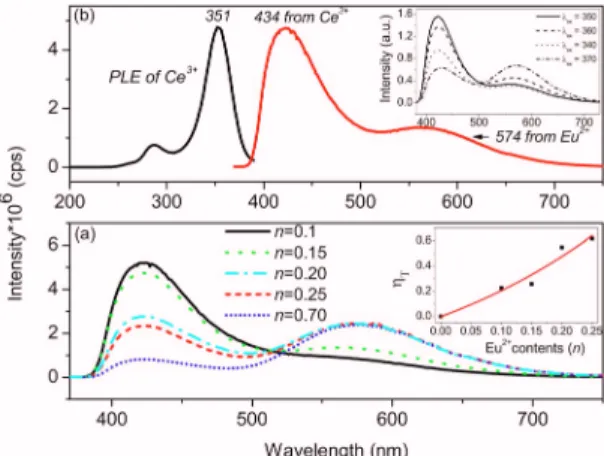
con-tents to investigate the energy transfer phenomenon. Figure 2共a兲 shows the PL spectra for Sr3B2O6: 1 % Ce3+, n % Eu2+ phosphors with different n’s of
0, 0.10, 0.15, 0.20, 0.25, and 0.70, which were measured at excitation wavelength of 351 nm, corresponding to the opti-mal excitation wavelength of the energy donor Ce3+. With
increasing Eu2+ content 共n兲, the PL intensity of Eu2+ was
observed to increase systematically from n = 0.10 to 0.15, and reach saturation as n equal to or larger than 0.2, whereas that
of Ce3+was simultaneously found to decrease gradually from
n = 0.10 to 0.70. The observed saturation in Eu2+ intensity might be attributed to the results of other nonradiative relax-ation present in the host matrix or Eu2+– Eu2+ internal
con-centration quenching effect. The above-described observa-tions confirmed that the ETCe→Eu in SBO:Ce,Eu and the
calculated Ce3+→Eu2+energy transfer efficiency共
T兲 can be
expressed by15
T= 1 − IS IS0,
where IS0and ISare the luminescence intensities of the
sen-sitizer共Ce3+兲 with and without activator 共Eu2+兲 present. The
Tof Sr3B2O6: 1 % Ce3+, n % Eu2+ was calculated as a
func-tion of n and represented in the inset of Fig.2共a兲, in which
T was found to increase gradually with increasing Eu2+
dopant content. Figure 2共b兲 portrays the detailed PLE/PL spectra for Sr3B2O6: 1 % Ce3+, n % Eu2+, where n is equal to
0.15. As indicated in Figs.1共a兲and1共b兲, the PLE spectra for Sr3B2O6: 1 % Ce3+, nEu2+ obtained by monitoringemat 434
and 574 nm, respectively, are different. When the emission wavelength was monitored at 434 nm, we have found the PLE spectrum of Sr3B2O6: 1 % Ce3+, n % Eu2+ to be identical
to that of solely Ce3+-doped Sr
3B2O6; on the other hand,
when the emission wavelength was monitored at 574 nm, the observed PLE spectrum resembles that of Sr3B2O6: Eu2+;
however, two broad emission bands centering at 434 and 574 nm ascribed to the emission of Ce3+ and Eu2+,
respec-tively, are observed in PL spectrum. Furthermore, the con-version efficiency portrayed in PL spectra of the phosphor under UV excitations of 340, 350, 360, and 370 nm is also shown in the inset of Fig.2共b兲. Actually, the conversion ef-ficienies under the excitations of 360 and 370 nm are about 87% and 50%, respectively, of the optimal excitation wave-length 共i.e., 351 nm兲, indicating that our phosphor is also effective under longer UV excitation.
Based on Dexter’s energy transfer formula of multipolar interaction and Reisfeld’s approximation, the following rela-tion can be obtained:15,16
0
⬀ Ca/3,
where0andare the luminescence quantum efficienies of
Ce3+ in the absence and presence of Eu2+, respectively; the values of0/can be approximately calculated by the ratio
of related luminescence intensities共IS0/ IS兲, C is the content
of Eu2+, and a = 6 and 8 correspond to dipole-dipole and
dipole-quadrupole interactions, respectively. The IS0/ IS-Ca/3
plots are further illustrated in Figs. 3共a兲 and 3共b兲, and the linear relationship were observed when n = 6 and 8. Electric dipole-dipole interaction with larger Columbic effect usually accompanies electric dipole-quadrupole interaction; there-fore, the electric dipole-dipole interaction predominates in the ET mechanism from Ce3+to Eu2+ in SBO:Ce,Eu, which is similar to the results of our previous study.17
For electric dipole-dipole interaction, the critical dis-tance共Rc兲 of ETCe→Eucan be expressed by16
Rc
6
= 0.63⫻ 1028QA
E4
冕
FS共E兲FA共E兲dE,where QA= 4.8⫻10−16 fd is the absorption cross section of
Eu2+ ions, fd⬇0.02 is the electric dipole oscillator strength
FIG. 1. 共Color online兲 PLE, PL, and DR spectra for 共a兲 Sr3B2O6: Ce3+
phosphor共PLE monitored at 434 nm, PL excited at 351 nm, and DR spectra shown in blue curve兲, 共b兲 Sr3B2O6: Eu2+ phosphor 共PLE monitored at
574 nm, PL excited at 377 nm, and DR spectra shown in blue curve兲, and 共c兲 DR spectra for Sr3B2O6host共blue solid line兲 and Sr3B2O6: Ce, Eu共blue
dashed line兲. Spectral overlaps between PLE of Sr3B2O6: Eu2+and PL of
Sr3B2O6: Ce3+are also shown.
FIG. 2.共Color online兲 共a兲 PL spectra for Sr3B2O6: 1 % Ce, n % Eu phosphors
excited at 351 nm. Inset: dependence of the energy transfer efficiencyTon Eu2+ content n. 共b兲 PL and PLE spectra for Sr
3B2O6: 1 % Ce, n % Eu 共n
= 0.15兲. Inset: the conversion efficiency under UV excitation.
081902-2 C.-K. Chang and T.-M. Chen Appl. Phys. Lett. 91, 081902共2007兲
This article is copyrighted as indicated in the article. Reuse of AIP content is subject to the terms at: http://scitation.aip.org/termsconditions. Downloaded to IP: 140.113.38.11 On: Wed, 30 Apr 2014 07:08:51
for Eu2+ ions, and 兰F
S共E兲FA共E兲dE represents the spectral
overlap between the normalized spectral shapes of Ce3+
emission FS共E兲 and Eu2+excitation FA共E兲, and it is estimated
to be about 1.13 eV−1; E 共in eV兲 is the maximum energy of spectral overlap. Therefore, the Rcof ETCe→Euin SBO:Ce,Eu
was calculated to be about 30.67 Å, which is slightly shorter than that 共i.e., 32.7 Å兲 in Ba2ZnS3: Ce, Eu reported by our group.17When Ce3+– Eu2+was supposed to form a close pair
at a distance of 3.59 Å, which is the nearest distance between Sr and Sr sites, and, hence, Rcwas approximated as 8.5 times
of lattice dimension in length.
In many cases, concentration quenching is due to energy transfer from one activator to another until energy sink in the lattice is reached.18Blasse suggested that the critical distance 共Rc兲 of energy transfer can be expressed by16
Rc⬇ 2
冉
3V 4xcN
冊
1/3
,
where V is the volume of the unit cell, xc is the critical
concentration, at which the luminescence intensity of sensi-tizer共Ce3+兲 is half that in the sample in the absence of
acti-vator共Eu2+兲, namely, x
coccurs whenTequals 0.5, and N is
the number of host cations in the unit cell. For Sr3B2O6host,
V is 889.93 Å,3N is 18,11and xcis 0.002 07 determined from
the inset of Fig.2共a兲. Therefore, the critical distance for en-ergy transfer Rcis estimated to be about 35 Å, which agrees
approximately with that obtained by using the spectral over-lap method.
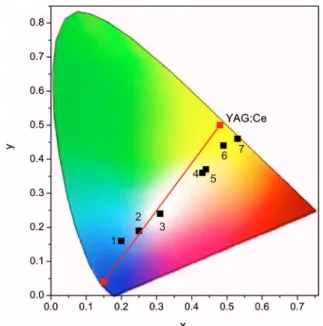
The CIE chromaticity coordinates with varied hues for SBO:Ce,Eu excited at 351 nm were measured and shown in Fig.4. With increasing Eu2+ content, the color tone changes
from blue, which is represented by point 1 共solely Ce3+
doped兲 through white 共Ce3+/ Eu2+ coactivated兲 and finally to
yellow, which is represented by point 7共solely Eu2+ doped兲, corresponding to chromaticity coordinates 共x,y兲 varying from 共0.20, 0.16兲 to 共0.31, 0.24兲 and ultimately to 共0.53, 0.46兲. Hence, by properly tuning the ratio of Ce3+/ Eu2+, the
diversified white light with different hues can be achieved under UVLEDs radiation. Higher CRI values can be antici-pated in our single-phased white phosphors because of more red-light component contribution from Eu2+ emission
in-cluded than that of the commercial YAG:Ce based white-emitting system.
In conclusion, we have demonstrated that the energy transfer from Ce3+ to Eu2+ in Sr
3B2O6: Ce3+, Eu2+ is
domi-nated by resonance-type electric dipole-dipole interaction. In addition, the tunable color hues from blue through white and finally to yellow-orange is achieved by properly tuning the relative Ce3+/ Eu2+ratio in Sr
3B2O6: Ce, Eu.
The authors acknowledge the generous financial support from the National Science Council of Taiwan under Contract No. NSC95-2113-M-009-024-MY3.
1Y. Shimizu, K. Sakano, Y. Noguchi, and T. Moriguchi, US Patent No.
5998925共December 7, 1998兲.
2G. Blasse and B. C. Grabmaier, Luminescent Materials共Springer, Berlin,
Germany, 1994兲, p. 46.
3J. S. Kim, P. E. Jeon, J. C. Choi, H. L. Park, S. I. Mho, and G. C. Kim,
Appl. Phys. Lett. 84, 2931共2004兲.
4J. S. Kim, P. E. Jeon, Y. H. Park, J. C. Choi, H. L. Park, G. C. Kim, and
T. W. Kim, Appl. Phys. Lett. 85, 3696共2004兲.
5J. S. Kim, K. T. Lim, Y. S. Jeong, P. E. Jeon, J. C. Choi, and H. L. Park,
Solid State Commun. 135, 21共2005兲.
6W. J. Yang, L. Luo, T. M. Chen, and N. S. Wang, Chem. Mater. 17, 3883
共2005兲.
7W. J. Yang and T. M. Chen, Appl. Phys. Lett. 88, 101903共2006兲. 8S. H. Lee, J. H. Park, S. M. Son, and J. S. Kim, Appl. Phys. Lett. 89,
221916共2006兲.
9J. S. Kim, A. K. Kwon, Y. H. Park, J. C. Choi, H. L. Park, and G. C. Kim,
J. Lumin. 122-123, 583共2007兲.
10C. K. Chang and T. M. Chen, Appl. Phys. Lett. 90, 161901共2007兲. 11L. Richter and F. Muller, Z. Anorg. Allg. Chem. 467, 123共1980兲. 12W. J. Schipper, D. van der Voort, P. van den Berg, Z. A. E. P. Vroon, and
G. Glasse, Mater. Chem. Phys. 33, 311共1993兲.
13G. Blasse and B. C. Grabmaier, Luminescent Materials共Springer, Berlin,
Germany, 1994兲, p. 45.
14A. Vegas, Acta Crystallogr., Sect. C: Cryst. Struct. Commun. 41, 1689
共1985兲.
15Y. Tan and C. Shi, J. Phys. Chem. Solids 60, 1805共1999兲. 16G. Blasse, Philips Res. Rep. 24, 131共1969兲.
17W. J. Yang and T. M. Chen, Appl. Phys. Lett. 90, 171908共2007兲. 18D. L. Dexter and J. A. Schulman, J. Chem. Phys. 22, 1063共1954兲.
FIG. 3.共Color online兲 Dependence of IS0/ ISof Ce3+on共a兲 C6/3and共b兲 C8/3.
FIG. 4. 共Color online兲 CIE chromaticity diagram for Sr3B2O6: m % Ce, n % Eu excited at 351 nm. 共1兲 m=1, n=0; 共2兲 m=1,
n = 0.1;共3兲 m=1, n=0.15; 共4兲 m=1, n=0.20; 共5兲 m=1, n=0.25; 共6兲 m=1, n = 0.7; and共7兲 m=0, n=1. The corresponding CIE chromaticity coordinates
共x,y兲 are 共1兲 共0.20, 0.16兲, 共2兲 共0.25, 0.19兲, 共3兲 共0.31, 0.24兲, 共4兲 共0.43, 0.36兲, 共5兲 共0.44, 0.37兲, 共6兲 共0.49, 0.44兲, and 共7兲 共0.53, 0.46兲. The Ce:YAG and GaN based white-emitting systems are compared with this work and portrayed in red line.
081902-3 C.-K. Chang and T.-M. Chen Appl. Phys. Lett. 91, 081902共2007兲
This article is copyrighted as indicated in the article. Reuse of AIP content is subject to the terms at: http://scitation.aip.org/termsconditions. Downloaded to IP: 140.113.38.11 On: Wed, 30 Apr 2014 07:08:51