Hole effective mass in strained Si
1−xC
xalloys
C. Y. Lina)
Department of Physics, National Chung Hsing University, Taichung, Taiwan, Republic of China S. T. Chang
Department of Electronic Engineering, Chung Yuan Christian University, Chungli, Taiwan, Republic of China
C. W. Liu
Department of Electrical Engineering and Graduatė Institute of Electronic Engineering, National Taiwan University, Taipei, Taiwan, Republic of China
(Received 13 May 2004; accepted 2 August 2004)
The directional, density-of-states, and carrier-concentration effective masses of light, heavy, and split-off holes have been calculated for strained Si1−xCxalloys on Si(001) substrate. The results for the directional effective mass show that the effect of strain makes the constant energy surface of light holes near the band edge more symmetric than that in pure silicon. The effect of strain on the heavy and split-off hole bands is rather regular; up to 7% of carbon concentration the strain effect monotonically reduces the density-of-states effective mass for the two bands at energy values within energy interval of 0.4 eV below the valence band edge. This reduction is obtained for the carrier-concentration effective mass at temperatures from 0 to 600 K. The strain effect on the light hole band is less trivial; at nonzero carbon concentrations the strain effect influences the density-of-states and the carrier-concentration effective mass in a similar way as it does to the heavy and split-off bands but irregular behavior shows up in the energy interval of 0.02 eV below the valence band edge and at the temperature range from 0 to 140 K. At 7% of carbon doping the total density-of-states effective mass for holes at 77 and 300 K are almost the same, namely, the values are 0.39 and 0.40 in units of free electron mass, respectively. © 2004 American Institute of Physics.
[DOI: 10.1063/1.1796516]
I. INTRODUCTION
The directional, density-of-states (DOS), and carrier-concentration (CC) effective masses of carriers, are impor-tant and fundamental parameters of the transport properties of semiconductors.1–3The directional effective mass, which is related directly to the curvature of the constant energy surface, provides information on anisotropy of mobility. The DOS effective mass mDOS is obtained from the density of
states and is energy dependent. The CC effective mass mCCis
obtained from the carrier concentration and depends both on temperature and Fermi level. The dependence of mCC on
Fermi level becomes insignificant for nondegenerate semi-conductors. The knowledge of these parameters is essential to the modeling of transport and optical phenomena in semi-conductors. In applications of group IV alloys, the effect of strain producing favorable transport and optical properties, has been observed in strained Si1−xGexlayer pseudomorphi-cally grown on (001) Si substrate.4–7 Recently, the optical and electronic properties of strained Si1−xCxand Si1−yGexCy on Si substrates have attracted much interest.8–14 Compared to strained Si1−xGexalloys on Si substrates, since the lattice constant of Si1−xCx alloy is smaller than that of Si, it is the tensile strain that acts on the Si1−xCxalloy rather than com-pressive strain. Also, since the atomic size of carbon is only about half of that of Si, relatively smaller amount of carbon
doping creates considerable effect of strain in the strained Si1−xCxalloy grown on Si substrate. The energy band struc-ture of strained Si1−xCxalloys on Si(001) substrates has been calculated based on a 20⫻20 Hamiltonian matrix con-structed from the linear combination of atomic orbital
(LCAO) approximation with spin-orbit interaction, strain
ef-fect, and lattice disorder effect taken into account.15 The re-sults show that the strain effect removes the degeneracy at⌫ point leaving the valence band edge monopolized by the light hole band. In this work all directional effective mass, mDOS, and mCC of strained Si1−xCx alloys are calculated based on the LCAO energy band structure proposed in Ref. 15. The mCCis evaluated only for the nondegenerate case.
II. EVALUATION OF THE DIRECTIONAL EFFECTIVE MASS
By using the LCAO energy band structure,15 the direc-tional effective masses are calculated from the energy curva-ture in the standard fashion by
1 mi = 1 ប2
冉
2E ki2冊
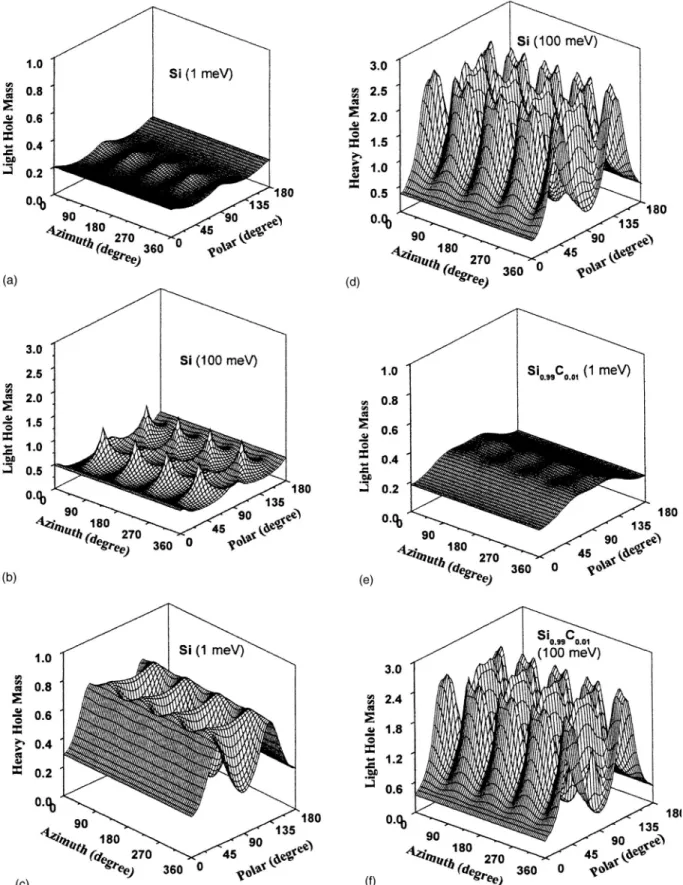
, 共1兲where the index i indicates the direction of interest. Using Eq. (1), the angular dependence of the directional effective masses are obtained in Figs. 1(a)–1(d) for bulk Si and in Figs. 1(e) and 1(f) for strained Si0.99C0.01on Si. Figures 1(a)
and 1(b) show the angular dependence of the Si light hole directional effective masses for two constant energy surfaces
a)Author to whom correspondence should be addressed; electronic mail: [email protected]
at 1 and 100 meV, respectively, and Figs. 1(c) and 1(d) show Si heavy hole directional effective masses for constant en-ergy surface at 1 and 100 meV, respectively, indicating that the constant energy surface for both light and heavy holes are
more warped as the energy increases. For strained Si0.99C0.01,
there is a different angular dependence of the directional masses. Very close to the valence band edge, as shown in Fig. 1(e), the directional masses are nearly constant along the
FIG. 1. Angular dependence of the directional effective masses. The light hole band directional effective masses of Si are at the equienergy surfaces of(a) 1 meV and(b) 100 meV. The heavy hole band directional effective masses of Si are at the equienergy surfaces of (c) 1 meV and (d) 100 meV. The light hole band directional effective masses of strained Si0.99C0.01grown on(001) crystallographic plane of Si are at the equi-energy surfaces of (e) 1 meV and (f) 100 meV.
azimuthal angle, i.e., on the plane normal to growth direction and show a small change along the polar angle. Compared to Figs. 1(a) and 1(c) we see that energy surface near the va-lence band edge for strained Si1−xCxalloy is more symmetri-cal (in fact it is an ellipsoid) than that for pure Si. The an-gular dependence of the directional masses of the strained Si0.99C0.01 shown in Fig. 1(f) becomes similar to that of
heavy hole of bulk Si at higher energy as shown in Fig. 1(d). These changes of the angular dependence of the directional effective masses under strain imply the possible anisotropy of the mobility. Expressing the effective mass in units of free electron mass m0, our result of the directional effective mass
of bulk Si averaged over all the directions for heavy hole is 0.518 at 1 meV and 1.15 at 100 meV.
FIG. 2. The DOS effective mass mDOS(in units of the free electron mass) of strained Si1−xCx. The unlabeled curves between the x = 0.2% and x = 1%
curves correspond consecutively to x = 0.4%, 0.6%, and 0.8%, respectively. Results of Fischetti and Laux (see Ref. 16) (using nonlocal empirical
pseudopotential method) for light and heavy hole bands of bulk Si at room
temperature thermal energy共3/2兲kBT(where T=300 K) are shown for
com-parison.(a) For the light hole band. (b) For the heavy hole band. (c) For the split-off hole band.
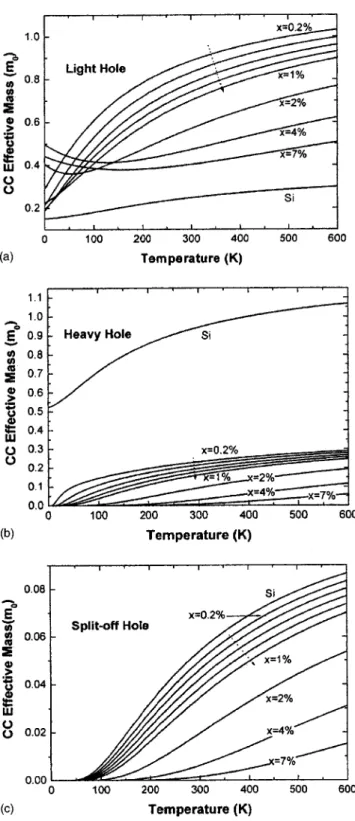
FIG. 3. The CC effective mass mCC(in units of the free electron mass) of strained Si1−xCx. The unlabeled curves between the x = 0.2% and x = 1%
curves correspond consecutively to x = 0.4%, 0.6%, and 0.8%, respectively.
(a) For the light hole band. (b) For the heavy hole band. (c) For the split-off
III. EVALUATION OF THE DENSITY-OF-STATES
EFFECTIVE MASSmDOS
Following a similar approach given by Refs. 1 and 2, the mDOS共E兲 in units of m0, as a function of energy E is
calcu-lated by mDOS共E兲 =ប 2 2
冉
1 2冑
E dV dE冊
2/3 , 共2兲where V共E兲 is the volume of a constant energy shell that is calculated by the integral
V共E兲 =1 3
冕
0 sind冕
0 2 dk3共E,,兲, 共3兲 where k,, anddenote the spherical polar coordinates. The function k共E,,兲, which is the k-space radial size of con-stant E surface along the direction of共,兲, is solved from the corresponding LCAO Hamiltonian matrix15 of the strained Si1−xCxalloys.In terms of energy the DOS effective masses for the light, heavy, and split-off hole bands are shown in Fig. 2 for various values of carbon contents x. For light holes, as shown in Fig. 2(a), the DOS masses decrease monotonically as the strain increases for cases of nonvanishing strains. However, there is a leap of the DOS mass values at the introduction of strain to the bulk Si. This is due to the fact that the valence band edge is assigned to be taken by the light hole band, in the same way as the degeneracy at the band edge in bulk Si is removed by the strain.15 Therefore, for each given energy the light hole band in strained Si1−xCx corresponds to the largest constant energy surface in k space, similarly as the heavy hole band does in the bulk Si. The largest-in-size constant energy surface in k space for the light hole band when strain effect is taken into account conse-quentially makes its DOS effective mass larger than that of the heavy hole band. Similar to the situation found in light hole band of strained Si1−xGexin Ref. 2 the crossing dips are observed at lower energies for higher carbon concentrations
2 %艋x艋7%. As shown in Figs. 2(b) and 2(c), the heavy
and the split-off hole DOS masses decrease monotonically as the strain increases. Our results of DOS effective mass for light and heavy hole bands of bulk Si, based on the LCAO approximation, at room temperature thermal energy
共3/2兲kBT (where kB is Boltzmann constant and T = 300 K), are in good agreement with those calculated from the nonlo-cal empirinonlo-cal pseudopotential method.16
IV. EVALUATION OF THE CARRIER-CONCENTRATION
EFFECTIVE MASSMCC
Following the expression derived in Ref. 1 the carrier-concentration effective mass mCC共, T兲, being a function of Fermi leveland temperature T, can be calculated in terms of DOS effective mass from formula
mcc3/2共,T兲 =  3/2 F1/2共兲
冕
0 ⬁ m DOS 3/2 共E兲E1/21 + exp关共E −兲兴dE, 共4兲 where F1/2 is a Fermi integral
17
Fn of order n = 1 / 2 and  =共kBT兲−1. The above expression can be simplified if the
Fermi level is sufficiently negative, namely, in the case of
⬍−3kBT. In this case Eq.(4) reduces to mcc3/2共T兲 =2
3/2
冑
冕
0⬁
mDOS3/2 共E兲E1/2exp共−E兲dE. 共5兲
We calculate the mCConly for the nondegenerate case.
Results of the carrier-concentration effective mass, as a function of temperature for various carbon contents, are shown in Fig. 3 for the light hole(LH), heavy hole (HH), and split-off hole (SH) bands. The fact that the DOS effective mass of light hole band is larger than that of heavy hole band when strain effect is taken into account in turn results in a larger CC effective mass for light hole band. In the tempera-ture range from 0 to 600 K, the CC effective masses for HH and SH bands decrease monotonically as the carbon fraction increases. The CC effective masses for LH band behave the same way except in the temperature range of 0 – 140 K. The result of total density-of-states effective mass for holes mdh,
which is defined as
mdh=共mcc,LH3/2 + mcc,HH3/2 + mcc,SH3/2 兲exp共− ⌬SO/kBT兲2/3, 共6兲
where⌬so is the spin-orbit splitting, is shown in Fig. 4. For carbon content less than 1% mdh increases monotonically as temperature increases and decreases monotonically as the strain effect increases. For carbon content x艌1%, mdh
be-haves in a more complex fashion in low temperature range below 140 K, due to stronger strain effects.
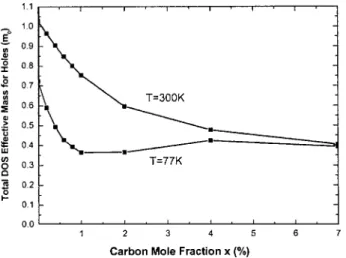
mdh as a function of carbon composition共x艋0.07兲, for
two common operating temperatures in semiconductor de-vices, is shown in Fig. 5. For pure Si 共x=0兲 at 300 K our result of 1.04m0matches well with the well-known value of
1.1m0. mdhfor both temperatures 300 and 77 K tend to
satu-rate as the strain effect gets stronger and the values are ap-proaching to each other, when the carbon content increases. mdh at the two temperatures are then almost the same at 7%
of carbon doping; they are 0.40m0 at 300 K and 0.39m0 at
77 K.
FIG. 4. The total density-of-states effective mass for holes mdh(in units of the free electron mass) of strained Si1−xCxas a function of temperature. The
unlabeled curves between the x = 0.2% and x = 1% curves correspond con-secutively to x = 0.4%, 0.6%, and 0.8%, respectively.
V. SUMMARY
In this work we report calculated results of directional, DOS, and CC effective masses of strained Si1−xCx alloys, with up to 7% of carbon concentration, with energy ranging from the valence band edge down to the energy of 0.4 eV below this edge. The effect of strain removed the degeneracy
at⌫ point leaving the valence band edge monopolized only
by an ellipsoidal light hole band. The DOS and CC effective masses for heavy hole and split-off hole bands decrease monotonically as the strain effect increases. The strain effect on the light hole band is more complex. For lower carbon concentrations, 0.2%艋x艋1%, the DOS effective mass as a function of energy decreases as the strain increases, but crossing dips are observed near the valence band edge at higher carbon concentrations, 2 %艋x艋7%. The CC
effec-tive mass of light hole band, as a function of temperature, behaves similarly; for 0.2%艋x艋1% mCCdecreases mono-tonically as the strain effect increases, but crossing dips are also observed at low temperatures for 2 %艋x艋7%. For temperature at 300 and 77 K, the value of mdh, as a function
of carbon concentration x, tends to saturate to the same value, as the strain effect increases.
ACKNOWLEDGMENTS
This work was supported by the National Science Coun-cil, Taiwan, ROC, under the Contract Nos. NSC92-2112-M-005-010(C. Y. Lin), NSC92-2215-E-033-004 (S. T. Chang), and NSC92-2120-F-002-006(C. W. Liu).
1
F. L. Madarasz, J. E. Lang, and P. M. Hemeger, J. Appl. Phys. 52, 4646
(1981).
2
T. Manku and A. Nathan, J. Appl. Phys. 69, 8414(1991).
3
S. K. Chun and K. L. Wang, IEEE Trans. Electron Devices 39, 2153
(1992).
4
R. People, IEEE J. Quantum Electron. 22, 1696(1986). 5
R. Zachai et al., Phys. Rev. Lett. 64, 1055(1990).
6
K. Ismail et al., Phys. Rev. Lett. 73, 3447(1994).
7
K. Ismail, J. O. Chu, and B. S. Meyerson, Appl. Phys. Lett. 64, 3124
(1994).
8
K. Eberl et al., J. Vac. Sci. Technol. B 10, 934(1992).
9
S. S. Iyer et al., Appl. Phys. Lett. 60, 356(1992).
10
K. Eberl et al., Appl. Phys. Lett. 60, 3033(1992). 11
P. Boucaud et al., Appl. Phys. Lett. 64, 875(1994). 12
K. Eberl, K. Brunner, and W. Winter, Thin Solid Films 294, 98(1997). 13
K. Eberl, K. Brunner, and O. Schmidt, Semicond. Semimetals 56, 387
(1999).
14
D. V. Singh, J. L. Hoyt, and J. F. Gibbons, Tech. Dig. - Int. Electron Devices Meet. 2000, 749.
15
S. T. Chang, C. Y. Lin, and C. W. Liu, J. Appl. Phys. 92, 3717(2002). 16
M. V. Fischetti and S. E. Laux, J. Appl. Phys. 80(4), 2234 (1996).
17
D. A. Neamen, Semiconductor Physics and Devices: Basic Principles, 3rd ed.(McGraw-Hill, Boston, 2003) p. 125.
FIG. 5. The total density-of-states effective mass for holes mdhof strained Si1−xCxas a function of C mole fraction for 77 and 300 K.