DOI:10.6245/JLIS.2016.421/692
Information Challenges of Digital Science:
Conceptual Frameworks
Jela Steinerová
Department of Library and Information Science, Comenius University, Slovakia
E-mail: [email protected]
Introduction
Open science and digital science are creating new challenges and opportunities for scholarly work and for information science research focusing on digital information in workplaces. For example, new studies focusing on scholarly information are emerging, including new models of scholarly communication based on big data (e.g., Borgman, 2015) and discussions of issues regarding the sustainability of scholarly information (e.g., Chowdhury, 2014). It is clear that better understanding of emergent opportunities and challenges with respect to scholarly communication and information behavior of researchers is required. It is important to identify what features of scholarly information and communication systems and services matter and how to broaden the conversation on information creation and use in scholarly work. The aim of this research in progress is to identify information needs and behavior of researchers, in order to enhance information use and design new systems and services.
Background: Open Science and Digital Science
Open science refers to research processes based on transparent information practices regarding methods, data, results and democratic access to knowledge and which allow broader public access to research and its results. Open science includes open access to scholarly literature, open data, open institutional repositories and electronic journals.
Digital science refers to the transformation of creative scholarly communication and information processes into digital environments. Digital technological developments and digital data deluge have changed information behavior and information interactions. New types of documents and genres have emerged in digital environments, ranging from blogospheres to mobile digital libraries.
Examples of new strategic models of digital and open science include the Finnish concept (Open Science and Research, 2014) and the models of centers of excellence for information services (Kirchner et al., 2015). Overall, participation and collaboration in digital environments (such as collaboratories and virtual research environments) have increased. In addition, new knowledge infrastructures (such as academic digital repositories including publications and data), conceptual infrastructures and special tools, systems and value-added services continue to emerge. Digital and open science opens up the review process and new, alternative ways of evaluation of science, referred to as altmetrics, are emerging. These and similar models and systems are changing many aspects of science, bringing new sociotechnical problems that information science research is well equipped to investigate.
Trends in information science research point to the role of professional information activities in digital environments and converging entities such as people, publications, methodologies, concept tools, systems. Information science can help manage new units of citations (readings, logs, downloads, bookmarks, conversations, tweets, etc.). Other topical research issues in information science include scientific literacy, research and methodological literacy and creativity of scholars.
Related Research
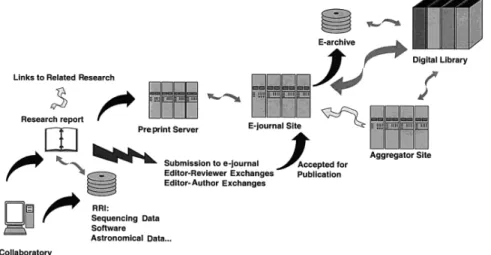
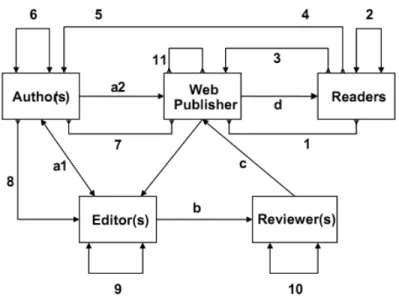
We analyzed several models of digital science and social networks for research workers. Hurd (2000) outlines the most important changes in the information process based on the building and use of digital libraries (Fig. 1). Whitworth and Friedman (2009) outline new rich information interactions between authors, editors, web publishers, reviewers and readers that have changed the traditional information environment (Fig. 2).
Fig. 2: A democratic knowledge exchange system design
(Whitworth & Friedman, 2009, http://firstmonday.org/ojs/index.php/fm/article/view/2642/2287) Björk (2005) offers an updated version of information flows in scholarly communications (Fig. 3). However, Borgman (2015) (Fig. 4) presents a scientific life cycle perspective on information flows based on analysis of big data creation and management.
Fig. 4: Scientific life cycle example from the Center from Embedded Networked Sensing (Borgman, 2015, p. 265)
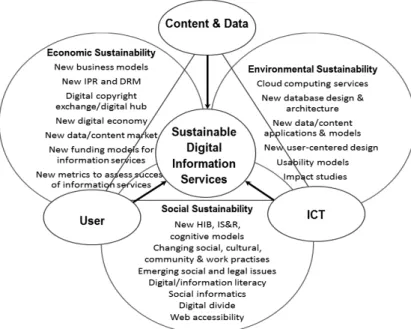
In comparison, Zuccala (2009) (Fig. 5) explores the relationships between scholarly communication with broader public, including open access to published works and data and public understanding of science, and Chowdhury (2014) presents a model of sustainable digital services based on sustainable information environment (Fig. 6).
Fig. 5: Relationship between the scientific research system and the public understanding of science (Zuccala, 2009, p. 378)
Fig. 6: Research issues and challenges in sustainable digital information services (Chowdhury, 2014, p. 195)
All these models are grounded in information ecology aimed at sense-making in information use and effective information interactions of objects, people, systems and sources. Synthesizing the models we can identify three basic components in open and digital science: artifacts and producers; knowledge infrastructure; and content, including value-added services. They provide a contextual background for our ongoing research.
Research Problem Statement
Based on these starting points we ask several research questions focusing on modeling the open and digital science information environment.
Our main research questions are:
Which components can build a new conceptual framework for modeling the information environment of digital science?
Which differences in information behavior of researchers from different disciplines can we identify? Which patterns of digital information use and publishing are typical for them? How should we design new services, tools and systems for researchers as part of knowledge
Research Approach
We developed two conceptual models based on the literature review and discussions (Widén-Wulff, Steinerová, Voisey 2014). The models were further explored in semi-structured interviews conducted with 19 selected researchers in Slovakia, and refined based on the interview data. The selected disciplines covered humanities, social sciences, sciences and medicine, and technical sciences. Interesting digital science features were noted in digital humanities (archaeology, archival studies, Maya culture, sinology), and also astronomy and physics, genetics, sociology and politology.
Future research utilizing citation analyses and terminological analyses is planned, and should point to specific publishing and citation patterns in selected disciplines in comparison with altmetrics tools. The results of this future research will be used to enhance the two models.
Results: Conceptual Models of Digital Science
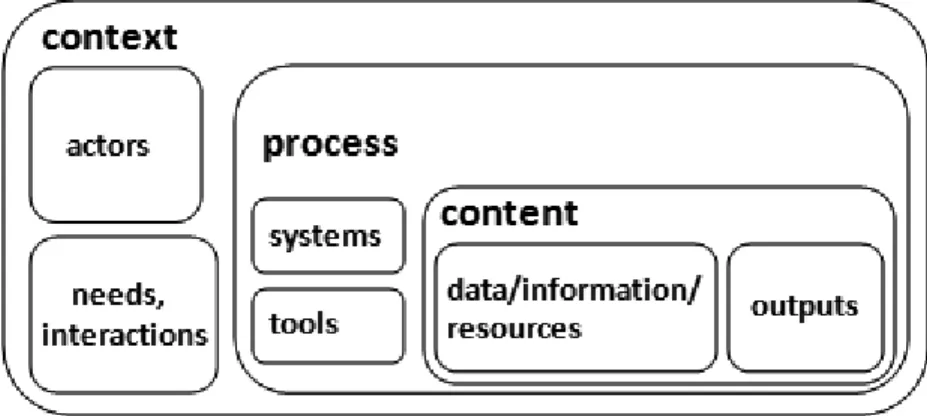
The first conceptual model sets the processes and content of the research activities into the contexts of actors and their information needs and information interactions (Fig. 7). The context includes topics, domains and tasks, and is the driving force for information needs of researchers. These are the factors which form a holistic framework of information ecology. The second stratum represents the research and information processes including systems and tools activated by interactions and communication. The third component represents the content embedded in the two previous strata and includes data, information/resources and outputs such as products and publications.
Fig. 7: Conceptual framework for digital science (based on Widén, Steinerová, & Voisey, 2014)
The second conceptual model (Fig. 8) illuminates information processes, knowledge infrastructure and external factors that influence the research process. Information behavior of researchers in
different scientific disciplines includes the access, analyses and creation, and distribution and sharing of information. Main components of information behavior of researchers, from information needs to sharing, motivation and creation and creativity, are highlighted. Another component of the model is the knowledge infrastructure which is composed of tools (including systems, social networks and libraries) and resources (including data and publications). External influences on the information environment, such as scientific policy, information ethics, metrics, values, barriers, risks, economic models, security and intellectual property, are also identified in the model.
This model has been used for empirical surveys of scholars in Slovakia and guides further modeling of the digital information environment of scholarly work.
Conclusions and Implications
Information interactions between people and information objects can lead to changes in the workflow of the research processes, and require new research and methodological literacy and information skills. We propose that digital environments of researchers can provide incentives for support of information activities, including creativity and new online genres and collaborations. Several components of this workplace digital environment (data, systems, tools, services) can contribute to new models of research and information process. First analyses of interviews confirm the importance of researchers´ information behavior related to expertise, methodology and collaboration, including promotion of results. We hope that further practical implications will be derived for building new models of knowledge infrastructure and value-added services for researchers and creative digital representations.
The paper was developed as part of the project VEGA 1/0066/ Modeling the information environment of digital science. The extended abstract is based on a poster in ENWI symposium 2015 (Gothenburg)
References
Borgman, C. L. (2015). Big data, little data, no data: Scholarship in the networked world. Cambridge, Massachusetts: MIT Press.
BJÖRK, B. Ch. (2005). A life-cycle model of the scientific communication process. Learned Publishing, 18(3), 165-176. doi: 10.1087/0953151054636129
Chowdhury, G. G. (2014). Sustainability of scholarly information. London: Facet.
Hurd, J. M. (2000). The transformation of scientific communication: A model for 2020. Journal of the American society for information science. 51(14), 1279-1283.
Kirchner, J., Diaz, J., Henry, G., Fliss, S., Culshaw, J., Gendron, H., & Cawthorne, J. (2015). The center of excellence model for information services. Retrieved from: http:// www.clir.org/pubs/reports/pub163 Ni, C., & Sugimoto, C. R. (2011). Four-facets study of scholarly communities: Artifact, producer, concept and
gatekeeper. Proceedings of the American Society for Information Science and Technology, 48(1), 1-4. doi: 10.1002/meet.2011.14504801343.
Open Science and Research (2014). The open science and research handbook. Retrieved from http://openscience.fi Whitworth, B., & Friedman, R. (2009). Reinventing academic publishing online. Part II: A socio-technical
vision. First Monday, 14(9). doi: http://dx.doi.org/10.5210/fm.v14i9.2642
Widén, G., Steinerová, J., & Voisey, P. (2014). Conceptual modelling of workplace information practices: A literature review. Information Research, 19(4), 96-106.
Zuccala, A. (2009). The lay person and Open Access. Annual Review of Information Science and Technology, 43(1), 1-62.