This content has been downloaded from IOPscience. Please scroll down to see the full text.
Download details:
IP Address: 140.113.38.11
This content was downloaded on 28/04/2014 at 08:28
Please note that terms and conditions apply.
Physical Properties of Polar Bis-Tolane Liquid Crystals
View the table of contents for this issue, or go to the journal homepage for more 2000 Jpn. J. Appl. Phys. 39 L38
(http://iopscience.iop.org/1347-4065/39/1A/L38)
Part 2, No. 1A/B, 15 January 2000 c
°2000 Publication Board, Japanese Journal of Applied Physics
Physical Properties of Polar Bis-Tolane Liquid Crystals
Shin-Tson WU, Chain-Shu HSU1, Ya-Yun CHUANG1and Han-Bin CHENG1 HRL Laboratories, LLC, 3011 Malibu Canyon Road, Malibu, CA 90265, U.S.A.
1Department of Applied Chemistry, National Chiao Tung University, Hsinchu, Taiwan 30050, R.O.C.
(Received October 29, 1999; accepted for publication November 26, 1999)
Several cyano and fluoro bis-tolane liquid crystals were synthesized and their physical properties evaluated. Some of these highly conjugated liquid crystals possess birefringence larger than 0.5 in the visible region. Adding 10% of a binary bis-tolane mixture to a cholesteric display enhances the brightness by more than 20%.
KEYWORDS: Polar bis-tolane liquid crystal, high birefringence, cholesteric display
L38
two isomers should be very similar. Thus, PTP(3-Me)TP-nF is preferred for practical applications from the viewpoint of lower melting temperature.
Table II lists the phase transition temperatures and heat fu-sion enthalpy of the ethyl-substituted fluoro and cyano bis-tolane compounds. Their melting and clearing points are both lower than the corresponding methyl derivatives. The molec-ular width of PTP(3-Et)TP homologues is larger than their methyl counterparts. Thus, their inter-molecular association is weaker and less thermal energy is needed to melt and clear the compounds. Among the fluoro series listed in Table II, all the four homologues have melting points below 70◦C and modest1H values. For the cyano series, their melting point fulness of these two homologues is limited. The n= 5 and 6 homologues have a reasonably wide nematic range although their melting point is still high. Owing to increased molecular conjugation, the polar compounds often have a higher melting point than their non-polar counterparts.
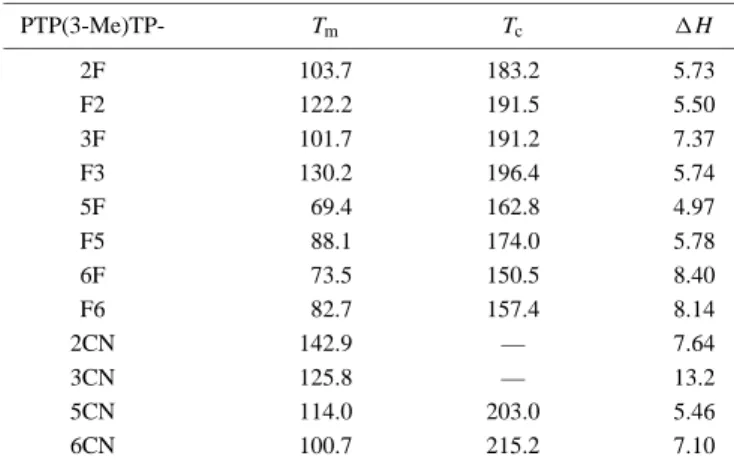
Since the lateral methyl is in the 3-position, the above-mentioned molecular structure is not symmetric. Switching the axial fluorine and alkyl positions could make a notice-able difference in the phase transition temperature. Several methyl-substituted fluoro bis-tolanes with exchanged alkyl and fluorine positions, abbreviated as PTP(3-Me)TP-Fn, have been reported previously.5) Some results are included in Ta-ble I for comparison. From TaTa-ble I, the melting point of PTP(3-Me)TP-nF is about 20◦C lower than the correspond-ing PTP(3-Me)TP-Fn. The electro-optical properties of these
Table I. Phase transition temperatures (in ◦C) and heat fusion enthalpy (1H, in kcal/mol) of the methyl-substituted fluoro and cyano bis-tolane liquid crystals. The dashed lines indicate that these two compounds have no LC phase. Also included here for comparison are the phase behaviors of PTP(3-Me)TP-Fn, the fluoro and alkyl positions are exchanged.
PTP(3-Me)TP- Tm Tc 1H 2F 103.7 183.2 5.73 F2 122.2 191.5 5.50 3F 101.7 191.2 7.37 F3 130.2 196.4 5.74 5F 69.4 162.8 4.97 F5 88.1 174.0 5.78 6F 73.5 150.5 8.40 F6 82.7 157.4 8.14 2CN 142.9 — 7.64 3CN 125.8 — 13.2 5CN 114.0 203.0 5.46 6CN 100.7 215.2 7.10 1. Introduction
Bis-tolane liquid crystals (LCs)1–7) possess birefringence (1n) greater than 0.4 in the visible spectral region and are particularly attractive for reflective displays employing cholesterics8) and polymer-dispersed LC.9) However, most bis-tolanes reported so far are non-polar and their dielectric anisotropy is relatively small (1ε ∼ 0.8). As a result, the threshold voltage is too high (Vth ∼ 4Vrms) for most display applications. There is an urgent need to develop polar com-pounds for reducing the operation voltage.
In this paper, we report five new series of polar bis-tolane liquid crystals. Both cyano and fluoro polar groups were in-vestigated. The cyano polar compounds exhibit not only large
1ε, but also very high birefringence (1n > 0.5) in the
vis-ible spectral region. Thus, it is desirable for high brightness cholesteric displays.
More than 20 cyano and fluoro bis-tolanes with molecular structures shown below were investigated:
The polar compounds we reported here have X=F or CN and R=methyl (CH3), ethyl (C2H5) and fluoro (F) group. For simplicity, these lateral methyl and ethyl substituted fluoro and cyano bis- tolanes are abbreviated as [PTP(3-Me)TP-nF, PTP(3-Me)TP-nCN] and [nF, PTP(3-Et)TP-nCN], respectively. Here P stands for the phenyl ring, T for the carbon-carbon triple bond and P(3-Me) and P(3-Et) for the middle phenyl ring with a methyl or ethyl group substi-tuted at the 3-position. For the lateral fluoro bis-tolanes, we have only studied X=F. These compounds are abbreviated as PTP(F)TP-nF. The synthesis procedures are similar to those of non-polar bis-tolanes.10)
2. Phase Transitions
The phase transition temperatures and heat fusion en-thalpy (1H) of the methyl-substituted fluoro and cyano bis-tolanes we synthesized are listed in Table I. Among the flu-orine series, PTP(3-Me)TP-5F has the lowest melting point (Tm= 69.4◦C) and smallest1H value. Thus, it is most fa-vorable for forming eutectic mixtures. From Schröder-van would lead to a low melting temperature of the eutectic mix-ture. On the cyano series, the n= 2 and 3 homologues exhibit no nematic phase. In addition, their1H values are quite high which implies to a poor solubility in a mixture. Thus, the use-Laar equation,11, 12) a compound with low T
is lowered by about 20◦C as compared to the corresponding methyl homologues and the clearing point of the n = 5 and 6 homologues is decreased by more than 50◦C. Although the ethyl substitution makes an important contribution to lower the phase transition temperatures, it also increases the viscos-ity dramatically, as to be discussed later.
Table III lists the phase transition temperatures and heat fusion enthalpy of the lateral fluorine-substituted fluoro bis-tolane compounds PTP(F)TP-nF. By comparison to the data listed in Table I, we find that the melting point of PTP(F)TP-nF is significantly (∼50◦C) higher than the corresponding methyl-substituted homologues PTP(3-Me)TP-nF. However, in comparison to the non-substituted fluoro bis-tolane,7) the melting point of PTP(F)TP-4F is still∼25◦C lower than that of PTPTP-4F. This sequence of phase transition tempera-ture is mainly attributed to the fact that fluorine has a slightly larger size than hydrogen, but smaller than methyl.
3. Physical Properties
In addition to phase transition temperatures, birefringence (1n), dielectric anisotropy (1ε) and viscosity/elastic con-stant ratio (γ1/K11) are important for practical application. Due to the relatively high melting temperature of these po-lar bis-tolane compounds, it is inconvenient to characterize the physical properties of these compounds in their nematic phase. Instead, we have used the guest-host method. Four compounds with same alkyl chain length were chosen for studies: 6F, PTP(3-Et)TP-6F, PTP(3-Me)TP-6CN and PTP(3-Et)TP-PTP(3-Me)TP-6CN. A Merck mixture E63 was used as host. In all the measurements, 10% of each selected com-pound was dissolved in E63. We measured the birefringence, dielectric anisotropy and visco-elastic coefficient of the mix-ture against host at room temperamix-ture (T ∼ 20◦C). Results of the guest compound under study are then extrapolated. Among the four compounds studied, the mixture containing 10% PTP(3-Me)TP-6F precipitates. Thus, its results were not obtained.
Table II. Phase transition temperatures (in◦C) and heat fusion enthalpy (1H, in kcal/mol) of the ethyl-substituted fluoro and cyano bis-tolane liq-uid crystals. PTP(3-Et)TP- Tm Tc 1H 3F 65.0 112.9 5.10 4F 69.1 98.3 5.25 5F 60.9 103.2 5.20 6F 46.5 89.1 4.77 3CN 102.9 161.9 4.56 4CN 118.5 157.4 7.32 5CN 85.2 159.3 3.51 6CN 77.2 131.7 4.64
Table III. Phase transition temperatures (in◦C) and heat fusion enthalpy (1H, in kcal/mol) of the lateral fluorine-substituted fluoro bis-tolane liq-uid crystals. PTP(F)TP- Tm Tc 1H 2F 150.0 179.7 8.56 3F 154.1 185.4 8.27 4F 145.7 170.3 6.49 6F 123.2 163.6 4.84
Table IV. The extrapolated results of PTP(3-Me)TP-6F, PTP(3-Et)TP-6CN and PTP(3-Me)TP-6CN. Host= E63. 1n was measured at three laser wavelengths,λ = 633, 514.5 and 488 nm. T = 20◦C. LC 1ε γ1/K11 1n(λ) (1 kHz) (ms/µm2) 633 515 488 E63 14.0 18 0.21 0.23 0.24 PTP(3-Et)TP-6F 8.3 73 0.33 0.37 0.41 PTP(3-Et)TP-6CN 13.0 129 0.42 0.51 0.54 PTP(3-Me)TP-6CN 15.6 62 0.44 0.53 0.57
To characterize 1ε, we measured the capacitance (Co) of an empty cell with patterned electrodes.13) The cell was then filled with the guest-host LC mixture. The capaci-tance at low and high voltage regimes lead to ε⊥ and εk, respectively. A HP-4274A multi-frequency LCR meter was used for such measurements. After the(1ε)gh of the guest-host system was measured, we used the following equation
(1ε)gh = 0.9(1ε)h+ 0.1(1ε)g to extrapolate the dielectric anisotropy(1ε)gof the guest LC, where(1ε)his the dielec-tric anisotropy of the host E63.
To characterize birefringence, we have prepared a homo-geneous cell with d = 7-µm and measured its voltage-dependent light transmittance under crossed polarizers.13) Through this measurement, the total phase retardation (δ = 2πd1n/λ) of the cell is obtained. Knowing the cell gap and wavelength, the mixture’s birefringence can be cal-culated. Three light sources were used for such measure-ments: an argon-ion (λ = 488 and 514.5 nm) laser and a HeNe (λ = 633 nm) laser. Similar extrapolation procedures were used to obtain the results of the compounds studied.
To characterize γ1/K11, we measured the transient phase decay time13)of the 7-µm homogeneous cell at a voltage that is not too far above the threshold. A HeNe laser was used for such measurements.
The extrapolated results are listed in Table IV. We first dis-cuss dielectric anisotropy. The CN group has a larger dipole moment14)than F and as expected, the two cyano bis-tolanes we studied have a larger 1ε than the fluoro compound. Among the two cyano compounds, PTP(3-Me)TP-6CN has a slightly larger1ε than PTP(3-Et)TP-6CN due to its more linear structure and denser molecular package. Regarding to birefringence, bis-tolanes possess a much higher1n than E63. As the wavelength gets shorter, the 1n becomes larger.15) At each wavelength, the 1n increases according to the order: PTP(3-Et)TP-6F < PTP(3-Et)TP-6CN < PTP(3-Me)TP-6CN. It is known that CN is an electron ac-ceptor and F exhibits a strong electro-negativity. That means the electron conjugation of a CN compound is longer than its fluoro counterpart.16)Therefore, the birefringence of a cyano bis-tolane is significantly higher than the corresponding flu-oro compound. The reason that PTP(3-Me)TP-6CN has a larger1n than PTP(3-Et)TP-6CN is because the methyl com-pound has a slightly higher molecular packing density.
Three key factors affecting the rotational viscosity of a LC compound are activation energy, moment of inertia (includ-ing molecular shape and mass), and temperature.17, 18) The three bis-tolanes studied exhibit a much largerγ1/K11 than E63 due to their larger moment of inertia. Among the two ethyl-substituted LCs studied, PTP(3-Et)TP-6CN has a much
largerγ1/K11than PTP(3-Et)TP-6F. The reasons are twofold: (1) the cyano compounds tend to form dimmers so that the in-ertia moment is increased, and (2) the cyano compounds gen-erally have a larger activation energy of rotational viscosity.17) Within the cyano family, the lateral alkyl group also makes a significant contribution to the visco-elastic coefficient. The
γ1/K11 of the PTP(3-Et)TP-6CN is about two times higher than PTP(3-Me)TP-6CN. Although the splay elastic constant (K11) of these two LCs may be slightly different, the major difference originates from the rotational viscosity (γ1).
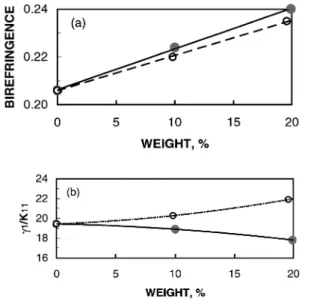
To further examine the effect of lateral methyl and ethyl groups on viscosity, we have compared two non-polar bis-tolanes: PTP(3-Me)TP-62 and PTP(3-Et)TP-62 at 10 and 20% concentrations in E63 host. Both birefringence and visco-elastic coefficient were measured using a HeNe laser wavelength and T ∼ 20◦C. Results are depicted in Figs. 1(a) and 1(b), respectively. From Fig. 1(a), the extrapolated1n for PTP(3-Me)TP-62 and PTP(3-Et)TP-62 is 0.38 and 0.35 at λ = 633 nm, respectively. And from Fig. 1(b), PTP(3-Me)TP-62 has a slightly lowerγ1/K11than E63. This is sistent with the other homologue reported earlier. In con-trast, PTP(3-Et)TP-62 has a higherγ1/K11than E63. Judged from birefringence and viscosity, the methyl-substituted bis-tolanes are more favorable than the ethyl for practical appli-cations except that their melting points are higher.
4. Cholesteric Reflective Display
An important application of high birefringence LCs is flective cholesteric display. In a cholesteric display, the re-flectance spectral bandwidth (1λ) is linearly proportional to the pitch length (p) and1n of the LC employed. Thus, a high
1n LC is favorable for improving the display brightness. In
addition, the use of high1n LC could reduce the number of required helical pitches for the Bragg reflection to occur. That means the LC cell gap can be reduced. For a cholesteric dis-play with uniform pitch length, the device operation voltage is inversely proportional to the cell gap.19)As a result, a high
1n LC not only enhances display brightness but also reduces
operation voltage.
Fig. 1. Comparison of PTP(3-Me)TP-62 (filled circles) and PTP(3-Et)TP-62 (open circles) in (a) birefringence atλ = 633 nm and (b) viselastic co-efficient (ms/µm2). T= 20◦C. Host: E63 mixture.
Fig. 2. Cholesteric display using ZLI-5400 alone (open circles) and ZLI-5400 + 10% binary bis-tolane mixture (15% PTP(3-Et)TP-5CN+ 85% PTP(3-Et)TP-53). Cell gap d= 2 µm and pitch length p = 0.35 µm.
We have formulated a binary eutectic mixture consisting of 15% PTP(3-Et)TP-5CN and 85% PTP(3-Et)TP-53. Its1n was measured to be 0.407 atλ = 633 nm and 1ε ∼ 2.7 at
T ∼ 20◦C. In principle, we could use this mixture directly for cholesteric display. However, the dielectric anisotropy of this binary mixture is too small so that its driving voltage would be too high for practical application. In a preliminary experi-ment, we mixed 10% of this binary mixture with Merck ZLI-5400. A 2-µm cholesteric cell was prepared with pitch length of∼0.35 µm. Its peak reflection is designed to be at 675 nm. The voltage-dependent reflectance of the cholesteric cell is depicted in Fig. 2. The open circles represent the measured reflectance of ZLI-5400 cell alone and squares are the data of the LC containing 10% binary bis-tolane mixture. From Fig. 2, the overall display brightness is increased by more than 20%.
High birefringence is not the only requirement for high brightness cholesteric displays. Other desirable properties of LC mixtures include wide nematic range, high1ε, and low
γ1/K11. More polar bis-tolanes with low melting temperature and low viscosity need to be developed.
5. Conclusion
We present the phase transition temperatures and physical properties of about 20 polar bis-tolane LC compounds. The lateral alkyl substitutions are found to make important contri-butions to melting temperature, birefringence and viscosity. Although a lateral ethyl substitution is favorable for lowering melting temperature, its negative effects on reducing birefrin-gence and particularly boosting viscosity are undesirable. By contrast, a methyl compound exhibits an acceptable viscosity, but their melting points are higher. More methyl homologues and eutectic mixtures need to be developed before the high birefringence advantage can be fully utilized for cholesteric displays.
Acknowledgments
The HRL group is indebted to W. H. Smith, Jr. for the technical assistance. Special thanks go to Drs. J. A. Hou and B. G. Wu of Advanced Display Systems for measuring the brightness of a cholesteric display. This work was supported by AFOSR under contract number F49620-98-C-0019.
1) Y. Goto and K. Kitano: European Patent EP 345.013 (1989). 2) Z. Huan, J. Tang and Z. Kao: Gaodeng Huaxue Xuebao 11 (1990) 586. 3) C. Pugh, S. K. Anderson and V. Percec: Liq. Cryst. 10 (1991) 229. 4) S. Yamada, S. Ikukawa, J. Ito and J. Nakayama: U. S. Patent 5,356,558
(1994).
6) S. T. Wu, C. S. Hsu and Y. Y. Chuang: Jpn. J. Appl. Phys. 38 (1999) L286.
7) S. T. Wu, C. S. Hsu, K. F. Shyu, Y. Y. Chuang, H. B. Cheng, Z. Chai, G. M. Day, L. Guo and L. R. Dalton: SID Tech. Dig. 30 (1999) 706. 8) D. K. Yang, J. W. Doane, Z. Yaniv and J. Glasser: Appl. Phys. Lett. 64
(1994) 1905.
9) J. L. Fergason: SID Tech. Dig. 16 (1985) 68.
10) C. S. Hsu, Y. Y. Chuang and S. T. Wu: to be published in Liq. Cryst. (2000).
11) L. Schröder: Z. Phys. Chem. 11 (1893) 449. 12) J. J. Van Laar: Z. Phys. Chem. 63 (1908) 216.
13) I. C. Khoo and S. T. Wu: Optics and Nonlinear Optics of Liquid Crys-tals (World Scientific, Singapore, 1993).
14) W. Maier and G. Meier: Z. Naturforsch. Teil A 16 (1961) 262. 15) S. T. Wu: Phys. Rev. A 30 (1986) 1270.
16) S. T. Wu: J. Appl. Phys. 69 (1991) 2080.
17) M. A. Osipov and E. M. Terentjev: Z. Naturforsch. Teil A 44 (1989) 785.
18) S. T. Wu and C. S. Wu: Phys. Rev. A 42 (1990) 2219.
19) P. G. deGennes: The Physics of Liquid Crystals (Clarendon, Oxford, 1974).