E L S E V I E R 0032-3861/96/$15.00 + 0.00
The mechanical properties of ternary liquid-
crystalline polymer blends
Kung-Hwa Wei*, Wei-June Hwang and Horng-Long Tyan
Institute of Materials Science and Engineering, National Chiao Tung University, Hsinchu, Taiwan 30049, ROC
(Received 11 September 1995)
The possibility of improving the compatibility of and the adhesion between liquid-crystalline poly- (oxybenzoate-co-oxynaphthoate) (Vectra) and polycarbonate (PC) by adding a stable compatibilizer based upon the transesterification between liquid-crystalline poly(oxybenzoate-co-ethylene terephthalate) (POB/ PET) (60/40) and polycarbonate was investigated. The goal was to provide a physical interaction between the matrix polymer and the liquid-crystalline polymer through a third polymer that contained similar chemical structural units to those in both polymers. It was found that at proper compositions the adhesion between Vectra and PC was greatly improved by the presence of the compatibilizer, as indicated by the morphological evidence. These ternary liquid-crystalline polymer blends displayed improved ultimate tensile stress (30% increase as compared to PC) and elongation at break (seven times as compared to binary blend) even under a nominal injection-moulding process. The impact property of the ternary liquid- crystalline polymer blend was also improved as compared to that of the binary liquid-crystalline polymer blends. Copyright © 1996 Elsevier Science Ltd.
(Keywords: compatibilizer; transesteriflcation; ternary L C P blend)
I N T R O D U C T I O N
Thermotropic liquid-crystalline polymer (LCP) blends have attracted great attention in recent years ~ 4 because o f their unique applications. The first advantage was that the low viscosity o f the liquid-crystalline polymer can reduce the overall viscosity o f the blend, and is a good processing aid. Secondly, at proper compositions and under shear or extensional flow, the L C P can form
fibrillar structure in the host thermoplastic matrix in situ.
Owing to the high modulus of LCP in the oriented
direction, the in situ fibrous LCP m o r p h o l o g y served as
reinforcement for the host thermoplastics. A previous study 5 has indicated that the morphology and the
properties of in situ composites were affected by the
interaction between the LCP and the matrix. Therefore, the compatibility or the adhesion between the LCP and the matrix has been a critical factor in developing LCP- reinforced composites.
A number of studies have been carried out to improve the compatibility of L C P and the matrix polymer. They included modification of the LCP fibre's geometry to have mechanical locking to the matrix 6 and chemical grafting of flexible polymer to the LCP fibre surface 7. Another study by DiBenedetto's group used a second LCP as a compatibilizer to improve the adhesion between incompatible LCP/thermoplastic phases s.
Our group has been studying the transesterification between a liquid-crystalline polyester such as poly(oxy-
benzoate-co-ethylene terephthalate) (POB/PET) or
poly(oxybenzoate-co-phenylene isophthalate) (HIQ)
* T o w h o m c o r r e s p o n d e n c e s h o u l d be a d d r e s s e d
and polycarbonate
(PC) 9-11. We have found that, for a
binary L C P blend, the compatibility between the LCP and the PC increases with ester exchange. However, these binary LCP blends suffered the drawback of not having consistent material properties during further processing. Our goal is to achieve compatible LCP blends, and our approach is to develop a compatibilizer based upon the transesterification between the matrix polymer and a second L C P that contains the same liquid-crystalline (rigid-rod) chemical structure as that in the reinforcing LCP. Therefore, the compatibilizer can be a block copolymer exhibiting liquid-crystalline character. Since the compatibilizer consisted of both the matrix polymer unit and the rigid-rod unit, the physical interaction between the matrix polymer and the compatibilizer as well as that between the LCP and the compatibilizer would be enhanced. Therefore, the compatibility of the ternary system would increase. This brings about better adhesion between the matrix polymer and the LCP. Consequently, during the application of these blends, stress can be transferred better across the blends. This resulted in better mechanical properties for the blends.
E X P E R I M E N T A L
Materials
Liquid-crystalline poly(oxybenzoate-co-ethylene tere- phthalate) (POB/PET) (60/40), denoted as P64, was provided by Unitika Corp., Japan. Polycarbonate (PC) was purchased from General Electric. The trade name of the PC is Lexan 121, and its molecular weight is Mw = 158900. Liquid-crystalline copolyester Vectra
A900 consisted of 73% oxybenzoate and 27% 2-oxy-6- n a p h t h o a t e and was supplied by Hoechst Celanese Corp. The Vectra A900 is shortened as Vectra in this study.
Compatibilizer preparation
The pellets o f liquid-crystalline P64 and PC were dried
at 110°C under vacuum for 8 h prior to the mixing. The ~,
mixture of P64 and PC was put into a Brabender mixer.
The speed of the roller blade was 50rpm. Blends /
containing 50 and 60% P64 were prepared. One blending temperature, 290°C, was chosen. The samples were taken out from the Brabender mixer every 4 min, and quenched in water for further analysis. The thermal analysis of the blends was carried out with a D U P O N T 2910 differential scanning calorimeter. The samples were heated f r o m 30 to 270°C at a heating rate of 20°Cmin 1, and then quenched in liquid nitrogen. The samples were heated again from 30 to 300°C at the same heating rate. The d.s.c, curves of the samples were taken the second time the samples were heated up at the heating rate of 20 C m i n ~1. To verify the transesterification between P64 and PC, nuclear magnetic resonance (n.m.r.) was employed to investigate the chemical structure of blends. The blends were dissolved in deuterated chloroform for
4 h: then, the undissolved particles were filtered with a =
syringe filter. Tetramethylsilane was added to the
solution as an internal reference standard, and the j
liquid mixture was put in a n.m.r, tube. A Varian [
Fourier T r a n s f o r m N M R (Unity-300) was used for this measurement. In the scanning electron microscopy (SEM) study, the samples were quenched in liquid nitrogen, and then were fractured. The fractured surface was coated with 10nm thick gold for observation in a Hitachi S-2500 SEM.
Ternary blend preparation
The three-component L C P blends were mixed at 300°C in a twin-screw c o m p o u n d e r attached to the Brabender. The speed of the twin screw was 80 rpm. The blend compositions of Vectra/PC/compatibilizer were 10/90/5 and 20/80/5. F o r comparison with the mechan- ical properties of blends without compatibilizer, two blends containing Vectra PC at 20/80 and 10/90 were also prepared. These blends were moulded with a Toshiba I S 5 5 E P N injection-moulding machine. The melt temperature was 300°C, and the cycle time was 30s during the moulding process. Tensile tests were performed according to A S T M D638 at 23°C using a Testometric Micro 500 machine. D a t a reported were
1
obtained at a crosshead speed of 1 . 3 m m m i n Unnotched Izod tests were performed according to A S T M D256 specification. F o r each data point, six specimens were tested, and the average value was taken. R E S U L T S A N D D I S C U S S I O N
The thermal analysis curves of P64, Vectra and PC are
shown in Figure 1. In Figure 1, the glass transition
temperatures (Tg) o f P64 and PC are 62.91"C and 150.28°C, respectively. There is a melting peak at 193.10°C for P64, and the melting point for Vectra is 285.88°C. The d.s.c, curves of the binary P64/PC blend at composition 50/50 for different blending times are
displayed in Figure 2. There is only one Tg apparent.
The Tg of the 50% P64 blend gradually decreases with
Figure 1 PC V e c t r a 2 8 5 . 8 8 ° C 5 0 100 150 2 0 0 2 5 0 3 0 0 3 5 0 ] e m p e r a E u P e (~C]
The d.s.c, curves o f PC, P64 and Vectra A900
. 2 6 ° C 1 3 4 " 6 5 0 C i 9 7 I c 4 m i n ~ 2 9 . 4 8 0 C
~
S m i n 1 2 6 , 1 4 ° C / 2 m i n 16min 20min 5 0 100 150 2 0 0 25O 3 0 0 3 5 0 4 0 0 T e m p e r a t u r e ( ° c )Figure 2 The d.s.c, curves of 50/50 P64/'PC blends mixed at 290°C for different times
increasing blending time, f r o m 134.65°C after 4 m i n to
125.37°C after 20min, as shown in Figure 2. Addition-
ally, the melting peak of P64 disappeared after 8 min blending time. This indicated that there was a change in chemical structure in the blend.
As the concentration of the P64 increased to 60% in
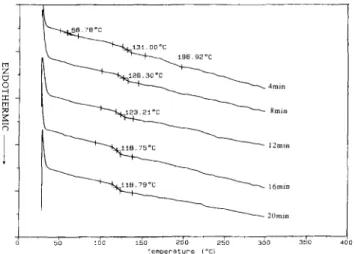
5 B . T B ° C 1 3 C ' 0 0 ° C C 9 6 . 9 2 ° C ~ 2 6 , 3 0 ° C
~
4 m i n 1 2 3 . 2 ~ ° C 8min 2min 16min ~ ~ 2 0 m i n~b ~o l~o 2do z6o 3do 3~o 4oo
T e m p e p a t u P e (°c)
Figure 3 The d.s.c, curves of 60/40 P64/'PC blends mixed at 290cC for different times
(a)
______]
4:127.814 7 : 1 5 1 . 9 9 8 ~ . ~ P C ~ 6 - - - - 0 PC 1:42.416 2:30.789 3:148.152 5:120.093 6:148.851 i .... , .... i .... , .... j .... , .... ~ ......... i ..... J l e e s e 6 0 4 e 2 oPC
(b)
.... i Figure 4 1-4,7,8:160-120 5,6:165-I75 9:65.790 i .... t .... i .... ~ .... i .... i .... i .... r .... i .... i .... d .... i , , 1 6 0 1 5 0 1 4 0 l ~ O 1 , ~ 0 I l e I N 9 0 8 0 7 e 611The n.m.r, spectra of (a) PC dissolved in deuterated chloroform and (b) P64 dissolved in deuterated trifluoroacetic acid
P64
. . . . , .... i .... , .... j .... , 1 6 0 1 4 1 1/
.... L . . . . .. . . . j .... r .... I .... , .... I .... ' .... I .... l ~ J l e e 8 0 6 0 4 e(a)
.... , .... ~ .... , .... i ... r " " r I .... ' .... r .... ' .... I 1 6 1 1 1 4 e l ~ e l e o 8 8ethylene
1
(b)
' i .... , .... J .... , .... i 4 e e o p ~ e s t e r . . .. , .... j ... , r . . I .... l r ~ , e 1 4 1 x ~ o I ~ 8 0 6 0 4 0(c)
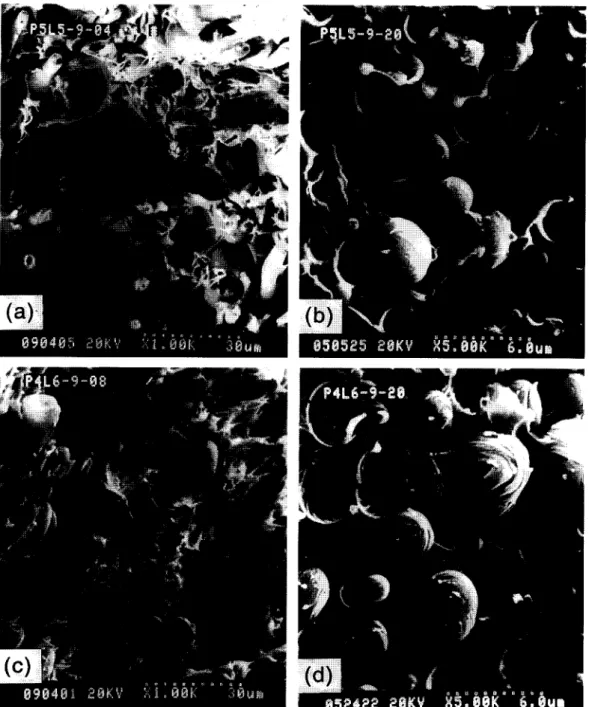
. . . . ~ q 211 p r -Figure 6 The SEM micrographs of (a) 50/50 P64/PC mixed at 290' for 4 min, (b) 50/50 P64/PC mixed at 290"C for 20 min, (c) 60/40 P64/PC mixed at 290"C for 8min and (d) 60/40 P64/PC mixed at 290°C for 20min
P64/PC blend, the decrease in Tg of the blend with blending time became more dramatic, from 131.00°C
after 4 m i n to 118.79°C after 20rain (Figure 3). The
melting peak of P64 also disappeared after 8 m i n blending time. The trend in b o t h blends can be explained by the fact that transesterification (ester exchange) between P64 and PC t o o k place. Ester exchange between polyester and PC has been documented in the literature 9. Owing to the transesterification, chain scission often t o o k place in the P64 blends, resulting in lower molecular weight and Tg.
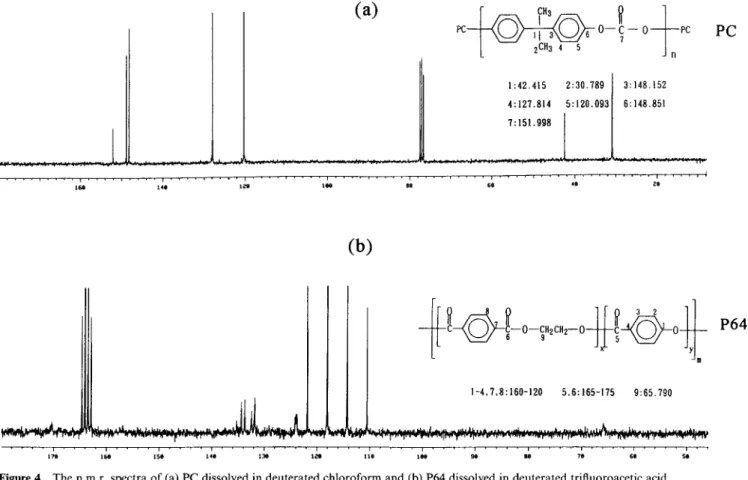
Further evidence on the ester exchange can be found in the n.m.r, spectra of the 60% P64 blend. The 13C resonance peaks of PC dissolved in deuterated chloro- f o r m and P64 dissolved in deuterated trifluoroacetic acid
are shown in Figures 4a and 4b, respectively. Since only
PC dissolved in chloroform, the portion of the 60% P64 blend extracted by deuterated chloroform would contain
only PC molecules and its derivatives. In Figure 4a, the
resonance peaks resulting from the different carbons in
PC are listed. In Figure 4b, there is an ester peak and an
ethylene peak at 165 and 65.79ppm, respectively, for P64. The transient ~3C n.m.r, spectra of the extracted
60% P64 blends are presented in Figure 5. As c o m p a r e d
to the spectrum of pure PC in Figure 4a, all n.m.r, spectra
of the extracted blend displayed distinctive PC peaks in
Figure 5. Additionally, ester and ethylene peaks showed up for blending times more than 12min, as shown in
Figures 5b and 5c. This is direct evidence that transester- ification between P64 and PC took place at this composition and in this blending condition. Secondly, the extent of ester exchange increased with the blending
time, judging f r o m the peaks in Figure 5.
The SEM micrographs also exhibited morphological differences for P64 blends taken at different blending
times, as shown in Figure 6. C o m p a r i n g Figures 6a and
125.72"C
12rain
t 6 m i n
20rain • 5b ~do ' ~go ' 26o ' a~o " s6o ' s~o ' 400
Temperature ( ° e l Figure 7 T h e d . s . c , c u r v e s o f i n h i b i t e d 6 0 / 4 0 P 6 4 / P C b l e n d m i x e d a t 2 9 0 ° C f o r d i f f e r e n t t i m e s 144.74°C 1 4 5 . 4 1 ° 0 rain
5b 160 " 1go " 260 e~o " 36o " 3~o " 400
Temperature (°C)
Figure 8 T h e d . s . c , c u r v e s o f 2 0 / 8 0 V e c t r a / P C b l e n d m i x e d a t 3 0 0 ° C f o r d i f f e r e n t t i m e s
6b, one found that the interface between the P64 and PC
was less apparent after 20 min blending, indicating the occurrence of ester exchange at the interface. A similar
p h e n o m e n o n can be observed in Figures 6c and 6d for
60% P64 blend, though there might be a phase inversion between blends after 8 and 20 min blending time.
As the ester exchange between PC and P64 continued, the chemical structure o f the polymers became more random. Moreover, the molecular weight of the poly- mers decreased with the ester exchange. These two facts make the transesterified compatibilizer less effective in terms o f interacting with both PC and P64. Therefore, it is necessary to control the ester exchange by adding inhibitor, which had been carried out by our group in a previous study 1°. In this case, 0.05% triphenylphosphate was added to the 60% P64 blend after 4 m i n blending time.
In Figure 7, the Tg o f the inhibited 60% P64 blend stayed at around 128°C throughout a 20min span. It indicated that the ester exchange between P64 and PC has been effectively stopped by the inhibitor. This inhibited compatibilizer, Vectra and PC were mixed in the Brabender mixer at 300°C as described in the prior section. To ensure the ester exchange did not happen between Vectra and PC, the thermal analysis o f a blend o f Vectra/PC at composition 20/80 was carried out. The
analysis result is presented in Figure 8. In Figure 8, the Tg
o f the 20% Vectra blend was between 144.74 and 146.32°C during 2 0 m i n blending time, indicating little change in physical property.
The stress-strain curves o f injection-moulded bars from 10/90 Vectra/PC blend as well as from 10/90/5
Vectra/PC/compatibilizer blend are shown in Figure 9.
In Figure 9, the tensile modulus o f the 10/90 Vectra/PC blend was about the same as that of pure PC. The failure behaviour of PC is typically yielding, whereas the failure
behaviour of 10/90 Vectra/PC is brittle failure. In Figure
10, in comparing with 20/80 Vectra/PC blend, the tensile
modulus and elongation at break increased substantially for the blend of Vectra/PC/compatibilizer (20/80/5). The ultimate stress for the Vectra/PC/compatibilizer (20/80/ 5) blend increased by 30% as compared to that o f pure PC. Also, the elongation at break for the compatibilized blend increased to 5.5% as compared to 0.6% for the uncompatibilized blend. This indicated that the stress
z o 60.00 40.00 2 0 0 0 / / / / i / / I I I / I /
/
0.00 0 0 0 PC I t - V e c t r a / P C / C o m p a t i b i l i z e r ( 1 0 / 9 0 / 5 ) V e c t r a / P C ( 10/90 ) I ' I ' I I I 2 O0 400 6 0 0 8 0 0 10.00 s t r a i n ( % ) Figure 9 T h e s t r e s s - s t r a i n c u r v e s o f P C , V e c t r a / P C ( 1 0 / 9 0 ) a n d V e c t r a / P C / c o m p a t i b i l i z e r ( 1 0 / 9 0 / 5 ) 60.00 - - z v 60.00 40.00 20.00 0.00 c t r a / P C i C o m p a t i b i l i z e r ( 2 0 / 8 0 / 5 ) / I • I ~ . ~ PC l / / / / / / /80 ) J ' I I ' I I 0.00 2.00 4.00 6.00 8.00 10.00 s t r a i n ( % ) Figure 10 T h e s t r e s s - s t r a i n c u r v e s o f P C , V e c t r a / P C ( 2 0 / 8 0 ) a n d V e c t r a / P C / c o m p a t i b i l i z e r ( 2 0 / 8 0 / 5 )was transferred in a b r o a d e r cross-sectional area of the specimen.
It is well documented in the literature that elongation at break is very sensitive to phase adhesion or partial miscibility at the interface o f blend c o m p o n e n t s in a phase-separated system ~2'13. This can be interpreted as the adhesion between Vectra and PC being improved by the presence of the compatibilizer.
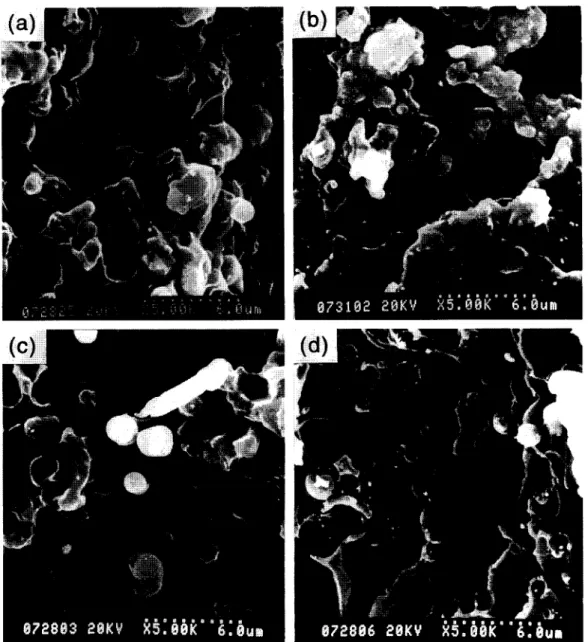
The i m p r o v e d interface interaction for the case o f added c o m p a t i b i l i z e r was manifested in the SEM m i c r o g r a p h s o f the fractured surface, as displayed in
Figures 11 and 12. Figures 11 and 12 show the centre
region and the side region of the fractured surface o f injection-moulded tensile bars respectively b o t h with and w i t h o u t the addition o f 5 p h r compatibilizer.
C o m p a r i n g Figures l l c and l l d , the observed inter-
faces were different in the sense that the L C P droplet
and PC interfaces were not distinctive for the c o m p a - tibilized case, especially for the compatibilized 20% Vectra case. On the other hand, clear interfaces were observed for the case w i t h o u t compatibilizer. A n o t h e r point was that the side and the centre m o r p h o l o g y o f the 20% Vectra blend w i t h o u t compatibilizer exhibited the well k n o w n skin core m o r p h o l o g y in L C P blend
m o u l d e d parts, as shown in Figures l l a and 12a. On the
c o n t r a r y , as in Figures 1 lb and 12b, the compatibilized
Vectra blend displayed m o r e uniform morphology throughout the cross-sectional area.
Further i m p r o v e m e n t in the mechanical property o f the compatibilized Vectra blend can be found in impact tests. The unnotched Izod impact test results are listed in
Table 1. In Table 1, it can be seen that the impact
property of the bar moulded from compatibilized 20/80 Vectra/PC blend has been greatly enhanced, as much as
Figure 11 The SEM micrographs of the centre region of the fractured surfaces normal to the injection-moulded bars of blends: (a) Vectra/PC (20/80);
(b) Vectra/PC/compatibilizer (20/80/5); (c) Vectra/PC (10/90): (d) Vectra/PC/compatibilizer (10/90/5)
Figure 12 The SEM micrographs of the side region of the fractured surfaces normal to the injection-moulded bars of blends: (a) Vectra/PC (20/80); (b) Vectra/PC/compatibilizer (20/80/5); (c) Vectra/PC (10/90); (d) Vectra/PC/compatibilizer (10/90/5)
Table 1 The impact strength of unnotched injection-moulded bars
Blend composition Impact strength (J m J)
Vectra/PC (10/90) 178.89
Vectra/PC/Compatibilizer (10/90/5) 240.83
Vectra/PC (20/80) 50.20
Vectra/PC/Compatibilizer (20/80/5) 428.80
seven times as compared to that from the non- compatibilized blend.
C O N C L U S I O N S
A compatibilizer based upon the transesterification between liquid-crystalline poly(oxybenzoate-co-ethylene terephthalate) (POB/PET) (60/40) and polycarbonate has been developed. This compatibilizer can exhibit liquid-crystalline behaviour, and was effective in improving the adhesion between p o l y c a r b o n a t e and incompatible liquid-crystalline polymer, Vectra (which
do not have ester exchange reaction). At p r o p e r composition, the enhanced adhesion in these ternary liquid-crystalline polymer blends resulted in greatly increased tensile properties such as elongation at break and ultimate stress in injection-moulded bars. The impact p r o p e r t y o f these ternary blends was also improved. An additional benefit was the more uniform m o r p h o l o g y in the injection-moulded samples. This d e m o n s t r a t e d the idea that, by providing enough physical interaction between matrix polymer and L C P t h r o u g h a third polymer, a compatible liquid- crystalline polymer blend can be formed. The third p o l y m e r contained similar chemical structural units to both matrix polymer and L C P t h r o u g h transesterifica- tion. These compatible L C P blends can have enhanced properties even when processed in very practical injection-moulding machines.
It is envisioned that further enhancement in mechan- ical properties o f these ternary liquid-crystalline polymer blends can be achieved through an elongational flow process such as fibre spinning.
A C K N O W L E D G E M E N T
The authors appreciated the financial support provided by the National Science Council through Project NSC83- 0405-E009-009.
REFERENCES
l Kiss, G. Po(vm. Eng. Sci. 1987, 27 (6), 410
2 Kolhi, A., Chung, N. and Weiss, R. A. Polym. Eng. Sci. 1989,
29, 573
3 Brostow, W. Polymer 1990, 31, 979
4 Sukhadia, A. M., Done, D. and Baird, D. G. Po(vm. Eng. Sci.
1990, 30 (9), 519
5 Lee, W. and DiBenedetto, A. T. Polym. Eng. Sci. 1990, 32 (6), 400
6 Shaw, M. T. and Rueda, G. Polym. Prepr. 1989, 30 (2), 538
7 Datta, A., De Souza, J. P., Sakhadia, A. M. and Baird, D. G.
ANTEC Tech. Pap. 1991, 913
8 Lee, W. and DiBenedetto, A. T. Polymer 1993, 34 (4), 684
9 Su, K. F. and Wei, K. H. J. Appl. Polym. Sci. 1995, 56, 79
10 Wei, K. H. and Su, K. F. J. Appl. Polym. Sci. 1996, 59, 789
11 Wei, K. H., Jang, H. C. and Ho, J. C. Macromolecules 1995,
submitted
12 Paul, D. R. in 'Polymer Blends' (Eds D. R. Paul and S. New-
man), Academic Press, New York, 1978, Vol. 2, Ch. 12
13 Olabisi, O., Robeson, L. M. and Shaw, M. T. 'Polymer
Polymer Miscibility', Academic Press, New York, 1979, p. 287