N A N O E X P R E S S
Open Access
Magnetotransport in an aluminum thin film on a
GaAs substrate grown by molecular beam epitaxy
Shun-Tsung Lo
1, Chiashain Chuang
1, Sheng-Di Lin
2*, Kuang Yao Chen
1, Chi-Te Liang
1*, Shih-Wei Lin
2,
Jau-Yang Wu
2, Mao-Rong Yeh
1Abstract
Magnetotransport measurements are performed on an aluminum thin film grown on a GaAs substrate. A crossover from electron- to hole-dominant transport can be inferred from both longitudinal resistivity and Hall resistivity with increasing the perpendicular magnetic field B. Also, phenomena of localization effects can be seen at low B. By analyzing the zero-field resistivity as a function of temperature T, we show the importance of surface scattering in such a nanoscale film.
Introduction
Aluminum has found a wide variety of applications in heat sinks for electronic appliances such as transistors and central processing units, electrical transmission lines for power distribution, and so forth. As a result, it is highly desirable to prepare high-quality aluminum materials for practical device applications. In particular, the epitaxial growth of Al thin films on GaAs substrates has attracted much interest because of its relevance to the field of electronic interconnects [1,2]. Fundamental limitations on the speed of interconnects are the various scattering processes [3,4] occurring in low-dimensional systems. In order to fully utilize it in the integrated cir-cuits consisting of GaAs-based high electron mobility transistors, investigations of the scattering mechanism on an Al thin film grown on a GaAs substrate are necessary.
One of the most important issues regarding the power dissipation and the speed of the device is the inelastic process such as electron-phonon scattering and elec-tron-electron scattering. It is also important for the illustrations of quantum interference phenomena [5-12], one of which is weak localization [WL]. In the WL regime, phase-coherent loops formed by the paths of electrons undergoing multiple scattering events and the
time-reversed ones lead to constructive interference at the original position of electrons at zero magnetic field under the assumption that the inelastic scattering time is much larger than the elastic one. However, phase coherence would be destroyed under a perpendicularB and lead to the negative magnetoresistance [NMR]. Positive magnetoresistance [PMR] can also be observed in the WL regime if the spin-orbit scattering [6,8,12] is strong enough.
Here, we review the temperature dependences of resis-tivity for various scattering mechanisms [13,14] that are generally observed in bulk materials. At low tempera-tures,T (lower than the Debye temperature), electron-phonon scattering is usually the dominant one, which is expected to give a Bloch-GruneisenT5 contribution to the resistivity. However, for the materials with complex Fermi surfaces or are suffering from interband scatter-ing, Umklapp process [13-15] should be taken into account, leading to theT3dependence instead. Umklapp process means that the crystal momentum is not con-served after an electron-phonon scattering event. A reci-procal lattice vector is added after this process, possibly leading to a large-angle scattering [15-17]. That is, the resistivity would not decrease as rapidly as T5, which introduces an additional factor of T2 for the low-angle phonon scattering at low T. Also, the T2 term expected for electron-electron scattering may possibly appear at low T [13,15], while at extremely high T (much larger than the Debye temperature), the resistivity follows AT [15], where A is a constant depending on the properties of the system.
* Correspondence: [email protected]; [email protected]
1
Department of Physics, National Taiwan University, No. 1, Sec. 4, Roosevelt Rd. Taipei 106, Taiwan
2
Department of Electronics Engineering, National Chiao Tung University, 1001 Ta Hsueh Rd., Hsinchu 300, Taiwan
Full list of author information is available at the end of the article
© 2011 Liang et al; licensee Springer. This is an Open Access article distributed under the terms of the Creative Commons Attribution License (http://creativecommons.org/licenses/by/2.0), which permits unrestricted use, distribution, and reproduction in any medium, provided the original work is properly cited.
It is well known that electronic transport is signifi-cantly affected by surface scattering [18-20], in addition to electron-electron scattering and electron-phonon scattering, as the thickness of a system is reduced to become comparable to the electron mean free path. There are several theories dealing with surface scattering.
As proposed by Olsen [21], neglecting the Umklapp process, low-angle scattering of electrons by phonons is important in a thin film where electrons are deflected by low-energy phonons to the surface [22,23] more easily than that in the bulk sample. That is, surface scat-tering occurs frequently in a thin film. A more careful treatment for the size effects considering the surface conditions is proposed by Soffer [24]. Here, we use Sof-fer’s theory as the beginning of our analyses for the zero-field resistivity.
An Al thin film is investigated in our experiments especially for its special properties. With increasingB, a crossover from electron- to hole-dominant transport occurs as a result of its non-simple Fermi surface [25-28]. Also, it is a good material for the investigations of quantum phenomena in low-dimensional systems ascribed to its long inelastic scattering time [7].
Experimental details
The sample used in this study was grown by molecular beam epitaxy [MBE]. The following layer sequence is grown on a semi-insulating GaAs (100) substrate: 200-nm undoped GaAs and 60-nm Al film. All the pro-cesses were performed in the ultra-high-vacuum MBE chamber to prevent unnecessary defects. The Al thin film investigated here is a single crystalline, which can be checked by the X-ray shown in Figure 1a. Figure 1b
shows an atomic force microscopy [AFM] image of the Al thin film. Four-terminal magnetotransport measure-ments were performed in a top-loading He3 system equipped with a superconducting magnet over the tem-perature range fromT = 4 K to T = 78 K using standard ac phase-sensitive lock-in techniques. The magnetic field is applied perpendicular to the plane of the Al thin film. It is necessary to mention that all the resistivity results have been divided by the thickness (60 nm).
Result and discussion
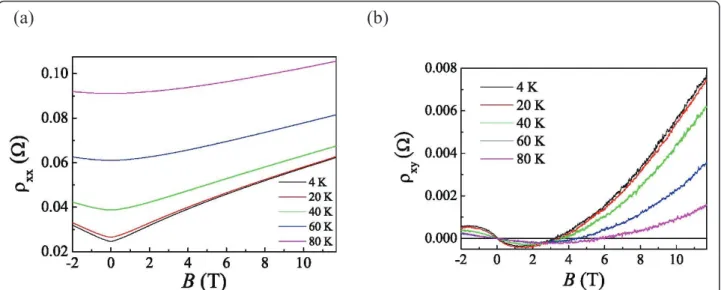
Longitudinal resistivity and Hall resistivity (rxxandrxy)
as a function of magnetic fieldB at various temperatures T are shown in Figure 2a,b, respectively. PMR [7,9] can be observed at all T. It is generally believed that PMR is proportional to the quadratic B in the low-field region followed by a linear dependence onB with increasing B for non-compensated (the numbers of electrons and holes are different) metals [14,26], such as aluminum investigated here. A classical PMR based on the two-band model [14,15,29] results in thisB2 dependence in the low-field regime where the Fermi surface is spheri-cal. With increasingB, the number of electrons under-going Bragg reflection at the cusps in the second Brillouin zone increases, leading to the linear depen-dence on B for rxx [26,27]. Another phenomenon
regarding the crossover from electron- to hole-dominant transport is the reverse of the sign of the Hall resistivity [28] with increasing B, as presented in Figure 2b. Such a bipolar phenomenon with increasing B can also be understood by the Bragg reflection occurring at the cusps, leading to the hole-like orbit.
While deviations from theB2dependence in the low-field regime at variousT can be observed in Figure 3a, it is
40nm
0nm
Figure 1 X-ray and AFM of the Al thin film. (a) The scanning of Al(111) peak of the sample. (b) An AFM 5 × 5-μm2image of a 60-nm-thick
beyond the classical mechanism. Thus, we know that quantum interference-induced corrections are needed to be taken into account for the exact illustration of our results. The contribution of weak localization [6,10] is usually dominant forT ≧ 20 K. At high B, rxx shows a
trend toward a linear dependence onB, shown in Figure 3b, representing that the hole-like transport becomes dominant indeed. It is worth mentioning that the PMR
can still be observed atT ≧ 20 K, without turning into the NMR [6]. Most of the measurements on Al [6-10] show that the PMR is almost diminished atT > 10 K due to its weak spin-orbit scattering. As suggested by Bergmann et al. [7], PMR almost diminishes atT ≧ 9.4 K for Al in the low-field regime. In order to study the scattering mechanisms in differentT ranges, we analyzed the zero-fieldrxxas a function ofT in the next section.
(a) (b)
Figure 2 Resistivity at various temperaturesT. (a) Longitudinal resistivity, rxx. (b) Hall resistivity,rxy, as a function of magnetic field B at
various temperatures T.
(a)
(b)
Figure 3 Deviations from theB2dependence in the low-field regime at variousT. rxxas function of B 2
(a) and B (b). The dotted lines in blue represent linear parts of the data.
As shown in Figure 4a, for 4.8 K ≦ T ≦ 78 K, the metallic behavior can be observed without a transition to the insulator, as is the case for a pure metal [11]. The mean free path for the bulk Al is approximately equal to 17.5μm [23], substantially larger than the thickness of the thin film studied here (60 nm). It prevails that sur-face scattering is important instead of the grain bound-ary scattering in such a thin film. For a polycrystalline material, grain boundary scattering needs to be consid-ered, while for the single crystal, it is a minor effect. In accordance with Soffer’s model [24] of surface scattering and the extensive work of Sambles et al. [19,20], the resistivity takes the form
xx 0AT2BT5, (1)
whereA and B are system-dependent constants. The first term represents the residual resistivity. The second and the third terms are due to electron-electron scatter-ing and Bloch-Gruneisen electron-phonon scatterscatter-ing, respectively. The fittings of Eq. (1) to the resistivity over the whole temperature range and aboveT = 30 K are shown in Figure 4a and its inset, respectively. It can be seen that the good fitting is limited to the temperature above 30 K. The obtained coefficient ofT2dependence is approximately equal to 600 fΩmK-2. However, Soffer’s theory cannot produce such a largeT2 term over such a wide temperature range 30 K <T < 78 K. Also, electron-electron scattering would not exist at such highT. It is believed that the violation of Soffer’s theory in aluminum is due to its complex Fermi surface. As suggested by
(a)
(b)
(c)
Figure 4 Resistivity and metallic behavior. (a) Zero-field resistivity as a function of T ranging from T = 4.8 K to T = 78 K. The red solid line corresponds to a fit to Eq. (1). The best fit is limited at T > 30 K, as shown in the inset. (b), (c)rxx(B = 0) as functions of T2and T3, respectively.
Sambles et al. [30],T2dependence can exist alone with-out aT5term, which is derived by considering the Umk-lapp scattering process occurring at the surface for materials with a disconnected Fermi surface [31]. Figure 4b shows thatrxxfollows theT2 dependence as
T > 30 K, indeed consistent with the model of surface Umklapp scattering. On the other hand, it shows a trend toward aT3 dependence with decreasingT below 30 K, as shown in Figure 4c, which can be ascribed to the elec-tron-phonon scattering introducing the Umklapp pro-cess, usually observed in the bulk material [13]. Even though we know that the Umklapp process is likely to be important in our system, the crossover fromT2to T3 dependence with decreasingT can still be explained by Olsen’s argument for low-angle scattering qualitatively. At relatively lowT, the magnitude of the momentum of phonons is too small to induce the size effect such that the Umklapp scattering process occurring in the interior may possibly be dominant over that occurring at the interface. Thus, the crossover from theT2dependence to T3
dependence of resistivity with decreasingT below 30 K can be predicted. A similarT2term can be observed for 46 K <T < 90 K performed in a subsequent cooldown in a closed cycle system, as shown in Figure 5. A devia-tion from this dependence atT > 90 K is ascribed to the mean free path shortening with decreasingT. Thus, the size effect becomes less important, also consistent with Olsen’s argument. At T > 105 K, rxxshows a tendency
toward a linear dependence onT, as shown in the inset of Figure 5. A classical model has predicted such a linear term at highT (much larger than the Debye temperature, about 394 K for aluminum). However, our result is not in
this case. The onset of this linear dependence with increasingT and how the size effects modulate the mag-netoresistance requires further investigations.
Here, it is worth mentioning that the electron-phonon impurity interference also leads to theT2 contribution to the resistivity [32-34], which should be smaller than the residual resistivity. However, in our results, the dif-ference between r(T = 78 K) and r(T = 30 K) is approximately equal to 0.059Ω, which is larger than r (T = 4.8 K) = 0.025Ω, taken as the residual resistivity, inconsistent with the requirement for the correction term. Also, there are several experimental results indi-cating that such a mechanism is not the dominant one for a relatively pure metal. Therefore, we can safely neglect the influence of the electron-phonon impurity interference in our Al thin film.
Conclusions
In conclusion, we have performed magnetotransport measurements on an aluminum thin film grown on a GaAs substrate. A crossover from electron- to hole-dominant transport can be inferred from both longitudi-nal resistivity and Hall resistivity with increasing B, characteristic of the complex Fermi surface of alumi-num. The existence of positive magnetoresistance atT ≧ 20 K indicates that the spin-orbit scattering should be taken into account for the exact treatment of localiza-tion effects. The observed surface caused T2 term for rxx demonstrates that surface Umklapp scattering is
important. With decreasing T, a tendency toward a T3 dependence suggests that an Umklapp process occurring in the interior is more important than that occurring at
Figure 5rxxas a function ofT2performed in a subsequent cooldown in a closed cycle system ranging fromT = 46 K to T = 298 K.
the surface. Such a crossover is consistent with Olsen’s argument for low-angle electron-phonon scattering qua-litatively. All these experimental results show that the nature of the interface between the Al thin film and the GaAs substrate would significantly affect the electrical properties of such a nanoscale film.
Acknowledgements
The authors declare that they have no competing interests. This work was funded by the NSC, Taiwan.
STL and CC performed the low-temperature experiments on the Al film and drafted the manuscript. KYC and MRY performed the low-temperature experiments on the Al film. SDL and CTL conceived of the study. JYW fabricated the Al samples. SWL prepared the Al samples and performed the AFM and X-Ray measurements. All authors read and approved the final manuscript.
Author details
1
Department of Physics, National Taiwan University, No. 1, Sec. 4, Roosevelt Rd. Taipei 106, Taiwan2Department of Electronics Engineering, National
Chiao Tung University, 1001 Ta Hsueh Rd., Hsinchu 300, Taiwan Competing interests
The authors declare that they have no competing interests. Received: 7 August 2010 Accepted: 26 January 2011 Published: 26 January 2011
References
1. Liu HF, Chua Sh, Xiang N: Growth-temperature- and thermal-anneal-induced crystalline reorientation of aluminum on GaAs (100) grown by molecular beam epitaxy. J Appl Phys 2007, 101:053510.
2. Feiginov MN, Kotel’nikov IN: Evidence for attainability of negative differential conductance in tunnel Schottky structures with two-dimensional channels. Appl Phys Lett 2007, 91:083510.
3. Davis JA, Venkatesan R, Kaloyeros A, Beylansky M, Souri SJ, Banerjee K, Saraswat KC, Rahman A, Reif R, Meindl JD: Interconnect limits on gigascale integration (GSI) in the 21st century. Proc IEEE 2001, 89:305.
4. Havemann RH, Hutchby JA: High-performance interconnects: an integration overview. Proc IEEE 2001, 89:586.
5. Santhanam P, Prober DE: Inelastic electron scattering mechanisms in clean aluminum films. Phys Rev B 1984, 29:3733.
6. Bergmann G: Quantum corrections to the resistance in two-dimensional disordered superconductors above Tc: Al, Sn, and amorphous Bi0.9Tl0.1
films. Phys Rev B 1984, 29:6114.
7. Santhanam P, Wind S, Prober DE: Localization, superconducting fluctuations, and superconductivity in thin films and narrow wires of aluminum. Phys Rev B 1987, 35:3188.
8. Lin JJ, Bird JP: Recent experimental studies of electron dephasing in metal and semiconductor mesoscopic structures. J Phys Condens Matter 2002, 14:R501.
9. Chui T, Lindenfeld P, McLean WL, Mui K: Localization and Electron-Interaction Effects in the Magnetoresistance of Granular Aluminum. Phys Rev Lett 1981, 47:1617.
10. Mui KC, Lindenfeld P, McLean WL: Localization and electron-interaction contributions to the magnetoresistance in three-dimensional metallic granular aluminum. Phys Rev B 1984, 30:2951.
11. Berengue OM, Lanfredi AJC, Pozzi LP, Rey JFQ, Leite ER, Chiquito AJ: Magnetoresistance in Sn-Doped In2O3Nanowires. Nanoscale Res Lett
2009, 4:921.
12. Hikami S, Larkin AI, Nagaoka Y: Spin-Orbit Interaction and
Magnetoresistance in the Two Dimensional Random System. Prog Theor Phys 1980, 63:707.
13. Fickett FR: A review of resistive mechanisms in aluminum. Cryogenics 1971, 11:349.
14. Krevet B, Schauer W: Transverse magnetoresistance and its temperature dependence for high-purity polycrystalline aluminum. J Appl Phys 1976, 47:3656.
15. Ashcroft NW, Mermin ND: Solid State Physics. Chicago: Holt, Rinehart, and Winston; 1976.
16. Ekin JW, Maxfield BW: Umklapp Processes and the Low-Temperature (T < 7°K) Electrical Resistivity of Aluminum. Phys Rev B 1970, 2:4805. 17. Holwech I, Jeppesen J: Temperature dependence of the electrical
resistivity of aluminium films. Phil Mag 1967, 15:217.
18. Garland JC, van Harlingen DJ: Low-temperature electrical and thermal transport properties of pure aluminium. J Phys F 1978, 8:117. 19. Sambles JR, Elsom KC, Sharp-Dent G: The effect of sample thickness on
the resistivity of aluminium. J Phys F 1981, 11:1075.
20. Sambles JR, Mundy JN: A reanalysis of resistive size effects in tungsten. J Phys F 1983, 13:2281.
21. Olsen JL: Helv Phys Acta 1958, 31:713.
22. Blatt FJ, Burmester A, LaRoy B: Resistance and Magnetoresistance of Thin Indium Wires. Phys Rev 1967, 155:611.
23. von Bassewitz A, Mitchell EN: Resistivity Studies of Single-Crystal and Polycrystal Films of Aluminum. Phys Rev 1969, 182:712.
24. Soffer SB: Statistical Model for the Size Effect in Electrical Conduction. J Appl Phys 1967, 38:1710.
25. Ashcroft NW: The Fermi surface of aluminium. Phil Mag 1963, 8:2055. 26. Balcombe RJ: The Magneto-Resistance of Aluminium. Proc Roy Soc 1963,
275:113.
27. Feder J, Lothe J: Magnetoresistance and Hall effect due to Bragg reflection of free electrons in aluminium. Philos Mag 1965, 12:107. 28. Banik NC: Overhauser AW. Hall coefficient of a holelike Fermi surface.
Phys Rev B 1978, 18:1521.
29. Stamenov P, Venkatesan M, Dorneles LS, Maude D, Coey JMD: Magnetoresistance of Co-doped ZnO thin films. J Appl Phys 2006, 99:08M124.
30. Sambles JR, Elsom KC: Thickness effects and theT2dependence of the
resistivity of aluminium. J Phys F 1985, 15:161.
31. Tsoi VS, Razgonov II: Reflection of conductivity electrons by surface of a tungsten sample. Zh Eskp Teor Fiz 1978, 74:1137.
32. Lin JF, Bird JP, Rotkina L, Sergeev A, Mitin V: Large effects due to electron-phonon-impurity interference in the resistivity of Pt/C-Ga composite nanowires. Appl Phys Lett 2004, 84:3828.
33. Ptitsina NG, Chulkova GM, Il’in KS, Sergeev AV, Pochinkov FS, Gershenzon EM, Gershenson ME: Electron-phonon interaction in disordered metal films: The resistivity and electron dephasing rate. Phys Rev B 1997, 56:10089.
34. Il’in KS, Ptitsina NG, Sergeev AV, Gol’tsman GN, Gershenzon EM, Karasik BS, Pechen EV, Krasnosvobodtsev SI: Interrelation of resistivity and inelastic electron-phonon scattering rate in impure NbC films. Phys Rev B 1998, 57:15623.
doi:10.1186/1556-276X-6-102
Cite this article as: Lo et al.: Magnetotransport in an aluminum thin film on a GaAs substrate grown by molecular beam epitaxy. Nanoscale Research Letters 2011 6:102.
Submit your manuscript to a
journal and benefi t from:
7 Convenient online submission 7 Rigorous peer review
7 Immediate publication on acceptance 7 Open access: articles freely available online 7 High visibility within the fi eld
7 Retaining the copyright to your article