Low-temperature study of lasing characteristics for 1.3-μm
AlGaInAs quantum-well laser pumped by an actively
Q-switched Nd:YAG laser
K. W. Su, Yi-Fan Chen, S. C. Huang , A. Li, S. C. Liu, Y. F. Chen, and K.F. Huang
Department of Electrophysics, National Chiao Tung University, Hsinchu, Taiwan
ABSTRACT
We report a l ow-temperature 1.3 μm Al GaInAs quantum-well l aser pumped by a 1. 06μm activ e Q-switched l aser quenched by a l ow-temperature vacuum sy stem. An a verage power of 3 30mW i s achieved at tem perature as low as 233K com pared to t he ave rage power of 50mW obtaine d at room-temperature without cooling device both at pu mping repetition rate of 30 kHz. And the average rate of gain peak shift was found to be 0.47 nm/K between 293-133 K.
Keywords: VECSEL ; AlGaInAs ; quantum well
1. INTRODUCTION
High-peak-power all-solid-state laser sou rces in th e 1.3-1.6μm spectral region are of particular interest in remote sensing, eye-safe optical ranging, fiber sensing, and communication [1-4]. To achieved this, diode pum ped so lid state lasers (DPSSLs) has v antage points of relatively co mpact size, high power, excellent b eam quality, long lifetime, and low h eat p roduction h ave b een wid ely u sed for various ap plications i ncluding i ndustry, pure sc ience, medical diagnostics, a nd entertainm ent [5]. Unfortunately, the spectral range of DPSSLs is lim ited by the properties of doped ion in crystals and glasses. Vertical-external-cavity Surface-emitting sem iconductor lase rs (VECSELs) which c ombines both a dvantages of DPSSLs a nd sem iconductor l asers al lows for f lexible c hoice o f em ission wavelength via bandgap engineering have successfully conquered this situation. Typically this structure
consists of a highly reflecting distributed reflector (DBR) grown on a l attice-matched substrate with resonant-periodic-gain st ructure t hat c omprises a se ries of ba rriers t o provide t he pump absorption, quantum wells to provide gain, and cap layers to prevent surface recombination and oxidation.
The l ong w avelength (1.3-1.55μm) sem iconductor l aser occurred at s pectral ra nge c overed by lasers based on G aAs and In P su bstrates. For InGaAs/GaAs system, at an operation over 1 μm there would be too m uch scatterin g lo ss to have good ef ficiency du e t o co mpressed strain. Bu t t he introduction of st rain-compensating GaAsP l ayers as buffer l ayer co uld i mprove t he high power operation [6]. On the other hand, laser gain structure based on InP substrate like InGaAsP solid solution system [7,8] suffers from poor te mperature characteristic due to their small conduction band offset. To conquer this, an alternative of using AlGaInAs material system with deeper conduction band offset has brought up . B ut th ere still h ave difficulties form ing DBRs lik e lo w refractive ind ex con trast, l ow thermal conductivity or high complexity of growth [9-11]. Another way to achieve long wavelength range is using GaInNAs/GaAs system with high contrast GaAs/AlGaAs DBRs and l arger conduction band offset [12]. Adding a few of nitrogen will result in the redshift of absorption wavelength and a reduction of lattice mismatch to GaAs [13]. So we can adjust the ratio of indium and nitrogen content to reach the wavelength we want. Because nitrogen is too small in this quaternary alloys, there is a d rawback that too many nitrogen content will introduce large number of nonradiative defects. As a result it is difficult to fabricate this compound for long wavelength range. In this work, we use AlGaInAs/InP MQWs as our g ain region of optically p umped VECSEL and w ith coo ling tem perature at 283K we ob tained 140mW output power at th e repetition rate of 10kHz and 1.2W input power [14]. Raising input power will decrease the lasing efficiency and a roll-over effect came into existence. However, the temperature dependent laser performance and physics have not been realized. But we believed that it mainly caused by the diffusion of carrier from the gain region due to the heat produced by the high absorbed power. To study the optical characteristics under low tem perature, we m ade a sim ple cavity put in a vacuum system cool ed by l iquid nitrogen an d heated by La ke Shore 331 T emperature C ontroller an d t he temperature is controlled at the suitable degree.
In this article we presen t a lo w-temperature 1.3μm AlGaInAs quantum-well laser p umped by a 1.06μm Nd:YAG active Q-switch laser quenched by liquid nitrogen. An average power of 330mW is achieved at tem perature as low as 233K com pared to t he ave rage power of 50mW obtaine d at room-temperature without cooling device both at pu mping repetition rate of 30 kHz. And the average rate of gain peak shift was found to be 0.47 nm/K between 293-133 K.
Nd:YAG AO crystal Solid state 1.06μ m laser
λ /2 30 groups AlGaInAs QWs Laser diode at 808 nm Coupling lens Beam expander Focusing lens Lake Shore 331 Temperature Controller HR at 1.3 μ m (R>99.8%) HT at 1.06 μ m (T>90%) PR at 1.3 μ m (R=94%) Transparency window 1.3 μ m laser output Liquid nitrogen Nd:YAG AO crystal Solid state 1.06μ m laser
λ /2 30 groups AlGaInAs QWs Laser diode at 808 nm Coupling lens Beam expander Focusing lens Lake Shore 331 Temperature Controller HR at 1.3 μ m (R>99.8%) HT at 1.06 μ m (T>90%) PR at 1.3 μ m (R=94%) Transparency window 1.3 μ m laser output Liquid nitrogen
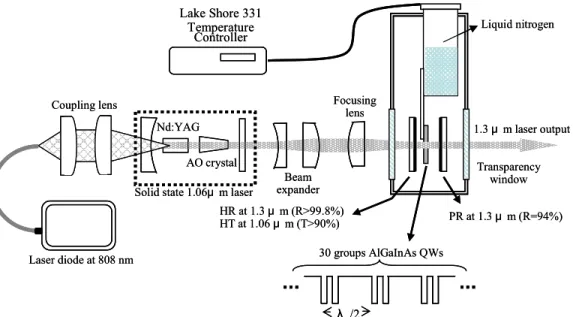
Fig. 1 Experimental setup of low temperature AlGaInAs/InP semiconductor disk laser at 1.3μm pumped by a 1.06μm A-O Q-switched laser and quenched by a low-temperature vacuum cooling system
2. EXPERIMENTAL SETUP
Fig. 1 s hows t he ex perimental con figuration of th e lo w-temperature 1.3μm AlGaI nAs quantum-well l aser pum ped by a 1.06μm Nd :YAG active Q-switch ed laser. Th e pumping so urce provides 20-60 ns pulses at repetition rate between 20 and 60 kHz. We controlled pump spot diameter to be about 420μm to have efficient spatial overlap with lasing mode. The gain region consist of 30 groups of two QWs spaced at half-wavelength intervals by AlGaInAs barrier layers with the bandgap around 1070 nm. This is a R PG structure that barrier layers are used not only to absorb pumping light but also to locate the quantum well region at the anti-node of the lasing field standing wave and it can enhance th e wav elength selectio n [15-17], and we ob tained th e p eak lu minescence wavelength ar ound 1365 nm.
The laser resonator is a plano-plano cavity with front mirror which has anti-reflection coating on the entra nce face at 1064 nm (R<0.2%), high-re flection coating at 1365 nm (R>99.8%), and high transmission coating at 1064 nm(T>90%) on the ot her face. The reflectivity of t he output coupler is 94% at 1365 nm and the overall cavity length is abou t 5mm. This flat-flat cavity is st abilized by the thermal induced lens in the gain medium [18,19]. It is an attractive design because it reduces complexity and makes the system compact and rugged. The gain medium is cooled down by liquid nitrogen and the temperature i s co ntrolled by La ke Shore 331 Temperature Controller . The wh ole structure of lase r cavity i s i nside t he Jani s V PF-100 c ryogenic vac uum equi pment t o avoi d t he f og o f st ream on t he
window. And the two transparency windows have high transmittance for spectral range of both lasing and pumping wavelength.
The gain medium was composed of an AlGaInAs QW/barrier structure grown on a Fe-doped InP transparent sub strate by m etalorganic ch emical-vapor deposition. Com pared to the conv entional S-doped I nP which has st rong a bsorption i n t he 1.0-2.0 s pectral region, Fe -doped In P has better transparency at lasing wavelength . It is worth mention that In-P based systems suffer from the lack of good DBR and has been challenging to transfer from edge-emitting lasers to surface-emitting lasers. By the use of Fe-doped InP, we could replace DBRs in the VECSEL by an external mirror. An InP window layer was deposited on the gain structure to avoid surface recombination and oxidation. The back side of t he s ubstrate was m echanically polished a fter g rowth. B oth sides of t he gain c hip we re anti-reflection coated at lasing and pumping wavelengths to reduce backreflections and coupled-cavity effects. And the total residual reflectivity of the AR-coated sample is approximately 5%.
900 1000 1100 1200 1300 1400 1500 0 20 40 60 80 100 Tran sm issio n (%) Wavelength(nm) 900 1000 1100 1200 1300 1400 1500 1600 0 20 40 60 80 100 Tr a nsm is si on( % ) Wavelength (nm) InP-Fe doped AR InP-S doped AR 900 1000 1100 1200 1300 1400 1500 0 20 40 60 80 100 Tran sm issio n (%) Wavelength(nm) 900 1000 1100 1200 1300 1400 1500 1600 0 20 40 60 80 100 Tr a nsm is si on( % ) Wavelength (nm) InP-Fe doped AR InP-S doped AR
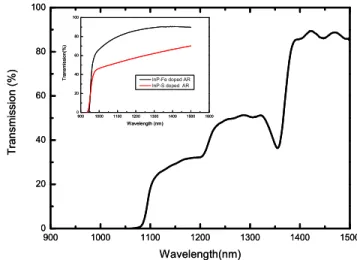
Fig. 2 Transmittance spectrum of AR-coated AlGaInAs/InP MQWs gain chip at room temperature. Inset, room temperature transmittance spectrum of S-doped and Fe-doped InP chip with anti-reflection coating.
Figure 2 shows the transmittance for the AR-coated AlGaInAs/InP gain chip at room temperature. It can be seen that the strong abs orption of the barrier layers leads to low transmittance near 1070nm. The total absorption efficiency of the barrier layers at 1064 nm was found to be approximately 95% for the pulse pumping. On the other hand, an abrupt change in transmittance near 1365nm comes from the absorption of the Al GaInAs QWs. Th e inset o f Figure 2 sh ows t he tran smittance o f Fe-d oped and S-doped InP with anti-reflection coating. We could observe th at th e tran smittance is abou t 90% for Fe-doped InP and 60% for S-doped InP near 1365nm.
3. RESULT AND DISCUSSION
Fig. 3 shows the performance of the optically-pumped 1.3 μm AlGaInAs MQWs laser operated with different cooling temperature ranged from 293 K to 233 K at repetition rate of 15 kHz at low power and 30 kHz at high power. The pulse width at repetition rate of 15 kHz and 30 kHz are ranged from 50 ns t o 30 ns and 120 ns t o 52 ns respectively. The transverse mode was measured to be the fundamental mode over the complete output power range. The beam quality factor was determined by the Gaussian fit to the laser beam waist and the divergence angle which was found to be less th an 1.5. We can see that the sl ope ef ficiency is i ncreasing with decreasing temp erature, a nd t he m aximum output power of 293 K and 233 K are 50 mW and 330 mW respectively. From the past work of our group [14,20,21], we k now that the roll-over of output power at lo w repetition rate is resu lted from the gain sat uration or t he transparency induce d by th e pumping b eam. Alth ough th e pumping en ergy density is larger than the lasing energy density, the gain-saturation effect is more conspicuous than the nonlinear transparency of th e barrier due to it’ s long absorption length. So we could still observe the roll-over of output power at 1.8W pumping power even at temperature as low as 293 K.
0.0 0.5 1.0 1.5 2.0 2.5 3.0 0 50 100 150 200 250 300 350 O u tpu t po we r ( m W) Input power (W) T=293K T=283K T=273K T=263K T=253K T=243K T=233K Repetition rate = 15kHz Repetition rate = 30kHz 0.0 0.5 1.0 1.5 2.0 2.5 3.0 0 50 100 150 200 250 300 350 O u tpu t po we r ( m W) Input power (W) T=293K T=283K T=273K T=263K T=253K T=243K T=233K Repetition rate = 15kHz Repetition rate = 30kHz
Fig. 3 Experimental results of AlGaInAs 1.3μm MQWs laser pumped by an 1.06μm active Q-switched Nd:YAG laser at different cooling temperature. It shows the output power of 15 kHz repe tition r ate at low input power and 30kHz at high input power.
Fig 4 i s t he photoluminescence o f Al GaInAs M QWs wafer exci ted by a 1. 06 μm activ e Q-switched laser with 1.2 W pu mping power and 800 μm pumping spot size at 30 kHz and cooled from 293 K to 133 K. There are two p eaks at abo ut 1350 nm and 124 5 nm due to the n =1 and n=2 transition at 293 K respectively. The n=1 peak wavelength shifts from 1350 nm to 1275 nm with the
slope of 0.47 nm /K and the n= 2 pea k disappears gradually. The line-width of n= 1 peak became narrower with decreasing temperature due to the reduction of collision broadening.
1200 1250 1300 1350 1400 0 20 40 60 80 100 120 140 160 180 200 In tens ity ( a. u.) Wavelength (nm) T=293K T=273K T=253K T=233K T=213K T=193K T=173K T=153K T=133K
Fig. 4 Experimental results of photoluminescence pumped at input power of 1.2W and repetition rate of 30kHz at different cooling temperature.
REFERENCE
[1] Gra btchikov, A. S., Kuzmin, A. N., .Lisinetskii, V . A., Orl ovich, V . A. , Dem idovich, A. A., Yumashev, K. V., Kuleshov, N. V., Eichler, H. J., and Danalov, M. V., “Passively Q-switched 1.35 μm diode pumped Nd:KGW laser with V:YAG saturable absorber,” Opt. Mater. 16, 349 (2001) [2] Fl uck, R ., Ha ring, R ., Paschotta, R ., Gi ni, R ., M elchior, H ., and Keller, U., “Eyesafe pulsed
microchip laser using semiconductor saturable absorber mirrors,” Appl. Phys. Lett. 72, 3273 (1998) [3] Stultz, R. D., Leyva, V., and Spariosu, K., “Short pulse, high-repetition rate, passively Q-switched
Er:yttrium-aluminum-garnet laser at 1.6 microns,” Appl. Phys. Lett. 87, 241118 (2005)
[4] Savitski, V. G., Posnov, N. N., Prokoshin, P. V., Malyarevich, A. M., Yumashev, K. V., Demchuk, M. I., and Lipovski, A. A., “PbS-doped phosphate glasses saturable absorbers for 1.3-μm neodymium lasers,” Appl. Phys. B 75, 841 (2002)
[5] Sp ies, D. L., “High ly ef ficient n eodymium :y ttrium alu minum g arnet laser en d pu mped b y a semiconductor laser array,” Appl. Phys. Lett. 47, 74 (1985)
[6] Keller, U., “Ultrafast all-solid-state laser technology,” Appl. Phys. B 58, 347 (1994)
[7] Symonds, C., Sagnes, I., Garnache, A., Hoogland, S., Saint-Girons, G., Tropper, A. C., Oudar, J. L., “Continuous-wave operation of m onolithically g rown 1.5- μm o ptically pu mped
vertical-external-cavity surface-emitting-lasers,” Appl. Opt. 42, 6678 (2003)
[8] Kurdi, M . E., B ouchoule, S., B ousseksou, A., Sa gnes, I., Pl ais, A., Strassner, M ., Symonds, C ., Garnache, A., Jacquet, J., “Room-temperature continuous-wave laser operation of electrically 1.55 μm VECSEL,” Electron. Lett. 40, 671 (2004)
[9] Lambert, B., Toudic, Y., Rouillard, Y., Gauneau, M., Baudet. M., Alard, F., Valiente, I., Simon, J. S., “High reflectiv ity 1 .55μm (Al)GaAsSb/AlAsSb Bragg reflector lattice matched on InP substrates,” Appl. Phys. Lett. 66, 442 (1995)
[10] Baek, J. H. , Choi, I. H. , Lee, B., Ha n, W. S., Ch o, H. K., “Pr ecise contr ol of 1.55 μm vertical-cavity surface-emitting laser structure with InAlGaAs/InAlAs Bragg reflectors by situ growth monitoring,” Appl. Phys. Lett. 75, 1500 (1999)
[11] Nishiyama, N., Caneau, C., Hall, B., Guryanov, G., Hu, M. H., Liu, X. S., Li, M. J., Bhat, R., Zah, C. E., “Long-wa velength ver tical-cavity surface-em itting lase r on InP with lattice m atched AlGaInAs-InP DBR grown by MOCVD,” IEEE J. Sel. Top. Quantum Electron.
[12] Kondow, M., Uomi, K., Niwa, A., Kitatani, T., Watahiki, S., and Yazawa, Y., “GaInNAs: A novel material for l ong-wavelength-range l aser diodes wi th e xcellent hi gh-temperature pe rformance,” Jpn. J. Appl. Phys. Part 1 35, 1273 (1996)
[13] Keller , U., T ropper, A. C., “ Passively mode locked s urface-emitting sem iconductor lasers,” Physics Reports 429, 67 (2006)
[14] S u, K. W., Huang, S . C., Li, A., Liu, S. C., Chen, Y. F., and H uang, K. F., “High-peak-power AlGaInAs quantum-well 1.3-μm laser p umped by a diode-pumped actively Q-switched solid-state laser,” Opt. Lett. 31, 2009 (2006)
[15] Raya, M. Y . A., Br ueck, S . R. J., Osinsky, M., Schaus, C. F., Mc inery, J. G., B rennan, T. M., Hammons, B . E., “R esonant pe riodic g ain su rface-emitting sem iconductor l asers,” IEE E J. Quantum Electron. 26, 1500 (1989)
[16] Raya, M. Y. A., Brueck, S. R. J., Scully, M. O., Lee, C., “Resonant periodic-gain surface-emitting semiconductor lasers and correlated emission in a ring cavity,” Phys. Rev. A 44, 4599 (1991)
[17] Zhou, J., Cada, M., He, J., M akino, T., “Analysis and desi gn of combined distributed-feedback/Fabry-Perot structures for surface -emitting sem iconductor lasers,” IEEE J . Quantum Electron. 32, 417 (1996)
[18] Zayhowski, J. J., Mooradian, “Single-frequency microchip Nd lasers,” A., Opt. Lett. 14, 24 (1989) [19] Dixson, G. J., Li ngvay, L. S., Jarm an, R. H., ”Properties of cl ose coup led m onolithic, lith ium neodymium, tetraphosphate lasers,” Proc. SPIE 1104, 107 (1989)
[20] Huang, S. C., Chang, H. L., Su, K. W., Li, A., Liu, S. C., Chen, Y. F., Huang, K. F., “AlGaInAs/InP eye-safe laser pumped by a Q-switched Nd:GdVO4 laser,” Appl. Phys. B 94, 483 (2009)
[21] Ch ang, H. L. , Huang, S . C. , Ch en, Yi-Fan, Su , K. W., Ch en, Y. F., Hu ang, K. F., “Ef ficient