行政院國家科學委員會專題研究計畫 成果報告
多目標決策理論發展及其應用(3/3)
計畫類別: 個別型計畫 計畫編號: NSC91-2416-H-009-013- 執行期間: 91 年 08 月 01 日至 92 年 07 月 31 日 執行單位: 國立交通大學科技管理研究所 計畫主持人: 曾國雄 計畫參與人員: Serafim Opricovic, 劉宜欣、胡宜中、謝嘉鴻、邱榆淨、邱 華凱、劉莉貞、唐良萍 報告類型: 完整報告 處理方式: 本計畫可公開查詢中 華 民 國 92 年 10 月 31 日
摘要
本研究的主要目標在發展多目標決策之理論及其應用。在研究方法上著重在模式之 建立與發展,並針對各種MCDM 方法作兩兩之比較。例如:VIKOR 法之程序包含產生 方案、建立準則、評估權重、排序並選出妥協解等,此方法可應用於處理與解台灣之各 複雜問題,如應用在重建計畫、環境品質、區位選擇等問題。此外,研究過程中亦建立 多準則之基因演算法,並將之應用於工程與管理排程之組合性等問題。三年的研究中, 已推展出許多對台灣及其他地區均居相當有助益之成果。一般實務問題中存在許多必須 嚴謹考量且卻又相互衝突的因子,例如經濟、環境、社會與可靠性,而本計畫發展出之 VIKOR 方法正可以廣泛地處理不同的工程與管理問題,例如以此法求台北市 Pao-San 飯店之較佳區位,而應用模糊多準則模式處理中台灣地區的九二一震災重建問題(南投 縣),此外亦尚有許多土木工程排程問題之相關應用;另一方面,各種多準則評估方法 亦可應用於台灣高科技產業之政策評選。此外,本研究並結合應用資料探勘技術,探討 如何在各種動靜態環境下,同時節省學習成本並擴展能力集合。在三年的研究當中,已 有數十篇論文接收或刊登於著名國際期刊中,或於國內外論文研討會中發表,據此可充 分顯示本計畫之研究成效。 關鍵詞:多目標決策、多準則評估、資料探勘、能力集合Abstract
The main goal was theoretical development of Multiple Criteria Decision Making (MCDM) methods and their applications. We investigated the MCDM methods, focusing on their foundations and applications. The results of this research are comparing of MCDM methods, such as VIKOR and TOPSIS, DEA and MCDM, fuzzy and crisp models. The VIKOR method consists of generating alternatives, establishing criteria, assessment of weights, ranking and selecting a compromise solution. We applied the VIKOR method to complex problems in Taiwan, such as reconstruction scheduling, environmental quality, location selection. We have developed the multicriteria genetic algorithm, applying it to combinational problems, such as routing and scheduling in engineering and management. A newly developed fuzzy multicriteria model is based on defuzzification. The results on the project are beneficial for Taiwan and abroad. The models and solutions of different methods are considered and compared. The general model task is conflict resolution between different criteria, such as economy, environmental, social, reliability. The developed method VIKOR could be applied to different engineering and management problems. We considered the compromise location of Pao-San restaurant in Taipei. The fuzzy multicriteria model is applicable for the regional post-earthquake reconstruction planning in Central Taiwan (Nantou County). We illustrated applications of multicriteria scheduling model in civil engineering. Furthermore, data mining was integrated to acquire compound skills for expanding competence sets. The results within the project prove that the research goal is achieved. Numbers of papers, as results within this project, are submitted for International Journals or presented at the National and International Conferences. All these results indicate good productivity.
Keywords: Multi-objective Decision Making, Multicriteria Decision Making, Data Mining,
Contents
摘要...I Abstract ...II Contents... III List of Figures ... IV 1. Introduction ... 1 2. Research Goal ... 1 3. Research Methodologies ... 2 4. Research Results ... 14 Appendix ... 27List of Figures
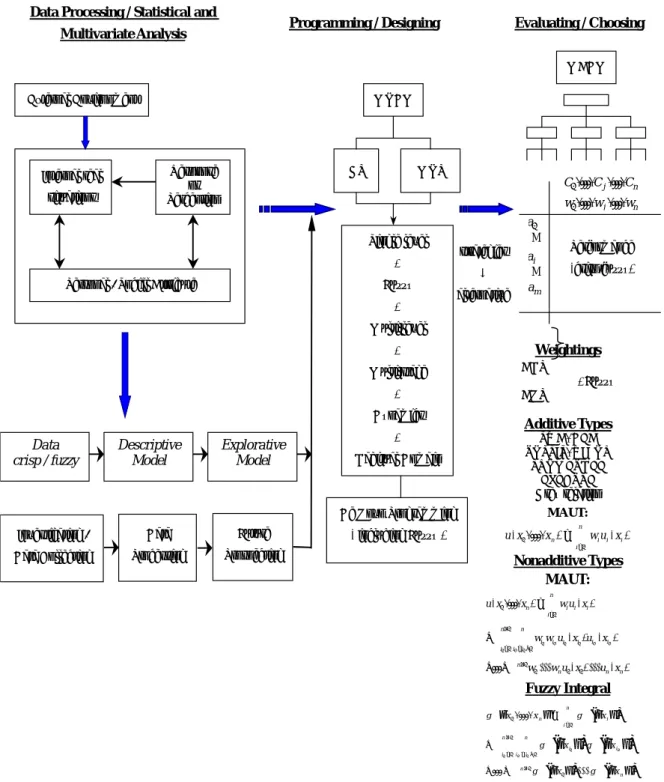
3.1 Basic Concepts of Course Design for “Research Methods” ... 6
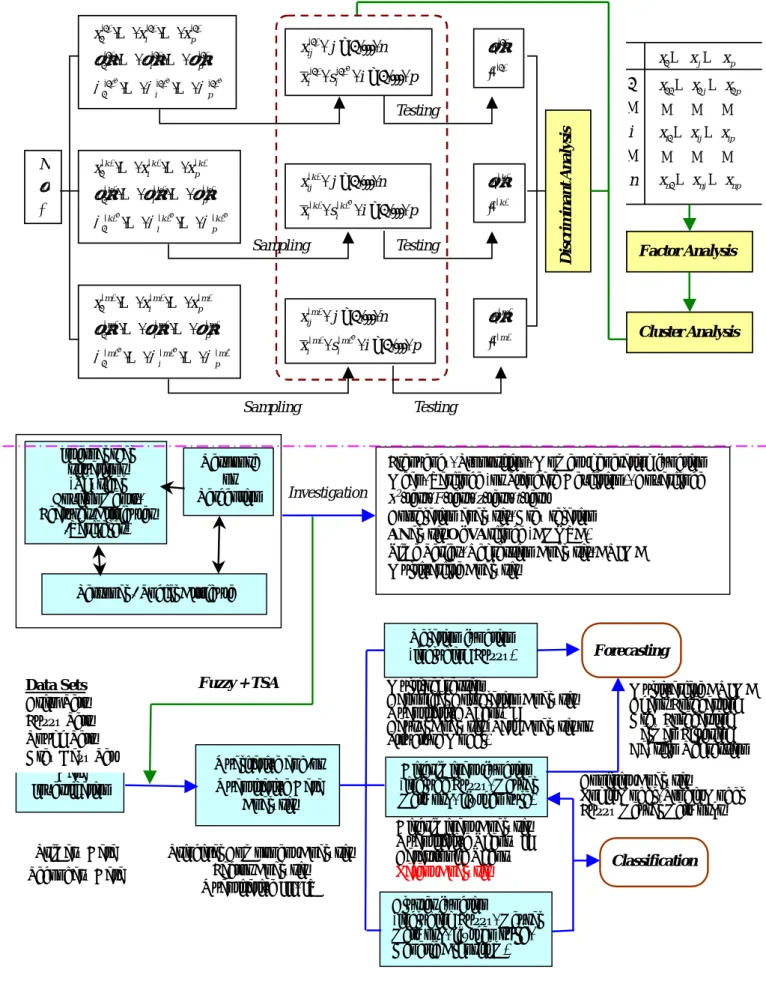
3.2 Data Processing & Statistical Analysis ... 7
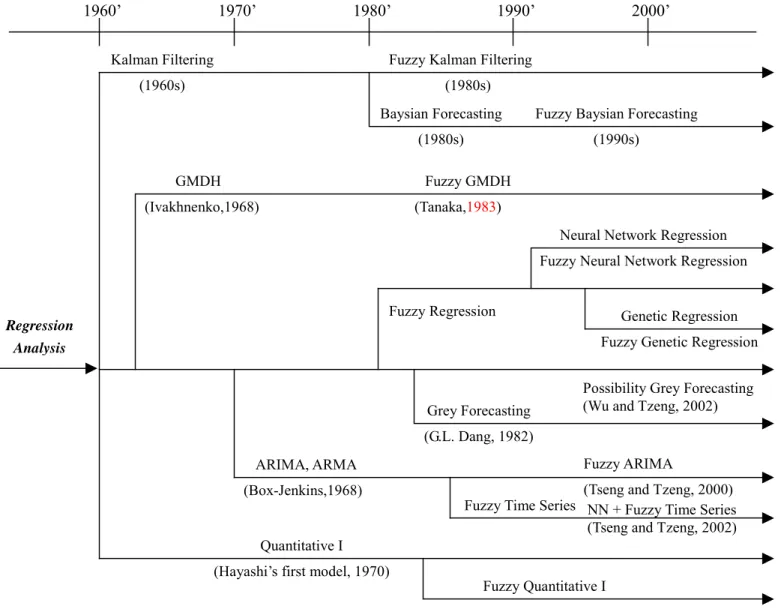
3.3 Forecasting Model... 8
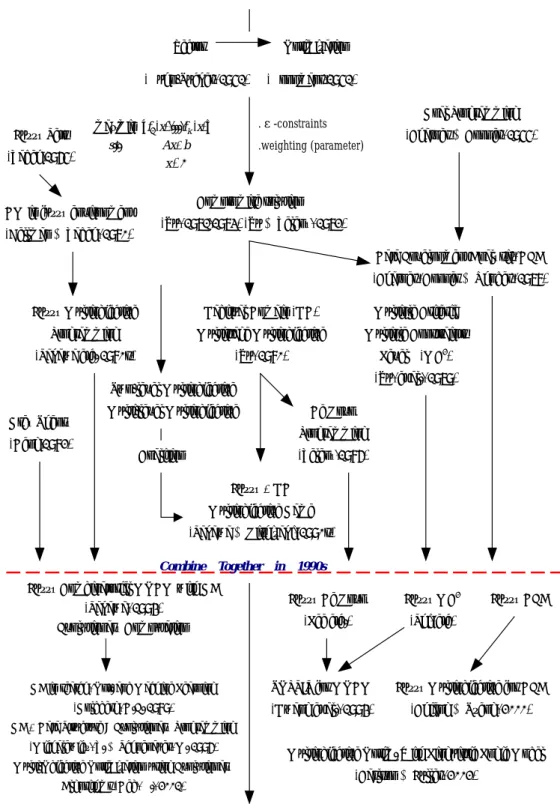
3.4 Development of Multiple Objective Decision Making ... 9
3.5 Development of Multiple Attribute Decision Making ... 10
3.6 Profile of Multiple Criteria Decision-Making... 11
3.7 Data Analysis for Stage-Level Achieving ... 12
1. Introduction
The research of this project covered relatively broad area of research methodologies, with an intention to focus on specific methods in the future research. Research methodologies are the essential tools in any research domain. Substantial research methodologies and related theories can make the research results more reasonable and acceptable. In the domain of decision analysis, the decision makers should consider the viewpoints of different aspects to solve the decision problems. With regard to the development of multicriteria decision making (MCDM), we should consider several research directions, as follows.
(1) For accurate examine the characteristics of problems, methodologies in the domain of statistic analysis should be researched and developed to find suitable method to handle MCDM problems.
(2) Methodologies in the domain of Design/Planning should be developed to solve the practical multi-aspect dynamic problems, determining an optimal solution.
(3) Theoretical development of multiple attribute evaluation of alternatives and of multicriteria choice method.
This 3-stages methodologies are added into the consideration of the fuzzy characteristics of human decision making. Zadeh introduced the fuzzy theory in 1965, and Bellman and Zadeh introduced the decision making in fuzzy environment. At the same period, P.L. Yu introduced the multi-objective compromise solution (in 1973). Since 1980, application of Neural Network and fuzzy multi-objective programming and evaluation method were developed rapidly. At the same time, Zeleny introduced De Novo programming method. In the period of 1990, Genetic Algorithm was applied to solve the problems of multi-objective combinational optimization problems, Goldberg in 1989, Michalewicz in 1996. The concept of De novo programming was applied to the fuzzy problems (Lee and Li in 1991).
2. Research Goal
The goal of this research is the development of decision analysis methodologies from the aspect of data discovering-statistic analysis, multi-objective programming (fuzzy, multi-level, multi-stage), multi-criteria evaluation and choice (fuzzy, additive, portioned hierarchy non-additive model), and applications to design, planning and management. Combining fuzzy
set, grey set, rough set, neural network and genetic algorithm, we are trying to develop new methods and apply them to practical problems.
3. Research Methodologies
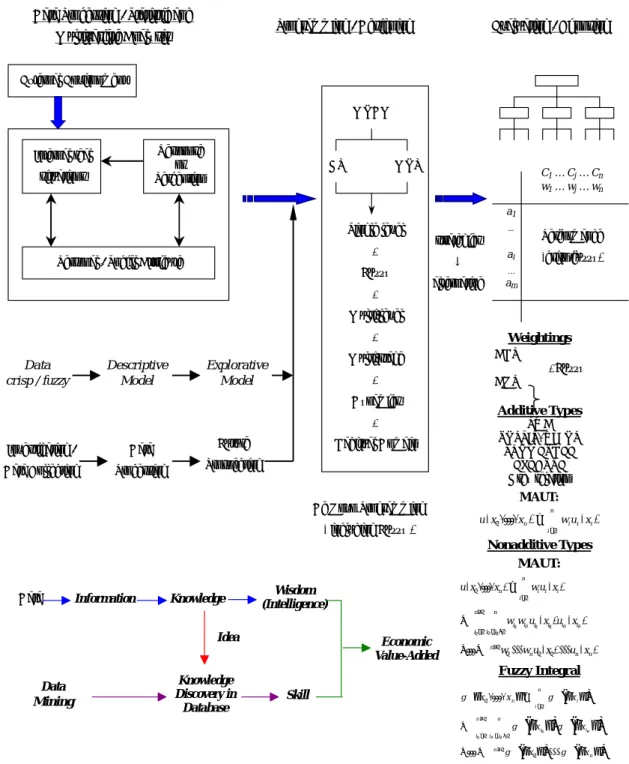
The research area includes data processing-statistic analysis, multi-objective programming, multicriteria decision making, and applications to design, planning and management.
Data discovering-statistic analysis includes data collection (including fuzzy data), frequency
statistic analysis, principal component analysis, factor analysis, AHP, cluster analysis, factor partitioned hierarchy fuzzy integral multi-criteria evaluation, statistical reasoning discriminatory analysis, Logit and Probit model, Fuzzy Logit, Fuzzy Neuron, Neuron Fuzzy, Logit and Probit model combined with Fuzzy Integral, and forecasting models (See figure 1). The research was concentrated on the following methods and models.
− Traditional econometrics;
− Kalman Filtering, Baysian forecasting and Fuzzy Kalman Filtering, Neuron Fuzzy Kalman Filtering, Fuzzy time series Kalman Filtering, GMDH (Group Method of Data Handling), Fuzzy GMDH, Neuron Fuzzy GMDH;
− Fuzzy Regression Analysis: piecewise possibility and necessity regression analysis, quadratic programming fuzzy regression;
− Grey Forecasting, Hybrid Grey Forecasting;
− Neural Network Forecasting, Fuzzy Neural Network Forecasting;
− Time Series, ARIMA Time Series, Fuzzy Time Series, Fuzzy Season Time Series, Hybrid Time Series;
− Chaos Time Series Forecasting, Fuzzy Chaos Time Series Forecasting;
− Partition Regression Analysis combined with Fuzzy Integral.
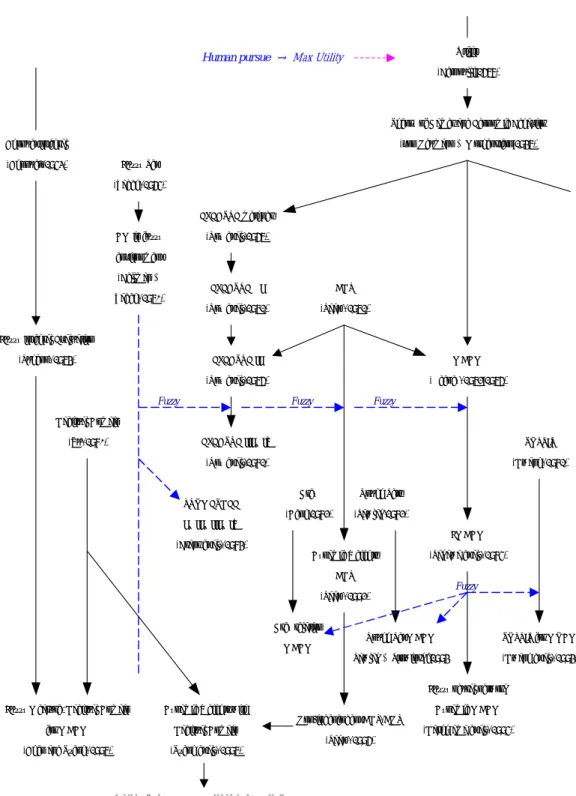
Multi-objective programming is based on the concept of Pareto optimization, which has
appeared in classic Economics. This method was developed rapidly since Kuhn Tucker and Koopman introduced Vector Optimization. The related methods presented in Figure 2 are categorized as follows.
Zadeh’s(1970) idea of Decision Making in a Fuzzy Environment developing Fuzzy Multi-Objective programming, which is the concept of
j , i x ,...,
xmin1 nmax. At the same period, Yu (1980) introduced Multi-stage Multi-objective programming. Around 1990, coefficients of variables in goals and constraints are introduced to be fuzzy numbers, which are considered to apply α-cut and goal achievement level λto solve in interactive manner. Two-phase approach is also applied to improve the possible achievement level.
− Charnes and Cooper introduced goal programming in 1975. Fuzzy goal programming became more and more important in 1980’s. Charnes, Cooper and their student-Rhodes introduced Data Envelopment Analysis (DEA) in 1975 to handle the problem of inconsistence of goal units. Tzeng and Chiang have introduced related research-Fuzzy Multi0objective DEA in 1999.
− De Nove programming was introduced by Zeleny in 1986. This method makes the programmers’ thinking in opposite direction. In 1990’s, Stanley Lee lead fuzzy theory into De Novo programming.
− Multiple-criteria and Multiple-constraints level (MC2) were introduced by Yu in 1979. In 1990’s, Yu and Shi combined the fuzzy theory with MC2.
− Bi-level and Multi-level multi-objective programming first appeared in 1960. Stackelberg-Nash game theory and multi-stage programming were also discussed around 1960’s. In 1990’s, Fuzzy theory was combined with these theories to be more compatible with practical problems.
− TOPSIS MODM: Hwang et al. introduced TOPSIS method to solve the alternatives ranking problems. This method was applied to handle the multi-objective programming problems and called TOPSIS MODM.
− Fuzzy Combinatorial MODM problem: In 1990’s, Sakawa et al. applied Genetic Algorithm and Revised GA to solve Fuzzy Combinatorial MODM problems.
Multi-criteria decision making is based on the concept of evaluation system along with the
concept of Utility introduced by Bernoulli. He Brought up that human didn’t pursue maximum benefit but maximum utility. “The Theory of Game and Economic Behavior (Wiley)” written by Von Neumann and Morgen in 1944 aroused the development of utility theory. The MCDM methods are presented in Figure 3, including the following methods.
multiplicative one.
− Fuzzy Integral introduced by Sugeno in 1974 changed the concept of additive multi-attribute utility and multi-attribute evaluation. Sakawa also introduced fuzzy multi-attribute utility decision making in 1955.
− ELECTRE I, II, III, IV: Roy first introduced ELECTRE in 1967. ELECTRE I was developed in 1971 (the alternatives were divided into good and bad). ELECTRE II developed in 1976 could rank the alternatives. After this time, the development of fuzzy theory was gradually mature. ELECTRE III, IV introduced in 1984 contained the concept of fuzzy membership.
− Gray relation was a part of Gray theory brought up by Deng in 1982. It is expanding to Gray relation multi-attribute decision making.
− TOPSIS MADM was introduced by Hwang et al. in 1981. This method is expanding to Fuzzy TOPSIS.
− The Compromise Ranking Method (called VIKOR) was developed by Opricovic in 1990 to rank alternatives in engineering and management.
− Rough Sets MADM: Rough Sets was introduced by Pawlak in 1982 and applied into Multi-attribute Decision Making by Pawlak and Slowinski in 1994.
− Analytic Hierarchy Process (AHP) was introduced by Satty in 1971. Its related development included Fuzzy AHP (1990), Dynamic Weighting AHP (Saaty, 1992), dependent AHP (Saaty, 1996) and HD Dynamic weighting AHP (Tzeng. et al., 1997).
− Fuzzy Neural Network Dynamic MADM was introduced by Hashiyama in 1995.
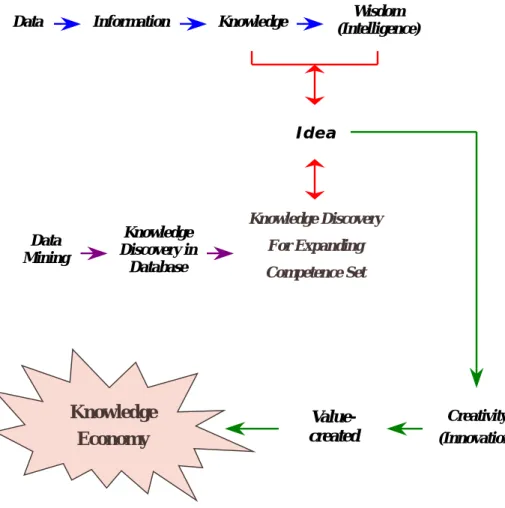
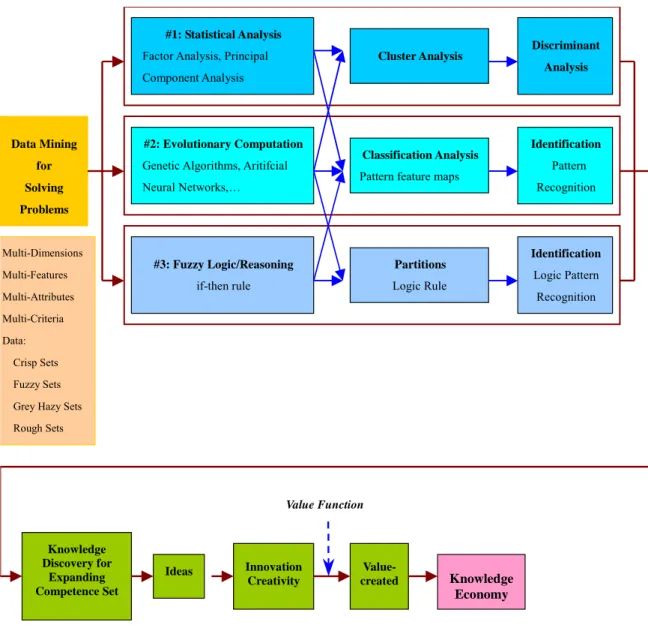
Data Mining: With the proliferation of data warehouses, data mining tools are flooding
the market. Their objective is to discover hidden gold in your data. Many traditional report and query tools and statistical analysis systems use the term "data mining" in their product descriptions. Exotic Artificial Intelligence-based systems are also being touted as new data mining tools. What is a data mining tool and what isn't?
The ultimate objective of data mining is knowledge discovery. Data mining methodology extracts hidden predictive information from large databases. With such a broad definition, however, an online analytical processing (OLAP) product or a statistical package could qualify as a data mining tool. Data mining methodology extracts hidden predictive
The research concentrated on Habitual Domain (HD), Competences sets expansion, developing fuzzy dynamic multi-stage multi-level MODM model, that is on developing a comprehensive method of HD + Fuzzy + Dynamic + Multi-stage + Multi-level + Multi-objective Decision Making.
1 a M i a M m a Performance (crisp/fuzzy) Data Processing Investigating / Data Collecting Future Prospecting Data crisp / fuzzy Descriptive Model Explorative Model
Data Processing / Statistical and
Multivariate Analysis Programming / Designing Evaluating / Choosing
Internal real situations
Response or Perception
Personal / Social Attribute
External Environment MODM
GP MOP Single level + Fuzzy + Multi-level + Multi-stage + Dynamics + Habitual Domain De Novo Programming ( including Fuzzy ) strategies ↓ alternative 1,..., j,..., n C C C 1,..., j,..., n w w w Weightings AHP +Fuzzy ANP Additive Types SWA, DEA TOPSIS, VIKOR PROMETHEE ELECTRE Grey relation MAUT: 1 1 ( , ..., ) ( ) n n i i i i u x x w u x = =∑ Nonadditive Types MAUT: 1 2 1 1 2 2 1 2 1 1 1 1 1 1 1 1 1 1 ( ,..., ) ( ) ( ) ( ) ... ( ) ( ) n n i i i i n n i i i i i i i i i n n n n u x x w u x w w u x u x w w u x u x λ λ = − = = + − = + + + ⋅⋅⋅ ⋅⋅⋅ ∑ ∑ ∑ Fuzzy Integral { } ({ }) { } ( ) ({ }) { } ( ) ({ }) 1 2 1 2 1 1 1 1 1 1 1 1 , .. ., . .. n n i i n n i i i i i n n g x x g x g x g x g x g x λ λ λ λ λ λ λ λ = − = = + − = + + + ⋅ ⋅ ⋅ ∑ ∑ ∑ MADM
N µ Σ 2 2 2 (1) (1) (1) 1 (1) (1) (1) 1 (1) (1) (1) 1 , , , , , , , , , , , , i p i p i p x x x µ µ µ σ σ σ L L L L L L 2 2 2 ( ) ( ) ( ) 1 ( ) ( ) ( ) 1 ( ) ( ) ( ) 1 , , , , , , , , , , , , k k k i p k k k i p k k k i p x x x µ µ µ σ σ σ L L L L L L 2 2 2 ( ) ( ) ( ) 1 ( ) ( ) ( ) 1 ( ) ( ) ( ) 1 , , , , , , , , , , , , m m m i p m m m i p m m m i p x x x µ µ µ σ σ σ L L L L L L 2 (1) (1) (1) , 1,..., , , 1,..., ij i i x j n x s i p = = 2 ( ) ( ) ( ) , 1,..., , , 1,..., k ij k k i i x j n x s i p = = 2 ( ) ( ) ( ) , 1,..., , , 1,..., m ij m m i i x j n x s i p = = (1) (1) ˆ ˆ µ Σ ( ) ( ) ˆ ˆ k k µ Σ ( ) ( ) ˆ ˆ m m µ Σ D iscrim ina n t Ana ly sis Cluster Analysis 11 1 1 1 1 j p i ij ip n nj np x x x x x x x x x L L M M M L L M M M L L 1 j p xL x L x 1 i n M M Factor Analysis Testing Sampling Sampling Testing Testing Internal real situations (Physical Environments, Features/Attributes /Variables) Response or Perception
Personal / Social Attribute
Investigation Data Investigation Qualitative and/or Quantitative Data Analysis Fuzzy + TSA Relation function (including Fuzzy) Cluster function
(including Fuzzy, Neural Network, If–then rule, Genetic Algorithm)
Discriminant function (include Fuzzy, Neural Network, If–then rule)
Classification Primary Data
Secondary Data
Principal Component Analysis Factor Analysis Quantitative III, IV Multivariate ARIMA Chaos Forecasting Grey Forecasting Kalman Filtering Baysian Regression Conjoint Analysis
Logit Model, Probit Model Fuzzy Neural Networks Multi-regression
Canonical Correlation Analysis Quantitative Theory I
Causal Analysis (Path Analysis or Structure Model) Discriminant Analysis Quantitative Theory II Catastrophe Theory Latent Analysis Forecasting Frequency, Proposition, Moment generating function Mean, Variance (or Standard Deviation), Covariance
x2-test, F-test, z-test, t-test
Correlation analysis, Grey relation ANalysis Of VAriance (ANOVA)
Time Series, Regression Analysis, ARIMA Multivariate Analysis
Figure 3.2 Data Processing & Statistical Analysis
Data Sets Crisp Sets Fuzzy Sets Rough Sets Grey Hazy Set
Possibility Grey Forecasting (Wu and Tzeng, 2002) Kalman Filtering (1960s) 1960’ 1990’1970’ 1980’ Regression Analysis GMDH (Ivakhnenko,1968) 2000’ Baysian Forecasting (1980s)
Fuzzy Baysian Forecasting (1990s)
Fuzzy Kalman Filtering (1980s)
Fuzzy GMDH (Tanaka,1983)
ARIMA, ARMA (Box-Jenkins,1968)
Neural Network Regression Fuzzy Neural Network Regression
Genetic Regression Fuzzy Genetic Regression Fuzzy Regression
Grey Forecasting (G.L. Dang, 1982)
Fuzzy Time Series Quantitative I
(Hayashi’s first model, 1970)
Fuzzy Quantitative I
NN + Fuzzy Time Series (Tseng and Tzeng, 2002) Fuzzy ARIMA
(Tseng and Tzeng, 2000)
Fuzzy Sets (Zadeh,1965)
DM in fuzzy environment (Bellman & Zadeh, 1970)
Grey Theory (Deng,1982)
Fuzzy Combinatorial MODM with GA (Sakawa, 1994)
Evolutionary Computation
GA in search, Opt. and Machine Learning (Goldberg, D.E. 1989)
GA + Data Structure = Evolutionary Programming (Michalewicz, Z. & Schoenauer, M. 1996) Multi-Objective Optimization using Evolutionary
Algorithms (Deb, K., 2001) Vector Optimization (Kuhn-Tucker, 1951) (Koopmans,1951) .ε-constraints .weighting (parameter) 0 . . )] ( ),..., ( [ min max/ 1 ≥ ≤ x b Ax t s x f x f k Compromise solution (Yu, 1971,1973) (Yu & Zeleny, 1972)
Habitual Domain (HD) Multistage Multiobjective
(Yu, 1980)
Fuzzy + HD Multiobjective Game (Sakawa & Nishizaki, 1990s)
De Novo Programming (Zeleny,1986)
Goal Programming (Charnes & Cooper, 1955)
Data Envelopment Analysis, DEA (Charnes, Cooper & Rhodes, 1978)
Multiple Criteria Multiple Constraints Level (MC2) (Yu, et al., 1979) Combine Together in 1990s Fuzzy De Novo (Lee etc.) Fuzzy MC2 (Shi, etc) Fuzzy DEA
Fuzzy Multiobjective for DEA (Chiang & Tzeng, 2000)
Fuzzy + HD + Dynamic + Multistage Multiobjective Decision Making TOPSIS for MODM
(Hwang et al., 1994) Fuzzy Multiobjective Programming (Sakawa etc. 1980s) In the Future Two-level Multiobjective Multi-level Multiobjective Coalition
Multiobjective Optim. With Linguistic Logic Model (Carlson & Fuller, 2002)
Figure 3.5 Development of Multiple Attribute Decision Making Fuzzy Integral Evaluation
(Sugeno, 1974)
Fuzzy Measure+Habitual Domain for MADM (Chen and Tzeng, 1997)
Utility (Bernoulli;1678)
Theory of Games and Economic Behavior (von Neumann & Morgenstern;1947)
MADM (Keeney, 1972;1976) ELECTRE methods (Roy et al.,1967) ELECTRE I (Roy et al.,1971) ELECTRE II (Roy et al.,1976) ELECTRE III、IV (Roy et al.,1981) TOPSIS (Hwang, 1981)
TOPSIS for MODM (Hwang et al., 1994) FMADM
(Sakawa et al., 1985)
Fuzzy neural network Dynamic MADM (Hashiyama et al., 1995) AHP (Saaty, 1971) Dynamic Weights AHP (Saaty, 1992)
Non-independent AHP, ANP (Saaty, 1996) Rough Sets (Pawlak,1982) Grey (Deng,1982) Fuzzy Set (Zadeh, 1965) DM in fuzzy environment (Bellman & Zadeh, 1970) Choquet Integral (Choquet, 1953) Habitual Domain (Yu, 1980)
Dynamic Weights with Habitual Domain (Tzeng et al., 1997) PROMETHEE I、II、III、IV (Brans et al., 1984) Fuzzy Fuzzy Fuzzy Fuzzy
Rough Set MADM Pawlak & Stowinski,1994 Grey relation
MADM
Human pursue → Max Utility
Weights from Fuzzy Knowledge in a Dynamic Environment (Hu and Tzeng, 2003)
a1 ... ai … am Performance (crisp/fuzzy) Data Processing Investigating / Data Collecting Future Prospecting Data crisp / fuzzy Descriptive Model Explorative Model
Data Processing / Statistic and
Multivariate Analysis Programming / Designing Evaluating / Choosing
Internal real situations
Response or Perception
Personal / Social Attribute External Environment MODM GP MOP Single level + Fuzzy + Multi-level + Multi-stage + Dynamics + Habitual Domain De Novo Programming ( including Fuzzy ) strategies ↓ alternative C1… Cj … Cn w1… wj … wn Weightings AHP +Fuzzy ANP Additive Types SWA TOPSIS, VIKOR PROMETHEE ELECTRE Grey relation MAUT: 1 1 ( , ..., ) ( ) n n i i i i u x x w u x = =∑ Nonadditive Types MAUT: 1 2 1 1 2 2 1 2 1 1 1 1 1 1 1 1 1 1 ( ,..., ) ( ) ( ) ( ) ... ( ) ( ) n n ii i i n n i i i i i i i i i n n n n u x x w u x w w u x u x w w u x u x λ λ = − = = + − = + + + ⋅⋅⋅ ⋅⋅⋅ ∑ ∑ ∑ Fuzzy Integral { } ({ }) { } ( ) ({ }) { } ( ) ({ }) 1 2 1 2 1 1 1 1 1 1 1 1 , ..., ... n n i i n n i i i i i n n g x x g x g x g x g x g x λ λ λ λ λ λ λ λ = − = = + − = + + + ⋅ ⋅ ⋅ ∑ ∑ ∑
Data Information Knowledge
Data Mining Knowledge Discovery in Database Idea Wisdom (Intelligence) Skill Economic Value-Added
Data Information Knowledge Data Mining Knowledge Discovery in Database Idea Wisdom (Intelligence) Knowledge Discovery For Expanding Competence Set Creativity (Innovation) Value- created Knowledge Economy
Data Mining for Solving Problems Knowledge Discovery for Expanding Competence Set #1: Statistical Analysis
Factor Analysis, Principal Component Analysis
#2: Evolutionary Computation
Genetic Algorithms, Aritifcial Neural Networks,…
#3: Fuzzy Logic/Reasoning
if-then rule
Cluster Analysis Discriminant Analysis
Classification Analysis
Pattern feature maps
Identification Pattern Recognition Partitions Logic Rule Identification Logic Pattern Recognition Innovation Creativity Value- created Knowledge Economy Ideas Multi-Dimensions Multi-Features Multi-Attributes Multi-Criteria Data: Crisp Sets Fuzzy Sets Grey Hazy Sets Rough Sets
Value Function
4. Research Results
Studying the research methodologies was a research goal for the first year of the project, including the possibilities of application of MCDM methods. The research results are presented in the papers submitted for the Journals and in the papers published in the proceedings of the International and National Conferences. These papers present applications in different areas, such as post-earthquake, reconstruction, environmental protection, water resources, low-energy consumption, economic growth, and education. The list of papers as results of this project follows after figures 1 to 3, and after that, the papers are attached.
The research results in 2002/2003 on the project
1. “Competence Sets for Deriving Two-Stage Learning Sequences for Knowledge in
Fuzzy Sequential Pattern Mining”, (Y.C. Hu, G.H. Tzeng, and C.M. Chen), Information
Sciences, 2003. (Accepted) SCI
Abstract:
A fuzzy sequential pattern consisting of several fuzzy sets represents a frequently occurring behavior related to time and can be discovered from transaction bases. An example is that large purchase amounts of one product were bought by customers after these consumers had bought small purchase amounts of another product. Recently, Hu et al. (2003) proposed a fuzzy data mining method to discover fuzzy sequential patterns. In this method, consumers’ products preferences and consumers’ product buying orders related to purchase behaviors can be found in the fuzzy sequential pattern mining. Since for each decision problem, there is a competence set consisting of ideas, knowledge, information, and skills for solving that problem, we consider knowledge found in fuzzy sequential pattern mining as a needed competence set for solving one decision problem. This paper uses a known competence set expansion method, the minimum spanning table method, to find appropriate two-stage learning sequences that can effectively acquire individual fuzzy knowledge sets found in the fuzzy sequential pattern mining. A numerical example is used to show the usefulness of the proposed method.
2. “Combining Grey Relation and TOPSIS concepts for Selecting the Expatriate
Assignment Problems”, (M.F. Chen and G.H. Tzeng), Mathematical and Computer
Modelling. (Accepted) SCI
Abstract:
As international corporate activities increase, the staffing of their operations involves more strategic concerns. However, not all foreign assignments are created equal and the dissatisfaction with the host country is known causes of expatriate failure. From the view of expatriate candidate’s points, the decision-making of whether taking expatriate assignment or not can be regarded as an FMCDM (Fuzzy Multiple Criteria Decision Making) problem since personal career planning and deciding to take an expatriate assignment are essentially conflict analysis characterized by personal factors, job and relocation attitudes, spouse characteristics and attitudes toward relocation and organization relocation support activities judgments. In this process, expatriate candidates often cannot clearly estimate each considered criterion in terms of numerical values for the anticipated alternatives, thus fuzziness is an appropriate approach. This paper extends grey relation based on the concepts of TOPSIS (Technique for Order Preference by Similarity to Ideal Solution) to solve expatriate assignment problems. This paper describes a fuzzy hierarchical analytic approach to determine the weighting of subjective judgments. Using the Sugeno integral for λ-fuzzy measure and non-additive fuzzy integral technique to
evaluate the synthetic utility values of the alternatives and the fuzzy weights then the best host country alternative can be derived with the grey relation model. The authors further combined the grey relation model based on the ideas of TOPSIS to evaluate and select the best alternative. A real case of expatriate assignments decision-making was used to demonstrate that the grey relation model further combined with the ideas of TOPSIS, which results in a satisfactory and an effective evaluation.
3. “Defuzzification Within a Fuzzy Multicriteria Decision Model”, (S. Opricovic and G.H. Tzeng), International Journal of Uncertainty, Fuzziness And Knowledge-Based Systems, Vol. 11, No. 5, 2003. (Forthcoming) SCI
Abstract:
In many cases, criterion values are crisp in nature, and their values are determined by economic instruments, mathematical models, and/or by engineering measurement. However, there are situations when the evaluation of alternatives must include the imprecision of established criteria, and the development of a fuzzy multicriteria decision model is necessary to deal with either “qualitative” (unquantifiable or linguistic) or incomplete information. The proposed fuzzy multicriteria decision model (FMCDM) consists of two phases: the CFCS phase - Converting the Fuzzy data into Crisp Scores, and the MCDM phase - MultiCriteria Decision Making. This model is applicable for defuzzification within the MCDM model with a mixed set of crisp and fuzzy criteria. A newly developed CFCS method is based on the procedure of determining the left and right scores by fuzzy min and fuzzy max, respectively, and the total score is determined as a weighted average according to the membership functions. The advantage of this defuzzification method is illustrated by some examples, comparing the results from three considered methods.
4. “Compromise Solution by MCDM Methods: A Comparative Analysis of VIKOR
and TOPSIS”, (S. Opricovic and G.H. Tzeng), European Journal of Operational Research,
2003. (Forthcoming) SCI
Abstract:
The multiple criteria decision making (MCDM) methods VIKOR and TOPSIS are based on an aggregating function representing ‘‘closeness to the ideal’’, which originated in the compromise programming method. In VIKOR linear normalization and in TOPSIS vector normalization is used to eliminate the units of criterion functions. The VIKOR method of compromise ranking determines a compromise solution, providing a maximum ‘‘group utility’’ for the “majority’’ and a minimum of an individual regret for the ‘‘opponent’’. The TOPSIS method determines a solution with the shortest distance to the ideal solution and the greatest distance from the negative-ideal solution, but it does not consider the relative importance of these distances. A comparative analysis of these two methods is
5. “Acquisition of Compound Skills and Learning Costs for Expanding Competence
Sets”, (Y.C. Hu, R.S. Chen, G.H. Tzeng, and Y.J. Chiu), Computers and Mathematics
with Applications, 2003. (Forthcoming) SCI
Abstract:
For each decision problem, there is a competence set consisting of ideas, knowledge, information, and skills for solving that problem. When decision makers have not acquired the competence set, it is more difficult for them to make decisions. In order to effectively acquire a needed competence set to cope with the problem they face, finding an appropriate learning sequence for acquiring needed single skills for decision makers, the so-called competence set expansion, is very necessary. A compound skill represents a collection of single skills that might be acquired, and some useful compound skills can be added to the needed competence set to help acquire some single skills. To effectively expand the competence set, effective acquisitions of compound skills and learning costs are both necessary. This paper thus proposes a data mining technique to extract potentially useful compound skills from single skills. Subsequently, an effective method is proposed to obtain the learning cost between any two skills. A computer simulation is employed to further show that it is feasible to use those potentially useful compound skills to facilitate the acquisition of single skills through a known integer programming method for expanding the competence set.
6. “Discovering Fuzzy Association Rules Using Fuzzy Partition Methods”, (Y.C. Hu, R.S. Chen, and G.H. Tzeng), Knowledge-Based Systems, 2003. (Forthcoming) SCI
Abstract:
Fuzzy association rules described by the natural language are well suited for the thinking of human subjects and will help to increase the flexibility for supporting users in making decisions or designing the fuzzy systems. In this paper, a new algorithm named fuzzy grids based rules mining algorithm (FGBRMA) is proposed to generate fuzzy association rules from a relational database. The proposed algorithm consists of two phases: one to generate the large fuzzy grids, and the other to generate the fuzzy association rules. A numerical example is presented to illustrate a detailed process for finding the fuzzy association rules from a specified database, demonstrating the effectiveness of the proposed algorithm.
7. “Assessing Weights of Product Attributes from Fuzzy Knowledge in a Dynamic
Environment”, (Y.C. Hu, J.S. Hu, R.S. Chen, and G.H. Tzeng), European Journal of
Operational Research, 2003. (Forthcoming) SCI
Abstract:
Fuzzy knowledge of consumers_ frequent purchase behaviors can be extracted from transaction databases. To effectively supporting decision makers, it is necessary to use fuzzy knowledge to assess weights or degrees of consumers’ attentiveness to product
attributes. From the standpoint of habitual domains, frequent purchase behaviors can be viewed as ideas that are contained in the reachable domain of customers. In addition, this reachable domain is changeable with time, due to the dynamic environment. This paper thus proposes a two-phase learning method with adaptive capability. The first phase builds a fuzzy knowledge base by discovering frequent purchase behaviors from transaction databases; the second phase finds weights of product attributes by a single-layer perception neural network. Indeed, customers are asked to evaluate alternatives and attributes through questionnaire. Then, each alternative can be transformed into a piece of input training data for the neural network by the fuzzy knowledge base and part-worths of attributes’ levels. After completing the training task, we can find weights from connection weights. Simulation results demonstrate that the proposed methods can use fuzzy knowledge to effectively find customers’ attentive degrees of attributes.
8. “Policy Tools on the Formation of New Biotechnology Firms in Taiwan”, (Y.G. Hsu, J. Z. Shyu, and G.H. Tzeng), Technovation, 2003. (Forthcoming). SCI
Abstract:
This research explores the contribution of policy tool toward the formation of Taiwanese biotechnology firms. The effect of technological policy for the formation of new biotechnology firms (NBFs) is complicated by the fact that biotechnology is new, and its development raises issues where there is a great deal of uncertainty. This research involved the evaluation of policy tools on the formation of NBFs and was based on a combination of fuzzy Multiple Criteria Decision Making Method (MCDM) and interviews with key actors in the field. The focus of this paper is how the users, bio-firms, and venture capitalists perceive the contribution of policy tools toward the formation of NBFs. The evaluating hierarchy toward the formation of NBFs shows that two user groups perceive differently. Venture capitalists emphasize the importance of factors relating to technology and human resources while bio-firms group emphasize those relating to market. The results of the evaluation reveal that: First, policy tools relating to technology and human capital are currently the main focus in Taiwan, a focus consistent with the perception of venture capitalists. However from the perspective of bio-firms, there are mismatches. Second, policy tools contribute to the formation of NBFs in different ways. Some contribute more widely across the criteria while some are more specific. Third, the ranking of eight policy tools indicates that the role of public research institutes in economic development has become more sophisticated. Not only are they the source of initial capabilities of emerging firms, they are also important actors in industrial innovation, especially for a knowledge intensive industry like biotechnology.
9. “Fuzzy Multiple Criteria Selection of Government-sponsored Frontier Technology
Selection of government-sponsored frontier R&D projects is made difficult by the coexistence of the conflicting participating parties, the availability of experts for new frontier technology review, and the ambiguity of new frontier technology. This paper presents a model that includes: (1) using the analytical hierarchy process (AHP) method to integrate various expectations from different interest groups into evaluating objectives/criteria, (2) the group-decision method by technical experts based on the predetermined objectives/criteria, and (3) the fuzzy approach in scoring the subjective judgments of the experts. The results reveal that differences of weights toward each criterion exist among various groups. The government and academia care more about social benefits, the researchers are more concerned about intellectual properties, and the experts from industry emphasize the importance of feasibility. The method presented in this paper was applied at a national research institute in Taiwan. The results reveal that: (1) the approach can solve the disparity between the profound knowledge required for evaluation and the different expectation from various interest groups, (2) the fuzzy approach is suitable to frontier technology R&D project selection because of the vagueness of the nature of frontier technology and the difficulties in evaluating quantitatively and accurately.
10. “A Fuzzy Data Mining Algorithm for Finding Sequential Patterns”, (Y.C. Hu, R.S Chen, G.H. Tzeng, and J.H. Shieh), International Journal of Uncertainty, Fuzziness and Knowledge-Based Systems, Vol. 11, No. 2, pp.173-193, 2003. SCI
Abstract:
Since fuzzy knowledge representation can facilitate interaction between an expert system and its users, the effective construction of a fuzzy knowledge base is important. Fuzzy sequential patterns described by natural language are one type of fuzzy knowledge representation, and can thus be helpful in building a prototype fuzzy knowledge base. We define that a fuzzy sequence is an ordered list of frequent fuzzy grids, and the length of a fuzzy sequence is the number of frequent fuzzy grids in the frequent fuzzy sequence. Frequent fuzzy grids and frequent fuzzy sequences can be determined by comparing individual fuzzy supports with the user-specified minimum fuzzy support. A fuzzy sequential pattern is just a frequent fuzzy sequence, but it is not contained in any other frequent fuzzy sequence. In this paper, an effective algorithm called the Fuzzy Grids Based Sequential Patterns Mining Algorithm (FGBSPMA) is proposed to generate fuzzy sequential patterns. A numerical example is used to show an analysis of the user visit to websites, demonstrating the usefulness of the proposed algorithm.
11. “Finding Fuzzy Classification Rules Using Data Mining Techniques”, (Y.C. Hu, R.S. Chen, and G.H. Tzeng), Pattern Recognition Letters, Vol. 24, pp. 509-519, 2003. SCI
Abstract:
data, so, it is feasible to incorporate data mining techniques into the classification process to discover useful patterns or classification rules from training samples. This paper thus proposes a data mining technique to discover fuzzy classification rules based on the well-known Apriori algorithm. Significantly, since it is difficult for users to specify the minimum fuzzy support used to determine the frequent fuzzy grids or the minimum fuzzy confidence used to determine the effective classification rules derived from frequent fuzzy grids, therefore the genetic algorithms are incorporated into the proposed method to determine those two thresholds with binary chromosomes, For classification generalization ability, the simulation results from the iris data and the appendicitis data demonstrate that the proposed method performs well in comparison with other classification methods.
12. “Discovering Fuzzy Association Rules Using Fuzzy Partition Methods”, (Y.C. Hu, R.S. Chen, and G.H. Tzeng), Knowledge-Based Systems, Vol. 16, No. 3, pp. 137-147, 2003.
SCI
Abstract:
Fuzzy association rules described by the natural language are well suited for the thinking of human subjects and will help to increase the flexibility for supporting users in making decisions or designing the fuzzy systems. In this paper, a new algorithm named fuzzy grids based rules mining algorithm (FGBRMA) is proposed to generate fuzzy association rules from a relational database. The proposed algorithm consists of two phases: one to generate the large fuzzy grids, and the other to generate the fuzzy association rules. A numerical example is presented to illustrate a detailed process for finding the fuzzy association rules from a specified database, demonstrating the effectiveness of the proposed algorithm.
13. “Fuzzy Multicriteria Model for Post-Earthquake Land-Use Planning”, (S. Opricovic and G.H. Tzeng), Natural Hazards Review, Vol. 4, No. 2, pp. 59-64, 2003. SCI
Abstract:
A multicriteria model is developed for analyzing land-use strategies for reducing the future social and economic costs in areas with potential natural hazards. A multicriteria decision-making procedure consists of generating alternatives, establishing criteria, assigning criteria weights, and applying the compromise ranking method. The alternatives are constructed to address various scenarios of sustainable hazard effects mitigation. They are generated in the form of comprehensive land-use plans. The alternative plans are developed with consideration of the redevelopment of urban areas and infrastructures and of multipurpose land use, including restrictions on buildings in hazardous areas. The plans have to be evaluated using specified criteria: public safety, reliability, social environment,
has been developed to deal with “qualitative” (unquantifiable or linguistic) or incomplete information . The objective is to provide a methodology for weighing land uses and choosing the best alternatives. An application of this model is illustrated with the postearthquake regional planning problem in central Taiwan.
14. “Application of the DEA Approach to Evaluate Management Performance of R&D
Organizations in the Industrial Technology Research Institute of Taiwan”, (C.S. Hsu,
Z.Y. Lee, C. Shih, C.Y. Hung, H.C. Yu, and G.H. Tzeng), Management Review, Vol. 22, No. 2, 2003. (Chinese) TSSCI
Abstract: 研發組織績效評量過去多採用主觀評量,未建立多投入與多績效(產出)的總體衡 量模型,因此未能針對不同部門提出應如何提升績效之改善建議。Data Envelopment Analysis (DEA)能解決上述問題,因此本研究運用構建國內工業技術研究院(簡稱工 研院)各研發單位多投入及多產出效果的評量模式。本研究採用工研院1999 年及 2000 年之投入產出資料進行分析,分別求解 CCR 效率、A&P 效率、交叉效率,及多目 標效率。此外,亦將CCR 效率進一步區分為純粹技術效率(BCC 效率)與規模效率。 除了效率值比較和相關管理意涵的討論外,還進行規模報酬分析,最後則進行工研 院各研究單位此兩年度之經營效率分析與比較。研究結果顯示工研院各研究單位應 擴大研發規模,以發揮研發綜效。經與工研院高階管理團隊認為交叉分析模式結合 多目標模式產生之結果可信度高且較以往績效評量客觀公正,故此評量模式亦應適 用於一般研發組織之研發績效評量。
15. “Multiple Objective Decision Making in Past, Present, and Future”, (G.H. Tzeng), Multi-Objective Programming and Goal-Programming: Theory and Applications, by Tanino, T., Tanaka, T. and Inuiguchi, M. (eds), Springer, pp. 65-76, 2003.
Abstract:
Since Kuhn and Tucker (1951) originally proposed the concept of proper noninferior solution solving nonlinear programming problems and it was later modified by Geoffrion (1967), Yu (1973) further introduce compromise solution method to cope with multicriteria decision-making problems. In addition, Charnes (1955) presented goal programming method, and Bellman and Zadeh (1970) proposed the concepts of decision-making in fuzzy environment, many distinguished work guide person study in this field. This paper review some methods concerning basic mathematical concepts of models applied on multiple objective decision making problem including fuzzy multiobjective linear programming (FMOLP), fuzzy goal programming (FGP), two-phase method, achievement function, data envelopment analysis(DEA), and De Novo Programming.
16. “An Extended Approach of Multicriteria Optimization for MODM Problems”, (H.K. Chiou and G.H. Tzeng), Multi-Objective Programming and Goal-Programming: Theory
and Applications, by Tanino, T., Tanaka, T. and Inuiguchi, M. (eds), Springer, pp. 111-116, 2003.
Abstract:
In this paper we propose an extended method for multicriteria optimization and compromise solution to solve multiple objective decision making (MODM) problems. This method assumes that optimal compromise solution should have the shortest distance from the positive ideal solution (PIS) as well as the longest distance from the negative ideal solution (NIS). We use the membership function of fuzzy set theory to express the satisfaction level, and use max-min operation for this bi-objective programming problem. To illustrate this procedure, prequalification for the project bidding process of an outsourcing partner for semiconductor enterprise in Taiwan is solved by use of our procedure.
17. “Multicriteria Expansion of a Competence Set Using Genetic Algorithm”, (S. Opricovic and G.H. Tzeng), Multi-Objective Programming and Goal-Programming: Theory and Applications, by Tanino, T., Tanaka, T. and Inuiguchi, M. (eds), Springer, pp. 221-226, 2003.
Abstract:
Optimal expansion of a competence set, consisting of knowledge, information and skills for a certain decision making problem and its effective solution, is considered in this paper. The competence set expansion is optimized with respect to minimizing costs and time, as well as maximizing efficiency and benefits of expansion. This problem is treated as a multi-criteria combinatorial optimization problem. A multicriteria genetic algorithm is developed to solve this optimization problem. The multicriteria measure of closeness to the “ideal” solution is introduced for the fitness assignment. An illustrative example of academic competence set expansion is presented. The results show the applicability of multi-criteria genetic algorithm to solve a competence set expansion formulated as a multi-criteria optimal route problem.
18. “Comparing DEA and MCDM Method”, (S. Opricovic and G.H. Tzeng), Multi-Objective Programming and Goal-Programming: Theory and Applications, by Tanino, T., Tanaka, T. and Inuiguchi, M. (eds), Springer, pp. 227-232, 2003.
Abstract:
Data Envelopment Analysis (DEA) introduces a model for weights determination maximizing efficiency of the decision-making units. The primary focus of the DEA model is to compare decision-making units (alternatives) in terms of their efficiency in converting inputs into outputs. A multicriteria decision making (MCDM) method uses a
maker. A comparison of DEA and MCDM shows that DEA resembles MCDM, but the results differ. In spite of these differences, DEA could be used as a supplement for screening alternatives within MCDM.
19. “Competence Set Expansion for Obtaining Scheduling Plans in Intelligent
Transportation Security Systems”, (Y.C. Hu, Y.J. Chiu, C.M. Chen, and G.H. Tzeng),
Multi-Objective Programming and Goal-Programming: Theory and Applications, by Tanino, T., Tanaka, T. and Inuiguchi, M. (eds), Springer, pp. 347-352, 2003.
Abstract:
In this paper, to reach safe driving, a new method is proposed to acquired project schedules by competence set expansion for developing intelligent transportation systems (ITSS), that can promote security, efficiency and comfort for drivers. Since for each decision problem, there is a competence set consisting of ideas, knowledge, information, and skills needed to solve that problem, this paper treats ITSS as the needed competence set to attain the goal of safe driving. Schedules can be further obtained by using a known method proposed by Li (1999) for expanding competence sets. An empirical study is utilized to demonstrate the usefulness of the proposed method.
20. “DEA for Evaluating the Current-period and Cross-period Efficiency of Taiwan’s
Upgraded Technical Institutes”, (L.C. Liu, C. Lee, and G.H. Tzeng), Multi-Objective
Programming and Goal-Programming: Theory and Applications, by Tanino, T., Tanaka, T. and Inuiguchi, M. (eds), Springer, pp. 353-360, 2003.
Abstract:
This study used Data Envelopment Analysis (DEA) to examine the relative managerial efficiency for evaluating current-period and cross-period efficiency of 38 technological institutes upgraded from junior colleges in Taiwan in 1998. In addition, the managerial efficiency variations of each individual institute in between 1995 and 1998 were also determined. The study results show that the operational category is significant among primary analysis variants, in other words, private schools perform significantly better than public schools in terms of managerial efficiency. Furthermore, school size is significant, with schools having more than 201 classes achieving higher managerial efficiency. However, geographical location is not significant. This study also verified that integration of the results of both relative managerial efficiency analysis and managerial efficiency variation analysis could be a powerful approach to help design managerial strategies that are both appropriate and feasible.
21. “Using DEA of REM and EAM for Efficiency Assessment of Technology Institutes
Upgraded from Junior Colleges: The Case in Taiwan”, (L.C. Liu, C. Lee, and G.H.
Tzeng), Multi-Objective Programming and Goal-Programming: Theory and Applications, by Tanino, T., Tanaka, T. and Inuiguchi, M. (eds), Springer, pp. 361-366, 2003.
Abstract:
The purpose of this study is to improve the assessment system for vocational education, thus helping to increase technology college education efficiency. This study employs both classical and new data envelopment analysis (DEA) to study relative radial efficiency, management efficiency and scale efficiency of the application of resources for the 38 technology colleges in Taiwan during 1998. Analysis outcomes showed that ranking differentiation between relative classical radial efficiency measure (REM) and efficiency achievement measure (EAM) is consistent, if the same group index differentiation, of an institution, is consistent. Both models support each other and provide clearer relative Pareto efficiency and efficiency achievement for comparison of results.
22. “Fuzzy MCDM for Evaluating the e-commerce Strategy”, (Y.C Chiu, J. Z. Shyu, and G.H. Tzeng), International Journal of Computer Applications in Technology, 2002. (Forthcoming). SCI
Abstract:
This study aimed to provide a theoretically and empirically based model for evaluating and selecting an e-commerce strategy. In practical environments, mangers face a variety of information types that are vague. Traditional decision making methods cannot fulfill the e-commerce manager’s needs. Therefore, a Fuzzy Multiple Criteria’ Decision-Making method is adopted in this research. In order to show the practicality and usefulness of this model, an empirical study of the Taiwan ISP industry is demonstrated. The results show that the first to market strategy is thee most application.
23. “Grey Self-Organizing Feature Maps”, (Y.C. Hu, R.S. Chen, Y.T. Hsu, and G.H. Tzeng), Neurocomputing, Vol. 48, No. 4, pp. 863-877, 2002. SCI
Abstract:
In each training iteration of the self-organizing feature maps (SOFM), the adjustable output nodes can be determined by the neighborhood size of the winning node. However, it seems that the SOFM ignores some important information, which is the relationships that actually exist between the input training data and each adjustable output node, in the learning rule. By viewing input data and each adjustable node as a reference sequence and a comparative sequence, respectively, the grey relations between these sequences can be seen. This paper thus incorporates the grey relational coefficient into the learning rule of the SOFM, and a grey clustering method, namely the GSOFM, is proposed. From the simulation results, we can see that the best result of the proposed method applied for analysis of the iris data outperforms those of other known unsupervised neural network models. Furthermore, the proposed method can effectively solve the traveling salesman problem.
Tzeng), Computers & Industrial Engineering, Vol. 43, No. 4, pp. 735-750, 2002. SCI
Abstract:
The effective development of data mining techniques for the discovery of knowledge from training samples for classification problems in industrial engineering is necessary in applications, such as group technology. This paper proposes a learning algorithm, which can be viewed as a knowledge acquisition tool, to effectively discover fuzzy association rules for classification problems. The consequence part of each rule is one class label. The proposed learning algorithm consists of two phases: one to generate large fuzzy grids from training samples by fuzzy partitioning in each attribute, and the other to generate fuzzy association rules for classification problems by large fuzzy grids. The proposed learning algorithm is implemented by scanning training samples stored in a database only once and applying a sequence of Boolean operations to generate fuzzy grids and fuzzy rules; therefore, it can be easily extended to discover other types of fuzzy association rules. The simulation results from the iris data demonstrate that the proposed learning algorithm can effectively derive fuzzy association rules for classification problems.
25. “The Key Dimensions of Criteria For the Evaluation of ISPs: An Exploratory Study”, (D. Y. Shee and G.H. Tzeng), The Journal of Computer Information System, Vol. XXXXII, No. 4, pp.112-121, 2002. SCI
Abstract:
The progressive advancements in information technology (IT) coupled with the global expansion of communication infrastructure has enabled firms to create and sustain large scale strategic advantages, with the result of an ever-increasing demand from firms for new types of an ever-increasing demand from firms for new types of information services (IS) to facilitate and coordinate their daily operations. Hence, the aim of this research is to explore the underlying dimensions of criteria for the evaluation and selection of information service providers (SPs). By undertaking a review of the literature, we first analyze the dynamics of ISPs to define their present day role before going on to develop a questionnaire for the field survey, Based on the data collected from 57 firms, two distinct procedures are adopted to carry out the exploratory factor analyses in order to derive the preliminary factor solutions. Followed by a process of post-analysis validation, these empirically derived factor solutions are reviewed and refined in accordance with domain experts’ opinions, and as a result, the final factor solution is obtained. It is hoped that through the utilization of mechanical factor analyses and subsequent manual validation, it will be possible to achieve both “parsimony” and “inclusiveness” of the final factor solution. This study results that there are seven dimensions of criteria which are critical to the evaluation and selection of ISPs: (1) performance of information systems; (2) awareness of and response to customer requirements; (3) ISP’s market capability; (4) performance of networking; (5) ISP’s credibility and fame; (6) provision of customized professional services; and (7) innovative R&D into technology.
26. “Generating Learning Sequences for Decision Makers Through Data Mining and
Competence Set Expansion”, (Y.C. Hu, R.S. Chen, and G.H. Tzeng), IEEE Transactions
on Systems, Man, and Cybernetics - Part B: Cybernetics, Vol. 32, No. 5, pp. 679-686, 2002. SCI
Abstract:
For each decision problem, there is a competence set, proposed by Yu, consisting of ideas, knowledge, information, and skills required for solving the problem. Thus, it is reasonable that we view a set of useful patterns discovered from a relational database by data mining techniques as a needed competence set for solving one problem. Significantly, when decision makers have not acquired the competence set, they may lack confidence in making decisions. In order to effectively acquire a needed competence set to cope with the corresponding problem, it is necessary to find appropriate learning sequences of acquiring those useful patterns, the so-called competence set expansion. This paper thus proposes an effective method consisting of two phases to generate learning sequences. The first phase finds a competence set consisting of useful patterns by using a proposed data mining technique. The other phase expands that competence set with minimum learning cost by the minimum spanning table method proposed by Feng and Yu. Froma numerical example, we can see that it is possible to help decision makers to solve the decision problems by use of the data mining technique and the competence set expansion, enabling them to make better decisions.
Appendix
Publications of recent years from 1996
Curriculum Vitae
Gwo-Hshiung Tzeng
• National Distinguished Chair Professor (Highest Honor offered by the Ministry of Education Affairs, Taiwan) and Distinguished Research Fellow (Highest Honor Offered by NSC, Taiwan)
• Professor, Institute of Technology Management, Institute of Traffic and Transportation, Institute of Information Management, Energy and Environmental Research Group, College of Management, National Chiao Tung University
Office
-114, 4F, Sec. 1, Chung Hsiao W. Rd. Taipei 100, Taiwan.
Tel: 886(2)23146515 ext 505, Tel/Fax: 886(2)23120519, 886(2)23120082,
-Room A705, Institute of Technology Management, 1001 Ta-Hsueh Road, Hsinchu 300, Taiwan. Tel: 886(3)5712121ext57505; Fax:886(3)5753926;
E-mail: [email protected].
Residence
11, 75 Lane, Fu-Jen Rd., Yang-Mei Chen, Taoyuan Hsien 326, Taiwan Tel/Fax: 886-3-4757031
Personal Date
Male; Married; Date of Birth: May 20, 1943 in Taiwan
Education
.Bachelor Course in Business Management, Tatung Institute of Technology (August 1963 - June 1967).
.Master Course in Institute of Urban Planning, National Chung Hsing University (August 1969 - June 1971).
.Doctoral Course in Division for Research of Economics (Major in Management Science), Osaka University, Japan (April 1973 -August 1977).
Work Experience
- Second Lieutenant, Military Service of the Taiwan (July 1967 - June 1968). - Teacher Assistant, Tatung Institute of Technology (July 1968 - June 1969). - Researcher, China Urban Planning Center (July 1970 - March 1971 Part-time). - Lecturer, Tatung Institute of Technology (July 1971 - March 1973 Part-time).
- Planner, Transportation Planning Board, Ministry of Communications (July 1971 -March 1973).
Part-time).
- Researcher, Kansai Institute of Information System in Japan (April 1976 - June 1977 Part-time).
- Associate Professor (MOE, ID: 5290), the Graduate School in Business Administration, Tatung Institute of Technology (July 1977 - July 1978).
- Associate Professor, Institute of Traffic and Transportation, National Chiao Tung University (August 1978 - July 1981),
- Resident Associate, Energy & Environmental Systems Division, Argonne National Laboratory (Visiting Research) July 1981 - January 1982.
- Visiting Professor, Department of Civil Engineering, University of Maryland at College Park (August 1989 - August 1990).
- Professor, Institute of Traffic and Transportation, National Chiao Tung University (August 1981 to present), (MOE, ID: 4332).
- Visiting Professor (Visiting Scholar), Department of Engineering and Economic Systems and Operations Research (EESOR), Energy Modeling Forum (EMF), Stanford University (August 1997 - 1998).
Distinguished Research Award
- Distinguished Research Award of the National Science Council, Taiwan, 1985-1986. - Distinguished Research Award of the National Science Council, Taiwan, 1993-1994. - Distinguished Research Award of the National Science Council, Taiwan, 1995-1996.
- Distinguished Research Fellow (Highest Honor Offered) by the National Science Council, Taiwan, 1997-2000.
- Distinguished Research Fellow (Highest Honor Offered) by the National Science Council, Taiwan, 1997-2000.
- Distinguished Research Fellow (Highest Honor Offered) by the National Science Council, Taiwan, 2000—2003.
- National Distinguished Chair Professor, Award of the Ministry of Education Affairs, Taiwan, 2000-2003.
- Fellow, IEEE Member.
Distinguished Professor Award
Ministry of Education Affairs, Taiwan (National Chiao Tung University), 1992.
The MCDM Conference Chairman Award
For the most gracious hospitality, and for the outstanding leadership and resourcefulness in organizing, managing and chairing the Tenth International Conference on MCDM, Taipei, Taiwan, R. O. C., July 1992.
International Society on Multiple Criteria Decision Making.
Co-Chairmen of ICIS
Co-Chairmen of International Conference on Information and Systems, September 3-6, 1992, Dalian, China.
Publications
A. Referred Papers 2003
Hu, Yi-Chung, Chen, Ruey-Shun, Tzeng, Gwo-Hshiung, and Shieh Jia-Hourng, “A Fuzzy Data Mining Algorithm for Finding Sequential Patterns”, International Journal of Uncertainty, Fuzziness and Knowledge-Based Systems, Vol. 11, No. 2, pp.173-193, 2003.
SCI
Tzeng, Gwo-Hshiung, “Multiple Objective Decision Making in Past, Present, and Future”, Multi-Objective Programming and Goal-Programming: Theory and Applications, by Tanino, T., Tanaka, T. and Inuiguchi, M. (eds), Springer, pp. 65-76, 2003.
Chiou, Hua-Kai and Tzeng, Gwo-Hshiung, “An Extended Approach of Multicriteria Optimization for MODM Problems”, Multi-Objective Programming and Goal-Programming: Theory and Applications, by Tanino, T., Tanaka, T. and Inuiguchi, M. (eds), Springer, pp. 111-116, 2003.
Opricovic, Serifam and Tzeng, Gwo-Hshiung, “Multicriteria Expansion of a Competence Set Using Genetic Algorithm”, Multi-Objective Programming and Goal-Programming: Theory and Applications, by Tanino, T., Tanaka, T. and Inuiguchi, M. (eds), Springer, pp. 221-226, 2003.
Opricovic, Serifam and Tzeng, Gwo-Hshiung, “Comparing DEA and MCDM Method”, Multi-Objective Programming and Goal-Programming: Theory and Applications, by Tanino, T., Tanaka, T. and Inuiguchi, M. (eds), Springer, pp. 227-232, 2003.
Hu, Yi-Chung, Chiu, Yu-Jing, Chen, Chin-Mi, and Tzeng, Gwo-Hshiung, “Competence Set Expansion for Obtaining Scheduling Plans in Intelligent Transportation Security Systems”, Multi-Objective Programming and Goal-Programming: Theory and Applications, by Tanino, T., Tanaka, T. and Inuiguchi, M. (eds), Springer, pp. 347-352, 2003.
Liu, Li-Chen, Lee, Chuan, and Tzeng, Gwo-Hshiung, “DEA for Evaluating the Current-period and Cross-period Efficiency of Taiwan’s Upgraded Technical Institutes”, Multi-Objective Programming and Goal-Programming: Theory and Applications, by Tanino, T., Tanaka, T. and Inuiguchi, M. (eds), Springer, pp. 353-360, 2003.
Liu, Li-Chen, Lee, Chuan, and Tzeng, Gwo-Hshiung, “Using DEA of REM and EAM for Efficiency Assessment of Technology Institutes Upgraded from Junior Colleges: The Case in Taiwan”, Multi-Objective Programming and Goal-Programming: Theory and Applications, by Tanino, T., Tanaka, T. and Inuiguchi, M. (eds), Springer, pp. 361-366, 2003.
Opricovic, Serafim and Tzeng, Gwo-Hshiung, “Defuzzification for a Fuzzy Multicriteria Decision Model”, International Journal of Uncertainty, Fuzziness and Knowledge-based Systems, 11(5) (Forthcoming, 2003) SCI
Hu, Yi-Chung; Chen, Ruey-Shun, and Tzeng, Gwo-Hshiung, “Finding Fuzzy Classification Rules Using Data Mining Techniques”, Pattern Recognition Letters, 24: 509-519, 2003.
SCI
Hu, Yi-Chung; Chen, Ruey-Shun and, Tzeng, Gwo-Hshiung, “Discovering Fuzzy Association Rules Using Fuzzy Partition Methods”, Knowledge-Based Systems, 16(3): 137 – 147, 2003. SCI
Opricovic, Serafim and Tzeng, Gwo-Hshiung “Fuzzy Multicriteria Model for Post-Earthquake Land-Use Planning”, Natural Hazards Review, Vol. 4, No. 2, pp. 59-64, 2003. SCI
Hsu, C. S., Lee, Z.Y., Shi, C.S., Hung, C.Y. and Tzeng, G.H. “The Clustering and Performance Efficiency of ITRI’s R&D Units, Journal of Technology Management, Vol. 8, No. 2, 2003 (Chinese, Taiwan).
Chen, Ting-Yu and Tzeng, Gwo-Hshiung, Exploring the Public Attitude Using Fuzzy Integrals, PanPacific Management Review, 6(1): 45-58, 2003.
Hsu, Yeou-Geng, Shyu, Joseph Z., and Tzeng, Gwo-Hshiung, “Policy Tools on the Formation of New Biotechnology Firms in Taiwan”, Technovation (Accepted). SCI
Hsu, Chi-Sheng, Lee, Zon-Yan, Shih, Chintary, Hung, Chih-Young, Yu, Hsiao-Cheng, and Tzeng, Gwo-Hshiung, “Application of the DEA Approach to Evaluate Management Performance of R&D Organizations in the Industrial Technology Research Institute of Taiwan”, Management Review, Vol.22, No. 2, 2003. (Chinese, TSSCI)
Hsu, Chi-Sheng, Lee, Zon-Yan, Shih, Chintary, and Tzeng, Gwo-Hshiung, “The Clustering and Performance Efficience of ITRI’s R&D Units”, Journal of Technology Management, Vol.8, No. 2 (Chinese, Forthcoming)
Chang, Shih-Chi, Hu, Douglas, Yu, Hsiao-Cheng, and Tzeng, Gwo-Hshiung, “A Performance Evaluation of Taiwan’s Distributors of Electronic Components: Using the DEA Approach”, Management Research, Vol. 3, No. 1, 2003 (Chinese, Taiwan)
Shee, Daniel Y., Tzeng, Gwo-Hshiung and Tang, Michael T., “AHP, Fuzzy Measure and Fuzzy Integral Approaches for the Appraisal of Information Service Providers in Taiwan”, Journal of Global Information Technology Management, Vol. 6, No. 1, pp. 8-30, 2003. Hu, Yi-Chung and Tzeng, Gwo-Hshiung, “Elicitation Of Classification Rules by Fuzzy Data
Mining”, Engineering Applications of Artificial Intelligence (Accepted) SCI
Ting, Shin-Chan and Tzeng, Gwo-Hshiung, “Ship Scheduling and Cost Analysis for Route Planning in Liner Shipping”, Maritime Economics & Logistics Vol. 5, No. 4 (Accepted) Ting, Shin-Chan and Tzeng, Gwo-Hshiung, “Ship Scheduling and service network integration
for liner shipping companies and strategic alliances”, Journal of Eastern Asia Society for Transportation Studies 2003.
Ting, Shin-Chan and Tzeng, Gwo-Hshiung, “An optimal containership slot allocation for liner shipping revenue management”, Maritime Policy and Management.
Chu, Po-Young, Tzeng, Gwo-Hshiung, and Teng, Mei-Jane, “A Multivariate Analysis of the Relationship Among Market Share, Growth and Profitability—The Case of the Science-Based Industrial Park”, Yat-Sen Management Review. (Accepted, May 14, 2003. Chinese) TSSCI
Lu, Shih-Tong; Hsieh, Ting-Ya; Tzeng ,Gwo-Hshiung, “Fuzzy MCDM Approach for Planning and Design Tenders Selection in Public Office Buildings”, International Journal of Project Management (Accepted, July 16, 2003) EI
Hsu, Yeou-Geng, Tzeng, Gwo-Hshiung, and Shyu, Joseph Z., “Fuzzy Multiple Criteria Selection of Government-Sponsored Frontier Technology R&D Projects”, R&D Management, 33(5) 2003 (Accepted, Forthcoming) SSCI
Yang, Yeou-Herng; Lee, Zon-Yau; Hung, Chih-Young and Tzeng, Gwo-Hshiung, “Fuzzy MCDM Approach for Analyzing the Best Mobilization Timing of Taiwan”, Journal of Defense Management, Vol.24, No.1, pp.27-44. (Chinese, Taiwan)
Chen, Mei-Fang and Tzeng, Gwo-Hshiung, “Combining Grey Relation and TOPSIS Concepts for Selecting an Expartriate Host Country”, Mathematical and Computer Modelling (Accepted, MCM4563, 10/23/03) SCI