國
立
交
通
大
學
資訊學院資訊科技(IT)
產業研發碩士專班
碩
士
論
文
雲端大型多人線上遊戲遊戲下基於負載預測之
資源分配方法
SVM-based load prediction for resource allocation in MMOG clouds
研 究 生:吳昭霖
指導教授:王國禎 博士
雲端大型多人線上遊戲遊戲下基於負載預測之資源
分配方法
SVM-based load prediction for resource allocation in
MMOG clouds
研 究 生:吳昭霖 Student:Zhao-Li Wu
指導教授:王國禎 Advisor:Kuochen Wang
國 立 交 通 大 學
資訊學院資訊科技(IT)產業研發碩士專班
碩 士 論 文
A ThesisSubmitted to College of Computer Science National Chiao Tung University in Partial Fulfillment of the Requirements
for the Degree of Master
in
Industrial Technology R & D Master Program on Computer Science and Engineering
雲端大型多人線上遊戲下基於負載預測之資源分配方法
學生:吳昭霖 指導教授:王國禎 博士
國立交通大學資訊學院產業研發碩士專班
摘 要
近年來大型多人線上遊戲(MMOG)已成為主流遊戲,其使用者超過數百萬
人。對大型多人線上遊戲來說,值得研究的課題非常的多,其中又以資源
分配為重要的研究課題之一。如何有效的進行資源分配使遊戲可以正常運
作,又可使其滿足使用者之QoS,如讓使用者滿意之反應時間,是為產業與
學界共同研究的課題。本論文利用支持向量機來進行資源預測並結合雲端
的資源分配,以便有效地進行資源分配以提升使用者之QoS。支持向量機能
運算大量的資料並具備快速計算的能力,使其被廣泛地運用在各種預測上。
由於其預測準確率高於類神經網路,因此更能有效用於MMOG負載的預測。
我們的方法是基於支持向量機於多伺服器架構下進行MMOG負載的預測,即
利用每個地圖區域的虛擬機器之歷史負載量來預測該區域未來負載量的層
級,從而進行有效的資源分配,以滿足使用者反應時間的要求。實驗結果
顯示,我們基於支持向量機的預測方法在預測準確率上比基於類神經網路
的預測方法高12.24%,且其在虛擬機器的使用數量上也減少8%。
關鍵詞:雲端計算、負載預測、大型多人線上遊戲、類神經網路、資源分
配、支持向量機。
SVM-based load prediction for resource
allocation in MMOG clouds
Student: Zhao-Li Wu Advisor: Dr. Kuochen Wang
Industrial Technology R & D Master Program of Computer Science College
National Chiao Tung University
Abstract
In recent years, massively multiplayer online games (MMOGs) have hundreds to
thousands of active concurrent players so as to have become a popular research topic in
academia and industry. MMOGs consume huge resources due to a massive number of players.
To utilize resources efficiently, we integrate MMOGs with cloud computing environments.
An MMOG game world is composed of game regions. MMOG load management allocates
resources (i.e. virtual machines, VMs) to each game region. In this paper, we propose an
SVM (support vector machine)-based load prediction scheme to first forecast cloud resources
needed based on the loading class of each game region in an MMOG cloud. Then we allocate
resources needed to achieve reasonable response time with less resources used. Simulation
results show that the proposed SVM-based load prediction is 12.24% better than neural
network-based load prediction in term of prediction accuracy. In addition, the proposed
SVM-based load prediction reduces 8% of the number of VMs used compared with the neural
network-based load prediction.
Keywords: cloud computing, load prediction, MMOG, neural network, resource allocation,
Acknowledgements
Many people have helped me with this thesis. I am in debt of gratitude to my thesis
advisor, Dr. Kuochen Wang, for his intensive advice and guidance. I would also like to show
my appreciation for all the classmates in the Mobile Computing and Broadband Networking
Laboratory for their invaluable assistance and inspirations. The support by the National
Science Council under Grants NSC 99-2221-E-009-081-MY3 is also gratefully acknowledged.
Contents
Abstract (in Chinese)……….……….i
Abstract ... iii
Contents ... v
List of Figures ... vii
List of Tables ... viii
Chapter 1 Introduction ... 1 1.1 Motivation ... 1 1.2 Resource allocation ... 2 1.3 Load prediction ... 2 1.4 Research objective ... 3 1.5 Thesis organization ... 3 Chapter 2 Preliminaries ... 5 2.1 SVM ... 5 2.2 The Applications of SVM ... 6
2.3 Pros and cons comparison of the proposed SVM-based and neural network-based load prediction ... 6
Chapter 3 Related Work ... 8
3.1 Neural network-based load prediction ... 8
3.2 Qualitative comparison of proposed SVM-based with neural network-based load prediction ... 8
Chapter 4 Proposed SVM-based Load Prediction for Resource Allocation ... 10
4.1 SVM-based resource allocation architecture for MMOGs ... 10
4.3 SVM-based load prediction ... 14
4.4 Resource assignment ... 17
Chapter 5 Performance Evaluation ... 18
5.1 Simulation setup and evaluation metrics ... 18
5.1.1 Prediction accuracy ... 19
5.2 Comparison between SVM-based and NN-based load prediction ... 19
Chapter 6 ... 20
Conclusion ... 20
6.1 Concluding remarks ... 20
6.2 Future work ... 21
List of Figures
Figure 1: Resource allocation for each region [13]. ... 3
Figure 2: SVM hyperplane and the support vector [9]. ... 6
Figure 3: Proposed SVM-based resource allocation architecture for MMOGs. ... 10
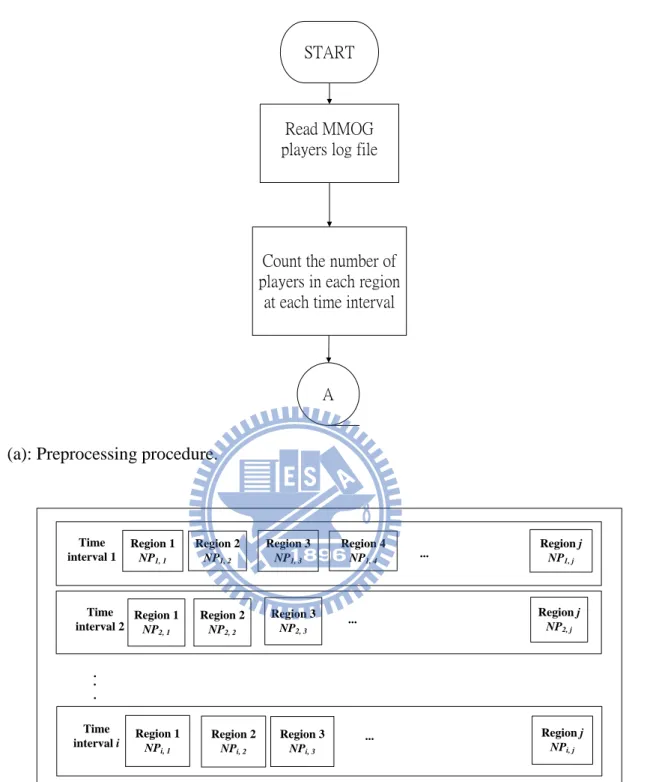
Figure 4: Preprocessing procedure and the MMOG player datasets format. ... 13
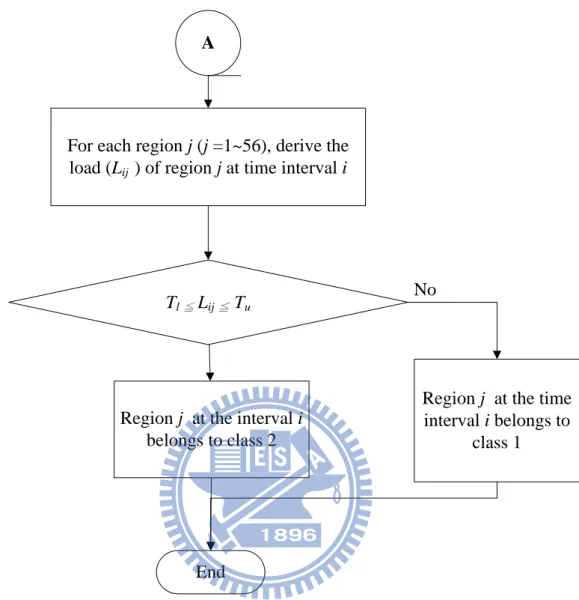
Figure 5: Preprocessing procedure for deriving the loading class of each game region j at time interval i. ... 14
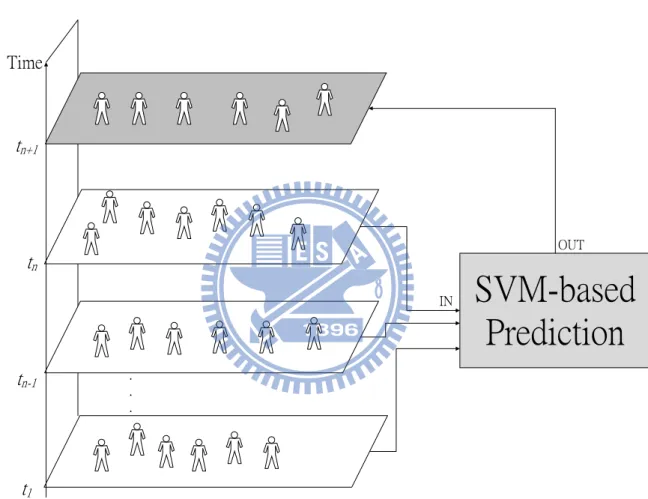
Figure 6: SVM using the loads in previous time intervals to predict the future load of a region. ... 15
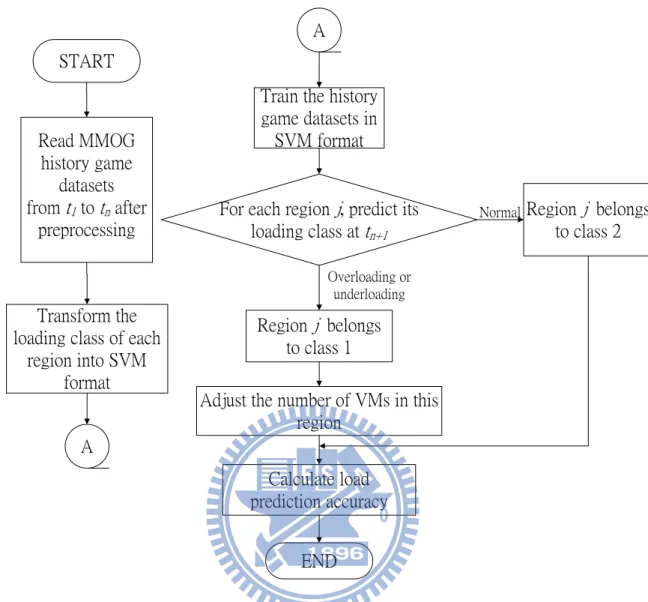
Figure 7: Flowchart of the proposed SVM-based load prediction and resource assignment. 16 Figure 8: Prediction accuracy comparison of the three load prediction schemes. ... 20
List of Tables
Table I. Pros and cons comparison of the proposed SVM-based and neural network-based
load prediction ... 7 Table II. Qualitative comparison of the proposed SVM-based with neural network-based
load prediction. ... 9 Table III. MMOG loading level and its SVM category. ... 17 Table IV. Simulation parameters [1,16]. ... 18
Chapter 1
Introduction
1.1 Motivation
In recent years, the development of massively multiplayer online games (MMOGs) has been
booming. In [6], it is reported that over 55% of Internet users are also online gamers, while
the number of MMOG players grows to 21 million in 2011. Today, MMOGs causes
high interest in academia and industry. MMOGs need to consume huge resources due to a
massive number of players. MMOG game servers are responsible for communicating
information among players. The challenges of MMOGs include scalability, reasonable
resource allocation, QoS, fairness among players and meeting response time requirement of
players. An important goal is to allocate or release resources (such as virtual machines - VMs)
to meet the response time requirement of players and to have efficient resource utilization for
power saving. In this paper, we pay attention to the resource allocation problem in MMOGs
and use the multi-server architecture in the cloud. Cloud computing integrates distributed
computing and virtualization techniques. It has powerful computing ability and high
scalability. Cloud computing applications are for distributed computing, data storage, and
sharing of various software. Cloud computing environments are suitable for MMOGs. By the
statistics of WoW (World of Warcraft), there are millions of players online [3]. So we
leverage the powerful computing ability and high scalability of cloud computing
environments to deal with a large number of MMOG players. In an MMOG cloud, it flexibly
uses VMs instead of physical machines to reduce response time and enhance QoS of players.
That is, it can allocate the resources of an MMOG cloud more effectively. In [3], it mentioned
system QoS modeling/prediction, and (iii) player loyalty modeling/prediction. Based on these
reason, we use players’ log files for predicting the VMs load in the proposed scheme.
The load of MMOGs depends on the number of active concurrent players [12]. Therefore,
fast and accurate load prediction algorithms are required to dynamically allocate resources for
MMOGs so as to provision VMs to game sessions with the minimum resources dynamically.
1.2 Resource allocation
A game world is composed of regions. Each region is supported by multiple VMs of
servers.Assume that each VM has the same CPU, memory, and network bandwidth capability.
The methods of resource allocation can be classified into two categories, real-time resource
allocation and pre-allocation [10]. The real-time resource allocation scheme dynamically
assigns resources when the user has the demand. The pre-allocation scheme can achieve better
system resource stability, but a good load prediction algorithm is needed. In this paper, we
combine real-time resource allocation with a load prediction scheme to predict the user load
and allocate resources efficiently. By prediction, resources can be allocated before players’
login to the MMOG servers.
1.3 Load prediction
Load prediction is based on historical data to forecast the load level of each region in
advance for VM assignment. Load prediction can help to achieve efficient real-time resource
allocation. It can help reduce resource allocation time to meet the response time requirement
1.4 Research objective
SVM (support vector machine) is a suitable tool for predicting MMOGs load. In this
paper, we propose an efficient real-time resource allocation scheme to support the workload
generated by MMOGs players. The task involves predicting the load of each region in an
MMOG game world using historic players’ log files. We use SVM to predict MMOGs game
world load. We integrate current MMOG multi-server architecture with a cloud computing
environment to achieve better performance.
1.5 Thesis organization
The rest of this paper is organized as follows. In Chapter 2, we introduce the basic concept
of SVM. In Chapter 3, we review an existing prediction-based real-time resource provisioning
scheme for MMOGs. We present the proposed SVM-based load prediction scheme in detail in
Chapter 4. In Chapter 5, we show simulation results that include comparison with neural
VM
VM
VM
VM
VM VM
VM
VM VM
network-based load prediction [13] in terms of prediction accuracy. In Chapter 6, we conclude
Chapter 2
Preliminaries
2.1 SVM
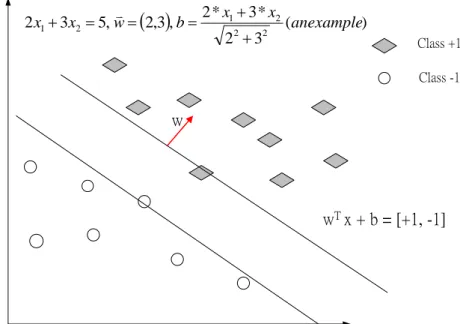
The support vector machine (SVM) was developed by Vapnik (1995) [1]. The main idea
of SVM comes from the binary classification, namely to find a hyperplane as a segmentation
of the two classes to minimize the classification error. The maximum margin hyperplane
gives the maximum separation between decision classes. The training data are closest to the
maximum margin hyperplane; it is called support vectors [1]. SVM analyzes data and
recognize patterns for classification and regression analysis (i.e. time sequence analysis).
SVM concentrates on applying regression to short-term electricity load forecasting. Its
forecasting accuracy outperforms other forecasting models. SVM has good performance on
reducing the outliers and improves the prediction accuracy efficiently. The SVM parameters
are defined as follows: , where Xi is a training vector,
Yi represents a class. Figure 2 shows the SVM hyperplane and the support vector w [9].
2 }, 1 , 1 { , ..., , 1 }, , {Xi Yi i n Yi Xi R
2.2 The Applications of SVM
SVM can be applied to some applications, such as flood forecasting, power prediction
[18], image recognition (large dataset), three-dimensional classification, text classification,
and time series prediction[1] [18].
2.3 Pros and cons comparison of the proposed SVM-based
and neural network-based load prediction
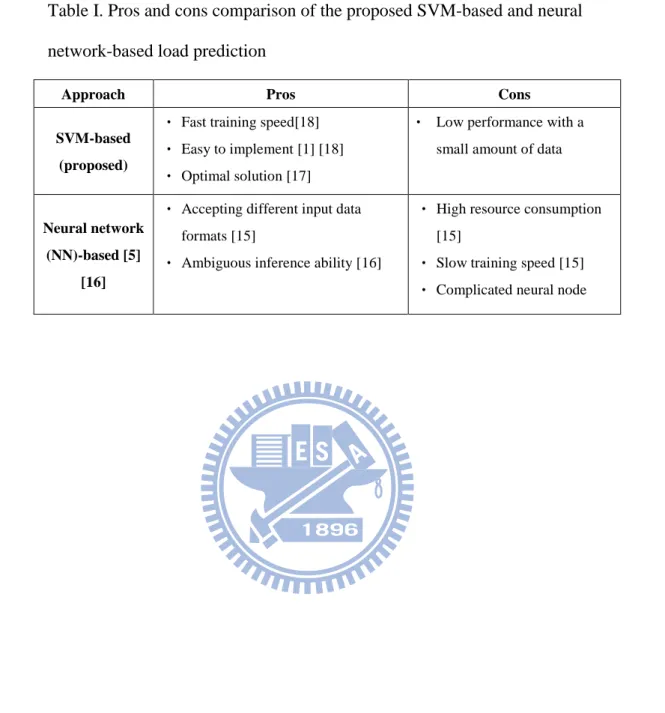
Table I shows the pros and cons between SVM-based and the NN-based load prediction.
For the SVM-based load prediction, it has low performance with a small amount of data. The
NN-based load prediction has slow training speed, complicated neural nodes, and high
wT x + b = [+1, -1] Class +1 Class -1 w
( ) 3 2 * 3 * 2 , 3 , 2 , 5 3 2 2 2 2 1 2 1 anexample x x b w x x Table I. Pros and cons comparison of the proposed SVM-based and neural
network-based load prediction
Approach Pros Cons
SVM-based (proposed)
• Fast training speed[18] • Easy to implement [1] [18] • Optimal solution [17]
• Low performance with a small amount of data
Neural network (NN)-based [5]
[16]
• Accepting different input data formats [15]
• Ambiguous inference ability [16]
• High resource consumption [15]
• Slow training speed [15] • Complicated neural node
Chapter 3
Related Work
3.1 Neural network-based load prediction
In [5], it proposed a neural network (NN) prediction-based method for dynamic resource
provisioning and scaling of MMOGs in distributed grid environments. The load prediction
method predicts the future game world entity distribution from history trace data by using the
neural network-based method. It developed generic analytical game load models used to
forecast the future hot-spots that congest the game servers and make the overall environment
fragmented and unplayable [5]. Finally, a resource allocation service performs dynamic load
distribution, balancing, and migration of entities that keep the game servers reasonably loaded
such that the real-time QoS requirements are maintained[5].
3.2 Qualitative comparison of proposed SVM-based with
neural network-based load prediction
The NN-based scheme [5] bases neural network to foresee future hot-spots to allocate
resources for the grid MMOG. However, it did not propose any mechanism to allocate
resources and had low prediction accuracy to predict the MMOG load. The above problems
motivate us to design a more efficient SVM-based load prediction for MMOGs. We propose
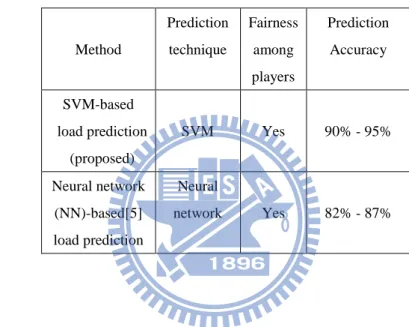
proposed SVM-based load prediction scheme will be described in Chapter 4. In Table II, the
prediction technique indicates the operation type of the prediction [5] [16]. The fairness
indicates that the same number of VMs is allocated to each game region at first. The
prediction accuracy indicates the fraction of prediction correctness for each load prediction
scheme.
Table II. Qualitative comparison of the proposed SVM-based with neural
network-based load prediction.
Method Prediction technique Fairness among players Prediction Accuracy SVM-based load prediction (proposed) SVM Yes 90% - 95% Neural network (NN)-based[5] load prediction Neural network Yes 82% - 87%
Chapter 4
Proposed SVM-based Load Prediction
for Resource Allocation
4.1 SVM-based resource allocation architecture for
MMOGs
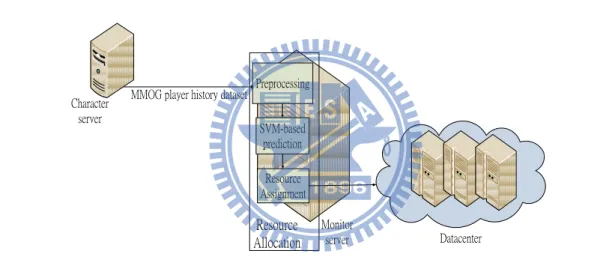
The proposed SVM-based resource allocation architecture for MMOGs is shown in Figure 3.
We obtain MMOG player history datasets from a character server. In a monitor server, there
are three main components preprocessing module, SVM-based prediction module, and
resource assignment module. The first component, preprocessing module, calculates the
SVM-based prediction
Resource Assignment MMOG player history dataset
Character server Preprocessing Monitor server Resource Allocation Datacenter
players in MMOGs. After load prediction, we allocate the resources to each region in the
datacenters of the MMOG cloud.
4.2 Preprocessing
MMOG loads are dynamic because of the player interaction [8]. Thus, accurate and fast load
prediction is necessary to dynamically allocate resources for MMOGs. In our MMOG cloud
system, we obtain MMOG player history datasets from the character server. Figure 4 shows
the preprocessing procedure and the MMOG player datasets format. The detailed
preprocessing procedure is described as follows:
Preprocessing procedure
1) Read MMOG player history datasets from the character server.
2) Count the number of players (NP) in each region at each time interval.
3) Calculate the loading class of each region.
The formula of estimating the loading level of region j at time interval i, Lj :
ij ij NV NP ij L (1)
where NPij = total number of players in region j at time interval I and NVij = number of VMs
used in region j at time interval i. We define MAX_LOAD vm = the maximal number of
players in a VM. The upper threshold of Lij is Tu and the lower threshold of Lij is Tl, which are
defined as follows: vm ij vm ij u MAX LOAD NV LOAD MAX NV T _ _ (2) ij vm ij l NV LOAD MAX NV T ( 1) _ 1 (3)
The loading state of a region can be: overloading, underloading, or normal.
Underloading: LijTl
(5)
Normal: Tl LijTu
(6)
In addition the loading class of a region is either: class 1 or class 2. Class 1 means the loading
state is overloading or underloading and has the value +1 in SVM. Class 2 means the loading
state is normal and has the value -1 in SVM. The actions taken by each region based on its
loading class is as follows:
If the loading class of a region is class 1, then the number of VMs in this region should
be adjusted,
else if the loading class of a region is class 2, then the number of VMs in this region does
not need to be adjusted.
Figure 5 shows the preprocessing procedure for deriving the loading class of each region j at
START
Count the number of players in each region
at each time interval Read MMOG players log file
A
(a): Preprocessing procedure.
Time interval 1 Region 1 NP1, 1 Region 2 NP1, 2 Region 3 NP1, 3 Region 4 NP1, 4 Region j NP1, j ... . Region 1 NPi, 1 Time interval i Region 2NP i, 2 Region 3 NPi, 3 Region j NPi, j ... . . Time
interval 2 Region 1NP2, 1 Region 2NP2, 2
Region 3
NP2, 3
Region j
NP2, j ...
(b): MMOG player datasets format for recording the number of players in each region at each time interval.
Figure 4: Preprocessing procedure and the MMOG player datasets format.
4.3 SVM-based load prediction
In this section, we describe the proposed SVM-based load prediction for MMOG
resource allocation. As shown in Figure 6, the SVM-based prediction bases on the loads in For each region j (j =1~56), derive the
load (Lij ) of region j at time interval i
Tl ≦ Lij ≦ Tu
Region j at the interval i belongs to class 2
Region j at the time interval i belongs to
class 1 No
End
A
Figure 5: Preprocessing procedure for deriving the loading class of each game
transformed to the SVM format, as shown in section 2.1. Then resources can be assigned to
each region based on predicted loading class. The flowchart of the SVM-based prediction and
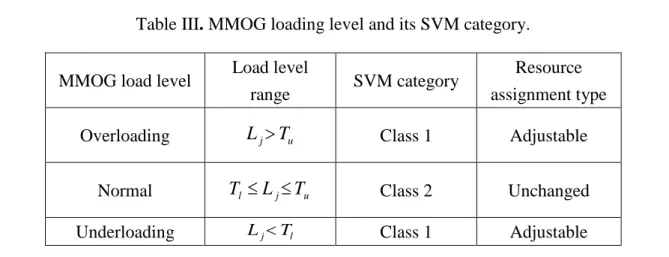
resource assignment is shown in Figure 7. Table III summarizes MMOG load levels and their
associated SVM-based loading classes.
tn+1 tn tn-1 t1 Time
SVM-based
Prediction
OUT IN . . .Figure 6: SVM using the loads in previous time intervals to predict the future load of a
Transform the loading class of each
region into SVM format
Train the history game datasets in
SVM format
Adjust the number of VMs in this region
Calculate load prediction accuracy
END START
For each region j, predict its loading class at tn+1 Read MMOG history game datasets from t1 to tn after preprocessing Region j belongs to class 1 Region j belongs to class 2 Overloading or underloading Normal A A
4.4 Resource assignment
Based on the results of load prediction, we propose the rule of resource assignment to add or
release VMs in each region. To allocate resources in an MMOG cloud efficiently, we assume
that the VMs in the cloud have the same specification. The resource assignment objectives are
to meet the QoS, such as the response time requirement of players and to reduce the waste of
resources. We adjust the number of VMs used in region j at time interval i+1 (NVij), as follows:
NVi+1j = NPij / MAX_LOADvm (7)
Note that NPij is number of players in region j at time interval i and MAX_LOADvm is the
maximum number of players in the VM.
Table III. MMOG loading level and its SVM category.
MMOG load level Load level
range SVM category
Resource assignment type
Overloading LjTu Class 1 Adjustable
Normal Tl LjTu Class 2 Unchanged
Chapter 5
Performance Evaluation
In this chapter, we first describe simulation setup and evaluation metrics. Then, we compare
the proposed SVM-based load prediction with the NN-based load prediction [5] in terms of
prediction accuracy.
5.1 Simulation setup and evaluation metrics
We ran libsvm[1] for SVM-based load prediction. SVM related simulation parameters are
shown in Table IV. MMOG running environment setting are as follows:
(1) We ran the libsvm [1] software package for MMOG load prediction in Intel 2.67 GHz CPU, 4GB, Windows 7 OS.
Table IV. Simulation parameters [1,19].
Parameter Value
Kernel type Radius Basic Function
Gamma 125
Degree 2
Scale -1 ~ 1
Label 1-12 (time interval) Index 1-56 (region number)
5.1.1 Prediction accuracy
The prediction accuracy is defined as the number of correct game region load predictions
divided by the total number of game region load predictions which is expressed as follows:
(7)
5.2 Comparison between SVM-based and NN-based load
prediction
As shown in Figure 8, the proposed SVM-based load prediction scheme achieves
12.24% and 26.77% better prediction accuracy than the NN-based load prediction and the last
value-based load prediction, respectively. The proposed SVM-based load prediction reduces
8% and 78.3% of the number of VMs needed compared with the neural network-based load
prediction and the last value-based load prediction, respectively.
s prediction load region game of number Total s prediction load region game correct of Number = accuracy Prediction
Chapter 6
Conclusion
6.1 Concluding remarks
In this thesis, we have presented an efficient SVM-based load prediction scheme for
resource allocation in MMOG clouds. We use historic load data of players in each region to
predict the future load. By using the load prediction results, we can allocate (or release) an Figure 8: Prediction accuracy comparison of the three load prediction schemes.
0 10 20 30 40 50 60 70 80 90 100 1002 1003 1004 1005 1006 1007 1008 1009 1010 10 1 1 1012 1013 1014 1015 1016 P re dic tion a c c ura c y (% ) Time Last value-based SVM-based (Proposed) NN-based
SVM-based load prediction reduces 8% of the number of VMs used compared with the neural
network-based load prediction. With a higher prediction accuracy and a smaller number of
VMs used, our SVM-based load prediction is feasible for efficient resource allocation in
MMOG clouds.
6.2 Future work
We will integrate the proposed SVM load prediction scheme to an efficient resource
allocation method for MMOG clouds. In addition, we will combine a fuzzy membership
function to each input datum of SVM and design a fuzzy-based SVM load prediction scheme
Bibliography
[1] Libsvm, software available at http://www.csie.ntu.edu.tw/ cjlin/libsvm, 2001.
[2] C. Hsu, C. Chang, and C. Lin, “A practical guide to support vector classication,”
http://www.csie.ntu.edu.tw/~cjlin/papers/guide/guide.pdf, 2003.
[3] Y. Lee, K. Chen, Y. Cheng, and C. Lei, "World of warcraft avatar history dataset," in the
ACM Multimedia Systems, Feb. 2011.
[4] K. W, “Resource allocation for massively multiplayer online games using fuzzy linear
assignment technique,” in Proc. of 5th IEEE Consumer Communications and Networking
Conference, pp. 1035 – 1039, Jan. 2008.
[5] R. Prodan and V. Nae, “Prediction-based real-time resource provisioning for massively
multiplayer online games,” in the Future Generation Computer Systems, Vol. 22, Issue 3,
pp. 785-793, July. 2009.
[6] Z. Wan and X. Xu. “An analysis of WoW players’ game hours,” in Proc. ACM
SIGCOMM Workshop on Network and System Support for Games, pp. 47-52, 2008.
[7] R. Suselbeck, G. Schiele, and C. Becker. “Peer-to-peer support for low-latency massively
multiplayer online games in the cloud,” in Proc. Network and Systems Support for Games,
pp. 1-2, Apr. 2009.
[8] V. Nae, A. Iosup, and R. Prodan, “Dynamic resource provisioning in massively
multiplayer online games,” in the IEEE Transactions on Parallel and Distributed Systems,
[12] H. Thorsten, B. Thomas, and H. Robert, “A peer-to-peer architecture for massive
multiplayer online games.” in Proc. ACM SIGCOMM Workshop on Network and System
Support for Games, Oct. 2006.
[13] S. Zhi, L. Yang, and Y. Tao. “Short-term load forecasting based on LS-SVM optimized
by bacterial colony chemotaxis algorithm,” in Proc. International Conference on
Information and Multimedia Technology, pp. 306-309, Dec. 2009.
[14] M. Mohandes , “Support vector machines for short-term electrical load forecasting.” in
the International Journal of Energy Research, pp. 335-345, 2002.
[15] http://en.wikipedia.org/wiki/Neural_network.
[16] P. Marco, “Peer-to-peer architecture for real-time strategy MMOGs with intelligent
cheater detection,” in Proc. International ICST Conference on Simulation Tools and
Techniques, pp. 1-8, Mar. 2010.
[17] Y. Li and T. Fang, “Application of fuzzy support vector machines in short-term load
forecasting,” in Proc. International Conference on Rough Sets, Fuzzy Sets, Data Mining,
and Granular computing, pp. 363-367, 2003.
[18] M. Javier and A. Muñoz, “Support vector machines with applications,” in Statist. Sci,
Vol. 21, pp. 322-336, Dec. 2006.
[19] L. Gang, et al. “Short-term load forecasting using support vector machine with SCE-UA
algorithm,” in Proc. International Conference on Natural Computation, pp. 290-294,