Solar Energy Vol. 64, Nos 4–6, pp. 223–226, 1998
1998 Elsevier Science Ltd
Pergamon P I I : S 0 0 3 8 – 0 9 2 X ( 9 8 ) 0 0 0 8 2 – 6 All rights reserved. Printed in Great Britain 0038-092X / 98 / $ - see front matter
A SOLAR EJECTOR COOLING SYSTEM USING REFRIGERANT R141b
†B. J. HUANG , J. M. CHANG, V. A. PETRENKO and K. B. ZHUK Department of Mechanical Engineering, National Taiwan University, Taipei 106, Taiwan
Received 8 October 1997; revised version accepted 14 July 1998 Communicated by BYARD WOOD
Abstract—A high-performance solar ejector cooling system using R141b as the working fluid was developed.
We obtain experimentally a COP of 0.5 for a single-stage ejector cooling system at a generating temperature of 908C, condensing temperature of 288C, and an evaporating temperature 88C. For solar cooling application, an optimum overall COP can be obtained around 0.22 at a generating temperature of 958C, evaporating
22
temperature of 88C and solar radiation at 700 W m . 1998 Elsevier Science Ltd. All rights reserved.
1. INTRODUCTION Petrenko, 1992; Eames et al., 1995a; Lallemand and Dorantes, 1995; Sun, 1996), while COP is A solar cooling / refrigeration system which
con-around 0.4–0.6 for a single-stage absorption verts the solar thermal energy into cooling effect
cooling system (Wilbur and Mancini, 1976; Bans-has long been an interesting subject for scientists
al et al., 1997). In the present study, we develop a and engineers (Chinnapa, 1961; Kakabaev and
solar ejector cooling system using R141b as the Davletov, 1966; Anderson, 1975; Wilbur and
working fluid which can obtain a better COP than Mancini, 1976; Stchetinina et al., 1987; Korres et
before.
al., 1989; Petrenko, 1992; Bansal et al., 1997). In
practical application, a solar collector is used to
absorb the solar thermal energy first. The heat is 2. DESIGN OF A SOLAR EJECTOR COOLING
then used to drive a heat-driven cooling machine SYSTEM
to produce a cooling effect.
Fig. 1 is the schematic of a single-stage solar The solar cooling system utilizing a LiBr–
ejector cooling system. The solar cooling system water or ammonia–water absorption cooling
ma-chine has been built frequently to demonstrate the application of solar cooling technology. However, the absorption cooling system utilizes a chemical absorption process and is thus quite complicated in design. Vacuum technology is also required for a LiBr–water absorption system. High installation cost retards their application in solar cooling systems.
An ejector cooling system (ECS) can operate with low boiling point refrigerants as the working fluid and is known as one of the most promising devices for solar cooling / refrigeration applica-tions. ECS is a mechanical system utilizing the Rankine cycle and the gas dynamic effect of ejector (a thermal compression process). The simplicity in design, high reliability and low installation cost makes the ECS more attractive than others. The only drawback of the ECS is its low COP, usually lower than 0.3 for a single-stage system (Jhadan et al., 1976; Huang et al., 1985;
†Author to whom correspondence should be addressed. Fig. 1. Schematic diagram of a solar ejector cooling system. 223
224 B. J. Huang et al. consists of only four major components: solar
collector (generator), ejector, condenser / re-generator, evaporator. The solar collector acts as the generator of the ECS in which the working fluid is heated and evaporated. The mixing ejector is used here with the separator to re-circulate the liquid working fluid through the solar collector to enhance the boiling heat transfer.
In the present study, R141b is selected as the working fluid for the ejector cooling machine. R141b has a low boiling point (32.078C) and high
performance according to Lallemand and
Dorantes (1995).
We used a commercially-available double- Fig. 2. Theoretical COP of a single-stage ejector cooling system.
glazed selective-surface flat-plate solar collector as the generator. The energy collection efficiency
of the collector is experimentally determined The analytical results are experimentally verified
according to the modified ANSI /ASHRAE 93- and presented in Figs. 3 and 4.
*
1986 Standard (Huang and Hsieh, 1990): The critical condensing temperature Tc is
defined as the vapor saturation temperature
corre-T 2 corre-Ti a sponding to the critical back pressure of the
]]
h 5 0.80 2 3.5sc I (1)
ejector. For the back pressure of an ejector
22
where I is the incident solar radiation (W m );
T and T are the collector inlet and the ambienti a
temperatures.
3. PERFORMANCE ANALYSIS OF AN EJECTOR COOLING SYSTEM
The ejector cooling system utilizes an ejector for vapor compression by use of the gas dynamic effect. For the ejector performance analysis, we developed an 1-D gas dynamic model which is similar to that of Eames et al. (1995b) but including the secondary flow choking phenomena proposed by Munday and Bagster (1976), (1977);
Fig. 3. Measured and computed ejector entrainment ratio. Huang et al. (1985). The results are then used to
evaluate the performance of a single-stage ejector cooling system.
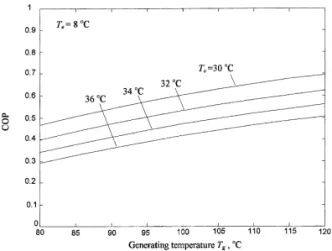
The design specifications of the ejector are listed in Table 1. Fig. 2 shows that the COP of a single-stage ejector cooling system using R141b as the working fluid can reach as high as 0.6 at generation temperature 1008C, condensing tem-perature 308C, and evaporating temtem-perature 88C.
Table 1. Specifications of ejector Primary flow nozzle:
Throat diameter, mm 2.64
Exit diameter, mm 4.50
Constant-area section: cylindrical type
Diameter, mm 8.10
Diffuser angle, deg: 5
Distance between nozzle and Fig. 4. Measured and computed COP of ejector cooling
A solar ejector cooling system using refrigerant R141b 225
exceeding the critical back pressure, the choking The solar ejector cooling system can also
of the secondary or suction flow will disappear become a refrigeration system if it was operated and the ejector performance drops dramatically at low evaporating temperature. Fig. 5 shows that
(Huang et al., 1985). the solar refrigeration system has an optimum
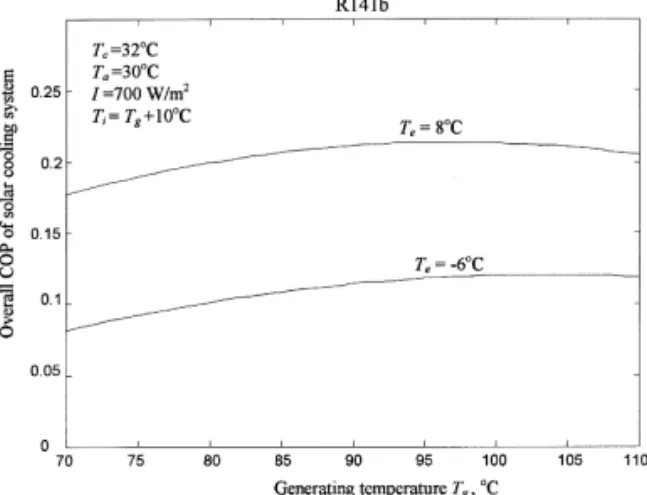
It is shown from Fig. 4 that the ejector cooling overall COP around 0.12 at T 51028C and T 5i e
22
system designed in the present study has a very 268C for solar radiation at 700 W m . This
high COP. For a generating temperature of 908C, system can be used for an ice-storage
air-con-the COP reaches 0.5 at a condensing temperature ditioning system.
of 288C and evaporating temperature of 88C. This A solar refrigeration plant using the ejector
experimental result exceeds the published test cooling system is shown to be feasible according
data for freon ejector cooling systems. to the present study. A solar air-conditioning
The COP of the ECS can be improved further system is proposed according to the present
by properly selecting the generating temperature results as follows: and using a better design of ejector. It can reach
nearly 0.6 at generating temperature 1008C, con- Cooling capacity 10.5 kW (3RT)
densing temperature 308C, and evaporating tem- Evaporating temperature 88C
perature 88C from the prediction of Fig. 2. Condensing temperature 328C
Generating temperature 958C
COPECS 0.5
4. SOLAR EJECTOR COOLING SYSTEM Solar collector eff. hsc 0.5
PERFORMANCE COPo 0.22
2
Solar collector area 68 m
The performance of the solar ejector cooling system can be analyzed by using the collector
In practical design, a backup heater which is characteristics in Eq. 1, the 1-D ejector analysis
driven by natural gas or oil is required at the exit (Fig. 2) and the testing results of the ejector
of the solar collector. A compact, low-cost gas-cooling system. The overall system COP of the
fired instant domestic water heater may be used solar cooling system becomes:
with some simple temperature controller.
COP 5 COPo ECS3hsc (2)
5. DISCUSSIONS AND CONCLUSION
where COPECS is the COP of the ejector cooling
system presented in Fig. 2. We calculate the The design of the solar ejector cooling system
collector efficiency using the collector inlet tem- is very simple. By using the solar collector as the perature at 108C higher than the generating tem- generator of the ejector cooling system, it has perature of the ejector cooling system, i.e. T 5i only four major components. The installation cost
T 1108C. Assuming no heat loss in the pipe, Fig.g thus can be lowered as compared to the
absorp-5 shows that the system will have an optimum tion cooling system. However, the performance of
overall efficiency around 0.22 at T 5958C andg the ejector cooling system needs to be improved
22
T 588C, for solar radiation at 700 W me . further in order to compete with the absorption
system.
The performance of an ejector cooling system is affected by the working fluid selected, the ejector design and manufacturing, and the thermo-dynamic cycle design. In the present study, we use R141b as the working fluid and experimental-ly obtain a very high COP (about 0.5) for a single-stage ejector cooling system. If this was used in solar cooling, the overall COP of the solar ejector cooling system can reach as high as 0.22. The solar cooling system can also be used for the ice-storage air-conditioning system if it was oper-ated at low evaporating temperature (268C).
The research on the ejector cooling system is still underway at the National Taiwan University. Fig. 5. Overall COP of a solar ejector cooling system. The final goal is to improve the COP of the
226 B. J. Huang et al.
refrigerant-absorbent systems of ammonia water and am-ejector cooling system to about 0.7 so that it can
monia lithium nitrate. Solar Energy 5, 1–18.
compete with the absorption cooling system. This Eames I. W., Aphornratana S. and Sun D.-w. (1995) The is possible based on the present and some other jet-pump cycle – a low cost refrigerator option powered by waste heat. Heat Recovery Systems and CHP 15, 8, 711– recent studies (Eames et al., 1995a,b; Nahdi et al.,
721. 1993). The ejector cooling system can also be
Eames I. W., Aphornratana S. and Haider H. (1995) A driven by various kinds of energy sources such as theoretical and experimental study of a small-scale stem jet
refrigerator. Int. J. Refrig. 18, 6, 378–386. solar, waste heat, bio-gas energy, natural gas, or
Huang B. J. and Hsieh S. W. (1990) An automation of oil etc.
collector testing and modification of ANSI /ASHRAE 93-1986 Standard ASME. J. Solar Energy Eng. 112, 257–267. Huang B. J., Jiang C. B. and Hu F. L. (1985) Ejector
NOMENCLATURE performance characteristics and design analysis of jet
refrigeration system. Trans ASME J. Eng. Power 107, 792–802.
COPECS Coefficient of performance (COP) of the ejector
Jhadan S. Z., Petrenko V. A., Kitaev V. F. and Vasiliev J. Z. cooling system, dimensionless
(1976) Investigation of the ejector refrigeration machine COPo Overall coefficient of performance (COP) of solar
using R142b at the operating conditions. Kholodilnaya ejector cooling system,
Technicai I technologia, Kiev, Technica, 3–7.
dimensionless
Kakabaev A. and Davletov A. (1966) A freon ejector solar
I Solar radiation incident upon the collector slope, 22
cooler. Geliotekhnika 2, 5, 42–48. W m
Ta Ambient temperature, 8C Korres C. J., Bardakas E. E. and Koumou-tsos N. G. (1989) *
Tc Vapor saturation temperature corresponding to the Performance analysis of a solar vapour thermal compression critical back pressure of ejector, 8C chiller. Int. J. Energy Res. 13, 243–252.
Te Evaporating temperature of ejector cooling sys- Lallemand R. and Dorantes A. (1995) Prediction of
per-tem, 8C formance of a jet cooling system operating with pure
Tg Generating temperature of ejector cooling system, refrigerants or non-azeotropic mixtures. Int. J. Refrig. 18, 1,
8C 21–30.
Ti Collector inlet temperature, 8C Munday J. T. and Bagster D. F. (1976) The choking
phenom-hsc Solar collector efficiency, dimensionless ena in ejector with particular reference to steam jet
refrige-v Ejector entrainment ratio (5primary flowrate / suc- ration. Thermal fluids Conference of Inst. of Eng. Australia, tion flowrate) Hobart, National Conference Publication, pp. 84–88, 1976. Munday J. T. and Bagster D. F. (1977) A new ejector theory applied to steam jet refrigeration. Ind. Eng. Chem. Process
Des. Dev. 16, 4, 442–449.
Acknowledgements—The present study was supported by the
Nahdi E., Champoussin J. C., Hostache G. and Cheron J. National Science Council, Taiwan, through Grant No.
NSC86-(1993) Optimal geometric parameters of a cooling ejector– 2212-E002-088 and NSC86-2811-E002-004R and the Energy
compressor. Int. J. Refrig. 16, 1, 67–72. Commission, the Ministry of Economic Affairs, Taiwan, ROC.
Petrenko V. A. (1992) A solar vapor ejector refrigerator testing in air conditioning regime. World Renewable Energy
Con-gress, Reading, UK, Sept. 13–18, 1992.
REFERENCES
Stchetinina N. A., Jhadan S. Z. and Petrenko V. A. (1987) Comparison between the efficiency of different types of Anderson H. (1975) Assessment of solar powered vapor jet
heating for solar ejector freon refrigeration machine genera-air-conditioning systems. Proc. 1975 ISES Congress, Los
tor. Heliotechnica N4, 71–74. Angeles, CA, USA, July 28–August 1, 1975.
Sun D.-w. (1996) Variable geometry ejectors and their applica-Bansal N. K., Blumenberg J., Kavasch H. J. and Roettinger T.
tions in ejector refrigeration systems. Energy 21, 10, 919– (1997) Performance testing and evaluation of solid
absorp-929. tion solar cooling unit. Solar Energy 61, 2, 127–140.
Chinnapa J. C. V. (1961) Experimental study of the intermit- Wilbur P. J. and Mancini T. R. (1976) A comparison of solar tent vapor absorption refrigeration cycle employing the absorption air conditioning systems. Solar Energy 18, 569.