Performance of DPSK Signals With
Quadratic Phase Noise
Keang-Po Ho, Senior Member, IEEE
Abstract—Nonlinear phase noise induced by the interaction of
the fiber Kerr effect and amplifier noises is a quadratic function of the electric field. When the dependence between the additive Gaussian noise and the quadratic phase noise is taken into account, the error probability for differential phase-shift keying signals is derived analytically. Depending on the number of fiber spans, the signal-to-noise ratio penalty is increased by up to 0.23 dB, due to the dependence between the Gaussian noise and the quadratic phase noise.
Index Terms—Error probability, fiber Kerr effects, nonlinear
phase noise, phase modulation.
I. INTRODUCTION
O
THER than the projection of additive Gaussian noise to the phase, phase noises from other sources can be con-sidered as multiplicative noise that adds directly to the phase of the received signal. When the local oscillator is not locked per-fectly into the signal, the noisy reference gives additive phase noise [1], [2]. Laser phase noise degrades coherent optical com-munication systems [3]–[5]. Those types of extra additive phase noise that add directly to the signal phase are independent of the additive Gaussian noise. In this paper, the additive phase noise is a quadratic function of the electric field. When the electric field is contaminated with additive Gaussian noise, although the quadratic phase noise is uncorrelated with the linear phase noise, both non-Gaussian distributed, the phase noise weakly depends on the additive Gaussian noise.Differential phase-shift keying (DPSK) signals [6]–[16] have received renewed attention recently for long-haul or spectrally efficiency lightwave transmission systems. When optical ampli-fiers are used periodically to compensate the fiber loss, the inter-action of optical amplifier noise and the fiber Kerr effect induced nonlinear phase noise, often called the Gordon–Mollenauer ef-fect [17], or more precisely, nonlinear phase noise induced by self-phase modulation. Added directly into the signal phase, the Gordon–Mollenauer effect is a quadratic function of the electric field, and degrades the DPSK signal [11], [14], [17]–[23].
Previous studies found the variance or the corresponding -factor of the quadratic phase noise [11], [17], [24]–[27] or
Paper approved by J. A. Salehi, the Editor for Optical CDMA of the IEEE Communications Society. Manuscript received May 24, 2004; revised February 2, 2005. This work was supported in part by the National Science Council under Grants NSC-92-2218-E-002-034 and NSC-93-2213-E-002-061. This paper was presented in part at the IEEE/LEOS Workshop of Advanced Modulation For-mats, San Francisco, CA, July 1994.
The author is an independent consultant in Cupertino, CA 95014 USA, on leave from the Institute of Communication Engineering and Department of Electrical Engineering, National Taiwan University, Taipei 106, Taiwan, R.O.C. (e-mail: [email protected]).
Digital Object Identifier 10.1109/TCOMM.2005.852831
the spectral broadening of the signal [14], [18], [28]. Recently, quadratic phase noise is found to be non-Gaussian distributed, both experimentally [20] and theoretically [29], [30]. As a non-Gaussian random variable, neither the variance nor the -factor is sufficient to completely characterize the phase noise. The probability density of quadratic phase noise is found in [30], and used in [23] to evaluate the error probability of the DPSK signal by assuming that quadratic phase noise and Gaussian noise are independent of each other. However, as shown in the simulation of [22] and [23], the dependence between Gaussian noise with quadratic phase noise increases the error probability.
Using the distributed assumption of an infinite number of fiber spans, the joint statistics of nonlinear phase noise and Gaussian noise is derived analytically by [19], [21], and [31]. The charac-teristic function of nonlinear phase noise becomes a very simple expression with the distributed assumption [29]. The error proba-bility of the DPSK signal has been derived with [22] and without [21], [32] the assumption that nonlinear phase noise is indepen-dent of the Gaussian noise. Based on the distributed assumption, it is found that the dependence between linear and nonlinear phase noise increases both the error probability and signal-to-noise ratio (SNR) penalty [21], [32].
The distributed assumption is very accurate when the number of fiber spans is larger than 32 [21], [29]. For a typical fiber-span length of 80 km, a fiber link of 32 spans has a total distance of over 2500 km. Most terrestrial fiber systems have an overall distance of less than 1000 km, and the distributed assumption needs to be verified for small numbers of fiber spans. Recently, DPSK signals have been used in systems with small numbers of fiber spans [16], [33], [34]. Of course, the independence as-sumption can be used for either small [23] or large [22] numbers of fiber spans. However, as shown in [21] and [32], the indepen-dence assumption of [22] and [23] underestimates both the error probability and the required SNR, contradicting the principles of conservative system design.
In this paper, taking into account the dependence between the quadratic phase noise and Gaussian noise, the error probability of the DPSK signal is derived for a finite number of fiber spans, to our knowledge, for the first time. Comparing with the inde-pendence approximation of [23], the deinde-pendence between the quadratic phase noise and Gaussian noise increases the error probability of the system.
In the remaining parts of this paper, Section II gives the model of the quadratic phase noise, mostly following the approach of [30]; Section III derives the joint statistics of the additive Gaussian noise and the quadratic phase noise. Using the joint statistics, Section IV gives the exact error probability of DPSK
signals with quadratic phase noise, taking into account the de-pendence between the additive Gaussian noise and quadratic phase noise; Section V calculates the error probability and the SNR penalty of DPSK signals, and is compared with the inde-pendence approximation of [23]; and Section VI is the conclu-sion of the paper.
II. QUADRATICNONLINEARPHASENOISE
For an -span system, for simplicity and without loss of gen-erality, the overall quadratic phase noise is [17], [25], [26], [30]
(1) where is a two-dimensional (2-D) vector as the baseband representation of the transmitted electric field, , are independent identically distributed (i.i.d.) zero-mean circular Gaussian random complex numbers as the optical amplifier noise introduced into the system at the th fiber span. Both electric fields of and amplifier noises of in (1) can also be represented as a complex number. The variance of
is , , where is the noise
vari-ance per span per dimension. In (1), the constant factor of the product of the fiber nonlinear coefficient and the effective non-linear length per span, , is ignored for simplicity. Without affecting the SNR, both signal and noise in (1) can be scaled by the same ratio for a different mean nonlinear phase shift of , except for the case without quadratic phase noise of . After the scaling, the mean nonlinear phase shift is approximately equal to the product of the number of fiber spans and the launched power per span, es-pecially for the usual case of large SNR with small noise.
In the linear regime, ignoring the fiber loss of the last span and the amplifier gain required to compensate it, the signal received after spans is
(2)
with a power of and SNR of .
In (1) and (2), the configuration of each fiber span is assumed to be identical with the same length and launched power.
In [30], using the method of [35] and [36], the characteristic function of the quadratic phase noise (1) is found to be
(3)
where , , ,
are the eigenvalues and eigenvectors of the covariance matrix , respectively. The covariance matrix with
..
. ... ... . .. ...
(4)
The characteristic function of (3) is used to find the error probability of a DPSK signal in [23] based on the assumption that the quadratic phase noise of (1) is independent of the re-ceived electric field of (2).
III. JOINTSTATISTICS OFGAUSSIAN NOISE ANDQUADRATICPHASENOISE
To find the dependence between the quadratic phase noise and the received electric field, the joint characteristic function of
(5) will be derived here, with and given by (1) and (2), respectively.
Similar to [21] and [30], with and , we obtain (6) where is given by (7) with , , , , and .
Similar to [30], using the -dimensional Gaussian proba-bility density function (pdf) of
for , we obtain
(8) or
(9)
where , and is an identity matrix.
Similarly, using in (9), we get
(10) where
(11) The joint characteristic function of
(12) becomes
where
(14) (15) (16) Based on the eigenvalues and eigenvectors of the covariance matrix , the characteristic function of becomes that of (3), and
(17)
(18) The characteristic function of (13) is similar to the corre-sponding characteristic function with the distributed assumption [21]. If the number of spans approaches infinity, the charac-teristic function should converge to that of [21].
Based on (13), we obtain
(19)
with , and denotes the inverse Fourier
transform with respect to . The partial characteristic function and pdf of (19) is similar to a 2-D Gaussian pdf with mean of and variance of . With the dependence on the quadratic phase noise, the variance of and the mean of are both complex numbers depending on the “an-gular frequency” of . The marginal pdf of the received elec-tric field is a 2-D Gaussian distribution with variance of
and mean of .
With normalization, the corresponding joint characteristic of (19) in [21] has
and (20)
when . Based on joint statistics of (19), similar to that of [21], [32], and [37], the exact error probability of the DPSK signal can be derived analytically, even for case with linearly compensated nonlinear phase noise [23]–[25], [27], [38]. As shown in [21], the optimal compensation curve of [26] and [27] can also be derived using (19).
IV. EXACTERRORPROBABILITY
With nonlinear phase noise, assuming zero transmitted phase, the overall received phase is
(21) where is the phase of (2). The received phase is con-fined to the range of . The pdf of the received phase is a periodic function with a period of . If the characteristic
function of the received phase is , the pdf of the received phase has a Fourier series expansion of
(22) where denotes the real part of a complex number. In (22), we use the conjugate symmetry property of
.
In order to derive the Fourier coefficient of , we need the joint characteristic function of and at the integer “angular frequency” of . Based on (19), using the same method as [19], [21], [32], and [39], we obtain
(23)
where is the complex-valued
fre-quency-dependent SNR parameter. When , it is obvious
that .
From (21), the Fourier coefficient in (22) is
. For the DPSK signal, the differential received
phase is , in which the pdfs of
and are the same as that of (22). The pdf of the differential received phase is the same as (22), with the Fourier coefficient equal to , i.e.,
(24) Similar to the procedure of [2], [3], [21], [23], [32], and [39]–[41], the error probability becomes
(25) or
(26) where
(27) analogous to the “angular frequency” depending on SNR as the ratio of complex power of to the noise variance of
.
The error-probability expression of (26) is almost the same as that in [21] and [32], but with a different parameter of (27). The error probability of (26) is also similar to the cases when additive phase noise is independent of Gaussian noise [2], [3], [23], [40], [41]. The frequency-dependent SNR is originated from the de-pendence between the additional phase noise and the Gaussian noise [19], [21], [32], [37].
V. NUMERICALRESULTS
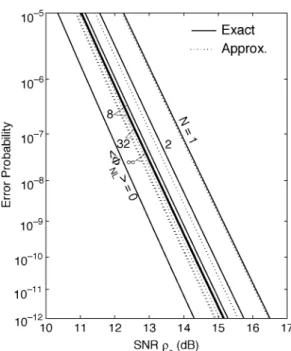
For DPSK signals with quadratic phase noise, Fig. 1 shows the exact error probability as a function of SNR for the mean nonlinear phase shift of rad. Fig. 2 shows the
Fig. 1. Error probability of DPSK signal as a function of SNR forN = 1, 2, 4, 8, 32, and an infinite number of fiber spans and mean nonlinear phase shift of h8 i = 0:5 rad.
Fig. 2. SNR penalty versus mean nonlinear phase shifth8 i.
SNR penalty for an error probability of as a function of the mean nonlinear phase shift . The SNR penalty is de-fined as the additional required SNR to achieve the same error probability of . Both Figs. 1 and 2 are calculated using (26) and the independence approximation of [23]. The independence approximation of [23] underestimates both the error probability and SNR penalty of a DPSK signal with quadratic phase noise of (1). Both Figs. 1 and 2 also include the exact and approx-imated error probability for that are the distributed model from [32] and [22], respectively. The distributed model is applicable when the number of fiber spans is larger than 32. In Fig. 1, without quadratic phase noise of , the error probability is [42]. The required SNR for systems without nonlinear phase noise of is
(13 dB) for an error probability of .
From Figs. 1 and 2, for the same mean nonlinear phase shift of , the SNR penalty is larger for a smaller number of fiber
spans. When the mean nonlinear phase shift is
rad, the SNR penalty is about 1 dB with a large number of fiber spans, but up to a 3-dB SNR penalty for a small number ( ) of fiber spans. For a 1-dB SNR penalty, the mean nonlinear phase shift is also reduced from 0.56 to 0.35 rad with a small number of fiber spans.
In [17], the optimal operating point is defined when the vari-ance of the quadratic phase noise is approximately equal to the variance of the phase of Gaussian noise. In [22] and [23], the optimal operating point is calculated rigorously at the operation condition, in which the increase of launched power does not im-prove the system performance. The optimal operating point is reduced from 0.97 to 0.55 rad with the decrease in the number of fiber spans.
When the exact error probability is compared with the inde-pendence approximation of [23], the indeinde-pendence approxima-tion is closer to the exact error probability for a small number of fiber spans. In all cases, the independence assumption of [22] and [23] underestimates the error probability of the system, con-tradicting the conservative principle of system design. The de-pendence between linear and nonlinear phase noise increases the SNR penalty up to 0.23 dB.
From the SNR penalty of Fig. 2, if a prior penalty of about 0.23 dB is added into the system, the independence assump-tion of [23] can be used to provide a conservative system-design guideline.
VI. CONCLUSION
For a system with a small number of fiber spans, the exact error probability of a DPSK signal with quadratic phase noise is derived analytically for the first time, when the dependence between linear and nonlinear phase noise is taken into account. For the same mean nonlinear phase shift, the error probability increases for a small number of fiber spans. The dependence between linear and non-linear phase noises increases the error probability for DPSK sig-nals. Depending on the number of fiber spans, the SNR penalty in-creases by up to 0.23 dB, due to the dependence between Gaussian noise and the quadratic phase noise.
For the same mean nonlinear phase shifts and SNR, the error probability of the system increases with the decrease in the number of fiber spans. As an example, the optimal operating point for a system with a large number of fiber spans
is a mean nonlinear phase shift of about 1 rad that is reduced to about 0.55 rad for a system with a small number of fiber spans
( ).
REFERENCES
[1] W. C. Lindsey and M. K. Simon, Telecommunication Systems
Engi-neering. Englewood Cliffs, NJ: Prentice-Hall, 1973.
[2] P. C. Jain, “Error probabilities in binary angle modulation,” IEEE Trans.
Inf. Theory, vol. IT-20, no. 1, pp. 36–42, Jan. 1974.
[3] G. Nicholson, “Probability of error for optical heterodyne DPSK system with quantum phase noise,” Electron. Lett., vol. 20, no. 24, pp. 1005–1007, 1984.
[4] G. J. Foschini and G. Vannucci, “Characterizing filtered light waves corrupted by phase noise,” IEEE Trans. Inf. Theory, vol. 34, no. 6, pp. 1438–1448, Jun. 1988.
[5] P. J. Smith, M. Shafi, and C. P. Kaiser, “Optical heterodyne binary-DPSK systems: A review of analysis and performance,” IEEE J. Sel. Areas
[6] A. H. Gnauck, G. Raybon, S. Chandrasekhar, J. Leuthold, C. Doerr, L. Stulz, A. Agrawal, S. Banerjee, D. Grosz, S. Hunsche, A. Kung, A. Marhelyuk, D. Maymar, M. Movassaghi, X. Liu, C. Xu, X. Wei, and D. M. Gill, “2.5 Tb/s (642 42.7 Gb/s) transmission over 40 2 100 km NZDSF using RZ-DPSK format and all-Raman-amplified spans,” in Proc. Opt. Fiber Commun. Conf., Anaheim, CA, 2002, postdeadline paper FC2.
[7] A. H. Gnauck, G. Raybon, S. Chandrasekhar, J. Leuthold, C. Doerr, L. Stulz, and E. Burrows, “25 40-Gb/s copolarized DPSK transmission over 12 100-km NZDF with 50-GHz channel spacing,” IEEE Photon.
Technol. Lett., vol. 15, no. 3, pp. 467–469, Mar. 2003.
[8] C. Rasmussen, T. Fjelde, J. Bennike, F. Liu, S. Dey, B. Mikkelsen, P. Mamyshev, P. Serbe, P. van de Wagt, Y. Akasaka, D. Harris, D. Gapontsev, V. Ivshin, and P. Reeves-Hall, “DWDM 40 G transmission over trans-Pacific distance (10,000 km) using CSRZ-DPSK, enhanced FEC and all-Raman amplified 100 km ultra-wave fiber spans,” in Proc.
Opt. Fiber Commun. Conf., Atlanta, GA, 2003, postdeadline paper
PD18.
[9] B. Zhu, L. E. Nelson, S. Stulz, A. H. Gnauck, C. Doerr, J. Leuthold, L. Grüner-Nielsen, M. O. Pederson, J. Kim, R. Lingle, Y. Emori, Y. Ohki, N. Tsukiji, A. Oguri, and S. Namiki, “6.4-Tb/s (1602 42.7 Gb/s) trans-mission with 0.8 bit/s/Hz spectral efficiency over 322 100 km of fiber using CSRZ-DPSK format,” in Proc. Opt. Fiber Commun. Conf., At-lanta, GA, 2003, postdeadline paper PD19.
[10] P. S. Cho, V. S. Grigoryan, Y. A. Godin, A. Salamon, and Y. Achiam, “Transmission of 25-Gb/s RZ-DQPSK signals with 25-GHz channel spacing over 1000 km of SMF-28 fiber,” IEEE Photon. Technol. Lett., vol. 15, no. 3, pp. 473–475, Mar. 2003.
[11] C. Xu, X. Liu, L. F. Mollenauer, and X. Wei, “Comparison of return-to-zero differential phase-shift keying and on-off keying long-haul disper-sion managed transmisdisper-sion,” IEEE Photon. Technol. Lett., vol. 15, no. 4, pp. 617–619, Apr. 2003.
[12] H. Kim and R.-J. Essiambre, “Transmission of 82 20 Gb/s DQPSK signals over 310-km SMF with 0.8 b/s/Hz spectral efficiency,” IEEE
Photon. Technol. Lett., vol. 15, no. 5, pp. 769–771, May 2003.
[13] C. Wree, N. Hecker-Denschlag, E. Gottwald, P. Krummrich, J. Leibrich, E.-D. Schmidt, and B. L. W. Rosenkranz, “High spectral efficiency 1.6-b/s/Hz transmission (82 40 Gb/s with a 25-GHz grid) over 200-km SSMF using RZ-DQPSK and polarization multiplexing,” IEEE Photon.
Technol. Lett., vol. 15, no. 9, pp. 1303–1305, Sep. 2003.
[14] T. Mizuochi, K. Ishida, T. Kobayashi, J. Abe, K. Kinjo, K. Motoshima, and K. Kasahara, “A comparative study of DPSK and OOK WDM trans-mission over transoceanic distances and their performance degradations due to nonlinear phase noise,” J. Lightw. Technol., vol. 21, no. 9, pp. 1933–1943, Sep. 2003.
[15] J.-X. Cai, D. G. Foursa, L. Liu, C. R. Davidson, Y. Cai, W. W. Patterson, A. J. Lucero, B. Bakhshi, G. Mohs, P. C. Corbett, V. Gupta, W. An-derson, M. Vaa, G. Domagala, M. Mazurczyk, H. Li, M. Nissov, A. N. Pilipetskii, and N. S. Bergano, “RZ-DPSK field trial over 13,100 km of installed non slope-matched submarine fibers,” in Proc. Opt. Fiber
Commun. Conf., Los Angeles, CA, 2004, postdeadline paper PDP34.
[16] A. H. Gnauck, J. Leuthold, C. Xie, I. Kang, S. Chandrasekhar, P. Bernasconi, C. Doerr, L. Buhl, J. D. Bull, N. A. F. Jaeger, H. Kato, and A. Guest, “62 42.7-Gb/s transmission over ten 200-km EDFA-ampli-fied SSMF spans using polarization-alternating RZ-DPSK,” in Proc.
Opt. Fiber Commun. Conf., Los Angeles, CA, 2004, postdeadline paper
PDP35.
[17] J. P. Gordon and L. F. Mollenauer, “Phase noise in photonic communi-cations systems using linear amplifiers,” Opt. Lett., vol. 15, no. 23, pp. 1351–1353, 1990.
[18] S. Ryu, “Signal linewidth broadening due to nonlinear Kerr effect in long-haul coherent systems using cascaded optical amplifiers,” J.
Lightw. Technol., vol. 10, no. 10, pp. 1450–1457, Oct. 1992.
[19] A. Mecozzi, “Limits to long-haul coherent transmission set by the Kerr nonlinearity and noise of the in-line amplifiers,” J. Lightw. Technol., vol. 12, no. 11, pp. 1993–2000, Nov. 1994.
[20] H. Kim and A. H. Gnauck, “Experimental investigation of the perfor-mance limitation of DPSK systems due to nonlinear phase noise,” IEEE
Photon. Technol. Lett., vol. 15, no. 2, pp. 320–322, Feb. 2003.
[21] K.-P. Ho, “Statistical properties of nonlinear phase noise,” in Advances
in Optics and Laser Research, W. T. Arkin, Ed. Hauppauge, NY: Nova, 2003, vol. 3.
[22] , “Performance degradation of phase-modulated systems with non-linear phase noise,” IEEE Photon. Technol. Lett., vol. 15, no. 9, pp. 1213–1215, Sep. 2003.
[23] , “Compensation improvement of DPSK signal with nonlinear phase noise,” IEEE Photon. Technol. Lett., vol. 15, no. 9, pp. 1216–1218, Sep. 2003.
[24] C. Xu and X. Liu, “Postnonlinearity compensation with data-driven phase modulators in phase-shift keying transmission,” Opt. Lett., vol. 27, no. 18, pp. 1619–1621, 2002.
[25] X. Liu, X. Wei, R. E. Slusher, and C. J. McKinstrie, “Improving trans-mission performance in differential phase-shift-keyed systems by use of lumped nonlinear phase-shift compensation,” Opt. Lett., vol. 27, no. 18, pp. 1616–1618, 2002.
[26] K.-P. Ho, “The optimal compensator for nonlinear phase noise,” Opt.
Commun., vol. 211, no. 4–6, pp. 419–425, 2003.
[27] K.-P. Ho and J. M. Kahn, “Electronic compensation technique to mit-igate nonlinear phase noise,” J. Lightw. Technol., vol. 22, no. 3, pp. 779–783, Mar. 2004.
[28] S. Saito, M. Aiki, and T. Ito, “System performance of coherent transmis-sion over cascaded in-line fiber amplifiers,” J. Lightw. Technol., vol. 11, no. 2, pp. 331–342, Feb. 1993.
[29] K.-P. Ho, “Asymptotic probability density of nonlinear phase noise,”
Opt. Lett., vol. 28, no. 15, pp. 1350–1352, 2003.
[30] , “Probability density of nonlinear phase noise,” J. Opt. Soc. Amer.
B, vol. 20, no. 9, pp. 1875–1879, 2003.
[31] A. Mecozzi, “Long-distance transmission at zero dispersion: Combined effect of Kerr nonlinearity and the noise of the in-line amplifiers,” J. Opt.
Soc. Amer. B, vol. 11, no. 3, pp. 462–469, 1994.
[32] K.-P. Ho, “Impact of nonlinear phase noise to DPSK signals: A compar-ison of different models,” IEEE Photon. Technol. Lett., vol. 16, no. 5, pp. 1403–1405, May 2004.
[33] Y. Miyamoto, H. Masuda, A. Hirano, S. Kuwahara, Y. Kisaka, H. Kawakami, M. Tomizawa, Y. Tada, and S. Aozasa, “S-band WDM coherent transmission of 402 43-Gbit/s CS-RZ DPSK signals over 400 km DSF using hybrid GS-TDFAs/Raman amplifiers,” Electron. Lett., vol. 38, no. 24, pp. 1569–1570, 2002.
[34] H. Bissessur, G. Charlet, E. Gohin, C. Simonneau, L. Pierre, and W. Idler, “1.6 Tbit/s (402 40 Gbit/s) DPSK transmission over 3 2 100 km of TeraLight fiber with direct detection,” Electron. Lett., vol. 39, no. 2, pp. 192–193, 2003.
[35] M. Kac and A. J. F. Siegert, “On the theory of noise in radio receivers with square law detectors,” J. Appl. Phys., vol. 18, pp. 383–397, 1947. [36] G. L. Turin, “The characteristic function of Hermitian quadratic forms in
complex normal variables,” Biometrika, vol. 47, no. 1–2, pp. 199–201, 1960.
[37] K.-P. Ho, Phase-Modulated Optical Communication Systems. New York: Springer, 2005, sec. 6.3.
[38] C. Xu, L. F. Mollenauer, and X. Liu, “Compensation of nonlinear self-phase modulation with self-phase modulators,” Electron. Lett., vol. 38, no. 24, pp. 1578–1579, 2002.
[39] V. K. Prabhu, “Error-rate considerations for digital phase-modulation systems,” IEEE Trans. Commun. Technol., vol. COM-17, no. 1, pp. 33–42, Jan. 1969.
[40] P. C. Jain and N. M. Blachman, “Detection of a PSK signal transmitted through a hard-limited channel,” IEEE Trans. Inf. Theory, vol. IT-19, no. 5, pp. 623–630, May 1973.
[41] N. M. Blachman, “The effect of phase error on DPSK error probability,”
IEEE Trans. Commun., vol. COM-29, no. 3, pp. 364–465, Mar. 1981.
[42] J. G. Proakis, Digital Communications, 4th ed. New York: McGraw-Hill, 2000, sec. 5.2.8.
Keang-Po Ho (S’91–M’95–SM’03) received the
B.S. degree from National Taiwan University, Taipei, in 1991, and the M.S. and Ph.D. degrees from the University of California at Berkeley in 1993 and 1995, respectively, all in electrical engineering.
He performed research with the IBM T. J. Watson Research Center, Hawthorne, NY, on all-optical networks in the summer of 1994. He was a Re-search Scientist with Bellcore, currently Telcordia Technologies, Red Bank, NJ, from 1995 to 1997, re-searching optical networking, high-speed lightwave systems, and broadband access. He taught in the Department of Information Engineering, Chinese University of Hong Kong, Shatin, NT, Hong Kong, from 1997 to 2001. He served as the Chief Technology Officer of StrataLight Communications, Campbell, CA, from 2000 to 2003, developing spectrally efficient 40-Gb/s lightwave transmission systems. He has been with the Institute of Communication Engineering and Department of Electrical Engineering, National Taiwan University since 2003. His research interests include optical communication systems, multimedia communication systems, combined source-channel coding, and communication theory. He was among the pioneers for research on hybrid WDM systems, combined source-channel coding using multicarrier modulation or turbo codes, and performance evaluation of PSK and DPSK signals with nonlinear phase noise. He has published over 70 journal articles and given numerous conference presentations on those fields. He is also the author of Phase-Modulated Optical Communication Systems (New York: Springer, 2005).