教育對於結婚的影響:教育程度別女性初婚年齡分佈模式
陳信木、陳雅琪
教育對於結婚的影響:教育程度別女性初婚年齡分佈模式
二十世紀裡,臺灣社會從一個「早婚」、「普遍成婚」的社會演變成為一個「遲
婚」
、甚至不少人們「終身不婚」的局勢。所以,臺灣人口除了完成生育率與死亡率的
轉型之外,同時也經歷重大的婚姻行為變遷。就如同其他社會一般,現今的臺灣人口
處在「二次人口轉型」階段,
「婚姻」與「家庭」等事物將成為影響人口變遷的主要作
用力。
臺灣社會的婚姻行為轉變,除了令人憂心地展現在「婚姻解組」
(尤其是離婚)現
象日益頻繁之外,家庭生命週期成形的起點,亦即初婚,其行為模式的變遷,特別是
從「早婚」轉變為「遲婚」、從「普遍成婚」而遞移至不少人群「終身不婚」,對於臺
灣人口的影響最為巨碩。更甚者,現今,臺灣人口面臨超低生育危機,婚姻(特別是
初婚)與生育的密切關連,致使我們必須更加深入瞭解婚姻行為模式變遷。
是以,本研究試圖援引 Coale and McNeil 所提出的初婚年齡分布模型,探討教育對於
初婚年齡時機的影響,藉以瞭解自一九六0年代開始的教育擴張對於臺灣人口的婚姻
產生如何作用。
壹、前言
「男大當婚、女大當嫁」
婚姻——尤其當其連結生育動力時,對於人口變遷的影響巨大,所以,婚姻制度
乃是每一社會主要的社會制度之一。因此,論及「男大『當』婚、女大『當』嫁」
,許
多的研究特別關注於「婚姻規範」或婚姻制度本身的變遷(例如, Cherlin, 2004;
Cooney and Hogan, 1991)
。在此,我們並不試圖涉入關於婚姻規範與制度的探討,反
之,轉而探討「男『大』當婚、女『大』當嫁」所關係的年齡時機課題。
範」(age norm);另一方面乃是體認,結婚時機(年齡)乃是應然面(規範)與實然
面(社會現實運作)的交互產物。因此,對於「結婚年齡」議題的分析,可以分別從
「婚配年齡規範」與「結婚年齡分佈」兩條途徑著手。探討「婚配年齡規範」
,不可避
免 地 , 將 會 連 結 「 同 質 婚 」( homogamy) 或 「 異 質 婚 」( heterogamy ) 相 關 議 題
(Kalmijn, 1998),試圖瞭解社會存在(盛行)如何的「婚配年齡規範」及其社會效應
(例如,參見楊靜利、李大正、陳寬政,2000)。至於將結婚年齡視為社會運作產物的
主張,則將著重於檢視結婚(尤其是初婚)的年齡分佈與連結因素(例如,Bernardi
and Smeenk, 1999; Booth and Edwards, 1985; Dixon, 1971; Goldscheider, Kobrin, and Waite,
1986; Mensch, Singh, and Casterline, 2005; Modell, 1980; Ono, 2003; Oppenheimer, 1988;
Teachman, Polonko, and Leigh, 1987)
。
由於結婚(尤其是初婚)年齡與生育之間存在相當密切的關係(姑且不論其間因
果角色),所以,本研究將僅焦點集中於探討女性的初婚年齡模式,而且,著重於檢視
教育對於女性初婚年齡變遷的效應。
貳、臺灣地區女性的婚姻狀況變遷
就婚姻的角度而言,二十世紀前半葉裡,臺灣係屬典型、傳統的社會,女性人口
普遍地早婚(根據《臺灣省五十一年來統計提要》表 69 數據,1906 年時,女性帄均
初婚年齡為 18.1 歲,至 1943 年則略微提高至 20.8 歲),而且,綜觀整個人口的婚姻狀
況分佈,幾乎是表現「普遍成婚」
(universal marriage)的現象(參見,李美玲,1994;
Lin, Lee, and Thornton, 1994; Pasternak, 1989)
。
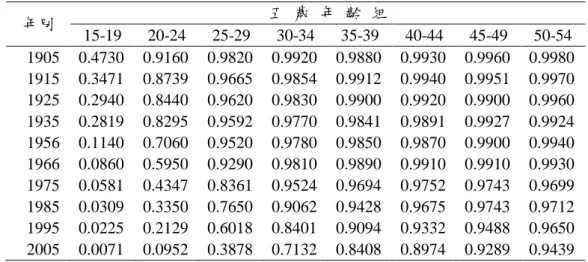
事實上,從表 1 或圖 1 數據可以看出,即便到了 1966 年時,在 50-54 歲的女性人
口當中,超過 99%乃是已婚者(即曾經結婚,ever-married),其中,九成以上在 30 歲
之前即曾結婚,或是六成以上在 25 歲之前就已結婚。所以,在二十世紀前半葉裡,臺
灣的女性人口不僅最終普遍成婚,而且,初婚年齡甚早。
表 1:臺灣地區女性「已婚者比例」按年齡組分:1905-2005
年別 五 歲 年 齡 組 15-19 20-24 25-29 30-34 35-39 40-44 45-49 50-54 1905 0.4730 0.9160 0.9820 0.9920 0.9880 0.9930 0.9960 0.9980 1915 0.3471 0.8739 0.9665 0.9854 0.9912 0.9940 0.9951 0.9970 1925 0.2940 0.8440 0.9620 0.9830 0.9900 0.9920 0.9900 0.9960 1935 0.2819 0.8295 0.9592 0.9770 0.9841 0.9891 0.9927 0.9924 1956 0.1140 0.7060 0.9520 0.9780 0.9850 0.9870 0.9900 0.9940 1966 0.0860 0.5950 0.9290 0.9810 0.9890 0.9910 0.9910 0.9930 1975 0.0581 0.4347 0.8361 0.9524 0.9694 0.9752 0.9743 0.9699 1985 0.0309 0.3350 0.7650 0.9062 0.9428 0.9675 0.9743 0.9712 1995 0.0225 0.2129 0.6018 0.8401 0.9094 0.9332 0.9488 0.9650 2005 0.0071 0.0952 0.3878 0.7132 0.8408 0.8974 0.9289 0.9439圖 1:臺灣地區女性「已婚者比例」按年齡組分:1905-2005
說明:1905-1966 年係為普查資料,1975-2005 年資料取自《臺閩地區人口統計》。可是,一九六0年代開始,這種普遍成婚和早婚的盛行現象,開始發生明顯變
化——雖然,截至 2005 年時,50-54 歲女性人口當中的已婚者比例仍近九成五,較為
1905 1915 1925 1935 1956 1966 1975 1985 1995 2005 0.0 0.1 0.2 0.3 0.4 0.5 0.6 0.7 0.8 0.9 1.0 15-19 20-24 25-29 30-34 35-39 40-44 45-49 50-54 55-59年輕的女性(也就是出生年輪較為晚近者),其結婚時間分佈則是全然迥異。舉例來
說,1905 年時,接近半數的女性(47%)在 20 歲之前即已結婚,甚至,超過九成在
25 歲之前結婚,半世紀之後,1956 年時,僅一成左右(11%)女性在 20 歲之前結
婚,到 25 歲時約有七成完婚,最後,一個世紀之後,也就是 2005 年時,不及百分之
一的女性在 20 歲之前結婚,即使到 25 歲,累積已婚比例仍少於一成。
總之,表 1 和圖 1 數據明顯指出,二十世紀前半葉裡,臺灣社會盛行早婚,並且
整個人口終將普遍成婚。可是,二次戰後,新生年輪的女性,結婚年齡日益延後——
上述最為尖銳的對比,在 20-24 歲女性當中,1905-2005 的一個世紀前後,已婚者比例
從超過九成完全扭轉變為不及一成。
其實,二次戰後所見的臺灣女性人口延遲結婚現象,普遍可見於現代化發展的許
多國家社會(Marini, 1984; Mensch, Singh, and Casterline, 2005; Modell, 1980; Retherford,
Ogawa, and Matsukura, 2001; Santow and Bracher, 1994)
。造成此種延遲結婚,甚至部份
人群終身不婚(Dixon, 1978)的因素,既有研究在在指出,二十世紀裡女性接受教育
(尤其是較高等教育)的機會與完成的教育程度,就是主要的決定因素(例如,Billari
and Philipov, 2004; Blossfeld and Jaenichen, 1992; Coppola, 2004; Heaton, 1998; Raymo,
2003; Raymo and Xie, 2000; Thornton and Teachman, 1995)
。
1968 年時,臺灣延長國民義務教育為九年,所以,在圖 2 的趨勢上可以明顯看
到,自此以後,接受中等以上教育的人數劇烈上揚,而且,女性相較於男性,開始時
後稍微些許落後,接下來不僅接受高等教育的人數迎頭趕上,在一九九0年代以後更
是幾無差異。
正是臺灣在一九六0年代開始的教育擴展,賦予女性帄等的接受教育機會、提高
其教育成就地位,那麼,在其他社會所發生的教育擴展影響初婚年齡現象,也就自然
現身於臺灣社會。的確,Thornton, et al.(1994)研究臺灣社會在一九六0至一九八0
年代的女性結婚時間,或是楊靜利、李大正、陳寬政(2006)分析一九九0年代的結
婚年齡變遷,更是明確指陳,教育擴展已經對於臺灣女性的結婚年齡、甚至是結婚可
能性產生巨大影響。
圖 2:1950-2006 年間臺灣地區中等以上學校在學人數變遷
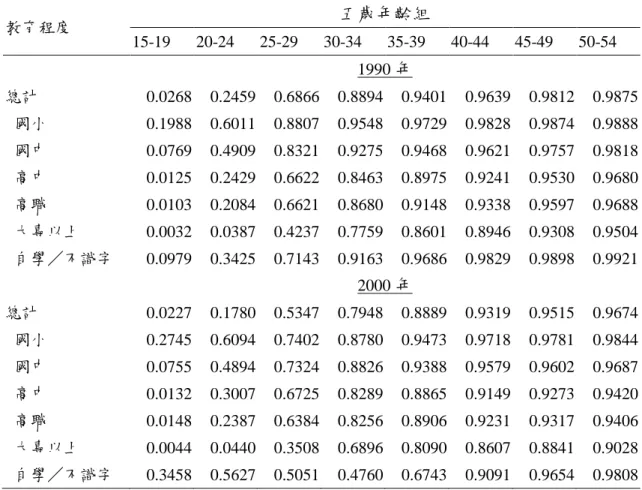
資料來源:根據教育部網站(http://www.moe.edu.tw)公布之教育統計資料繪製。表 2 比較 1990 與 2000 年時女性的已婚比例,仔細檢視其中數據,更是再次肯定
教育對於結婚的作用——不論任何年齡組(或是對應的出生年輪),隨著教育程度提
高,其已婚比例就明顯下降,而且,愈是晚近的年輪,此種教育擴展影響結婚的效應
就更加強烈。
教育對於結婚年齡與結婚可能性的影響作用,已經是毋庸置疑,因此,本研究試
圖瞭解,教育程度提高之下,臺灣地區的女性人口,其初婚年齡模式如何變化,藉此
推計未來的結婚盛行率發展趨勢。
1950 1955 1960 1965 1970 1975 1980 1985 1990 1995 2000 2005 0 100000 200000 300000 400000 500000 600000 700000 高中男 高中女 高職男 高職女 大專男 大專女 高中男 高中女 高職男 高職女 大專男 大專女表 2:1990 年及 2000 年女性人口已婚比例人口已婚比例按教育程度與年齡組分
教育程度五歲年齡組
15-19 20-24 25-29 30-34 35-39 40-44 45-49 50-54 1990年
總計 0.0268 0.2459 0.6866 0.8894 0.9401 0.9639 0.9812 0.9875 國小 0.1988 0.6011 0.8807 0.9548 0.9729 0.9828 0.9874 0.9888 國中 0.0769 0.4909 0.8321 0.9275 0.9468 0.9621 0.9757 0.9818 高中 0.0125 0.2429 0.6622 0.8463 0.8975 0.9241 0.9530 0.9680 高職 0.0103 0.2084 0.6621 0.8680 0.9148 0.9338 0.9597 0.9688 大專以上 0.0032 0.0387 0.4237 0.7759 0.8601 0.8946 0.9308 0.9504 自學/不識字 0.0979 0.3425 0.7143 0.9163 0.9686 0.9829 0.9898 0.9921 2000年
總計 0.0227 0.1780 0.5347 0.7948 0.8889 0.9319 0.9515 0.9674 國小 0.2745 0.6094 0.7402 0.8780 0.9473 0.9718 0.9781 0.9844 國中 0.0755 0.4894 0.7324 0.8826 0.9388 0.9579 0.9602 0.9687 高中 0.0132 0.3007 0.6725 0.8289 0.8865 0.9149 0.9273 0.9420 高職 0.0148 0.2387 0.6384 0.8256 0.8906 0.9231 0.9317 0.9406 大專以上 0.0044 0.0440 0.3508 0.6896 0.8090 0.8607 0.8841 0.9028 自學/不識字 0.3458 0.5627 0.5051 0.4760 0.6743 0.9091 0.9654 0.9808 資料來源:根據行政院主計處戶口普查原始資料檔計算。參、初婚年齡分佈模型
一九七0年前後,Ansley J. Coale 為了建立年齡別生育率(尤其是有偶生育率)模
型,同時發現,比較不同時期
不同社會(其比較的案例也包括二十世紀初的臺灣人
口)的女性年齡別初婚率分佈曲線,竟然存在高度相似、一致性(類似圖 3 的當代臺
灣經驗),因而提出以下的參數模型,並且相信可以適用於所有的人類社會(Coale,
1971, 1977; Coale and McNeil, 1972; Coale and Trussell, 1996)
:
exp exp x x g x
公式中的
為 gamma 函數(
1 0 x tx
t
e dt
)
,至於
、
和
則為模型的參數。藉
由此一模型,Coale and McNeil 指出,我們可以正確地描述各個人口的女性年齡別初婚
率(
g x )
。
圖 3:臺灣地區女性歷次普查之單一年齡別「已婚比例」分佈
資料來源:根據歷年戶口普查報告之婚姻狀況分佈數據計算。
Coale and McNeil 所提出的模型,後來曾經被引用於許多的分析(例如,Bennett,
Bloom, and Craig, 1989; Bloom and Bennett, 1990; Chowdhury, 1983; Goldstein and Kenney,
2001)
,證實與支持其價值。更重要者,Coale(1977)早已強調,其所提出之女性年
齡 別 初婚 率模型,其實 是種特 別 的機率分佈,係 由若干的指數分配( exponential
distribution)所迴旋捲積(convolution)而成,所以,這個結構正是反映人類結婚過程
所經歷的多重階段(譬如,覓偶、求偶、盟訂等)
,因此,該模型不僅只是一個數學模
型,也同時具有人口學與社會學意涵。
0.0 0.1 0.2 0.3 0.4 0.5 0.6 0.7 0.8 0.9 1.0 15 20 25 30 35 40 45 50Proportions Ever Married
1956
1966
2000 1990
Coale and McNeil 的模型,由於能夠極佳配適於實證的經驗資料,Rodriguez and
Trussell ( 1980 ) 乃 進 一 步 分 析 計 算 , 然 後 設 定 其 中 參 數
1.145
,
1.896
及
0.805
,得到以下公式:
1.2813 exp
1.145
.805
exp
1.896
.805
sg
z
z
z
這也是著名的標準初婚率時程(standard first marriage schedule),他們相信可以適用於
各個人類經驗。在這個公式中,
z代表標準化的初婚年齡,而且,由於該公式中未存
在任何參數,所以,只要得知任一人口的初婚年齡之帄均數與標準差(藉此標準化)
,
即能透過上述公式描述其年齡別初婚模式(曲線)
。
Kaneko(2003)更進一步指出,Coale and McNeil 的模型,乃是一種一般化的對
數 gamma 分佈(generalized log gamma distribution),因此,我們可以改用此種分佈而
描述初婚的年齡曲線。一般化的 gamma 分佈,特別是三參數的一般化 gamma 分佈,
在存活分析研究中其實相當普遍(參見,Kleinbaum and Klein, 2003; Lawless, 2003; Lee
and Wang, 2003)
,近來,在統計研究領域也不斷發展(例如,Cheng, 2004; Choi and
Srivastava, 2005; Lin and Balakrishnan, 2004)
,所以,更為便利於用以描述初婚的年齡
曲線。
根據 Kaneko 的推導,初婚的年齡分佈模型,其機率密度函數和累積密度函數分
別是:
2 2 1 2 2 exp exp x u x u g x b b b
2 21
,
exp
x
u
G x
I
b
公式中的
、 b 和
u為三個參數,
代表 gamma 函數, I 則是 lower incomplete gamma
function
0 1 1 , , k x t I x k x k t e du x
Kaneko 應用上述的一般化對數 gamma 分佈模型,深入分析日本的女性初婚年齡
分佈,結果發現,Rodriguez and Trussell 所提出的標準初婚率時程,無法適切描述和應
用於日本的女性人口初婚經驗,因此,他建議認為,不同的人口可能存在其獨特的標
準初婚時程,所以,經由廣泛分析之後,他也提出日本人口的標準初婚時程。
針對臺灣的經驗資料,陳信木(2007)結合 1980 年戶口普查資料與 1975-2005 年
之《台閩地區人口統計》當中的年齡別初婚人數分佈,估算臺灣女性人口的標準初婚
時程為:
1.16692 exp
1.39948
0.11468
exp
1.104051
0.11468
Tg
z
z
z
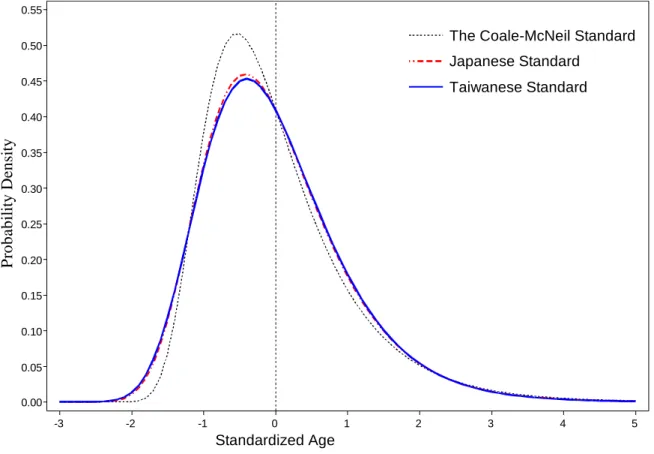
比較 Rodriguez and Trussell 所推導之 Coale-McNeil 標準時程、Kaneko 的日本標準
時程,和陳信木所建立的臺灣初婚時程,可以發現(參見圖 4),臺灣的女性人口初婚
經驗與日本極其類似吻合,但是,這兩者卻與 Coale-McNeil 原始標準時程差異頗大。
無論如何,透過上述的女性初婚年齡分佈之參數模型,可以作為描述與比較教育
對於初婚年齡影響作用的極佳工具,是以,本研究進一步藉此分析和比較臺灣晚近的
女性初婚年齡變遷。
圖 4:「標準年齡別初婚率模型」比較(Standard First Marriage Schedules)
0.00 0.05 0.10 0.15 0.20 0.25 0.30 0.35 0.40 0.45 0.50 0.55 -3 -2 -1 0 1 2 3 4 5 Standardized Age P ro b a b il it y D e n si ty
The Coale-McNeil Standard Japanese Standard
肆、資料與方法
分析女性初婚年齡模式,必須建立在完整的年齡別初婚率系列資料之上,而且,
若要比較教育程度差別的女性人口初婚經驗,則需要更為精細的教育程度別暨年齡別
初婚率資料。
《台閩地區人口統計》自 1975 年開始刊載年齡別初婚人數數據,可以用
來計算年齡別初婚率,但是,卻無從所悉有關教育程度的資訊。或許,另外一個可能
的資料來源就是 1980 年戶口普查,然而,該資料除了本身的限制(參見 Lin, Lee, and
Thornton, 1994)
,也未能涵蓋本研究最感興趣的時期。
少數的調查資料,曾經觸及初婚年齡(例如 KAP)或婚姻史,但是,樣本的選擇
偏誤(selection bias)、或是樣本規模有限,以及測量時間只有少數時間點,因此,也
無法提供本研究所需資料。其實,不論人口統計或調查資料,只能提供人口的年齡別
婚姻狀況分佈資訊,經常無法獲悉年齡別初婚率。因此,我們必須另闢途徑思考。
在 此 , 如 果 將 婚 姻 況 分 佈 還 原 思 考 , 將 會 發 現 , 婚 姻 狀 況 分 佈 乃 是 盛 行 率
(prevalence)的測量,而初婚率則是一種偶發率(incidence)測量,那麼,年齡別已
婚比例(proportion ever-married)正就是初婚的累積盛行結果,換言之,我們可以將
年齡別初婚率視為機率密度函數(pdf),而年齡別已婚比例就是累積密度函數(cdf),
雖然無法測量密度函數,卻是能夠獲悉密度函數,因而,初婚的年齡分佈參數模型可
以建立在累積密度函數之上。
基於此一策略改變,回頭檢視既有資料,我們採用行政院主計處長期進行的「人
力資源調查」
,累積 1978-2005 年各月資料,不論其規模或時間涵蓋幅度,皆可作為本
研究分析的最佳素材。接下來,我們簡略說明測量與參數模型估計。
以 1978-2005 年所有各月累積的「人力資源調查」資料作為基礎,首先,可以計
算年輪別、年齡別、暨教育程度別的已婚比例,此一比例即是年輪別暨教育程度別的
累積初婚率密度函數(
F x )。現在,引用一般化對數 gamma 分佈,初婚模型的
CDF 為:
2 21
,
exp
x
u
G x
I
b
根據 Coale and McNeil(1972)的論證,「經驗觀察的年齡別初婚率,必須經過最
終已婚比例」(就是一個年輪終其一生所完成初婚的比例)而調整,假設此一比例為
C ,則下列的參數模型就是我們試圖估計的標的:
; , ,
F x
C G x
b u
考量臺灣教育擴展的階段,以及「人力資源調查」所涵蓋的資料時間幅度,本研
究針對 1955-1975 年出生年輪,分別估計其教育程度別的初婚年齡分佈參數模型。由
於初婚主要發生在特別年齡階段,所有 1955-1975 年出生年輪雖然尚未經歷「完全
的」初婚歷程,仍可合理推計——就如同 Goldstein and Kenney(2001)分析美國資料
時發現,其誤差範圍大多小於 2%。
伍、教育程度別初婚年齡分佈
根據上文描述的參數模型估計策略,我們以 1978-2005 年「人力資源調查」資料
作為基礎,針對 1955-1975 年出生年輪的女性人口,估計其教育程度別的初婚年齡分
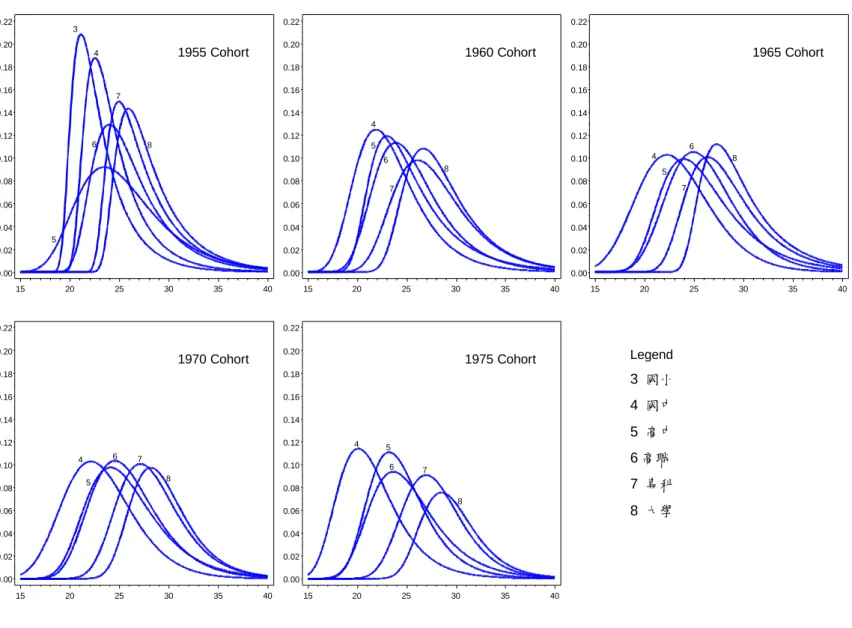
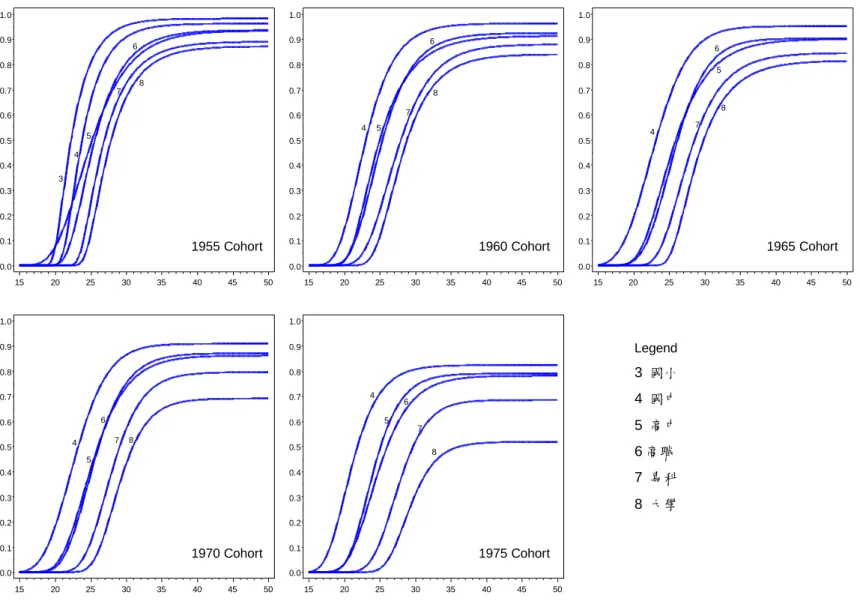
佈模式。參數估計結果,摘要其中部分年輪數據於表 3,並且,根據表 3 呈現其密度
函數(即年齡別初婚率)
、與累積密度函數(即年齡別已婚比例)於圖 5 和圖 6。
檢視表 3 數據可以發現,教育程度造成初婚年齡差異的效應與模式,從 1955 至
1975 出生年輪,皆是一致地、穩定地存在。例如,對於 1960 出生年輪來說,僅完成
義務教育(國中)者,帄均初婚年齡為 23.52 歲,若是完成更高教育,則隨著學歷提
昇延後結婚,若是完成大學教育者,帄均初婚年齡上升至 28.83 歲。總之,隨著教育
程度提高,初婚年齡一致地延後,而且,愈為晚近的年輪,其延後初婚的趨勢就更加
顯著。
表 3:臺灣地區女性 1955-1975 出生年輪年齡別初婚模式之參數估計值
出生年輪 教育程度 模型參數
b
uC
Mean STD 1955 小學 -1.7977 1.4938 21.1294 0.9810 22.9718 2.8261 國(初)中 -1.7301 1.6482 22.5445 0.9610 24.4766 3.0208 高中 -1.0251 3.7296 23.4873 0.9333 25.7071 4.8395 高職 -1.4000 2.4867 23.9930 0.9352 26.1975 3.8786 專科 -1.9510 1.8294 24.9633 0.8893 27.4781 3.7116 大學 -1.7751 1.9390 25.9167 0.8707 28.2684 3.6297 1960 國(初)中 -0.9898 2.8433 21.8988 0.9615 23.5194 3.6296 高中 -1.5435 2.5592 23.0097 0.9124 25.5890 4.2860 高職 -1.0680 2.9722 23.8946 0.9238 25.7566 3.9357 專科 -1.0142 3.2991 26.1128 0.8788 28.0507 4.2592 大學 -1.2763 2.7278 26.6843 0.8395 28.8283 3.9998 1965 國(初)中 -0.5586 3.6189 22.2616 0.9543 23.3243 3.9176 高中 -1.1975 3.2417 23.9619 0.9006 26.3092 4.5710 高職 -0.7224 3.2803 24.9407 0.9026 26.2261 3.7461 專科 -1.1951 2.9960 26.3912 0.8449 28.5551 4.2196 大學 -1.5966 2.4039 27.2993 0.8141 29.8327 4.1318 1970 國(初)中 -0.6022 3.4365 22.1234 0.9103 23.2199 3.7688 高中 -0.9730 3.2700 24.1219 0.8613 25.9469 4.1424 高職 -0.8353 3.1808 24.5632 0.8705 26.0399 3.7956 專科 -0.8198 2.9887 27.1362 0.7946 28.4932 3.5437 大學 -0.9165 2.6498 28.1821 0.6905 29.5569 3.2731 1975 國(初)中 -0.9334 2.6941 20.1117 0.8245 21.5409 3.3527 高中 -0.8912 2.6711 23.2334 0.7898 24.5732 3.2633 高職 -0.9646 3.0895 23.6518 0.7810 25.3578 3.8988 專科 -0.7066 2.8921 26.9602 0.6846 28.0651 3.2841 大學 -0.8474 2.5841 28.5336 0.5179 29.7539 3.0989表 4 或圖 6 所呈現的訊息中,更為嚴峻的警訊,則是隨著教育程度提高,最終的
初婚盛行率就巨幅下降。舉例言之,1955 出生年輪中,僅小學教育者,終身的初婚盛
行率高達 98%,表示只有不到 2%的人將會終身不婚。這種差異,到了稍後年輪,變
成更加惡化——例如,1975 出生年輪的女性,若僅完成國中教育,推計其終身初婚盛
行率仍高達 82%,可是,若是接受大學及其以上教育者,屆時將有幾近半數終身不
婚。
圖 5:臺灣地區女性 1955-1975 出生年輪之年齡別初婚率分佈按教育程度分
3 4 5 6 7 8 4 5 6 7 8 4 5 6 7 8 4 5 6 7 8 4 5 6 7 8 0.00 0.02 0.04 0.06 0.08 0.10 0.12 0.14 0.16 0.18 0.20 0.22 15 20 25 30 35 40 0.00 0.02 0.04 0.06 0.08 0.10 0.12 0.14 0.16 0.18 0.20 0.22 15 20 25 30 35 40 0.00 0.02 0.04 0.06 0.08 0.10 0.12 0.14 0.16 0.18 0.20 0.22 15 20 25 30 35 40 0.00 0.02 0.04 0.06 0.08 0.10 0.12 0.14 0.16 0.18 0.20 0.22 15 20 25 30 35 40 0.00 0.02 0.04 0.06 0.08 0.10 0.12 0.14 0.16 0.18 0.20 0.22 15 20 25 30 35 401955 Cohort 1960 Cohort 1965 Cohort
1970 Cohort 1975 Cohort Legend
3 國小 4 國中 5 高中 6 高職 7 專科 8 大學
圖 6:臺灣地區女性 1955-1975 出生年輪之年齡別累積初婚率分佈按教育程度分
3 4 5 6 7 8 4 5 6 7 8 4 5 6 7 8 4 5 6 7 8 4 5 6 7 8 0.0 0.1 0.2 0.3 0.4 0.5 0.6 0.7 0.8 0.9 1.0 15 20 25 30 35 40 45 50 0.0 0.1 0.2 0.3 0.4 0.5 0.6 0.7 0.8 0.9 1.0 15 20 25 30 35 40 45 50 0.0 0.1 0.2 0.3 0.4 0.5 0.6 0.7 0.8 0.9 1.0 15 20 25 30 35 40 45 50 0.0 0.1 0.2 0.3 0.4 0.5 0.6 0.7 0.8 0.9 1.0 15 20 25 30 35 40 45 50 0.0 0.1 0.2 0.3 0.4 0.5 0.6 0.7 0.8 0.9 1.0 15 20 25 30 35 40 45 50 Legend 3 國小 4 國中 5 高中 6 高職 7 專科 8 大學1955 Cohort 1960 Cohort 1965 Cohort
表 4:臺灣地區女性 1955-1975 出生年輪年齡別已婚比例按教育程度分
出生年輪 教育程度
年齡
20
25
30
35
40
50
1955 小學
0.1408
0.8321
0.9577
0.9772
0.9802
0.9808
國(初)中
0.0051
0.6986
0.9154
0.9531
0.9596
0.9610
高中
0.0979
0.5178
0.7980
0.8949
0.9228
0.9326
高職
0.0056
0.4842
0.8206
0.9078
0.9287
0.9348
專科
0.0000
0.3120
0.7431
0.8533
0.8805
0.8888
大學
0.0000
0.1823
0.6930
0.8291
0.8609
0.8701
1960 國(初)中
0.1873
0.7278
0.9171
0.9539
0.9602
0.9615
高中
0.0340
0.5427
0.8055
0.8822
0.9039
0.9117
高職
0.0356
0.5066
0.8204
0.9017
0.9192
0.9236
專科
0.0032
0.2619
0.6729
0.8281
0.8672
0.8782
大學
0.0000
0.1557
0.6166
0.7846
0.8264
0.8388
1965 國(初)中
0.2304
0.7013
0.9082
0.9470
0.9518
0.9523
高中
0.0380
0.4568
0.7614
0.8614
0.8898
0.8998
高職
0.0291
0.4234
0.7900
0.8853
0.9003
0.9025
專科
0.0002
0.2016
0.6278
0.7886
0.8309
0.8441
大學
0.0000
0.0617
0.5424
0.7394
0.7938
0.8126
1970 國(初)中
0.2205
0.6851
0.8725
0.9050
0.9088
0.9092
高中
0.0421
0.4508
0.7510
0.8370
0.8562
0.8611
高職
0.0300
0.4344
0.7677
0.8528
0.8677
0.8705
專科
0.0002
0.1546
0.5992
0.7620
0.7901
0.7946
大學
0.0000
0.0467
0.4654
0.6545
0.6857
0.6904
1975 國(初)中
0.3543
0.7284
0.8101
0.8222
0.8239
0.8242
高中
0.0532
0.5298
0.7489
0.7845
0.7891
0.7898
高職
0.0495
0.4556
0.7045
0.7660
0.7782
0.7809
專科
0.0004
0.1509
0.5440
0.6669
0.6828
0.6845
大學
0.0000
0.0239
0.3381
0.4927
0.5151
0.5179
最後,表 4 數據中,另有一項值得探究的現象,就是,僅完成基本義務教育的女
性,不只其終身初婚盛行率較高,早婚現象極其明顯——例如,1975 出生年輪中,僅
具有國中學歷者,在 20 歲之前,竟高達 35%曾經結婚。這個現象,是否隱含社會問
題,可能必須佐以更多深入研究。
陸、結語
本研究援引 Coale and McNeil 的初婚年齡分佈模型,針對 1955-1975 出生年輪的
女性,比較教育對於初婚年齡分佈的效應。研究發現,就如同許多既有研究所指出,
隨著教育程度提高,初婚的帄均年齡延後。不過,本研究的分析結果,最為警訊者,
當教育程度提高之後,不僅初婚年齡延後,甚至,最終不婚的可能性巨幅上揚。
相較於 Goldstein and Kenney(2001)針對美國女性的模擬分析認為,美國女性接
受高等教育者,雖然結婚初始年齡延遲,終將迎頭趕上,甚至出現「cross-over」現
象,更勝一籌。所以,對於美國女性而言,教育在婚姻市場是個正向效應,完成高等
教育女性擁有優勢的地位。
顯然地,臺灣的女性人口相對於美國的女性人口,乃是身處兩個截然不同的生活
世界。這樣的差異,對於女性生命歷程、家庭生命週期發展,將會帶來全然迥異的後
果。
參考書目
內政部。歷年。《臺閩地區人口統計》。 李美玲。1994。「二十世紀以來臺灣人口婚姻狀況的變遷」,〈人口學刊〉,16:1-15。 陳信木。2007。「臺灣地區女性人口初婚年齡分佈模式:變遷與推計」。 楊靜利、李大正、陳寬政。2006。「臺灣傳統婚配空間的變化與婚姻行為之變遷」,〈人口學 刊〉,33:1-32。 臺灣省行政官署統計室(編印)。1946,《臺灣省五十一年來統計提要》。 蔡淑鈴。2004。「高等教育的擴展對教育機會分配的影響」,〈台灣社會學〉,7:47-88。 Bennett, Neil G., David E. Bloom, and Patricia H. Craig. 1989. "The Divergence of Black and WhiteMarriage Patterns." American Journal of Sociology 95(3):692-722.
Bernardi, Fabrizio and Wilma Smeenk. 1999. "Opportunity and Marriage. The Impact of Individual Resources and Marriage Market Structure on First Marriage Timing and Partner Choice in the Netherlands." European Sociological Review 15(4):Dec, 458-461.
Billari, Francesco C. and Dimiter Philipov. 2004. "Women's Education and Entry into a First Union. A Simultaneous-Hazard Comparative Analysis of Central and Eastern Europe." Vienna
Bloom, David E. and Neil G. Bennett. 1990. "Modeling American Marriage Patterns." Journal of the
American Statistical Association 85(412):1009-1017.
Blossfeld, Hans-Peter and Ursula Jaenichen. 1992. "Educational Expansion and Changes in Women's Entry into Marriage and Motherhood in the Federal Republic of Germany." Journal of
Marriage and the Family 54(2):302-315.
Booth, Alan and John N. Edwards. 1985. "Age at Marriage and Marriage Instability." Journal of
Marriage and the Family 47(1):67-75.
Cheng, R. C. H. 2004. "Threshold Estimation in the Log-Gamma Model." Journal of Statistical
Planning and Inference 119(2):241-262.
Cherlin, Andrew J. 2004. "The Deinstitutionalization of American Marriage." Journal of Marriage
and Family 66(4):848-861.
Choi, Junesang and H. M. Srivastava. 2005. "A Family of Log-Gamma Integrals and Associated Results." Journal of Mathematical Analysis and Applications 303(2):436-449.
Chowdhury, A. K. M. Alauddin. 1983. "Application of a Marriage Model in Rural Bangladesh."
Journal of Biosocial Science 15(3):281-287.
Coale, Ansley J. 1971. "Age Patterns of Marriage." Population Studies 25(2):193-214.
—. 1977. "The Development of New Models of Nuptiality and Fertility." Population (French Edition) 32e Année, La mesure des phénomènes démographiques: Hommage à Louis Henry:131-154. Coale, Ansley J. and Donald R. McNeil. 1972. "The Distribution by Age of the Frequency of First
Marriage in a Female Cohort." Journal of the American Statistical Association 67(340):743-749.
Coale, Ansley J. and James Trussell. 1996. "The Development and Use of Demographic Models."
Population Studies 50(3):469-484.
Cooney, Teresa M. and Dennis P. Hogan. 1991. "Marriage in an Institutionalized Life Course: First Marriage among American Men in the Twentieth Century." Journal of Marriage and the
Family 53(1):178-190.
Coppola, Lucia. 2004. "Education and Union Formation as Simultaneous Processes in Italy and Spain." European Journal of Population/Revue europeenne de demographie 20(3):219-250. Crafts, N. F. R. 1978. "Average Age at First Marriage for Women in Mid-Nineteenth-Century
England and Wales: A Cross-Section Study." Population Studies 32(1):21-25.
Dixon, Ruth B. 1971. "Explaining Cross-Cultural Variations in Age at Marriage and Proportions never Marrying." Population Studies 25(2):215-233.
—. 1978. "Late Marriage and Non-Marriage as Demographic Responses: Are They Similar?"
Population Studies 32(3):Nov, 449-466.
Goldscheider, Frances Kobrin and Linda J. Waite. 1986. "Sex Differences in the Entry into Marriage."
American Journal of Sociology 92(1):91-109.
Goldstein, Joshua R. and Catherine T. Kenney. 2001. "Marriage Delayed or Marriage Forgone? New Cohort Forecasts of First Marriage for U.S. Women." American Sociological Review
66(4):506-519.
Heaton, Tim B. and Renata Forste. 1998. "Education as Policy: The Impact of Education on Marriage, Contraception, and Fertility in Colombia, Peru, and Bolivia." Social Biology 45(3-4):194-213. Kaneko, Ryuichi. 2003. "Elaboration of the Coale-McNeil Nuptiality Model as The Generalized Log
Gamma Distribution: A New Identity and Empirical Enhancements." Demographic Research 9(10).
Kleinbaum, David G. and Mitchel Klein. 2003. Survival Analysis: A Self-Learning Text, Second Edition. New York: Springer Science+Business Media, Inc.
Kalmijn, Matthijs. 1998. "Intermarriage and Homogamy: Causes, Patterns, Trends." Annual Review of
Lawless, Jerald F. 2003. Statistical Models and Methods for Lifetime Data, 2nd Edition. New York: John Wiley & Sons,Inc.
Lee, Elisa T. and John Wenyu Wang. 2003. Statistical Methods for Survival Data Analysis, Third Edition. New York: John Wiley & Sons,Inc.
Lin, Chien-Tai, Sam J. S. Wu, and N. Balakrishnan. 2004. "Interval Estimation of Parameters of Log-Gamma Distribution Based on Progressively Censored Data." Communications in Statistics:
Theory and Methods 33(11):2595-2626.
Lin, Hui-Sheng, Mei-Lin Lee, and Arland Thornton. 1994. "Trends in the Timing and Prevalence of Marriage." Pp. 202-224 in Social Change and the Family in Taiwan, edited by H.-S. Lin and A. Thornton. Chicago: The University of Chicago Press.
Marini, Margaret Mooney. 1984. "Age and Sequencing Norms in the Transition to Adulthood." Social
Forces 63:229-44.
Mensch, Barbara S., Susheela Singh, and John B. Casterline. 2005. "Trends in the Timing of First Marriage among Men and Women in the Developing World." Policy Research Division Working Papers No. 202, Population Council.
Modell, John. 1980. "Normative Aspects of American Marriage Timing since World War II." Journal
of Family History 5(2):210-234.
Ono, Hiromi. 2003. "Women's Economic Standing, Marriage Timing, and Cross-National Contexts of Gender." Journal of Marriage and the Family 65(2):275-286.
Oppenheimer, Valerie Kincade. 1988. "A Theory of Marriage Timing." American Journal of
Sociology 94(3):563-591.
Pasternak, Burton. 1989. "Age at First Marriage in a Taiwanese Locality 1916-1945." Journal of
Family History 14(2):91-117.
Prentice, R. L. 1974. "A Log-Gamma Model and Its Maximum Likehood Estimation." Biometrika 61(3):539-544.
Raymo, James M. 2003. "Educational Attainment and the Transition to First Marriage among Japanese Women." Demography 40(1):83-103.
Raymo, James M. and Yu Xie. 2000. "Temporal and Regional Variation in the Strength of Educational Homogamy." American Sociological Review 65(5):Oct, 773-781.
Retherford, Robert D., Naohiro Ogawa, and Rikiya Matsukura. 2001. "Late Marriage and Less Marriage in Japan." Population & Development Review 27(1):65-102.
Rodriguez, Germán and James Trussell. 1980. "Maximum Likelihood Estimation of the Parameters of Coale's Model Nuptiality Schedule from Survey Data." WFS Technical Bulletin, No. 7, International Statistical Institute, Voorburg, Netherlands.
Santow, Gigi and Michael Bracher. 1994. "Change and Continuity in the Formation of First Marital Unions in Australia." Population Studies 48(3):Nov, 475-496.
Schoen, Robert and Vladimir Canudas-Romo. 2005. "Timing Effects on First Marriage: Twentieth-Century Experience in England and Wales and the USA." Population Studies 59(2):135-146. Teachman, Jay D., Karen A. Polonko, and Geoffrey K. Leigh. 1987. "Marital Timing: Race and Sex
Comparisons." Social Forces 66(1):239-268.
Thornton, Arland, William G. Axinn, and Jay D. Teachman. 1995. "The Influence of School
Enrollment and Accumulation on Cohabitation and Marriage in Early Adulthood." American
Sociological Review 60(5):762-774.
Thornton, Arland, Hui-Sheng Lin, Jui-Shan Chang, and Li-Shou Yang. 1994. "Determinants of Historical Changes in Marital Timing." Pp. 225-244 in Social Change and the Family in
Taiwan, edited by H.-S. Lin and A. Thornton. Chiago: The University of Chicago Press.
Todd, Peter M., Francesco C. Billari, and Jorge Simao. 2005. "Aggregate Age-at-Marriage Patterns from Individual Mate-Search Heuristics." Demography 42(3):559-574.