2k-Grating-assisted self-pumped phase conjugation:
theoretical and experimental studies
Shiuan Huei Lin,* Ying Wu Lian,†and Pochi Yeh
Electrical and Computer Engineering Department, University of California, Santa Barbara, California 91306
Ken Y. Hsu
Institute of Electro-Optical Engineering, National Chiao Tung University, Hsinchu, Taiwan
Zhu Yong
Institute of Physics, Chinese Academy of Sciences, Beijing, China
Received November 1, 1995
We investigated 2k-grating-assisted self-pumped phase conjugation in photorefractive Ce:BaTiO3 crystals.
The phase-conjugation process involves a combination of four-wave mixing and stimulated photorefractive backscattering. An approximation involving separate interaction regions is used to theoretically calculate the reflectivity of phase conjugation as a function of the coupling strength of four-wave mixing and stimulated photorefractive backscattering. In our experiments, grating-erasure techniques are employed at the inter-action regions to investigate the dependence of phase-conjugate reflectivity on the coupling strength of four-wave mixing and stimulated photorefractive backscattering. The experimental results are in good agreement with the theoretical prediction.
Key words: Self-pumped phase conjugate, stimulated photorefractive backscattering, four wave mixing.
1996 Optical Society of America
1.
INTRODUCTION
In self-pumped phase conjugators the counterpropagating beams needed in a four-wave-mixing process are
gener-ated by the incident beam itself. By a process that is
not entirely understood, the self-generated pump beams are often formed in a configuration tending to optimize
the phase-conjugated beam. Self-pumped phase
conju-gators have been demonstrated in a variety of
configu-rations. Two classes of self-pumped phase conjugator
have been proposed and demonstrated: the passive
self-pumped phase conjugator, which needs externally
aligned mirrors,1 and the true self-pumped phase
con-jugator, which uses a single crystal without external
elements.2 The true self-pumped phase conjugator is of
potential interest because of its convenience for practical
applications.3 The first true self-pumped configuration
was observed in 1982 by Feinberg in a single BaTiO3
photorefractive crystal.4 There are three different
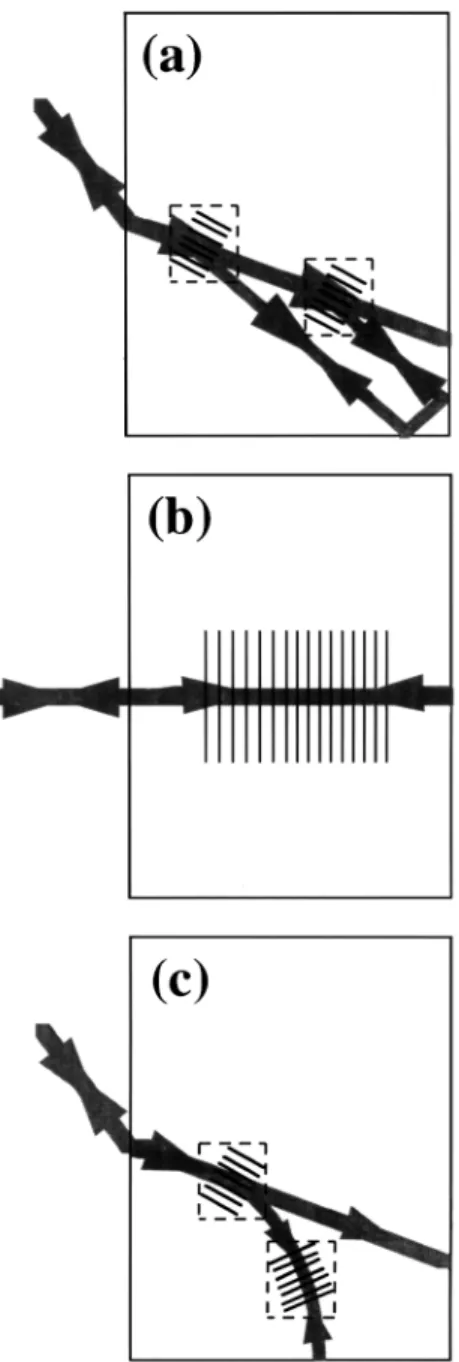
mod-els to explain the origin of self-pumped phase conjugators in a signal photorefractive crystal (as shown in Fig. 1). In 1983, based on the experimental observation of the
beam path in BaTiO3crystals, MacDonald and Feinberg5
proposed a model that involved both four-wave mixing and total internal reflection (FWM-TIR) [see Fig. 1(a)]. In the model the phase conjugation is a result of FWM in two regions that are connected by TIR’s from a
cor-ner of the crystal. Hence, a closed optical path loop is
often observed inside the crystal. In 1985, Chang and
Hellwarth6 were the first to point out the close analogy
between backward-stimulated Brillouin scattering and
some configurations of self-pumped phase conjugation
(SPPC) in BaTiO3 and suggested that stimulated
photo-refractive backscattering (SPB) or stimulated two-wave mixing may be responsible for the generation of the SPPC
[as shown in Fig. 1( b)]. It has been shown theoretically
that the backward-scattered wave is dominated by the phase conjugate of the incident beam.7,8 Recently we9,10
proposed an alternative model of FWM-SPB (four-wave mixing and SPB, in which the SPB is produced by the formation of 2k gratings) to explain the SPPC observed in
KTN:Fe and BaTiO3:Ce crystals [as shown in Fig. 1(c)].
In this case the SPPC formation relies on both four FWM
and SPB interactions. The phase-conjugate beam is
gen-erated by a four-wave-mixing process involving the inci-dent beam, the forward-propagating beam (the fanning beam), and its backward-stimulated scattering beam. The backward-stimulated scattering beam is generated
by the SPB process involving 2k gratings. Hence instead
of a closed loop inside the crystal, filaments representing counter propagating beams are often observed.
In a typical SPPC experimental configuration, an ex-traordinarily polarized input beam is incident on the a face of a regular-cut BaTiO3photorefractive crystal. The
SPPC formation mechanism is usually determined by the
fanning pattern and the boundary conditions.11
Gener-ally speaking, SPPC is often generated by the SPB or the FWM-SPB mechanisms in some doped crystals but
by the FWM-TIR mechanism in undoped crystals. This
is mainly due to a significantly stronger fanning and larger coupling coefficients for 2k gratings in doped
crys-tals. Changing the dopant concentration or the
Fig. 1. Different modes of SPPC: (a) FWM-TIR, ( b) SPB, and (c) FWM-SPB.
ing wavelength can cause a reconfiguration of the initial fanning pattern that leads to a change of the physical
mechanism and the reflectivity of SPPC. Recently, we
observed that the formation mechanism of SPPC was transformed from FWM-SPB to FWM-TIR when the wavelength of the input beam increased or the dopant
concentration decreased.12,13 We also observed that the
mechanism transformation during SPPC and an enhance-ment of phase-conjugate reflectivity could be obtained by the variation of the polarization state of the input beam.14
In a typical experiment an extraordinarily polarized
in-put beam produces SPPC by FWM-SPB in a Ce:BaTiO3
crystal. As the input polarization varies, the ordinary
component, which serves as an erasing beam, decreases
the effective coupling constant. This leads to a weaker
fanning pattern. Depending on the boundary conditions,
the fanned beam may reach the corner of the crystal cube,
leading to SPPC by FWM-TIR. In this paper we
theo-retically and experimentally study the role of the 2k grating of SPB and the coupling strength of FWM in the
FWM-SPB mode of self-pumped phase conjugators. A
two-interaction-region approximation is used to theoreti-cally calculate the reflectivity of phase conjugation and
the threshold. We then present the results of our
experi-mental studies, which validate the theoretical predictions. To vary the coupling constant, we also use an ordinarily incoherent erasing beam to reduce the index grating in
the FWM and the SPB regions. The theoretical and the
experimental results show that the reflectivity of phase conjugation depends strongly on the coupling strength of
both the FWM and the SPB regions. In addition, the
temporal dynamics of the phase-conjugate signal buildup process indicates that the 2k grating plays an important
role in the FWM-SPB model. The paper can be
orga-nized as follows. In Section 2 we discuss a theoretical
model of this new mode of SPPC. A closed-form solution
of coupled-wave equations is obtained by use of an
ap-proximation. In Section 3 we discuss the experimental
investigation using grating-erasure techniques at the two interaction regions to validate the theoretical predictions regarding the role of the 2k grating and the coupling strength of FWM during SPPC.
2.
THEORETICAL ANALYSIS
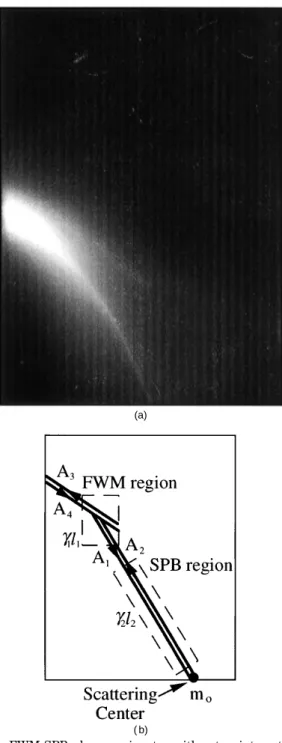
Figure 2(a) shows a photograph of a typical optical beam
path in the FWM-SPB mode of SPPC in Ce:BaTiO3
crys-tals. Based on our experimental observation, the model
of the FWM-SPB phase conjugator can be divided into two interactions regions, i.e., SPB and FWM interaction re-gions [as shown in Fig. 2( b)]. In the SPB interaction re-gion there are two counterpropagating beams coupled by
self-induced 2k gratings. The stimulated-backscattering
beam A2 is initially seeded by backscattering of fanned
light from imperfection (pits) at the surface of the
crys-tal. The backscattered light is amplified by SPB
interac-tion with fanning beam A1. These two beams provide the
counterpropagating pump beams needed in the FWM for
the generation of a phase-conjugate wave. Thus the SPB
interaction region mainly acts as a feedback mirror (the SPB mirror, defined as the combination of the 2k grating gain region plus the scattering center) that provides one of
the pump beams for the FWM interaction region. In the
FWM interaction region, incident beam A3, fanning beam
A1, and backscattering beam A2 are coupled by a FWM
interaction to generate a phase-conjugated beam A4. For
the phase-conjugation process to be sustained, the reflec-tivity of SPB region must be large enough to generate a self-oscillation between the SPB mirror and the FWM
in-teraction region. Thus this phase conjugator is similar
to a semilinear phase conjugator,15in which the mirror is
replaced by a SPB mirror. The threshold and the
reflec-tivity of a FWM-SPB phase conjugator are related to the net reflectivity of the SPB mirror.
We now treat this phase conjugator by using both op-tical FWM and contradirectional two-wave mixing in two separate regions. Referring to Fig. 2( b), we consider the interactions of all beams by using the following two sets
of coupled equations. We consider only the transmission
grating in the FWM region and the 2k grating in the
(a)
( b)
Fig. 2. FWM-SPB phase conjugator with a two-interaction re-gion: (a) photograph of the optical beam path in a Ce:BaTiO3
FWM-SPB phase conjugator; ( b) theoretical model in which the forward-going fanning beam A1overlaps well with its
backward-going scattering beam A2to form a SPB region. The amplified
backscattering beam A2enters the FWM regions, mixes with A1
and A4, and generates the phase conjugate A3.
equations are written as dA1 dz g1 2I0sA 1Ap41 Ap2A3dA42 g2 2I0 A1Ap2A2, dA2 dz g1 2I0sAp1 A41 A2Ap3dA32 g2 2I0 Ap1A2A1, dA3 dz g1 2I0sA 1Ap41 Ap2A3dA2, dA4 dz g1 2I0sAp1 A41 A2Ap3dA1, (1)
and for the SPB interaction region, the coupled equations are written as dA1 dz0 2 g2 2I00 A1Ap2A2, dA2 dz0 2 g2 2I00 Ap1A2A1, (2)
where g1 and g2 are the coupling constants of the
trans-mission grating in the FWM region and the 2k grating
in the SPB region, respectively. They are real and
posi-tive without the external electrical field in
diffusion-dominant crystals, such as BaTiO3, SBN, and KTN
crystals. I0 P
4
j1jAjj2 is the total intensity in the
FWM region, and I00sz0d
P2
j1Ijsz0d P2
j1jAjsz0dj2 is
the total intensity in the SPB region. The coordinate
axis of the FWM region is defined as z, and that of
the SPB region is defined as z0. These two regions are
connected at z0 0 or z l
1, where l1 is the
interac-tion length of the FWM region and l2 is the interaction
length of the SPB region. In a typical FWM-SPB mode
of self-pumped phase conjugation [as shown in Fig. 2(a)]
the interaction length of the FWM region sl1d is much
smaller than that of the SPB region sl2d, but the g1 is
much larger than g2(in our case, l2ø 6l1 and g1ø 5g2).
Hence these two sets of equations can be analytically solved by neglecting the 2k grating in the FWM region. In what follows, we first obtain the reflection
gener-ated by the SPB interaction by solving Eqs. (2). We
then solve the coupled-mode equations in the FWM
re-gion by neglecting the 2k-grating terms of Eq. (1). The
phase-conjugate threshold and reflectivity of the FWM-SPB phase conjugator are obtained in terms of the cou-pling strength sg2l2d of SPB and that sg1l1d of FWM
interaction.
A. Stimulated Photorefractive Backscattering Interaction Region
To examine the reflectivity of the SPB mirror, we first solve the coupled equations [Eqs. (2)] by follow-ing the procedure of contrapropagatfollow-ing two-wave mix-ing in Ref. 16 and by usmix-ing the boundary condition I2sl2dyI1sl2d m0 at the surface of crystal (at z0 l2),
where m0is the backscattering coefficient of the
imperfec-tion on the surface of crystal. The solutions of Eqs. (2)
are I1sz0d jA1sz0dj2 2C 1 p C21 B exps2g 2z0d , I2sz0d jA2sz0dj2 C 1 p C21 B exps2g 2z0d , (3a)
where B and C are integration constants given by
B I1sl2dI2sl2dexps2g2l2d, C
I2sl2d 2 I1sl2d
2 . (3b)
The effective intensity reflectivity of the SPB mirror, R, at z0 0 (or z l
Fig. 3. Reflectivity of the SPB mirror as a function of g2l2with various m0. R É A2s0d A1s0d É2 s1 2 m0d21 2m0expsg2l2d 2 s1 2 m0d p s1 2 m0d21 4m0 expsg2l2d 2m0expsg2l2d . s4d
When m0,, 1, the reflectivity R can be written
approxi-mately as R 1 1 2m0expsg2l2d 2 p 1 1 4m0expsg2l2d 2m0expsg2l2d . (5)
We note that R depends strongly on the product of m0
and exponential factor expsg2l2d. According to Eq. (5),
the presence of an efficient 2k gratingsg2l2.. 1d is
suf-ficient to achieve a high reflectivity even through the ini-tial seeding m0 from crystal-surface imperfection is very
weak. The reflectivity of the SPB mirror reaches 100%
when g2l2approaches infinity. By use of Eq. (4), Fig. 3
plots the reflectivity of the SPB mirror as a function of g2l2for various m0. It can be seen that for a given small
g2l2, the reflectivity R of the SPB mirror is very different
for different m0. When g2l2increases, the difference is
diminished and R reaches almost 100% when g2l2. 5,
while m0varies from 1025to 1021. This means that the
amplification of a 2k grating provides an efficient mecha-nism to retroreflect the fanning beam into the FWM re-gion to facilitate the phase-conjugation process.
B. Four-Wave-Mixing Interaction Region
With the reflectivity of the SPB mirror available we can now solve the coupled equations (1) in the FWM region by
neglecting the 2k grating. Following a procedure similar
to the one used in Ref. 1, we obtain the following expres-sion for the phase-conjugate reflectivity:
hjA3sz 0dj 2 jA4sz 0dj2 √ 1 1 s 1 2 s !2 1 R , (6)
where R again is reflectivity of the SPB mirror, s is the net power flow in this region, given by
s 21 6
p
R2s21 Rs22 R
1 1 R , (7)
and s can be obtained from the following transcendental equation, which is related to the coupling strength g1l1of
the FWM region:
tanh g1l1
4 s s . (8)
Equations (7) and (8) provide some constraints on g1l1and
s. We note that nontrivial solutions of the
transcenden-tal equation exist only when g1l1. 4. Once s is solved, s
is determined by Eq. (7). Being a new power flow, s has
to be real. This requires s2. 1ys1 1 Rd. Thus if s or
g1l1 are too small, there would be no phase conjugation.
These constraints lead to a threshold coupling strength sg1l1dthand a threshold SPPC reflectivity hthof the
FWM-SPB phase conjugator, according to Eqs. (6) and (8), of sg1l1dth 2 p 1 1 R ln √ p 1 1 R 1 1 p 1 1 R 2 1 ! , (9) hth R s1 1 Rd2. (10)
We note that the phase-conjugate reflectivity is finite at threshold. Equation (9) shows thatsg1l1dth is a
decreas-ing function of R, reachdecreas-ing a minimum of 4.98 at R 1.
In order to further understand the concept, we plotsg1l1dth
as a function of g2l2 for various scattering-center
reflec-tivities m0 (shown in Fig. 4). The SPPC reflectivity at
threshold hthis also plotted as a function of g2l2for
vari-ous m0 (shown in Fig. 5). It can be seen that both m0
and g2l2 influence greatly the threshold of the
FWM-SPB phase conjugator. The threshold value ofsg1l1dth
de-creases with m0and g2l2. The minimum value of 4.98 is
almost the same as the threshold of the FWM-TIR phase conjugator (4.68 without loss, in which we should note that there is a factor of 2, according to our definition of
the coupling constant).17 It is also interesting to note
that the reflectivity of SPPC at the threshold hth is a
de-creasing function ofsg1l1dth. In general, the reflectivity
of scattering center m0 in the crystals is,1023. An
ef-fective method to obtain a large SPB-mirror reflectivity R is to increase the coupling strength of the 2k grating g2l2
Fig. 4. Threshold coupling strengthsg1l1dth of the FWM-SPB
phase conjugator versus the coupling strength of the 2k grating g2l2 for various m0.
Fig. 5. SPPC reflectivity at threshold versus g2l2 for
vari-ous m0.
(a)
( b)
Fig. 6. Phase-conjugate reflectivity versus coupling strength of the 2k grating g2l2: (a) at different coupling strengths of the
transmission grating g1l1and ( b) for various m0.
(as shown in Fig. 3). This can be achieved by properly
doping the crystals (e.g., Ce:BaTiO3).
For g1l1 . sg1l1dth the reflectivity of the FWM-SPB
phase conjugator h can be plotted as a function of g2l2for
the various g1l1and m0[as shown in Figs. 6(a) and 6( b)].
We note that the reflectivity h obviously increases with g2l2and behaves very differently for different g1l1. The
reflectivity approaches a saturation value for a given g1l1,
corresponding to a SPB-mirror reflectivity of R 100%
(at g2l2 `). Referring to Fig. 3, we recall that
SPB-mirror reflectivity R is an increasing function of g2l2,
reaching R 100% when g2l2 `. We also note that all
curves of different m0 will approach the same saturation
value when g2l2 `. These figures confirm that the
presence of a SPB 2k grating is essential to enhance
the phase-conjugate reflectivity during SPPC. In order
to increase the SPB-mirror reflectivity R, we can insert a retroreflecting screen into the path of the beam after the fanning beam leaves the crystal or use an artificial scattering center on the crystal face to increase m0. We
can also increase the coupling constant of 2k gratings by choosing an appropriate dopant and a proper wavelength. However, when the reflectivity of backscattering center
m0 is large enough, the phase-conjugate reflectivity is
insensitive to the coupling strength of a 2k grating. For
example, in the case of FWM-TIR, the corner cube is already providing a near 100% retroreflection regardless of the presence of 2k gratings. A small decrease of
phase-conjugate reflectivity of,20% was reported when the 2k
grating was erased by an erasure beam in Ref. 18.
4.
EXPERIMENT
In this section we report the results of our experiments to verify theoretical predictions based on the model of the
FWM-SPB phase conjugator. The schematic diagram
of the experimental arrangement is shown in Fig. 7.
Our Ce-doped BaTiO3 crystal has a red-orange color
and a dopant concentration of approximately 30 parts in 106. The crystal is poled and 0±cut with dimensions
6.15 mm 3 5.20 mm 3 8.2 mmsa 3 b 3 cd. An
extraor-dinarily polarized beam from an argon laser (wavelength of 514.5 nm) is incident upon the crystal on the a face
at an external angle of u 60±. The phase conjugation
was monitored by a calibrated photodiode (PD1). In
or-der to investigate the buildup process of 2k gratings, the fanning beam was also monitored by another photodiode (PD2), and the optical path in the crystal was observed by imaging through the top of the crystal into a CCD camera. Figure 2(a) shows a photograph of the optical beam path inside the crystal during a typical mode of FWM-SPB
SPPC. The input beam is depleted almost completely
after propagating through a short distance and bends to the bottom surface of the crystal owing to the fanning
effect. At steady state the end of the beam is
charac-terized by a filament that is sustained through the SPB
Fig. 7. Experimental setup used to demonstrate SPPC in the FWM-SPB mode: PBS’s, polarizing beam splitters; BS’s, beam splitters.
Fig. 8. Time evolution of the reflectivity of SPPC (solid curve) and intensity of the fanning beam (dashed curve).
process by 2k gratings. This SPPC formation is
signi-ficantly different from the traditional FWM-TIR
mecha-nism. There is no closed optical loop involving a corner
inside the crystal.
Figure 8 shows the time evolution of the phase-conjugate signal (the solid curve) and the fanning sig-nal (the dotted curve) during the buildup of the phase
conjugation. At the first stage (t of 0 – 110 s, where
t 0 corresponds to the time when the incident beam is
turned on), the fanning signal grows to a steady state, but the phase-conjugation signal only begins to start,
as indicated by the recording at PD1. It indicates that
at this moment, only the fanning beam is produced by the fanning grating in the FWM region, but the 2k
grat-ing has not been established in the SPB region. The
forward fanning beam cannot be retroreflected into the
FWM region to generate the phase conjugation. When
t . 110 s, the phase-conjugation signal appears suddenly, while the fanning signal decreases significantly. This
in-dicates the buildup of the 2k grating. After the fanning
beam is produced by the incident beam, a backscatter-ing can be generated by some defects on the surface of crystal, and the 2k grating can be written by the fanning
beam and the retroreflected scattering beam. Once the
2k grating is formed, energy will be transformed from
the fanning beam to the backscattering beam. With the
increase of the backscattering, the amplitude of 2k
grat-ing also increases. This leads to more energy transfer
from the fanning beam to the backscattering beam. The
positive feedback provides the stimulated photorefractive backscattering and leads to some filaments at steady
state. At the same time the backscattering beam will
generate the phase conjugation by the FWM region and rewrite a new in-phase version of the fanning grating with the phase-conjugate beam to enhance the coupling
in the FWM region. This explains the sharp rise of the
phase conjugation as indicated in Fig. 8.
To further study the characteristics of the 2k grating in our model, we use an ordinarily polarized beam (see Fig. 7) that is incoherent with the input beam to
illumi-nate the filaments uniformly in the SPB region. Since
the refractive-index change of a photorefractive crystal is proportional to the modulation depth of the input light, the coupling coefficient of the 2k grating, g2sIrd, can be
written to incorporate the reduction in the modulation
that results from the erasing beam, g2sIrd
g2o
1 1 IryI, (11)
where I is the total intensity in the filament, and g2o
is the coupling-coefficient constant in the absence of the
erasure beam Ir. According to the above equation, the
coupling strength of the photorefractive grating can be
easily controlled. Figure 9 shows the time evolution and
the reflectivity of the phase-conjugate signal as the
era-sure beam is turned on. The signal decreases to different
steady-state values depending on the intensity of erasure
beams Ir. Figure 9 also shows that the reflectivity of
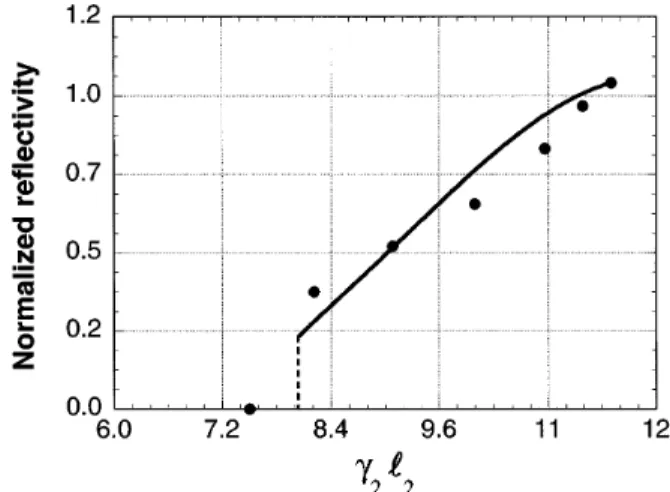
the phase-conjugation signal decreases with the intensity of the erasing beam and exhibits a sharp threshold at Ir 4 Wycm2. To further illustrate the concept, we re-plot the phase-conjugate reflectivity as a function of g2l2,
in which the intensity of the erasure beam can be calcu-lated in terms of the coupling strength by use of Eq. (10). We also present the theoretical results by the dashed line
in the figure for the purpose of comparison. The results
are shown in Fig. 10, in which we estimate an average of I as 4 Wycm2, a value of g
2ol2as 11.5, a value of g1l1
as 7.0, and a reflectivity of scattering center m0as 0.001.
Fig. 9. Time-evolution of the phase-conjugate signal when the different erasing beams are applied.
Fig. 10. Experimental phase-conjugate reflectivity versus g2l2.
Note the phase-conjugate threshold at g2l2ø 7.5
(correspond-ing to Ir 4 Wycm2). The solid curve is from a theoretical
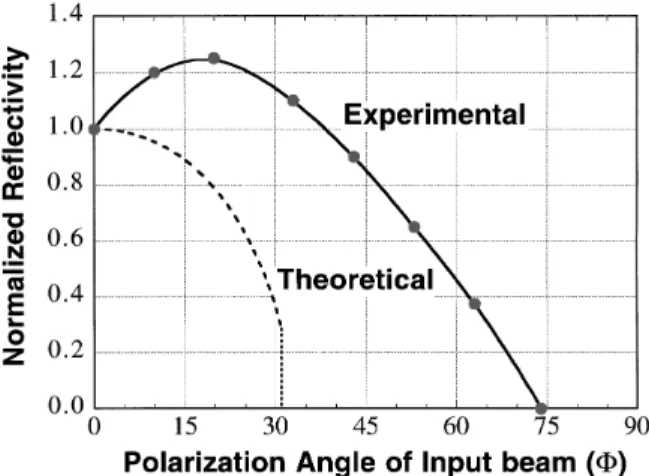
Fig. 11. Normalized phase-conjugation reflectivity as a function of the polarization angle, F, of the input beam. These experimental data are not corrected for Fresnel reflections. The dashed curve is from a theoretical calculation for a pure FWM-SPB mode of SPPC.
This curve is in agreement with the experimental results. Thus we note again that the presence of a 2k-grating significantly affects the reflectivity of the backscattering beam and the SPPC in this model.
In a different experiment, to study the characteristic of the FWM region in this model, we block the erasing beam and introduce a general linear polarized input beam by inserting a half-wave plate in the path of the input beam (as shown in Fig. 7). The plane of polarization of the in-put beam could now be changed by rotating the half-wave
plate. This leads to the presence of an ordinarily
polar-ized component of the input beam. It is known that the
coupling coefficient in Ce:BaTiO3crystal for an ordinarily
polarized beam is much less than that of an extraordinar-ily polarized beam, and the cross coupling is negligible. Thus the extraordinarily polarized beam will contribute significantly to the fanning and the phase conjugation, whereas the ordinarily polarized beam will serve only to erase the gratings in the interaction regions. In this case the effective coupling coefficient of the grating, g1sfd, can
be written as
g1sfd
g1o
1 1 tan2f, (12)
where g1o is the coupling coefficient at f 0±, where f
is the state of polarization of the input beam. It is
de-fined (as shown in Fig. 7) as f 0± for the
extraordi-narily polarized direction and f 90±for the ordinarily
polarized direction. The experimental (solid curve) and
the theoretical (dashed curve) results of the reflectivity of
phase conjugation are shown in Fig. 11. Here, we note
that the phase-conjugate output is always extraordinar-ily polarized regardless of the input polarization state. The reflectivity of phase conjugation is therefore defined as the ratio of the conjugated signal and the
extraordi-nary component of the incident beam. In other words,
the reflectivity is normalized to that of a totally extraor-dinarily polarized state of the input beamsf 0±d.
Ac-cording to the theoretical prediction, the reflectivity will decrease with the ordinarily component of input beam. On the contrary, the experimental results show an
im-provement over the theoretical prediction. The
reflectiv-ity of phase conjugation exceeds the value at f 0±in
the range f , 35±. The increase in phase-conjugate
re-flectivity can be caused by a mechanism transformation
during SPPC.14 In addition, the presence of an
ordinar-ily polarized component in the input beam can restrain
the self-generated fanning pattern. Thus the energy loss
caused by fanning can be limited.
5.
CONCLUSION
We have carried out a theoretical analysis of a FWM-SPB self-pumped phase conjugator by using
two-interaction-region approximation. The phase-conjugate wave is
generated by four-wave mixing with the assistance of
2k gratings by SPB. From our results, we find that
the coupling strength g2l2 of the 2k grating in the SPB
region and the feedback reflectivity m0of scattering
cen-ters play very important roles in the generation of the
phase-conjugate wave. We have also presented the
re-sults of a comprehensive experimental investigation of a FWM-SPB phase conjugator by using two different types
of erasing beam. We find that the phase conjugation of
the FWM-SPB model relies on both the FWM and the SPB interactions.
ACKNOWLEDGMENT
This work is supported, in part, by the U.S. Office of Naval Research and the Air Force Office of Scientific Re-search. Pochi Yeh is also a principal technical advisor at Rockwell International Science Center, Thousand Oaks, California.
*Permanent address, Institute of Electro-Optical
Engineering, National Chiao Tung University, Hsinchu, Taiwan.
†Current address, Lambda Research Optics, Inc., 17605
Fabrica, Suites A and B, Cerritos, California 90703.
REFERENCES
1. See, for example, P. Yeh, Introduction to Photorefractive Nonlinear Optics (Wiley, New York, 1993).
2. M. Cronin-Golomb, B. Fisher, J. O. White, and A. Yariv, “Theory and applications of four-wave mixing in photorefrac-tive media,” IEEE J. Quantum Electron. QE-20, 12 (1984). 3. See, for example, P. Gunter and J.-P. Huignard, eds., Photo-refractive Materials and Their Applications (Springer-Verlag, Berlin, 1988), Vols. I and II.
4. J. Feinberg, “Self-pumped, continuous-wave phase conjuga-tor using internal reflections,” Opt. Lett. 42, 919 (1983). 5. K. R. Macdonald and J. Feinberg, “Theory of a self-pumped
phase conjugator with two coupled interaction regions,” J. Opt. Soc. Am. 73, 548 (1983).
6. T. Y. Chang and R. W. Hellwarth, “Optical phase conjugation by backscattering in barium titanate,” Opt. Lett. 10, 408 (1985).
7. J. F. Lam, “Origin of phase conjugate waves in self-pumped photorefractive mirrors,” Appl. Phys. Lett. 46, 909 (1985). 8. G. C. Valley, “Evolution of phase-conjugate waves in
stimu-lated photorefractive backscattering,” J. Opt. Soc. Am. B 9, 1440 (1992).
9. Y. W. Lian, H. Gao, P. Ye, Q. Guan, and J. Wang, “Self-pumped phase conjugation with a new mechanism in KTa1-xNbxO3:Fe crystals,” Appl. Phys. Lett. 63, 1754 (1993).
10. Y. W. Lian, S. X. Dou, H. Gao, Y. Zhu, X. Wu, C. Yang, and P. Ye, “Mechanism transformation with wavelength of self-pumped phase conjugation in BaTiO3:Ce,” Opt. Lett. 19,
11. A. A. Zozulya, M. Saffman, and D. Z. Anderson, “Propaga-tion of light beams in photorefractive media: fanning, self-bending, and formation of self-pumped four-wave-mixing phase conjugation geometries,” Phys. Rev. Lett. 73, 818 (1994).
12. Y. W. Lian, S. X. Dou, J. Zhang, H. Gao, Y. Zhu, X. Wu, C. Yang, and P. Ye, “Variation of mechanism transition wavelength of self-pumped phase conjugation with Ce-content in BaTiO3:Ce crystals,” Opt. Commun. 110, 192
(1994).
13. Y. W. Lian, H. Gao, S. X. Dou, H. Wang, P. Ye, Q. Guan, and J. Wang, “Mechanism transition of self-pumped phase conjugation in KTa1-xNbxO3:Fe crystals,” Appl. Phys. B 59,
655 (1994).
14. Y. W. Lian, S. H. Lin, S. Campbell, K. Y. Hsu, P. Yeh, and
Y. Zhu, “Polarization-dependent mechanism transformation during self-pumped phase conjugation in BaTiO3:Ce,” Opt.
Lett. 20, 1683 (1995).
15. M. Cronin-Golomb, B. Fisher, J. O. White, and A. Yariv, “Passing (self-pumped) phase conjugate mirror: theoretical and experimental investigation,” Appl. Phys. Lett. 41, 689 (1982).
16. P. Yeh, “Two-wave mixing in nonlinear media,” IEEE J. Quantum Electron. 25, 484 (1989).
17. Q. He, “Theory and applications of four-wave mixing in photorefractive media,” IEEE J. Quantum Electron. QE-24, 2507 (1988).
18. G. L. Wood, E. J. Sharp, and G. J. Salamo, “Performance of photorefractive self-pumped phase conjugators,” Proc. SPIE