Pricing and Fee Sharing for Point to Multipoint and Quality
Guaranteed Multicast Services*
Chian-Chi Liu, Shi-Chung Chang, Hsin-Ho Cheng
Control and Decisions Laboratory, Department of Electrical Engineering National Taiwan University, Taipei, Taiwan, R.O. C. 1061 7
Phone: 886-2-23635251-207; Fax: 886-2-2362765I emai1:scchang @cc.ee. ntu.edu. tw
Abstract
In this paper, the pricing of point to multipoint (PTMP) and qualify guaranteed multicast services is investigated. We propose a two-phase, usage-based charging scheme. In phase I , QoS requirements are converted into bandwidth reservation requirements based on the eflective bandwidth theory. Exploiting an empirical model of the relationship between unicast and multicast services, the charging scheme approximates a PTMP multicast session as an aggregated unicast. The incentive compatible unicast charging scheme of Kelly, 1997, is then extended to the multicast case. Phase 2 conducts fair fee allocation among individual multicast users. The fee sharing is proportional to individual members’ resource requirements should a unicast service be used. It not only has the fair and reasonable properties of “equal charge for the same service level,” “a higher charge for a better service level,” and “a higher member- charge under a higher group cost,” but also is feasible for implementation under current technological
constraints.
1. Introduction
In the recent decade, Internet has gone through dramatic growths in its size, applications, number of users and technology advancements. Besides the best effort service, there have been growing user demands for service options with quality of service (QoS) [Tan961 differentiated and controlled. To provide QoS, various traffic control and network resource management mechanisms have been proposed for QoS provisioning. There are direct control mechanisms such as traffic shaping and policing, packet scheduling in a router and resource reservation protocols. However, QoS provisioning may not be achieved by direct controls only.
Given network services of multiple QoS grades, a user would naturally select the highest grade if the price to *This work was supported in part by the National Science Council of Republic of China under Grants NSC87-2213-EO02-
050 and NSC88-2213-E002-067.
pay is independent of the grade chosen. Such a user behavior cannot be prevented by direct controls. It would lead to inefficient use of network resources. Pricing the service
classes appropriately has been proposed as an indirect control mechanism to offer a monetary incentive for users to choose a QoS grade based on their true needs. Pricing and the direct controls together may then lead to both QoS provisioning and network efficiency [McB97].
Multicast service for applications such as video conferencing, and video- or audio-on-demand is an important class of services in the next generation Internet. Multicast service poses new and unique challenges to pricing. The prominent ones include the accounting infrastructure, how to reflect the group usage and how to charge individual receivers fairly. Shenker et al [SCE961 gave the problem definitions and pointed out some research directions.
Existing pricing schemes can roughly be classified into two types: flat rate pricing and usage-based pricing. In the former class, the tariff is based on the bandwidth of access line and is identical among users all the time. Except the few minimalists advocating for flat rate-based pricing [AnS97], many researchers proposed usage-based pricing schemes. Some are summarized as follows.
In [MaV94], the authors proposed a smart-market bidding scheme for congestion control and to improve network efficiency. The authors of [CES93] designed a priority pricing policy for multiple service disciplines in computer networks based on a Nash game formulation. Kelly [Ke194a] adopted the results of effective bandwidth (EBW) theory that maps QoS to network resource requirements and proposed a measurement-based pricing scheme that induces a user to use the network as declared. In [JcM98], the authors studied a multicast pricing problem. They correlated, through an empirical study result, the resource usage of a multicast group to that of an average single cast. They then developed a cost-based pricing scheme by using the single cast service tariff and
the simple idea of average cost-sharing among customers with homogeneous demands.
In this paper, we study the pricing of a point-to- multipoint (PTMP) multicast service with guaranteed QoS. The receivers in the multicast group may require different QoS grades. We design a usage based pricing scheme to provide incentive control to the group so that network resources are used as reserved and to allocate group cost fairly to individual members. We take an approach similar to the axiomatic approach of [HSE94, HES971. Technical feasibility and simplicity of implementation are two main design factors in addition to economic efficiency.
The remainder of this paper is organized as follows. Section 2 first describes the PTMP multicast service environment. The theory of EBW for QoS provisioning and Kelly’s EBW-based pricing scheme for a unicast service [Ke194a] are then introduced in Section 3. Section 4 presents our design of a two-phase pricing and fee allocation framework. An estimated resource-based pricing scheme is also designed, where the multicast group is aggregated into one entity with the sender as a representative. In Section 5, the group fee is allocated to individual members by extending the equal tree split (ETS) scheme to the case with heterogeneous QoS demands. Finally, Section 6 concludes the paper.
2. QoS Guaranteed PTMP multicast service
In this paper, the pricing of point-to-multipoint (PTMP) multicast service with QoS guarantee is studied. It covers a large portion of multicast applications and may serve as the basis for studying more complex multicast services. To begin a PTMP multicast service session, receivers and the service provider negotiate a traffic contract that contains both service quality description and tariff of the session. The service provider reserves network resources to guarantee the demanded QoS and charges receivers based on the measured usage.There are some functional requirements for facilitating QoS service provisioning.
1 . Flow specification: The flow specification (flowspec)
describes the characteristics of both the traffic streams sent by the source and the service requirements of the application.
2 . Routing: Transport routes of a multicast session are
determined before resource reservation.
3 . Resource Reservation: Certain resources, such as
bandwidth and/or buffers need to be reserved for guaranteeing QoS.
4. Call Admission Control (CAC): It controls the admitted service requests to be within resource capacity and realizes the policy of “No Pay, No Service.”
5 . Packet Scheduling: A network switch or a router
manages the sequence of packet delivery to guarantee the granted QoS to individual flows.
6. Traffic shaping/policing mechanism: It is to police the actual traffic on sustainable byte rate, maximum burst size, and peak rate.
7. Meters: Meters are located in or near the routers placed at the administrative boundary to collect performance statistics so that the service provider and consumer can reconcile their activities.
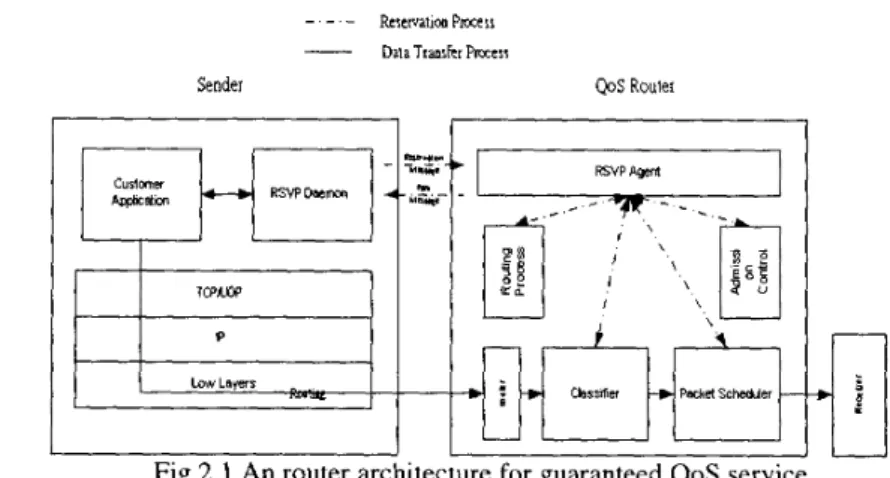
Figure 2.1 illustrates a functional diagram for guaranteed QoS Point-to-multipoint (G-QoS-PTMP) service provisioning between a host and an IP router. The host contains an RSVP [BrZ97] daemon responsible for resource reservation. The QoS router contains the required functional components mentioned above. The dash line in Figure 2.1 indicates the process of resource reservation.
Given a PTMP multicast tree T built by using the DVMRP multicast routing protocol, a two-phase algorithm of [FiT96] is adopted for performing call admission of the multicast service. Based on the even division policy, the allocation phase first maps the end-to-end QoS requirements into local per-€ink QoS requirements. Then, the allocation phase adopts the concept of effective bandwidth to relate the local QoS requirements to bandwidth reservation of each link and determines whether or not there are sufficient resources along the routing paths to individual destinations. If the multicast service can be admitted, the allocation phase performs an initial allocation of resources at the links of T , where the maximal amount of required resources over each link is reserved so that all local QoS requirements can be satisfied. The second phase optimizes the resource allocation by taking advantage of situations where the upstream links of a routing path may be allocated resources for a tighter QoS than needed because of other routing paths through the same links. In this case, the optimization phase may allocate the down stream links of the path less resources for a loser QoS than the original one from equal division of end-to-end QoS while still maintaining the end-to-end QoS of the routing path.
The two-phase algorithm is exemplified in Fig 2.2. Figure 2.2.a gives a one-to-two multicast tree. There are two members with end-to-end QoS requirements of loss probability Q1= 4 ~ 1 0 . ~ and Q 2 = 1 2 ~ l O - ~ respectively. Paths to the two members DI and D2 share a common portion (S, A). By approximation and equal division of the end-to- end QoS, the per link loss probability over the path to each member is depicted in Figure 2.2.b. Note that links of path (S,A) have two requirements I x I O - ~ and 3 ~ 1 0 ‘ ~ respectively. In 2.2.c, the allocation phase assigns the tighter one of the two QoS to a link of path (S,A). The QoS for (S,D2) is then approximately 8 (1=1+3=3) x < Q2. Then optimal phase finally relaxes the per link QoS to 5 ~ 1 0 ‘ ~ oevr the path (A,D2) as shown in Fig 2.2.d.
3. Effective Bandwidth-Based Unicast Tariffing
In this paper, the EBW theory in [Ke191, KWC91 Ke194b, CoK981 is adopted to serve the purpose of quantifying them and a peak rate h but actually delivers his traffic at a mean rate M. Point M obviously penalizes the overuse. It can be similarly argued that the user has no incentive to under use.
relationship between a QoS grade and its bandwidth requirements. Consider slow ordoff traffic flows sharing a transmission link with a given buffer space. All these flows have a mean rate m, a peak rate h and the probabilities of on and off be P(off)=l-m/h and P(on)=m/h respectively. Then the EBW required to guarantee a QoS for each traffic
Since an EBW upper bound can be derived when mean rate and peak rate are distinct, the tariff line is set to tangent the upper bound curvature. As a result, the tangent
line of EBW curvature at the user claimed operating point could be described
flow over the link is derived as: 4. Estimated Resource-based Charging
(3.1)
cr
1
h"1
In a video-on-demand like service, receivers should1
aOn lo# ( m . h ) = -log I
+
"(e~yrh - 'L '.
I. J
undoubtedly pay for the service fee; however, it is the sender that controls the traffic pattern and negotiates for the network service. In view of such roles between sender and receivers, we separate the charging problem into two subproblems: setting group tariff with an incentive control of senders' behavior and fair fee allocation among group members based on individual QoS requirements. A two- phase framework for charging is then proposed. Some assumptions are listed below.
Assumptions
A l . Only Intra-Domain PTMP where the space parameter s (measured in (kbps).')
corresponds to the degree of multiplexing among the traffic flows and depends on the size of the peak rate of the multiplexed sources relative to the link capacity, and the parameter t corresponds to the most probable duration of the buffer busy period prior to overflow [Sir991, Si199bl.
It 's proven by [KeW971 that the EBW Of an 'low Ordoff source model bounds the EBW of all the other traffic source models with equal mean rate m and peak rate h. In other words, reserving the EBW of a slow ordoff traffic flow promises a sufficient bandwidth to guarantee the required QoS for any traffic source with a mean rate m and a peak rate h.
i n the network of an ISP is concerned. There is no need to consider members with extra long routes.
A2. The network is homogeneous in buffer size, link Kelly [Ke197] proposed a EBW and measurement-
based tariff method abbreviated as EBCS (Effective Bandwidth Charging Scheme). It considers multiplexing gain and the impact of traffic pattern via exploiting parameter s and t. Peak rate can be policed at the entrance of the traffic. Under the scheme, a user claims the mean rate, peak rate, and a QoS level of transmission to the network in advance. Then the network provider determines the needed EBW. Note that under a fixed capacity C , buffer B, and peak rate h, the EBW in (3.1) is a monotonically non-decreasing function of the mean rate m, as depicted i n Figure 3.1. The tariff per unit time is then designed by making a tangent line at the point on the EBW curve where mean rate equals what the user claims as
f(m, h) = a(m, h)
+
b(m, h)m , where ,sth - 1 b(m, h) =st[h
+
m(esth - I ) ]a(m, h) = cr,,n/,,ff (m, h)
-
mb(m, h) (3.3)A total cost a T + bm'T = a T + bV will then be charged to a call lasting T units of time with a measured mean rate m', or equivalently, a total volume of transmission V=mT.
The incentive control of the scheme is that both over reservation and bandwidth overuse result in punishment in the pricing rate. The advantage of the scheme can be shown in Figure 3.1. In the Figure, if the user delivers the declared mean rate m, the charge point is P. Ef(m, h; M) is the charging point for a customer who declares a mean rate
-
capacity, and cost/ (BW*hop). So, the (s,t) values are fixed throughout the network under a QoS requirement.
A3. A multicast tree T is already constructed and the
routing node number of each QoS class is known. A4. Bandwidths have been reserved over links of tree T .
A5. The QoS metrics are packet transfer delay and the
probability of packet loss due to buffer overflow. Though detailed PTMP multicast tree information may possibly be collected under the framework of RSVP, the procedure may be too complicated and not practical. However the number of routing nodes in T is relatively
easy to get through monitoring individual router states, which are available to network managers, which leads to assumption A3 in this paper.
4.1. A 2-Phase Framework
The first phase of the charging scheme assigns all charges of the multicast session to the sender who is responsible for making traffic contracts with the network and controls the actual traffic load. The PTMP multicast group is considered as an aggregated user with the sender
as the representative of the group. In doing so, the
multicast problem is converted into a unicast paradigm. The aforementioned EBCS can then be extended to the multicast problem. It may then impose the same incentive control effect to the sender. In the first phase, after a multicast tree is settled, the sender negotiates a traffic contract with ISP, sends its traffic, and receives the total charge of the multicast session from ISP.
After the sender receives the total charge of the multicast session, the group charge is then fairly allocated to all its service receivers. This allocation mechanism is carried out in the second phase to achieve some fairness and reasonable properties. They include “equal charge for the same service level,” “a higher charge for a better service level,” “the same sharing pattern among members under the same group cost and service requirements,” and “a higher member-charge under a higher group cost” as described by [Hms92, HSE94, HES971.
4.2. Group charging scheme
Metering the resource usage per link and per call is time-consuming and technically not practical. Instead, we consider charging a group based on less accurate information but at a faster speed. We design an Estimated Resource Based Charging Scheme for a PTMP service with heterogeneous QoS requirements (ERBCRI). Let us state some more assumptions first:
A6. The usage cost of an edge in a multicast tree is proportional to the effective bandwidth it requires.
A7. A hop-based weight metric is adopted as the cost of a
path; the distance effect on edge cost is ignored.
A8. There are finite number of QoS grades; the higher the
QoS grade, the lower the cell loss probability. As users may require different end-to-end QoS levels, there are two issues for estimating the bandwidth required for each link that the multicast tree T traversed. One is how
to divide an end-to-end QoS into QoS for each link and the other is which QoS should be considered if there are more than one QoS requirements for each link. To address these two issues and to design the charging scheme, let us define some notations.
Notations:
L,: an empirical average number of hops that a unicast packet travels from the source to a destination;
I: total number of QoS grades; i: the QoS class index, i=l,
...,
I;Qi: the end-to-end packet loss probability of end-to-end Q’,: the maximum per link loss probability corresponding Mi: estimated number of links with QoS grade greater than Mi’: estimated number of links with a QoS grade i; Ni: number of routing nodes with a QoS grade greater than Ri: number of customers requesting a QoS grade greater or
QoS class i with Qi > Qj if i < j;
to a grade-i end-to-end QoS requirement; or equal to I;
or equal to I; equal to I;
Estimation of per link bandwidth requirement
The
per link QoS requirement is first estimated by equal division of the end-to-end QoS requirement over the average unicast routing length, i.e.,log( 1 -Q’i) = log( 1 -Qi) I L,. (4.1) Note that L, is a network-specific constant determined by topological factors such as the number of nodes and links in the network, average node degree, and network diameter. Note that the estimated local QoS requirements of a PTMP tree are uniform. This estimation is reasonable under assumption A1 where there is no member with an extraordinarily long route. When there are more than one QoS requirements over a link, the most stringent one, i.e., the one with the largest value of index i, say i*, is taken as the QoS in effective bandwidth calculation for the link.
Given a mean rate m, a peak rate h, and a packet loss probability Qti, the effective bandwidth af (m,h) required over each link with end-to-end QoS class greater than i can then be calculated by using Eq. (3.1) as
n/(m,h) = - - l o g [ l + ~ ( e S 1 i h f 1 -I)]. (4.2) S i 4 h
where a,!(m,h) means local EBW bound for it,, service class with mean rate m and peak rate h, characteristic parameters si and ti. The required QoS (Q’i } is guaranteed if a / ( m , h ) is reserved over the link.
Estimation of link numbers per QoS grade
Suppose that members of the multicast group are randomly distributed throughout the intra-domain network. For a multicast tree of N receiving routers, the normalized multicast tree length, L,, is approximately L, /L, = Nk [JcM98], which is a dimensionless parameter after normalization by L,. The constant k is called a economy of scale (EOS) factor and reflects the gain of the group by using a multicast instead of a unicast service. The study of [JcM98] shows that the empirical value of k falls within a narrow range around 0.8 under reasonable network conditions. Based on such an empirical estimation, we can estimate the number of links with QoS grade greater than or equal to i by
It is obvious that Mi < Mj if i < j by definition. The number of links with QoS grade exactly equal to i can then be estimated by
M i = L , N i k . (4.3)
M . ’ = M . - M . I , + 1 . i < 1,and M i ’ = M i i = 1. (4.4)
Setting group tariff
The estimated total bandwidth requirement of the PTMP multicast tree is therefore
I
B(m,h) = xMJa;(m,h)
j= I
(4.5) Note that B(m,h) stays concave since a f ( m , h ) is concave for each link. Treating B(m,h) as the demand of an aggregated unicast service with a mean rate m and a peak rate h, we can apply the EBSC scheme described in Section 3 for incentive control of the PTMP multicast
a(m,h)=B(m,h)- b(m,h)m. (4.7) Such a tariff is presented to the group and the total group charge can be calculated based on the measured transmission time T and mean rate m’ (or equivalently, volume V=m’T) at the sender as
total charge = aT
+
bm’T = aT+
bV. (4.8)5.Fee Allocation among Members
How should the group charge be fairly allocated to individual members? To be consistent with the group pricing scheme, the allocation must not assume knowing the detailed topology of a multicast tree. As each routing path of the multicast tree is regarded to have the same number of hops, it is natural that members of the same QoS grade receive the same amount of charge. Users sharing a resource should also share the cost of that resource.
Based on these intuitive reasoning, our fee allocation design adopts both concepts of “equal tree split” (ETS) and “average cost pricing” (ACP). The ETS scheme adopts the egalitarian approach that equally divides the total group charge among all receivers ([HSE94]). The ETS policy does not discriminate among receivers by their relative locations to the source. It thus does not attempt to hold receivers accountable for the costs their individual memberships incur. In ACP, The cost sharing to individual customers is proportional to their demanded quantities. When the members of a multicast tree request for service of the same QoS grade, the group charge can simply be divided equally and allocated to individual members.
In the case of heterogeneous QoS service, different amounts of bandwidth are needed among members. Consider an PTMP multicast example where a link has three members’ service routes going through it. Two of the members request for service grade I with the local EBW requirement being IMbps while one member requests for grade 2 service with a EBW of 2 Mbps. The reserved bandwidth should therefore be 2 Mbps. It is intuitively reasonable that although the reserved EBW of a link is for the maximum QoS requirement among routing paths going through the link, a member requesting for a lower QoS grade should not pay for the portion of bandwidth needed only for supporting a higher QoS grade. Namely, in the example, all the three members should equally share the cost of lMbs but only one should pay for the second 1Mbps. We now extend ETS, which is called enhanced ETS(EETS), to the case of heterogeneous QoS demands.
In a multicast group, there are Ri members requesting the multicast service of a grade i or higher, and there are
Mi links with their bandwidths reserved for supporting service grade i or higher according to our previous definitions. Define the incremental bandwidth
Bi (m, h) = Mi [a: (m, h) - ai-] 1 (m, h)], i = 2 ,...,I, and BI (m, h) = M I a!(m, h). (5.1) From Eqs. (5.1) and ( 4 3 , it can be easily derive that
I 1-1 Z B i (m,h) = C ( M i + l - Mi)ail(m,h)+ M p : (m,h) i = l i = l I , =
Z
Miaf(m,h) = B(m,h). i = l Define ai (m, h) = Bi (m, h) - bi (m,h)m,i = 1 ,...,I.Eq. (4.8) can then be expressed as
I
aT
+
bV = z ( a i T+
biV),(5.3)
(5.4)
i = l
where aiT
+
biV is the cost of the incremental bandwidth needed for grade i or higher, and (ai,bi) is the corresponding tariff. The share due to a member requesting a grade i or higher service isThe total fee charge to a member requesting a grade i service is then
CSi = ( a i T + b i V ) / R i , i = l ,..., I. ( 5 . 5 )
I
Feei = CCSi j= I
It can be easily shown [Liu99] that the total group charge is fully allocated to individual members and that the allocation method has the desirable properties of “Cost balance”, “equal treatment equals”, “equivalency”, “monotonocity”, and “ranking” as defined in the literature [HSE94]. .
6. Conclusions
This paper first introduced QoS, PTMP multicast service, and the required Internet functions. In an ISP intra-domain environment, the pricing problem was divided into two sub-problems of group charging and fee allocation among multicast members. Exploiting the concept of EBW, we proposed a two phase, resource usage-based charging and fee-sharing framework. In phase 1, QoS requirements are converted into bandwidth reservation requirements based on EBW. By exploiting an empirical model of the relationship between unicast and multicast services, a PTMP multicast session is approximated as an aggregated unicast. The incentive compatible unicast charging scheme of Kelly, 1997, is then extended to the multicast case. Group fee allocation among individual members is proportional to individual members’ resource requirements should a unicast service be used. It can be shown that the scheme has many properties of fairness.
I I I
Fig 2.1 An router architecture for guaranteed QoS service
Q I = 4 r 1 0 ( a ) E x a m p l e i e r v t c e ( h ) E q u a l Q o S d i v i s i o n I 1 3 (‘) A l l ~ r d l l ~ ~ d i i ~ n p h a s e ( d ) A l t e r r e ~ l a i m p h r i e
Fig 2.2 An example of allocation and reclaim phase
minimize tarifff(E(M). h ) Penalty for
overuse
Penalty for I -
m over
reserve m - Measured
mean rate mean rate
Figure 3.1 Effective bandwidth versus mean rate m under
fixed peak rate p, capacity C, and buffer B.
References
[AnS97] L. Anania, R. Solomon, “Flat - the Minimalist Price,” Intemet Economics, MIT Press, 1997, pp. 91-120.
[BrZ97] R. Braden, L. Zhang, “Resource Reservation Protocol” IETF RFC 2205.
[CES93] R. Cocchi, D. Estrin, S . Shenker, ”Pricing in computer networks; Motivation, formulation, and example”, IEEE /ACM Trans. Networking, vol. 1, pp. 614-627, Dec. 1993.
[CoK98] C.Courcoubetis, E P. Kelly, “Study of Simple Usage- Based Charging Schemes for Broadband Networks”, http://www.ics. forth.gr/-courcod.
[Fin61 Victor Firoiu, Don Towsley, “Call admission and Resource Reservation for multicast sessions” IEEE
INFOCOM ’96, pp. 94- 101.
(HSE941 S. Herzog, S. Shenker. D. Estrin, “Charing multicast costs” lntemet Economics, MIT press, pp. 169-212. [HSE97] S. Herzog, S. Shenker, D. Estrin, ”Sharing the ’Cost’ of
Multicast Trees: An Axiomatic Analysis,” IEEWACM Transactions on Networking, vol. 5 , no. 6, Dec. 1997, pp. [HmS92] H. Moulin, S. Shenker, “Serial Cost Sharing”,
Econometrica, vol. 60. No.5. pp. 1009-1037.
[JcM98] John Chung, A. Marvin, “Pricing Multicast Communications: A Cos:-Based Approach,” http://www.ini.cmu.edu/-sirbu/pubs/ 98354//chuang.html/. [Ke191] E P. Kelly, ” Effective Bandwidths at multi-class
queues,” Queuing Syst. vol. 9, pp. 5-15, Sept.1991.
[Ke194a] E P. Kelly, ‘‘ On tariffs, policing and admission control for multi-service networks,” Operation Research letter, ~01.15, 1994.
[Ke194b] E P. Kelly, “Notes on effective bandwidths,”
h m [ ’
[Ke197] F. P. Kelly, “Charging and accounting for bursty connections,”h%.
[KeW97] E P. Kelly, R. Weber, ” Measurement based charging in
comm. Networks,” h p
[KWC91] G Kesidis, J. Walrand, C. S. Chang “Equivalent capacity and its application to bandwidth allocation in high speed networks,” IEEE J . Select. Areas Commun., vol. 9, pp. 968-981, Sept.1991.
[Liu99]Chian-Chi Liu, “research on Pricing and Fee Sharing for point to Multipoint and Quality Guanranteed Multicast Serices,” hgp;//ac.ee.ntu.edu.tw/thesis/Brvan/thesis.doc. [MaV94] J. k. Makie-Mason and H. R. Varian , ” Pricing the
intemet,” Proc. 2”d Int. Conf Telecomm. Syst. Modelling, Mar.24-27. pp. 24-27 1994.
[McB97] L. W. McKnight, J. P. Bailey, eds. Internet
Economics, The MIT Press, Cambridge, 1997.
[SCE961 S. Shenker, D. Clark, D. Estrin, S. Herzog, “Pricing in Computer Netw0rks:Reshaping the Research Agenda,” ACM
Computer Communication Review, 1996, pp. 1943. [Sir99a] V. A. Siris, “Effective Bandwidth and (s. t) calculation
program,” http:/lwww.ics.forth.gr/netgroup/ msal.
[Sir99b] V . A. Siris, “Large Deviation Techniques for Traffic Engineering”, http://www.ics.forth.grheteroup/ ma/. (Tan961 Andrew S.Tanenbaum, “Quality of Service” Computer
Networks, third edition, pp. 460-463. 847-860.