N A N O E X P R E S S
Open Access
Illumination Effect on Bipolar Switching
Properties of Gd:SiO
2
RRAM Devices Using
Transparent Indium Tin Oxide Electrode
Kai-Huang Chen
1*, Kuan-Chang Chang
2, Ting-Chang Chang
3,4*, Tsung-Ming Tsai
2, Shu-Ping Liang
5, Tai-Fa Young
5,
Yong-En Syu
5and Simon M. Sze
4,6Abstract
To discuss the optoelectronic effect on resistive random access memory (RRAM) devices, the bipolar switching properties and electron-hole pair generation behavior in the transparent indium tin oxide (ITO) electrode of Gd:SiO2
thin films under the ultraviolet (λ = 400 nm) and red-light (λ = 770 nm) illumination for high resistance state (HRS)/ low resistance state (LRS) was observed and investigated. In dark environment, the Gd:SiO2RRAM devices exhibited
the ohmic conduction mechanism for LRS, exhibited the Schottky emission conduction and Poole-Frankel
conduction mechanism for HRS. For light illumination effect, the operation current of the Gd:SiO2RRAM devices for
HRS/LRS was slightly increased. Finally, the electron-hole pair transport mechanism, switching conduction diagram, and energy band of the RRAM devices will be clearly demonstrated and explained.
Keywords: Nonvolatile memory, Illumination effect, Gadolinium, Silicon oxide, RRAM Background
Magnetic random access memory (MRAM), ferroelectric random access memory (FeRAM), and phrase change memory (PCM) devices are indispensable to various nonvolatile electronic applications in portable electron devices [1–4]. Because of the excellent compatibility integrated circuit (IC) processes, long retention cycles, low operation voltage, and low electric consumption, the various resistive random access memory (RRAM) devices are investigated and discussed in recent memory device search [5–10]. Among these RRAM device applica-tions, the different metal element-doped silicon dioxide thin films prepared by various physical vapor disposition methods are widely considered and fabricated [1–10].
According to previous studies, the bipolar resistance switching and initial metallic filament forming properties of the various structure RRAM devices using indium tin oxide (ITO) electrode for the high resistance state (HRS) and low resistance state (LRS) are investigated for experimental
details [5–12]. Besides, the illumination effect induced the electron-hole pair generation in switching operation current of the RRAM devices for the transparent ITO elec-trode is not widely discussed.
In this study, the ITO/Gd:SiO2/TiN structure of the
RRAM devices was prepared by gadolinium-doped SiO2
layer between of titanium nitride (TiN) and ITO elec-trode. In addition, the bipolar switching resistive proper-ties of Gd:SiO2RRAM devices for HRS/LRS affected by
the ultraviolet (λ = 400 nm) and red-light (λ = 770 nm) illumination effect were also discussed later.
Methods
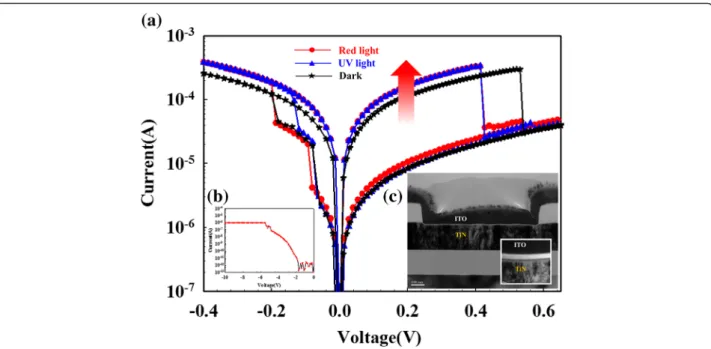
The metal-insulator-metal (MIM) structure samples were fabricated and investigated to the bipolar switching properties of RRAM devices by co-sputtering technology with pure silicon dioxide and gadolinium targets in Fig. 1(c). The Gd:SiO2 thin film was about 10 nm of
thickness. In addition, the sputtering power was the rf power of 200 W and dc power of 10 W for silicon diox-ide and gadolinium targets, respectively. To form ITO/ Gd:SiO2/TiN structure, the ITO top electrode with a
thickness of 200 nm was also deposited on Gd:SiO2thin
film by rf sputtering. The typical switching resistance
* Correspondence:[email protected];[email protected]
1
Department of Electrical Engineering and Computer Science, Tung Fang Design Institute, Kaohsiung, Taiwan
3
Department of Physics, National Sun Yat-Sen University, Kaohsiung, Taiwan Full list of author information is available at the end of the article
© 2016 Chen et al. Open Access This article is distributed under the terms of the Creative Commons Attribution 4.0 International License (http://creativecommons.org/licenses/by/4.0/), which permits unrestricted use, distribution, and reproduction in any medium, provided you give appropriate credit to the original author(s) and the source, provide a link to the Creative Commons license, and indicate if changes were made.
Chenet al. Nanoscale Research Letters (2016) 11:224 DOI 10.1186/s11671-016-1431-8
properties of Gd:SiO2 RRAM devices are obtained by
Agilent B1500 semiconductor parameter analyzer. To discuss the illumination effect on Gd:SiOx RRAM de-vices, the switching conduction diagram for electron-hole pair carrier transport properties is measured and described by the ultraviolet (λ = 400 nm) and red-light (λ = 770 nm) environment.
Results and Discussion
In Fig. 1(a), the typical I-V switching curves of the Gd:SiO2thin film RRAM device was exhibited the
bi-polar switching behavior properties. After the initial electrical forming process in Fig. 1(b), the LRS/HRS states of the Gd:SiO2 RRAM device was reached and
observed. To define reset process, the operation switching current of the devices was gradually de-creased from LRS to HRS by sweeping the positive bias over the reset voltage. To avoid the failure and broken situation of RRAM devices, the compliance current was limited to 1 μA. For inverted bipolar switching resistive behaviors, the transmission elec-tron in metallic filament path early captured by the lots of oxygen vacancy in ITO top electrode of Gd:SiO2 RRAM devices was proved and investigated
in Fig. 1(a) [12].
To investigate the optoelectronic effect on the ITO electrode of Gd:SiOxRRAM devices, the bipolar
switch-ing properties measured by ultraviolet-light (λ = 400 nm) and red-light (λ = 770 nm) illumination environment was shown in Figs. 2 and 3. In set state, all switching
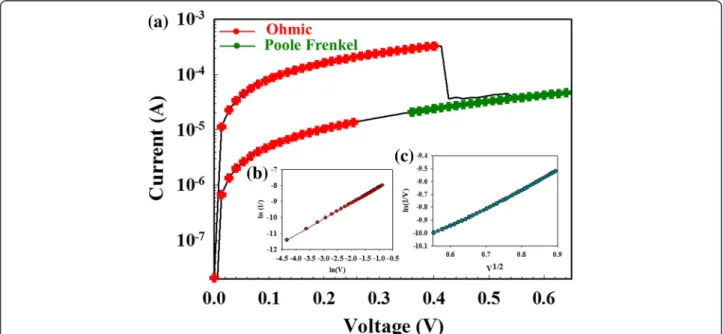
operation current of RRAM devices for LRS/HRS were slightly increased and induced by light illumination ef-fect. In dark environment, the I-V curves of the RRAM devices exhibited the ohmic conduction for low voltage and exhibited Schottky emission mechanism for high voltage in Fig. 2(a). In light environment, the operation current of RRAM devices for LRS/HRS was exhibited to ohmic conduction mechanism in Fig. 3(a). The Schottky emission mechanism for HRS was observed for high ap-plied voltage.
To describe the physical mechanism for optoelectronic effect on ITO electrode of the RRAM devices, the electron-hole pair carrier generated in conduction mech-anism and electron transport path diagram was ex-plained in Figs. 2 and 3. In Fig. 2(a), the RRAM device for HRS was transferred from the Schottky emission mechanism to Poole-Frankel mechanism in illumination effect environment [9–11]. In Fig. 2(b, c), the electrons of initial metallic filament path in the Gd:SiO2thin film
RRAM devices jumped from the defect activation en-ergy, induced the leakage current, and exhibited the Poole-Frankel mechanism in illumination environment.
In Fig. 3(a), the RRAM device for LRS was transferred from the Schottky emission mechanism to ohmic conduc-tion mechanism in illuminaconduc-tion environment. In Fig. 3(b), the RRAM devices exhibited the Schottky emission con-duction for high applied voltage. The barrier height of oval-shaped depletion region in ITO thin films was formed by the oxygen-rich atoms surrounding tip metallic fila-ment. In Fig. 3(c), the ohmic conduction mechanism was
Fig. 1 (a) The typical bipolar behavior of the Gd:SiO2thin film RRAM devices for (b) initial electrical forming process and (c) using the
caused by lots of intrinsic carrier generation of electron transport behavior in metallic filament of Gd:SiO2 thin
films.
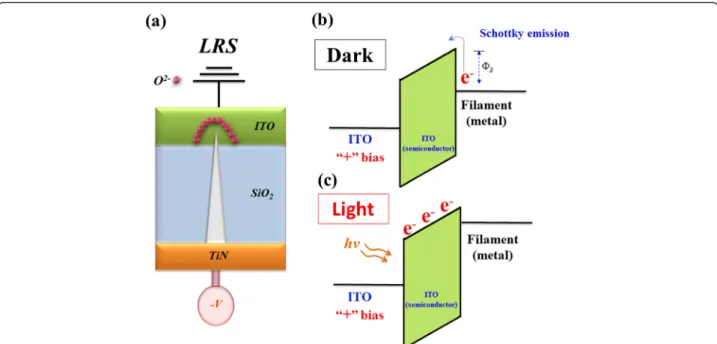
To further discuss and prove the above inference detail for optoelectronic effect, the energy band model of phys-ical conduction mechanism was drawled and described in Figs. 4 and 5. In Fig. 4a, the oval-shaped depletion re-gion formed by the oxygen ions in ITO electrode of the Gd:SiO2thin film RRAM devices for LRS was gradually
accumulated. Then, the metallic path tip was passed through the oval-shaped depletion region in ITO electrode for continuing applied high negative volt-age. Besides, the semiconducting ITO thin films ex-hibit the n-type semiconductor for energy band diagram. In Fig. 4b, the transmission electron in metallic filament path transferred and overcome the barrier height was exhibited the schottky conduc-tion mechanism for continuing applied voltage. In
Fig. 3 (a) TheI-V switching properties of Gd:SiOxRRAM devices in illumination environment for (b) ohmic conduction and (c) Poole-Frankel
emission mechanism
Fig. 2 (a) TheI-V switching properties of Gd:SiOxRRAM devices in dark environment for (b) ohmic conduction and (c) Schottky emission mechanism
illumination environment, the electron-hole pair of ITO electrode was generated in conduction/valance band and exhibited the ohmic conduction mechan-ism in Fig. 4c.
In HRS, the oxygen ions return the TiN electrode and recombined the metallic filament tip in Gd:SiO2 thin
films for high positive applied voltage in Fig. 5a. In Fig. 5b, the transmission electron of ITO electrode over-come the barrier height in Gd:SiO2thin film region which
was also found for the Schottky conduction mechanism.
For continuing positive applied voltage, the electron was departed from the trap and exhibited the Poole-Frankel conduction mechanism in Fig. 5c.
Conclusions
For the ultraviolet (λ = 400 nm) and red-light (λ = 770 nm) illumination environment, the bipolar switching properties and conduction mechanism of Gd:SiO2 RRAM devices
using transparent ITO electrode for HRS/LRS states were measured and investigated. Besides, the switching
Fig. 4 a Initial metallic filament model, b energy band model in dark, and c energy band model in light of the Gd:SiOxRRAM devices for LRS
operation current for LRS/HRS was slightly increased by ultraviolet and red-light illumination effect. For the Schottky emission mechanism transferred to the Poole-Frankel mechanism in illumination environment for HRS, the leakage current of RRAM devices was caused by electron jump from the defect activation energy. For illumination environment effect in LRS, the Schottky emission mechanism transferred to ohmic conduction of the RRAM devices induced by lots of electron-hole pair generation was proved.
Competing Interests
The authors declare that they have no competing interests.
Authors’ Contributions
K-HC and K-CC designed and performed the experimental work, explained the obtained results, and wrote the paper. T-CC and T-MT conceived the study and participated in its design and coordination. K-HC, S-pL, and T-FY helped in writing the paper and participated in the experimental work. All authors read and approved the final manuscript.
Acknowledgements
This work was performed at the National Science Council Core Facilities Laboratory for Nano-Science and Nano-Technology in the Kaohsiung-Pingtung area and was supported by the National Science Council of the Republic of China under Contract MOST. 104-2633-E-272-001 -MY2.
Author details
1Department of Electrical Engineering and Computer Science, Tung Fang
Design Institute, Kaohsiung, Taiwan.2Department of Materials and
Optoelectronic Science, National Sun Yat-Sen University, Kaohsiung, Taiwan.
3Department of Physics, National Sun Yat-Sen University, Kaohsiung, Taiwan. 4Advanced Optoelectronics Technology Center, National Cheng Kung
University, Tainan, Taiwan.5Department of Mechanical and
Electro-Mechanical Engineering, National Sun Yat-Sen University, Kaohsiung, Taiwan.6Department of Electronics Engineering and Institute of Electronics,
National Chiao Tung University, Hsinchu, Taiwan.
Received: 13 March 2016 Accepted: 13 April 2016
References
1. Yang PC, Chang TC, Chen SC, Lin YS, Huang HC, Gan DS (2011) Influence of bias-induced copper diffusion on the resistive switching characteristics of a SiON thin film. Electrochem Solid State Lett 14(2):H93–H95
2. Syu YE, Chang TC, Tsai TM, Hung YC, Chang KC, Tsai MJ, Kao MJ, Sze SM (2011) Redox reaction switching mechanism in RRAM device with Pt/ CoSiOX/TiN structure. IEEE Electron Device Lett 32(4):545–547 3. Yang CF, Chen KH, Chen YC, Chang TC (2007) Fabrication and study on
one-transistor-capacitor structure of nonvolatile random access memory TFT devices using ferroelectric gated oxide film. IEEE Trans Ultrason Ferroelectr Freq Control 54:1726–1730
4. Chen KH, Chang TC, Chang GC, Hsu YE, Chen YC, Xu HQ (2010) Low temperature improvement method on characteristics of Ba(Zr0.1Ti0.9)O-3 thin films deposited on indium tin oxide/glass substrates. Appl Phys A-Mater Sci Process 99(1):291–295
5. Chen KH, Liao CH, Tsai JH, Wu Sean (2013) Electrical conduction and bipolar switching properties in transparent vanadium oxide resistive random access memory (RRAM) devices. Appl Physics A 110(1):211–216
6. Chen KH, Chang KC, Chang TC, Tsai TM, Liao KH, Syu YE, Simon M. Sze (2016) Effect of different constant compliance current for hopping conduction distance properties of the Sn:SiOx thin film RRAM devices. 122:228. doi:10.1007/s00339-016-9768-5
7. Chang KC, Tsai TM, Chang TC, Syu YE, Chuang SL, Li CH, Gan DS, Sze SM (2012) The effect of silicon oxide based RRAM with tin doping. Electrochem Solid State Lett 15(3):H65–H68
8. Liu Q, Long SB, Wang W, Zuo QY, Zhang S, Chen JN, Liu M (2009) Improvement of resistive switching properties in ZrO2-based ReRAM with implanted Ti ions. IEEE Electron Device Lett 30(12):1335–1337
9. Wang Y, Liu Q, Long SB, Wang W, Wang Q, Zhang MH, Zhang S, Li YT, Zuo QY, Yang JH, Liu M (2010) Investigation of resistive switching in Cu-doped HfO2 thin film for multilevel non-volatile memory applications. Nanotechnology 21:045202
10. Li YT, Long SB, Zhang MH, Liu Q, Shao LB, Zhang S, Wang Y, Zuo QY, Liu S, Liu M (2010) Resistive switching properties of Au/ZrO2/Ag structure for low voltage nonvolatile memory applications. IEEE Electron Device Lett 31(2):117–119
11. Feng LW, Chang CY, Chang YF, Chen WR, Wang SY, Chiang PW, Chang TC (2010) A study of resistive switching effects on a thin FeOx transition layer produced at the oxide/iron interface of TiN/SiO2/Fe-contented electrode structures. Appl Phys Lett 96:052111
12. Feng LW, Chang CY, Chang YF, Chang TC, Wang SY, Chen SC, Lin CC, Chen SC, Chiang PW (2010) Improvement of resistance switching characteristics in a thin FeOx transition layer of TiN/SiO2/FeOx/FePt structure by rapid annealing. Appl Phys Lett 96:222108
Submit your manuscript to a
journal and benefi t from:
7 Convenient online submission 7 Rigorous peer review
7 Immediate publication on acceptance 7 Open access: articles freely available online 7 High visibility within the fi eld
7 Retaining the copyright to your article
Submit your next manuscript at 7 springeropen.com