Synthesis and Characterization of Poly(fluorene)-Based Copolymers
Containing Various 1,3,4-Oxadiazole Dendritic Pendants
Chung-Wen Wu, Chien-Min Tsai, and Hong-Cheu Lin*
Department of Materials Science and Engineering, National Chiao Tung UniVersity, Hsinchu, Taiwan (ROC)
ReceiVed April 3, 2006; ReVised Manuscript ReceiVed April 26, 2006
ABSTRACT: A series of poly(fluorene)s (PFs) containing different generations of poly(benzyl ether) dendritic wedges with oxadiazole (OXD) peripheral functional groups, including copolymers bearing carbazole (CAZ) pendent groups, were synthesized. The dendritic side-chain polymers possessed excellent solubility in common solvents and good thermal stability with decomposition temperatures of 5% weight loss at more than 370°C. Photophysical studies reveal that the photoluminescent (PL) properties of the dendronized polymers were greatly affected by the size of the dendritic side chains. The G1- and G2-substituted PF derivatives greatly suppress the aggregation PF backbones and thus to induce pure blue PL emission (with shorter wavelengths than PF). Excitation of the peripheral functional groups leads to substantial energy transfer from the dendrons to the poly(fluorene) backbones. In addition, the excitation of PF bearing G2 dendrons (G2-OXD) at 303 nm creates stronger fluorescence than that at 390 nm, indicating that the intensity of the sensitized emission (by OXD absorption at 303 nm) is even stronger than that of a direct poly(fluorene) emission (by PF backbone absorption at 390 nm). Double-layer light-emitting diode (LED) devices with the configuration of ITO/PEDOT/polymer/LiF/Al were fabricated and reported. The device with PF bearing G0 dendrons and CAZ pendants (G0-OXDCAZ) as an emitter shows a turn-on voltage of 4.5 V and a bright luminescence of 2446 cd/m2at 12 V with a power efficiency of 0.24 cd/A
at 100 mA/cm2.
Introduction
π-Conjugated materials with electronically rigid backbones have attracted considerable interest in both academic research and industrial applications due to increasing potential as active components for a wide range of electronic and optoelectronic devices.1In the past decade, fluorene-based conjugated polymers have emerged as a very outstanding class of blue-light emitting materials because of their high photoluminescence (PL) and electroluminescence (EL) quantum efficiencies, thermal stability, good solubility, high hole mobility, and facile functionalization at the C-9 position of fluorene.2However, devices are restricted by their tendency to form aggregates,3 excimers,4 or ketone defects5during either annealing or passage of current, leading to red-shifted and less efficient emissions. To avoid this detrimental behavior, a number of approaches have been used. One approach is to introduce end-capped poly(fluorene)s (PFs) with bulky groups,6,7 spirofluorene functionalized bifluorene moieties,8,9 networking poly(fluorene)s,10 and dendritic side groups into the C-9 position of poly(fluorene)s11 as well as minimization of isolated fluorenone defects.12
To obtain highly efficient light emitting devices, a balance in the injection and transportation of both holes and electrons into the polymer emissive layer is necessary.13-17However, most electroluminescent polymers inject and transport holes more efficiently than electrons, which result in an unbalance of opposite carrier currents. Polymers containing electron-with-drawing units in the main chains or side chains usually have large electron affinities. 2,5-Diphenyl-1,3,4-oxadiazole (OXD) derivatives are the most widely studied classes of electron-injection and/or hole-blocking materials18by virtue of many merits owned by 1,3,4-OXD moieties, such as prominent electron affinity, high photoluminescence, and good thermal
stability.19Certain poly(fluorene)s containing OXD units have been synthesized and reported recently.20-22
To reduce the formation of excimers and the aggregation of emitters, dendronized polymers are a promising approach to be used as multifunctional light-emitting materials. The dendrons not only protect the polymer rods from both aggregation and degradation but also tune unbalanced carrier-transporting prop-erties, where proper charge-transporting functionalities are incorporated to the periphery of the dendrons.23,24Furthermore, the peripheral donor units can transfer excitation energy to the polymer backbones and enhance fluorescent properties. Here, we report a family of dendronized poly(fluorene)s bearing OXD units on the outer surface of poly(aryl ether) dendritic wedges. To determine the minimal steric requirements for prevention of aggregation, we prepared polymers bearing OXD side chains with three generations of dendrons. We hope the dendronized polymers can take advantage of the bulky OXD pendants to avoid the tendency of spontaneous aggregation and crystalliza-tion normally encountered in poly(fluorene)s, so as to show specific light-antenna capacity and tunable charge-transporting characteristics. On the other hand, the previous research21 reported that the ionization potential of poly(fluorene) with pendant OXD units is 5.76 eV, which is similar to that of poly-(9,9-dioctylfluorene) (5.8 eV). This means that there is a significant energy barrier for hole injection, and it needs to be improved in order to further enhance the device performance. It is well-known that the carbazole (CAZ) unit reduces the hole-injection barrier in poly(fluorene) in this manner, to facilitate hole injection from ITO electrodes.25For this reason, we also introduce hole-transporting CAZ groups to the PF backbones as pendants for a comparative investigation. The absorption, PL emission, and EL spectra were also studied to gain insight into the interaction between peripheral units and poly(fluorene) backbones.
* Author for correspondence. Telephone: 8863-5712121 ext. 55305 Fax: 8863-5724727. E-mail: [email protected].
10.1021/ma060743q CCC: $33.50 © 2006 American Chemical Society Published on Web 05/26/2006
Experimental Section
Materials. 2,7-Bis(4,4,5,5-tetramethyl-1,3,2-dioxaborolan-2-yl)-9,9-dihexylfluorene26and
9,9-bis(4-carbazol-9-ylhexyl)-2,7-dibro-mofluorene (M4)25were synthesized according to literature
pro-cedures. Synthesis and characterization of compounds 1-3 (shown in Scheme 1) and their intermediates are described in the Supporting Information (as shown in Scheme 1 of the Supporting
Informa-tion).27Chemicals and solvents were reagent grades and purchased
from Aldrich, Acros, TCI, and Lancaster Chemical Co. Dichlo-romethane and THF were distilled to keep them anhydrous before use. The other chemicals were used without further purification. General Procedure for the Synthesis of Dendronized Mac-romonomers. A mixture of 2,7-dibromofluorene and triethylben-zylammonium chloride (TEBAC) in THFwas degassed three times; Scheme 1. Synthetic Routes of Macromonomers (M1-M3) and Polymers (P1-P6)
a 50 wt % aqueous KOH solution was added and stirred for 10 min under nitrogen. To this mixture, the solution of 1 (or 2 or 3) was added in degassed THF under nitrogen; the reaction mixture was stirred under nitrogen for 10 h, water was added, and the aqueous layer was extracted with CH2Cl2. The combined organic
phases were dried over MgSO4. After removal of the solvent, the
crude product was purified as outlined in the following text. M1. 2,7-Dibromofluorene (0.13 g, 0.39 mmol), TEBAC (3.0 mg, 0.01 mmol), THF (140mL), aqueous KOH solution (2 mL, 50 wt %), and compound 1 (0.33 g, 0.82 mmol) were used. Chromatog-raphy on silica gel eluted with CH2Cl2 afforded M1 as a white
solid (0.41 g, 62%).1H NMR (ppm, CDCl 3): 0.87-0.94 (m, 12H), 1.24-1.53 (m, 16H), 1.69-1.75 (m, 2H), 3.46 (s, 4H), 3.88 (d, J ) 5.7 Hz, 4H), 6.76 (d, J ) 8.7 Hz, 4H), 6.97 (d, J ) 9.0 Hz, 4H), 7.16 (d, J ) 8.1 Hz, 2H), 7.35 (dd, J ) 1.5, 8.4 Hz, 2H), 7.66-7.70 (overlap, 6H), 7.97 (d, J ) 9.0 Hz, 4H). MS (FAB): m/z [M+] 1049.3; calcd m/z [M+] 1048.94. Anal. Calcd for C59H60Br2N4O4:
C, 67.56; H, 5.77; N, 5.34. Found: C, 67.42; H, 5.69; N, 5.26. M2. 2,7-Dibromofluorene (0.13 g, 0.39 mmol), TEBAC (3.0 mg, 0.01 mmol), THF (140 mL), aqueous KOH solution (2 mL, 50 wt %), and compound 2 (0.76 g, 0.82 mmol) were used. Chromatog-raphy on silica gel eluted with EA/CH2Cl2(2:1) afforded M2 as a
white solid (0.51 g, 65%).1H NMR (ppm, CDCl 3): 0.91-0.97 (m, 24H), 1.34-1.53 (m, 32H), 1.72-1.78 (m, 4H), 3.19 (s, 4H), 3.92 (d, J ) 5.4 Hz, 8H), 4.82 (s, 8H), 5.91 (s, 4H), 6.29 (s, 2H), 7.02 (d, J ) 9.0 Hz, 8H), 7.26 (d, J ) 8.1 Hz, 2H), 7.41 (d, J ) 8.1 Hz, 2H), 7.48 (d, J ) 8.4 Hz, 8H), 7.58 (s, 2H), 8.05 (d, J ) 9.0 Hz, 8H), 8.11 (d, J ) 8.1 Hz, 8H). MS (MALDI-TOF): m/z [M+] 2018.78; calcd m/z [M+] 2018.11. Anal. Calcd for C119H124
-Br2N8O12: C, 70.82; H, 6.19; N, 5.55. Found: C, 70.88; H, 6.27;
N, 5.57.
M3. 2,7-Dibromofluorene (0.04 g, 0.1 mmol), TEBAC (0.6 mg), THF (90 mL), aqueous KOH solution (2 mL, 50 wt %), and compound 3 (0.46 g, 0.24 mmol) were used. Chromatography on silica gel eluted with THF/CH2Cl2(1:5) afforded M3 as a white
solid (0.22 g, 55%).1H NMR (ppm, CDCl 3): 0.89-0.96 (m, 48H), 1.29-1.56 (m, 64H), 1.68-1.76 (m, 8H), 3.08 (s, 4H), 3.89 (d, J ) 5.7 Hz, 16H), 4.70 (s, 8H), 5.03 (s, 16H), 5.87 (s, 4H), 6.32 (s, 2H), 6.48 (s, 4H), 6.60 (s, 8H), 6.99 (d, J ) 8.4 Hz, 16H), 7.22 (d, J ) 7.8 Hz, 2H), 7.32 (d, J ) 8.1 Hz, 2H), 7.43 (s, 2H), 7.51 (d, J ) 7.8 Hz, 16H), 8.01 (d, J ) 8.4 Hz, 16H), 8.07 (d, J ) 8.1 Hz, 16H). MS (MALDI-TOF): m/z [M+] 3957.87; calcd m/z [M+] 3956.46. Anal. Calcd for C239H252Br2N16O28: C, 72.55; H, 6.42;
N, 5.66. Found: C, 72.65; H, 6.41; N, 5.73.
General Procedure for the Synthesis of Dendronized Poly-mers P1)P6. The synthetic route of polyPoly-mers is shown in Scheme 1. A general procedure of polymerization is proceeded through the Suzuki coupling reaction. For polymers P1-P3, a mixture of 2,7- bis(4,4,5,5-tetramethyl-1,3,2-dioxaborolan-2-yl)-9,9-dihexyllfluo-rene (1 equiv), monomer M1 (or M2 or M3) (1 equiv), and freshly prepared Pd{P(p-tolyl)3}3(1.0 mol %) were added in a degassed
mixture of toluene ([monomer] ) 0.2 M) and aqueous 2 M potassium carbonate (3:2 in volume). The mixture was vigorously stirred at 80°C for 72 h. After the mixture was cooled to room temperature, it was poured into 200 mL of methanol. A fibrous solid was obtained by filtration. The solid was washed sequentially with methanol, water, and methanol. A similar procedure is carried out for the synthesis of P4-P6, and the feed ratio of 2,7-bis(4,4,5,5-tetramethyl-1,3,2-dioxaborolan-2-yl)-9,9-dioctylfluorene/M1 (or M2 or M3)/M4 is 2/1/1. The actual m/n ratio of the resulting polymers P4-P6 is about 1:1, which is calculated from proton NMR.
P1 (G0-OXD). Yield: 87%.1H NMR (ppm, CDCl
3):
0.79-0.95 (m, 22H), 1.16-1.49 (m, 28H), 1.72-1.74 (m, 2H), 2.16 (br, 4H), 3.67 (br, 4H), 3.89 (d, 4H), 6.99-7.02 (m, 8H), 7.61-7.81 (m, 16H), 8.03 (d, J ) 8.4 Hz, 4H). Anal. Calcd for C84H92N4O4:
C, 82.58; H, 7.59; N, 4.59. Found: C, 81.71; H, 7.56; N, 4.06. P2 (G1-OXD). Yield: 83%.1H NMR (ppm, CDCl 3): 0.64-0.94 (m, 34H), 1.32-1.49 (m, 44H), 1.70-1.72 (m, 4H), 2.09 (br, 4H), 3.40 (br, 4H), 3.86 (d, J ) 5.4 Hz, 8H), 4.77 (s, 8H), 6.12 (s, 4H), 6.36 (s, 2H), 6.96 (d, J ) 9.0 Hz, 8H), 7.32 (d, J ) 7.5 Hz, 8H), 7.64 (m, 12H), 7.99 (d, J ) 9.0 Hz, 16H). Anal. Calcd for
C144H156N8O12: C, 78.94; H, 7.18; N, 5.11. Found: C, 78.21; H, 7.23; N, 4.61. P3 (G2-OXD). Yield: 80%. 1H NMR (ppm, CDCl 3): 0.64-0.94 (m, 58H), 1.29-1.44 (m, 76H), 1.68 (m, 8H), 2.05 (br, 4H), 3.40 (br, 4H), 3.82 (d, 16H), 4.80 (m, 24H), 6.36-6.48 (m, 18H), 6.92 (d, J ) 8.1 Hz, 16H), 7.35 (d, J ) 8.7 Hz, 16H), 7.64 (m, 12H), 7.92 (d, J ) 9.0 Hz, 32H). Anal. Calcd for C264H284N16O28:
C, 76.79; H, 6.93; N, 5.43. Found: C, 75.73; H, 7.01; N, 4.74. P4 (G0-OXDCAZ). Yield: 80%. 1H NMR (ppm, CDCl 3): 0.77-1.11 (m, 36H), 1.30-1.59 (m, 48H), 1.71 (m, 6H), 2.08 (br, 12H), 3.63 (br, 4H), 3.88 (d, 4H), 4.16 (t, 4H), 6.99 (d, J ) 9.0 Hz, 8H), 7.18 (t, 4H), 7.27-7.38 (m, 8H), 7.64-7.81 (m, 28H), 8.00-8.06 (m, 8H). Anal. Calcd for C158H170N6O4: C, 85.59; H,
7.73; N, 3.79. Found: C, 83.78; H, 7.65; N, 3.41. P5 (G1-OXDCAZ). Yield: 77%. 1H NMR (ppm, CDCl 3): 0.64-0.95 (m, 48H), 1.01-1.45 (m, 64H), 1.66-1.70 (m, 8H), 2.05 (br, 12H), 3.40 (br, 4H), 3.86 (d, J ) 4.8 Hz, 8H), 4.15 (t, 4H), 4.78 (s, 8H), 6.12 (s, 4H), 6.35 (s, 2H), 6.96 (d, J ) 8.7 Hz, 8H), 7.13-7.38 (m, 20H), 7.65-7.80 (m, 24H), 8.01-8.04 (m, 20H). Anal. Calcd for C218H234N10O12: C, 82.18; H, 7.40; N, 4.40.
Found: C, 81.56; H, 7.26; N, 4.20. P6 (G2-OXDCAZ). Yield: 73%. 1H NMR (ppm, CDCl 3): 0.70-1.08 (m, 76H), 1.31-1.46 (m, 92H), 1.69-1.71 (m, 12H), 2.05 (br, 12H), 3.40 (br, 4H), 3.84 (d, J ) 5.4 Hz, 16H), 4.13 (t, 4H), 4.70-4.89 (m, 24H), 6.14 (s, 4H), 6.40-6.52 (m, 14H), 6.94 (d, J ) 7.2 Hz, 16H), 7.14-7.30 (m, 12H), 7.40 (d, J ) 8.7 Hz, 16H), 7.64 (m, 24H), 7.94-8.05 (m, 36H). Anal. Calcd for C338H362N18O28: C, 79.22; H, 7.12; N, 4.92. Found: C, 78.79; H,
7.14; N, 4.74.
Characterization.1H NMR spectra were recorded on a Varian
Unity 300 MHz spectrometer using CDCl3 solvent. Elemental
analyses were performed on a HERAEUS CHN-OS RAPID elemental analyzer. Transition temperatures were determined by differential scanning calorimetry (Perkin-Elmer Diamond) with a heating and cooling rate of 10°C/min. Thermogravimetric analysis (TGA) was conducted on a Du Pont Thermal Analyst 2100 system with a TGA 2950 thermogravimetric analyzer under nitrogen with a heating rate of 20°C/min. Gel permeation chromatography (GPC) analysis was conducted on a Water 1515 separation module using polystyrene as a standard and THF as an eluant. UV-visible absorption spectra were recorded in dilute chloroform solutions (10-6M) on a HP G1103A spectrophotometer, and fluorescence spectra were obtained on a Hitachi F-4500 spectrophotometer. PL excitation and emission slits in solutions were 5 and 2.5 nm, respectively. PL excitation and emission slits in solid films were both 5 nm. Electrochemistry measurements were performed using an Autolab PGSTAT30 potentiostat/galvanostat with a standard three-electrode electrochemical cell containing a 0.1 M tetrabuty-lammonium hexafluorophosphate solution in acetonitrile at room temperature under nitrogen at a scanning rate of 100 mV/s. A platinum working electrode, a platinum wire counter electrode, and an Ag/AgCl reference electrode were used. The onset potentials were determined from the intersection of two tangents drawn at the rising current and background current of the cyclic voltammo-gram. Polymer solid films were spin-coated on quartz substrates from THF solutions with a concentration of 10 mg/mL.
EL Device Fabrication. The devices were fabricated on ITO substrates that had been ultrasonicated and sequentially washed in detergent, methanol, 2-propanol, and acetone and further treated with O2plasma for 10 min before use. A thin layer of PEDOT (40
nm) and polymers (70-100 nm) (from a 15 mg/mL solution of the polymers in dichloroethane solution) was spin-coated on the ITO surface, after which a thin layer of LiF(1 nm)/Al(100 nm) was deposited on the polymer film by thermal evaporation under a vacuum of 10-6Torr. The luminance-current-voltage character-istics were recorded on a power source (Keithley 2400) and photometer (MINOLTA CS-100A).
Results and Discussion
Synthesis and Characterization. The chemical structures of dendronized macromonomers M1-M3 are shown in
Scheme 1. The attachment of compounds 1-3 to 2,7-dibro-mofluorene was done by following a literature procedure11cwith THF as a solvent, aqueous KOH as a base, and triethylbenzy-lammonium chloride (TEBAC) as a phase transfer catalyst (PTC). Pure monomers M1-M3 were confirmed by1H NMR, elemental analyses, and FAB (or MALDI-TOF) mass spec-troscopy. The dendronized polymers P1-P6 were synthesized from a Suzuki coupling reaction in a biphasic system (toluene/ aqueous K2CO3) with freshly prepared Pd{P(p-tolyl)3}3 as a catalyst precursor.28In the beginning, when Pd(PPh3)4is used as a catalyst precursor, the G2-substituted polymer (P3 and P6) cannot be obtained due to the bulky side group of M3 (6) to hide the reactive site, where Pd{P(p-tolyl)3}3 seems to be a superior choice in many SPC cases.29 Copolymers P4-P6 containing hole-transporting CAZ pendent groups were also synthesized to compare with those polymer counterparts without CAZ pendants (P1, P2, and P3). Standard workup afforded the dendronized polymers P1-P6 as amorphous, slightly yellow materials. All polymers could be fully dissolved in common organic solvents, such as dichloromethane, chloroform, and THF. The molecular weights determined by GPC against polystyrene standards are summarized in Table 1. These data show that considerable molecular weights were achieved in these dendronized polymers, which have number-average molecular weights (Mn) ranging 20200-34500 with polydispersity indices (Mw/Mn) of 1.36-2.97.
The thermal stability of the polymers was determined by thermogravimetric analysis (TGA) under nitrogen. All polymers exhibited degradation temperatures (Td) higher than 370°C (5%
weight loss under nitrogen). The degradation patterns of these polymers are quite similar, which possess a main weight loss step at the onset temperatures of Tdin the range of 430-450
°C. Phase transition temperatures of the polymers were also investigated by differential scanning calorimetry (DSC) under nitrogen. Though poly(fluorene)s usually reveal a crystallization temperature due to their crystalline nature in the solid state, DSC curves showed no crystallization and melting peaks but only glass transition temperatures (Tgs) in polymers P1-P6 (as shown in Figure 1 of the Supporting Information). This obviously indicates that the presence of OXD and CAZ units in these copolymers suppresses the crystallinity and chain aggregation of the polymers effectively. The Tgs of the polymers are in the range of 85-143°C and gradually drop by increasing the size of the dendritic OXD wedges, i.e., P1 > P2 > P3 and P4 > P5 > P6. However, the copolymers containing CAZ pendent units (P4, P5, and P6) have lower glass transition temperatures (Tgs) than those polymer counterparts without CAZ pendants (P1, P2, and P3), respectively, which might be due to the longer spacer length in CAZ side chains.
Optical Properties. The absorption and PL data of dendriti-cally functionalized polymers P1-P6 were measured in both solution and solid states, and the optical properties are sum-marized in Table 2. As shown in Figure 1, the intensities of the
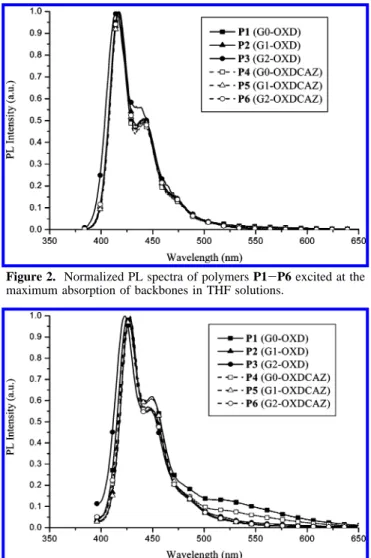
short-wavelength absorption peaks (at ca. 300 nm) in THF solutions of P1-P3 increase with the generation number of the dendrons, which are attributed to the absorption of the peripheral OXD units. Similarly, the absorption band of P4-P6 solutions (in THF) at ca. 295 nm are originated from the combined absorption band of OXD and CAZ pendent groups (as shown in Figure 2 of the Supporting Information). The additional absorption bands of polymers P1-P6 at 384-391 nm are assigned to theπ-π* transition contributed from the conjugated backbones of the poly(fluorene)s. The absorption spectra of the polymers in solid films are similar (a little red-shifted) to those in THF solutions (as shown in Figure 3 of the Supporting Information). Optical band gaps (Eg) determined from the absorption edge of P1-P6 in solid films are found to be about 2.94 eV. As shown in Figure 2, the PL spectra of polymers in THF solutions are quite similar to one another. All polymers emit blue light at 417 nm with vibronic bands at 441 nm (except P3, which reveals two sharp bands at 415 and 439 nm). The slightly blue-shifted spectrum of P3 could be explained by the incorporation of the attachment of G2-bulky OXD dendrons onto the side chains of the fluorene units, which twist the poly-(fluorene) backbones to decrease the effective conjugation length to some extent. The PL spectra of polymers in solid films are similar to those in THF solutions in Figure 2. In comparison with the corresponding dilute solutions, the emission spectra of P1-P6 in solid films show a slight red-shift of 8-11 nm (Figure 3). Similar to the solution state, the PL spectrum of P3 in the solid state is slightly blue-shifted relative to the other polymers. It is worth noticing that the PL spectra of P1 and P4 have a long tail extending to longer wavelength regions (the “onsets” of the longer wavelength region is at 610 nm) and show a shoulder at ca. 520 nm. This spectral feature is attributed to the interchain excimer formation and/or keto defects, which is commonly observed in 9,9-disubstituted poly(fluorene)s.30-32 It appears that the G0-substituent is not bulky enough to shield the polymer backbones completely. The incomplete suppression of long wavelength emission band were also seen in similar dendronized poly(fluorene)s with smaller dendrons.11(c) How-ever, P2, P3, P5, and P6 with larger dendrons do not show any sign of aggregation or excimer formation. These results clearly indicate that the steric hindrance of larger dendritic substituents suppresses the intermolecularπ-π stacking of the polymers and eliminates undesirable red-shifts in the emission spectra.
It is already known that OXD and CAZ units can act as energy-transfer donors (light antennae) for the light-emitting Table 1. Molecular Weights and Thermal Properties of Polymers
polymer Mna Mwa PDI Tgb(°C) Tdc(°C) P1 (G0-OXD) 34 500 102 600 2.97 143 372 P2 (G1-OXD) 35 600 66 700 1.87 102 395 P3 (G2-OXD) 21 300 29 000 1.36 87 405 P4 (G0-OXDCAZ) 33 800 95 800 2.83 118 378 P5 (G1-OXDCAZ) 21 100 40 900 1.93 95 394 P6 (G2-OXDCAZ) 20 200 42 900 2.12 85 410
aMolecular weight determined by GPC in THF, based on polystyrene
standards.bGlass transition temperature (°C) determined by DSC at a
heating rate of 10°C min-1.cTemperature (°C) at 5% weight loss measured
by TGA at a heating rate of 20°C min-1under nitrogen.
Figure 1. Absorption spectra of polymers P1-P6 in THF solutions,
cores (as energy-transfer acceptors). In fact, the photoexcitations of OXD or CAZ units predominantly created identical emissions as those excited at the absorption of poly(fluorene) backbones. No characteristic emission features of OXD or CAZ side chains were observed in Figure 4, which indicate that both pendant groups (as energy-transfer donors) and polymer backbones (as energy-transfer acceptors) contribute the major emissions of the poly(fluorene)s. As shown in Figure 4(a), the intensity of the sensitized emission (excited at peripheral OXD units ca. 303 nm) of P3 is 31% higher than the direct backbone emission (excited at the maximum absorption of the polymer backbone ca. 390 nm), which is the only enhanced result of the sensitized emission due to the largest number of dendritic OXD pendants (energy-transfer donors) in the highest generation of dendrons. The result clearly indicates that the photoluminescence of dendronized polymers by the light antenna design is more efficient than direct excitation at the absorption maximum of
the polymer backbone. The PL quantum yields (ΦPL) of polymers P1-P6 excited at the maximum absorption of backbones in solutions were measured with 9,10-diphenylan-thracene as a reference standard (cyclohexane,ΦPL) 0.90),33 where the highest quantum yield reaches 1.0. The PL quantum yields in solid films were measured using the same standard in poly(methyl methacrylate),34and the results are listed in Table 2. The PL efficiencies of copolymers P1-P3 show a trend similar to those of copolymers P4-P6, where the polymers incorporating smaller G0-substituted dendrons exhibit relatively higher degrees of aggregation and larger tendencies of excimer formation, and thus to possess relatively lower PL efficiencies. The G1-substituted polymers, however, exhibit the highest PL Table 2. Absorption and PL Emission Spectral Data of Polymers in THF Solutions and Solid Films
polymer λabs,sola(nm) band gap (eV) λPL,sola(nm) λPL,filma(nm) ΦPL,solb ΦPL,filmc
P1 (G0-OXD) 302, 387 2.94 417, 441 426, 449 0.73 0.34 P2 (G1-OXD) 300, 391 2.94 417, 441 427, 449 0.98 0.55 P3 (G2-OXD) 299, 384 2.94 415, 439 423, 445 0.77 0.16 P4 (G0-OXDCAZ) 295, 391 2.94 417, 441 427, 448 0.97 0.30 P5 (G1-OXDCAZ) 295, 391 2.94 417, 441 428, 449 1.00 0.52 P6 (G2-OXDCAZ) 295, 388 2.94 417, 441 426, 448 0.86 0.24
aThe data in parentheses are the wavelengths of shoulders and subpeaks.bSolution fluorescence quantum efficiency were measured in THF, relative to
9,10-diphenylanthracene (ΦPL) 0.90).cPL quantum efficiency were estimated relative to 9,10-diphenylanthracene in poly(methyl methacrylate) as a standard (ΦPL) 0.83).
Figure 2. Normalized PL spectra of polymers P1-P6 excited at the
maximum absorption of backbones in THF solutions.
Figure 3. Normalized PL spectra of polymers P1-P6 excited at the
maximum absorption of backbones in solid films.
Figure 4. Normalized PL spectra of polymers (a) P1-P3 and (b) P4-P6 in solid films, which were excited at the maximum absorption of
the peripheral OXD pendants (open symbols) and at the maximum absorption of the polymer backbone (solid symbols).
efficiencies with respect to their G0- and G2-analogues. The lower quantum yields of G2-analogues (P3 and P6) with the highest generation of dendrons are probably due to the lower degrees of polymerization and slight twists of backbones in poly-(fluorene) backbones, which lead to the quenching effect of poly(fluorene)s.
Electrochemical Characterization. Cyclic voltammetry (CV) measurements were carried out in a conventional three-electrode cell. The measured oxidation potentials and HOMO and LUMO energy values are summarized in Table 3. As
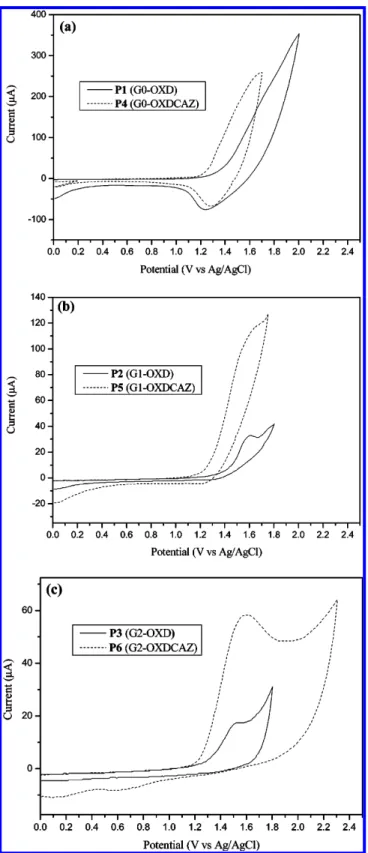
depicted in Figure 5, polymers P1-P3 show the onset potentials of oxidation between 1.32 and 1.38 V in the anodic scans. The onset potentials are similar to the reported value of poly(2,7-(9,9-dioctyl)-fluorene)s (1.4 V)35and the onset potentials are due to the oxidation of the poly(fluorene) backbones. On the contrary, copolymers P4-P6 have lower onset potentials of oxidation between 1.23 and 1.26 V, which are attributed to the introduction of CAZ groups.36 It implies that the CAZ units reduce the hole-injection barrier by 0.08-0.14 eV thus to facilitate the capability of hole injection from ITO electrodes. Similarly, the high electron affinity of OXD units is helpful in electron injection. The HOMO energy values of P1-P6 were calculated relative to ferrocene (Fc), which has a value of -4.8 eV with respect to zero vacuum level. In addition, the optical edges of absorption spectra are utilized to derive the band gaps and give the LUMO energy values of the dendronized poly-mers.37It can be visualized that the generation variety of the OXD dendrons has little effect on the oxidation potentials. The redox wave broadening or shifted effects on higher generations of dendrons, which were referred as the shell effect,38can be observed in G2-substituted polymers P3 and P6.
Electroluminescent Properties. To evalutae these novel dendron-functionalized luminescent materials, double-layer light emitting devices using the dendronized polymers P1-P6 as the active layer with the configuration of ITO/PEDOT/polymer/ LiF/Al have been fabricated and investigated. The performance data of these devices are collected in Table 4. As a result, the emission wavelengths and spectral features of the EL spectra (Figure 6) are very similar to those of the corresponding PL spectra in solid films, which suggest that their EL emissions originate from the poly(fluorene) backbones. Both P1 and P4 show significantly broadened emissions to agree with their PL spectra, which might be due to excimer fromation by aggrega-tion in the solid state or fluorenone defects introduced during
Figure 5. Cyclic voltammograms of the polymers: (a) P1 and P4;
(b) P2 and P5; (c) P3 and P6.
Figure 6. Normalized EL spectra of the devices with the configuration
of ITO/PEDOT/polymer/LiF/Al.
Table 3. Oxidation Potentials and Calculated HOMO and LUMO Energies of Polymers
polymer Eox/onset(V) HOMO (eV) LUMOa(eV)
P1 (G0-OXD) 1.37 -5.72 -2.78 P2 (G1-OXD) 1.38 -5.73 -2.79 P3 (G2-OXD) 1.32 -5.67 -2.73 P4 (G0-OXDCAZ) 1.23 -5.58 -2.64 P5 (G1-OXDCAZ) 1.26 -5.61 -2.67 P6 (G2-OXDCAZ) 1.24 -5.59 -2.65
aLUMO Energies were deduced from HOMO values and optical band
device fabrication and operation.5c,39,40 However, the green emission has been efficiently suppressed in P2, P3, P5, and P6, which might be due to the hindrance of the exciton migration to reduce oxidized ketonic defects by the bulky OXD dendrons and thereby to increase the color stability of these devices.41 The PLED device made of P4 (Figure 7) has the maximum brightness of 2446 cd/m2at a bias voltage of 12 V with a power efficiency of 0.24 cd/A at 100 mA/cm2. The turn-on voltages of PLED devices based on G2-substituted polymers were a few volts higher than those of PLED devices based on G0- and G1-substituted polymers as shown in Table 4. Such unfavorable results are presumably due to a dominant shielding effect of G2-dendritic wedges, which deteriorates the charge transporting properties for the higher generations of the dendrimers.42The device performance characteristics of G0 dendritic PF-based PLEDs are generally better than those of corresponding G1 and G2 dendritic PF-based devices, which suggests that the larger dendron shells have a larger influence on the trapping process.43 Conclusion
A series of novel poly(fluorene)s containing three generations of dendronized side chains, including Fre´chet-type poly(aryl ether) dendrons and functional peripheral groups such as OXD units were synthesized. The resulting polymers possess good thermal stability and excellent solubility in common organic solvents. The G1- and G2-substituted polymers may narrow down the emission spectra by reducing the emission spectral tail (extending to longer wavelength regions). The improvement of the emission spectral quality is attributed to less molecular packing caused by the steric hindrance of bulky dendritic side chains. The PLEDs with the configuration of ITO/PEDOT/ polymer/LiF/Al were fabricated, and emitted blue light. The poor device performance of the more bulky dendronized poly-(fluorene)-based PLEDs are presumably due to a large excess
of the electron-affinitive OXD moieties in the higher generations of dendrons, which could act as electron traps and lead to the reduction of charge balance.
Acknowledgment. We express thanks for the financial support from the National Science Council of Taiwan (ROC) through NSC 93-2113-M-009-011. Prof. Yu-Tai Tao (vacuum deposition) at Institute of Chemistry, Academia Sinica (in Taiwan) and Prof. Chain-Shu Hsu (CV measurements), Prof. Yu-Chie Chen (MALDI-TOF mass spectroscopy), and Prof. Ching-Fong Shu (GPC measurements) at Department of Applied Chemistry, National Chiao Tung University (in Taiwan) are also acknowledged for their instrumental support.
Supporting Information Available: Text giving the prepara-tions of compounds 1-3 and their intermediates, a scheme showing this, and figures showing the absorption spectra of polymers in solid films and DSC thermograms of polymers. This material is available free of charge via the Internet at http://pubs.acs.org.
References and Notes
(1) (a) Handbook of Conducting Polymers, 2nd ed.; Skotheim, T. A., Ed.; Dekker: New York, 1997. (b) Conjugated Conducting Polymers; Kies, H., Ed.; Springer: Berlin, 1992; Vol. 102. (c) Miller, J. S. Adv. Mater.
1993, 5, 671. (d) Roncali, J. Chem. ReV. 1992, 92, 711.
(2) (a) Pei, Q.; Yang, Y. J. Am. Chem. Soc. 1996, 118, 7416. (b) Leclerc, M. J. Polym. Sci., Part A: Polym. Chem. 2001, 22, 1365. (c) Grice, A. W.; Bradeley, D. D. C.; Bernius, M. T.; Inbasekaran, M.; Wu, W. W.; Woo, E. P. Appl. Phys. Lett. 1998, 73, 629.
(3) (a) Huber, J.; Mu¨llen, K.; Salbeck, J.; Schenk, H.; Scherf, U.; Stehlin, T.; Stern, R. Acta Polym. 1994, 45, 244. (b) Lemmer, U.; Heun, S.; Mahrt, R. F.; Scherf, U.; Hopmeier, M.; Sieger, U.; Go¨bel, E. O.; Mu¨llen, K.; Ba¨ssler, H. Chem. Phys. Lett. 1995, 240, 373. (c) Grell, M.; Bradley, D. D. C.; Ungar, G.; Hill, J.; Whitehead, K. S. Macromolecules 1999, 32, 5810.
(4) Jenekhe, S. A.; Osaheni, J. A. Science 1994, 265, 765.
(5) (a) List, E. J. W.; Gu¨ntner, R.; Scanducci de Freitas, P.; Scherf, U. AdV. Mater. 2002, 14, 374. (b) Gong, X.; Iyer, P. K.; Moses, D.; Bazan, G. C.; Heeger, A. J.; Xiao, S. S. Adv. Funct. Mater. 2003, 13, 325. (c) Scherf, U.; List, E. J. M. Adv. Mater. 2002, 14, 477.
(6) (a) Lee, J. I.; Klarner, G.; Miller, R. D. Chem. Mater. 1999, 11, 1083. (b) Klarner, G.; Lee, J. I.; Davey, M. H.; Miller, R. D. AdV. Mater.
1999, 11, 115.
(7) Xiao, S.; Nguyen, M.; Gong, X.; Cao, Y.; Wu, H.; Moses, D.; Heeger, A. J. AdV. Funct. Mater. 2003, 13, 25.
(8) Yu, W. L.; Pei, J.; Huang, W.; Heeger, A. J. AdV. Mater. 2000, 12, 828.
(9) Zeng, G.; Yu, W. L.; Chua, S. J.; Huang, W. Macromolecules 2002, 35, 6907.
(10) (a) Marsitzky, D.; Murry, J.; Scott, J. C.; Carter, K. R. Chem. Mater.
2001, 13, 4285. (b) Cho, H. J.; Jung, B. J.; Cho, N. S.; Lee, J.; Shim,
H. K. Macromolecules 2003, 36, 6704.
(11) (a) Setayesh, S.; Grimsdale, A. C.; Weil, T.; Enkelmann, V.; Mu¨llen, K.; Meghdadi, F.; List, E. J. W.; Leising, G. J. Am. Chem. Soc. 2001, 123, 946. (b) Hawker, C. J.; Fre´chet, J. M. J. J. Am. Chem. Soc. 1990, 112, 7638. (c) Marsitzky, D.; Vestberg, R.; Blainey, P.; Tang, B. T.; Hawker, C. J.; Carter, K. R. J. Am. Chem. Soc. 2001, 123, 6965. (d) Tang, H. Z.; Fujiki, M.; Zhang, Z. B.; Torimitsu, K.; Motonaga, M. Chem. Commun. 2001, 2426. (e) Chou, C. H.; Shu, C. F. Macromol-ecules 2002, 35, 9673.
(12) (a) List, E. J. W.; Guentner, R.; de Freitas, P. S.; Scherf, U. AdV. Mater. 2002, 14, 374. (b) Gaal, M.; List, E. K. W.; Scherf, U. Macromolecules 2003, 36, 4236. (c) Craig, M. R.; Kok, M. M.; Hofstraat, J. W.; Schenning, A. P. H. J.; Meijer, E. W. J. Mater. Chem.
2003, 13, 2861. (d) Kulkarni, A. P.; Kong, X.; Jenekhe, S. A. J. Phys. Chem. B 2004, 108, 8689.
(13) (a) Liu, M. S.; Jiang, X.; Liu, S.; Herguth, P.; Jen, A. K. Y. Macromolecules 2002, 35, 3532. (b) Jenekhe, S. A.; Osaheni, J. A. Science 1994, 265, 765.
(14) Krebs, F. C.; Jorgensen, M. Macromolecules 2002, 35, 7200. (15) Chen, Z. K.; Meng, H.; Lai, Y. H.; Huang, W. Macromolecules 1999,
32, 4351.
(16) (a) Marsella, M. J.; Fu, D. K.; Swager, T. M. AdV. Mater. 1995, 7, 145. (b) Gillissen, S.; Jonforsen, M.; Kesters, E.; Johansson, T.; Theander, M.; Andersson, M. R.; Inganas, O.; Lutsen, L.; Vanderzande, D. Macromolecules 2001, 34, 7294.
Table 4. EL Data of PLED Devicesa
polymer λmax,EL (nm) Vonb (V) power effiencyc (cd/A) luminance effiencyc (lm/W) max. brightness (cd/m2) P1 (G0-OXD) 436 5.0 0.90 0.31 1480 P2 (G1-OXD) 438 7.5 0.34 0.08 380 P3 (G2-OXD) 432 9.0 0.10 0.05 520 P4 (G0-OXDCAZ) 434 4.5 0.24 0.12 2446 P5 (G1-OXDCAZ) 438 7.0 0.10 0.02 119 P6 (G2-OXDCAZ) 432 8.5 0.05 0.02 92
aDevice structure: ITO/PEDOT/polymer/LiF/Al.bVonis the turn-on
voltage of light.cMeasured at 100 mA/cm2.
Figure 7. Current density-voltage-brightness (J-V-B) characteristics
of the PLED device containing P4 with the configuration of ITO/ PEDOT/P4/LiF/Al.
(17) (a) Du, P.; Zhu, W. H.; Xie, Y. Q.; Zhao, F.; Ku, C. F.; Cao, Y.; Chang, C. P.; Tian, H. Macromolecules 2004, 37, 4387. (b) Pan, J.; Zhu, Zhu, W.; Li, S.; Zeng, W.; Cao, Y.; Tain, H. Polymer 2005, 46, 7658. (c) Liu, Y.; Yu, G.; Li, H.; Tian, H. Zhu, D. Thin Solid Films
2002, 417, 206. (d) Pan, J.; Zhu, W.; Li, S.; Xu, J.; Tian, H. Eur. J. Org. Chem. 2006, 986.
(18) (a) Wang, C.; Jung, G. Y.; Hua, Y.; Pearson, C.; Bryce, M. R.; Petty, M. C.; Batsanov, A. S.; Goeta, A. E.; Howard, J. A. K. Chem. Mater.
2001, 13, 1167. (b) Zhan, X.; Liu, Y.; Wu, X.; Wang, S.; Zhu, D. Macromolecules 2002, 35, 2529. (c) Lee, Y. Z.; Chen, X.; Chen, S. A.; Wei, P. K.; Fann, W. S. J. Am. Chem. Soc. 2001, 123, 2296. (d) Peng, Z.; Zhang, J. Chem. Mater. 1999, 11, 1138. (e) Chung, S. J.; Kwon, K. Y.; Lee, S. W.; Jin, J. L.; Lee, C. H.; Lee, C. E.; Park, Y. AdV. Mater. 1998, 10, 1112. (f) Kim, J. H.; Park, J. H.; Lee, H. Chem. Mater. 2003, 15, 3414.
(19) Adachi, C.; Tsutsui, T.; Saito, S. Appl. Phys. Lett. 1990, 56, 799. (20) Shu, C. F.; Dodda, R.; Wu, F. I.; Liu, M. S.; Jen, A. K. Y.
Macromolecules 2003, 36, 6698.
(21) Wu, F. I.; Reddy, D. S.; Shu, C. F.; Liu, M. S.; Jen, A. K. Y. Chem. Mater. 2003, 15, 269.
(22) Sung, H. H.; Lin, H. C. Macromolecules 2004, 37, 7945. (23) Kwok, C. C.; Wong, M. S. Macromolecules 2001, 34, 6821. (24) Kwok, C. C.; Wong, M. S. Chem. Mater. 2002, 14, 3158. (25) Sung, H. H.; Lin, H. C. J. Polym. Sci., Part A: Polym. Chem. 2005,
43, 2700.
(26) Ranger, M.; Rondeau, D.; Leclerc, M. Macromolecules 1997, 30, 7686. (27) Wu, C. W.; Lin, H. C. Macromolecules, Submitted (2006). (28) Tolman, C. A.; Seidel, W. C.; Gerlach, D. H. J. Am. Chem. Soc. 1972,
94, 2669.
(29) (a) Frahn, J.; Karakaya, B.; Scha¨fer, A.; Schlu¨ter, A. D. Tetrahedron
1997, 53, 15459. (b) Schlu¨ter, S.; Frahn, J.; Schlu¨ter, A. D. Macromol. Chem. Phys. 2000, 201, 139.
(30) (a) Kreyenschmidt, M.; Klaemer, G.; Fuhrer, T.; Ashenhurst, J.; Karg, S.; Chen, W. D.; Lee, V. Y.; Scott, J. C.; Miller, R. D. Macromolecules
1998, 31, 1099. (b) Bliznyuk, V. N.; Carter, S. A.; Scott, J. C.; Kla¨rmer,
G.; Miller, R. D.; Miller, D. C. Macromolecules 1999, 32, 361.(c) Sims, M.; Bradley, D. D. C.; Ariu, M.; Koeberg, M.; Asimakis, A.; Grell, M.; Lidzey, D. G. AdV. Funct. Mater. 2004, 14, 765. (31) Lee, J. I.; Klaerner, G.; Miller, R. D. Chem. Mater. 1999, 11, 1083. (32) Jenekhe, S. A.; Osaheni, J. A. Science 1994, 265, 765.
(33) Eaton, D. Pure Appl. Chem. 1998, 60, 1107.
(34) Guilbault, G. G., Ed. Practical Fluorescence; Marcel Dekker: New York, 1990; Chapter 1.
(35) Janietz, S.; Bradley, D. D. C.; Grell, M.; Giebeler, C.; Inbasekaran, M.; Woo, E. P. Appl. Phys. Lett. 1998, 73, 2453.
(36) Xia, C.; Advincula, R. C. Chem. Mater. 2001, 13, 1682.
(37) Hohle, C.; Hofmann, U.; Schloter, S.; Thelakkat, M.; Strohriegl, P.; Haarer, D.; Zilker, S. J. J. Mater. Chem. 1999, 9, 2205.
(38) Satoh, N.; Cho, J. S.; Higuchi, M.; Yamamoto, K. J. Am. Chem. Soc.
2003, 125, 8104.
(39) Setayesh, S.; Grimsdale, A. C.; Weil, T.; Enkelmann, V.; Mu¨llen, K.; Meghdadi, F.; List, E. J. W.; Leising, G. J. Am. Chem. Soc. 2001, 123, 946.
(40) Kraft, A.; Grimsdale, A. C.; Holmes, A. B. Angew. Chem., Int. Ed.
1998, 37, 402.
(41) Pogantsch, A.; Wenzel, F. P.; List, E. J. W.; Leising, G.; Grimsdale, A. C.; Mullen, K. AdV. Mater. 2002, 14, 1061.
(42) Lupton, J. M.; Samuel, I. D. W.; Beavington, R.; Burn, P. L.; Ba¨ssler, H. AdV. Mater. 2001, 13, 258.
(43) Qu, J.; Zhang, J.; Grimsdale, A. C.; Mu¨llen, K.; Jaiser, F.; Yang, X.; Neher, D. Macromolecules 2004, 37, 8297.