
從企業外交到企業外交官 - 政大學術集成
109
0
0
全文
(2) . 從企業外交到企業外交官 From Business Diplomacy to Business Diplomats 研究生:毛慕生 Student: Michaël MARDYKS 指導教授:蘇威傑 Advisor: Weichieh SU. 政 治 大 . 立. . ‧ 國. 學. . 國立政治大學 . ‧. 商學院國際經營管理英語碩士學位學程 . y. Nat. 碩士論文 . n. A Thesis. er. io. al. sit. . v. i Submitted to C International MBAnProgram. hengchi U. National Chengchi University in partial fulfillment of the Requirements for the degree of Master in Business Administration 中華民國一O三年六月 June 2014.
(3) . Acknowledgements At the end of my journey in obtaining my Master Degree, it is a pleasant task to express my thanks to all the kind and knowledgeable people around me who made this thesis possible. First and foremost, I offer my sincerest gratitude to my advisor, Prof. Weichieh Su, for his excellent guidance and pedagogy throughout my thesis. He supported me with precious knowledge, patience and inspiring references. He showed me the way at every stage of the project. I appreciated all his contributions of time and his unparalleled responsiveness.. 治 政 I would also like to say many thanks to Prof. William 大 Reinfeld, for his valuable suggestions 立 and comments. In particular, I will always remember one discussion in Taipei, which has been ‧ 國. 學. illuminating for the whole course of my thesis.. ‧. The kindness and assistance of all members of the IMBA Office at National Chengchi University, especially Li-chi Ho and Frank Chang, provided me with an excellent atmosphere. Nat. sit. y. for completing this Program.. n. al. er. io. I would also like to thank Prof. Danchi Tan and Prof. Min-Fen Tu for doing me the honor of being my reading and oral defense committee.. Ch. engchi. i n U. v. These acknowledgements cannot pass without an expression of gratitude to my parents and grandparents for their encouragements and for giving me the financial support to study in Taiwan. Without them and my sister Laura, nothing would have been possible. Last, but by no means least, special thanks go to Elodie Benayon, Quentin Lestra and Laura Baumel, who as good friends, were always there cheering me up and stood by me through the good times and bad. We worked as a close team at the library, since they were also conducting some researches on other topics at the same time. This thesis would have been a lonely project without them. They made it an unforgettable experience. Thank you.. i .
(4) . Abstract From Business Diplomacy to Business Diplomats By Michaël MARDYKS The quest toward competitiveness, legitimacy and sustainability in our globalized world involves a growing number of factors; not only financial, marketing or commercial (called. 政 治 大. market parameters) but also political, legal, social, environmental (non-market parameters). That is where “business diplomacy” (such as stakeholder management, issue management. 立. and environmental scanning) comes in. This unique concept has been coined to ensure the. ‧ 國. 學. link between multinational companies and their non-market environments. As a matter of fact however, a position of “business diplomat” does not exist yet. The domains of business. ‧. diplomacy are horizontally splited between different business departments and vertically. y. Nat. decentralized across different geographic levels. The strategies and actions resulting from this. er. io. sit. siloed approach are likely to be inconsistent, inefficient and even counterproductive.. al. My model is designed to fill this gap between theory and practice and create an integrated. n. v i n approach toward the non-marketC environments. The central argument is to superimpose the hengchi U domains and layers of business diplomacy, instead of displaying them side-by-side. The ensuing intersections give rise to new areas which form a new domain at the interface between the horizontal overlaps and vertical interdependencies of the non-market context. I propose that this domain should be the responsibility of a new business position: the “business diplomat”. Keywords: Non-market environments, Public Affairs, Corporate Political Activities. ii .
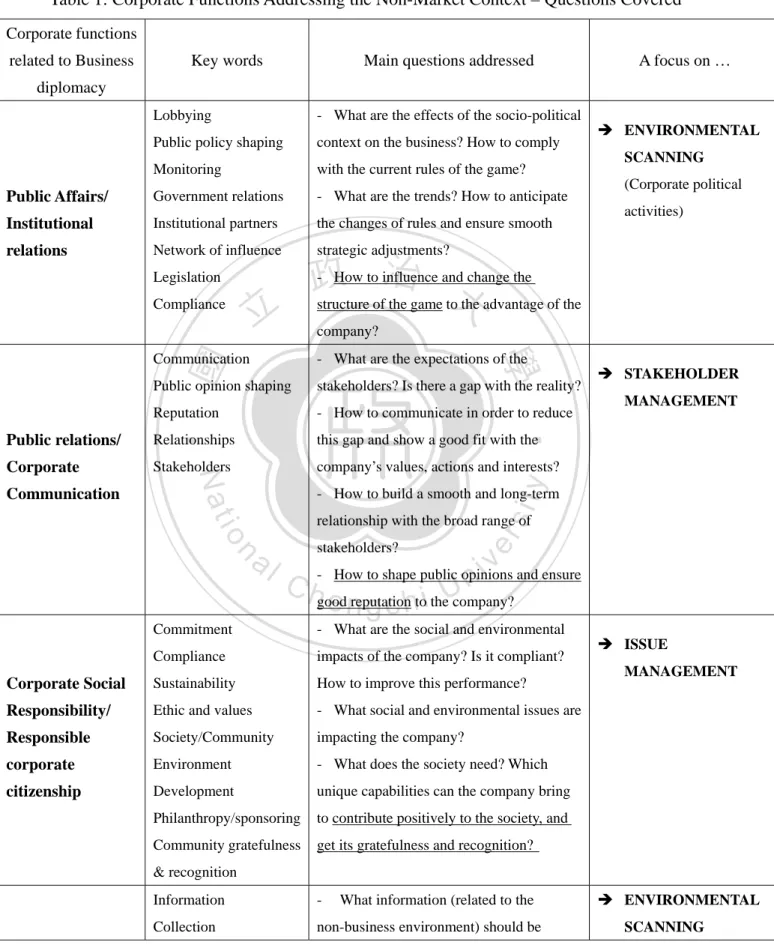
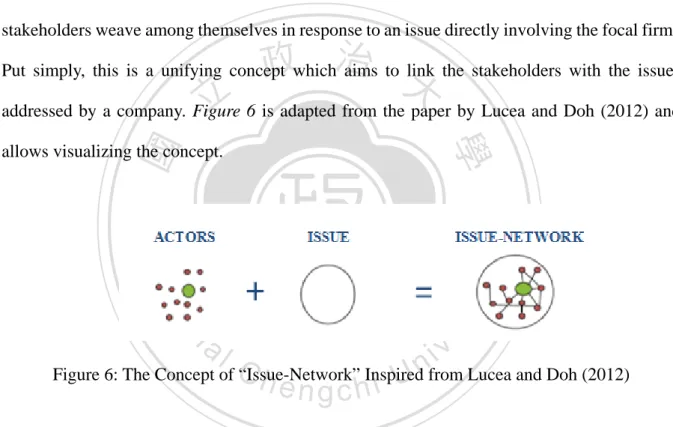
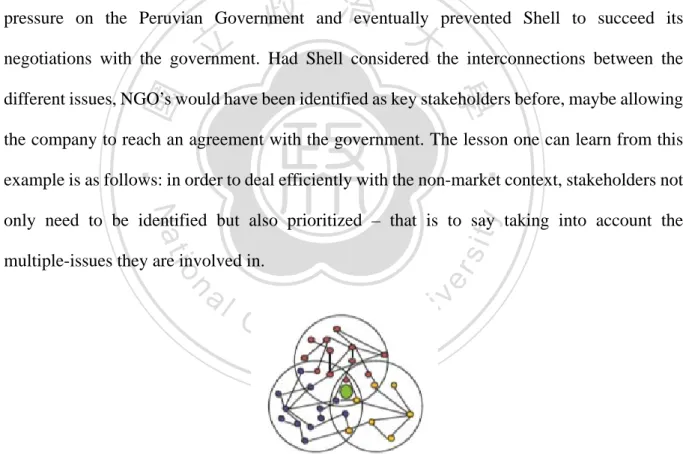
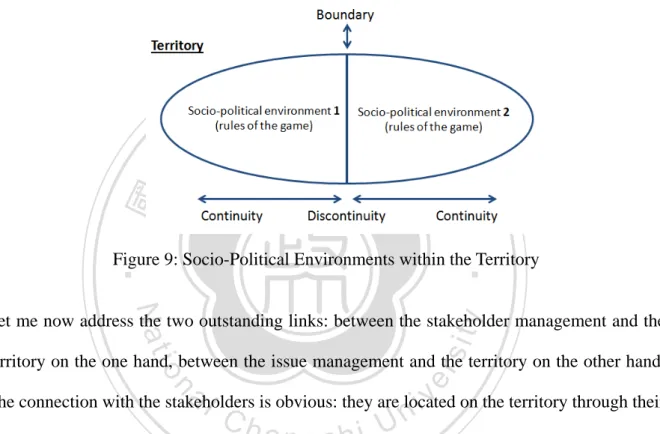
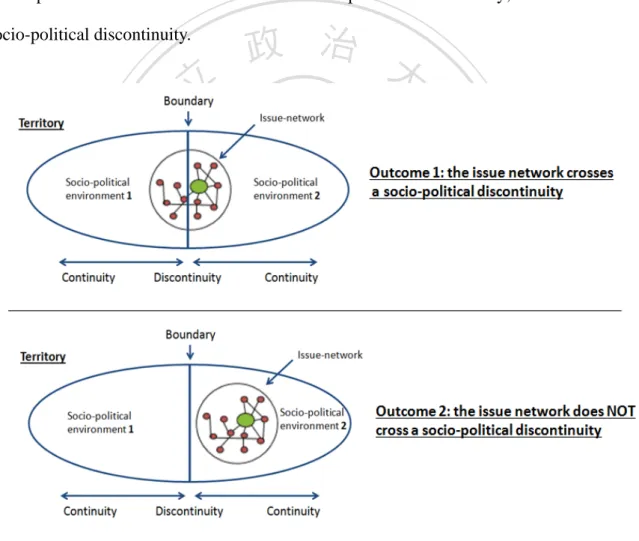
(5) . TABLE OF CONTENTS 1. . Introduction ............................................................................................................................... 1 . 2. . Literature Review...................................................................................................................... 6 . 2.1. . Conceptual Foundations of Business Diplomacy ................................................................... 6 . 政 治 大. 2.1.1. Business Diplomacy and Non-Market Context .................................................................. 6 . 立. 2.1.2. A Fruit of Globalization and a Response to Its Excesses ................................................... 7 . ‧ 國. 學. 2.1.3. The Added Value of Business Diplomacy ........................................................................ 10 . ‧. 2.2. . The Roles of Business Diplomacy ........................................................................................ 14 . sit. y. Nat. io. n. al. er. 2.2.1. Stakeholder Management ................................................................................................. 15 . i n U. v. 2.2.2. Issue Management ............................................................................................................ 21 . Ch. engchi. 2.2.3. Environmental Scanning .................................................................................................. 27 . 2.3. . Ongoing Debate Regarding the Implementation of the Concept .......................................... 37 . 2.3.1. A Competency or a Position? ........................................................................................... 37 . 2.3.2. Corporate Functions Related to Business Diplomacy ...................................................... 39 . 3. . Theoretical Model ................................................................................................................... 47 . iii .
(6) . 3.1. . Gaps in the Existing model – A Siloed Approach ................................................................. 47 . 3.1.1. Empirical Evidence: The Example of Shell Oil Company ............................................... 47 . 3.1.2. An Horizontal Segmentation which Ignores the Overlaps between Departments............ 51 . 3.1.3. A Vertical Segmentation which Ignores theMmulti-Layered Interdependences .............. 55 . 3.2. . First Step of My Model: Superimpose the Three Domains of Business Diplomacy ............ 58 . 學. ‧ 國. 3.2.1. . 政 治 大 Overlaps between Stakeholder Management and Issue Management .............................. 59 立. 3.2.2. Overlaps between Issue Management and Socio-Political Scanning ............................... 63 . ‧. 3.2.3. Overlaps between Socio-Political Scanning and Stakeholder Management .................... 67 . y. Nat. Second Step of My Model: Superimpose the Multiple Layers of the Non-Market. io. sit. 3.3. . er. Environment....................................................................................................................................... 71 . al. n. v i n C h The Territory ....................................................................... A Solid Base for the Model: 72 engchi U. 3.3.1. . 3.3.2. An Approach to Assess the Multi-Layered Interdependencies ......................................... 75 . 3.3.3. Mapping the Non-Market Context to Identify the Most Suitable Levels for Actions ...... 79 . 4. . Discussion ................................................................................................................................. 84 . 4.1. . Contributions ........................................................................................................................ 84 . 4.1.1. A New Superimposed Domain at the Heart of the Non-Market “Interfaces” .................. 85 . iv .
(7) . 4.1.2. Implications: A New Created Position of “Business Diplomat” ...................................... 87 . 4.2. . Limitations and Future Research .......................................................................................... 91 . 4.2.1. Practical Challenges to Manage Such A Large Number of Interfaces .............................. 92 . 4.2.2. Organizational Challenges................................................................................................ 93 . References ............................................................................................................................................. 97 . . . ‧. ‧ 國. 立. 學. . 政 治 大. n. er. io. sit. y. Nat. al. Ch. engchi. v . i n U. v.
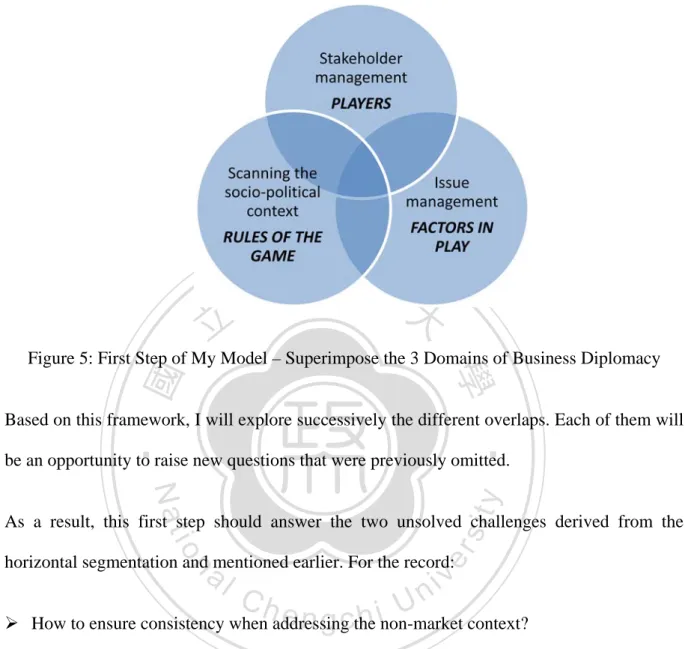
(8) . List of Figures and Tables Figure 1: The Roles of Business Diplomacy toward the Non-Market Context,....................... 15 Figure 2: A Typology of Non-Market Stakeholders ................................................................. 19 Figure 3: A Typology of Issues in the Non-Market Arena........................................................ 24 Figure 4: A Typology of Structural Elements in the Non-Market Environment ...................... 33 Figure 5: First Step of My Model – Superimpose the 3 Domains of Business Diplomacy ..... 59. 政 治 大. Figure 6: The Concept of “Issue-Network” Inspired from Lucea and Doh (2012) .................. 60. 立. Figure 7: Interconnected issue-networks that the firm needs to address simultaneously,. ‧ 國. 學. extracted from Lucea and Doh (2012).............................................................................. 62 Figure 8: Second Step of My Model – Superimpose the Multiple Layers ............................... 71. ‧. Figure 9: Socio-Political Environments within the Territory ................................................... 74. Nat. n. al. er. io. sit. y. Figure 10: Superimposing Issue-Networks and Socio-Political Contexts ............................... 80. i n U. v. Table 1: Corporate Functions Addressing the Non-Market Context – Questions Covered...... 45. Ch. engchi. Table 2: A New Domain Raising New Questions to be Addressed .......................................... 86 . vi .
(9) . 1. Introduction Multinational companies in this beginning of the 21st century play in a multifaceted environment. The context is both characterized by the culmination of the globalization process, which extends the existing game and the excesses of globalization, which press on changing the game. On the one hand, markets expansion, acceleration, and interconnection make competition more intense and complex. On the other hand, non-market parameters tend to be. 政 治 大. increasingly crucial, especially after the global economic crisis of 2008 which highlighted the. 立. “mad finance syndrome” and urged a move toward a more regulated and fairer globalization.. ‧ 國. 學. The trend is for multinational companies to comply with new rules (i.e. overlapping of governmental and supra-governmental legislations), deal with new players (i.e. NGOs, civil. ‧. society, communities, the media, and the governments) and cope with new issues in political,. Nat. sit. y. social and environmental areas. There is therefore a need for multinational companies to. n. al. er. io. broaden their strategic approach. Both market and non-market parameters should be taken into. i n U. v. account in their quest toward competitiveness, legitimacy and sustainability.. Ch. engchi. Business diplomacy is a unique concept to address this growing need. More precisely, business diplomacy “pertains to the management of interfaces between the global company and its multiple non-business counterparts and external constituencies. [It] build[s] bridges between core businesses and the complex political environments within which global firms conduct business.” (Saner, Yiu and Sondergaard, 2000). On the basis of this definition, business diplomacy ensures the link between corporations and their non-market environment, that is to say the “social, political, and legal arrangements that structure the firm's interactions outside of, and in conjunction with, markets”. (Baron, 1995) 1.
(10) . Especially, the non-market environment concerns those relationships with “the public, stakeholders, government, the media, and public institutions.” (Baron, 1995). Although the importance of linking businesses with the non-market environment is broadly recognized, the notion of “business diplomacy” (also called “corporate diplomacy”) remains rarely employed and not fully considered yet by researchers and professionals. This being said, some theoretical works do explore this concept in the fields of international business and. 政 治 大 concepts such as public affairs or corporate political activities. Theoretical works on business 立. strategic management, and some more papers address similar issues through associated. ‧ 國. 學. diplomacy most often provide conceptual considerations to refine the definition of this broad concept (Asquer, 2012), discuss the added value of business diplomacy (Ordeiw-Rigo & Duarte,. sit. y. Nat. literature review.. ‧. 2009) or its roles (Saner and Yiu, 2005). This deficiency will be elaborated further in the. n. al. er. io. In practice, business diplomacy turns up to be a real question for practitioners, especially when. i n U. v. conducting cross-border activities. This is evidenced by the Institute Choiseul for International 1. Ch. engchi. Politics and Geoeconomics , which recently devoted an entire book (Lucas, 2012) to collect testimonies by business leaders, managers, diplomats and experts: from the point of view of those practitioners in varieties of industries, companies and departments, coping with their non-market environment has become a daily major concern and a profession in itself. To. such an extent that the Institute Choiseul decided to make the mentioned book serves as the first in an annual series dedicated in collecting testimonies and entitled “The business diplomats”.. 1. French research center specializing in the analysis of international affairs.. 2.
(11) . However, if all of the interviewed practitioners were involved in one way or the other with business diplomacy, none of them were officially holding a position of “business diplomat”: some were working in public affairs or public relations, others were in charge of international strategy. They could have been responsible for corporate social responsibility as well, or compliance.. In addition to the anecdotal evidence provided by these testimonies, a few academic researches. 政 治 大 companies implement business diplomacy, 立. have conducted qualitative or quantitative analysis to compare the different manners whereby multinational. ‧ 國. 學. pharmaceutical industry (Saner and Yiu, 2005).. for example in the Swiss. Stated plainly: the position of “business diplomat” does not exist so far as a formal corporate. ‧. function: business diplomacy practices represent a collection of perspectives, rather than an. y. Nat. er. io. sit. integrated grouping. Each company has its own approach toward the non-market context.. al. While the lack of a systematic practice in business diplomacy has been clearly observed, and. n. v i n C h importance of U despite the unanimously acknowledged e n g c h i the concept, solutions to bridge the gap. between theory and practice are left largely unexplored. “To date, the field of nonmarket strategy has little to offer in the way of a truly integrated perspective” (Mahon et al. 2003).. Therefore, the research question of this thesis is: How can multinational companies move from the concept of “business diplomacy” to the position of “business diplomat” in a more systematic and integrated way? Business diplomacy covers three domains: the management of non-market stakeholders (that I also call the players, using a game analogy), the management of non-market issues (the factors in play) and the scanning of non-market environments (the rules of the game). Each of these roles is implemented across four levels (local, national, regional and 3.
(12) . global).. However, I establish that this model passes through a siloed approach: an horizontal segmentation which ignores the overlaps between the different domains and a vertical segmentation which ignores the multi-layers interactions and discontinuities. Central to my argument is that such a fragmented perspective, splited between different departments and different organizational levels in the company, is very likely to result in inconsistencies,. 政 治 大 be especially useful to give texture to my argument. 立. inefficiencies and even counter productivities. The case of the Royal Dutch Shell Company will. ‧ 國. 學. My metaphor makes things glaringly obvious: how can we seriously isolate the players, the factors in play and the rules of the game? Completing in practice the roles of business. ‧. er. io. sit. Nat. successful through a more transverse approach.. y. diplomacy toward the non-market environments is a delicate balancing act which can only be. al. Overall, the goal of this paper is to create an integrated model to address the non-market. n. v i n environment and deal with the C three of business diplomacy (socio-political scanning, h eroles ngchi U. stakeholders management and issue management), across the different layers of implementation (global, regional, national and local) in a comprehensive and systematic way.. The rest of this thesis is organized as follow. I first describe the existing siloed model and highlight the challenges that emerge from its horizontal and vertical segmentations.. Then, I propose a new approach that builds on the same three domains (socio-political scanning, stakeholders management and issue management) and four layers (global, regional, national and local). However, I superimpose these elements, instead of displaying them side-by-side:. 4.
(13) . this is the heart of my proposal. As a major advantage, this allows considering the different domains and layers in combination with the others, making interfaces visible. The first step of my model superimposes the three domains and explores their overlaps: this helps resolving the challenges derived from the initial horizontal segmentation. In the second step, I superimpose the different layers, in order to tackle the interdependencies and discontinuities that come from the vertical segmentation.. 政 治 大 that multinational companies do not handle in a systematic and integrated manner when dealing 立. From the superimposed areas of the model, I highlight a whole set of new transverse questions. ‧ 國. 學. with the non-market context. By doing so, I identify a new domain at the intersections of the horizontal and vertical dimensions of the non-market context. I propose that this domain,. ‧. located at the heart of the model, should be the responsibility of a new created position: the. sit. y. Nat. “business diplomat”, serving as an interface between the many non-market overlaps,. io. er. interdependencies and discontinuities. At this point, the journey from the concept of business diplomacy to the position of business diplomat will have already come a long way.. n. al. Ch. engchi. 5. i n U. v.
(14) . 2. Literature Review The concept of business diplomacy is very broad, resulting in a relative vagueness as to its meaning. Although it is a relatively recent notion, coined at the turn of the millennium and still rarely employed, many different definitions and perspectives are associated with it. In this literature review, I propose to begin with the elements where there is unanimity, to build a solid foundation for the thesis. I then progressively address the points that provoke debate.. 政 治 大. In keeping with this logic, I hope to allow a good understanding on the concept of business. 立. diplomacy as it currently stands and is implemented today.. ‧ 國. 學. 2.1.. Conceptual Foundations of Business Diplomacy. ‧. 2.1.1. Business Diplomacy and Non-Market Context. Nat. sit. y. The starting point is the definition of business diplomacy as already introduced in the opening. n. al. er. io. section. Business diplomacy “pertains to the management of interfaces between the global. i n U. v. company and its multiple non-business counterparts and external constituencies”. It “build[s]. Ch. engchi. bridges between core businesses and the complex political environments”. (Saner et al., 2000) From this initial definition, I make it clear that business diplomacy shall ensure the link between business and non-business environments.. I should also emphasize straight away a preliminary assumption that Steger (2003) explicitly clarifies from the very first pages of his book dedicated to “Corporate Diplomacy”: “Let us agree that corporations are, above all, economic entities. […]So markets are dominant for companies.” I fully adopt this postulation and will keep it in mind all along this thesis. However, such assumption does not contradict the definition of business diplomacy stated above. Steger. 6.
(15) . recognizes that companies are part of the society - in direct contact with citizens, lobbyists and politicians – and cannot step aside. This being said, the author makes a strong statement to which I join my voice: « Whether companies like it or not, they cannot avoid dealing with interests, institutions, ideas and rules that are outside the market domain.” But what is “outside the market domain”? The work of Baron (1995) is particularly enlightening to grasp this area. Indeed, Baron distinguishes between the so called “market. 政 治 大 between a company and its external stakeholders related to commercial and financial issues 立 environment” and “non-market environment”. Put simply, the former concerns the relationship. ‧ 國. 學. arranged by the market. The latter is defined in these terms: “The Nonmarket environment consists of the social, political, and legal arrangements that structure the firm's interactions. ‧. outside of, and in conjunction with, markets. [It] includes those interactions intermediated by. sit. y. Nat. the public, stakeholders, government, the media, and public institutions.” (Baron, 1995). io. er. Business diplomacy concentrates on this second category of relationships: accordingly, this study will focus on the link between the company and the non-market environment.. n. al. Ch. engchi. i n U. v. The background within which I will carry out this research is now established.. 2.1.2. A Fruit of Globalization and a Response to Its Excesses The one point of consensus with regards to business diplomacy is its origin, inextricably linked to globalization. Indeed, the process of globalization has conferred multinational companies with a central position, upsetting the worldwide governance balance, eventually making business diplomacy becomes possible.. 7.
(16) . The unprecedented weight of corporations is reflected in the terminology itself: “mega-enterprises” or “giant corporations” are expressions commonly used today to refer to this reality. For example, some of these very large companies have financial capacities that are comparable with those of States.. Public diplomacy has been for a long time considered exclusively as the domain of the State, when dealing with other States. As defined by the Oxford English Dictionary, diplomacy is “the. 政 治 大 adjusted and managed by ambassadors and envoys”. However, this is not the whole story 立 management of international relations by negotiation; the method by which these relations are. ‧ 國. 學. anymore, as evidenced by Ordeix-Rigo and Duarte (2009) in their paper entitled From Public Diplomacy to Corporate Diplomacy. The authors focus on the recent evolutions of the roles. ‧. undertaken by multinational companies: they highlight « important roles that modern. sit. y. Nat. corporations are increasingly playing and which might be shaping the definition of corporations. io. er. as institutions within society». Transposing this concept of “diplomacy” from the political to the business field is only made possible thanks to the new influence companies can derive from. al. n. v i n C h Which makes me their significant weight in globalization. e n g c h i U state that business diplomacy is both a result of globalization and a response to its excesses.. This new status given to multinational companies creates opportunities but implies corresponding duties in return. Corporations have to respond to emerging expectations of society: Hence, the need of business diplomacy.. It is no longer sufficient to do things “expeditiously and profitably” (London, 1999) for a company to be successful in the long-term. Business practice must also get the support of politics, demonstrate « high integrity, trust, and honestly » (London, 1999) and respect a “social. 8.
(17) . contract” (Robin and Reidenbach, 1987) between business and society. In particular, a greater transparency is required, due to the immediacy of information provided by internet.. The petrol and gas industry provides a good illustration of the causal link between globalization, the changing roles of corporations, the increasing need for taking into account non-market parameters, and eventually the rise of business diplomacy. All along the thesis, I will draw upon this industry to provide some examples and give texture to my argument.. 政 治 大. Indeed, there is no denying that the petrol and gas industry is truly at the heart of globalization.. 立. Among other advantages, it constitutes the energy source for transportation, on which relies. ‧ 國. 學. global trade. The Fortune Global 500 ranking for the year 2013 is very telling: 6 petroleum companies are in the top 10 of the largest worldwide corporations (regardless the industry) as. ‧. measured by revenue. Especially, Royal Dutch Shell is ranked first.. sit. y. Nat. io. er. Due to the strategic and geopolitical dimensions involved, governments pay close attention to. al. this industry, whose leading companies are private or public. It comes that the petrol and gas. n. v i n industry is highly regulated and C hashto cope with major e n g c h i Upolitical risks. This is another factor making the illustration all the more significant and relevant.. The paradox of globalization appears clearly. On the one hand, oil and gas companies derive their growth and power from globalization: they are a fruit of globalization. In the meanwhile, they are a primary target of criticism, symbol of the excesses of globalization. The industry has strong socio-environmental impacts, and periodically generates public scandals.. The 1990s marked a turning point when the industry realized the need to move in the direction expected by society, taking into account new parameters and endorsing new roles. This is. 9.
(18) . reflected, for example, by Shell’s new Mission Statement in 1997: “Helping people build a better world”. The way towards Business diplomacy was opened up.. 2.1.3. The Added Value of Business Diplomacy I previously showed as a first foundation stone that Business Diplomacy builds bridges between the core business and the non-market context. Now, the relevance of such “bridges” still remains to be called into question.. 政 治 大 Indeed, it seems natural to wonder: “Can companies meet the social and ecological expectations 立. ‧ 國. 學. of society without sacrificing their mission – which is to generate a profit by satisfying market demand?” (Steger, 2003) This question is in line with my initial assumption stated in Section. ‧. 2.1.1.. y. Nat. sit. Consequently, what are the results of non-market activities expressed in business terms? In. n. al. er. io. other words, does Business Diplomacy create some added values? A positive answer to this. i n U. v. question would prove the relevancy of Business Diplomacy in the eyes of multinational. Ch. engchi. companies; and this is precisely the stance I will defend below. Not only Business diplomacy is compatible with profits and international developments, but it also strongly supports these goals, directly and indirectly. Rosabeth Moss Kanter uses a catch phrase that applies well to this perspective: “the strategic value of values” (2009).. Business diplomacy and competitiveness The outcomes of business diplomacy can be directly linked to competitiveness, the biggest issue for most companies. The work of Baron (1995) is of high interest regarding this argument. Indeed, Baron does not limit his research in defining and distinguishing two dimensions, the. 10.
(19) . market and nonmarket environments (as previously discussed); his main purpose is rather to decrypt the strategic interactions of those two notions. “A market strategy is a concerted pattern of actions taken in the market environment to create value by improving economic performance […]. A nonmarket strategy is a concerted pattern of actions taken in the nonmarket environment to create value by improving its overall performance.[…] For a business strategy to be effective these two components must be integrated.“ (Baron, 1995). 政 治 大 creation process. In which sense, more concretely? I propose to organize my analysis in two 立 This suggests clearly, as a starting point, that non-market strategy is part of the strategic value. ‧ 國. 學. parts, successively highlighting a defensive approach and an offensive one.. Concerning the defensive approach, Business diplomacy is seen as a protection against. ‧. non-market factors “that could negatively impact the bottom line” (Saner and Yiu, 2005), and. y. Nat. sit. “helps offset competitive disadvantage” (Baron, 1995). In particular, Baron proposes an. n. al. er. io. original way to counteract Porter’s five forces using non-market strategies. For instance,. i n U. v. companies could intend to reduce the threat of new entrants by lobbying and advocating for. Ch. engchi. protectionist measures. Similarly, rivalry among firms could be mitigated with “antidumping” regulations.. As for the offensive approach, which is in my eyes even more crucial, non-market strategies can result in “competitive advantage” (Baron, 1995). Baron transposes the notion of “Asset” into the non-market field and builds a new concept totally appropriate for the perspective of this thesis: namely, the “non-market assets”. They encompass knowledge and capacity in managing non-market stakeholders and issues (see next section about the Roles of Business Diplomacy), and “include a reputation for responsible behavior”. (Baron, 1995) Just as traditional market. 11.
(20) . assets do, those non-market assets appear to help the firm differentiate from its rivals, be unique and competitive. As a result: business diplomacy “creates and seizes new business opportunities” (Saner and Yiu, 2005).. But beyond that, it is not unusual to see direct competitors forming alliances when it comes to non-market strategies. “Some nonmarket strategies are pursued by industries rather than by individual firms and hence do not provide a competitive advantage against industry rivals”.. 政 治 大 by business diplomacy, as discussed in the next paragraphs. 立. (Baron, 1995) This reflects the fact that competitiveness is not the only added value provided. ‧ 國. 學. Business diplomacy and legitimacy. Nobody will be surprised reading that multinational companies are concerned by their. ‧. reputation. It is interesting to note though, that this notion has a market-oriented connotation.. y. Nat. er. io. sit. Reputation is generally seen through its impacts on customers and investors.. al. When it comes to the non-market environment, the question of image takes a deeper meaning. n. v i n C h It consists inU“generalized perception or assumption better expressed under the term legitimacy. engchi. that the actions of an entity are desirable, or appropriate within some socially constructed system of norms, values beliefs and definitions.” (Suchman, 1995). Steger (2003) and a few years later Ordeix-Rigo and Duarte (2009) recognize the importance of this concept, seen as major asset for multinational companies. The authors transpose it using a more practical term, “licence-to-operate”, and doing so highlight the concrete implications of legitimacy. The “main added value [of corporate diplomacy] to the corporation is a greater degree of legitimacy or license-to-operate, which in turn improves its power within a given social system.” (Ordeix-Rigo and Duarte, 2009) 12.
(21) . Indeed, a legitimate company within society is more likely to be perceived as meaningful and credible. This is of great importance to “build confidence” (Saner and Yiu, 2005). In return, a company needs to demonstrate its meaning and credibility to gain legitimacy. From this, an underlying challenge appears and will be critical throughout the next discussions: the question of consistency. Ensuring consistency is made even more complicated by the fact that the non-market environment is very “fragmented” (Steger, 2003), as we shall see later.. 政 治 大 industry will prove to be, once again, a good example in this perspective. Indeed, this is one of 立. The importance and impacts of legitimacy will be illustrated along the thesis. The oil and gas. ‧ 國. 學. the most controversial industry, due to the nature of its products (with environmental and health consequences) but also to its behaviors (with ethical, geopolitical and developing world issues).. sit. y. Nat. legitimacy.. ‧. As pointed out by Shuili et al. (2012), oil and gas companies embarked upon a quest for more. n. al. er. io. Business diplomacy and sustainability. i n U. v. This third added-value is essentially the combination of the previous ones. Competitiveness. Ch. engchi. together with legitimacy augur a sustainable future for multinational companies.. Saner and Yiu (2005) showed interest in this third dimension. They conducted a study within the pharmaceutical and agro-industries to assess the effect of business diplomacy on sustainability. Their conclusion was that business diplomacy appears as “one important factor contributing to the sustained success of multinational companies operations in foreign markets”.. 13.
(22) . Concretely, this challenge of sustainability takes shape in many different situations, when it comes to deal with stakeholders, issues and rules. This will be reflected in the next subsection dedicated to the roles of business diplomacy.. These added-values of business diplomacy mark the overall direction of the thesis. The model that I will build is designed to help business diplomats better achieve these added-values in practice.. 政 治 大. 2.2. The Roles of Business Diplomacy. 立. ‧ 國. 學. In this section, I present the theoretical model of business diplomacy as it currently stands. Based on Saner and Yiu (2005), we can distinguish three categories of roles addressed by. ‧. business diplomacy: “Stakeholder Management”, “Issue Management” and “Environmental. sit. y. Nat. Scanning”. Each of them is related to a specific component of the non-market context and needs. io. al. er. to be performed at every level, from global to local. “Overlooking any one of these levels would. n. render [Business diplomacy] efforts incomplete”. (Saner and Yiu, 2005). Ch. engchi. i n U. v. I propose to display graphically this approach: Figure 1 shows the three categories of roles addressed by business diplomacy at various intervention levels. In the next subsections, I describe this model from left to right.. 14.
(23) . 立. 政 治 大. ‧. ‧ 國. 學. io. sit. Inspired from Saner and Yiu (2005). er. Nat. a Stakeholder Management n. 2.2.1.. y. Figure 1: The Roles of Business Diplomacy toward the Non-Market Context,. iv l C n hengchi U. Here below, I concentrate on a first category of roles: the Management of Stakeholders. As stated by Ordeix-Rigo and Duarte (2009), “corporate diplomacy is a way to strengthen the network of stakeholder relationships for a company and thus a valid stakeholder management strategy”.. Theoretical work on Stakeholder Management is already very advanced. The scope of this section does not intend to provide a complete picture on these theories, but rather to link some of them with the challenges of business diplomacy. In other words, going back to my game metaphor, the purpose now is to explore the role of business diplomacy toward the non market 15.
(24) . players of the game.. Stakeholder Management literature – definitions and background With his book entitled Strategic Management- A Stakeholder Approach (1984), Freeman is widely accepted as the founding father of the stakeholder theories. Recognizing that the strategic management literature of the time had a too narrowed perspective on the firm environment, restricted to the so called “shareholder view”, Freeman employed the concept of. 政 治 大 “stakeholder” himself, first used by Abrams in 1951; nonetheless his work went further and 立. “stakeholders” in order to broaden this approach. True, Freeman did not coin the word. ‧ 國. 學. opened a debate in academic circles that has been going on for thirty years until today. According to Freeman’s definition, stakeholders are “any group or individual who is affected. ‧. by or can affect the achievement of an organization’s objectives”. (Freeman, 1984) The success. sit. y. Nat. of a firm depends on its ability to interact with all of those stakeholders.. n. al. er. io. Obviously, this definition meets its target to correct the prevalent strategic view of the firm. i n U. v. environment, simplistically focused on the business-oriented actors - especially the. Ch. engchi. shareowners. But, conversely, the risk might shift from a too narrow view of the players to a too broad one whose managerial implications would be impossible to handle. For example, extending Freeman’s perspective at the extreme of the spectrum, Starik incorporates animals, trees and inanimate objects as part of the stakeholders. (Starik, 1995) Thus, the focus of most stakeholder theorists after Freeman was to refine, qualify and assess more precisely which actors should be embraced under the concept of “stakeholders.”. Post et al. provide an important answer, linking the stakeholders to their impacts in terms of “Organizational wealth”: “The stakeholders in a firm are individuals and constituencies that. 16.
(25) . contribute, cither voluntarily or involuntarily, to its wealth-creating capacity and activities, and who are therefore its potential beneficiaries and/or risk bearers”. (Post et al., 2002) This definition will remain in my mind all along this thesis when I attend to better link the company to its large environment, thanks to business diplomacy, in a goal of value creation.. This is not the whole story of the book by Post et al. (2002) whose title, Redefining the Corporation, is particularly enlightening: indeed Stakeholder theories lead to rethink the. 政 治 大 enterprise” defined as follow: « the extended enterprise concept is enlarged to include not only 立. company itself. This is in this way that the authors put forward the notion of “extended. ‧ 國. 學. the focal firm's interactions with other businesses, but also its relationships with other stakeholders”. A first categorization is reflected here with the so called “other stakeholders” as. ‧. compared to the “other businesses”. What do these terms refer to more precisely?. y. Nat. sit. Baron provides a simple and powerful way to classify the large range of stakeholders into two. n. al. er. io. sets: the “market stakeholders” and the “non-market stakeholders” (Baron, 1995). The formers. i n U. v. are business focused and originate from the traditional ‘input-output model”: Investors,. Ch. engchi. Customers, Suppliers and Employees (Donaldson and Preston, 1995). The latter have a wide range of perspectives and interests and are also called “socio-political stakeholders” (Holtbrügge and Berg, 2004). The central idea in stakeholders theories is that market stakeholders, traditionally seen as the “key stakeholders” (Campbell and Alexander, 1997) should not let multinational companies neglect their “non-market stakeholders” that can be as crucial.. Since business diplomacy addresses the link between the company and its non-market environment, this article will focus on the second set of stakeholders, namely the non-market. 17.
(26) . stakeholders.. Typology of non-market stakeholders Non-market stakeholders are a heterogeneous group. These actors are numerous, disparate in nature, public or private. There is no unique taxonomy to depict the diversity of non-market actors in the international environment.. Holtbrügge and Berg (2004) distinguish three main categories of socio-political players:. 政 治 大. “governmental actors” (local or national governments), “non-governmental organizations”. 立. (NGO’s organized at any level from the local to the global scale), and “supranational. ‧ 國. 學. organizations” (the European Union, the Word Bank, or the World Trade Organization for example). In this paper, I will use the two first categories (governments and NGO’s). However. ‧. I will prefer the conception of “regulatory authorities” (Post et al., 2002) which has the. y. Nat. sit. advantage of embracing both the international organizations (like the UN family institution or. n. al. er. io. the intergovernmental trading blocs) and the national/local regulatory groups.. i n U. Moreover,. v. Donaldson and Preston (1995) consider “communities” as part of the stakeholders. They can be. Ch. engchi. local or more spread. It is also worth noting that Campbell and Alexander (1997) refer, among other actors, to “the media”.. For reasons of clarity, there is a need to choose one typology and keep it until the end of the thesis. Building on the selected typologies mentioned above and combining them, I came up with my own classification. Figure 2 shows the five categories of non-market stakeholders that I consider: Governmental actors, NGO’s, Regulatory authorities, communities and media. In the next parts of the thesis, I provide some real examples, based on the case of Royal Dutch Shell Company, that illustrate this typology.. 18.
(27) . Governmental actors . Media . NGO's Multinational company. 立. 政 治 大 Regulatory authorities. Communities. ‧. ‧ 國. 學. Nat. io. sit. Dealing with non-market stakeholders – roles and challenges. y. Figure 2: A Typology of Non-Market Stakeholders. n. al. er. After having described the notion of “Stakeholder Management”, its instrumental and. Ch. managerial implications remain to be explored.. engchi. i n U. v. I made it clear that business diplomacy aims addressing the non-market stakeholders. As expressed by Saner et al. (2000), multinational companies need to “communicate effectively with non-business interest and pressure groups, influence the decisions of foreign governments, maintain and cultivate constructive relations with external constituencies, and negotiate on behalf of the company in foreign countries with non-business groups”. Now, what are the concrete roles and challenges raised by this perspective?. 19.
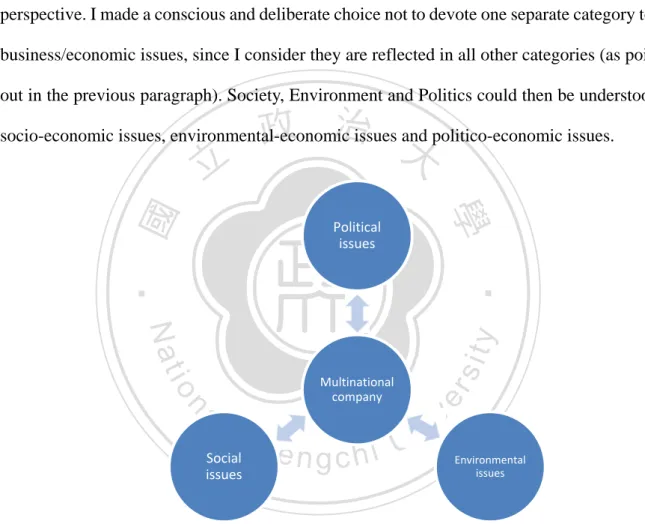
(28) . First of all, dealing with so many stakeholders implies the need to take account of diverging points of view and expectations, which “represent diametrically opposing religious, political and cultural systems” (Saner et al., 2000). Those differences have to be decrypted and understood. They can be explained by disparities in nature of stakeholders: for example an NGO often is likely not to have the same perspectives and interests as a Government. Different localizations of stakeholders can also impact their views: this relationship is central in many geopolitical theories, which analyze the actors’ “mental representations” depending on their. 政 治 大. geographic localization on the “territory”. (Lacoste, 1993). 立. ‧ 國. 學. Then, all stances cannot be satisfied in practice: it is essential to prioritize. Indeed, assuming that multinational companies have a general understanding of the configuration of various. ‧. interests involved, knowledge has yet to be transposed into action. Here appears a major. sit. y. Nat. instrumental interest of Stakeholders theories: they provide some useful conceptual tools to. io. er. weight the relative importance of stakeholders, in terms of potential impact for the company. The most well-known of such frameworks is certainly the one developed by Mitchell et al.. al. n. v i n C h that allow comparing (1997). It recognizes three “attributes” e n g c h i U the significance of stakeholders: power, legitimacy and urgency.. Finally, from a managerial perspective, how to “create a satisfactory balance of interest” (Freeman, 1984)? Put simply, companies can adopt two approaches to manage the relationship with their stakeholders: confrontational or conciliatory. On the one hand, “Zero sum game theories” argue that any advantage given to one party provides a disadvantage to the other party. Companies relying on such a philosophy tend to see the balance of power with stakeholders as a “win-lose battle”. (London, 1999) In sharp contrast, London proposes a smoother approach: “Winning is not everything. The idea is to create win-win situation wherever possible”. My 20.
(29) . paper will draw up on this second approach, also expressed in terms of “mutual benefit” (Post et al., 2002) or “mutual interests” (Robert Heath, 1997), absolutely centrals in the concept of business diplomacy. Indeed, as classically defined in the field of international relations, diplomacy is “the conduct of relations between states and other entities with standing in world politics by official agents and by peaceful means” (Bull, 1977). Transposed in the business area, it comes that the heart of business diplomacy is to deal with counterparts “without hostility” (London, 1999), and to be able to come up with “alternatives solutions” (Saner et al., 2000).. 立. Issue Management. 學. ‧ 國. 2.2.2.. 政 治 大. The second category of roles addressed by Business diplomacy concerns the Management of Issues, “be they of an economic, social, environmental or political nature” (Saner and Yiu,. ‧. 2005). This section will highlight the factors in play, according to the metaphor.. sit. y. Nat. io. er. Issue Management literature – definitions and background. al. The notion of “Issue” is the building block of this literature and foremost needs to be clarified. n. v i n C hissues are “situations straightaway. In their simplest form, e n g c h i U [or events] that present matters of. concern to organizations” (Smith, 2002); in other words, issues are the factors in play, and go hands and hands with the events of the game. Now, to provide some more elaborate definitions of this notion, the existing literature adopts three different approaches based on various emphasizes. The most widely cited definition comes from the Strategic Issue Management School: issues are seen as “forthcoming developments […] likely to have an important impact on the ability of the enterprise to meet its objectives” (Ansoff, 1980). The fundamental feature of this first approach is expressed in terms of impacts. In contrast, the Business and Society literature would rather insist on the “gaps” (to use the key term) “between stakeholder. 21.
(30) . expectations and an organization” (Buchholz, 1988). As for the Public Policy Literature, the element of “controversy” is central: issues are seen as a “conflict between two or more identifiable groups” (Cobb and Elder, 1972).. Since the objective of this work is to move toward an integrated approach to link the business with its non-market context, I will prefer a more holistic definition. The comprehensive approach of Wartick & Mahon (1994) fits perfectly: an issue is « a controversial inconsistency. 政 治 大 creates some significant […] impact on the organization” 立. between stakeholder perceptions of what is and what ought to be corporate performance that. ‧ 國. 學. It follows naturally that “Issue Management”, a term coined by Chase in 1977, is the process to manage the mentioned issues. The goals of Issue Management are to prevent “threats” and. ‧. favor “opportunities” (Ansoff, 1980), “close [the] gap between expectations and reality” (Lucea. y. Nat. er. io. sit. and Doh, 2012) and “mediate potential or ongoing conflicts” (Saner and Yiu, 2005).. al. Typology of issues in the non-market arena. n. v i n Business diplomacy deals with C non-market This more specific field appears in the h e n gissues. chi U literature under the name of “Social Issue Management” and refers to the “corporations attempt to actively manage issues in the social and political arenas.” (Mahon and Waddock, 1992) The work of Arrington and Sawaya helps even more for my perspective: the two authors point out that Social Issue Management reflects the consideration by companies to handle public issues more comprehensively and to be important actors in their resolution (Arrington and Sawata, 1984). . Obviously, one cannot discuss this category of issues without mentioning the nowadays omnipresent concept of Corporate Social Responsibility. Indeed, many non-market issues are 22.
(31) . embedded in this concept “whereby companies integrate social and environmental concerns in their business operations and in their interaction with their stakeholders” (European Union Green Paper on CSR, 2001). A link between Issue Management and Corporate Social Responsibility appears clearly in the writings of Heath (1997) in the way that CSR standards need to be met by Issue management. Ordeix-Rigo and Duarte (2009) go even further and establish a direct leverage between Business Diplomacy and Corporate Social Responsibility: “corporate diplomacy uses social responsibility practices as one of its tactics to grow the. 政 治 大. legitimacy and influence of the company, thus depending on corporate social responsibility to pursue its own objectives”.. 立. ‧ 國. 學. However, Business diplomacy should not be equated with Corporate Social Responsibility.. ‧. While they share some common issues, business diplomacy does not cover all the CSR issues. sit. y. Nat. and, conversely, business diplomacy addresses some issues outside the scope of CSR. Indeed,. io. er. on the one hand, CSR activities can be decomposed into “philanthropy”, “product related” and “business practices” (Peloza and Shang, 2011). Business diplomacy focuses on the “business. al. n. v i n practices” category, that is to sayC thehsocial and environmental e n g c h i U impact of business practices, the gaps between business practices and expectations, and the social and environmental conflicts resulting from business practices. It follows that Business diplomacy’s approach is more business-oriented and should “develop a business-related sociopolitical perspective”, as phrased by Saner et al. (2000). On the other hand, it should be noted that Saner et al. explicitly incorporate political issues as part of the Business diplomacy approach. Although politics is an underlying matter of concern for Corporate Social Responsibility, it is not directly integrated in the so called “triple bottom line” - Environment, Economy and Society - which frame CSR activities.. 23.
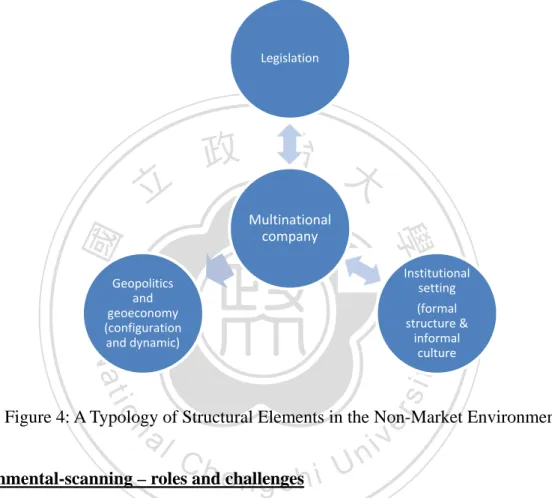
(32) . In this paper, I build on the perspectives mentioned above and extract their related non-market issues that are relevant for Business diplomacy. I derive my own typology of non-market issues, composed of three classes: Society, Environment, and Politics. The first two categories come from the CSR perspective whereas the latter comes from the social issue management perspective. I made a conscious and deliberate choice not to devote one separate category to the business/economic issues, since I consider they are reflected in all other categories (as pointed out in the previous paragraph). Society, Environment and Politics could then be understood as. 政 治 大. socio-economic issues, environmental-economic issues and politico-economic issues.. 學. ‧ 國. 立. Political issues. ‧. n. engchi. er. io. Ch. Social issues. sit. y. Nat. al. Multinational company. i n U. v. Environmental issues. Figure 3: A Typology of Issues in the Non-Market Arena. Dealing with issues in the non-market arena – roles and challenges So far, I have been committed to defining the “issue” part of the term “Issue Management”. I will now elaborate on the “managerial” part.. The first question that has to be raised concerns the responsibilities related to the management 24.
(33) . of non-market issues. As Oomens and Bosh (1999) remarked, while there is a general consensus on the importance of dealing with Issue Management in the literature, few research wonder who should be in charge of the related tasks. The two authors consequently advance the concept of “Issue allocation”, and its corollary – “Issue ownership”, that is to say the explicit responsibility on a specific issue. Applying these notions to the non-market context, it comes: business diplomacy has the “issue-ownership” for non-market issues.. 政 治 大 (2000) state that business diplomacy should “forecast, plan and manage international issues”. 立 Then, what does this responsibility concretely involve for business diplomacy? Saner et al.. ‧ 國. 學. The idea behind this sentence is that business diplomacy should intervene on a continuous basis within the different stage of the Issue Management process: “issue identification”, “issue. ‧. analysis”, “issue change strategy options” and “issue action program” – to use the wording of. sit. y. Nat. the first issue management process model developed by Jones and Chase in 1979.. n. al. er. io. One major challenge for business diplomacy is to be proactive and get involved at the right. i n U. v. moment. (Saner et al., 2000) In line with the “issue life-circle” depicted by Mahon and. Ch. engchi. Waddock (1992), many theorists argue that issue-management should start as early as possible to be efficient (for example Oomens and Bosch, 1999). Such a switch from a reactive to a proactive perspective is central for business diplomacy. Issues are no longer seen as “a problem […] being faced” (Tombari, 1984) but as an opportunity. Companies are actively “seeking to become global interlocutors to address the global issues of today’s world” (Ordeix-Rigo and Duarte, 2009). To do so, the annual World Economic Forum in Davos is a key moment. On the one hand, this event reflects the evolutions of the international issues and allows the company to be reactive; on the other hand, but certainly of no less importance, this is a chance for companies to express their views and “mobilize issues into the institutional agenda”, as wrote 25.
(34) . Ordeix-Rigo and Duarte, 2009). In more general terms, this question of influencing the public-policy agenda is addressed by many researchers interested in the link between corporate strategy and society (for example Mahon and Waddock, 1992 ; Baron, 1995). Another challenge is to strike the right balance between the various issues related to one project. The simplest way to explain this point is perhaps to give an example. Shell Company was operating an oil storage and tanker loading buoy in the North Sea. This facility - called Brent. 政 治 大 decision of decommissioning the huge buoy. In the mid-90s, issues raised by this project were 立. Spar - lost its relevance after the creation of a pipeline in the early 90s’, which led to the. ‧ 國. 學. serious and diverse. The potential environmental impacts were obviously at the heart of the discussions, but Shell could not either leave aside the economic issues. Shell officially. ‧. highlighted on its home page the « difficulty of reaching a balance […] Safety, cost and. sit. y. Nat. environment [are] all key considerations in the search of a Spar Solution ».. n. al. er. io. This poses an additional challenge: business diplomacy should ensure coherence between the. i n U. v. ideas that are put forward and practical action. This assumption will be of paramount important. Ch. engchi. in future arguments (see next sections). As expressed by Ordeix-Rigo and Duarte (2009), “public diplomacy should be aimed at reducing the difference between reality and expression”. This approach is in line with the definition of “issue” as a “gap” mentioned earlier.. In case an issue is handled too late, or in an unbalanced or inconsistent way, a crisis is likely to erupt. “Crisis management is the name given to the process by which an organization deals with out-of-control issues.” (Smith, 2002) The question then becomes to react to such situation quickly, consistently and effectively. Business diplomacy is once again fully involved in this arena and must be ready to “cope with multiple crises” (Saner et al., 2000).. 26.
(35) . 2.2.3.. Environmental Scanning. “All economies are defined by formal and informal norms and regulations that structure market competition”. These are the words used by Baron and Diermeier in 2007 to define the so called “rules of the game”. The third role of business diplomacy, the environmental scanning, deals specifically with those rules.. Definitions and background . 政 治 大. Contrary to the first two categories of roles – stakeholder and issue management – the. 立. environmental scanning is not directly related to a specific field in the literature. Instead, it. ‧ 國. 學. involves many research areas such as political science, political economy, corporate strategy, sociology, or geopolitics.. ‧ sit. y. Nat. As expressed by Baron in the very first lines of its famous analysis entitled The Nonmarket. io. er. Strategy System (1995), environmental scanning responds to the “challenge of understanding. al. non-market forces”. Let me recall that, according to this author, “the Nonmarket environment. n. v i n C hthat structure the Ufirm's interactions outside of, and in consists of the […] arrangements engchi conjunction with, markets”. For the purpose of this article, I would like to highlight the importance of the word “structure” used in this definition. Indeed, this notion allows understanding clearly the distinction I see between the issue management and the environmental scanning. In the previous section, I depicted the issues in close connection with. specific events: in this sense, issues are mainly contextual. In contrast, environmental scanning concerns the structural part of the non-market context, the long-term parameters. In other words, using the game vocabulary : issue management deals with the factors in play during the course of the game, whereas environmental scanning deals with the configuration and the rules of the. 27.
(36) . game.. Environmental scanning addresses two main questions. Firstly, to what extent does this (non-market) structure affect the company? And then, once having solved the first question, how to convert the information into knowledge and action to change the rules of the game? The following part of the literature review will intend to provide some background to clarify these two questions and better understand the statement by Saner et al. (2000): « business diplomacy. 政 治 大. provides a feedback loop from the external environment […] to the global company and back to. 立. the environment ».. ‧ 國. 學. Typology of structural elements in the non-market environment Tackling the first question mentioned above is a good opportunity to grasp at the same time a. ‧. typology of structural elements that belong to the scope of environmental scanning. Put simply,. y. Nat. er. io. sit. what do these rules (or configuration) of the game refer to concretely?. al. The first element in my typology is naturally the regulatory system. This notion is mainly. n. v i n discussed in the academic field ofC politic in terms of “regulatory politics”, that is to say h e science, ngchi U from a public-policy point of view. However, in this paper I am more interested in the corporate strategist point of view and will rather rely on such approaches as Mahon and Waddock’s for example: they focus on the “interaction of public policy with corporate strategy” and assess the impact of “the ebb and flow of regulation, deregulation, and reregulation” on the business (Mahon and Waddock, 1992).. Please note, as Mitnick remarqued in 1993, that regulations can concern diverse perimeters. There are “social regulations [which aim] controlling activities with direct effects on people” and “economic regulations which seeks to control instrumental market activities” (like price, 28.
(37) . entry and trade practices), to which I can add environmental regulations even if the latter are not explicitly mentioned by Mitnick. Business diplomacy is involved in all these types of regulations.. Regarding the impacts of legislation on the company, Baron and Diermeier (2007) state that “both competitive advantage and industry profitability are affected by this interaction”, due to entry barriers implications for instance. Most researchers associate regulations with additional. 政 治 大 regulation study for the business Roundtable, 1979). Mitnick takes the opposing view and see 立. costs for the company (see for example Anderson’s work entitled Cost of Government. ‧ 國. 學. the effects of regulations more positively: « there are opportunities associated with regulation, or the lack of it, and it is time for management to take advantage of them” (Mitnick, 1993).. ‧. Environmental regulations for instance can give impetus for innovation and create new. sit. y. Nat. opportunities (the green market), while economic regulations help stabilize the markets and. io. er. make it more predictable. Also, some theories focus more precisely on the impact of a change in regulation: such is the case, for instance, of Banker, Das and Ou (1997), who study the impact. n. al. Ch. of deregulations in the airline industry.. engchi. i n U. v. The second element in my typology, namely the institutional setting, comes from the political economy literature. Once again though, the initial point of view concerning the role of institutions toward the market economy is out of the scope of this article. Instead, we wonder how different governance systems affect the company. In other words: “what are the key components of the institutional arrangements that may explain variation in the business-government interface in different economies?” (Hillman and Keim, 1995). 29.
(38) . Hillman and Keim give a broad definition to the word institutions, as “devices for organizing the collective decision-making process [toward] public policies”. In a very interesting way for the perspective of this thesis, the two authors build on North’s work (1990) to distinguish two dimensions of institutional characteristics: the “formal constraints” and the “informal constraints” (North, 1990). This broad definition of institutions fits well with my approach, since both dimensions are within the scope of business diplomacy: thus I will work on the basis of this definition throughout this article.. 政 治 大 The “formal constraints” of institutions correspond to their organizational structure to 立. ‧ 國. 學. systematize the division of power (presidential vs. parliamentary system, ministries vs. cabinets, etc.). Hillman and Keim question how those differences should impact the way companies deal. ‧. with institutions. For example, “in established parliamentary systems, business efforts to. sit. y. Nat. influence pertinent government policy will be more focused on executive branch ministries. io. er. than on parliaments.” (Hillman and Keim, 1995) Around ten years later, Hillman goes further and refers to some “variables” to assess institutional differences, such as “majority party,. al. n. v i n C h membership”U(Hillman et al., 2004). member electoral security […] committee engchi. The “informal constraints” embrace “culture, values and norms” (North, 1990) that characterize a society, i.e. the conventions and way of behave within an institution. “The underlying norms of our society create an institutionalized environment within which policy decisions must be made”. (Hillman and Keim, 1995) This impact of culture is also the object of the work by Cobb and Ross entitled Cultural Strategies of Agenda Denial: Avoidance, Attack, and Redefinition (1997). The three authors defend that the political and institutional agenda depends highly on “cultural strategies”.. 30.
(39) . Finally, the conclusion of Hillman and Keim will be useful in future developments: “we contend that differences in business-government relations across countries can be better understood by examining the institutions through which business and government interact.” This argument is a step to cross the players of the game with the rules of the game, in line with the integrated model I will attend to build.. The last element in my typology is of geopolitical and geo-economic nature. Growth of the. 政 治 大 nuclear proliferation, fights against terrorism: the beginning of the 21 立. Chinese economy and power, raw material race, European integration, resurgence of piracy, st. century has been marked. ‧ 國. 學. by many geopolitical and geo-economic parameters whose impacts have been spreading on the business environment.. ‧. Consistently with the distinction I already explained between the issue management and the. y. Nat. sit. environmental scanning (contextual vs. structural), I consider geopolitical and geo-economic. n. al. er. io. elements not only as single events (like a war or an embargo) but rather as structural. i n U. v. configurations (like economic unions or balance of military power) and long term dynamics. Ch. engchi. (shifts in the world economic and political centers). This approach can be based on the work by Lacoste, one of the most well-known geographer and geopolitician in France, who discerns three dimensions to analyze a geopolitical situation over time: the so called “dispositif”, “processus” and “événements” (written in French (1993), no official English version available) that I propose to translate respectively as configurations, dynamics and events. (Lacoste, 1993). Since I refer to both geopolitical and geo-economic elements, their relation and distinction should be briefly brushed. As stressed by Rozov in 2012, some searchers consider geo-economics as part of geopolitics, while some other consider geopolitics as part of. 31.
(40) . geo-economics. What is certain is that these two realities are intrinsically linked. However, Rozov provides an interesting distinction, highlighting different “objective logics”, which will also serve to better define what I mean with these two words in the rest of the thesis: “Everything related to control over economic resources within the framework of the existing structures of territorial rule is geoeconomics. Everything related to the struggle for this territorial control itself is geopolitics.”(Rozov, 2012). 政 治 大 is definitely within the scope of the article though is to claim that business diplomacy must scan 立 I will not take any position regarding this debate since it is out of the scope of this article; what. ‧ 國. 學. both geopolitics (change in military and political control over territories for ex) and geo-economic (development of markets, accumulation and concentration of capital for ex). ‧. parameters, since both dynamics have a complementary impact on the business environment.. y. Nat. sit. International Relations and International Business fields often involve, albeit implicitly, some. n. al. er. io. geopolitical dimensions when analyzing the international business environment. (Mezias, 2002). i n U. v. Two relatively recent works have been much more explicit about the impacts of geopolitics and. Ch. engchi. geo-economy on the environment and thus on the corporate international strategies. The first claims that “geopolitical variables […] play an important role in conditioning the international business environment”, such as “geographic distance”, “location”, “consequences of colonial, Cold War and post Cold War”, “regionalization”, “distribution of the global population” (As-Saber et al., 2001). The second writes that “the International Business Environment […] is shaped and influenced by the geopolitical context, over a longer timeframe, though, on certain occasions, sudden geopolitical events could also immediately impact the competitive business environment”. (Sethi, 2007). 32.
(41) . Even more recently, in 2013, Teixeira and Dias focused on a more specific question: the impacts of geopolitical factors on the firm’s Foreign Direct Investment location decisions. This is proof that this field is subject of increasing interest. . Legislation. 政 治 大. 立. ‧ 國. 學. Multinational company. Institutional setting (formal structure & informal culture. . er. io. sit. y. Nat. . ‧. Geopolitics and geoeconomy (configuration and dynamic). Figure 4: A Typology of Structural Elements in the Non-Market Environment. n. al. Ch. engchi. Environmental-scanning – roles and challenges. i n U. v. I can proceed now to the next question raised earlier in this section: how to transform the scanned information into knowledge and action to play efficiently the current game first, and then to change the game.. The first step consists in decrypting information about the different structural elements identified in the typology, in order to better understand the rules of the game and anticipate their evolutions. This role of environment scanning derives from the first “I” of Baron’s “four Is” model.. 33.
(42) . “Information play an important role” (Baron, 1995), and this role is becoming even more challenging when we have in mind that the scope of the thesis especially involves multinational companies. Indeed, the “rules of game vary significantly across countries” (Baron and Diermeier, 2007) which makes business diplomacy tasks harder. Saner et al. (2000) give strong emphasizes to the great variety of roles, knowledge and know-how required to cope with these challenges. In order to have a clearer overview, I propose to reorganize these knowledge and roles (required for scanning the environment) and articulate them within the frame of my typology.. 立. 政 治 大. ‧ 國. 學. Regarding the regulations, “Global companies are expected to abide by multiple sets of national laws and multilateral agreements” (Saner and Yiu, 2005) In order to decrypt and. ‧. comply with these legislations, business diplomacy has to cover “national, international, and. sit. y. Nat. host country laws and regulations” (Saner et al., 2000). Furthermore, when it comes to. io. er. institutions, business diplomacy should take into account “the logic, ideological precepts, and related intellectual underpinnings of governance systems that differ from the dominant form of. al. n. v i n C h2005) More precisely, Western capitalism.” (Saner and Yiu, e n g c h i U insisting on the informal constraint. of institutions, business diplomacy can help “comply with protocol, procedures and etiquette based on international practice and norm appropriate to local culture” (Saner et al., 2000). As for the geopolitical configurations, business diplomacy implies “collect[ing] and analyz[ing] pertinent information emanating from host countries […], Political analysis of key countries and regional groupings [and] utilizing trade rules” (Saner et al., 2000).. The second step is crucial and concretizes the move from acknowledgement to influence. I note immediately a dominant assumption which enables the transition from the first to this second step and without which business diplomacy could not exist. Traditionally, theories and 34.
數據


+7
Outline
Introduction
A Fruit of Globalization and a Response to Its Excesses
The Added Value of Business Diplomacy
Environmental Scanning
Corporate Functions Related to Business Diplomacy
Empirical Evidence: The Example of Shell Oil Company
An Horizontal Segmentation which Ignores the Overlaps between Departments
A Vertical Segmentation which Ignores theMmulti-Layered Interdependences
A Solid Base for the Model: The Territory
An Approach to Assess the Multi-Layered Interdependencies
相關文件
It would be game-changing to form a class atmosphere that encourage diversity and discussion, formed of groups with different microculture that optimized the sense of belonging
“From the perspective of the contemplation of the mind on the disputes between the mountain school(山家) and the branch (山外) of the T’ien-t’ai School” as a case study,
• To introduce the use of the LPF as a tool for planning the school English Language curriculum; and
Understanding and inferring information, ideas, feelings and opinions in a range of texts with some degree of complexity, using and integrating a small range of reading
Writing texts to convey information, ideas, personal experiences and opinions on familiar topics with elaboration. Writing texts to convey information, ideas, personal
Expecting students engage with a different level of language in their work e.g?. student A needs to label the diagram, and student B needs to
Writing texts to convey simple information, ideas, personal experiences and opinions on familiar topics with some elaboration. Writing texts to convey information, ideas,
Establishing the connection between the exact master equation and the non -equilibrium Green functions provides a general approach to explore the non-Markovian
We explicitly saw the dimensional reason for the occurrence of the magnetic catalysis on the basis of the scaling argument. However, the precise form of gap depends
