Spontaneous magnetization and ferromagnetism in PbSe quantum dots
W. B. Jian, Weigang Lu, Jiye Fang, M. D. Lan, and J. J. Lin
Citation: Journal of Applied Physics 99, 08N708 (2006); doi: 10.1063/1.2171130 View online: http://dx.doi.org/10.1063/1.2171130
View Table of Contents: http://scitation.aip.org/content/aip/journal/jap/99/8?ver=pdfcov Published by the AIP Publishing
Articles you may be interested in
Electroabsorption spectra of PbSe nanocrystal quantum dots Appl. Phys. Lett. 98, 161911 (2011); 10.1063/1.3583450
Transport and magnetic properties of dilute rare-earth–PbSe alloys J. Appl. Phys. 102, 043707 (2007); 10.1063/1.2771048
Optical properties of PbSe nanocrystal quantum dots under pressure Appl. Phys. Lett. 90, 043110 (2007); 10.1063/1.2431777
Orbital susceptibilities of PbSe quantum dots
J. Chem. Phys. 124, 064711 (2006); 10.1063/1.2168444
Synthesis and characterization of PbSe quantum dots in phosphate glass Appl. Phys. Lett. 71, 3406 (1997); 10.1063/1.120349
[This article is copyrighted as indicated in the article. Reuse of AIP content is subject to the terms at: http://scitation.aip.org/termsconditions. Downloaded to ] IP: 140.113.38.11 On: Thu, 01 May 2014 02:02:38
Spontaneous magnetization and ferromagnetism in PbSe quantum dots
W. B. Jiana兲
Department of Electrophysics, National Chiao Tung University, Hsinchu 300, Taiwan
Weigang Lu and Jiye Fang
Department of Chemistry and Advanced Materials Research Institute, University of New Orleans, New Orleans, Louisiana 70148
M. D. Lan
Department of Physics, National Chung Hsing University, Taichung 402, Taiwan
J. J. Lin
Department of Electrophysics and Institute of Physics, National Chiao Tung University, Hsinchu 300, Taiwan
共Presented on 2 November 2005; published online 21 April 2006兲
A high-temperature organic solution approach was applied to prepare crystalline PbSe quantum dots. It is diamagnetic with an atomic susceptibility of⬃−1.0⫻10−4emu/ mol Oe for bulk PbSe. The core diamagnetism of bulk PbSe was subtracted from our raw data. While transforming into the nanophase, orbital susceptibility including finite-size corrections to the Landau susceptibility has been observed. A paramagnetic zero-field peak with a large diamagnetic susceptibility in high fields exhibit in the field dependent susceptibility as characteristics of the Landau orbital susceptibility. At low temperatures and fields the paramagnetism dominates the contribution of magnetization of quantum dots while the diamagnetism dominates at high temperatures and fields. All these measurements, showing paramagnetism at low fields, indicate the existence of spontaneous magnetization in the quantum dot. In addition, we have observed profound hysteresis loops implying ferromagnetism among the quantum dots even at room temperature, which is spontaneous magnetization in the quantum dot and of the ferromagnetic order among these quantum dots. © 2006 American Institute of Physics.关DOI:10.1063/1.2171130兴
Although physical properties, especially electronic and optical properties, of semiconductors at the nanometer scale have been studied extensively,1 measurements of magnetic susceptibility have rarely been reported. In the early 1990s, Lévy et al.2measured magnetic susceptibility of an ensemble of isolated GaAs squares and found a large paramagnetic susceptibility at zero field. To remove magnetic response from the spin contributions, the authors used dc supercon-ducting quantum inteference device共SQUID兲 with ac fields and obtained the differential of susceptibility instead of mea-suring the magnetic susceptibility directly. They carried out measurements of the orbital susceptibility. As the size of the squares is small compared to the mean free path, the ballistic billiards will display orbital magnetism. In 2002, Schwarz
et al.3 reported that the magnetization of electrons in semi-conductor quantum dot 共QD兲 array was lithographically in-scribed on AlGaAs/ GaAs heterostructure. The authors con-cluded that the electron–electron interaction strongly affects the magnetization of QDs with an average lateral size of 550 nm. Recently, Neeleshwar et al.4studied size-dependent properties of CdSe QDs which were synthesized by a chemi-cal method and were protected by some capping agents. They determined that the magnetic susceptibility changes to more positive value with a decrease of the QD size.
Many theoretical reports5–7describe the Landau diamag-netism of free electron gas enclosed in a box of finite vol-ume. They argued that finite-size corrections to the Landau susceptibility could properly explain the paramagnetic zero-field peak which was observed in Lévy’s experiments.2 In addition to the semiclassical approach, another method using an atomic picture to treat QDs was proposed to demonstrate the linear orbital response of the QDs.8 The orientational paramagnetism and precession diamagnetism, which were dependent on and independent of temperature, respectively, provided insights into the role of electron–electron interac-tions in the QD. Recently, Krasny et al.9calculated both the orbital and the spin magnetic properties of QDs and showed a paramagnetic spin contribution at low temperatures and fields, and a diamagnetic orbital contribution at high tem-peratures and fields. Experiments on magnetic susceptibility of QDs have not been carried out in detail to examine the theoretical works mentioned above. In this article, we show the magnetization of PbSe QDs in comparison with theoret-ical works and report a ferromagnetism among the PbSe QDs.
PbSe QDs with different sizes were prepared by using a high-temperature organic solution approach.10–13The sizes of QDs were selected post synthesis and the size distribution was monitored using a transmission electron microscope 共TEM兲. The average diameters of two monodisperse PbSe QDs were determined as 10.5 and 6.7 nm on the basis of TEM images, whereas the standard deviations were
calcu-a兲Author to whom correspondence should be addressed; electronic mail:
JOURNAL OF APPLIED PHYSICS 99, 08N708共2006兲
0021-8979/2006/99共8兲/08N708/3/$23.00 99, 08N708-1 © 2006 American Institute of Physics
[This article is copyrighted as indicated in the article. Reuse of AIP content is subject to the terms at: http://scitation.aip.org/termsconditions. Downloaded to ] IP: 140.113.38.11 On: Thu, 01 May 2014 02:02:38
lated as 7.1% and 4.1%, respectively. The crystalline struc-ture and the spherical shape of both sizes of PbSe QDs were observed on TEM as well. Magnetic properties of PbSe QDs were investigated using a SQUID magnetometer 共Quantum Design MPMS-7兲, within a temperature range from 2 to 300 K and under a field from 0 to 50 kOe. The magne-tization of PbSe QDs is at least ten times larger than that from a background noise of the sample holder which mainly contributes from the capsule, i.e., about −1⫻10−4emu at 1 kOe.
The as-grown PbSe QDs stabilized by capping agents of both trioctylphosphine 共TOP兲 and oleic acid. According to results of thermogravimetric analysis共TGA兲, the weight ra-tio between the organic compound and the PbSe is⬃10% in both samples. The molecular susceptibilities from TOP and oleic acid are about −0.12 and −0.11⫻10−4emu/ mol Oe, which are smaller than the diamagnetic susceptibility of bulk PbSe共−1.0⫻10−4emu/ mol Oe兲14 by ten times, and can be neglected. We only subtract the core diamagnetism of bulk PbSe from our raw data, and the resulted outcomes suggest a magnetic response from QDs.
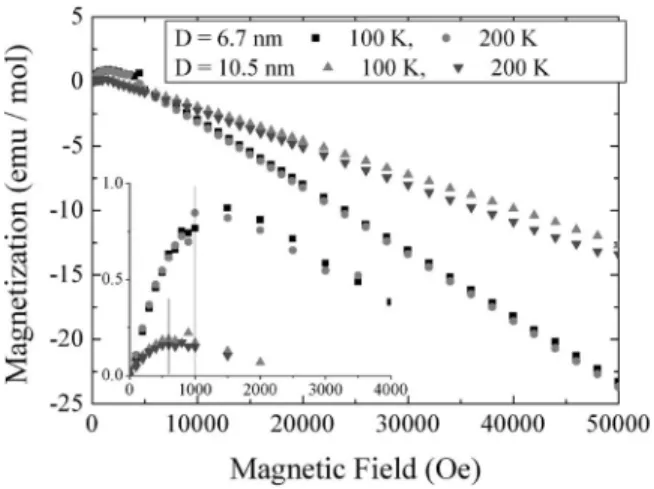
The temperature dependence of magnetic susceptibility is presented in Fig. 1. All the curves of magnetic susceptibil-ity as a function of temperature show a Curie paramagnetism at temperatures lower than 20 K 共see a Curie–Weiss fit in Fig. 1兲. For QDs with the same size of 6.7 nm, the magnetic susceptibility exhibits paramagnetics-diamagnetic interplay with an increase of magnetic field. The observed paramag-netic and diamagparamag-netic behaviors at low fields and at high fields, respectively, are consistent with theoretical calculation.9 By reducing the size of the QDs from 10 to 6.7 nm, the magnetic susceptibility, taken at a low field of 1 kOe, becomes more positive共paramagnetic兲; in contrast, the magnetic susceptibility is more negative 共diamagnetic兲 when data from a high field of 10 kOe are chosen. The re-sults of size dependence of low-field 共1 kOe兲 susceptibility are in good agreement with a recent report of a study on CdSe QDs.4 In addition to a positive shift of magnetic sus-ceptibility at a low field for the smaller QDs, we have real-ized a negative shift of susceptibility at a high magnetic field. The magnetization of QDs at high temperatures is dis-played as a function of magnetic field in Fig. 2. The
magne-tization is positive at a low field, whereas it is a diamagne-tism at a magnetic field higher than 5 kOe. The curves of field dependent magnetization taken at 100 and at 200 K do not change apparently. At a high field of 50 kOe, the nega-tive magnetization is much larger for 6.7 nm PbSe QDs 共smaller QDs兲. The positive magnetization at low fields also seems larger for the smaller QDs 共see the inset in Fig. 2兲. The vertical lines indicate the field where maximum magne-tization is observed. If applied field is higher than the indi-cated field of maximum magnetization, the diamagnetic re-sponse will be superior to the paramagnetic rere-sponse of QDs. Since diamagnetism may break down any possibly magnetic order, we select a field range of lower than the indicated value to carry out the hysteresis loop measurements.
In order to observe the paramagnetic zero-field peak, the differential susceptibility derived from data in Fig. 2 is shown in Fig. 3. The differential susceptibility of PbSe QDs exhibits a positive value near zero field and then decreases to approach a negatively saturated value of susceptibility. The saturated susceptibility is larger than the core diamagnetism of bulk PbSe by several times. The values are about −1.9 FIG. 1. Temperature dependence of magnetic susceptibility of PbSe
quan-tum dots. The diameter共D兲 of PbSe quantum dots and the applied magnetic field共H兲 are labeled in the graph. Solid lines are Curie–Weiss fit of the data.
FIG. 2. Magnetization as a function of magnetic field taken at 100 and 200 K for PbSe quantum dots with two different sizes. The field dependent magnetization in range of low field is reproduced in the inset. The vertical lines point out the field at which maximum value of magnetization is observed.
FIG. 3. The differential susceptibility as a functions of field being calculated from the data shown in Fig. 2共Inset兲. The hysteresis loops of PbSe quantum dots with a diameter of 6.7 nm.
08N708-2 Jian et al. J. Appl. Phys. 99, 08N708共2006兲
[This article is copyrighted as indicated in the article. Reuse of AIP content is subject to the terms at: http://scitation.aip.org/termsconditions. Downloaded to ] IP: 140.113.38.11 On: Thu, 01 May 2014 02:02:38
⫻10−4 and −4.0⫻10−4emu/mol Oe for QDs with sizes of 10.5 and 6.7 nm, respectively. Since a larger field is required to enclose the same amount of magnetic flux for a smaller QD, the fact that a lower field to approach a saturation for the larger PbSe QDs verifies that the magnetic response mainly comes from the QDs. The smaller PbSe QDs give higher paramagnetic zero-field peak and demonstrate a higher value of saturated diamagnetism simultaneously. We conducted measurement of the hysteresis loop from −1 to + 1 kOe as illustrated in the inset of Fig. 3. The magnetiza-tion is estimated in the unit of Bohr magneton per single QD. Unexpectedly, profound hysteresis loops were recorded at both 200 K and room temperature. It therefore suggests that, in the range of low field, ferromagnetic order among the QDs exists even at room temperature.
When the magnetization is estimated on the basis of per PbSe unit cell, its magnitude seems enhanced for smaller QDs. However, we may come to an opposite conclusion in which the magnetization is reduced in the case of 6.7 nm QDs 共smaller QDs兲, as we estimate it on the basis of per single QD. For example, the saturated diamagnetic suscepti-bilities are −1.9 and −4.0 共⫻10−4emu/ mol Oe兲 for QDs with sizes of 10.5 and 6.7 nm, respectively. The magnitude of the saturated diamagnetism is almost inversely propor-tional to squares of diameter共D兲, i.e., D−2. Since the number of PbSe unit cells in a QD is proportional to D3, we come to a conclusion of linear dependence on the diameter共D1兲, for magnetization of a single QD. This conclusion suggests more electrons orbiting in a larger QD and agrees well with theo-retical predictions.
In summary, the magnetic response of PbSe QDs has been studied by measurements of field and temperature de-pendence of magnetic susceptibility. At low temperatures and fields the paramagnetism dominates the contribution of mag-netization, whereas the diamagnetism dominates it at high
temperatures and fields. For smaller PbSe QDs, magnetic susceptibility shifts upward at low fields and shifts to a more negative value at high magnetic fields. The paramagnetic zero-field peak has been observed in the field dependence of differential susceptibility. All of the investigations above im-ply the existence of spontaneous magnetization in the QD. Surprisingly we have also observed profound hysteresis loops, showing a ferromagnetic order among the QDs even at room temperature.
This work was supported by the National Science Coun-cil of R.O.C. under Grant Nos. 2112-M-009-038 and 93-2120-M-009-009, and by NSF CAREER program 共Grant DMR-0449580兲.
1A. P. Alivisatos, Science 271, 933共1996兲.
2L. P. Lévy, D. H. Reich, L. Pfeiffer, and K. West, Physica B 189, 204
共1993兲.
3M. P. Schwarz, D. Grundler, M. Wilde, Ch. Heyn, and D. Heitmann, J.
Appl. Phys. 91, 6875共2002兲.
4S. Neeleshwar, C. L. Chen, C. B. Tsai, Y. Y. Chen, C. C. Chen, S. G. Shyu,
and M. S. Seehra, Phys. Rev. B 71, 201307共2005兲.
5F. von Oppen, Phys. Rev. B 50, 17151共1994兲.
6D. Ullmo, K. Richter, and R. A. Jalabert, Phys. Rev. Lett. 74, 383共1995兲. 7J.-X. Zhu and Z. D. Wang, Phys. Lett. A 203, 144共1995兲.
8Y. H. Zeng, B. Goodman, and R. A. Serota, Phys. Rev. B 47, 15660
共1993兲.
9Y. P. Krasny, N. P. Kovalenko, U. Krey, and L. Jacak, J. Phys.: Condens.
Matter 13, 4341共2001兲.
10C. B. Murray, S. Sun, W. Gaschler, H. Doyle, T. A. Betley, and C. R.
Kagan, IBM J. Res. Dev. 45, 47共2001兲.
11F. Chen, K. L. Stokes, W. Zhou, J. Fang, and C. B. Murray, Mater. Res.
Soc. Symp. Proc. 691, 359共2002兲.
12K.-S. Cho, D. V. Talapin, W. Gaschler, and C. B. Murray, J. Am. Chem.
Soc. 127, 7140共2005兲.
13W. Lu, J. Fang, Y. Ding, and Z. L. Wang, J. Phys. Chem. B共to be
pub-lished兲.
14J. R. Anderson, G. Kido, Y. Nishina, M. Górska, L. Kowalczyk, and Z.
Golacki, Phys. Rev. B 41, 1014共1990兲.
08N708-3 Jian et al. J. Appl. Phys. 99, 08N708共2006兲
[This article is copyrighted as indicated in the article. Reuse of AIP content is subject to the terms at: http://scitation.aip.org/termsconditions. Downloaded to ] IP: 140.113.38.11 On: Thu, 01 May 2014 02:02:38