行政院國家科學委員會
獎勵人文與社會科學領域博士候選人撰寫博士論文
成果報告
訊息影響碳權排放津貼之遞延效果:歐盟排放貿易計畫實證
分析與選擇權定價
核 定 編 號 : NSC 100-2420-H-004-032-DR 獎 勵 期 間 : 100 年 08 月 01 日至 101 年 07 月 31 日 執 行 單 位 : 國立政治大學金融系 指 導 教 授 : 林士貴 博 士 生 : 李章益 公 開 資 訊 : 1.公開資訊:本計畫涉及專利或其他智慧財產權,1 年後可公 開查詢中 華 民 國 103 年 02 月 13 日
‧
國
立
政 治 大
學
‧
N
a
tio
na
l C
h engchi U
ni
ve
rs
it
y
國立政治大學商學院金融學系
博士論文
在馬可夫狀態轉換市場下之
選擇權定價
:雙重
Esscher
transform 下馬可夫可調控高斯 HJM 模型
Valuation Of Options In A Markovian Regime-Switching
Market : Markov-Modulated Gaussian HJM Model by
Double Esscher transform
指導教授: 陳松男、江彌修 博士
研究生:李章益 撰
‧
國
立
政 治 大
學
‧
N
a
tio
na
l C
h engchi U
ni
ve
rs
it
y
Valuation Of Options In A Markovian Regime-Switching
Market : Markov-Modulated Gaussian HJM Model by
Double Esscher transform
Ph.D. Dissertation
Submitted to the Graduate Faculty of National Chengchi University and Department of Money and Banking in Fulfillment of the Requirements for the
Degree of Doctor of Philosophy
in
Department of Money and Banking
National Chengchi University
Advisors: Dr. Son-Nan Chen Dr. Mi-Hsiu Chiang
by Chang-Yi Li
Taipei, Taiwan, Republic of China
‧
國
立
政 治 大
學
‧
N
a
tio
na
l C
h engchi U
ni
ve
rs
it
y
謝 辭
首先誠摯的感謝指導教授陳松男老師,陳老師悉心的教導使我得以一窺金融領域 的深澳,不時的討論並指點我正確的方向,使我在這些年中獲益匪淺。陳老師對 學問的嚴謹更是我輩學習的典範。 感謝口試委員陳松男老師、江彌修老師、徐保鵬學姊、蔡恆修老師及謝明華 老師,由於老師們的指導與建議,使得我的博士論文能更臻完善。 在進入博士班就讀之初,因為從未接觸過任何一門有關財經或經濟的課程, 因此剛開始學習時徬徨無助,但感謝眾位老師的醍醐灌頂、學長姐的加油提攜、 同學的共同砥礪、學弟的相互幫忙使七年的博士班生涯活變得絢麗多彩,其中感 謝廖四郎老師、江彌修老師、林士貴老師,總能在我迷惘時為我解惑,徐保鵬學 姊、蔡宏彬、吳庭斌、周奇勳學長及湯美玲學姊等不厭其煩的指出我研究中的缺 失;感謝連育民學長、陳俊洪學弟、盧淑惠及楊啟鈞同學,你們的幫忙我銘感在 心。 「畢業並非人生的終點,而是另外一種挑戰的開始」,在未來的學術生涯裡, 我將秉持嚴謹的態度,不斷充實自己。 最後,感謝一路走來一直在我身邊支持我的家人及親人、讓我在最辛苦的時 候有所依靠,在本論文完成之屆甚懷念雙親 李德志先生與李陳富美女士養育之 鴻恩,謹以此論文獻給我摯愛的雙親、永懷雙親。 李章益 于政大 民國一零二年九月‧
國
立
政 治 大
學
‧
N
a
tio
na
l C
h engchi U
ni
ve
rs
it
y
i論文摘要
有越來越多的學術研究顯示,在著名的 Black-Scholes 金融市場下幾何布朗運動 並不能描述一些標的資產價數據中,比如標的資產的報酬的分布有厚尾、偏斜、 及波動叢聚的現象,而馬可夫可調控狀態轉換的金融保險模型似乎比相對於經典 的金融保險模型而言,更能貼近現實中的金融數據。在風險的觀點中,馬可夫可 調控的模型有這樣一個優點: 此模型可以隨外界環境 (經濟體的好壞、政府的政 策等) 改變自身模型的風險,使得證劵公司進而可以調整自身的政策。 另外一方面,在傳統上 Esscher transform 的測度轉換架構下,無法有足夠 的自由度(解集合)使得在馬可夫可調控的狀態轉換過程下之資產動態達到平睹過 程的條件,因此本篇論文也致力於發展雙重 Esscher transform 的轉換技巧,使得 標的資產可以使用兩種不同的馬可夫鍊容納吸收來自經濟體雙重影響。 關鍵字: 歐式選擇權,Esscher transform,馬可夫鏈,馬可夫可調控的卜瓦松 過程,波動叢聚‧
國
立
政 治 大
學
‧
N
a
tio
na
l C
h engchi U
ni
ve
rs
it
y
iiAbstract
The celebrated Black-Scholes financial market is based on a geometric Brownian motion to capture the price dynamics of underlying assets. However, a lot of academic studies reveal that this assumption for assets price dynamics cannot provide realistic description for some important empirical behavior of financial returns such as a kurtosis, a skewness, and volatilities clustering the return’s distribution. Compared with the classical risk model or finance model, the Markov-modulated model or Markovian regime-switching model can provide a better fit to the reality data of insurance and finance. In risk or financial theory, regime-switching risk under Markov-modulated process can capture the feature such that changed environment, such as economic growth or recession, government political, which helps the insurance policies of insurance companies to change their policies.
On the other hand, classical Esscher transform cannot provide sufficient degree of freedom, which is solution of set, such that the underlying assets under Markov-modulated regime-switching process are a martingale process. Hence, this paper is also devoted to considering the mythology of double Esscher transform which accommodate two different Markov chain capturing different effects on economics.
Keywords: European options, Esscher transform, Markov-modulated Poisson process, volatilities clustering.
‧
國
立
政 治 大
學
‧
N
a
tio
na
l C
h engchi U
ni
ve
rs
it
y
iii Contents Abstract ... ii Chapter 1 Introduction ... 1Chapter 2 Valuation Of Quanto Options In A Markovian Regime-Switching Market: A Markov-Modulated Gaussian HJM Model ... 5
2.1 Introduction ... 5
2.2 Regime-switching model ... 7
2.3 Risk-neutral Martingale measure via Esscher transform ... 10
2.4 Valuation of European quanto options ... 13
2.5 Conclusions ... 19
Chapter 3 Valuation Of Currency Options Under A Regime-Switching Gaussian HJM Model ... 20
3.1 Introduction ... 20
3.2 Econometric analysis of spot-FX rate markets ... 23
3.3 Econometric analysis of yields and bond market via RSBM ... 35
3.4 European currency options ... 42
3.5 Empirical study and numerical illustration ... 51
3.6 Conclusions ... 57
Chapter 4 Conclusions ... 59
‧
國
立
政 治 大
學
‧
N
a
tio
na
l C
h engchi U
ni
ve
rs
it
y
ivChange of parameters under new measure ... 60
Appendix B of Chapter 2 ... 63
Lemma B ... 63
Case1: Options struck in a foreign currency ... 63
Case 2: A foreign equity call stuck in domestic currency ... 64
Case3: A guaranteed-exchange rate foreign equity call option ... 65
Case 4: An equity-linked foreign exchange call ... 67
Appendix A of Chapter 3 ... 70
Appendix B of Chapter 3 ... 74
‧
國
立
政 治 大
學
‧
N
a
tio
na
l C
h engchi U
ni
ve
rs
it
y
vList of Tables
Table 1: Statistics Of The GBP/USD Spot-FX Rate Returns Starts Form 1
January, 1990 to 30 December, 2011. ... 27
Table2: Estimated Parameters of The BSM, The JDM And The RSJD In The
GBP/USD Spot-FX , The 100JPY/USD and The EUR/USD Spot- FX ... 32
Table 3: Estimated Parameters Of Interest Rates Under Regime-Switching
Brownian Motion. ... 37
Table4 : The Collected Options Prices Under The RSBM Model With
Constant Drift ... 51
‧
國
立
政 治 大
學
‧
N
a
tio
na
l C
h engchi U
ni
ve
rs
it
y
viList of Figures
Figure 1: The daily data for the GBP/USD spot-FX rate starts form 1 January,
1990 to 30 December, 2011. ... 25
Figure 2: The daily data of U.K. and U.S. Zero-coupon yields with maturity
of 1 year starting form from 3 January, 2000 to 30 December 2011. . 39
Figure 3 The call option prices against spot-to-strike staring from 0.7 to 1.3
for T 1 year. ... 54
Figure 4: The call-option prices of the market data and the calibrated prices
( )
R
C t . ( The circles represent market prices, and the pluses denote
‧
國
立
政 治 大
學
‧
N
a
tio
na
l C
h engchi U
ni
ve
rs
it
y
1Chapter 1
Introduction
The classical compound Poisson risk model is broadly known as the classical jump
diffusion model proposed by Merton (1976). In this model claim arrivals as well as
claim sizes are homogemeous in time. However a lot of feature, for example the
interest rates where macroeconomic condition plays a major role in the financial
market ( see Hamilton, J.D., (1989), Garcia and Perron (1996), Evans (1998), and
Bansal and Zhou (2002)). Since it turns out unrealistic use it to model economic grow
and recession, Markov-modulated risk model such as Markov-modulated compound
Poisson risk model, has become more and more popular over the last decades. The
Markov-modulated risk model can capture the feature that underlying assets return
need to change if the environment, such as weather condition economical or political
environment, etc, changes. For instance, in the Markov-modulated compound Poisson
risk model claim size distribution and the intensity of the claim arrival process are
modulated by an irreducible Markov chain with finite state space, and Markov chain
can be seen to describe the change in macro-economic conditions, the changes in
political regime, the impact of economic news and business cycles, etc.
The Markov-modulated risk model in options is first introduced by Naik (1993).
‧
國
立
政 治 大
學
‧
N
a
tio
na
l C
h engchi U
ni
ve
rs
it
y
2Zhang et al. (2012), abd Shen et al. (2013) devote to develop regime-switching option
pricing with Markov chain. Naik (1993) provides an elegant treatment for the pricing
of the European option under a regime-switching model with two regimes. Elliot et al
(2005) provide a quasi explicit price formula corresponding geometric Brownian
motion by occupation time. Mamon and Rodrigo (2005) obtain the explicit solution to
European options in regime-switching economy by considering the solution of PDEs.
Elliott et al (2007) study the price of European option and American option under a
Generalized Esscher transform and a set of coupled partial-differential-integral
equations. Siu et al. (2008) study the price of European option and American option of
spot foreign exchange rate under a two-factor Markov-modulated stochastic volatility
model, and he also considers the option pricing problem in a game theoretical
approach which is found to be consistent with the result of regime-switching Esscher
transform.
However, one important feature for regime-switching pricing options is that the
market is incomplete[ 1 ] and thus, pricing the regime-switching risk becomes a challenge issue . Guo (2001) introduces a set of change-of-state contracts to complete
the market. Then by using the martingale representation technique of double
martingale introduced by Elliott (1976). Shen et al. (2013) show the price of options
1
The no arbitrage price of the derivative security is not unique. For more details see Elliot and Swishchuk (2007)
‧
國
立
政 治 大
學
‧
N
a
tio
na
l C
h engchi U
ni
ve
rs
it
y
3can also be obtained Markovian jump proposed by Zhang et al. (2012) to fixing risk
premium under unique Esscher transform. Hence, we want to find a method to
complete the Markovian regime-switching market with two-kind Markov chain and
study the results of double Esscher transform to complete market. The idea of
completing the Markovian regime-switching is inspired by Elloitt (1976), Gerber and
Shiu (1994), and Bo et al. (2010). We also devote regime-switching jump diffusion
model by Markovian-modulated different jump intensity and adopt the double Esscher
transform corresponding two-kind HJM to price regime-switching options.
In Chapter 2, we consider the valuation of European quanto call options in an
incomplete market where the domestic and foreign forward interest rates are allowed
to exhibit regime shifts under the Heath-Jarrow-Morton (HJM) framework, and the
foreign price dynamics is exogenously driven by a regime switching jump-diffusion
model with Markov-modulated Poisson processes. We derive closed-form solutions
for four different types of quanto call options, which include: options struck in a
foreign currency, a foreign equity call struck in domestic currency, a foreign equity
call option with a guaranteed exchange rate, and an equity-linked foreign
exchange-rate call. In Chapter 3, spot foreign exchange (FX) rates usually exhibit
jumps and regime switching in a finite number of states due to change in
‧
國
立
政 治 大
學
‧
N
a
tio
na
l C
h engchi U
ni
ve
rs
it
y
4model proposed in this paper is modeled by a Markovian system that is capable of
capturing the feature of the dynamic spot-FX rate. We also examine term-structure
data to show that the regime-switching of forward interest rates is distinct from that of
the spot-FX rate, and thereby leading to different associated impacts (or
regime-switching impacts). Hence, a regime-switching Gaussian
Heath-Jarrow-Morton (HJM, (1992)) model is introduced via another Markov chain.
The RSJD model is used along with the forward Esscher-transform technique for the
arbitrage-free condition with which European currency call options are priced under
the Markov-modulated Gaussian HJM model (MMHJM). Empirical study shows that
the RSJD model combined with the MMHJM model is a more complete and
appropriate model for pricing currency options, and the regime-switching impacts of
the spot-FX rate and forward interest rates should be properly taken into account. In
‧
國
立
政 治 大
學
‧
N
a
tio
na
l C
h engchi U
ni
ve
rs
it
y
5Chapter 2
Valuation Of Quanto Options In A
Markovian Regime-Switching Market: A
Markov-Modulated Gaussian HJM Model
2.1 Introduction
Recent works that consider alternative option pricing models have progressed in
various directions: Zumback (2012) explores the valuation of options when
discrete-time ARCH processes drive the underlying asset prices; Xu et al. (2012) price
vulnerable options under a continuous-time jump-diffusion setting; Hsu and Chen
(2012) investigate the valuation of exchange-rate barrier options when interest rates
are driven by a Lévy process. In view of incorporating the regime switching feature
into the pricing model, Hamilton (1989) provides empirical evidence of business
cycles under a regime-shift model of hidden Markov chain, Elliott et al. (2003)
propose a regime-switching Brownian motion model with a Markov-modulated
system that captures the volatilities-clustering feature. Simonato (2011), on the other
hand, computes American option prices under a lognormal jump-diffusion setting
based on a numerical approach.
‧
國
立
政 治 大
學
‧
N
a
tio
na
l C
h engchi U
ni
ve
rs
it
y
6based on the Markov-modulated HJM (MMHJM) model of Valchev (2004) for
interest rates, and the other via the regime switching jump-diffusion model (RSJD) for
foreign stock prices. Existing literature that incorporates either discrete or continuous
regime-shifts in model parameters includes Bansal and Zhou (2002), who develop a
term structure model in which the short rates and the market price of risk are subject
to discrete-time regime shifts, and Zhu (2011), who shows that regime shifts are able
to explain the predictability of excess returns.
When a financial market is incomplete, the pricing measure is not unique. In
order to identify a risk-neutral measure for derivatives pricing under an incomplete
market, Gerber and Shiu (1994) propose the Esscher transform approach that
characterizes the risk-neutral measure by moment-generation functions, and Husmann
and Todorova (2011) apply the equilibrium approach of Jarrow and Madan (1997) to
the case of an incomplete lognormal market. In this paper, we adopt the
regime-switching Esscher transform proposed by that Elliott et al. (2005) to identify
the risk-neutral measure under which quanto call options can be priced.
Other approaches for options pricing that consider the presence of different
sources of risk, such as liquidity and credit, are also worth noting. Sample works in
this category include Ku et al. (2012), where the valuation framework of Leland
‧
國
立
政 治 大
學
‧
N
a
tio
na
l C
h engchi U
ni
ve
rs
it
y
7under an incomplete-market setting when liquidity risk is present; Jarrow (2011), on
the other hand, argues that asymmetric information structure in fact plays an
important role in the determination of credit market equilibrium, and hence affects the
capital structure of a firm.
Subsequent parts of this article are organized as follows: In Section II, while the
domestic and foreign forward interest rates are modeled by a MMHJM model, the
exchange rate is assumed to follow a geometric Brownian motion, and the foreign
stock prices are specified by a RSJD model. In section III, we use the
regime-switching Esscher transform to construct a risk-neutral martingale measure. In
section IV, we derive closed-form solutions for four types of quanto options. The final
section concludes our research findings.
2.2 Regime-switching model
In this section, we first specify the MMHJM model for the domestic and the foreign
forward interest rates, and we also specify the RSJD model that the foreign stock
prices are assumed to follow.
2.2.1 Specifications of Markov chains
According to Elliott et al. (2005)[2], we assume that the state space of Markov chain
2
Elliott et al. (2005) also establish the occupation time of the moment generating function for Markov chain .
‧
國
立
政 治 大
學
‧
N
a
tio
na
l C
h engchi U
ni
ve
rs
it
y
8 is a set of two states:
2 1, (1,0),(0,1)2I e e , which implies respectively, a
boom or a recession (good or bad time) for the state of economy. A continuous-time Markov chain has the transition matrix given as below:
11 11 22 22 ( ) 1 ( ) ( ) 1 ( ) ( ) p t p t t p t p t P . (2.2.1)
A Markov-Modulated Poisson Process (MMPP), ( )t , represents a particular class of doubly-stochastic Poisson processes where the jump intensity is modulated by a Markov chain ( )t . In particular, we consider a set of nonnegative numbers
1, 2
, where i, 1, i 2, denotes the intensity of the Poisson process when aMarkov chain ( )t is at state ei at time t, i.e.,
i ( ,
1 2)ei where the dot ( ) denotes the scalar product. ( )t and ( )t can be defined by the joint probability,( , )
ijn t
( ( )t n, (0) ei, ( ) t ej). The moment-generating function of thejoint probability admits a unique solution ( , )u t such that, ( , )u t
0 ( , ) n n n t u
(1 u)
t exp Ψ Λ , where Λ represents the intensity matrix 1
2 0 0 (cf.
Last and Brandt (1995)). The numerical method for computing ij( , )n t can be found
in Abate and Whitt (1992).
2.2.2 Regime-switching HJM model for the forward interest rates
Let the regime-switching feature of interest rates be represented by a Markov chain
f
‧
國
立
政 治 大
學
‧
N
a
tio
na
l C
h engchi U
ni
ve
rs
it
y
9 space
,
(1, 0), (0,1)
f g hI e e . We use the following notations for the Markov-modulated parameters in the HJM model:
t T, , ( )f t
1( , ), ( , )t T 2 t T
f( )t and
t T, , ( )f t
v
v1,1 t T, , v1,2 t T, ( ), , f t v2,1 t T , v2,2 t T, ( ), , f t v3,1 t T , v3,2 t T, ( )f t
,(2.2.2)where
vm,1
t T, ,
vm,2
t T,
, m1, 2,and 3, represent, respectively, the volatility structures of short-, mid- and long-term interest rates.Following Valchev (2004), the dynamics of forward rates formulated by the MMHJM
model under the physical measure is given by:
, , ( )
, , ( )
, , ( )
( ),k f k f k f k
df t T t t T t v t T t dW t (2.2.3)
where Wk( )t nis a standard Brownian motion, k
D F,
denotes, respectively, a domestic or a foreign country.The domestic and the foreign money market accounts are given by:
, ( )
exp
0t
, ( )
,k t f t r uk f u du
k
D F,
, (2.2.4)where r uk
, ( )
u
f u uk
, , ( )
u
is the spot interest rate.2.2.3 Regime-switching jump diffusion model for stock prices and BSM for spot FX
rate
‧
國
立
政 治 大
學
‧
N
a
tio
na
l C
h engchi U
ni
ve
rs
it
y
10FX. The dynamics of the spot-FX rate under the Black-Scholes framework is given
by:[3] ( ) ( ), (0) 0 ( ) X X D dX t dt d t X X t σ W , (2.2.5)
under the physical measure . Hence the price dynamics of SF( )t under the RSJD
model is found to be:
( ) ( ) exp 1 ( ; ), (0) 0 ( ) F F F F n F F F F dS t dt d t Z d t S S t σ W , (2.2.6)where l an d σl, l
F X,
, are constants, and ( )n k t
W , where k
D F,
, are, respectively, the domestic or the foreign country. A foreign MMPP F( ;t F)isused to model changes in the state of foreign economy. The jump term,
exp Zn 1
dF( ;t F), is a compound Poisson process.Z
n, where n1, 2, 3..., represents a sequence of mutually independent jump sizes. The jump size variableZ
n has a normal distribution with mean
F J, and variance2 ,
F J
. All random
variables are assumed to be mutually independent.
2.3 Risk-neutral Martingale measure via Esscher
transform
In this section, a regime-switching Esscher transform is introduced and applied to the
RSJD model such that the price dynamic process becomes a martingale.
3
We expect that the FX rate should be subject to a (much) weaker regime-switching (RS) impact of the domestic and the foreign interest rates (rDand rF ). By interest rate parity X T( ) /X t( )=
(1rD) /(1rF), the RS effects of the numerator rD and the denominator rF tend to offset with each other, and hence resulting in (much) weaker RS associated with the FX rateX T( ). In addition, by assuming away the RS of the FX rate, we avoid further mathematical complication, and thereby facilitating us to obtain a closed-form pricing model without losing its significance.
‧
國
立
政 治 大
學
‧
N
a
tio
na
l C
h engchi U
ni
ve
rs
it
y
11 2.3.1 Regime-switching Esscher measureThe filtrations of the foreign assets and the spot-FX rate are denoted, respectively, by
F t
S
and
tX . The filtration of hidden Markov chains
F
f is given byf F
T
. The join filtration of the foreign assets (or stocks), the FX rate, the foreign
forward interest rates, and the hidden Markov chain
F
f is denoted by a -algebra given by:
( ) f F SF fk T t t t X t .Two families of regime-switching parameters for the Esscher transform are
denoted, respectively, by θC
u, ( )f u
and J
F( )u
such that ( C,J) ~ on( )t
, and are given as follows:
, ( )
1,1( ), ( )1,2
( ),
2,1( ), ( )2,2
( ),
3,1( ), 3,2( )
( )
C f f C C C f f C C C u u u u u u u u u u u θ θ θ θ θ θ θ , where
( )
1 , 2
( ) J J F J F u
u
t u T T .The foreign regime-switching Esscher transform under the RSJD model takes the
following definition: (cf. Bo et al. 2010)
,( , ) ( ) exp , ( ) ( ) exp ( ) ( ; ) exp ( , ( )) ( ) ( ) exp ( ) ( ; ) ( ) C J T T C J f F F u F F F t t T T C J t f F F u F F t t u u d u u Z d u d d E u u d u t E u Z d u t
θ W θ θ W θ .(2.3.1)‧
國
立
政 治 大
學
‧
N
a
tio
na
l C
h engchi U
ni
ve
rs
it
y
12 ,( C, J) F , where the superscript ‘‘F ’’ indicates the foreign measure, is given as
follows: Theorem 1
, , ( )
T F f u u s u ds
1
2 , , ( ) , ( ) 2 C F u T f u F u f u V σ θ
2 2 1 1 , ( ) 2 2 C F u f u F σ θ and
J ( ) 1
J
( )
0 F F u F F u , (2.3.2) where
, , ( )
, , ( )
T F f F f u u T u
u s u ds V σ , 0 u s T T , denotes thenorm in , and n
F( )u Eexp
uZn 2, , 1 exp( ) 2 F J F J u u is the
moment-generating function of the jump size variable.
Proof (See Appendix A) □
Let SFQ F, ( )T be the time
T
foreign-stock process discounted by the foreign money market account (Fin (2.4)) under the foreign martingale measure F,(C*,, *J ) , and the superscript ‘‘Q F, ’’ denotes for the foreign risk-neutral measure.The process SFQ F, ( )T can be represented as follows:
, , ( ) ( ) Q F Q F F F S T S t
1 2 , exp , ( ) ( ) 2 T T T Q F F f F F F t t t r u u du du d u
σ
σ W , , exp ( ; ) T Q F Q F u F F t Z d u
,(2.3.3)where denotes the Euclidean norm, ,
( )
Q F F u
‧
國
立
政 治 大
學
‧
N
a
tio
na
l C
h engchi U
ni
ve
rs
it
y
13 and Q F, uZ is normally distributed with mean
2 , 1 2F J and variance
F J2, . , ( ; ) Q F F u F therefore admits an new intensity matrix Q F,
F given by: * ,1 , * 2 2 , , 2 , , 2 exp 2 8 ( ) 0 0 ( ) F J F J J F Q F J F F J F F .
In addition, under the risk-neutral measure F,(C*,, *J ), the interest rate in
,
( )
Q F F
S T is modulated by the Markov chain f , while the jump intensities of the
,
( )
Q F F
S T are modulated by the Markov chain
F. Existing empirical studies, such asBansal and Zhou (2002), and Estrella and Hardouvelis (1991), suggest that interest
rates are not only intimately related to business cycles, but also act as economic
leading indicators. In this research we see that the stock-price dynamics are influenced by the effects of regime-switching interest rates via the Markov chain f
associated with the yield curve. This feature is incorporated into the stock-price
dynamics given in (3.3) to capture the changes in economic cycles. This formulation
is also supported by Harvey (1989) who shows that the bond market reveals more
information about future economic growth than the stock market.
2.4 Valuation of European quanto options
Without loss of generality, in the following we shall omit the superscript notation
under the RSJD model for the risk-neutral measure.
‧
國
立
政 治 大
學
‧
N
a
tio
na
l C
h engchi U
ni
ve
rs
it
y
14times of the state of Markov chain f over the option duration
t T . , That is:
2
, , , , 1 , , ( ) , ( ) , ( ) ( , ) T T T i m f i m f i m h h h h t t t V u T u du V u T u du V u T d t T
,where i
D F,
, m1, 2, 3 , and h( ,t T) , h1, 2 , denotes the two-stateoccupation time, and ( 1, 2) denotes the joint probability distribution for the
occupation times
1( , ), ( , )t T
2 t T
, which can be determined by its correspondingmoment-generating function given in Elliott et al. (2005). Therefore, the quanto call
options under study CwRS( ; t f, )n , w =1, 2, 3, 4, depend on the occupation times
and jump number (n).
For simplicity, the price notation CwRS
t; , , 1 2 n ( )t
is replaced by the notation CwRS( ; , )t f n in the pricing models given below. Then, withregime-switching of forward interest rates under the MMHJM model, a European
quanto call option can be expressed in terms of the occupation times given by
Theorem 2: Theorem 2 2 * 1 2 1 2 1 2 0 ( ) F ( , ) ( ; , , ) ( , ) T T RS w i ij w n i t t C t
Q T t n C t
n
d d
, where F i is the stationary state of Markov chain F used as initial value. □ Let
T
be an expiry date of an option and Kk, k
D F,
, be an exercise price.‧
國
立
政 治 大
學
‧
N
a
tio
na
l C
h engchi U
ni
ve
rs
it
y
15Four types of quanto call options CwRS( ; , )t f n ,
w
=1, 2, 3, 4, are considered andgiven by the following four corollaries.
As was observed by Reiner (1992), an investor often hedges against the currency
exposure of his/her foreign-stock investments by a large variety of options. In this
following we provide closed-form solutions for four different types of quanto options
that suffice such hedging needs.
Corollary 1: Options struck in a foreign currency
The domestic currency-denominated terminal payoff of a foreign-equity call option
stuck in foreign currency is given by:
1( ) ( ) F( ) F
C T X T S T K ,
where the terminal payoff of a foreign-stock call option is converted into domestic
currency at the spot exchange rate at expiry.
With the risk of jump and regime-switching interest rates, the arbitrage-free price of
this European quanto call option at time t is equal to
1 ( ; , ) ( ) ( ) ( 1,1) ( , , ( )) ( 1,2) RS f F F F f C t n X t S t d K B t T t d , (2.4.1) where ( ) is a cumulative normal distribution function,
2 1, 2 1 , 2 2 1 , 1 ( ) 1 ln( ) ( , , ( )) , , ( ) , , ( ) 2 F f F J F F T t T t f f F J S t K B t T d u T u du n t u T u du n
ζ ζ‧
國
立
政 治 大
學
‧
N
a
tio
na
l C
h engchi U
ni
ve
rs
it
y
16
1,2 1,1 2 2 1 , , f( ) F J, T t u u d d
ζ T n ,
1
u T
, ,
f( )
u
σ
F
V
F
u T
, ,
f( ) ,
u
and FK = the strike price in foreign currency.
(Proof: See Appendix B, Case1) □ Corollary 2: A foreign equity call struck in domestic currency
An investor wishes to receive a positive payoff from a foreign equity market, but
would like the underlying foreign stock to be denominated in domestic currency at
expiry. The payoff of this type of European quanto call options at expiry
T
is givenby:
2( ) ( ) F( ) D
C T X T S T K .
Then, with the risk of jump and regime-switching interest rates, the arbitrage-free
price of this type of European quanto-call options at time t is equal to
2 ( ; , ) ( ) ( ) ( 2,1) ( , , ( )) ( 2,2) RS f F D D f C t
n X t S t d K B t T
t d (2.4.2) where
2 2 2 , 2 2 2 2,1 , ( ) ( ) 1 ln( ) ( , , ( )) , , ( ) , , ( 2 ) T F D D t T f F J f t f F J u T u n t X t S t du K B u T u du n t T d
ζ ζ
2,2 2,1 2 2 2 , , f( ) F J, T t u u d d
ζ T n , ζ2
u T, ,f( )u
σF σX VD( , ,u T f( ))u and D‧
國
立
政 治 大
學
‧
N
a
tio
na
l C
h engchi U
ni
ve
rs
it
y
17Corollary 3: A foreign equity call option with a guaranteed exchange rate
An investor wishes to capture a positive payoff on his foreign equity investment, but
also desires to eliminate all exchange-rate risk by denominating the foreign payoff in
domestic currency.
The payoff of this type of options at expiry
T
is given by:
3( ) F( ) F
C T S T K ,
where
is the pre-specified exchange rate with which the option’s payoff is converted into domestic currency.With the risk of jump and regime-switching interest rates, the arbitrage-free price of
the call option at time t is equal to
3 ( ; , ) ( , , ( )) RS f D f C t n B t T t
4 3,1 3,2 ( ) exp , , ( ) , , ( ) ( ) ( ) ( , , ( )) T F f F f F F F f t S t u T t u T u du d K d B t T t
V σ (2.4.3) where
4 3,1 2 2 3 , ( ) ln( ) , , ( ) , , ( ) ( , , ( )) , , ( ) T F F f f F F F f t T f F J t S t u T u u T t du K B t T t d u T u du n
ξ V ξ σ
2 2 3 , 2 2 3 , 1 , , ( ) 2 , , ( ) T f F J t T f F J t u T u du n u T u du n
,
2 2 3, 3,2 1 3 , , ( ) , T f F J t d u T u d d
un , and‧
國
立
政 治 大
學
‧
N
a
tio
na
l C
h engchi U
ni
ve
rs
it
y
18
4 u T, , f( )u
σX VF
u T, ,f( )u
VD
u T, ,f( )u
3 u T, , f( )u F F u T, , f( )u
σ V
. (Proof: See Appendix B, Case 3) □Corollary 4: An equity-linked foreign exchange-rate call
Finally, an investor wants to hold a foreign stock whose payoff depends on the payoff
of a foreign-exchange call option. The final payoff of this type of quanto options is
given by:
4( ) F( ) ( ) D C T S T X T K .
With the risk of jump and regime-switching interest rates, the arbitrage-free price of
this quanto call option at time t is equal to
4 ( ; , ) ( ) ( ) ( 4,1) RS f F C t n S t X t d
4
4,2 ( , , ) exp ( , , ( )) , , ( ) ( ) ( , , ) T D f D F F f f F f t B t T K u T u u T u dt d B t T
σ V (2.4.4) where d4,1
4 2 4 ( , , ) ( ) ln ( , , ( )) , , ( ) ( , , ) , , ( ) T F f F f F f D D f t T f t B t T X t u T u u T u du K B t T u T u du
V σ
2 4 2 4 1 , , ( ) 2 , , ( ) T f t T f t u T u du u T u du
, 4,2 4,1 4
, , f( )
2 T t u‧
國
立
政 治 大
學
‧
N
a
tio
na
l C
h engchi U
ni
ve
rs
it
y
192.5 Conclusions
Through a regime-switching Brownian motion, we introduce regime shifts in the
dynamics of zero-coupon yields under a Markov-Modulated HJM (MMHJM) market.
In addition, the price dynamics of foreign stocks are also allowed to exhibit regime
shifts via the regime-switching jump diffusion (RSJD) setting. We adopt the
regime-switching Esscher transform proposed by Elliott et al. (2005) to construct the
risk-neutral measure under which the prices of quanto call options can be found. Our
research findings include explicit closed-form solutions for four different types of
‧
國
立
政 治 大
學
‧
N
a
tio
na
l C
h engchi U
ni
ve
rs
it
y
20Chapter 3
Valuation Of Currency Options Under A
Regime-Switching Gaussian HJM Model
3.1 Introduction
Issues related to currency exchange rates are usually very popular topics that have
been extensively studied in macroeconomics and international finance. Its relevant
derivatives have also been extensively examined over the past decades. Pricing
currency options is first investigated by Biger and Hull (1983) and Garman and
Kohlhangen (1983). They model the dynamics of the spot-FX rate by a geometric
Brownian motion (GBM) with a constant drift and volatility, and derive an explicit
valuation formula for the arbitrage-free price of a European currency option under
constant domestic and foreign interest rates. However, Jorion (1988) examines FX
rates and finds that FX rates exhibit different behaviors with jumps in different time
periods. We observe with evidence showing not only jump but also
time-inhomogeneous features of the GBP/USD, the 100JPY/USD and the EUR/USD
spot-FX rates.
Regime-switching models have recently become more important in financial
‧
國
立
政 治 大
學
‧
N
a
tio
na
l C
h engchi U
ni
ve
rs
it
y
21an exchange rate regime is affected and altered by arrivals of change in
macroeconomic variables, and that currency returns generating process cannot be
characterized by a simple diffusion process. Instead, it should be formulated with a
more complete model such as a jump-diffusion process. Nakatsuma (2000) then
proposes a regime-shift model of daily returns to fit the FX rates of the Asian
currencies which suffered from drastic devaluation during the Asian financial crisis in
1997. He also finds evidence of regime shifts in currency volatility structures. Bollen
et al., (2000) examine the adaptability of regime-switching models for formulating the
dynamics of FX rates, and their analysis suggests that the regime-switching model can
capture the real dynamics of FX rates better than alternative time series models such
as GARCH models. By modeling a regime-switching property, our study provides
evidence indicating that currency returns should be modeled with a regime-switching
jump diffusion (RSJD) model that is embedded with a Markov-modulated Poisson
process (MMPP) to capture an important feature of regime switching found in
currency returns such as the GBP/USD, the 100JPY/USD and the EUR/USD spot-FX
rates.
Stochastic interest rates have been adopted frequently in empirical and academic
research and also well-known to be an important factor for option pricing. Heath et al.
‧
國
立
政 治 大
學
‧
N
a
tio
na
l C
h engchi U
ni
ve
rs
it
y
22(HJM) model. Hamilton and Susmel (1994), Gray (1996), and Dahlquist and Gray
(2000) show that various foreign short-term rates can be well modeled by Markov
processes. Bansal and Zhou (2002) further develop a term structure model where the
short interest rate and the market price of risk are subject to discrete regime shifts. On
derivative pricing with stochastic interest rates, Amin and Jarrow (1991) provide the
valuation of foreign currency options under stochastic interest rates without regard to
regime shifts. Bo et al. (2010) introduce a Markov-modulated jump-diffusion model
(MMJDM) for spot-FX rates to capture both rate events and the time-inhomogeneous
fluctuations in currency markets. They then price currency options using the MMJDM.
However, the MMJDM is unable to capture forward-rate structure information. Since
change in the states of zero-coupon bonds (ZCBs) exhibit a regime-switching
structure, our study incorporates this important feature into the valuation of currency
options. Hence, two families of Markov chain systems are adopted for the HJM model
and the spot-FX rate, which consequently leading to regime-switching risks. In
addition, the RSJD model combined with the MMHJM model is a more complete and
appropriate model for pricing currency options.
This article is organized as follows: Section II provides an economic analysis for
regime-switching GBP/USD FX rate. With statistic descriptions and tests, the RSJD
‧
國
立
政 治 大
學
‧
N
a
tio
na
l C
h engchi U
ni
ve
rs
it
y
23Black-Scholes model (BSM or GBM). In Section III, we investigate empirical data of
zero-coupon yield curves and deal with stochastic forward interest rates under a
regime-switching Gaussian HJM model. In Section IV, the RSJD model is
accommodated with Markovian systems of stochastic interest rates. In addition, we
apply the forward Esscher transform with a regime-switching condition under which
currency options on a spot-FX rate can be valued. Section V provides empirical study
showing that regime-switching risk exhibits a significant impact on prices of currency
options. The final section concludes the results.
3.2 Econometric analysis of spot-FX rate markets
In this section, we investigate spot-FX rates to find evidence of regime-switching risk
with the proposed Markov-chain system. The volatilities clustering feature of spot-FX
rates shows time-inhomogeneous fluctuations in different time periods, as implied by
different jump intensities that sometimes exhibit high or low intensities due to change
in the state of the economy or financial crises. In addition, a model can be used to
formularize autocorrelations by a Markovian system that is able to capture the
volatilities clustering feature of spot-FX rates (Timmermann (2000)). Hence, we
propose the RSJD model with two-state Markov chain to modulate jump intensities.
‧
國
立
政 治 大
學
‧
N
a
tio
na
l C
h engchi U
ni
ve
rs
it
y
24We note that the time-inhomogeneous fluctuation feature in a spot-FX rate is due to
regime-switching jumps. To show it, the daily data of the GBP/USD spot-FX rate and
the 100JPY/USD spot-FX rates are collected form 1 January, 1990 to 30 December,
2011, and the EUR/USD spot-FX rate is collected form 3 January, 2000 to 30
December, 2011.
Panel A: The dynamics of the GBP/USD spot-FX rates.
Panel B: The returns dynamics of the GBP/USD spot-FX rate returns.
Panel C: The dynamic returns of the squared GBP/USD spot-FX rates.
12/90 12/91 12/92 12/93 12/94 12/95 12/96 12/97 12/98 12/99 12/00 12/01 12/02 12/03 12/04 12/05 12/06 12/07 12/08 12/09 12/10 12/11 1.3 1.4 1.5 1.6 1.7 1.8 1.9 2 2.1 2.2 12/90 12/91 12/92 12/93 12/94 12/95 12/96 12/97 12/98 12/99 12/00 12/01 12/02 12/03 12/04 12/05 12/06 12/07 12/08 12/09 12/10 12/11 -0.05 -0.04 -0.03 -0.02 -0.01 0 0.01 0.02 0.03 0.04 12/90 12/91 12/92 12/93 12/94 12/95 12/96 12/97 12/98 12/99 12/00 12/01 12/02 12/03 12/04 12/05 12/06 12/07 12/08 12/09 12/10 12/11 0 0.5 1 1.5 2 x 10⁻³
‧
國
立
政 治 大
學
‧
N
a
tio
na
l C
h engchi U
ni
ve
rs
it
y
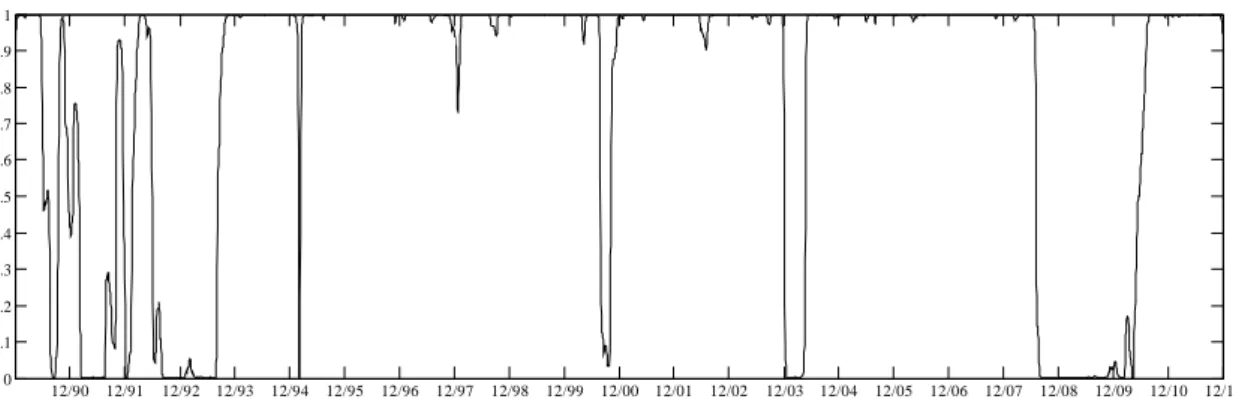
25Panel D: The probabilistic dynamics of low intensity
1 with spot-FX rate GBP/USD returns under the RSJD model.Figure 1: The daily data for the GBP/USD spot-FX rate starts form 1 January, 1990
to 30 December, 2011.
Figure1 exhibits evidence of jumps and the time-inhomogeneous fluctuations in the
GBP/USD spot-FX rate. In Panel A of Figure 1, the spot-FX rate shows two different
regions of time-inhomogeneous fluctuations during four time periods,
01/1990-12/1993, 01/1994-12/1999, 01/2000-12/2007, and 01/2008-12/2011. Panel B
provides evidence of different volatilities during the four time periods; the time
periods 01/1990-12/1993 and 01/2008-12/2011 show higher volatility than the other
two periods. Higher volatilities in these two periods are induced, respectively, by the
Oil crisis and the subprime lending crisis. The financial crises with information lag
lead to alternate high and low jump intensities with high and low volatilities. In
addition, the high and low volatilities reveal strong evidence of time-inhomogeneous
12/90 12/91 12/92 12/93 12/94 12/95 12/96 12/97 12/98 12/99 12/00 12/01 12/02 12/03 12/04 12/05 12/06 12/07 12/08 12/09 12/10 12/11 0 0.1 0.2 0.3 0.4 0.5 0.6 0.7 0.8 0.9 1
‧
國
立
政 治 大
學
‧
N
a
tio
na
l C
h engchi U
ni
ve
rs
it
y
26fluctuations in the spot-FX rate. Furthermore, Panel C of Figure 1 reports the returns
dynamics of the squared GBP/USD spot-FX rate against time. It shows clearly that
not only there are jump trends, but also there exists a different degree of jumps with
‧
國
立
政 治 大
學
‧
N
a
tio
na
l C
h engchi U
ni
ve
rs
it
y
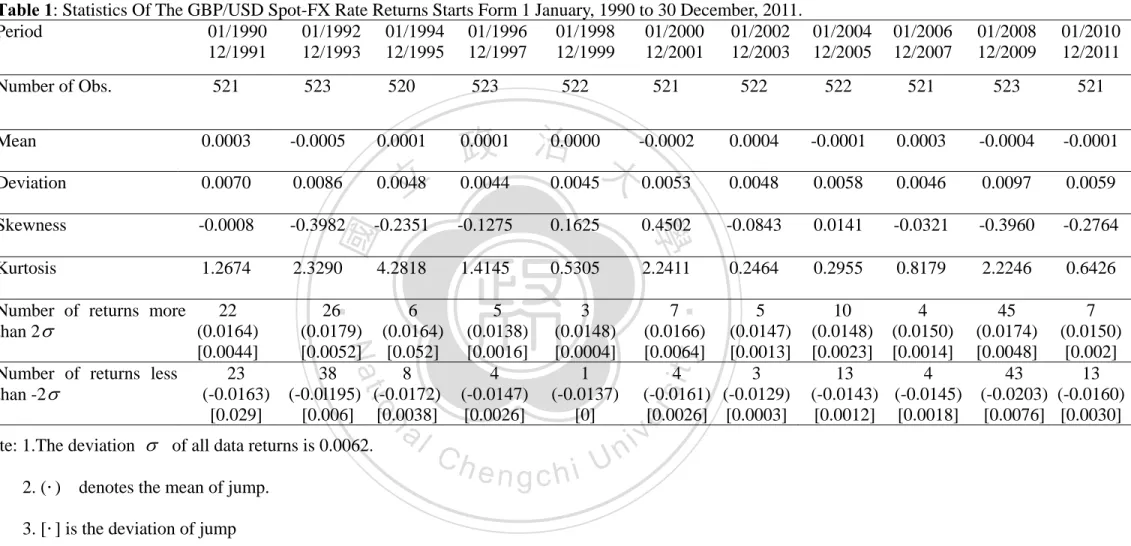
27Table 1: Statistics Of The GBP/USD Spot-FX Rate Returns Starts Form 1 January, 1990 to 30 December, 2011. Period 01/1990 12/1991 01/1992 12/1993 01/1994 12/1995 01/1996 12/1997 01/1998 12/1999 01/2000 12/2001 01/2002 12/2003 01/2004 12/2005 01/2006 12/2007 01/2008 12/2009 01/2010 12/2011 Number of Obs. 521 523 520 523 522 521 522 522 521 523 521 Mean 0.0003 -0.0005 0.0001 0.0001 0.0000 -0.0002 0.0004 -0.0001 0.0003 -0.0004 -0.0001 Deviation 0.0070 0.0086 0.0048 0.0044 0.0045 0.0053 0.0048 0.0058 0.0046 0.0097 0.0059 Skewness -0.0008 -0.3982 -0.2351 -0.1275 0.1625 0.4502 -0.0843 0.0141 -0.0321 -0.3960 -0.2764 Kurtosis 1.2674 2.3290 4.2818 1.4145 0.5305 2.2411 0.2464 0.2955 0.8179 2.2246 0.6426
Number of returns more than 2
22 (0.0164) [0.0044] 26 (0.0179) [0.0052] 6 (0.0164) [0.052] 5 (0.0138) [0.0016] 3 (0.0148) [0.0004] 7 (0.0166) [0.0064] 5 (0.0147) [0.0013] 10 (0.0148) [0.0023] 4 (0.0150) [0.0014] 45 (0.0174) [0.0048] 7 (0.0150) [0.002] Number of returns lessthan -2
23 (-0.0163) [0.029] 38 (-0.0l195) [0.006] 8 (-0.0172) [0.0038] 4 (-0.0147) [0.0026] 1 (-0.0137) [0] 4 (-0.0161) [0.0026] 3 (-0.0129) [0.0003] 13 (-0.0143) [0.0012] 4 (-0.0145) [0.0018] 43 (-0.0203) [0.0076] 13 (-0.0160) [0.0030] Note: 1.The deviation
of all data returns is 0.0062.2. (
) denotes the mean of jump. 3. [
] is the deviation of jump‧
國
立
政 治 大
學
‧
N
a
tio
na
l C
h engchi U
ni
ve
rs
it
y
28The descriptive statistics of GBP/USD spot-FX returns rate are reported for every two-year period in Table 1. Jumps are identified as follows: returns that are more than two standard deviations (2 ) or less than 2 from the mean are identified as jumps. Notice that a high number of jumps is associated with a high jump intensity, and vice versa, which implies that the spot-FX dynamics has two jump intensities (high and low) due to change in the state of the economy. The above result for the GBP/USD spot-FX rate carries over to the 100JPY/USD spot-FX rate and the EUR/USD spot-FX rate.
Based on the above observed phenomena of the spot-FX rate data, a hidden Markovian process is employed to formulate regime switching as an important feature for modeling the spot-FX rate dynamics, which also specifically considers jump sizes and their intensities. Hence, in the next subsections, the spot-FX rate dynamics is formulated with the RSJD model modulated by Markov chain. We then provide the estimated parameters and the test statistics for the BSM, the JDM, and the RSJD models based on the GBP/USD, the 100JPY/USD and the EUR/USD spot-FX rates. In addition, a regime-switching jump diffusion model is also established for spot-FX rates.
3.2.2 Regime-switching jump diffusion model for the spot-FX rate
A complete probability space is denoted by
, ,
with a real probability measure ,and a finite time is specified by 0, T in the continuous-time setting.
( )
t TY Y t is a continuous-time, finite-state Markov chain defined on the actual probability space
, ,
. We take the state space of Y to be a finite state set
21, 2 (1, 0), (0, 1)
Y
‧
國
立
政 治 大
學
‧
N
a
tio
na
l C
h engchi U
ni
ve
rs
it
y
29bad time) for the state of the economy. Hence, the RSJD model of the spot-FX rate ( )
S t under the actual measure is proposed and given by:
( ) ( ) exp( ) 1 ( ), (0) 0 ( ) S n dS t dt dW t Z d t S S t (3.2.1)where and
S are constants, W t( ) is Brownian motion, ( )t is a MMPP,and the term,
eZn 1
d( )t , is a compound Poisson process.n
Z
n1
represents a sequence of mutually independent jump variables. The jump variable Zn has a normal distribution with mean
J and variance2
J
. Moreover, the MMPP ( )t
modulated by Markov chain Y has low and high jump intensity of the Poisson process denoted, respectively, by , i i1, 2. The ’s are governed by change in i the state ei of the economy modeled by Markov chain Y at time t. Specifically, we have the i
1, 2
ei , 1, i 2, where the dot ( ) denotes the scalar product, and the MMPP is governed by continuous-time Markov chain Y with a transition matrix given below:
11 11 22 22 ( ) 1 ( ) ( ) 1 ( ) ( ) Y Y Y Y Y Y p t p t t t p t p t P exp Ψ . (3.2.2) where 1 1 2 2 Y a a a a Ψ denotes a transition-rate matrix of Markov chain Y t( )
whose element
a
i,
1, i 2, represents the transition rate of the process leaving from state eiIY to the other state e , andj
a
i is the transition rate of staying at state ei.‧
國
立
政 治 大
學
‧
N
a
tio
na
l C
h engchi U
ni
ve
rs
it
y
30 ( , ) ij n t . Then, we have the following proposition.
Proposition 1 Under the Kolmogorov's forward equation, the moment-generating
function of the joint probability has a unique solution
0 ( , ) ( , ) n Y (1 ) n u t n t u u t
exp Ψ Λ ,where the is an intensity matrix 1
2 0 0 of the MMPP, and
0 ! n n A A n
exp , Ais a square matrix. □ The above proposition is established in Last and Brandt (1995). The ( , )u t can be used to provide estimated value to the joint probabilities ( , )n t of the MMPP. The numerical method for computing ( , )n t is proposed by Abate and Whitt (1992).Note that the RSJD model in (2.2) reduces to the JDM when
1 2 , and is given by:
ex
1 ( p ) ( ( ) ( ), (0) 0 ( ) S n) 1 dS t dt dW t dN t S S t Z . (3.2.3)where N t1( ) is a Poisson process with constant intensity
1. The RSJD model without regard to the jump term
eZn1
d( )tbecomes the well-known BSM given as follows:
( ) ( ), (0) 0 ( ) S dS t dt dW t S S t . (3.2.4)
3.2.3 Empirical analysis: the GBP/USD Foreign Exchange rate
We estimate the parameters of the discrete-time BSM, the JDM, and the RSJD models, and test the models empirically using the likelihood ratio test (LRT). The RSJD
‧
國
立
政 治 大
學
‧
N
a
tio
na
l C
h engchi U
ni
ve
rs
it
y
31parameters are estimated using the maximum likelihood method with the Expectation Maximization algorithm (EM, Dempster et al. (1977)) and a gradient algorithm (Lange, (1995)). [ 4 ] Their standard errors are estimated using Supplemented Expectation Maximization algorithm (SEM, Meng et al. (1991)).
4
For details, see the text book: McLachlan and Krishnan 2008, The EM algorithm and extensions. John Wiley & Sons, Inc, Hoboken, New Jersey.