www.elsevier.com / locate / chroma
Analysis of coptisine, berberine and palmatine in adulterated
Chinese medicine by capillary electrophoresis–electrospray ion trap
mass spectrometry
a b a ,
*
Yet Ran Chen , Kuo Ching Wen , Guor Rong Her
a
Department of Chemistry, National Taiwan University, Taipei, Taiwan
b
National Laboratories of Food and Drugs, Department of Health, Executive Yuan, Taipei, Taiwan Received 1 June 1999; received in revised form 11 October 1999; accepted 13 October 1999
Abstract
Chinese medicine preparations contaminated with coptisine, berberine and palmatine were studied by capillary electrophoresis–electrospray ion trap mass spectrometry. The dubious adulterants were identified by their retention times, molecular ions and specific fragment ions produced from collision induced dissociation. The results showed that, in comparison with CE–UV and capillary electrophoresis–electrospray mass spectrometry (CE–ESI-MS), more reliable identification could be achieved with CE–ESI-MS–MS using ion trap mass spectrometry. 2000 Elsevier Science B.V. All rights reserved.
Keywords: Pharmaceutical analysis; Coptisine; Berberine; Palmatine; Alkaloids
1. Introduction obtain and thus reliable compound identification is
difficult.
It is not very uncommon to see traditional Chinese Because of its low detection limit, high specificity medicine illegally adulterated by the addition of and more importantly abundant structural informa-synthetic chemical drugs. Recently, methods based tion, mass spectrometry (MS) has been considered as on high-performance liquid chromatography (HPLC) one of the ideal methods for chromatographic de-[1–12] and capillary electrophoresis (CE) [13–20] tection [21–23]. The merits of using MS as the have been developed for the analysis of these chromatographic detector are best demonstrated with adulterants in Chinese medicine. In comparison with the highly successful gas chromatography (GC)–MS. HPLC, CE often provides excellent separation ef- The coupling of HPLC or CE with MS has been a ficiency and short analysis time. However, owing to much more difficult task than the interfacing of GC the often-unavoidable capillary surface modification with MS; however, recent developments in MS such resulting from the complex Chinese medicine prepa- as electrospray ionization (ESI) [24–27] and atmos-ration, reproducible migration times are difficult to pheric pressure chemical ionization (APCI) make the
coupling of CE with MS much easier [28–32]. In Taiwan, the herbs used in the preparation of *Corresponding author. Tel.: 1886-2-2369-0152 ext. 109; fax:
1886-2-2363-8058. Chinese medicine have to be approved and also
0021-9673 / 00 / $ – see front matter 2000 Elsevier Science B.V. All rights reserved. P I I : S 0 0 2 1 - 9 6 7 3 ( 9 9 ) 0 1 1 1 5 - 2
The CE–MS interface utilizes a triaxial flow Methanol, ammonium acetate, acetic acid were of arrangement whereby CE eluent is mixed with a chromatographic grade from J.T. Baker (Phillips- suitable sheath liquid at the tip and nebulized by burg, NJ, USA). Deionized (18 MV) water (Milli-Q nitrogen gas. CE columns were 70 cm long. High water system, Millipore, Bedford, MA, USA) was voltage applied on the buffer reservoir was 24.5 kV. used in the preparation of the samples and buffer With a 14.5 kV ESI voltage applied on the outlet of solution. Berberine and palmatine chloride were the separation column, the potential difference dur-obtained form Sigma (St. Louis, MO, USA), cop- ing the analysis was about 20 kV for CE–ESI-MS tisine chloride was obtained from Nacalai Tesque analysis. For the purpose of electrical contact, a (Kyoto, Japan). Coptisine, berberine and palmatine sheath liquid was delivered at a flow-rate of 5 ml / standard solutions were prepared by dissolving 1.2 min by a syringe pump. The mass spectrometer was mg powder in 5 ml of 70% aqueous methanol. operated in the positive ion mode and data were collected by selected ion monitoring (SIM) for CE– 2.2. Preparation of sample extract
Powder of ‘‘wuyoufun-13’’ was purchased from a local drug store in Taipei. A sample of ca. 10 g was extracted with 50 ml 70% methanol and filtered with No. 1 filter paper. The extract was dried and dissolved in 5 ml 70% methanol and filtered with a 0.45-mm filter.
2.3. CE–UV system
The CE system was constructed in the laboratory and had been described elsewhere [35]. CE columns were fused-silica capillaries (Polymicro
Tech-nologies, Phoenix, AZ, USA) of 85 cm (70 cm to the Fig. 1. CE–UV electropherogram of coptisine, berberine and palmatine. A 85 cm (70 cm effective length)350 mm I.D. fused-detector)350 mm I.D.3375 mm O.D. A small area of
silica capillary tubing was used with 50 mM ammonium acetate at the polyimide coating was burned off to form a
pH 3.8 as running buffer. The potential was 120 kV and the window for UV detection. On column detection was detection wavelength was 230 nm. Sample (33 ppm) was injected performed on an UV detector (UV-C Rainin, hydrodynamically 15 mbar for 10 s. Peaks were assigned as (1) Emeryville, CA, USA) operated at 230 nm. The coptisine, (2) berberine and (3) palmatine.
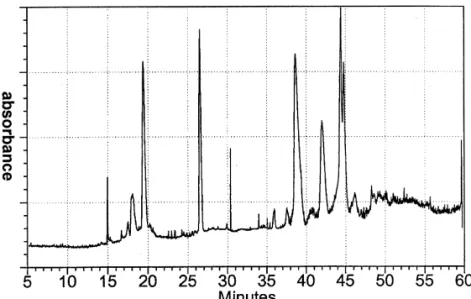
Fig. 2. CE–UV electropherogram of Chinese medicine possibly contaminated with coptisine, berberine and palmatine. Conditions as in Fig. 1.
Fig. 3. CE–ESI-MS electropherograms of coptisine, berberine and palmatine. Sheath liquid composition was methanol–water (80:20) containing 1% acetic acid. The potential used for CE separation was 124 kV and the ESI voltage was 14.5 kV. SIM5Selected ion monitoring; TIC5total ion current.
1). CE–UV analysis of the crude extract that was
possibly contaminated with small amount of cop- ESI is a soft ionization method and the ESI mass tisine, berberine and palmatine is shown in Fig. 2. spectra of coptisine, berberine and palmatine are Although the electropherogram of the extract was characterized with molecular ions with fragment ions more complicated than the standards, two peaks with of low abundance. CE–ESI-MS analysis of coptisine, similar a retention time to berberine (about 18 min) berberine and palmatine is shown in Fig. 3. Three and palmatine (about 19 min) were observed. The peaks were observed in the ion electropherogram of
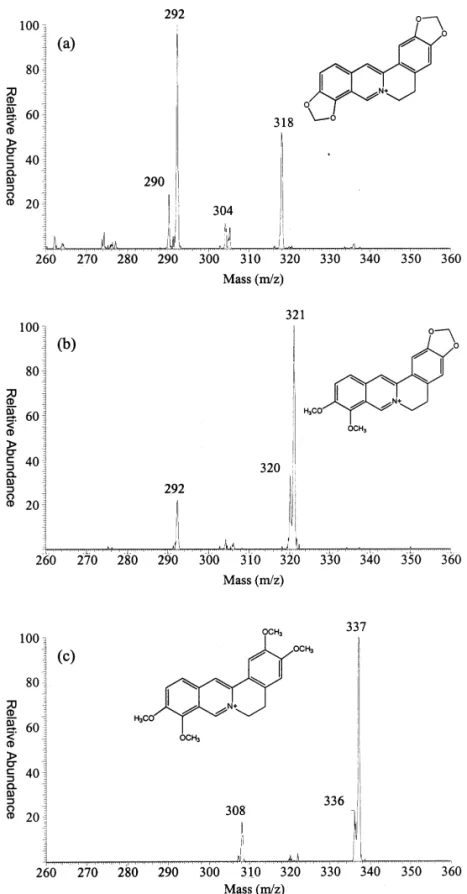
and palmatine are shown in Fig. 5. The three most This is not unexpected considering the similarity in abundant and also characteristic fragment ions were the structures of coptisine, berberine and palmatine. selected for CE–ESI-MS–MS analysis. The analysis Because of the very similar UV and ESI sensitivity of coptisine, berberine and palmatine by CE–ESI- and the much higher specificity in ESI-MS–MS, the MS–MS is shown in Fig. 6. In comparison with the larger peak, which was tentatively identified as data of CE–ESI-MS, only one peak was observed in palmatine in CE–UV analysis, is very likely
con-Fig. 6. CE–ESI-MS–MS electropherograms of coptisine, berberine and palmatine. The collision-induced dissociation (CID) fragmentation
Fig. 7. CE–ESI-MS–MS analysis of the Chinese medicine possibly contaminated with coptisine, berberine and palmatine. Conditions as in Fig. 6.
taining more than one component. Another advan- 4. Conclusions tage of using mass spectrometry as the detector is
demonstrated in the analysis of the minor com- In this paper, a practical solution of analyzing ponent, coptisine. This compound is identified un- dubious adulterants coptisine, berberine and pal-ambiguously by CE–ESI-MS–MS whereas the pres- matine in Chinese medicine ‘‘wuyoufun-13’’ has ence of this compound in the extract is not very clear been demonstrated. Without extensive sample clean-in CE–UV analysis. ing and preparation, the active ingredients of Cop-All the herbs listed in wuyoufun-13 had been tidis rhisoma in contaminated ‘‘wuyoufun-13’’ were analyzed and no protoberberine alkaloid was found identified by the combination of CE with ESI-MS– [36]. The concentrations of coptisine, berberine and MS. The use of ESI-MS–MS instead of UV as the palmatine in the sample were 14 ppm, 50 ppm and detector provides qualitative analysis with higher 17 ppm, respectively. These concentrations are not quality. Furthermore, the problem resulting from the high enough to have significant medical effect. complexity of crude extract such as the complicated Considering the price of purchasing the isolated electropherogram and poor retention time reproduci-alkaloids and the difficulty of organic synthesis, it is bility can be overcome by the coupling of CE with more likely that the sample is contaminated by an ESI-MS–MS.
herb containing coptisine, berberine and palmatine. Although several Chinese herbs contain
protober-berine alkaloids. The herb is believed to be Coptidis References rhizoma because only Coptidis rhizoma contains all
[11] R. Zheng, G. Li, Zhongcaoyao 24 (1993) 265. 645 (1988) 313.
[12] S. Liu, W. Ma, X. Tang, D. Cheng, Zhongcaoyao 25 (1994) [31] M.S. Kriger, K.D. Cook, Anal. Chem. 67 (1995) 385. 355. [32] Y. Takada, M. Sakairi, H. Koizumi, Anal. Chem. 67 (1995) [13] T.C. Wu, S.J. Sheu, Chin. Pharm. J. 45 (1993) 157. 1474.
[14] X. Qiu, C. Wu, B. Chen, Yaoxue Xuebao 21 (1986) 458. [33] T. Sawada, J. Yamahara, K. Goto, M. Yamamura, Yao Hsueh [15] S.J. Sheu, C.F. Lu, J. High Resolut. Chromatogr. 19 (1996) Pao 25 (1971) 74.
409. [34] J. Haginiwa, M. Harada, Shoyakugaku Zasshi 82 (1962) 726. [16] Y.R. Ku, M.J. Tsai, K.C. Wen, Yaowu Shipin Fenxi 3 (1995) [35] C.Y. Tsai, G.R. Her, J. Chromatogr. A 743 (1996) 315.
185. [36] Thin-Layer Chromatography of Chinese Medicine, Vol. 6,
[17] S.J. Sheu, J. Chinese Chem. Soc. 54 (1996) 55. National Laboratories of Food and Drugs, Department of [18] H.M. Liebich, R. Lehmann, C. Di Stefano, H.U. Haring, J.H. Health, Executive Yuan, Taiwan, 1994.