國立交通大學
統計學研究所
碩士論文
有關近視眼研究的統計方法
Statistical Analysis for Studying
the Progression of Myopia
研究生:傅驛爲
指導教授:王維菁 教授
有關近視眼研究的統計方法
Statistical Analysis for Studying
the Progression of Myopia
研究生:傅驛爲 Student:Yi-Wei Fu
指導教授:王維菁 教授 Advisor:Dr. Wei-jing Wang
國立交通大學
統計學研究所
碩士論文
A Thesis
Submitted to Institute of Statistics College of Science
National Chiao Tung University in partial Fulfillment of the Requirements
for the Degree of Master
in Statistics June 2014
Hsinchu, Taiwan, Republic of China
有關近視眼研究的統計方法
研究生:傅驛爲 指導教授:王維菁 教授
國立交通大學理學院
統計學研究所
摘要
在科技進步的現代社會,近視已是日趨嚴重的公衛問題,不僅盛行率增
加,發生年齡亦下降,其中又以華人社會最為嚴重。同時眼科醫學亦著力
於近視的預防與治療。在近視眼的研究中,統計分析是不可或缺的角色。
本論文整理了有助於近視研究的統計方法,內容包含:最常見的橫斷面研
究,可找出近視的風險因子
;
利用分析長期追蹤資料,探討近視度數演進
的變化。此外眼科測度為“成對”但彼此相關的資料,存活分析可以用來探討
眼睛發生重要 “事件” 所需的時間長度。我們亦回顧了台灣、新加坡及其他
地區所發表有關於近視眼研究的醫學文獻,並整理這些論文使用的統計方
法。最後我們以統計的角度,建議了未來研究可採用的方法。
關鍵詞:
盛行率
、橫斷面研究
、長期追蹤研究
、存活分析
iStatistical Analysis for Studying
the Progression of Myopia
Student:Yi-Wei Fu Advisor:Dr. Wei-jing Wang
Institute of Statistics
National Chiao Tung University
ABSTRACT
Nowadays myopia has become a global critical health problem, especially in
Chinese community. Statistical analysis plays an important role in myopia
research. In the thesis, we investigate related statistical methods, including
cross-sectional studies for identifying possible risk factors for myopia and
longitudinal studies for studying the evolution of myopia. Eye measurements are
“paired” observations so that we review methods for analyzing such data.
Furthermore survival analysis can also be applied to study critical event times
such as the onset of myopia. We also review medical literature on myopia, most
of which are recent empirical studies in Taiwan and Singapore. At the end of the
thesis, we provide some suggestions for future research from the viewpoint of
statistical analysis.
Keywords: cross-sectional study, longitudinal study, prevalence rate, survival
analysis
誌 謝
本論文可以順利的完成,首先我要感謝王維菁教授,在與老師作研究的
過程中,老師教導了我如何從統計的角度來看待科學問題,進而培養正確
的研究態度及方法,並適時地提醒我如何將龐大的資料作整合,接著以簡
單明瞭的方式呈現出來是相當重要的能力,非常感謝老師這一年多來的教
誨;也感謝所有統計所上所有的教授這兩年來的指導,讓我看到統計的不
同面向並學習到許多統計工具;感謝郭姐及怡君姐,時常給予生活上或學
業上的建議和叮嚀,並協助處理設備的問題;最後感謝研究室裡和我一起
努力的同學們,除了在課業上的交流討論,也經常給予我精神上的鼓勵。
本論文的完成同時也代表著我將踏入人生的另一個階段,期許能將所學
發揮在自己的領域,並保持自己在研究所生涯中培養的統計思維及熱情。
希望能將完成此論文的滿足和快樂分享給所有曾經幫助和關心我的人。
傅驛爲 謹誌
2014年 6月
于交通大學統計學研究所
iiiContents
中文摘要 ... i
英文摘要 ... ii
誌謝 ... iii
Contents ... iv
Tables ... vi
Figures ... vii
1 Introduction ... 1
1.1 Motivation... 11.2 Outline of the Thesis ... 2
2 Medical background on Myopia ... 3
2.1 Introduction of Myopia - Medical Background ... 3
3 Literature Review on Related Statistical Methods ... 5
3.1 Methods for Cross-sectional Studies ... 5
3.2 Methods for Longitudinal Studies ... 8
3.3 Survival Analysis ... 9
3.4 Methods for analyzing paired data ... 14
4 Statistical Applications in Myopia Research ... 16
4.1 Myopia research in Taiwan ... 16
4.2 Myopia Research in Singapore ... 17
4.3 Studying Risk Factors on Myopia of Different Severity ... 17
4.4 A Longitudinal Study for Predicting Myopia ... 19
4.5 Myopia and other eye diseases ... 20
5 Our Suggestions on Statistical Analysis ... 21
References ... 23
附 錄 眼科醫學名詞之中譯 ... 25
Tables
Table 1 General criteria of AUC ... 8
Figures
Figure 1 The phenomenon of Myopia ... 1
Figure 2 ROC curve and the best cut-off point ... 7
Figure 3
Construction of the mass interval censored data and the idea of self-consistency. .. 13
Chapter 1: Introduction
1.1 Motivation
Myopia affects many school-aged children nowadays. As technology advances in a very
fast speed, fancy electronic products are becoming more and more popular for children. At the
same time, the prevalence of myopia increases while its onset age decreases. Thus myopia
prevention and control have become important health issues. In the thesis, we will examine
statistical methods which can be used in myopia research and hope that our analysis can help
clinicians to adopt suitable methods for analyzing their datasets.
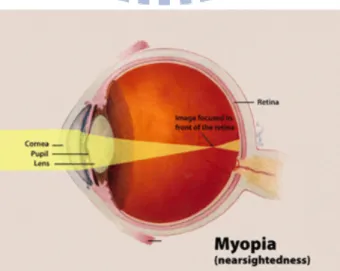
The following descriptions about myopia are summarized from Wikipedia. Myopia,
commonly known as being “nearsighted” or “shortsighted”, is a condition of the eye where the light that comes in does not directly focus on the retina but in front of it. As a result, the image that one sees when looking at a distant object to be out of focus, but in focus when looking at a close object. Youth onset myopia occurs in the early childhood or teenage, and the ocular power can keep varying until the age of 21. In some parts of Asia, myopia is very common. Singapore is believed to have the highest prevalence of myopia in the world; up to 80% of people there have myopia, but the accurate figure is unknown.
Figure 1: The phenomenon of Myopia 1
Data collected for myopia studies often involve complicated data structures and therefore
provide an abundant area for statistical applications. Besides studies based on cross-sectional
data, the development of myopia can be investigated via longitudinal follow-up. The
problems of interests such as the onset age, the gap time between two clinical stages … etc.
can be formulated under the framework of survival analysis. Ocular measurements are paired
observations. To use the information of one eye or both eyes requires special attentions. In the
thesis, we will first review the related methodology in separate domains. Then we will review
existing medical literature on myopia most of which, however, use only elementary statistical
methods. After presenting all the methods and showing some examples, we will give our
suggestions.
1.2 Outline of the Thesis
Here is the outline of the thesis. In the second chapter, we introduce some medical
background for myopia studies. In Chapter 3, we review statistical methods developed in
separate areas including longitudinal data analysis and survival analysis and methods for
analyzing paired data. In Chapter 4, we review some medical papers on studies of myopia.
Chapter 5 contains our suggestions for the future study.
Chapter 2: Medical background on Myopia
2.1 Introduction of Myopia - Medical Background
Myopia is a type of refractive error. Refraction is the ability of crystalline lens that refractes
light to focus on retina. If the focal point lies in front of the retina, it’s called myopia which is
shown in Figure 1. The common medical definition of myopia is based on spherical
equivalent to be at least -0.5D. According to spherical equivalent, children’s myopia can be
classified as higher myopia (SE≦-3.0 diopters) and lower myopia (-3.0<SE≦-0.5 diopters).
In myopia studies, researchers may also collect other biological measures, including
cycloplegic autorefraction, keratometry, axial eye length, anterior chamber depth, crystalline
lens thickness and vitreous chamber depth … etc. These measures provide useful information
for assessing the conditions of eyes. Many studies focus on investigating the relationships
between myopia and these measures.
It has been known that common risk factors of myopia include race, heredity and
environment influences. In respect of race, French AM et al. (2013) discover that the chance
of Asian children to have myopia (6.9% to 7.3%) is higher than Caucasian children (1.3% to
2.9%) in Australia. In addition, the incidence of myopia for 5 to 12 years old children is
14.1% in Shanghai and that for 5 to 16 years old children in Hong Kong is 14.4%. Jones et al.
(2007) found that parents with myopia and how much time that children spend in sports and
outdoors are the risk factors. Technology advancement has made myopia become an
increasingly important health issue for children. According to the study of Lin et al. (2004),
the mean ocular refraction for children in Taiwan began to progress to a myopic condition at
the age of 11 in 1983 and increased to 8 in 2000
Once children had myopia, how to avoid myopia deterioration becomes the next issue.
Currently, myopia treatments including drugs, phototherapy and refractive surgery.
Cycloplegic and ocular hypotensive agents are most commonly used in the drug treatment.
Atropine is the most effective drug to avoid myopia deterioration. Phototherapy is the
treatment that children wear glasses to correct refraction error. Refractive surgery is used to
correct the refraction error and only suitable for adults above18 years old whose progression
of myopia has ended.
Chapter 3: Literature Review on Related Statistical Methods
In this chapter, we review related statistical methods which can be applied to myopia
studies.
3.1 Methods for Cross-sectional Studies
For cross-sectional studies, data are collected at one specific point in time. One goal of
cross-sectional studies is to compare individuals with different characteristics at the same time.
One example in myopia research is to investigate which factors, such as gender, race,
nearwork and age … etc., can explain the condition of myopia for different children at the
time of data collection.
Let ( , )Y Z be the response and covariate vectors respectively. Many statistical methods
have been developed to study how Z affects Y . If Y is a numerical variable with the range on the whole real line, the following linear model is often chosen to depict the influence
of Z on Y :
T
Y =
β
Z+ε
,where
ε
is the error variable. The model states that for people with different values of Z, their expected values of Y , at the time of data collection, equalsβ
TZ
. Generalized linear models provide a more flexible setting that allows the distribution of Y to be more flexible. Let µ=E Y( ). The model assumes that after the transformation of g(.), which is called the link function, the effect becomes linear with g( )µ
=β
TZ . Usually g(.) is a mapping from the domain ofµ
to (−∞ ∞, ).When Y is a binary variable, the logistic regression model is often chosen such that: Pr( 1| ) log Pr( 0 | ) T Y Z Z Y Z β = = = ,
Where E Y( )=Pr(Y = =1) µ and ( ) log( ) 1
g
µ
µ
µ
=
− is the log odds function. In other
words, exp( ) Pr( 1| ) 1 exp( ) T T Z Y Z Z β β = = + .
When Y is a categorical variable, taking K possible outcomes, say 0,...,K −1. The multinomial logistic regression model may be useful:
1 1 exp( ) Pr( ) 1 exp( ) T k K T k k Z Y k Z β β − = = = +
∑
where k=1,...,K−1 and 1 1 1 Pr( 0) 1 exp( ) K T k k Y Z β − = = = +∑
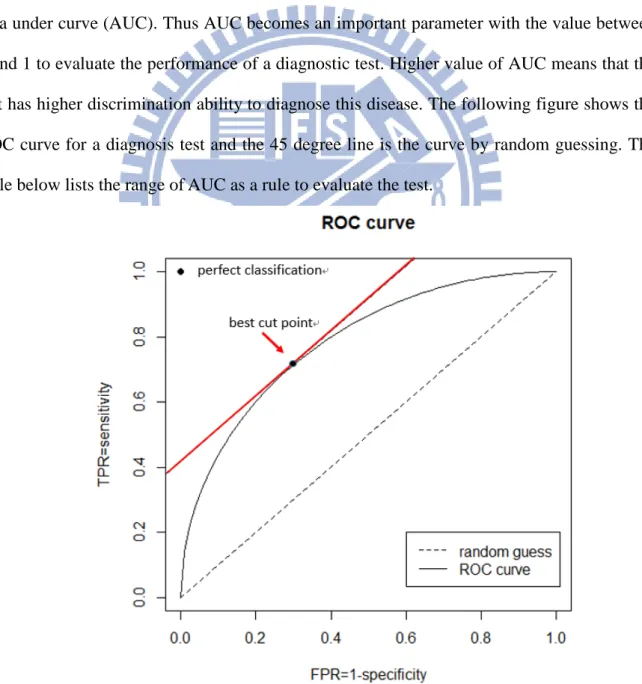
.ROC curves can also be used to evaluate the importance of risk factors on predicting the
occurrence of the disease. Suppose Y indicates whether a subject has the disease or not and
Z is a covariate taking continuous (numerical) value. Denote ∆( )z = I Z( ≤ z) and assume
that the larger value of Z is associated with higher chance of having the disease. If we choose a cut-off point based on Z as a way to classify the result as being “positive” (Z ≥z) or “negative” (Z <z). Consider the following two-by-two table, where “TP”, “FP”, “FN” and “FN” represent “true positive”, “false positive”, “false negative” and “true negative”
respectively. True condition Y=1 Y=0 Diagnosis result ( ) 1z ∆ = TP=Pr(Y = ∆1, ( )z =1) FP=Pr(Y = ∆0, ( )z =1) ( )z 0 ∆ = FN=Pr(Y = ∆1, ( )z =0) TN=Pr(Y = ∆0, ( )z =0)
Then define TPR and FRR as
Pr( 1, ( ) 1) Sensitivity(z) ( ) Pr( 1) Y z TPR z Y = ∆ = = = = Pr( 0, ( ) 0) pecificity(z) 1 ( ) Pr( 0) Y z S FPR z Y = ∆ = = − = = . 6
In other words, “sensitivity” is the probability that a man with the disease is correctly
diagnosed; while “specificity” is the probability that a man without the disease is correctly
diagnosed.
A useful test should have “high sensitivity and high specificity”, which is equivalent to
“high TPR and low FPR”. An ROC curve plots (FPR z ,( ) TPR z ) in the (( ) X Y axes , ) based on many points of z. In many studies, the main purpose is to choose a cut-off point
that makes the location of (FPR z ,( ) TPR z ) to be most near the upper left corner. This ( ) corresponds to choose a point z* based on Z which gives the largest AUC, defined as the
area under curve (AUC). Thus AUC becomes an important parameter with the value between
0 and 1 to evaluate the performance of a diagnostic test. Higher value of AUC means that the
test has higher discrimination ability to diagnose this disease. The following figure shows the
ROC curve for a diagnosis test and the 45 degree line is the curve by random guessing. The
table below lists the range of AUC as a rule to evaluate the test.
Figure 2: ROC curve and the best cut-off point 7
AUC=0.5 no discrimination
0.8>AUC≧0.7 acceptable discrimination
AUC≧0.8 excellent discrimination
Table 1: General criteria of AUC
3.2 Methods for Longitudinal Studies
For longitudinal studies, data are collected over a period of time. The main purpose is to
study the progress of the response variable along the time and how the change of covariates
affects the progression over the period. Thus the cost longitudinal studies is higher compared
with cross-sectional studies. Longitudinal variables can be denoted as ( ,Y Zj j
,
t
j) which represent the response variable and the vector of covariates collected at time t respectively jfor j=1,...,n where t1
< <
...
t
n.If the time points are equally spaced which means that the influence of (t1
,...,
t
n)
can be ignored, one can consider the following model1 ( 1)
j C L j j
Y =
β
Z +β
Z −Z +ε
,where
β
C describes the baseline effect whileβ
L measures the effect of covariate change on the same person’s expected response value. It is equivalent to write1 ( 1) ( 1)
j L j j
Y −Y =
β
Z −Z +ε
−ε
.With the data {( ,Y Zij ij
,
t
ij)(i=1,..., ;m j =1,...,ni)}
, there are two helpful scatterplots.Specifically we can plot {(Z Yi1
,
i1)(i=1,...,m)}
in the (X,Y) axis which reveals the information ofβ
C and plot {(Zij −Zi1,Yij −Yi1)}
which reflects the information ofβ
L.Note that (Yi1
,...,
Y
ini)
are correlated. In the simplified situation withn
i=
n
, thedependence structure can be investigated via plotting
r
ij versusr
ik(
k
≠
j
)
, wherer
ij is the residual 1 1 ˆ ˆ ( )[
]
ij C i L ij i ij r=
Y−
β
Z +β
Z −Zfor
j
=
1,...,
n
with (β
ˆC,
β
ˆ
L)
being the fitted values. There are1
2
n
−
such plotsand we can pay attention to examine whether the association changes with respect to the
change of
k
−
j
. The plots reveal information about the structure of the variance-covariance matrix of (Yi1,...,
Y
in)
V =σjk:n n× , whereσ
jk=
Cov Y Y
( ,
ij ik)
.Note that
β
L evaluates the “average” effect for a group of individuals with the same degree of covariate change on the change of response. If the focus is on a single individual,say the i-th observation at time t , we may consider j T
ij ij i ij
Y =z β γ ε+ +
where β describes the population average effect and γ is the person-specific effect which i is usually assumed to follow a mean normal distribution with the variance explaining the
magnitude of heterogeneity.
3.3 Survival Analysis
In survival analysis, the response variable of interest is the time, from a given starting
point, to an event of interest. Denote the event time as T . The probabilistic behavior of T
can be summarized by the survival function
( ) Pr( ) 1 ( ) ( ) u t S t T t F t ∞ f u du = = > = − =
∫
where f t( ) dF t( ) dS t( ) dt dt= = − is the density function, or the hazard function
0 Pr( [ , ] | ) ( )t lim T t t T t λ ∆→ ∈ + ∆ ≥ = ∆ ( ) log ( ) ( ) f t d S t S t− dt = = − ,
where log(.) here denotes the natural logarithm function. There is a one-to-one relationship
between the two functions such that
( ) exp( ( ))
S t = −Λ t
where
0
( )t tλ( )u du log ( )S t
Λ =
∫
= − is the cumulative hazards function.There are two popular regression models to describe how covariate Z affects the failure time T . The most popular choice is the Cox proportional hazards model which can be written as
0
( ) ( ) exp( T )
Z t t Z
λ =λ β ,
where
λ
0( )t is the baseline hazard function whose form is usually unspecified. Anothercommon option is the AFT (accelerated failure time) model which can be written as
logT =ZT
β ε
+ ,where
ε
is the error variable whose distribution is not specified. Note that the AFT model can also be written in terms of the hazard function0
( )t { exp(t ZT )}exp( ZT )
λ =λ − β − β .
If survival data are obtained from a longitudinal study, some covariates may become
time-dependent. The original form of the Cox model assumes that the influence of Z on the hazard is a constant. However in a longitudinal study, values of some covariates such as blood
pressure or biochemical measures may change over time. To include time-dependent
covariates, the model can be modified as
0
( )t ( ) exp(t Z tT( ) )
λ =λ β .
The most special feature of survival analysis, compared with other areas of statistics, is
the so-called “censoring” problem which happens when the occurrence of the event is not be
accurately observed. There are several types of censoring. Here we introduce right censoring
and interval censoring.
For right censoring, define C as the censoring time and one observes X =min( ,T C)
andδ =I T( ≤C). Usually it is assumed that T and C are independent. Observed data can
be written as {(Xi, , )(
δ
i Z ii =1,..., )}n . The likelihood for right censored data can be written as1 1 ( ) { ( ) Pr( )} {i ( ) ( )} i m i i i i i i Lθ f xθ C x δ S x g xθ −δ = =
∏
>where θ : p×1 is the parameter of interest and g(.) is the density function of C . If C
does not carry any information of θ , it becomes
1 1 1 1 0 ( ) ( ) ( ) ( ) ( ) ( ) exp{ ( ) } i i i i i x n n n i i i i i i i i Lθ fθ x δSθ x −δ λθ x δSθ x λθ x δ λθ u du = = = ∝
∏
=∏
=∏
−∫
.When the density form of T is not specified, S t( ) can be estimated nonparametrically by the Kaplan-Meier estimator:
1 1 ( , 1) ˆ( ) 1 ( ) n i i i n u t i i I X u S t I X u δ = ≤ = = = = − ≥
∑
∏
∑
.In the presence of covariates, data can be written as {(Xi
, , )(
δ
iZ i
i=
1,..., )}
n
. Under the Cox model assumption λZ( )t =λ0( ) exp(t ZTβ) without specifying the form ofλ
0( )t , the partial likelihood for β can be written as: 1 : exp( ) ( ) exp( ) i j i T i T i i j X X Z L Z δ
β
β
β
= ≥ =∏ ∑
.In the case of time-dependent covariates, the ideal data set structure be written as
{(Xi, , ( ) : 0
δ
i Z si ≤ ≤s X ii)( =1,..., )}n and the resulting score function for β can be written as: 1 : ( ) exp( ( ) ) ( ) ( ) exp( ( ) ) j i j i T T j i j i n j X X i i i T i j i j X X Z X Z X U Z X Z X β β δ β ≥ = ≥ = −
∑
∑
∑
. 11However in practice it may not be possible to obtain the whole process of Z si( ) for 0≤ ≤s Xi. In some statistical software such as SAS or Splus, the nearest data from same individual may be used. Sometimes smoothing methods, such as kernel smoothing, may be
adopted to impute the missing information.
Survival analysis can be adopted either for cross-sectional data or longitudinal data. In
particular for longitudinal follow-up, observations are often collected at consecutive and
distinct time points. It may happen that the exact event time may never be observed. Interval
censoring occurs when we only have the information that T lies in an interval between two measurement times. Observed data can be written as {( , )(L R ii i =1,..., )}n and we know that
( , ]
i i i
T ∈ L R . The likelihood function can be written as
1 ( ) ( ) ( ) n i i i Lθ F Rθ F Lθ = =
∏
− .Unlike the Kaplan-Meier estimator suitable for right censored data, the nonparametric
estimator for S t( ) under interval censoring has no explicit form (Turnbull,1974 and 1976). It
has been shown that the nonparametric MLE can be obtained by solving the following
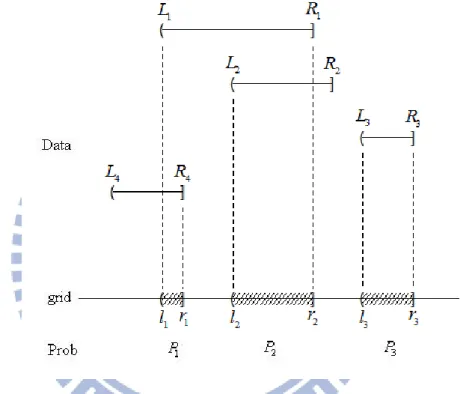
self-consistency equation. The first step is to create grid intervals by
rearranging{( , ](L R ii i =1,..., )}n in an ascending order and identifying the intervals such that a left-endpoint and a right-endpoint are adjacent to each other. Then denote the disjoint
intervals as {( , ] (l rj j j=1,..., )}m . The following figure depicts the construction of such intervals. Define the indicator δij =I{( , )L Ri i ⊂( , ]}l rj j which shows whether the ith observed interval overlaps with the jth interval. Let
p
j be the mass in( , ]
l r
j j which can be estimated by solving the following equation1 1 1 1 1 1 ... n n ij j j ij i i im m i p p w n p p n δ δ δ = = = = + +
∑
∑
(j=1,...,m)where
w
ij measures the contribution of the ith observation for estimating the probability ofinterval Pr(Ti ⊂( , ])l rj j 1 ( 1) m ij j w = =
∑
. In the figure, the weights for ( , ]L R in estimating 1 11
ˆ
P ,Pˆ2,P are ˆ3 P1 (1⋅ + ⋅ + ⋅P1 1 P2 0 P3), 1⋅P2 (1⋅ + ⋅ + ⋅P1 1 P2 0 P3) and 0, respectively.
Figure 3: Construction of the mass interval censored data and the idea of self-consistency.
Now we briefly compare survival analysis with logistic regression. Suppose T refers to the onset age of an event and A is the current age. Denote Y =I T( ≤ A). By fitting a
logistic model, we have
Pr( 1) Pr( ) log log Pr( 0) Pr( ) T Y T A Z Y T A β = = ≤ = = > , where Pr( ) ( ) a( ) u T ≤A =
∫
F a f u du , Pr( ) ( ) a( ) uT > A =
∫
S a f u du and fa(.) is the density function of A. We see that the age distribution for observations in the sample will have a confounding effect on the analysis. Also logistic regression analysis for event-type data inpractical applications often ignores the fact that T is subject to censoring and makes the results more mis-leading.
3.4 Methods for analyzing paired data
Myopia data usually contain paired observations. Here we review different methods for
analyzing paired data. Let ( , )Y Y1 2 be some measures obtained from left and right eyes respectively. If the main purpose is to make comparison based on the means, define
1 2 i i i D =Y −Y , 1 / n i i D D n =
=
∑
and S is the standard deviation of D D ii ( =1,..., )n . We may consider the paired T statistic given by/ D D t s n =
which can be used to test whether the mean of E D( )=0. Other nonparametric tests are available such the sign test or signed rank test.
Sometimes the purpose is to find the association between the two variables rather than
making comparison. To describe the association between paired variables ( , )X Y , which may be ( ,Y Y in the above case, we can consider Pearson’s correlation coefficient: 1 2)
, [( )( )] cov( , ) X Y X Y X Y X Y E X Y X Y
µ
µ
ρ
σ σ
σ σ
− − = =which can be estimated by
, 2 2 ( )( ) ( ) ( ) i i i X Y i i i i X X Y Y r X X Y Y − − = − −
∑
∑
∑
.Kendall tau correlation is a rank correlation coefficient and is more robust than Pearson’s
correlation. Before defining Kendall’s tau, we first introduce the concept of concordance. Let
(X Yi, )i and (X Y be two independent replications from j, )j ( , )X Y . They are “concordant” if 14
(Xi−Xj)(Yi−Yj)>0 ; while they are “discordant” if (Xi−Xj)(Yi−Yj)<0 . If (Xi−Xj)(Yi−Yj)=0, the pair is neither concordant nor discordant. After calculating the
number of concordant pairs,
n
c, and the number of discordant pairs,n
d,the Kendall tau correlation coefficient can be written as( ) / 2 c d n N N τ = − where c [( i j)( i j) 0] i j i N I X X Y Y >
=
∑∑
− − > is the number of concordance pairs and[( i j)( i j) 0]
i j i
d
N I X X Y Y
>
=
∑∑
− − < is the number of discordance pairs.Chapter 4: Statistical Applications in Myopia Research
In this chapter, we will review how statistical methods are applied to study myopia in
Taiwan and Singapore. In particular, Singapore has the highest prevalence rate in the world.
4.1 Myopia research in Taiwan
In Taiwan, myopia has also been a serious health problem. The research team of National
Taiwan University conducted five nationwide surveys for 7 to 18 years-old schoolchildren in
1983, 1986, 1990 and 2000 (Lin et al., 2001 and 2004). It was found that the prevalence of
myopia for 7 years-old children increased from 5.8% in 1983 to 21% in 2000; while the
prevalence for 12 years-old children increased from 36.7% in 1983 and to 61% in 2000
rapidly. The onset age of myopia had decreased during the period of 17 years. Specifically the
average onset age of myopia decreased from 11 years-old in 1983 to 8 years-old in 2000.
They also compared the differences in gender and the living environments. For example for
children of the same age, girls had higher prevalence rate and more severe myopia status than
boys. School children living in cities had higher prevalence rate and more severe myopia than
those living in countries. Shih et al. (2010) further studied the progression of myopia based on
the longitudinal study and found that the growth patterns of myopia were also different for
children living in cities and countryside. For example the average growth rates of myopia for
10-15 years old children who lived in cities were 0.43D/year and 0.50D/year for boys and
girls, respectively; while the rates for children living in countryside were 0.24D/year and
0.31D/year for boys and girls, respectively. This implies that environmental factors play some
roles in the development of myopia.
Another research team in Chung Shan Medical University investigated possible factor
that might influence the status of myopia for elementary school students in Taiwan. Cheng et
al. (2013) selected three elementary schools in Tamsui, Taichung and Tainan, located in the
northern, middle and southern parts of Taiwan, respectively. They found that the condition of
myopia is affected by the level of nearwork, outdoor physical activities and the use of 16
spectacles … etc.
The above studies focused more on epidemiological issues. Alternatively some
researchers investigated the relationship between myopia and possible biometrical measures.
For example Pei-Yao Chang et al. (2010) studied the relationship between myopia and the
axial length and corneal hysteresis.
4.2 Myopia Research in Singapore
In Singapore, about 85% of people have myopia. Chew et al. (1988) found that people
with higher education level were more likely to get myopia and the condition was more
severe. SCORM (the Singapore Cohort study Of the Risk factors for Myopia) is a cohort
study which has collected the information of schoolchildren from several schools since 1999.
The projected was conducted by researchers in National University of Singapore. They found
that breast feeding, birth weight, parental smoking and outdoor activities are related to
myopia. Genetic investigation by studying monozygotic twins was also pursued. The
influences of race, culture and education level has also be examined. The article “Historical
Overview of Myopia Research in Singapore” (2008) provides a useful summary about the
research development, important findings and key persons.
We now summary some papers of Saw et al., who is the leader of SCORM. Then we will
give some comments from the viewpoint of statisticians.
4.3 Studying Risk Factors on Myopia of Different Severity
In the paper by Saw et al. The main purpose is to investigate the relationship of nearwork
activities and myopia for elementary school-age children. The cross-sectional study conducted
in 1999 collected 1005 children, aged 7 to 9 years, from two schools in Singapore.One school
is ranked among the top 20 schools in Singapore, and the other is ranked among the bottom
20 schools. For each child, ophthalmological measurements including the axial eye length,
anterior chamber depth, crystalline lens thickness and vitreous chamber depth were taken 17
from two eyes. Besides the lab results, additional questionnaires were given to children’s
parents to record the information about children’s nearwork activities such as reading, time on
computer or video games and other possible risk factors, such as parental myopia,
socioeconomic status, and light exposure history.
Now we summarize the statistical methods. First, the correlation between the refractive
errors for the left and right eyes was found to be 0.94. As result they decided to use the right
eyes data in analysis. The severity of myopia is classified into three levels: : “higher myopia”
(SE≦-3.0 diopters), “lower myopia” (-3.0<SE≦-0.5 diopters) and “nonmyopes” (SE>-0.5
diopters), where “SE” is the abbreviation of “spherical equivalent”. To investigate the
relationship between the level of myopia and possible risk factors, they used ANCOVA which
combines ANOVA and regression. Specifically ANCOVA evaluates whether population
means of a dependent variable (DV) are equal across levels of a categorical variable, while
statistically controlling for the effects of other variables which are of less interest.
We present their results. The prevalence rates of higher myopia and lower myopia were
8.1% and 24.3%. Chinese students had higher prevalence (37.0%) than non-Chinese (19.9%).
For children with higher myopia, there are 10% Chinese students with higher myopia and
2.9% non-Chinese students in both schools. Compared with the children with lower myopia
or no myopia, children with higher myopia were more likely to have higher cylinder power,
longer axial lengths, deeper anterior chambers, longer vitreous chambers, steeper corneas, and
a higher ratio of axial length (AL) to corneal radius (CR). In respect of family background,
there exist positive associations between higher myopia prevalence rates and larger housing
type, higher family income, more advanced father’s and mother’s education (P < 0.001, for
each). To assess the effect of nearwork activities, higher myopia is strongly related to the
number of books reading per week. In summary, severe myopia is related to the above
mentioned biological measurements. Children growing up in a richer or more educational
environment are more likely to have myopia. 18
Multiple logistic regression analysis was also conducted to study the effect of “reading
more than two books per week” on the incidence of high myopia. It was found that the crude
odds ratio of higher myopia for reading more than two books per week was 3.15 (95% CI,
1.96-5.04), whereas the odds ratio adjusted for other risk factors was 3.05 (95% CI, 1.80-5.18).
Note that Chinese parents in Singapore usually encouraged reading and had higher income.
4.4 A Longitudinal Study for Predicting Myopia
Here we introduce how a longitudinal study can be used to predict the occurrence of myopia
based on the paper of Jones et al. (2007). The study recruited 514 children in the third grade
(aged from 8 to 9 years) who did not have myopic in the right eye and then the subjects were
followed up until the eighth grade. The major interest was to investigate whether there was
any difference between those who developed myopia and those who did not developed
myopia within the five years given that their eye conditions were in similar at the baseline.
Besides the family information, at each follow-up, children’s information about the time on
activities or biometrical measures to assess the visual condition was collected.
Several T tests were performed to compare the two groups at the eighth grade.
Furthermore, a number of simple logistic regression analysis was conducted. For example, let
1
Y = indicate that the student developed myopia within the study period and Y = 0 otherwise and Z can be chosen from the following variables, namely cycloplegic sphere,
corneal power, axial length, hours of sports, hours of reading, hours of TV, hours of studying,
hours of computer, diopter hours, father myopia, mother myopia and number of myopia
parents. Logistic regression model assumes that
0 1 Pr( 1) log( ) Z Pr( 0) Y Y β β = = + = .
We summarize their findings. The odds ratio was 2.17 with only one parent having
myopia; while the ratio was 5.4 with both parents having myopia. Note that parents’ myopia
conditions may also affect their parenting behavior. To examine this issue, the number of
myopic parents is treated as a categorical variable of tree levels (0,1,2) and the other
categorical variable is constructed based on the number of hours of sports and outdoor
activity per week. Applying the Chi-square test, it was found that the number of physical
activities per week and the number of myopic parents are correlated. Some covariates are
further evaluated by AUC based on the ROC curve. The results show that the number of
myopic parents, the time on sports and outdoor activity per week and the time on reading per
week were significantly associated with children’s future myopia. Then, the authors used
these three variables to construct the multivariate logistic model. The reading time was not
significant in this model. The final model included the following explanatory variables:
cycloplegic sphere, corneal power, axial length, the number of hours of sports and outdoor
activity per week, the number of myopic parents and the interaction of sport and myopic
parents.
4.5 Myopia and other eye diseases
Tong et al. (2006) conducted a longitudinal study to assess the relationships between the
severity of myopia and other conditions of eyes (prevalence of anisometropia, changes in the
inter-eye difference in spherical equivalent and the change of axial length). The study
recruited 1979 children aged 7 to 9 years from 3 Singaporean schools. Several biometrical
measurements on eyes were taken per year and then continued for 4 years. Based on their
baseline conditions, children were classified as “both eyes myopic”, “both eyes hyperopic”,
“one eye myopic and the other eye emmetropic” and “one eye hyperopic and the other eye
emmetropic”.
To make comparison for different groups, Mann-Whitney test and Kruskal-Wallis test
were considered. The result showed the prevalence rate of anisometropia was not associated
with gender at any visit and was associated with age. The prevalence rate of anisometropia in
those with “at least one myopic eye” was significantly different from “nonmyopes”.
Chapter 5: Our Suggestions on Statistical Analysis
We find that although statistical methods played an important role in myopia research,
some advanced but useful statistical methods have not been adopted. For example myopia is a
progressive status and practitioners may be interested in some particular stages. We may
define
1 2
( ,T T ,,Tk) as the times to reach these stages. If the events have an ordered structure, we have
1 2 k
T <T <<T but their order can also be arbitrary. searchers can apply techniques of multivariate survival analysis to study the association structure of the event
times or study how covariates affect the joint behavior.
We also noticed that most literature utilized on a half of data based on paired
observations. Appropriate use of all data which needs to handle the association of pairs will
increase the efficiency. For example for two variables (Y Y1i
,
2i)
on the same person i, we mayassume
( 1, 2; 1,..., ) T
ji ji i ji
Y =
β
Z + +α ε
j= i= mwhere
β
stands for the fixed-effect parameter andα
i ~iid N(0,σ
α)
is the random effectspecific to the ith person. The magnitude of
σ
α reflects the degree of association for the two measurements. Alternatively GEE methods can also be used by employing the workingcorrelation matrix.
The onset ages of myopia of two eyes can be denoted as (T1
, )
T
2 and their associationcan be described by the odds ratio function originally defined by Oakes (1989) such that
2 1 2 1 2 1 2 1 2 1 2 1 2 1 2 ( , ) ( , ) ( , ) ( , ) ( , ) S t t S t t t t t t S t t S t t t t θ ∂ ∂ ∂ = ∂ ∂ ∂ ∂
where S t t( , )1 2 is the joint survival function of (T1
, )
T
2 . Statistical inference of θ( , )t t1 2based on bivariate censored data has been discussed by many statisticians. One can refer to
the paper of Wang and Wells (2000) which summarizes related references.
References
〔1〕 Au Eong, Kah Guan, Primary Eye Care In Singapore: Looking Back, Looking Forward, Sight & Eye International Pte Limited, 2008.
〔2〕 Cheng CY, Huang W, Su KC, Peng ML, Sun HY, Cheng HM, “Myopization factors affecting urban elementary school students in Taiwan”, Optom Vis Sci, 900, pp. 400-6,
2013 Apr.
〔3〕 Jones LA, Sinnott LT, Mutti DO, Mitchell GL, Moeschberger ML, Zadnik K, “Parental History of Myopia, Sports and Outdoor Activities, and Future Myopia”,
Invest Ophthalmol Vis Sci, 48, pp.3524-32, 2007 Aug.
〔4〕 Lin LL, Shih YF, Hsiao CK, Chen CJ, Lee LA, Hung PT, “Epidemiologic study of the prevalence and severity of myopia among schoolchildren in Taiwan in 2000”, J
Formos Med Assoc, 100, pp. 684-91, 2001 Oct.
〔5〕 Lin LL, Shih YF, Hsiao CK, Chen CJ, “Prevalence of myopia in Taiwanese
schoolchildren: 1983 to 2000”, Ann Acad Med Singapore, 33, pp. 27-33, 2004 Jan.
〔6〕 Peter Diggle, Patrick Heagerty, Kung-Yee Liang, Scott Zeger, Analysis of Longitudinal Data, Oxford University Press,2013
〔7〕 Saw SM, Chua WH, Hong CY, Wu HM, Chan WY, Chia KS, Stone RA, Tan D. “Nearwork in Early-Onset Myopia”, Invest Ophthalmol Vis Sci, 43, pp.332-9, 2002
Feb.
〔8〕 Shih YF1, Chiang TH, Hsiao CK, Chen CJ, Hung PT, Lin LL, “Comparing myopic progression of urban and rural Taiwanese schoolchildren”, Jpn J Ophthalmol, 54, pp.
446-51, 2010 Sep
〔9〕 Tong L, Chan YH, Gazzard G, Tan D, Saw SM, “Longitudinal Study of Anisometropia in Singaporean School Children”, Invest Ophthalmol Vis Sci, 47, pp. 3247-52, 2006
Aug.
〔10〕 Weijing Wang, Martin T. Wells, "Model Selection and Semi-parametric Inference for Bivariate Censored Data" , Journal of American Statistical Association, 95, pp.
62-72, 2000 Jan
附 錄:
眼科醫學名詞之中譯
anterior chamber depth 前房深度
autorefractor 自動驗光機
axial length 眼軸長
corneal 角膜
corneal curvature radius 角膜曲率半徑
crystalline lens thickness 水晶體厚度
cycloplegia 睫狀肌麻痺劑
ocular power 視力
retina 視網膜
spherical equivalent 屈光度
vitreous chamber depth 玻璃腔深度