國
立
交
通
大
學
經營管理所
碩
士
論
文
科技接受模式之擴散與主要趨勢研究:使用共引文分析方法
Technology Acceptance Model: Dissemination and Main Trends, Using Co-citation Analysis
研 究 生:高麒紜
指導教授:楊 千 教授
科技接受模式之擴散與主要趨勢研究:使用共引文分析方法
Technology Acceptance Model: Dissemination and Main
Trends, Using Co-citation Analysis
研 究 生:高麒紜
Student︰Ci-Yun Kao
指導教授:楊 千
Advisor︰Chyan Yang
國 立 交 通 大 學
經 營 管 理 研 究 所
碩 士 論 文
A Thesis
Submitted to Institute of Business and Management
College of Management
National Chiao Tung University
in Partial Fulfillment of the Requirements
for the Degree of
Master of Business Administration
June 2009
Taipei, Taiwan, Republic of China
中華民國 九十八 年 六 月
科技接受模式之擴散與主要趨勢研究:使用共引文分析方法
學生:高麒紜 指導教授
:楊 千 博士
國立交通大學經營管理研究所碩士班
摘
要
本 論 文 以 書 目 計 量 法
(bibliometrics) 中 之 文 章 共 引 文 分 析 法
(document co-citation analysis) 為 量 化 基 礎 , 針 對 科 技 接 受 模 式
(technology acceptance model, TAM)於已收錄在社會科學引文索引
SSCI 中之所有相關研究期刊文獻為資料主體,以統計套裝軟體 SPSS
為工具進行統計方法量化分析,企圖找出學界在科技接受模式研究裡
之主要研究類別以及研究趨勢,並試圖提供未來可行研究建議。
本研究發現,目前學界中科技接受模式的相關文獻出現兩大主要
研究趨勢,一為探討在不同資訊科技(如 e-mail、電子商務等)的應用
下,科技接受模式的應用效果;另一為將科技接受模式與其他使用者
心理行為研究理論結合,試圖整合出更加完整健全的新模型以全面描
述使用者接受資訊科技時的意圖、態度、行為等心理過程。研究最後
建議未來對於科技接受模式有興趣之研究者,可以新興科技為使用媒
介的電子商務(如行動商務、互動電視商務)等進行使用者接受之心理
過程及影響因素探討。
關鍵字:科技接受模式、共引文分析法、電子商務
Technology Acceptance Model: Dissemination and Main Trends, Using Co-citation Analysis
Student:Ci-Yun Kao Advisors:Dr. Chyan Yang
Institute of International Business and Management
National Chiao Tung University
ABSTRACT
In this study, we investigate the dissemination on technology
acceptance model (TAM) with document co-citation analysis of the
inductive bibliometrical methods. After factor analysis, cluster analysis
and multidimensional scaling, the current studies represent these
dissemination: (1) appliance of technology acceptance model in different
IT context; (2) extended technology acceptance model and combination
of diversified theories. And four major groups of IT context are applied in:
(1) job-related IT; (2) information-acquiring IT for knowledge
management; (3) leisure IT; and (4) e-commerce. With the historical
diffusion of TAM, we suggest studies on e-commerce with emerging
media and new technology adoption are still popular in the future.
Keyword: technology acceptance model, co-citation analysis,
e-commerce
誌
謝
論文的完成,代表在交大兩年的修業完成。
兩年的時間,不算長也不說短,卻遇到足以影響我生命的一群人,
包括老師們、學長姐以及同學等等。在所上所有老師們的指導下,學
會自我學習的技巧以及獨立思考的習慣,這將是日後得以不斷自我終
身學習的重要技能;楊千教授與君華學姐的論文指導,提供了細部個
別的學習觀點,加上同學間的互相切磋討教,大家激盪出新的火花。
最可貴的是同儕兩年的情誼,相互間沒有利害關係的心靈契合,這樣
的友情相信會持續一輩子。
感謝命運安排我進入交大,學到一輩子都有用的知識,以及認識
一輩子知心的好友。這一切的一切,最終都帶來了人生中最寶貴的財
富,即是再多擁有一些「選擇的權力」,人生多一點選擇,也就多一
點自由,希望大家都能擁有自己最想要的自由。
最後感謝這一路上所有支持我的人。但要感謝的人實在太多了,
在此就感謝天吧!所有的細節,將放在心上細細回味,留待成為大夥
日後相聚時的茶酒良伴。
願上天賜福大家,人生一切平安順利。
高麒紜
2009 年 6 月 24 日
誌於交大經管所
Content
I. Introduction ... 1
II. Literature Review ... 3
III. Methodology ... 5
3.1 Co-citation Method ... 5
3.2 Data Collection and Analysis ... 6
3.2.1 Research Procedure ... 6
3.2.2 Data Selecting ... 7
3.2.3 Co-citation Analysis ... 13
IV. Results ... 16
4.1 Factor Analysis ... 16
4.2 Cluster Analysis ... 21
4.3 Multidimensional Scaling (MDS) ... 25
4.4 Discussion ... 29
4.4.1 General Discussion ... 29
4.4.2 Prediction for Future Research Trend ... 31
V. Conclusions and Limitations ... 33
List of Table
Table 1 Core Set Documents I ... 10
Table 2 Core Set Documents II ... 11
Table 3 Core Set Documents III ... 11
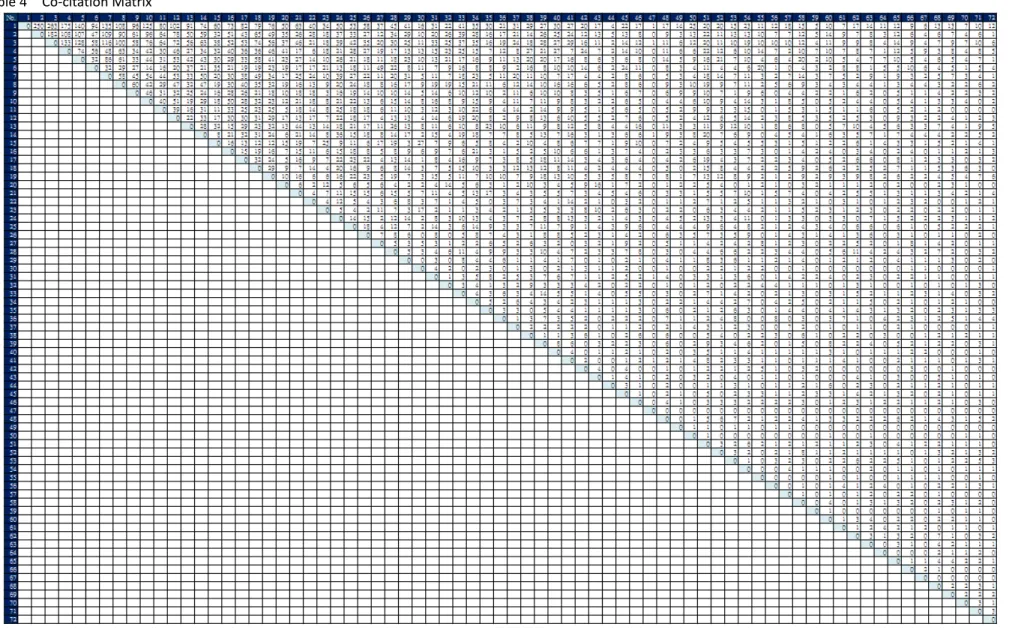
Table 4 Co-citation Matrix ... 14
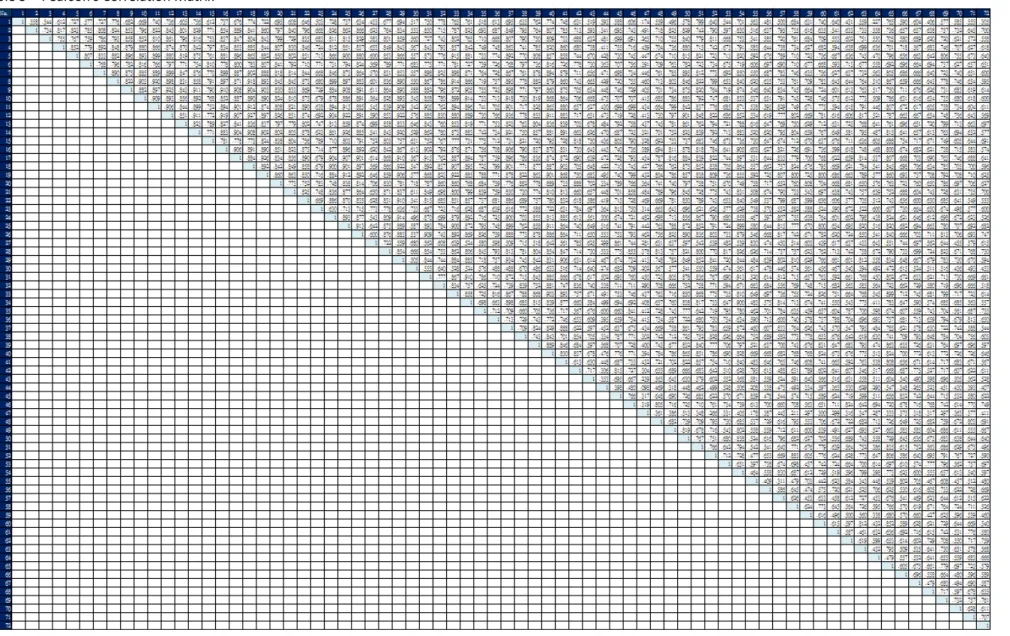
Table 5 Pearson’s Correlation Matrix ... 15
Table 6 Explanation of Total Variance ... 16
Table 7 Factor Analysis I ... 17
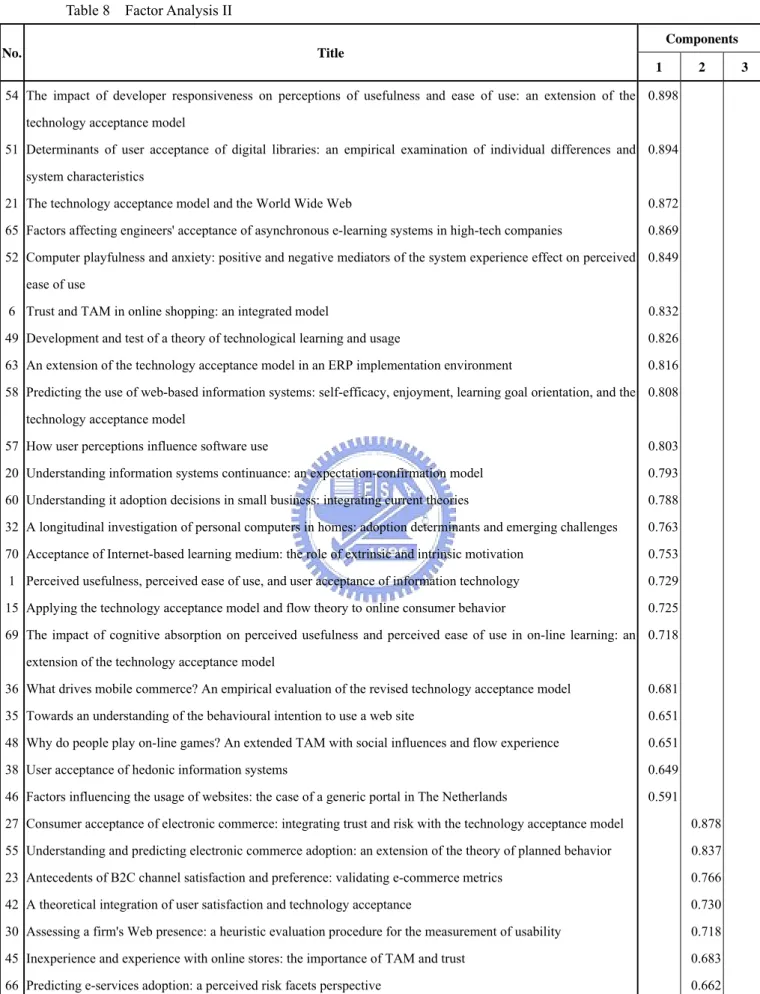
Table 8 Factor Analysis II ... 18
Table 9 Factor Analysis III ... 18
Table 10 Factor Identification I ... 19
Table 11 Factor Identification II ... 20
Table 12 Stress and Squared Correlation (R2) ... 26
Table 13 Papers Published After 2006 in Major Journals ... 32
List of Figure
Figure 1 Technology Acceptance Model by Fred D. Davis, 1986 ... 3Figure 2 Concept of Co-citation Analysis ... 6
Figure 3 Research Procedure ... 7
Figure 4 SSCI Database ... 8
Figure 5 Result of TAM Paper-Searching in ISI Database ... 8
Figure 6 Hierarchical Cluster Analysis ... 23
Figure 7 Cluster Identification and Additional Affecting Factors ... 24
I. Introduction
Research MotiveInformation technology offers the potential and convenient tools for improving work performance and life quality (Curley, 1984; Edelman, 1981; Sharda, et al., 1988), but performance gains are largely affected by user willingness to accept and use these available systems (Thompson et al., 1991). Numerous studies have presented various theories to investigate the process how human beings’ acceptance toward using new information system is affected, such as model of PC utilization (MPCU) (Thompson et al., 1991), theory of reasoned action (TRA) (Ajzen and Fishbein, 1980), and the combined TAM and TPB (C-TAM-TPB) (Taylor and Todd, 1995). Besides, a lot of models highlight independent variables to probe into what factors may exert influences on user acceptance, such as self-efficacy (Bandura, 1982), the trade-off between cost and benefit (Beach & Mitchell, 1978; Johnson & Payne, 1985), compatibility, relative advantage, and complexity (Tornatzky & Klein, 1982; Rogers & Shoemaker, 1971), the perceived importance and perceived usableness (Larker & Lessig, 1980), and the psychological trade-off between information quality and costs of access (Swanson, 1982, 1987). These theories and models provide diverse perspectives to explain what affects user acceptance to IT.
One of the most powerful and parsimonious theories to describe such influence toward attitude to adopt new technology is technology acceptance model (TAM), which is advanced by Fred D. Davis in his doctorial dissertation of 1986. TAM provides an efficient measurement scales for predicting user acceptance of information technology. This model proposes two variables, which are perceived usefulness (PU) and perceived ease of use (PEOU), to be the fundamental determinants of user attitude toward acceptance of new technology.
Since TAM was proposed, a lot of research studies have been carried out to extend to different aspects. For instance, additional variables have been added to explain other influences to adoption (Venkatesh and. Davis, 2000; Chau, 1996). A lot of practical applications in purchasing behavior in e-commerce (Gefen, Karahanna, and Straub, 2003) and individual and organizational adoption to different electronic products (Amoako-Gyampah and Salam 2003; Lu, et al., 2003) are quite common. The development and evolution related to technology acceptance from TAM are unclear now.
Research Method
This study aims to employ an inductive perspective with bibliometrical methods to explore the trends and academic groups of TAM research. Bibliometrics provides a tool to document the intellectual development of the ideas represented by published studies in journals of Social Science Citation Index (SSCI) based on a document co-citation analysis. The co-citation analysis is one form of document coupling to measure the number of documents which have cited any given pair of documents (Garfield, 1979; Small, 1973). The number of times that two documents are cited jointly in the same work can determine how close two documents relate to each other and identify groups of closely related documents as considering to belong to the same “research front” (Price, 1965). Through the systematical analysis, an objective perspective to examine the evolution and trends (Ramos-Rodrigues and Ruiz-Navarro, 2004) of TAM-related studies could be presented.
Research Questions
Resulting from the above literature and method review, this paper targets four research topics:
(1) The intellectual subfields emerging from research related to TAM. (2) The interrelations among these subfields.
(3) The evolutions of these subfields emerged from TAM research. (4) The research front on TAM research.
Research Procedure
The research structure of this study will be organized into four parts. Firstly, we will review literatures associated to TAM. Secondly, we will delineate the method we use to systematically analyze these data we gather from social science journals database, such as SSCI (social science citation index). That is co-citation analysis. Thirdly, a statistical analysis of document co-citation, and further examination of factor analysis, cluster analysis, and multidimensional scaling(MDS) to give a panoramic view of the present research. Finally, we will give a general discussion and then advance some suggestions for future study.
II. Literature Review
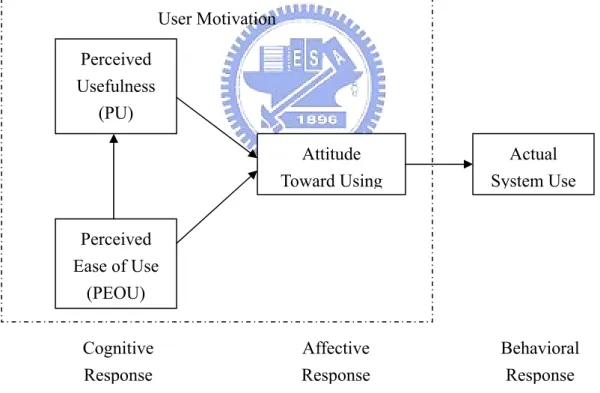
Technology Acceptance ModelTechnology Acceptance Model (TAM), which is introduced by Fred D. Davis in 1986, provides efficient measurement scales for predicting user acceptance of information technology (IT). TAM proposes two variables to be the fundamental determinants – perceived usefulness (PU) and perceived ease of use (PEOU) – toward user attitude to use information technology systems. TAM suggests that perceived usefulness has a significantly greater influence on attitude toward acceptance to new information system than perceived ease of use does (Davis, 1986). This model also suggests that perceived ease of use (PEOU) may actually be a causal antecedent to perceived usefulness (PU), as opposed to a parallel, direct determinant of system usage (Davis, 1989). The model is shown in Figure 1.
Figure 1 Technology Acceptance Model by Fred D. Davis, 1986
A lot of papers give further research on these two factors – perceived usefulness (PU) and perceived ease of use (PEOU) – in TAM. These studies attempt to explore more determinants that may exert influence on PU and PEOU, respectively, in TAM.
User Motivation Cognitive Response Behavioral Response Affective Response Perceived Usefulness (PU) Perceived Ease of Use (PEOU) Attitude Toward Using Actual System Use
Some Critical Papers on TAM
TAM is derived from the theory of reasoned action (TRA). TRA is derived from the social psychology setting and it indicates that a person’s behavioral intention depends on his/her attitude concerning the behavior and subjective norms. In 1986, Davis suggests TAM which is applied TRA in IT contexts. TAM focuses on the two constructs (PU and PEOU) that specially influence attitude. Now, TAM is a powerful and widely employed model on IT adoption.
Venkatesh and Davis (1996) conduct a study to discuss the antecedents of perceived ease of use. They suggested that general computer self-efficacy has an impact on ease of use perceptions at all times, and objective usability has an impact on ease of use perceptions about a specific IT system only after direct experience with the IT system.
The following the study in 1996 with Davis and Venkatesh (2000) further tests an anchoring and adjustment-based theoretical model of the determinants of system-specific perceived ease of use. The model proposes control (conceptualized as computer self-efficacy and perceptions of external control), emotion (conceptualized as computer anxiety), and intrinsic motivation (conceptualized as computer playfulness) as anchors that determine early perceptions about the ease of use of a new IT system. With increasing experience, the perceived ease of use will adjust to reflect objective usability, perceptions of external control, and perceived enjoyment.
Venkatesh and Davis (2000) also propose a theoretical extension of the TAM, which is referred to as TAM 2, to explain perceived usefulness and usage intention in terms of social influence and cognitive instrumental processes. The work examines longitudinal data collected through pre-implementation and post-implementation of four months. The TAM 2 shows that both social influence processes (subjective norm, voluntariness, and image) and cognitive instrumental processes (job relevance, output quality, result demonstrability, and perceives ease of use) have significant influences on user acceptance toward IT.
Electronic commerce, commonly known as e-commerce, is a set of behavior to buy and sell products or services over electronic systems such as the Internet. The amount of e-commerce has grown fast and commonly accepted because of widespread Internet usage. Any successful e-vendor is attempting to attract new customers and retain them. Research (Gefen, Karahanna, and Straub, 2003) has shown two sets of usage antecedents that may affect on-line customers to stay with the e-commerce website: (1) customer trust in the e-vender, and (2) customer assessments to the
in the technology acceptance model (TAM). A number of replications widely discuss TAM in the e-commerce context.
III. Methodology
3.1 Co-citation Method
The present paper analyzes a set of relevant publications or papers with bibliometric method. Bibliometrics is a set of methods which are used to study or measure texts and information. Co-citation analysis is one of commonly used bibliometric methods. Co-citation, which is a measure related to bibliographic coupling, was introduced by Small in 1973 (Jarneving, 2005). This form of document coupling is defined as the frequency of two documents cited together. The strength of co-citation is defined as the number of identical citing items (Jarneving, 2005). The more often two documents are cited together, the closer the relation between them is (White and Griffith, 1981). Nevertheless, the relation only means that these authors discuss the same issue. They do not necessarily agree with each other (Acedo, Barroso, and Galan, 2006).
The justification of this work is based on a core principle: the bounded rationality of individuals (Simon, 1957). It is very difficult to keep current with the development and trends of an expanding and diverse subject (Acedo, Barroso, and Galan, 2006). It is likely that analysis occurs biases by researchers’ own cognitive barriers that are determined by the personal circumstances, including their education, experiences, and social groups to which they belong (Acedo, Barroso, and Galan, 2006). Co-citation analysis provides an objective method with mathematical and statistical quantification. The major utility of bibliometric co-citation analysis as a research methodology is on the assumption that bibliographic citations are an acceptable proxy for the actual influence of various information sources on a research project (Culnan, 1986).
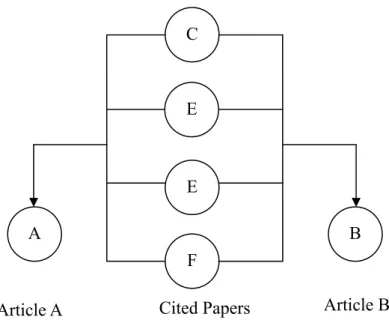
Article A and B are associated because both of them are cited by papers C, D, E and F. Figure 2 Concept of Co-citation Analysis
Modified from: Garfield E, 2001
With co-citation analysis, the relation among our core papers will be revealed. From these connections, our core papers can be classified and the trend how our target topic – TAM – has been developed could be studied. Based on this TAM development trend, suggestions could be given for the possibly future study worthy to do.
3.2 Data Collection and Analysis
3.2.1 Research Procedure
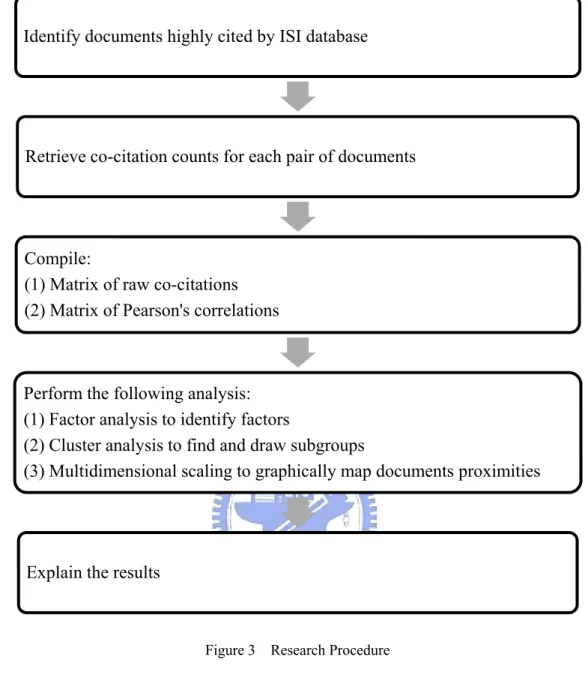
The complete procedure of this research is shown in Figure3. In the beginning, we identified our core research papers by selecting the highly cited documents about TAM in ISI database. Then we retrieved the co-citation counts for each pair of the selected core documents to compile the raw co-citation matrix. Starting from the co-citation matrix, we estimated the Pearson’s correlation matrix with the statistics software package-SPSS. With this correlation, three data analysis are performed: (1) factor analysis, (2) cluster analysis, and (3) multidimensional scaling (MDS). From the statistics analysis, the historical dissemination of TAM might be unveiled.
Cited Papers Article A Article B F E E C A B
Figure 3 Research Procedure
3.2.2 Data Selecting
In order to explore the trend of TAM development, we planned to analyze the relation among some papers which we consider as important TAM articles in academic field. But what a proper criteria can be used for deciding research papers on TAM as important articles? The research papers on TAM that are published in SSCI1 journals collected for the present research. On January 1st, 2009, we searched the articles with the key word “technology acceptance model” in SSCI database.
1
SSCI: Social Sciences Citation Index. SSCI is the most famous and powerful accreditation in social science developed the Institute for Scientific Information (ISI), the US. SSCI is an interdisciplinary citation index product of Thomson Scientific. This citation database covers more than 1,700 of the world’s leading journals of social sciences, and more than 50 disciplines online. This database product provides information to identify the articles cited most frequently and by what publisher and author.
Identify documents highly cited by ISI database
Retrieve co-citation counts for each pair of documents
Compile:
(1) Matrix of raw co-citations (2) Matrix of Pearson's correlations
Perform the following analysis: (1) Factor analysis to identify factors
(2) Cluster analysis to find and draw subgroups
(3) Multidimensional scaling to graphically map documents proximities
Figure 4 SSCI Database
Figure 5 Result of TAM Paper-Searching in ISI Database
The result shows that there are 518 papers that their research topics are about “technology acceptance model” (Figure 5). According to the reference paper ” The Intellectual Development of Management Information Systems, 1972-1982: A Co-Citation Analysis” by Mary J. Culnan, 1986, the author chooses 30 or more times that a paper had been cited to retained for subsequent co-citation analysis (Culnan, 1986). We collected the research papers on TAM that had been cited 30 or more times from 1977 to January 1st, 2009. This procedure results in a list of 65 papers received
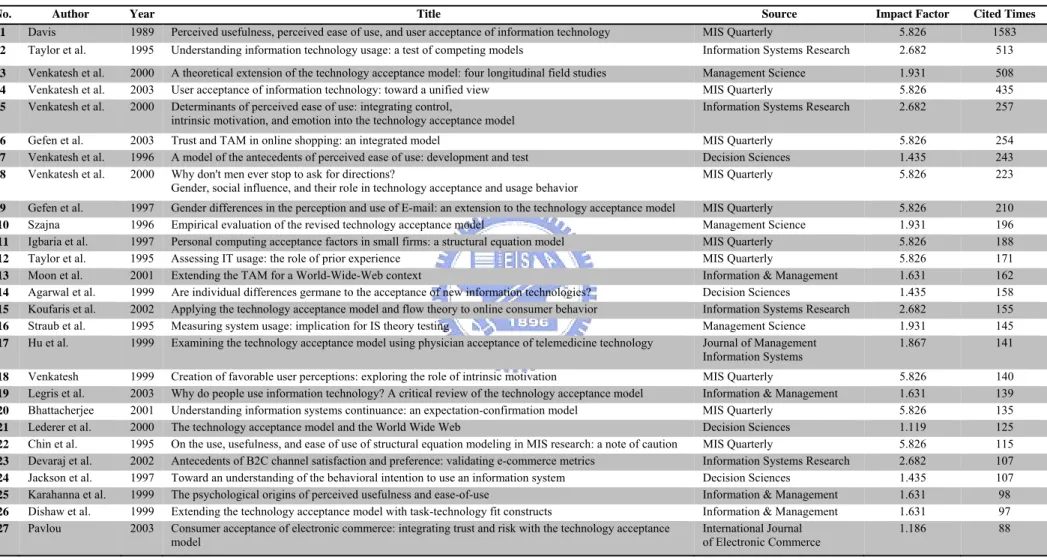
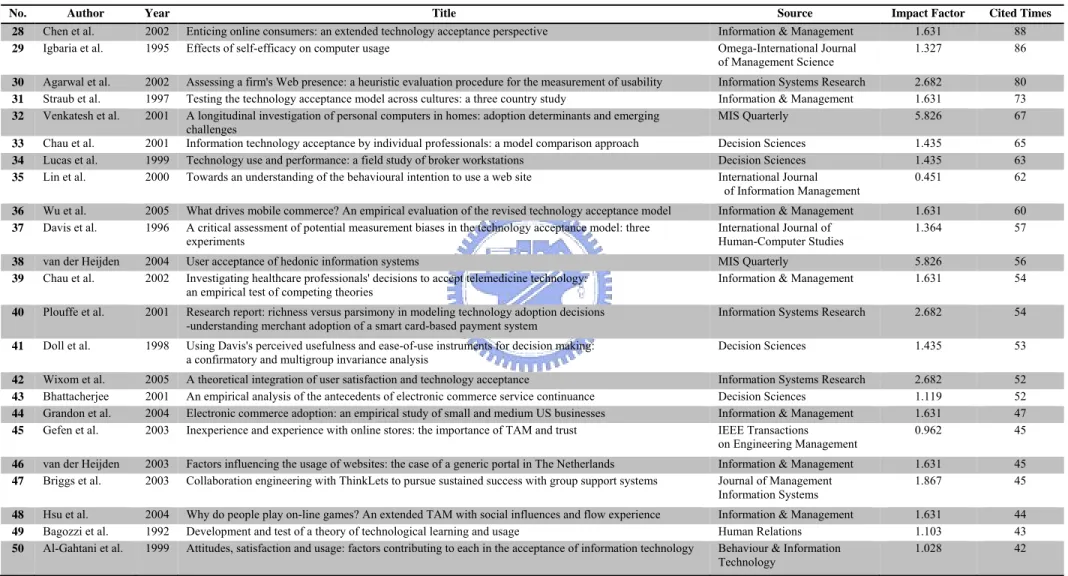
between 513 and 30 cited times. But this collection is clearly not exhaustive of the articles which are currently published in the SSCI journals. The later the papers are published, the lesser the cited times they have. Only two articles published in 2005 and no one published after 2006 are collected in our research pool. This phenomenon is called “publication lag” due to the fact that a number of years are required for published articles to be subsequently cited. To reduce the possible bias due to publication lags, we enlarged our collection of the core papers which have 20 or more cited times published after 2005 (Acedo, Barroso, and Galan, 2006). Another six articles published after 2005 are included in our research pool. Last, we added the most important article on TAM in our research pool. That is "Perceived Usefulness, Perceived Ease of Use, and User Acceptance of Information Technology” in MIS Quarterly by Davis, FD, 1989. This article is generally considered as the first article proposed the TAM concept in academic journals. The whole procedure finally resulted in 72 articles to our research pool. The list of these 72 core papers are shown in Table 1, Table 2, and Table 3.
Table 1 Core Set Documents I
No. Author Year Title Source Impact Factor Cited Times
1 Davis 1989 Perceived usefulness, perceived ease of use, and user acceptance of information technology MIS Quarterly 5.826 1583
2 Taylor et al. 1995 Understanding information technology usage: a test of competing models Information Systems Research 2.682 513
3 Venkatesh et al. 2000 A theoretical extension of the technology acceptance model: four longitudinal field studies Management Science 1.931 508
4 Venkatesh et al. 2003 User acceptance of information technology: toward a unified view MIS Quarterly 5.826 435
5 Venkatesh et al. 2000 Determinants of perceived ease of use: integrating control,
intrinsic motivation, and emotion into the technology acceptance model Information Systems Research 2.682 257
6 Gefen et al. 2003 Trust and TAM in online shopping: an integrated model MIS Quarterly 5.826 254
7 Venkatesh et al. 1996 A model of the antecedents of perceived ease of use: development and test Decision Sciences 1.435 243
8 Venkatesh et al. 2000 Why don't men ever stop to ask for directions?
Gender, social influence, and their role in technology acceptance and usage behavior
MIS Quarterly 5.826 223
9 Gefen et al. 1997 Gender differences in the perception and use of E-mail: an extension to the technology acceptance model MIS Quarterly 5.826 210
10 Szajna 1996 Empirical evaluation of the revised technology acceptance model Management Science 1.931 196
11 Igbaria et al. 1997 Personal computing acceptance factors in small firms: a structural equation model MIS Quarterly 5.826 188
12 Taylor et al. 1995 Assessing IT usage: the role of prior experience MIS Quarterly 5.826 171
13 Moon et al. 2001 Extending the TAM for a World-Wide-Web context Information & Management 1.631 162
14 Agarwal et al. 1999 Are individual differences germane to the acceptance of new information technologies? Decision Sciences 1.435 158
15 Koufaris et al. 2002 Applying the technology acceptance model and flow theory to online consumer behavior Information Systems Research 2.682 155
16 Straub et al. 1995 Measuring system usage: implication for IS theory testing Management Science 1.931 145
17 Hu et al. 1999 Examining the technology acceptance model using physician acceptance of telemedicine technology Journal of Management
Information Systems
1.867 141
18 Venkatesh 1999 Creation of favorable user perceptions: exploring the role of intrinsic motivation MIS Quarterly 5.826 140
19 Legris et al. 2003 Why do people use information technology? A critical review of the technology acceptance model Information & Management 1.631 139
20 Bhattacherjee 2001 Understanding information systems continuance: an expectation-confirmation model MIS Quarterly 5.826 135
21 Lederer et al. 2000 The technology acceptance model and the World Wide Web Decision Sciences 1.119 125
22 Chin et al. 1995 On the use, usefulness, and ease of use of structural equation modeling in MIS research: a note of caution MIS Quarterly 5.826 115 23 Devaraj et al. 2002 Antecedents of B2C channel satisfaction and preference: validating e-commerce metrics Information Systems Research 2.682 107
24 Jackson et al. 1997 Toward an understanding of the behavioral intention to use an information system Decision Sciences 1.435 107
25 Karahanna et al. 1999 The psychological origins of perceived usefulness and ease-of-use Information & Management 1.631 98
26 Dishaw et al. 1999 Extending the technology acceptance model with task-technology fit constructs Information & Management 1.631 97
27 Pavlou 2003 Consumer acceptance of electronic commerce: integrating trust and risk with the technology acceptance
model
International Journal of Electronic Commerce
Table 2 Core Set Documents II
No. Author Year Title Source Impact Factor Cited Times
28 Chen et al. 2002 Enticing online consumers: an extended technology acceptance perspective Information & Management 1.631 88
29 Igbaria et al. 1995 Effects of self-efficacy on computer usage Omega-International Journal
of Management Science
1.327 86
30 Agarwal et al. 2002 Assessing a firm's Web presence: a heuristic evaluation procedure for the measurement of usability Information Systems Research 2.682 80
31 Straub et al. 1997 Testing the technology acceptance model across cultures: a three country study Information & Management 1.631 73
32 Venkatesh et al. 2001 A longitudinal investigation of personal computers in homes: adoption determinants and emerging
challenges
MIS Quarterly 5.826 67
33 Chau et al. 2001 Information technology acceptance by individual professionals: a model comparison approach Decision Sciences 1.435 65
34 Lucas et al. 1999 Technology use and performance: a field study of broker workstations Decision Sciences 1.435 63
35 Lin et al. 2000 Towards an understanding of the behavioural intention to use a web site International Journal
of Information Management 0.451 62
36 Wu et al. 2005 What drives mobile commerce? An empirical evaluation of the revised technology acceptance model Information & Management 1.631 60 37 Davis et al. 1996 A critical assessment of potential measurement biases in the technology acceptance model: three
experiments
International Journal of Human-Computer Studies
1.364 57
38 van der Heijden 2004 User acceptance of hedonic information systems MIS Quarterly 5.826 56
39 Chau et al. 2002 Investigating healthcare professionals' decisions to accept telemedicine technology:
an empirical test of competing theories
Information & Management 1.631 54
40 Plouffe et al. 2001 Research report: richness versus parsimony in modeling technology adoption decisions
-understanding merchant adoption of a smart card-based payment system Information Systems Research 2.682 54
41 Doll et al. 1998 Using Davis's perceived usefulness and ease-of-use instruments for decision making:
a confirmatory and multigroup invariance analysis
Decision Sciences 1.435 53
42 Wixom et al. 2005 A theoretical integration of user satisfaction and technology acceptance Information Systems Research 2.682 52
43 Bhattacherjee 2001 An empirical analysis of the antecedents of electronic commerce service continuance Decision Sciences 1.119 52
44 Grandon et al. 2004 Electronic commerce adoption: an empirical study of small and medium US businesses Information & Management 1.631 47 45 Gefen et al. 2003 Inexperience and experience with online stores: the importance of TAM and trust IEEE Transactions
on Engineering Management 0.962 45
46 van der Heijden 2003 Factors influencing the usage of websites: the case of a generic portal in The Netherlands Information & Management 1.631 45 47 Briggs et al. 2003 Collaboration engineering with ThinkLets to pursue sustained success with group support systems Journal of Management
Information Systems
1.867 45
48 Hsu et al. 2004 Why do people play on-line games? An extended TAM with social influences and flow experience Information & Management 1.631 44
49 Bagozzi et al. 1992 Development and test of a theory of technological learning and usage Human Relations 1.103 43
50 Al-Gahtani et al. 1999 Attitudes, satisfaction and usage: factors contributing to each in the acceptance of information technology Behaviour & Information
Technology
1.028 42
No Author Year Title Source Impact Factor Cited Times 51 Hong et al. 2001 Determinants of user acceptance of digital libraries:
an empirical examination of individual differences and system characteristics
Journal of Management Information Systems
1.867 41
52 Hackbarth et al. 2003 Computer playfulness and anxiety:
positive and negative mediators of the system experience effect on perceived ease of use Information & Management 1.631 39
53 Vijayasarathy 2004 Predicting consumer intentions to use on-line shopping:
the case for an augmented technology acceptance model
Information & Management 1.631 38
54 Gefen et al. 1998 The impact of developer responsiveness on perceptions of usefulness and ease of use:
an extension of the technology acceptance model
Data Base For Advances in Information Systems
- 38
55 Pavlou et al. 2006 Understanding and predicting electronic commerce adoption: an extension of the theory of planned
behavior
MIS Quarterly 5.826 37
56 Bruner et al. 2005 Explaining consumer acceptance of handheld Internet devices Journal of Business Research 0.878 37
57 Morris et al. 1997 How user perceptions influence software use IEEE Software 1.462 37
58 Yi et al. 2003 Predicting the use of web-based information systems:
self-efficacy, enjoyment, learning goal orientation, and the technology acceptance model
International Journal of Human-Computer Studies
1.364 36
59 Sussman et al. 2003 Informational influence in organizations: an integrated approach to knowledge adoption Information Systems Research 2.682 36 60 Riemenschneider
et al.
2003 Understanding it adoption decisions in small business: integrating current theories Information & Management 1.631 36
61 Luarn et al. 2005 Toward an understanding of the behavioral intention to use mobile banking Computers in Human Behavior 1.344 34
62 Shih 2004 An empirical study on predicting user acceptance of e-shopping on the Web Information & Management 1.631 33
63 Amoako et al. 2004 An extension of the technology acceptance model in an ERP implementation environment Information & Management 1.631 31 64 Nysveen et al. 2005 Intentions to use mobile services: antecedents and cross-service comparisons Journal of Management
Information Systems
1.18 30
65 Ong et al. 2004 Factors affecting engineers' acceptance of asynchronous e-learning systems in high-tech companies Information & Management 1.631 30 66 Featherman et al. 2003 Predicting e-services adoption: a perceived risk facets perspective International Journal
of Human-Computer Studies 1.364 30
67 Carter et al. 2005 The utilization of e-government services: citizen trust, innovation and acceptance factors Information Syatems Journal 1.531 26
68 Shang et al. 2005 Extrinsic versus intrinsic motivations for consumers to shop on-line Information & Management 1.631 25
69 Saade et al. 2005 The impact of cognitive absorption on perceived usefulness and perceived ease of use
in on-line learning: an extension of the technology acceptance model
Information & Management 1.631 22
70 Lee et al. 2005 Acceptance of Internet-based learning medium: the role of extrinsic and intrinsic motivation Information & Management 1.631 20
71 Yu et al. 2005 Extending the TAM for a t-commerce Information & Management 1.631 20
3.2.3 Co-citation Analysis
Based on these 72 core papers, we collected every paper citing our core papers from ISI database. 7133 citing papers in total are collected as the data to build our co-citation matrix. The co-citation matrix is shown in Table 4. This co-citation matrix is the starting point of this present inductive analysis. The first row and column of this 72 squared matrix are the numbers of our core papers. The figures in the boxes indicate the number of papers that cite each pair of our core papers.
Using SPSS, the co-citation matrix is transferred into the Pearson’s correlation matrix that is shown in Table 5. These correlation quotients can be the indicators of similarities between the co-citation profiles of two core papers. There are two advantages of using correlations instead of counts of co-citations. One is to standardize the data in order to avoid the scale effects caused by the number of citation consisting different documents. Another is to reduce the number of zeros existing in the matrix that can cause problems in the statistics application. (Francisco Jos’e Acedo, et al., 2006)
IV. Results
4.1 Factor Analysis
Factor analysis is a statistical method used to describe variability among original variables in terms of fewer unobserved variables called factors. The motivation for reducing the dimension when analyzing multi-response data is a balance between attainment of parsimony for understanding and the retention of sufficient information for adequate analysis (Mark L. Berenson, et al., 1983). Using factor analysis, we can identify the salient groups of documents that define historical trends within TAM.
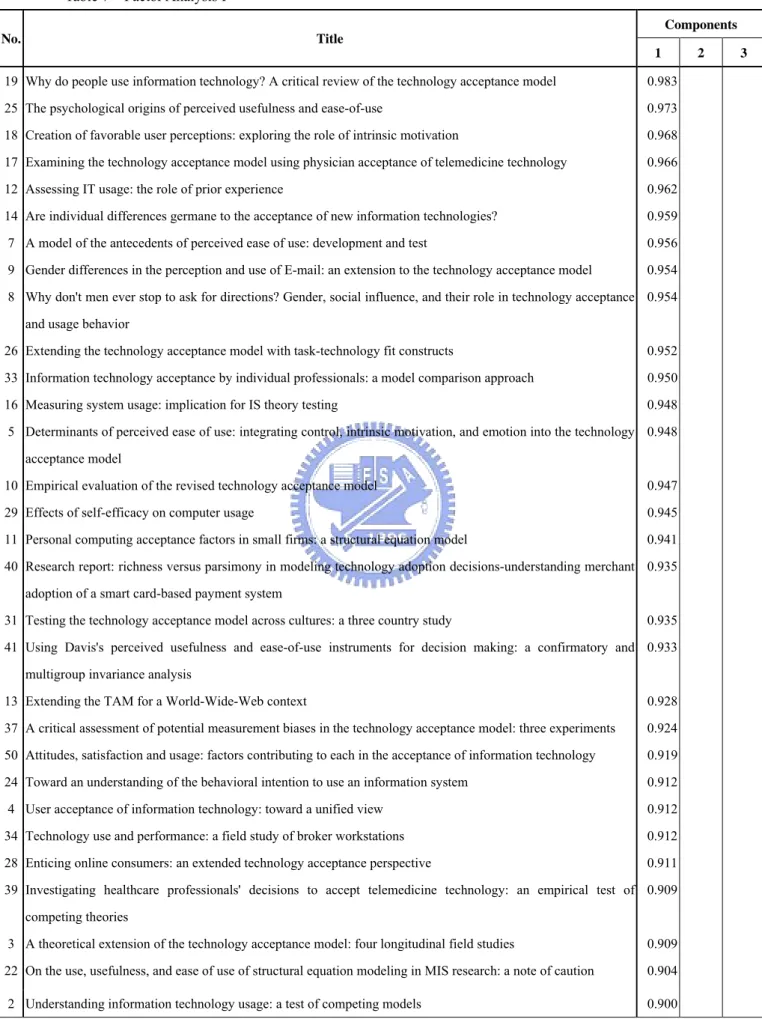
Three factors are chosen to explain 82.40 percent of the variance (Table 6). Table7 shows the results of factor analysis with varimax rotation. Varimax rotation has the advantage of showing the loads on more than one factor and expresses the importance of the variables loading on a given factor.
Table 6 Explanation of Total Variance Extracted Components Eigenvalues % of Variance Accounted for Cumulative Variance 1 44.57 59.12 59.12 2 10.12 14.06 73.18 3 6.62 9.19 82.40
Table 7 Factor Analysis I
No. Title
Components 1 2 3
19 Why do people use information technology? A critical review of the technology acceptance model 0.983 25 The psychological origins of perceived usefulness and ease-of-use 0.973 18 Creation of favorable user perceptions: exploring the role of intrinsic motivation 0.968 17 Examining the technology acceptance model using physician acceptance of telemedicine technology 0.966 12 Assessing IT usage: the role of prior experience 0.962 14 Are individual differences germane to the acceptance of new information technologies? 0.959 7 A model of the antecedents of perceived ease of use: development and test 0.956 9 Gender differences in the perception and use of E-mail: an extension to the technology acceptance model 0.954 8 Why don't men ever stop to ask for directions? Gender, social influence, and their role in technology acceptance
and usage behavior
0.954 26 Extending the technology acceptance model with task-technology fit constructs 0.952 33 Information technology acceptance by individual professionals: a model comparison approach 0.950 16 Measuring system usage: implication for IS theory testing 0.948
5 Determinants of perceived ease of use: integrating control, intrinsic motivation, and emotion into the technology acceptance model
0.948 10 Empirical evaluation of the revised technology acceptance model 0.947 29 Effects of self-efficacy on computer usage 0.945 11 Personal computing acceptance factors in small firms: a structural equation model 0.941 40 Research report: richness versus parsimony in modeling technology adoption decisions-understanding merchant
adoption of a smart card-based payment system
0.935 31 Testing the technology acceptance model across cultures: a three country study 0.935 41 Using Davis's perceived usefulness and ease-of-use instruments for decision making: a confirmatory and
multigroup invariance analysis
0.933 13 Extending the TAM for a World-Wide-Web context 0.928 37 A critical assessment of potential measurement biases in the technology acceptance model: three experiments 0.924 50 Attitudes, satisfaction and usage: factors contributing to each in the acceptance of information technology 0.919 24 Toward an understanding of the behavioral intention to use an information system 0.912 4 User acceptance of information technology: toward a unified view 0.912 34 Technology use and performance: a field study of broker workstations 0.912 28 Enticing online consumers: an extended technology acceptance perspective 0.911 39 Investigating healthcare professionals' decisions to accept telemedicine technology: an empirical test of
competing theories
0.909 3 A theoretical extension of the technology acceptance model: four longitudinal field studies 0.909 22 On the use, usefulness, and ease of use of structural equation modeling in MIS research: a note of caution 0.904
Table 8 Factor Analysis II
No. Title
Components 1 2 3
54 The impact of developer responsiveness on perceptions of usefulness and ease of use: an extension of the technology acceptance model
0.898 51 Determinants of user acceptance of digital libraries: an empirical examination of individual differences and
system characteristics
0.894 21 The technology acceptance model and the World Wide Web 0.872 65 Factors affecting engineers' acceptance of asynchronous e-learning systems in high-tech companies 0.869 52 Computer playfulness and anxiety: positive and negative mediators of the system experience effect on perceived
ease of use
0.849 6 Trust and TAM in online shopping: an integrated model 0.832 49 Development and test of a theory of technological learning and usage 0.826 63 An extension of the technology acceptance model in an ERP implementation environment 0.816 58 Predicting the use of web-based information systems: self-efficacy, enjoyment, learning goal orientation, and the
technology acceptance model
0.808 57 How user perceptions influence software use 0.803 20 Understanding information systems continuance: an expectation-confirmation model 0.793 60 Understanding it adoption decisions in small business: integrating current theories 0.788 32 A longitudinal investigation of personal computers in homes: adoption determinants and emerging challenges 0.763 70 Acceptance of Internet-based learning medium: the role of extrinsic and intrinsic motivation 0.753 1 Perceived usefulness, perceived ease of use, and user acceptance of information technology 0.729 15 Applying the technology acceptance model and flow theory to online consumer behavior 0.725 69 The impact of cognitive absorption on perceived usefulness and perceived ease of use in on-line learning: an
extension of the technology acceptance model
0.718 36 What drives mobile commerce? An empirical evaluation of the revised technology acceptance model 0.681
35 Towards an understanding of the behavioural intention to use a web site 0.651 48 Why do people play on-line games? An extended TAM with social influences and flow experience 0.651 38 User acceptance of hedonic information systems 0.649 46 Factors influencing the usage of websites: the case of a generic portal in The Netherlands 0.591
27 Consumer acceptance of electronic commerce: integrating trust and risk with the technology acceptance model 0.878 55 Understanding and predicting electronic commerce adoption: an extension of the theory of planned behavior 0.837 23 Antecedents of B2C channel satisfaction and preference: validating e-commerce metrics 0.766 42 A theoretical integration of user satisfaction and technology acceptance 0.730 30 Assessing a firm's Web presence: a heuristic evaluation procedure for the measurement of usability 0.718 45 Inexperience and experience with online stores: the importance of TAM and trust 0.683 66 Predicting e-services adoption: a perceived risk facets perspective 0.662
No .
Title
Components 1 2 3
67 The utilization of e-government services: citizen trust, innovation and acceptance factors 0.623 43 An empirical analysis of the antecedents of electronic commerce service continuance 0.553 61 Toward an understanding of the behavioral intention to use mobile banking 0.553 44 Electronic commerce adoption: an empirical study of small and medium US businesses -0.432 47 Collaboration engineering with ThinkLets to pursue sustained success with group support systems -0.391 53 Predicting consumer intentions to use on-line shopping: the case for an augmented technology acceptance model 0.725 68 Extrinsic versus intrinsic motivations for consumers to shop on-line 0.705 72 Technology acceptance model for internet banking: an invariance analysis 0.659 64 Intentions to use mobile services: antecedents and cross-service comparisons 0.649 71 Extending the TAM for a t-commerce 0.633 56 Explaining consumer acceptance of handheld Internet devices 0.610 59 Informational influence in organizations: an integrated approach to knowledge adoption -0.607 62 An empirical study on predicting user acceptance of e-shopping on the Web 0.579
From the above factor analysis, we can group 72 core papers into 3 main factors to discuss (Table 10 and Table 11).
Table 10 Factor Identification I
Factor Factor Name Number of Core Set Papers
1 TAM development and IT application 19, 25, 18, 17, 12, 14, 7, 9, 8, 26, 33, 16, 5, 10, 29, 11, 40, 31, 41, 13, 37, 50, 24, 4, 34, 28, 39, 3, 22, 2, 54, 51, 21, 65, 52, 6, 49, 63, 58, 57, 20, 60, 32, 70, 1, 15, 69, 36, 35, 48, 38, 46 Summary
(1) Other factors affecting users’ intention, attitude, and actual behavior of IT adoption : PU, PEOU, social norms, gender, cost, computer anxiety, risk, trust, enjoyment, and so on (Davis, 1985, 1989; Venkatesh, et al., 2000; Gefen, et al., 2003; Taylor, et al., 1995).
(2) Combination with other adoption-assessing model : Theory of planned behavior (TPB)、task-technology model (TTM)、innovation diffusion theory (IDT), and others (Taylor, et al., 1995; Dishaw, et al., 1999; Chen, et al., 2002). (3) Applied to work-related IT : Word processor, email, voice mail, telemedicine
technology, etc.(Agarwal, et al., 1999; Gefen , et al., 1997; Straub, et al., 1995; Hu, et al., 1999), e-learning (Ong, et al.,2004), ERP (Amoako-Gyampah, et al., 2004)
Table 11 Factor Identification II
Factor Factor Name Number of Core Set Papers
2 Online shopping 27, 55, 23, 42, 30, 45, 66, 67, 43, 61, 44, 47 Summary
(1) Published after 2001
(2) Users’ adoption (Pavlou, 2003; Grandon, et al., 2004; Gefen, et al., 2003) and selection (Devaraj, et al., 2002) about online shopping based on TAM.
Factor Factor Name Number of Core Set Papers
3 E-commerce with
new technology 53, 68, 72, 64, 71, 56, 59, 62 Summary
(1) Published after 2001, or fresher
(2) The infrastructure and efficiency of Internet bandwidth ↑, wireless devices and novel interactive electronical devices, emerging e-commerce have been paid more attention to.
EX: mobile-commerce (Bruner et al., 2005; Nysveen, et al., 2005) and shopping with iTV (an interactive TV to facilitate the purchase of goods and services in the home using remote control instead of a telephone) (Yu, et al., 2005) are discussed in this subgroup.
Factor 1 : TAM development and IT application
Factor 1 consists of 52 papers in Table7, 8, and 9. The commonality of the topics of these papers is about the TAM development and IT application. Factor 2 consists of 12 papers in Table7, 8, and 9. They are commonly interested in the user adoption of online shopping. 8 papers are grouped in Factor 3 in Table7, 8, and 9. These papers almost discuss the user adoption in emerging technology such as mobile commerce and t-commerce (using interactive television, iTV).
From these three main factors, the dissemination of TAM is unveiled. The largest part of the dissemination is model developing. In factor 1, to complete and ensure TAM proposed by Davis in 1986, many research have been conducted to test factors affecting users’ intention, attitude, and actual behavior of IT adoption, such as PU, PEOU, social norms, gender, cost, computer anxiety, risk, trust, enjoyment, and so on
(Davis, 1985, 1989; Venkatesh, et al., 2000; Gefen, et al., 2003; Taylor, et al., 1995). But the frameworks of these replications are still constructed on the basis of TAM. It shows that TAM is generally considered as a simple but effective fundamental model. Some studies compare TAM with other adoption-assessing model, such as theory of planned behavior (TPB), task-technology model (TTM), innovation diffusion theory (IDT), and so on (Taylor, et al., 1995; Dishaw, et al., 1999; Chen, et al., 2002). This subgroup represents some researchers attempt to form a more comprehensive model to get better understanding about how users’ IT adoption is affected. In this group, TAM are applied in work-related IT (word processor, email, voice mail, telemedicine technology, etc.) (Agarwal, et al., 1999; Gefen , et al., 1997; Straub, et al., 1995; Hu, et al., 1999), e-learning (Ong, et al.,2004), ERP (Amoako-Gyampah, et al., 2004), and so on.
Factor 2 and Factor 3: E-commerce
Articles in factor 2 and factor 3 generally concentrate on e-commerce. All of them are published after 2001. As the Internet has gone from novelty to utility for many households, increasing number of customers are spending more time shopping electronically for books, music, and airline tickets (Devaraj, et al., 2002). Many papers study users’ adoption (Pavlou, 2003; Grandon, et al., 2004; Gefen, et al., 2003) and selection (Devaraj, et al., 2002) about online shopping based on TAM. In factor 3, the year of publication of these articles are even fresher than those in factor 2. As increasing of the infrastructure and efficiency of Internet bandwidth, wireless devices and novel interactive electronical devices, emerging e-commerce have been paid more attention to. For example, mobile-commerce (Bruner et al., 2005; Nysveen, et al., 2005) and shopping on iTV2 (Yu, et al., 2005) are discussed in this subgroup. From the above discussion, we can induce the trend of TAM study evolving from basic model developing on work-related IT to the adoption to e-commerce.
4.2 Cluster Analysis
The objective of cluster analysis is to develop subgroups such that objects within a particular subgroup (called cluster) are more like other objects within this subgroup than they are like objects in a different subgroup (Mark L. Berenson, et al., 1983). Hence, the outcome of cluster analysis is to develop a classification scheme that provides the sequence of groupings by which a set of objects is subdivided (Mark L.
2 iTV is an interactive TV to facilitate the purchase of goods and services in the home using remote control instead of a telephone
Berenson, et al., 1983). We use agglomerative (buttom-up) hierarchical algorithm to find successive clusters using previously established clusters. The squared Euclidean distance is selected as the distance measure. We use Ward Method to link the articles together in clusters.
The following dendrogram (Figure 6) shows the result of the agglomerative hierarchical clustering.
Cluster 1‐1 Cluster 1‐2 Cluster 2 Cluster 1 Figure 6 Hierarchical Cluster Analysis Cluster 1‐2‐1 Cluster 1‐2‐2 Cluster 2‐2 Cluster 2‐1
F clus show Clu C com mod 1-1 stud voic earl wor it m From the ab sters. And ws the iden uster 1 : Ins Compiled in mmonality o del testing. and cluster dies are com
ce mail, an ly stage o rk-related IT more compre Cluster 1‐1 Job‐Related Cluste Know Manag ove cluster also, in clu tification of Figure 7 C strument w n Figure 7, c of the topic However, c r 1-2 are com mmonly in nd telemedic of TAM (p T to test the ehensive. Cluster 1 Instrumen 1 d IT C [E r 1‐2‐1 wledge gement analysis, w uster 1, two f these clust Cluster Identifi with Variabl cluster 1 com cs of these p cluster 1 ca mposed of 3 terested in cine techno proposed i e efficiency
Hierarch
1 nt Cluster 1‐2 Enjoyment] Cluste Leisu we can grou o subgroup ters. fication and Ad le “Enjoym mprises 53 papers is a an be furthe 30 and 23 c job-related ology. This in 1986), of TAM, anhical Clust
er 1‐2‐2 ure IT E‐c Ne up these 72 s can be fu dditional Affe ment” Parti core papers lso about th r divided in ore papers, d IT, such distinguish researchers nd tried to mter Analys
E Cluster 2‐1 commerce wit ew Technolog core papers further class ecting Factors ially s. Similar w he TAM de nto two sub respectivel as word pr hing feature s have app modify thissis
Cluster 2 E‐commer [Trust] th gy E Co s into two m sified. Figu with factor 1 evelopment bgroups. Clu y. In cluster rocessor, em e shows tha plied TAM model to m 2 ce Cluster 2‐2 E‐commerce w omputer Inte main ure 7 , the and uster r 1-1, mail, at in M to make 2 with rfaceCluster 1-2 represents studies interested in non-work-related IT such as online shopping (Koufaris, 2002), e-learning (Ong, et al., 2004; Saade, et al., 2005), online game (Hsu, et al., 2004), entertainment and information websites (van der Heijden, 2004; Hong, et al., 2001; Venkatesh, et al., 2001). Most of these papers concern about the same additional construct – enjoyment (van der Heijden, 2003; Yi, et al., 2003; Lee, et al., 2005). Other three similar words are used to express the same idea – playfulness (Hackbarth, et al., 2003), flow experience (Koufaris, 2002; Hsu, et al., 2004), and hedonic (Venkatesh, et al., 2001; van der Heijden, 2004). With these two features, it can be inferred that one of main reasons that people continue to use IT after work is enjoyment. The pleasure derived from the consumption, or use, of these IT products(Venkatesh, et al., 2001).
Cluster 2: E-commerce with Variable “Trust”
Cluster 2 is made of 19 core papers. The publication years of these articles are even fresher (9 of 19 papers are published after 2005). Papers in this clusters are commonly emphasize the effect of trust (Pavlou, 2003; Gefen, et al., 2003; Pavlou, et al., 2006; Carter & Belanger, 2005; Yu, et al., 2005). Also, the similar idea is expressed with some other terms. For example, uncertainty (Devaraj, et al., 2002), reliability (Wixom, et al., 2005), confirmation (Bhattacherjee, 2001), credibility (Luarn & Lin, 2005; Sussman & Siegal, 2003), risk (Featherman & Pavlou, 2003), and security (Shih, 2004). This common employment to trust and risk perceptions in the uncertain context of e-commerce shows that people feel uncertain about virtual shops, and the virtual shops which are believed to be honest and reliable are considered to transact with by consumers.
4.3 Multidimensional Scaling (MDS)
Multidimensional scaling (MDS) is a set of related statistical techniques often used in information visualization for exploring similarities or dissimilarities in data. Like principle components and factor analysis, MDS can be categorized as reduction procedures whereby either a measure of similarity or distance between objects is utilized as the basis to form subgroups or determine the dimensions that separate the objects on a geometric map (Mark L. Berenson, et al., 1983).
We use metric MDS to maintain a linear functional relationship between plotted objects and actual distance to deal with interval or ratio level data. After SPSS maps MDS result, two basic aspects need to be considered. One is determination of the proper number of dimensions, another is interpretation of the dimensions. Considering
both the number of dimensions and goodness of fit for the particular configuration obtained, an increase in the number of dimensions will improve the fit of the configuration to the actual data, but increasing dimensionality complicates any analysis. Hence, one of objectives in MDS is to maximize the goodness of fit of the result while minimizing the number of dimensions to be interpreted simply.
Table 12 Stress and Squared Correlation (R2)
Number of Dimensions Kruskal’s Stress Values R2
1 0.24625 0.90798
2 0.18873 0.92447
3 0.15590 0.93684
Table 12 shows that our data reveal a stress of 0.24625 for one dimension, 0.18873 for two dimensions, and 0.15590 for three dimensions. In view of the relatively large difference in stress between one and two dimensions, and relatively small difference between the stress values for two and three dimensions, it would make sense to take the two-dimension configuration presented as Figure 8. The R2 of two-dimension configuration is 0.92447, which indicates an outstanding fit for our data.
Figure 8 Multidimensional Scaling (MDS)
A72 A71
Cluster 2-1
E-commerce with New Technology Cluster 1-2-1 Knowledge Management Cluster1-1 Job-Related IT Cluster 1-2-2 Leisure IT
Theory Development & Combination with TRA, TPB <--- Dimension 1 ---> Theories Combination with Diversified Others
Leisur e-Or iented <--- Dimen sion 2 ---> T a sk -Or iented A61 Cluster 2-2 E-commerce with Computer Interface
Dimension 1: Theory Development or Combination with Different Theories
To explain our MDS, interpretation to the dimensions can lead to an understanding of the processes underlying the perceived nearness of objects. Furthermore, it is possible to incorporate individual or group differences in the solution. We mark out five groups based on cluster analysis shown in Figure 7. If we examine the horizontal axis (Dimension 1), we may observe that the research works (Taylor &Todd, 1995 a,b ; Venkatesh, et al., 2003; Chau & Hu, 2001, 2002; Riemenschneider, et al., 2003) located on the left side focus on the TAM development that they attempt to form a robust model with different construct added to examine, and integrate TAM with the theory of reasoned action (TRA)3 and the theory of planned behavior (TPB)4, both of which propose good frameworks to describe the relation among human behavior, intention, and attitude.
On the other hand, papers located on the right side also attempt to integrate TAM with various theories or models to make TAM more comprehensive. But the combined theories are others beyond TRA and TPB. For example, the theory of trying (TT), the flow theory, the innovation diffusion theory, the transaction cost analysis (TCA), Service Quality (SERVQUAL), and so on (Bagozzi & Davis; 1992; Koufaris, 2002; Briggs, et al., 2003; Devaraj, wt al., 2002). These combined theories or models provide diversified sets of acceptance determinants toward IT.
With the above discussion, the horizontal axis (dimension 1) can be then interpreted as a “theory development or combination with different theories” dimension – with the polarization of early research on the left side away from current research on the right side.
Dimension 2: Job-oriented or Leisure-oriented
To interpreting the factor related to the vertical axis (dimension 2), aside from cluster 1-1 in which the studies are almost applied in work-related IT context such as word processing applications and spread sheet, most of the studies at the bottom of the vertical axis focus on work-related IT (Davis, 1989; Amoako-Gyampah & Salam, 2004), e-learning (Ong, et al., 2004; Yi & Hwang, 2003), informational web sites
3
The theory of reasoned action (TRA) suggests that an individual’s behavior is determined by the behavioral intention (BI) to perform the behavior. This provides the accurate prediction of behavior (Chang, 1998). Behavioral intention is a function of one’s attitude toward the behavior (A) and subjective norm (SN).
(Hong, et al., 2001; Lin & Lu, 2000). These can be classified as job-related and information-acquiring IT usage.
On the contrary, most of the studies at the top of the vertical axis focus on e-commerce (Gefen, et al., 2003; Koufaris, 2002), online banking (Bhattacherjee, 2001), online game (Hsu & Lu, 2004), and leisure websites (van der Heijden, 2004; 2003). These can be interpreted as that the focus of these studies are the non-work-related, voluntary, and leisure IT usage.
With the above discussion, the vertical axis (dimension 2) can be then interpreted as a “job-oriented or leisure-oriented” dimension – with the polarization of job-related IT adoption research on the bottom side away from recreational IT usage research on the top side.
4.4 Discussion
4.4.1 General Discussion
The current research attempts to provide the intellectual development of TAM to identify the dissemination and main trends related within research about this model. Using document co-citation analysis, 72 papers on TAM published in SSCI journals are collected as our core papers to be the basis for three statistical analyses, which are factor analysis, cluster analysis and multidimensional scaling. The results of this study show the presence of our key findings in two major aspects: (1) TAM appliance in different IT context; (2) extended TAM and combination of diversified theories.
On applying TAM in different IT context, researchers have conducted their studies incorporating four main IT categories: (1) job-related IT; (2) information-acquiring IT for knowledge management; (3) leisure IT; and (4) e-commerce.
Observing the relation between the year of publication of core papers in this study and the applied context of IT, it might be induced that the works in early years investigate the adoption of IT which people utilize in the workplace in order to improve work performance. According to Legris’ meta-analysis on TAM (2003), he groups these studies under three software tool categories: office automation (e.g. spreadsheet, text-editor, e-mail), software development (e.g. programming tools, software maintenance tools), and business application (e.g. software used in the core 29usiness). To enhance work performance and efficiency are always important issues in business management. Researchers put job-related IT as the first priority to apply in
TAM research. These works are conducted in mandatory settings like work tools. However, as the degree of penetration of personal computers (PC) is getting higher, research trends are gradually transferred to voluntary IT usage context like information-acquiring IT for knowledge management, leisure IT, and e-commerce.
As for information-acquiring IT such as e-learning, digital library, and ERP, the common feature of these media is convenient electronic collections to convey rich content for knowledge management. Knowledge management refers to identifying and leveraging the collective knowledge in an organization (Alavi & Leidner, 2001) or an individual to help build competency. These works have been proven that TAM has been successfully applied to these content-based systems or IT-based systems that are developed to support the organizational or individual processes of knowledge storage, retrieval, transfer, creation, and application (Alavi & Leidner, 2001). Knowledge management is crucial for organizations or individuals as one of the key successful, even survival, factors in today’s knowledge-based economy. This shows another main issue in the trends of research of TAM.
Leisure IT includes on-line games, websites providing recreational information, and so on. Leisure IT aims to provide self-fulfilling rather than instrumental value to users (van der Heijden, 2004), and people use them for leisure purpose. The attention on enjoyment and flow experience as people use IT are caught commonly in academic research. Flow experience describes one’s action with total involvement. When people are in the flow state, they are absorbed in this activity; their awareness is narrowed into the activity; they even lose their self-consciousness so that they feel in control of the environment. Studies indicate flow experience might occur in gaming, shopping, and so on (Hsu & Lu, 2004). Many TAM researchers put enjoyment or flow experience in the TAM studies as a new construct to examine the influence on users’ IT adoption, and they have quite good explanation. The third main trend is revealed.
E-commerce is another important issue emerging with the penetration of PCs and Internet. In this trend, traditional e-commerce (using media with PC interface) and e-commerce with new IT (using media with mobile phone and interactive TV interface) are applied on TAM investigations. As it is mentioned previously, online consumers care about trust and risk of e-commerce because the environment of e-commerce lacks of the typical human interaction which is one of important reasons to lead to trust (Gefen, et al., 2003). This shows that the importance of trust on users’ e-commerce adoption.
combined with TAM in IT adoption research. This is an interesting dissemination. Many researchers attempt to form a comprehensive model to get a better understanding about IT adoption with diverse constructs to attitude, different antecedents toward PU and PEOU, and diversified theories and models to combine with. But the parsimonious TAM, which have merely two variables – PU and PEOU – to influence attitude and then affect IT adoption, is still widely discussed and commonly treated as a solid basis for modification. This shows that TAM is certainly a powerful model to predict and explaining IT usage.
4.4.2 Prediction for Future Research Trend
Reviewing the papers which are published in SSCI journals in management of information system (MIS) with the top three highest impact factors – MIS Quarterly (impact factor: 5.826), Information System Research (impact factor: 2.862), and Information & Management (impact factor : 1.631) after 2006 (Table 12), we found that TAM research in e-commerce context (Kamis, et al, 2008; Xiao & Benbasatis, 2007; Kamis & Stohr, 2006; Ahn et al., 2007; Cyr, et al., 2006; Diney & Hart; 2006) are still popular. New technology adoption is also a popular research topic in TAM. As more and more technology innovation coming, we expect that new technology adoption and e-commerce with new medium will still catch researchers’ attention in the future.
Topic Author Year Title Source Impact Factor
e-commerce Kamis, A; Koufaris, M; Stern, T 2008 Using an attribute-based decision support system for user-customized products online: An experimental investigation MIS Quarterly 5.826 e-commerce Xiao, B; Benbasat, I 2007 E-commerce product recommendation agents: Use, characteristics, and impact MIS Quarterly 5.826 e-commerce Kamis, AA; Stohr, EA 2006 Parametric search engines: What makes them effective when shopping online for differentiated products? Information &
Management
1.631
e-commerce Ahn, T; Ryu, S; Han, I 2007 The impact of Web quality and playfulness on user acceptance of online retailing Information &
Management
1.631
e-commerce Cyr, D; Head, M; Ivanov, A 2006 Design aesthetics leading to m-loyalty in mobile commerce Information &
Management 1.631
e-commerce Diney, T; Hart, P 2006 An extended privacy calculus model for E-commerce transactions Information
Systems Research
2.862
new technology adoption Castaneda, JA; Munoz-Leiva, F;
Luque, T
2007 Web Acceptance Model (WAM): Moderating effects of user experience Information &
Management
1.631
new technology adoption Kim, SH 2008 Moderating effects of Job Relevance and Experience on mobile wireless technology acceptance: Adoption of a
smartphone by individuals
Information & Management
1.631
new technology adoption Ha, I; Yoon, Y; Choi, M 2007 Determinants of adoption of mobile games under mobile broadband wireless access environment Information &
Management
1.631
new technology adoption Shin, DH 2009 Determinants of customer acceptance of multi-service network: An implication for IP-based technologies Information &
Management 1.631
new technology adoption Premkumar, G; Ramamurthy, K;
Liu, HN
2008 Internet messaging: An examination of the impact of attitudinal, normative, and control belief systems Information & Management
1.631
e-learning Chiu, CM; Wang, ETG 2008 Understanding Web-based learning continuance intention: The role of subjective task value Information &
Management
1.631
ERP Kwahk, KY; Lee, JN 2008 The role of readiness for change in ERP implementation: Theoretical bases and empirical validation Information &
Management
1.631
meta-analysis Schepers, J; Wetzels, M 2007 A meta-analysis of the technology acceptance model: Investigating subjective norm and moderation effects Information &
Management
1.631
meta-analysis King, WR; He, J 2006 A meta-analysis of the technology acceptance model Information &
Management 1.631
new construct Karahanna, E; Agarwal, R;
Angst, CM
2006 Reconceptualizing compatibility beliefs in technology acceptance research MIS Quarterly 5.826
new construct Mao, E; Palvia, P 2008 Exploring the effects of direct experience on IT use: An organizational field study Information &
Management
1.631
new construct Walczuch, R; Lemmink, J;
Streukens, S
2007 The effect of service employees’ technology readiness on technology acceptance Information & Management
1.631
new construct Burton-Jones, A; Hubona, GS 2006 The mediation of external variables in the technology acceptance model Information &
Management 1.631
new construct Hasan, B 2006 Delineating the effects of general and system-specific computer self-efficacy beliefs on IS acceptance Information &
Management
1.631
post adoption stage Saeed, KA; Abdinnour-Helm, S 2008 Examining the effects of information system characteristics and perceived usefulness on post adoption usage of information systems
Information & Management
1.631
theories combination Pagani, M 2006 Determinants of adoption of High Speed Data Services in the business, market:
Evidence for a combined technology acceptance model with task technology fit model
Information & Management
1.631
V. Conclusions and Limitations
In this study, we investigate the dissemination on technology acceptance model with document co-citation analysis of the inductive bibliometrical method. After factor analysis, cluster analysis and multidimensional scaling, the current study represents the following dissemination: (1) TAM appliance in different IT context; (2) extended TAM and combination of diversified theories. Four major groups of IT context are applied in: (1) job-related IT; (2) information-acquiring IT for knowledge management; (3) leisure IT; and (4) e-commerce. With the historical diffusion of TAM, we suggest studies on e-commerce with emerging media and new technology adoption are still popular in the future. With the above research results, some ideas could be brought to further research on TAM to make this research more complete.
Though several important dissemination and trends on TAM are revealed using document co-citation method, some limitations resulting from this co-citation method are hard to avoid (Nerur, et al., 2008.). Firstly, all citations are treated alike when they may be cited according to different reasons, ranging from a reference to support one’s work to a retort to criticism. Secondly, the process of selection of core papers is unavoidably somewhat subjective like that Davis’ article (1989) is added into the set of core papers because it is considered as an important and famous research work on TAM, but this work cannot be found through key-word search. This might diminish the objectivity of which the co-citation method is proud. However, despite of these limitations, the value for reference from our results does not detract. Further research could keep tracks on the dissemination on TAM research in the future to prove this study or improve our results.