Preparation and Characterization of Polyester Fibers/Absorbent Cotton
Composite Dressing Matrix Fabrics
Ching-Wen Lou
1, Jin-Jia Hu
2,b*, Chao-Chiung Huang
3,c*, Chao-Tsang Lu
4,
Cheng-Tien Hsieh
5and Jia-Horng Lin
5,6,a*
1Institute of Biomedical Engineering and Material Science, Central Taiwan University of Science and
Technology, Taichung 406, Taiwan, R.O.C.
2Department of Biomedical Engineering, National Cheng Kung University, Taiwan, R.O.C 3Department of Textiles & Clothing, Fu Jen Catholic University, Taipei County 242, Taiwan, R.O.C.
4Institute of Life Sciences, Central Taiwan University of Science and Technology, Taichung 406,
Taiwan, R.O.C.
5Laboratory of Fiber Application and Manufacturing, Department of Fiber and Composite Materials,
Feng Chia University, Taichung City 407, Taiwan, R.O.C.
6School of Chinese Medicine, China Medical University, Taichung 40402, Taiwan, R.O.C.
*corresponding email:[email protected], [email protected] , [email protected]
Keywords: Polyester fiber, Absorbent cotton, Water absorption, Wound dressing matrix fabric
Abstract.
In this study, the polyester fiber (PET) and absorbent cotton (AC) blend was needle-bonded to make the nonwoven PET/AC composite wound dressing matrix fabrics. The combined advantages of mechanical strength due to PET and water absorption due to AC make the composite nonwoven an attracting wound dressing matrix fabric. We examined physical features, such as mechanical properties, air permeability, softness, water imbibition, and water absorption rate, of the nonwovens made of different blending ratios of PET and AC. We found that while the strength and air permeability were slightly reduced at blending ratio of 80:20, the water imbibition increased about 1.6 cm for the same nonwoven. The results suggested that the optimal blending ratio for the nonwoven to be used as a wound dressing matrix is 80:20.
Introduction
With the advances of chemical engineering industry, all kinds of different polymers were developed for different purposes. Many wound dressings have come into the market. These products, however, are only suitiable for superficial wound and not applicable to deep wound or large amounts of skin loss. Generally, wound dressings can be categoried into traditional textile dressing, synthetic dressing, and biological dressing. Traditional textile dressings are made of plant fibers or substances in animal hairs; examples are gauze, cotton pad, wool, and vaseline gauze. This type of dressing provides only temperature coverage of the wound and has to be replaced after a certain period of time. On the other hand, synthetic dressings in the format of foam and spray can also be found in the market. These synthetic dressings have further developed into bilayer or even multi-layer structure. For a multi-layer dressing, the outer layer is designed for the durability whereas the innder layer is aimed at the tackiness and stretchability. Unfortunately, these dressings did not significantly enhance wound healing in cases of large and deap wound such as severe burns, and trauma. Because of the limitations of the traditional textile and synthetic dressings, a large number of research groups are working on the development of biological dressing, aiming at a dressing with better quality and functionality.[1-8] For example, water-rolling method has been applied to spray chitosan on matrix fabric, and impregnation process has been used to made hyaluronic acid dipped into needle-bonded fabric.[9-12] In this study, we used polyester fibers and absorbent cotton to make a composite dressing matrix fabric. The mechanical properties, air permittibility, softness, water absorption, and water absorption rate were tested.
Materials and Methods
Preparation of the PET/AC nonwoven
PET and AC were opened separately. PET was then blended with AC at ratios of 100:0, 90:10, 80:20, 70:30, 60:40, and 50:50. The blended PET/AC was subjected to needle-bonding and net-laminating, resulting in the nonwoven sheet.The sample test was containing tearing strength, tensile strength, softness, air permeability, water absorbability, and water absorption rate to acquire optimal process parameter for fabricating dressing base fabric。(PET fiber: fiber fineness 2 D、length 51 mm,from Far East Chemical Fiber Co., LTD,Taiwan. AC:fineness 0.9~1.7 D、length 20~25 mm,from Vesteralen hing industrial Co., LTD,Taiwan.)
Testing procedure
We used a mechanical testing system (MTS, Hong-Da, Taiwan) to test mechanical properties of the nonwoven according to CNS12915, a testing standard for the nonwoven. Ten specimens were tested for tensile strength and tear break strength at each 0o (machine direction, (MD)) and 90o (cross-machine direction, (CD)) direction. The mean and standard deviation of the data were calculated. Thirty specimens were used to measure air permeability using the fabric air permeability tester (TEXTEST FX3300, Germany) according to ASTM D737. Softness test was performed using a fabric softness tester (Countries around technology, Taiwan), according to CNS 12915 cantilever standard. Six samples were checked for each MD and CD, and then the mean and standard deviation of the data were obtained. We measured water imbibition height and water absorption for 10 minutes according to CNS 13905. For water imbibition, PET/AC dressing fabric was cut into 20cm×5cm, and six samples at each MD and CD were measured to obtain the mean and standard deviation. For water absorption rate, the number of specimen for each group is 4.
Results and Discussioin
Mechanical properties of PET/AC fabric
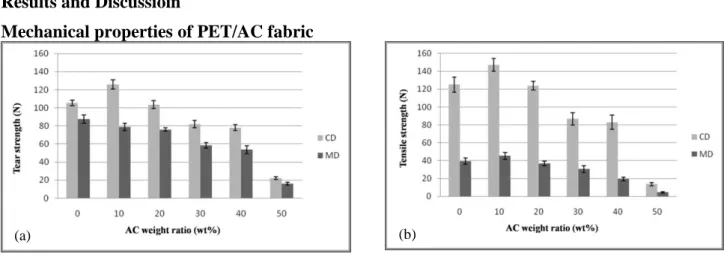
Figure 1. (a) AC mixing ratio influence on tear strength of PET/AC , (b) AC mixing ratio influence on tensile strength of PET/AC
Figure 1(a) illustrated the influence of AC mixing ratio on maximum tear strength of PET/AC. The tearing strength of PET/AC with 10 wt% AC increased by about 20% compared to that of the pure PET fabric. But the trend turned opposite when the AC ratio reached 20%. The reason may be that the interspace of pure PET dressing fabric was greater than that of the blend. Note that AC fibers were shorter than PET fibers. Proper blending of the two could result in a compact structure. Furthermore, due to natural convolution of AC fiber, which also increase the contact between the two fibers, the friction force between two increased and hence the tear strength of PET/AC. However, beacuse the strength of AC fibers is weaker than that of PET fibers, the tear strength of PET/AC trended to decrease with further increase of AC to 20 wt %. Figure 1(b) showed that the maximum tensile strength and tear strength of PET/AC followed the same trend. Particularly, when AC weight ratio was 10 %, tensile strength increased by about 18% compared to that of pure PET fabric. That was
mainly beacuse pure PET fiber interspace which was partly filled with AC fiber were bigger, leading to PET and AC fiber producing more entanglements from natural twisted of AC fiber. And frictional force between two types of fibers increses, causing tensile strength of fabric improved. But for AC fiber is weaker than PET, tensile strength of PET/AC was slightly decreased with the increase of AC to 20 wt %. Note that the mechanical properties of PET/AC nonwoevn with 20% AC were comparable to that of pure PET.
Effects of AC proportion in the composite on air permeability and softness
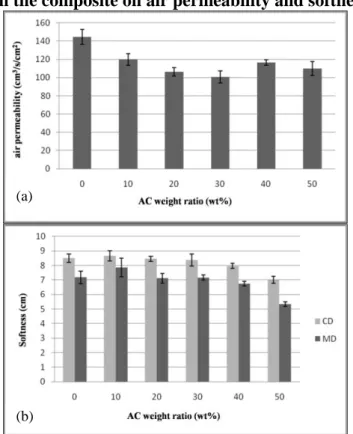
Figure 2. (a) AC mixing ratio vs. air permeability of PET/AC;fig (b) AC mixing ratio vs. softness of PET/AC. According to CNS 12915, fabric stiffness expressed in terms of lengh (cm) is the main decision factor for hand feeling and drapability. A longer bending length represents a harder fabric.
Air permeability of pure PET fabric was above 140 cm3/s/cm2 (Figure 2(a)). An increase of AC content reduced the air permeability significantly. This might be because fiber interspace among pure PET fabric is bigger, and with the increase of AC, the interspace would be filled by AC fiber causing porosity less than pure PET. Because AC fibers occupied nearly half space of PET/AC, porosity of blends with 40 wt% AC or above was slightly increased, resulting in the same fiber fineness. The air permeability of PET/AC with different AC contents retained above 100 cm3/ s/cm2, however.
Figure 2(b) showed the effects of AC mixing ratios on softness of PET/AC fabric. The softness appeared to reach the peak when the AC content was 10%. This may be due to the originally empty fiber interspace in pure PET fabric was now filled with AC fibers, which enhances fiber friction between the two fibers. When the AC ratio continued to decrease, however, the bending length was slightly reduced. As AC fibers were more flexible than PET fibers, PET/AC nonwoven fabric became softer as AC contents increased.
Effects of AC proportion in the composite on water ambibition and water absorption
(a)
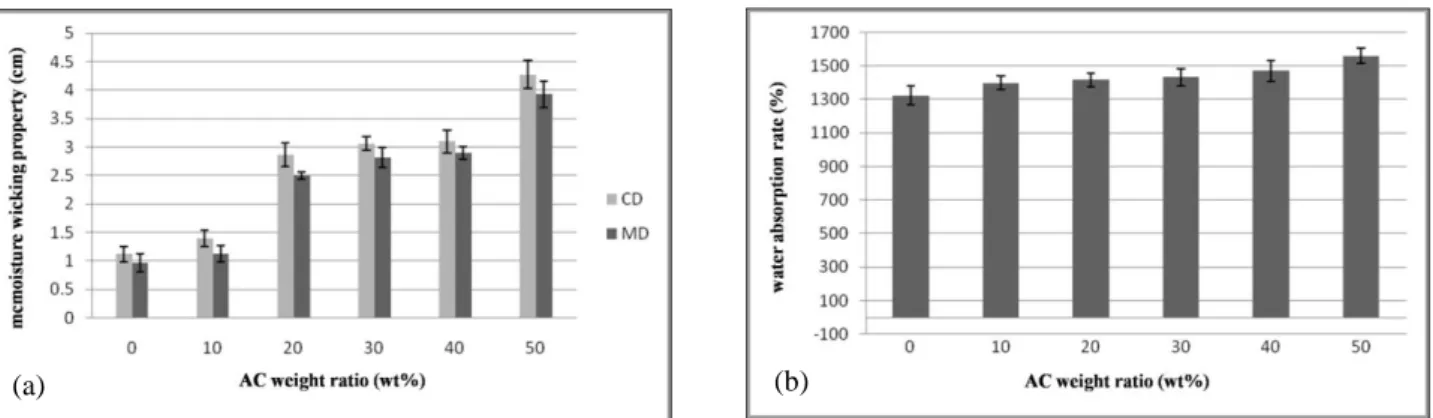
Figure 3. (a) AC mixing ratio vs. water absorbability of PET/AC, (b) AC mixing ratio vs. water absorption rate of PET/AC. According to 12915 CNS, if the suction height of the specimen at both CD and MD are greater than 1.1 cm, it means that the specimen has great water absorption and otherwise if the suction height is less than 0.2 cm
Dressing fabric is to absorb the wound tissue fluid, so water imbibition is one of the important indices to evaluate the fabric performance. As shown in Figure 3(a), moisture wicking properties of PET/AC fabric tended to increase with AC content increase. This may be due to the many hydrophilic functional groups in AC fibers but not in PET fibers. While AC ratio was above 10% , the suction height in CD and MD was more than 1.1 cm,which are the best performence for water imbibition of all fabrics. With the increase of AC proportion, water absorption increased due to many hydrophilic functional groups in cellulose fibre with as shown in Figure 3(b).
Conclusion
A manufacturing process of making PET/AC functional dressing fabric was developed. The tensile strength and tear strength for fabrics with AC ratio of 20% were less than those of 10% but comparable with those of pure PET fabric. However, fabrics with AC ratio of 20% had better water imbibition. The air permeability of all testing fabrics was above 100 cm3/s/cm2 with softness of 8.5 cm. We suggested that to be used as a wound dressing, the optimal ratio of PET/AC was 80/20.
Acknowledgements
This work was supported by the National Science Council, Taiwan (R.O.C.), grant number NSC 96-2622-E-166 -002 -CC3.
References
[1] N.S. Levine, R.A. Lindberg, R. E. Salisbury, A.D. Mason, Jr., & Pruitt and B.A. Jr: Am. J. Surg Vol. 131(1976), p. 727-729.
[2] M. Malmsjo, R. Ingemansson, R. Martin and Huddleston: Wound.Repair Regen Vol. 17 (2009), p. 200-205.
[3] M. McGuckin, R. Goldman, L. Bolton and R. Salcido: Adv.Skin Wound.Care Vol. 16 (2003), p. 12-23.
[4] M.J. Morykwas, L.C. Argenta, E.I. Shelton-Brown and W. McGuirt: Ann.Plast.Surg Vol. 38 (1997a), p. 553-562.
[5] M.J. Morykwas, L.C. Argenta, E.I. Shelton-Brown and W. McGuirt: Ann.Plast.Surg Vol. 38 (1997 b), p. 553-562.
[6] M.J. Morykwas, L.C. Argenta, E.I. Shelton-Brown and W. McGuirt: Ann.Plast.Surg Vol. 38 (1997 c), p. 553-562.
[7] T.A. Mustoe: Aesthetic Plast.Surg Vol. 32 (2008), p. 82-92.
[8] C.W. Lou, C. T. Lu, S. P. Wen, C. W. Lin, C. Y. Chao and J. H. Lin: Advanced Materials Research Vol. 123-125 (2010), p.177-180.
[9] J.H. Lin, C. T. Lu, Z. H. Wu, C. K. Lin, C. W. Lin and C. W. Lou: Advanced Materials Research Vol. 123-125 (2010), p. 359-362.
[10] C.C. Huang, C.W. Lou and J.H. Lin: Textile Research Journal Vol. 80(4) (2010), p. 325-333. [11] C.K. Lin, C.W. Lou, C.T. Lu, C.C. Huang and J.H. Lin: Advanced Materials Research Vol.
55-57 (2008), p. 397-400.