行政院國家科學委員會專題研究計畫成果報告
期中報告
大型海藻的磷代謝 (2/3)
P
HOSPHORUSM
ETABLOSIM INM
ACROALGAE(2/3)
NSC 90-2311-B-110-003
90 年 8 月 1 日至 91 年 7 月 31 日
李澤民
Tse-Min Lee
國立中山大學海洋生物研究所
Institute of Mar ine Biology, National Sun Yat-sen Univer sity,
Kaohsiung, Taiwan 80424, Republic of China (R.O.C.)
*Tel: 07-5252000 ext. 5110. Fax: 07-5251509. e-mail: [email protected]
中文摘要 本研究為三年計畫之第二年,本年度 目的是探討大型海藻石蓴(Ulva lactuca L.) 及傘房龍鬚菜(Gracilaria coronopifolia J. Agardh) 為材料探討:(1)、缺磷下的 ACP 與 extracellular AP 活性變化之關係。(2)、 缺 磷 對 ACP isozyme 的 影 響 。 (3) 、 extracellular AP 及細胞內的 ACP 酵素特 性。 關鍵詞:大型海藻,石蓴,傘房龍鬚菜, 磷,有機磷分解,細胞外磷酸分解酵素 (extracellular AP),細胞內磷酸分解酵素 (ACP)。 ABSTRACT
This study is the 2nd-year project of a 3-year
project. The main purpose of this year project was to study the uptake of inorganic phosphate (Pi) and the responses of DOP-degradation enzymes in macroalgae,
Ulva fasciata Delile and Gracilaria
tenuistipitata var. liui Zhang et Xia. In this study, we would like to investigate the following questions: 1. the optimal seawater Pi level for growth; 2.the physiological changes under P deficiency (including photosynthesis 、 respiration 、 nitrogen
metabolism 、 the composition of
phycobiliproteins 、 growth and tissue total carbon (TC)、total phosphorus (TP) levels, the activities of extracellular alkaline phosphatase, intracellular alkaline (AP) and acid (ACP) phosphatase); 3. The comparison the responses to Pi deficiency among different parts of Gracilaria (such as tip and
base); 4. the kinetics of Pi uptake; 5. the ability of P accumulation (storage?) and its formation. Now, we have done the folling items: 1. the optimal seawater Pi level for growth; 2. the kinetics of Pi uptake; 3. The critical and subsistence N and P levels.
前言
磷 是 細 胞 生 化 代 謝 的 必 需 營 養 因 子,缺磷會造成生化代謝及生長發育受阻 (Lynch et al., 1991),如光合作用 (Lauer et al., 1989)、碳的分配代謝 (Jeschke et al., 1996) 及氮素吸收 (Heuwinkel et al., 1992; Pilbeam et al., 1993)、代謝 (Rufty et al., 1993) 會因缺磷而受阻。
水 體 中 的 磷 種 類 有 無 機 磷 酸 (inorganic phosphate,Pi) 及有機磷 (organic phosphate,P) 兩種。大型海藻可吸收的磷 為無機磷酸,磷的吸收是一需能的主動吸 收過程 (Eppley, 1958); 高等植物的研究指 出 植 物 細 胞 無 機 磷 酸 的 吸 收 是 藉 由 與 plasma membrane H+-ATPases 的 proton 之
co-transport process (Epstein, 1976;
Ullrich-Eberius et al., 1981, 1984; Sakano, 1990)。無機磷的吸收速率因細胞外的磷濃 度增高而增高。
無機磷吸收的 saturation kinetics 則因 海藻種而不同: 紅藻的 Agardhiella subulata 的 Vmax=0.47 µmol/g DW/h ,Ks=0.4 µM
(DeBoer, 1981); 綠藻的Ulva sp.的 Vmax=8.5 µmol/g DW/h ,Ks=3.5 µM (Lavery and
McComb, 1991); 綠藻的Enteromorpha sp.
的 Vmax=20.8 µmol/g DW/h ,Ks=10 µM
(Lavery and McComb, 1991)。紅藻的龍鬚菜 (Gracilaria tikvahiae) 的 磷 吸 收 有 三 相 : 0-0.2 µM, 0-2 µM 及 0-11 µM (Friedlander and Dawes, 1985)。 無機磷吸收的 kinetics 因植物細胞內 的磷狀態而不同。高等植物的研究指出在 缺磷下,無機磷的吸收速率是不缺磷植物 細 胞 的 數 倍 (Cartwright, 1972; Clarkson, 1985; Clarkson and Scattergood, 1978),此一 增加係一植物適應缺磷的策略之一。 材料與方法: 1、材料栽培: 本試驗材料,石蓴 (Ulva lactuca L.) 及傘房龍鬚菜 (Gracilaria coronopifolia J. Agardh) 係取自墾丁南灣。龍鬚菜及石蓴 以滅菌海水 (高雄西子灣抽取天然海水, 取得後高溫高壓 (120°C,1.2 Kgs/cm,20min) 滅菌) 沖洗過後,培養於含 40 公升培養液 ( 含 全 量 ES nutrient solution (Provasoli, 1963) 的滅菌海水) 之養殖箱中,內裝置小 型沉水馬達,使水流保持流通。菊花心種 龍鬚菜的栽培海水鹽度控制為 3%。光照強 度 70~100 µE m-2s-1 ( 光 源 為 日 光 燈 (FL30D, 旭光公司,桃園,台灣) 6 管加 2 個白熱燈泡 (E2760W,東亞公司,新竹, 台灣)),日照時間為 12 小時,溫度為 25°C
(Edelstein et al., 1976)。CO2 來源以 CO2 鋼
瓶提供。每週固定置換二分之一的培養 液。培養四週後即進行試驗。 2、磷酸處理: 龍鬚菜培養於 7.6 x 7.6 x 10.2 cm = W x D x L 的培養盒中,內含 300 mL 含培 養液的人工海水 (35‰ ; 405 mM NaCl,10 mM KCl,30 mM MgSO4,10 mM CaCl2), 培養密度為 1.2~1.5 g FW/300 mL,培養液 內含全量 ES solution 之 micro-nutrient 及 3 mM NaHCO3,海水磷酸濃度為 0 及 20 µM 的 KH2PO4,氮濃度為 400 µM 的 NaNO3, pH 值以 NaOH 及 HCl 調整為 8.0,光照強 度 70~100 µE m-2s-1 ( 光 源 為 日 光 燈 (FL30D,旭光公司,桃園,台灣) 6 管加 2 個白熱燈泡 (E2760W,東亞公司,新竹, 台灣)),日照時間 12 小時,每天固定更換 全部培養液。溫度以加熱控溫器 (BC-2D, Wisdom Appartus MFG Company,Taiwan, ROC) 及冷卻器(HC-04,Wisdom Appartus MFG Company, Taiwan , ROC ) 維 持 為 25°C。
3、比生長速率 (specific growth rate) : 經處理之龍鬚菜,以紙把水份吸乾
於 –20°C 冷 凍 乾 燥 機 (SVC-100H , SAVANT,Farmingdale,N.Y.,USA) 乾 燥 18 小時後取出稱其乾重,以下列式求得 比生長速率 (specific growth rate) (Patwary and van der Meer 1984)。
生長速率=ln(Wt/Wo) t-1 t=生長的天數 Wt=第 t 天的濕重或乾重 Wo=第 0 天的濕重或乾重 4、ACP 及 extracellular AP 活性測定: 取冷凍乾燥後之材料 0.02 g DW 以 液態氮研磨後加入含 0.1 mM PMSF、1 mM MgCl2及 1 mM EDTA 之 Tris-HCl (pH=7.0) 緩衝液 1 mL,於 4o C 下 16000g 離心 20min 後所得之上清液即為 ACP 萃取液。ACP 活 性於 40o C 下以 acetate buffer (pH=4.0) 含 40 mM pNPP 反應 30 min 後以 KOH 終 止,測 A405。 extracellular AP 活性測定則取活體 組織 0.1-0.5 g w. wt.加於含 40 mM pNPP 之 人工海水反應 30 min 後以 KOH 終止,測 A405。 5、磷的測定: 根據 Hernandez et al. (1993) 的方法 將藻體內的磷分為 total P (TP)、soluble reactive P (SRP)、total soluble P (TSP)、
particulate P (PP=TP-TSP) 、 soluble non-reactive P (SNRP=TSP-SRP)。 冷凍乾燥的龍鬚菜後,以液態氮研 磨成粉狀,再加入水振盪 2 h 以抽取細胞內 之無機磷 (SRP),以 0.45 m filter 過濾後即 為 SRP 待測液。取部份的 SRP 待測液加 acid digestion solution (conc. HNO3 : conc.
H2SO4 : conc. HClO4 = 5:1:2) 於室溫下分 解 1 h 後逐漸加溫至 95o C 分解 2 h,降溫後 加入 ddH2O 至 3 mL,為 TSP 待測液。TP 則將藻體直接至於同上的 acid digestion solution 進行酸解及隨後的加水,即為 TP 待測液。SRP、TSP、TP 以 Malachite green 方法測定 (Lanzetta et al., 1979)。分解率以 glycerophosphate 加以估算。 6、總氮測定:
總氮以經 conc. H2SO4 (含 HgO and
K2S2O3) 分解的分解液以 Kjedahl 方法以
0.5 N HCl 滴定 (謝, 1978) 及本研究改良 之 phenol-hypochlorite 方法 (Smith, 1980) 加以測定。
7、藥品與統計分析:
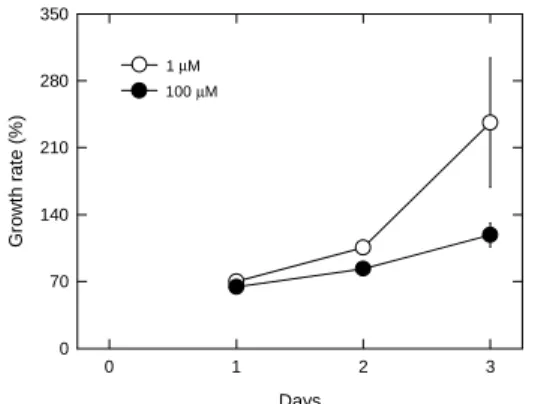
藥品買自 Sigma (USA),Serva or Merck (Germany). 統計分析以 SAS (Version 6.03, SAS Ltd., NC, USA) 進行之。. 結果與討論 1、石蓴 ACP 及 extracellular AP 利用海水磷酸濃度為 1 及 100 µM 的 KH2PO4形成缺磷與不缺磷之生長,缺磷會 抑制石蓴的生長速率 (Figure 1)。 Extracellular AP 活性則在缺磷之第一 天及快速增高後維持不變,而 ACP 則在缺 磷之第三天才有增高之現象 (Figure 2)。所 以,石蓴缺磷下的 extracellular AP 較 ACP 活性上升為快。可能是因為本研究所栽培 之石蓴的儲藏性磷含量尚未達最高量或不 足為分解用(Figures 3 and 4),所以對於儲 藏性磷含量不高之石蓴於缺磷環境的策略 是先以 extracellular AP 活性增高來分解獲 取細胞外的儲藏性磷以獲取生長所須的無 機磷營養鹽。 ACP 活性染後的 isozyme 圖譜指出缺 磷會誘導兩個 ACP bands (Figure 5)。
2、傘房龍鬚菜 ACP 及 extracellular AP 傘房龍鬚菜處理之海水磷酸濃度為 0 及 20 µM 的 KH2PO4形成缺磷與不缺磷之 生長,與石蓴處理缺磷之狀態不同。缺磷 會明顯抑制傘房龍鬚菜的生長速率 (data not shown)。 Extracellular AP 活性則在缺磷之第八
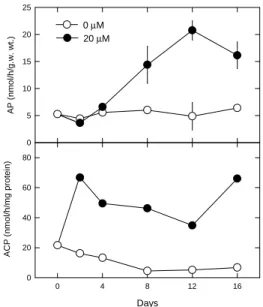
天增高後,於第十二天達最高值,接著稍 下降 (Figure 6)。ACP 則在缺磷之第二天即 增高後維持在對照組的十倍左右 (Figure 6)。所以,傘房龍鬚菜在缺磷下的 ACP 較 extracellular AP 活性上升為快。傘房龍鬚菜 與石蓴之情形恰好不同,可能是細胞內磷 之型態不同所致。 缺磷下,傘房龍鬚菜的總磷含量有下 降 (Figure 7) 且 SNRP (soluble non-reactive phosphorus) 含量下降最明顯 (Figure 8)。 傘房龍鬚菜儲藏性磷含量已達 最高量,所以對於儲藏性磷含量高之傘房 龍鬚菜於缺磷環境的策略是先以 ACP 活性 增高來分解獲取細胞內的儲藏性磷以獲取 生長所須的無機磷營養鹽。 傘 房 龍 鬚 菜 的 ACP 活 性 染 後 的 isozyme 圖 譜 指 出 缺 磷 會 誘導兩個 ACP bands (Figure 9)。 目 前 , 正 待 純 化 藻 體 的 ACP 及 extracellular AP。 REFERENCES
Anderson, D. (1994) Red Tides. Sci. Am. August: 62-68.
Anghinoni, I. And Barber, S. A. (1980) Phosphorus influx and growth characteristics of corn roots as influenced by phosphorus supply. Agron. J. 72: 685-688.
Antia, N. and Watt, A. (1965) Phosphatase activity in some species of marine phytoplankters. J. Fis. Res. Bd. Can. 22: 793-799.
Barrett-Lennard, E. G., Robin, E. G. and Greenway, H. (1982) Effect of phosphorus deficiency and water deficit on phosphatase activities from wheat leaves. J. Exp. Bot. 33: 682-693. Berman, T. (1969) Phosphatase release of
inorganic phosphorus in Lake Kinneret.
Nature 224: 1231-1232.
Bone, L. Carpene, E., Wynne, D. and Reti, M (1989) Alkaline phosphatase activity in Protogonyaulas tamarensis. J.
Plankton Res. 11: 879-887.
Brandes, D. and Elston, R. N. (1956) An electron microscopical study of the histochemical localization of alkaline phosphatase in the cell wall of
Chlorella vulgaris. Nature 77: 274-275.
Bun-ya, M., Nishimura, M., Harashima, S. and Oshima Y. (1991) The PHO84 gene of Saccharomyces cerevisiae encodes an inorganic phosphate transporter. Mol. Cell Biol. 11: 3229-3238.
Cembella, A. D., Anti, N. J. and Harrison, P. J. (1984) The utilization of inorganic and organic phosphorus compounds as nutrients by eukaryotic microalgae: a multidisciplinary perspective: part I. CRC Crit. Rev. Microbiol. 10: 317-391.
Davies, A. G. (1988) Nutrient interactions in the marine environment. In: Rogers, D. and Gallon, F. (eds.) Biochemistry of the Algae and Cyanobacteria Proc. Phytochem. Soc. Europe, Vol. 28. Pp. 241-256. Oxford University Press. Oxford.
Dracup, M. N. H., Barrett-Lennard, E. G., Greenway, H. and Robson, A. D. (1984) Effect of phosphorus deficiency on phosphatase activity of cell walls from roots of subterranean clover. J. Exp. Bot. 35: 466-480.
Drew, M. C. and Saker, L. R. (1984) Uptake and long-distance transport of
phosphate, potassium and chloride in relation to internal ion concentrations in barley: evidence of non-allosteric regulation. Planta: 160: 500-507.
Duff, S. M. G., Plaxton, W. C. and Lefebvre, D. D. (1991) Phosphate starvation response in plant cells: De novo synthesis and degradation of acid phosphatase. Proc. Natl. Acad. Sci. USA 88: 9538-9542.
Duff, S. M. G., Sarath, G. and Plaxton, W. C. (1994) The role of acid phosphatases in plant phosphorus metabolism. Physiol. Plant. 90: 791-800.
Epstein, E. (1976) Kinetics of ion transport and the carrier concept. In: Luttge, U. and Pittman, M. G. (eds.) Encyclopedia of Plant Physiology, New Series, Vol. 2B: Transport in Plants, II, Part B: Tissues and Organs. Springer, Berlin, pp. 70-94.
Falkowski, P. G., Greene, R. M. and Geider, R. J. (1992) Physiological limitations on phytoplankton productivity in the ocean. Oceangraphy 5: 84-91.
Fernandez, J. A. and Gracia-Sanchez, M. J. (1994) Photosynthetic induction of dual phosphate uptake kinetics in Porphyra umbilicalis. Physiol. Plant. 91:
581-586.
Fitzgerald, G. P. and Nelson, C. (1966) Extractive and enzymatic analyses for limiting or surplus phosphorus in algae. J. Phycol. 2: 32-37.
Furihata, T. Suzuki, M. and Sakurai, F. (1992) Kinetic characterization of two
phosphate uptake systems with different affinities in
suspension-cultured Catharanthus roseus protoplasts. Plant Cell Physiol. 33: 1151-1157.
Gibson, M. T. and Whitton, B. A. (1987) Hairs, phosphatase activity and enviromental chemistry in Stigeoclonium, Chaetophora and Draparnaldia (Chaetophorales). Br. Phycol. J. 22: 11-22.
Grcia-Sanchez, M.J., Fernandez, J. A. and Niell, F. X. (1996) Photosynthetic response of P-deficient Gracilaria tenuistipitata under two different phosphate treatments. Physiol. Plant. 96: 601-606.
Hallegraeff, G. M. (1993) A review of harmful algal blooms and their apparent increase. Phycologica 32: 79-99.
Harrison, P., Hu, M., Yang, Y. and Lu, X. (1990) Phosphate limitation in
estaurine and coastal waters of China. J. Exp. Mar. Biol. Ecol. 140: 79-87.
Healey, F. P. Characteristics of phosphorus deficiency in Anabaena. J. Phycol. 9: 383-394.
Hernandez, L., Niell, F. X. and Fernandez, J. A. (1992) Alkaline phosphatase activity in Porphyra umbilicalis (L.) Kutzing. J. Exp. Mar. Biol. Ecol. 159: 1-13.
Hernandez, L., Christmas, M., Yelloly, J. M. and Whitton, B. A. (1997) Factors affecting surface alkaline phosphatase activity in the brown alga Fucus spiralis at a north sea intertidal site (Tyne Sands, Scotland). J. Phycol. 33: 569-575.
Heuwinkel, H., Kirkby, E. A., Le Bot, J. and Marschner, H. (1992) Phosphorus deficiency enhances molybdenum uptake by tomato plants. J. Plant Nutr. 15: 549-568.
Huang, Y. and Kao, C. H. (1991) Senescence of rice leaves XXV. Changes of acid phosphatase activity. Bot. Bull. Acad. Sin. 32: 37-42.
Hurd, C. L., Galvin, R. S., Norton, T. A. and Dring, M. J. (1993) Production of hyaline hairs by intertidal species Fucus (Fucales) and their role in phosphate uptake. J. Phycol. 29: 160-165.
Istvanovics, V., Pettersson, K., Pierson, D. and Bell, R. (1992) Evaluation of phorus deficiency indicators for summer phytoplankton in Lake Erken. Limnol. Oceanogr. 37: 890-900. Jeschke, W. D., Peuke, A., Kirkby, E. A.,
Pate, J. S. and Hartung, W. (1996) Effects of P deficiency on the uptake, flows and utilization of C, N and H2O
within intact plants of Ricinus communis L. J. Exp. Bot. 47: 1737-1754.
Kai, M., Masuda, Y., Kikuchi, Y., Osaki, M. and Tadano, T. (1997) Isolation and characterization of a cDNA from Catharanthus reseus which is highly homologous with phosphate transporter. Soil Sci. Plant Nutr. 43: 227-235.
Katsuji, U. and Sato, S. (1977) Regulation of phosphatase synthesis by
orthophosphate in cultured tobacco cells. Plant Cell Physiol. 8: 1255-1263. Kautsky, L. (1982) Primary production and
uptake kinetics of ammonium and phosphate in Enteromorpha compressa in an ammonium sulfate industry outlet area. Aquat. Bot. 12: 23-40.
Krom, M., Kress, N., Brenner, S. and Gordon, I. (1991) Phosphorus limitation of primary production in the eastern Miditerranean. Linmol. Oceangr. 36: 424-432.
Kuenzler, F. and Perras, J. (1965)
Phosphatase in marine algae. Biol. Bull. 128: 271-284.
Lapointe, B. E. (1987) Phosphorus- and nitrogen-limited photosynthesis and growth of Gracilaria tikvahiae (Rhodophyceae) in the Florida Keys: an experminetal field study. Mar. Biol. 93: 561-568.
Lapointe, B. E. (1997) Nutrient thresholds for bottom-up control of macroalgal
blooms on coral reefs in Jamaica and southeast Florida. Limnol. Oceanogr. 42: 1119-1131.
Lauer, M. J., Pallardy, S. G., Blevins, D. G. and Randall, D. D. (2989) Whole leaf carbon exchange characteristics of phosphate-deficient soybeans (Glycine max L.). Plant Physiol. 91: 848-854. Lee, T. M. (1999) Phosphate starvation
induction of acid phosphatase in Ulva lactuca L. (Ulvales, Chlorophyta). Bot. Bull. Acad. Sin.(in press)
Lee, T. M., Tsai, C. C. and Shih, M. C. (1999) Induction of phosphorus deficiency and phosphatase activity by salinity (NaCl) stress in Gracilaria tenuistipitata (Gigartinales, Rhodophyta). Phycologia 38: 428-433.
Lefebvre, D. D. and Glass, A. D. M. (1982) Regulation of phosphate influx in barley roots: effects of phosphate deprivation and reduction of influx with provision of orthophosphate. Physiol. Plant. 54: 199-206.
Leggewie, G., Willmitzer, L. and Riesmeier, J. W. (2997) Two cDNAs from potato are able to complement a phosphate uptake-deficient yeast mutant:
identification of phosphate transporters from higher plants. Plant Cell 9: 381-392.
Liu, C., Muchhal, U. S., Raghothama, K. G. (1997) Differential expression of TPS11, a phosphate starvation-induced gene in tomata. Plant Mol. Biol. 33: 867-874.
Liu, C. M., Muchhal, U. S., Uthappa, M., Kononowicz, A. K. and Raghothama, K. G. (1998) Tomato phosphate transporter genes are differentially regulated in plant tissues by
phosphorus. Plant Physiol. 116: 91-99. Lubian, I. M., Blasco, J. and Establier, R.
(1992) A comparative study of acid and alkaline phosphatase activities in several strains of Nonnochloris (Chlorophyceae) and Nannochlorpsis (Eustigmatophyceae). Br. Phycol. J. 27: 119-130.
Lundberg, P., Weich, R. G., Jensen, P. and Vogel, H. J. (1989) Phosphorus-31 and nitrogen-14NMR studies of the uptake of phosphorus and nitrogen compounds in the marine macroalgae Ulva lactuca. Plant Physiol. 89: 1380-1387.
Lynch, J., Lauchli, A. and Epstein, E. (1991) Vegetative growth of the common bean in response to phosphorus nutrient. Crop Sci. 31: 380-387.
Miller, E. I. (1989) Biological Oceangraphy: An Early History, 1870-1960. Ithaca, Cornell University Press, p.378. Mitsukawa, N., Okumura, S., Shirano, Y.,
Sato, S., Kato, T., Harashima, S. and Shibata, D. (1997) Overexpression of an Arabidopsis thaliana high-affinity phosphate transporter gene in tobacco cultured cells enhances cell growth under phosphate-limited conditions. Proc. Natl. Acad. Sci. USA 24: 7098-7102.
Muchhal, U. S., Pardo, J. M. and
Raghothama, K. G. (1996) Phosphate transporters from higher plant
Arabidopsis thaliana. Proc. Natl. Acad. Sci. USA 93: 10519-10523.
Murphy, J. and Rilly, P. J. (1962) A modified single solution method for the
determination of phosphate in natural waters. Anal. Chim. Acta 27: 31-36. Myklestad, S. and Sakshang, F. (1983)
Alkaline phosphatase activity of Skeletonema costatum populations in the Trondheims fjord. J. Plankton Res. 5: 558-565.
Novikoff, P. M. (1987) The lysosomal
concept: from isolated particles to acid hydrolyase compartment of the cell. Adv. Cell Biol. 1: 59-95.
Pan, S. M. (1985) Phosphatase in spinach leaves: subcellular localization and the stress effect. Bot. Bull. Acad. Sin. 26: 185-194.
Pan, S. M. (1987) Characterization of multiple acid phosphatase in salt stressed spinach leaves. Aust. J. Plant Physiol. 14: 117-124.
Pan, S. M. and Chen, Y. R. (1988) The effects of salt stress on acid phosphatase activity of Zea mays seedlings. Bot. Bull. Acad. Sin. 29: 33-38.
Panti, N. J., Billmire, E. and Aaronson, S. (1974) Isolation of the Ochromonas plasma membrane and identification of several membrane enzymes. Biochim. Biophys. Acta 373: 347-355.
Patwary, M. U., and Meer, J. P. v. d. (1984). Growth experiments on autopolyploids of Gracilaria tikvahiae
(Rhodophyceae). Phycologia 23, 21-27. Perry, M. (1972) Alkaline phosphatase
activity in subtropical Central North Pacific waters using a sensitive fluorometric method. Mar. Biol. 15: 113-119.
Pilbeam, D. J., Cakmak, I., Marschner, H. and Kirkby, E. A. (1993) Effect of withdrawal of phosphorus on nitrate assimilation and PEP carboxylase activity in Tomato. Plant and Soil 154: 111-117.
Provasoli, L. (1968) Media and prospects for the cultivation of marine algae. In: Watanabe, A. and Hattori, A. (eds.), Cultures and Collections of Algae, pp. 63-75. Proc. US-Japan Conf., Hakone, Jpn. Soc. Plant Physiol.
A. R. (1996) Biochemical
characterization of the extracellular phosphatases produced by
phosphorus-deprived Chlamydomonas reinhardtii. Plant Physiol. 111:
839-848.
Rivkin, R. B. and Swift, E. (1979) Diel and vertical patterns of alkaline
phosphatase activity in the oceanic dinoflagellate Pyrocystis noctiluca. Limnol. Oceanogr. 21: 106-116.
Rufty, T. W. Jr., MacKown, C. T. and Israel, D. W. (1993) Phosphorus stress effects on assimilation of nitrate. Plant Physiol. 94: 328-333.
Sakano, K. (1990) Proton/phosphate stoichiometry in uptake of inorganic phosphate by cultured cells of
Catharathus roseus (L.) G. Don. Plant Physiol. 93: 479-483.
Schmidt, G., Bartsch, G., Laumont, M. C., Herman, T. and Liss, M. (1963) Acid phosphatase of Baker’s yeast: an enzyme of the external cell surface. Biochemistry 2: 126-131.
Shimogawara, K. and Usuda, H. (1995) Uptake of inorganic phosphate by suspension-cultured tobacco cells: kinetics and regulation by Pi starvation. Plant Cell Physiol. 36: 341-351.
Smith, F. W., Ealing, P. M., Dong, B. and Delhaize, E. (1997) The cloning of two Arabidopsis genes belonging to a phosphate transporter family. Plant J. 11: 83-92.
Strickland, J. D. H. and Austin, K. H. (1960) On forms, balance and cycles of
phosphorus observed in the coastal and oceanic waters of the northwestern Pacific. J. Fish. Res. Board. Can. 17: 337-348.
Takaoki, T. (1968) Relationship between drought tolerance and aging in higher
plants. II Some enzyme activities. Bot. Mag. 81: 297-309.
Torriani, A. (1960) Influence of inorganic phosphate in the formation of phosphatases by Escherichia coli. Biochim. Biophys. Acta 38: 460-479. Torriani-Gorini, A (1994) Introduction: the
Pho regulon of Escherichia coli. In Torriani, A., Yagil, E. and Silver, S. (eds.) Phosphate in Microorganisms: Cellular and Molecular Biology. American Society for Microorganism, Washington, DC, pp. 1-5.
Tsekos, I. And Schnepf, E. (1991) Acid phosphatase activity during spore differentiation of the red algae Gigartina teedii and Chondria tenuissima. Plant Syst. Evol. 176: 35-51.
Vogo, G. A. and Shanley, E. (1985) Alkaline phosphatase activity in the red-tide dinoflagellate Ptychodiscus brevis. Mar. Ecol. 6: 251-264.
Wallentinus, I. (1984) Comparisons of nutrient uptake rates for Baltic macroalgae with different thallus morphologies. Bot. Mar. 80: 215-225. Walter, K. and Fries, I. (1976) Extracellular alkaline phosphatase in multicellular marine algae and their utilization of glycerophosphate. Physiol. Plant. 36: 118-122.
Weich, R. G. and Graneli, E. (1989) Extracellular alkaline phosphatase activity in Ulva lactuca L. J. Exp. Mar. Biol. Ecol. 129: 33-44.
Whitton, B. A. (1980) Hairs in eukaryotic algae. In: Round, F. E. (ed.) Algae and the Aquatic Environment. Biopress. Bristol. pp. 446-460.
Days 0 1 2 3 G row th rat e ( % ) 0 70 140 210 280 350 100 µM 1 µM
Figure 1 Growth rate in Ulva lactuca L. in response to phosphorus deficiency. Data are presented as means± 95% confidence interval (n=3). A P (n m o l/m in /g .w . wt .) 0 200 400 600 800 1000 1 µM Days 0 1 2 3 A CP (n m o l/ h /m g p ro te in ) 0 100 200 300 400 100 µM
Figure 2 Changes in extracellular AP and intracellular ACP activities in Ulva lactuca L. in response to P deficiency. Data are
presented as means± 95% confidence interval (n=3). N (% DW) 0 4 8 12 1 µM Days 0 1 2 3 P ( % DW) 0.0 0.1 0.2 0.3 100 µM A B
Figure 3. Changes in N and P contents in Ulva lactuca L. in response to P deficiency. Data are presented as means± 95%
confidence interval (n=3). SR P ( µ mol /g) 0 10 20 30 40 1 µM SN R P ( µ mol /g) 0 10 20 Days 0 1 2 3 T SP ( µ mol /g) 0 20 40 100 µM A B C
Figure 4. Changes in SRP, SNRP and TSP contents in Ulva lactuca L. in response to P deficiency. Data are presented as means± 95% confidence interval (n=3).
1 2 3
Figure 5. ACP zymogram in Ulva lactuca L. in response to P deficiency. 1, initial; 2, P sufficient materials; 3, P deficient materials. Soluble protein of 50 µg was loaded in each lane. AP ( nmo l/ h /g. w . w t. ) 0 5 10 15 20 25 0 µM Days 0 4 8 12 16 ACP (n m ol /h/ mg pro tei n) 0 20 40 60 80 20 µM
Figure 6. Changes in extracellularAP and intracellular ACP activities in Gracilaria coronpifolia in response to P deficiency. Data are presented as means± 95% confidence interval (n=3). N (% D W ) 0 1 2 3 0 µM Days 0 4 8 12 16 P (% D W) 0.00 0.02 0.04 0.06 20 µM A B
Figure 7. Changes in N and P contents in Gracilaria coronpifolia in response to P deficiency. Data are presented as means± ←
95% confidence interval (n=3). SR P ( µ mo l/ g ) 0 30 60 90 120 0 µM SNR P ( µ mo l/ g ) 0 20 40 60 80 Days 0 4 8 12 16 TSP ( µ mo l/ g ) 0 30 60 90 120 20 µM A B C
Figure 8. Changes in SRP, SNRP and TSP contents in Gracilaria coronpifolia in response to P deficiency. Data are
presented as means± 95% confidence interval (n=3).
Figure 9. ACP zymogram in Gracilaria coronpifolia in response to P deficiency. 1, initial; 2, +P for 2 days; 3, -P for 2 days; 4, +P for 4 days; 5, -P for 4 days; 6, +P for 8 days; 7, -P for 8 days; 8, +P for 12 days; 9, -P for 12 days; 10, +P for 16 days; 11, -P for 16 days. Soluble protein of 60 µg was loaded in each lane.