230
Ceramic
Processing Research
Calcium aluminate composites with controlled duplex structures:
II. Microstructural development and mechanical properties*
H.J. Liaw and Wen-Cheng. J. Wei*
Institute of Materials Science and Engineering, National Taiwan University, Taipei, Taiwan 106, ROC
This study used monocalcium aluminate (CaAl2O4, CA) to produce ceramic composites with duplex microstructures by
hydration and gelation reactions of the aluminate, and compared the properties with those made by a die-pressing process with mixed powders. The microstructure of sintered bodies, the fracture strengths and toughness of the composites with and without thermal shock was characterized by different techniques. Experimental results show that the composites with the addition of CA resulted in the formation of CA6 (CaO*6Al2O3) platelets, so as to reveal two types of microstructures, either
in a cluster of agglomerated platelets or with a uniform distribution of platelet CA6 grains. The former, which appeared as
a duplex microstructure consisted of a dense matrix and distributed clusters of CA6 platelets, gave an improvement in
toughness and thermal shock resistance. The toughness mechanisms of the samples with duplex microstructures are discussed. Key words: calcium aluminate, composite, platelets, duplex, microstructure.
Introduction
CaO segregation at the grain boundaries of Al2O3 grains has been characterized and reported for decades [1]. Even 30 ppm of Ca impurity induces abnormal grain growth after sintering at 1900oC for 1 h [2]. The driving force for the segregation was dominated by the misfit strain of the Ca ions in the alumina lattice. The CaO has also been treated as a liquid-phase former which is responsible for the formation of abnormal Al2O3 grain growth [3].
Calcium aluminates, for instance CA, C12A7, and C3A, where C stands for CaO and A for Al2O3, were used in a previous report to prepare CaO-Al2O3 composites [4]. Among the aluminates, CA powder is the important ingredient used for the hydration and gelation of the alumina in an aqueous state The CA confines one eutectic composition with the C12A7 phase at the tem-perature of 1360oC in the Al
2O3-CaO system. Liquid phase formation at temperatures greater than 1320oC is able to densify the composites to densities better than 95% T.D. (theoretical density).
CA6 (CaO*6Al2O3)is a high temperature phase with an hexagonal structure. The phase has been found at the grain boundaries of 96% Al2O3 by Powell-Dogan and Heuer [5]. They reported that CA6 grew to a plate morphology from the glass phase of SiO2/MgO/CaO with a strong preferred orientation on α-Al2O3 grains.
No formation mechanism nor the use of CA6 as a reinforcing phase are reported in literature.
Lutz and Claussen [6, 7] used porous ZrO2 agglomerates in a dense matrix to induce compressive zones in a tetragonal zirconia polycrystalline (TZP) matrix. The toughness and strength of the duplex structure have a reverse behavior during thermal quenching, and show an improvement in thermal shock behavior of the TZP ceramics. The present study has selected CA6/Al2O3 composites as the subject, and prepared the composites with two different duplex structures. In the previous study [4], two processing routes were used, either from a hydration and colloidal process of CA particles mixed with Al2O3, the other used a dry powder mixture. This report will concentrate on the effects of the CA additive during sintering stages, so as to control the microstructural states of newly grown CA6 platelets in a dense Al2O3 matrix. Also, the thermal shock resistance and the toughening by the duplex structures will be investigated. Possible mechanisms will be reported.
Experimental
Materials99.7% pure Al2O3 powder (A-16SG, Alcoa, PA, USA) and 98% pure CaO powder (with 2% MgO, 150 ppm Fe2O3, Nacalai Tesque, Japan) were used as the precursor of CA. Two dispersants, PMAA-N (ammonia salt of polymethyl acrylic acid, R. T. Vanderbilt Co., Morwalk, CT, USA) and semicarbazide hydrochloride (S-HCl Hanawa Chemical Japan), were used for dispersion of the Al2O3 suspensions. One deflocculating agent, acetic acid (Showa Chemical, Japan) was used to control *Corresponding author:
Tel : +886-2-23632684 Fax: +886-2-23634562 E-mail: [email protected]
the gelation of CA-Al2O3 admixtures to longer than 50 min.
–
Synthesis of CA
CaO was calcined at 750oC for 2 h in order to get rid of Ca(OH)2. Then the precursors, Al2O3 and CaO, were mixed in highly purified iso-propanol in a molar ratio of 1.0 : 1.0. The slurry was ground for 4 h with a Y-ZrO2 grinding media, and dried in the oven at 105oC for 2 h. The dried mixture was calcined at 650oC for 4 h, then at 1300oC for 5 h. The powder was ground to pass a -400 mesh and showed an average particle size of 11.2μm. The powder was found to be a pure CA
phase by XRD.
Sample preparation
– Dry pressing process
1 to 10 mass% CA powder mixed with Al2O3 powder in highly purified iso-propanol, ball-milling for 4 h, and drying in the oven. The mixture was pre-calcined at 650oC for 3 h before die-pressing, then filled in a rectangular die with the dimensions of 4 × 5 × 45 mm3. The die surface was coated with a thin layer of stearic acid as a die lubricant. A uniaxial pressure of 85 MPa was applied. The sample was designated “DCAx”, of which D is the die-pressing process, x means the amount of CA in the formulation.
– Hydration reaction process
Al2O3 powder in a 40 vol% ratio was added in the aqueous solution with 1 mass% PMAA-N. After mixing for 2 h, the dried CA powder was added and mixed for an additional 5 min. The slurry was cast in a polyacrylic mold with 2 × 6 × 8 cm3 dimensions, and cured at 50oC until gelation. The sample was designated “HCAx”.
– Sintering
In order to optimize the shrinkage rate during the formation of the CA6 phase, the sintering schedule was designed as follows: Room temperature to 650oC at a rate of 5 K/min, heating to 1200oC at a rate of 20 K/ min, then slowly to 1650oC at a rate of 2 K/min. Then the composites were finally sintered at 1650oC for 1 h.
– Comparison case
An Al2O3 sample prepared by pressure-filtration and sintered at 1500oC for 1 h was prepared. The sintered sample had 4% porosity which was comparative to the porosity in the sintered HCA3 and DCA3 samples.
Characterization
Thermal expansion of pure sintered Al2O3 and CA with the dimensions of 25 × 3.0 × 3.0 mm3 was measured by dilatometry (α-dilatometer, Theta Industries, Inc.,
USA). The 4-point fracture strength and single-edge-cracking toughness of the composites were made by following the CNS standards [8] and the report by Nisitani and Mori. [9]
Microstructural analysis was performed using SEM (Philips 515, Netherlands), EPMA (electron probe X-ray micro-analysis, JXA-8600SX, JEOL) on the observation
of grain morphology and crack propagation, and quantitative analysis of Ca-elemental distribution.
Thermal shock tests were done by the evaluation of strength degradation of quenched samples. These samples had the same dimensions as the 4-point bending test bars. The bars were held in a tube furnace at a specified temperature up to 350oC for 30 min, then quenched in a water bath at 25oC. The dependence of the strength on the quenching temperature gave the critical temperature (ΔTc).
Results and Discussion
Formation of CA
6platy structure
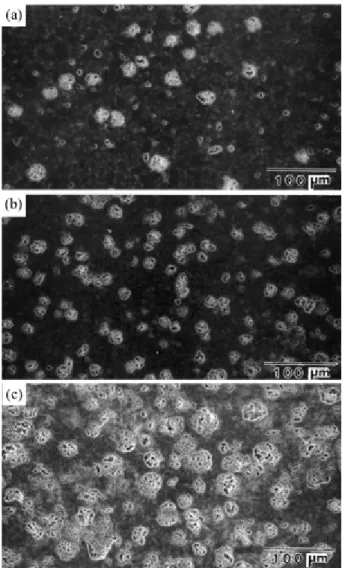
Two types of CA6-Al2O3 composites were prepared, either designated as HCAx or DCAx. The microstructures of HCAx samples are shown in Fig. 1. Porous regions approximately in spherical with sizes 20-40μm were
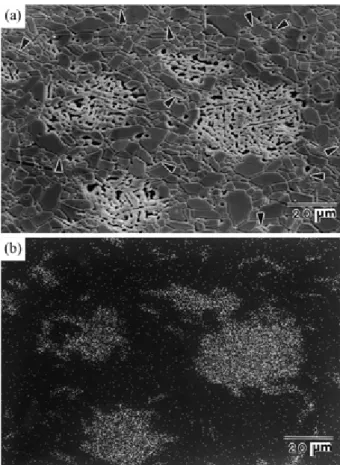
observed and the porosities were 4.5% (HCA1.9), 5.0% (HCA3.7), and 11% (HCA7.3). Most of the porous regions (Fig. 2(a)) were associated with an assembly of
Fig. 1. SEM micrographs of sintered (a) HCA1.9, (b) HCA3.7 and
platelet grains, which were identified to be the Ca-rich phase as revealed by X-ray mapping, as shown in Fig. 2(b). In addition, the arrows also indicate in Fig. 2(b) the CA6 platelets embedded in the A12O3 matrix. The Al2O3 grains in the matrix have an average grain size of 5.3μm, the platelets have a length of 10-20μm and
thickness of 0.5-1.0μm. The eutectic liquid of the
CaO-Al2O3 system is possibly formed at 1360oC with a composition close to C12A7. In this study, the addition of CA to Al2O3, can form another eutectic liquid at ca. 1600oC, and help the formation of CA
6 plates. In order to prevent the platelet formation in the early stages of sintering, the sintering was slowly conducted between 1200 to 1600oC. The matrix can thus be densified and result in the least porosity (4-5%) in the composites.
The volume fraction of the porous CA6 clusters was estimated, to be close to 13 vol% in HCA3. The amount of CA6 clusters was less than the theoretical value of 16%. The difference is due to some CA additive forming discrete platelet CA6 grains dispersed in the matrix. Several dispersed CA6 grains were identified from X-ray mapping of Ca element, as pointed in Fig. 2(a). These platelets are formed by the liquid phase reactions of CA-Al2O3 or due to the Ca-rich boundaries [2, 3]. The CA particles can be hydrolyzed in the wet-processing stage to a form of C3AH6 and Al(OH)3 [10]. A sequence
of transformation reactions of the hydrates and the reaction with Al2O3 took place, finally transforming to CA6. This resulted in a volume expansion of 2.3 times as big as the original size of CA and the formation of the CA6 phase.
In comparison, the CA particles were pre-milled and uniformly doped in the Al2O3 matrix. Only dispersed CA6 platelets were found, as shown in Figs. 3(a) and 3(b). The pointed CA6 grains had an aspect ratio of 3-6. The microstructure was distinct from the pure Al2O3 sample (Fig. 3(c)), which appeared with equiaxial Al2O3 grains and dispersed porosity.
Crack propagation
SEM micrographs in Fig. 4 illustrate the propagation (along the direction of the arrows) of surface cracks
Fig. 2. Micrographs of polished HCA3 sample (a) imaged with
secondary electron signal and (b) X-ray mapping of Ca element. Arrows indicate the CA6 plates embedded in A12O3 matrix.
Fig. 3. (a) SEM micrographs and (b) imaged by X-ray mapping of
introduced by an indentation with a 30 kg load on the surfaces of HCA3 and DCA3 composites. The cracks showed an interesting pattern of interactions with porous CA6 clusters and separate CA6 grains. The cracks propagated toward the cluster, then passed the outer interface of the clusters and finally left the cluster in radial direction (Fig. 4(a)). The trajectory of the crack propagation is typical pattern seemly influenced by the residual stresses existing in the matrix and the clusters. These features increase the length of the crack path, resulting in toughening effects. Similar crack deflection and branching were observed in DCA samples, as the features shown in Fig. 4(a). However, the platelets broke, which shows an adverse effect on toughening, as indicated as “4” in Fig. 4(b).
The residual forces come from the differences of thermal expansion coefficients (TEC) between CA6 and Al2O3, of which for pure phases were measured and reported in Fig. 5. The residual stress (P) can be estimated from the equation below [11]:
(1) where Δα is the difference of TEC (αm−αp), ΔT is the
quenching temperature range, υ is Poisson’s ratio, E is
the Young’s modulus, and R is the radius of a particular phase (the cluster in this study). If the composites cool
from 1400oC to room temperature, a linear difference of 0.51 × 10
−3 is expected (Fig. 5). Also, the Young’s modulus of pure CA6 and Al2O3 are 134 GPa and 380
P = 1 + υ ΔαΔT
m
( )⁄2Em + 1 - 2( υp) E⁄ p
---Fig. 4. SEM micrographs illustrating surface crack propagation
introduced by an indentation (30 kg load) of (a) HCA3, (b) DCA3
composites.
Fig. 5. Linear expansion (mm/mm) and coefficient of expansion
coefficient (K−1) of calcium aluminate with CA
6 composition and
pure Al2O3.
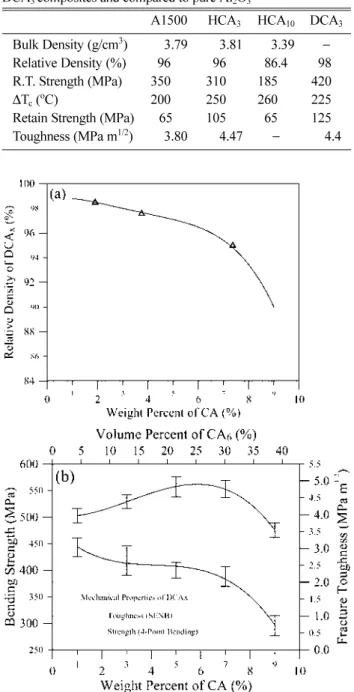
Fig. 6. (a) Relative density and (b) mechanical properties of
GPa, respectively. If we take 0.25 as the Poisson’s ratio for both phases, the calculated residual stress is 93 MPa. A cluster of platelets will have a compressive stress inside with a tangential tensile stress in the matrix. Therefore, the crack can be attracted and deflected by the clusters, and improve the toughness by the duplex structure.
Mechanical Properties at Room Temperature
Figure 6(a) gives the sintered density of HCAx samples as a function of CA content. The resulting volume% of CA6 platelets, which was measured from SEM micrographs, is also shown on the axis. The
density results showed that the highest density (96% T.D. in Table 1) and strength could be achieved by 3 mass% CA addition, which contained CA6 clusters of about 13 vol%. A similar trend of the toughness with the maximum value (4.47 MPam0.5) of the CA
3 composition is observed in Fig. 6(b). The connection of two clusters was hardly observed in the HCA3 sample, but occasionally found in the HCA5, which had 22 vol% of the clusters. Therefore, the strength and toughness of HCA5 apparently decreased.
The densification results (Fig. 7) of DCAx was different from HCAx. The relative density monotonically decreased from 98.5% to 96% T.D., and then dramatically reduced as the CA content was more than 7 mass%. The residual porosity is due to the sintering retardation contributed partially by the formation of CA6 platelets and also from insufficient green density. The trend of the strength of DCAx was found to be similar to that of the density. However, the toughness gained a 25% improvement as 5-7% of CA was added, in which 22-30 vol% of CA6 phase resulted (Fig. 7(b)). The crack deflection (Fig. 4(b)) has reached a maximum toughening effect with 22-30 vol% CA6 platelets, and slightly reduced strength (10%). If the volume fraction of the CA6 is greater than 30%, the resulting porosity is more than 10% which greatly reduces the surface fracture energy, and is not a benefit to the toughness.
Thermal Shock Behavior
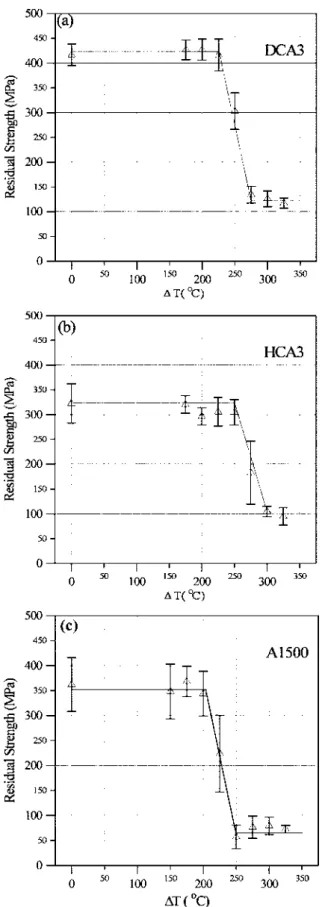
Three typical test results of the residual strength of the composites are shown in Fig. 8. The detailed properties of all samples, including DCA3, HCA3, and A1500 are summarized in Table 1. The critical quenching temperature (ΔT) improved slightly from 200oC (A1500) to 250oC (HCA3) by the CA addition. The best residual strength (σr) after shocking was 125 MPa for DCA3, then the HCA3 with 105 MPa. The A1500 shows the lowest σr (65 MPa). The cracking pattern of HACx was similar to that in Fig. 4(a). No debris was found for HCAx samples.
A residual stress ratio (σr/σo) was proposed [8] to be linear increase as the parameter (R'''') of thermal shock
damage resistance [12, 13]. This is
(2) where Eo is the elastic modulus. The calculated ratio of the surface fracture energies (γ) of A1500, DCA3, HCA3 is 1.0 : 2.5 : 1.5. If three parameters, γ, Eo, and
σo, are considered for the evaluation of R'''', the ratio is 1.0 : 2.0 : 1.6 which is consistent with the test results in Table 1.
Conclusions
The addition of CA particles to an Al2O3 matrix has given two different duplex structures, one appeared
σr σo --- R'''' = γEo σo2 ---⎝ ⎠ ⎛ ⎞ ∝
Table 1. Summary of mechanical properties of sintered HCAx,
DCA3 composites and compared to pure Al2O3
A1500 HCA3 HCA10 DCA3
Bulk Density (g/cm3) 003.79 003.81 003.39 −
Relative Density (%) 096.00 096.00 086.40 098.0
R.T. Strength (MPa) 350.00 310.00 185.00 420.0
ΔTc (oC) 200.00 250.00 260.00 225.0
Retain Strength (MPa) 0 65.00 105.00 065.00 125.0
Toughness (MPa m1/2) 003.80 004.47 − 004.4
Fig. 7. (a) Relative density and (b) mechanical properties of
with porous clusters filled with CA6 platelets, the other showed a uniform distribution of the platelets. The density of the composites can be better than 95% which is associated with improved toughness and thermal shock resistance, but a slight sacrifice (<10%) of the fracture strength.
The fracture mode in the dense Al2O3 sample was mainly by inter-granular fracture. However, this changed to crack deflection and branching as the CA6 platelets and clusters are formed in the duplex microstructure. The improvement in the surface fracture energy of the composites was also contributed to an increase of the residual strength and critical quenching temperature. The control of platelet grains in the dense and fragile matrix increases the fracture toughness to some degree.
Acknowledgement
The funding given by National Science Council (NSC84-2216-E-002-034 & NSC85-2216-E-002-031) in Taiwan is appreciated.
Reference
1. R.F. Cook and A.G. Schrott, J. Am. Ceram. Soc. 71[1] (1988) 50-58.
2. S.I. Bae and S. Baik, J. Am. Ceram. Soc. 76[4] (1993) 1065-1067.
3. H. Song and R.L. Coble, J. Am. Ceram. Soc. 73[7] (1990) 2077-2085.
4. W.J. Wei, S.D. Tze, and H.C. Liaw, “Calcium aluminate composites with controlled duplex structures: I. Hydration reaction and densification”, (submitted) J. Ceram. Proc. Res.
5. C.A. Powell-Dogan and A.H. Heuer, J. Am. Ceram. Soc. 73[12] (1990) 3670-3691.
6. H.E. Lutz and N. Claussen, J. Europ. Ceram. Soc. 7[4] (1991) 209-226.
7. H.E. Lutz and N. Claussen, J. Am. Ceram. Soc. 74[4] (1991) 11-18.
8. CNS 12701, Standard tests for the fracture strength of fine ceramics.
9. H. Nishitani and K. Mori, Tech. Reports of the Kyushu Univ., 58[5] (1985) p. 751.
10. K. Fujii, W. Kondo, and H. Ueno, J. Am. Ceram. Soc. 69[4] (1986) 361-364.
11. R.W. Davidge, Mechanical Behavior of Ceramics, Cam-bridge University, London (1979).
12. J. Nakayama, Fracture Mechanics of Ceramics, Vol. 2 p. 759-778, ed. By R.C. Bradt, D.P.H. Hasselman, F. F. Lange, Plenum Press, New York (1974).
13. D.P.H. Hasselman, (Mat. Sci. Res. Vol 5), ed. By W. W. Kriegal and H. Palmor III, Plenum Press, NY (1971). Fig. 8. Residual strength of different samples as a function of