行政院國家科學委員會專題研究計畫 成果報告
熱帶幾何相交理論與熱帶循環之研究
研究成果報告(精簡版)
計 畫 類 別 : 個別型 計 畫 編 號 : NSC 97-2115-M-004-003- 執 行 期 間 : 97 年 08 月 01 日至 98 年 09 月 30 日 執 行 單 位 : 國立政治大學應用數學學系 計 畫 主 持 人 : 蔡炎龍 報 告 附 件 : 國外研究心得報告 出席國際會議研究心得報告及發表論文 處 理 方 式 : 本計畫可公開查詢中 華 民 國 98 年 12 月 27 日
國科會專題研究成果報告:
熱帶幾何相交理論與熱帶循環之研究
計畫編號: NSC97-2115-M-004-003 計畫主持人: 蔡炎龍 (政治大學應用數學系)
Chapter 1
報
報
報告
告
告內
內
內容
容
容
1.1
Introduction
The project survey recent results on tropical geometry especially those related to intersection theory. When we start the project, there is no tropical intersection in general, but in the past year, some exciting results toward this direction have been carried out. We study these results and present the ideas behind these somehow technical results. To elaborate the concepts, we choose to present here in a bit more intuitively. However, the references for rigors statements and proofs are provided.
1.2
Basics of Tropical Geometry
Tropical geometry is the geometry with underline “field” (actually, semifield or semiring) be the tropical semiring.
Definition 1 (tropical semiring). A tropical semiring is (T, ⊕, ), where T = R ∪ {−∞}. For any x, y ∈ T, define
• x ⊕ y := max{x, y} • x y := x + y
One can then of course define tropical polynomials: they are just classical polynomials with tropical operations. More precisely, let x = (x1, x2, . . . , xn)
and i = (i1, i2, . . . , in), we denote x i1 1 x i2
2 · · · x in n by x i. A tropical
polynomial is of the form
f (x) =
⊕
X
i∈I
αi x i,
where I is a finite subset of (N ∪ {0})n.
We can then define the tropical hypersurface defined by the “roots” of a tropical polynomial.
Definition 2 (Tropical Hypersurface). Let f (x) be a tropical polynomial. Eval-uate this polynomial is to find the maximum of the linear forms αi+ hx, ii. A
point in the tropical hypersurface Hfis the maximum of the linear forms achieve
at least twice and it is exactly where the graph fails to be linear.
1.3
Tropical Curves
We work with some examples to see what really happen in tropical world. First, let us see an example of tropical plane curve, which is defined by a two variables tropical polynomial.
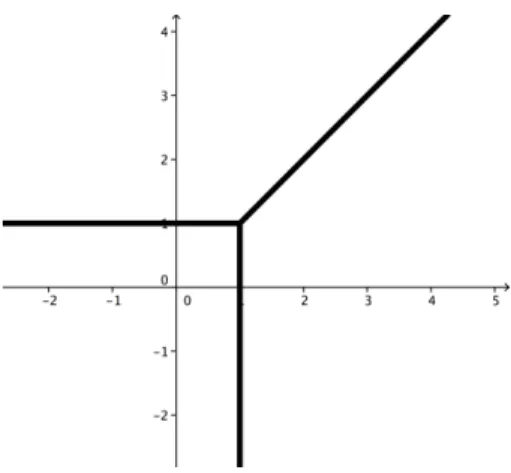
Example 1. Let f (x, y) = x ⊕ y ⊕ 1 = max{x, y, 1} be a tropical polynomial which defines a tropical line. To get the graph of this tropical line, we draw the following rays:
• x = y ≥ 1, • x = 1 ≥ y, and • y = 1 ≥ x.
The result picture is as in Figure 1.1.
Figure 1.1: The tropical line defined by f (x, y) = x ⊕ y ⊕ 1.
Note that a tropical curve satisfies so called balancing condition. In Exam-ple 1, the direction of three rays are given by the vector v1= (1, 1), v2= (−1, 0),
v3= (0, −1), respectively. We have
v1+ v2+ v3= (0, 0).
Of course, the direction given by (1, 1) can be directed by (2, 2). Here we want to take primitive vector, namely the first integer-coordinate vector in that
direction. Moreover, sometimes adding the primitive vectors up dose not give us the zero vector, we might need to consider “weighted” rays. Hence for any vertex in a tropical curve, and v1, v2, . . . , vk are primitive vectors, the balancing
condition means
w1v1+ w2v2+ · · · + wkvk = (0, 0),
where w1, w2, . . . , wk are corresponding weights. For introduction to tropical
geometry with more details, please see [3, 4, 6, 7]
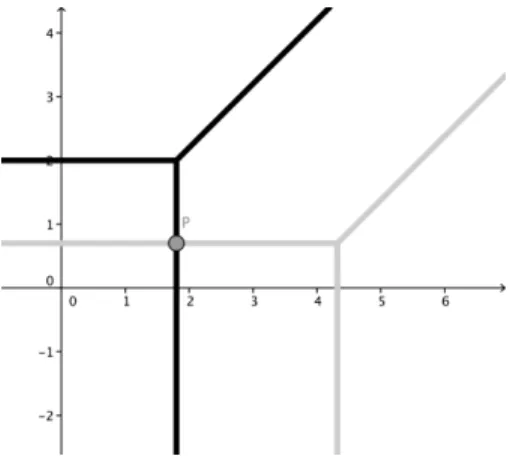
One can easily find out all tropical lines look exactly like the one in Fig-ure 1.1, except the vertex might move. We also have two tropical lines in general positions intersect at one point as in figure 1.3, just like classical cases. However, it is easy to see that but sometimes two tropical line intersect at in-finitely many points (a ray). The unexpected behavior indicates the tropical intersection theory need to be more careful to make it really work.
Figure 1.2: two tropical lines in general positions
1.4
Stable Intersection
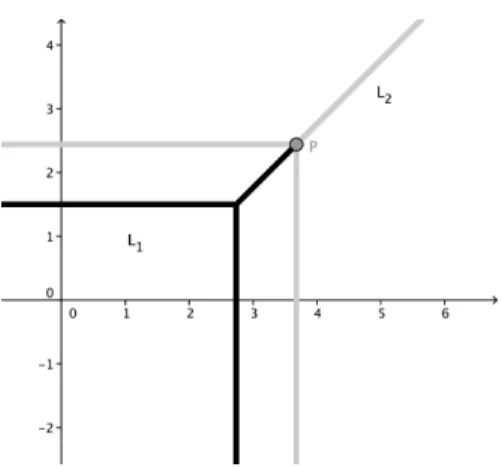
Two tropical lines might intersect “incorrectly,” which means they intersect in infinitely many points, as L1, L2 in Figure 1.3.
However, we can move L1a bit, call the new line Lε1, and move L2a bit, call
the new line Lε
2 such that Lε1∩ Lε2 correctly. That is, they intersect at exactly
one point.
It is easy to see, we have
P = lim ε→0L ε 1∩ L ε 2.
We will call P the stable intersection of L1 and L2, as defined in [6]. One can
actually prove tropical B´ezout’s Theorem in the sense of stable intersection. In mathematics, what we usually want to do is the following. We consider a class of curves [C1] and a class of curves [C2], which we want the correct
Figure 1.3: two tropical lines intersect in infinitely many points
intersection number. What we want is the stable intersection of C1and C2. On
the other hand, we would like to have “good” representatives of [C1] and [C2]
such that C1 and C2 intersect correctly.
Stable intersections seem a correct way to do tropical intersection, but it is a bit ambiguous and not always easy to work with.
1.5
Tropical Cycles
Allermann and Rau [1] tried to develop general tropical intersection theory. The idea is to mimic classical algebraic geometry, defining intersections on divisors. That is, to develop the intersection theory in the sense of Fulton [2].
First, we can generalize the definition of tropical hypersurfaces a bit to define what a tropical fan is.
Definition 3. A tropical fan (X, ωx) of dimension k is a weighted fan satisfying
the balancing condition for all τ ∈ X(k−1).
Of course, different tropical fans might basically “the same,” which means both can have the same refinement. Please see [1] for detailed definitions. Thus we can consider a class of tropical fans. As usual, [(X, ωx)] denotes the
equiva-lent class of (X, ωx). We call [(X, ωx)] an affine cycle.
Definition 4. The element of
Zkaff(V ) = {[(X, ωx)] | (X, ωx) a tropical fan of dimension k in V }
is called an (tropical) affine k-cycle in V . One can put a structure of abelian group on Zkaff(V ).
We can then define affine tropical varieties be the tropical cycles with non-negative weights.
Definition 5. Let C be a tropical cycle. A Weil divisor on C is an integer linear combination of Zdim C−1aff (C). An affine Cartier divisor on C is a piecewise integer affine linear function modulo globally affine linear function.
One can then define intersection product of two tropical affine Cartier divi-sors, as in [1].
Allermann and Rau allow us to deal with tropical intersection in more general settings. However, it is not clear if it coincide with the stable intersection. Recently, Katz [5] proved that two definitions are indeed equivalent.
Chapter 2
成
成
成果
果
果自
自
自評
評
評
In this project, we learned how do we deal with tropical intersections by using an analogue theory to classical intersection theory in algebraic geometry. During the project, there was a graduate student summer school in MSRI, Berkeley, USA. We send Ph.D. student Cheng-Wei Chen there, and he brought many notes also new ideas back and help us to set more clear direction in the future. In the mean time, we found out that it is necessary to have more solid understanding on basic stuff of tropical geometry in order to convert classical theory into tropical ones. For instance, we have to be able to work on tropical polynomials, rational functions, and meromorphic functions. We survey the related work and prove some classical properties still hold in tropical settings. All results will be on our forthcoming paper [8].
We are in a position to actually carry out some calculation of intersections of tropical curves, which we will continue to work on the next project.
Bibliography
[1] Lars Allermann and Johannes Rau. First steps in tropical intersection. arXiv:0709.3705v2, 2007.
[2] William Fulton. Intersection Theory. Springer, 2nd edition, 1998.
[3] Andreas Gathmann. Tropical algebraic geometry. Jahresber. Deutsch. Math.-Verein., 108(1):3–32, 2006.
[4] Ilia Itenberg, Grigory Mikhalkin, and Eugenii Shustin. Tropical algebraic geometry, volume 35 of Oberwolfach Seminars. Birkh¨auser Verlag, Basel, second edition, 2009.
[5] Eric Katz. Tropical intersection theory from toric varieties. arXiv:0907.2488v1, 2009.
[6] J¨urgen Richter-Gebert, Bernd Sturmfels, and Thorsten Theobald. First steps in tropical geometry. In Idempotent mathematics and mathematical physics, volume 377 of Contemp. Math., pages 289–317. Amer. Math. Soc., Providence, RI, 2005.
[7] David Speyer and Bernd Sturmfels. Tropical mathematics. Math. Mag., 82(3):163–173, 2009.
[8] Y. L. Tsai. Working with one-variable tropical meromorphic functions. (forthcoming).
Visiting Report
08.24.2009 08.28.2009
Introductory Workshop: Tropical Geometry
Department of Mathematical Science, Chen-Wei Chen
December 7, 2009
1
Information of the Seminar
I joined the seminars held by MSRI (Mathematical Sciences Research Insti-tute) this summer and I learnt a lot from them. MSRI held four seminars this summer, respectively: Connections for Women: Tropical Geometry (08, 22, 2009 - 08, 23, 2009), Introductory Workshop: Tropical Geometry, (08, 24, 2009 - 08, 28, 2009),Tropical Geometry in Combinatorics and Algebra, (10, 12, 2009 - 10, 16, 2009) , and Tropical Structures in Geometry and Physics (11 30, 2009 - 12, 4, 2009).
This workshop was to lay the foundations for the upcoming program. Mini-courses comprising lectures and exercise/discussion sessions covered the foundational aspects of tropical geometry as well as its connections with adjacent areas: symplectic geometry, several complex variables, algebraic geometry (in particular enumerative and computational aspects) and geo-metric combinatorics. The mini-courses were augmented by research talks on current tropical developments to open the scene and set up new goals in the beginning semester. I attended the Introductory Workshop: Tropical Geometry, since it was in the summer vacation, and there are many schol-ars and graduate students all over the world to join this seminar. Hence I could have more opportunity to share views with them. For the reason that MSRI is an important institute of UC Berkeley in researching Tropi-cal Geometry, many famous professors in this field came here. For instance, Grigory Mikhalkin, Andreas Gathmann, and Bernd Sturmfels attended this seminar. Especially, Grigory Mikhalkin is the most well-known scholar in Tropical Geometry, because he has proven that tropical geometry can be used to compute the numbers of plane curves of given genus g and degree d
through 3d + g + 1 general points, cf. [5]. This seminar covers the founda-tional aspects of tropical geometry as well as its connections with adjacent areas: symplectic geometry, several complex variables, algebraic geometry and geometric combinatorics.
2
Thoughts of the seminar
It was a five-day seminar, containing five courses. We had three courses and one speech each day. What I was most interested in was the course named Complex amoebas and (co)amoebas, it was given by professor Mikael Pas-sare. The course focused on the theory of complex (co)amoebas, especially on the method to combine the Tropical Geometry and amoeba spines. This theory contains many methods in analysis. When it came to Ronkin func-tion, I realized that Tropical Geometry could be widely used in many areas. I thought it must be interesting if we apply it to the Nevanlinna Theory. However, there are already some people using this idea few years ago. So when I came back to Taiwan, I talked to professor Yen-Lung Tsai about information and my ideas of this conference. Then he appreciated what I had learnt and gave me more papers to read. They are all about Tropical Nevanlinna theory, which are Tropical Nevanlinna theory and ultra-discrete equations [1], Tropical versions of Clunie and Mohonko lemmas [3], Trop-ical Nevanlinna theory and second main theorem [2]. Hence now I have gained some ideas in Tropical Nevanlinna Theory. Moreover, this seminar had broadened my horizon. I realized that there are still many areas that we can apply Tropical Geometry to analyze things. Take symplectic geom-etry for example, many researchers take effort in the connection of Tropical Geometry to this field.
The second course that I was interested in was Introduction to tropical algebraic geometry given by Diane Maclagan. In this course, the tropical arithmetic operations are a ⊕ b = max{a, b} and a ⊗ b = a + b, which is dif-ferent from the normal mathematic operations. Under the new operation, I learned many new things and had a new perspective on tropical variety. Tropical variety is similar to conventional variety in some parts, however, they are different in essence. For example, the intersection of a variety under conventional concept is still a variety. Nevertheless, in Tropical Geometry, this property only holds in tropical basis, and other arbitrary intersection is not a tropical variety. It also mentioned some relationship between valu-ation, normal toric variety and initial form. Besides that, I was fascinated in the connection of subdivision and tropical curve. Finally, the speaker refered to the tropical moduli space, which I had learnt a lot from it. In this space, let Mo,n be the set of all tropical curves of genus zero with n
(n − 3) − dim fan in R(n
2)−n with a coarsest fan structure , where is the space
of phylogenetic trees. For example, in M0,5, the global picture of adjacency
and rays is the well-known Petersen graph , cf. [6] and [7].
After I was back to Taiwan, MSRI sent me a book written by Diane Macla-gan and Bernd Sturmfels, named Introduction to Tropical Geometry ([4]). I found many things I learned from the seminar in this book, and fortunately, I can have many references and opportunity to research in this fascinating field.
References
[1] Rodney G. Halburd and Neil J. Southall. Tropical Nevanlinna theory and ultradiscrete equations. Int. Math. Res. Not. IMRN, (5):887–911, 2009.
[2] Ilpo Laine and Kazuya Tohge. Tropical nevanlinna theory and second main theorem, 2009.
[3] Ilpo Laine and Chung-Chun Yang. Tropical versions of clunie and mo-hon’ko lemmas. Complex Variables and Elliptic Equations, 2009. [4] Diane Maclagan and Bernd Sturmfels. Introduction to Tropical
Geome-try. October 9, 2009.
[5] Grigory Mikhalkin. Enumerative tropical algebraic geometry in R2. J.
Amer. Math. Soc., 18(2):313–377 (electronic), 2005.
[6] Grigory Mikhalkin. Moduli spaces of rational tropical curves. In Pro-ceedings of G¨okova Geometry-Topology Conference 2006, pages 39–51. G¨okova Geometry/Topology Conference (GGT), G¨okova, 2007.
[7] David Speyer and Bernd Sturmfels. The tropical Grassmannian. Adv. Geom., 4(3):389–411, 2004.
Visiting Report
08.24.2009 08.28.2009
Introductory Workshop: Tropical Geometry
Department of Mathematical Science, Chen-Wei Chen
December 7, 2009
1
Information of the Seminar
I joined the seminars held by MSRI (Mathematical Sciences Research Insti-tute) this summer and I learnt a lot from them. MSRI held four seminars this summer, respectively: Connections for Women: Tropical Geometry (08, 22, 2009 - 08, 23, 2009), Introductory Workshop: Tropical Geometry, (08, 24, 2009 - 08, 28, 2009),Tropical Geometry in Combinatorics and Algebra, (10, 12, 2009 - 10, 16, 2009) , and Tropical Structures in Geometry and Physics (11 30, 2009 - 12, 4, 2009).
This workshop was to lay the foundations for the upcoming program. Mini-courses comprising lectures and exercise/discussion sessions covered the foundational aspects of tropical geometry as well as its connections with adjacent areas: symplectic geometry, several complex variables, algebraic geometry (in particular enumerative and computational aspects) and geo-metric combinatorics. The mini-courses were augmented by research talks on current tropical developments to open the scene and set up new goals in the beginning semester. I attended the Introductory Workshop: Tropical Geometry, since it was in the summer vacation, and there are many schol-ars and graduate students all over the world to join this seminar. Hence I could have more opportunity to share views with them. For the reason that MSRI is an important institute of UC Berkeley in researching Tropi-cal Geometry, many famous professors in this field came here. For instance, Grigory Mikhalkin, Andreas Gathmann, and Bernd Sturmfels attended this seminar. Especially, Grigory Mikhalkin is the most well-known scholar in Tropical Geometry, because he has proven that tropical geometry can be used to compute the numbers of plane curves of given genus g and degree d
through 3d + g + 1 general points, cf. [5]. This seminar covers the founda-tional aspects of tropical geometry as well as its connections with adjacent areas: symplectic geometry, several complex variables, algebraic geometry and geometric combinatorics.
2
Thoughts of the seminar
It was a five-day seminar, containing five courses. We had three courses and one speech each day. What I was most interested in was the course named Complex amoebas and (co)amoebas, it was given by professor Mikael Pas-sare. The course focused on the theory of complex (co)amoebas, especially on the method to combine the Tropical Geometry and amoeba spines. This theory contains many methods in analysis. When it came to Ronkin func-tion, I realized that Tropical Geometry could be widely used in many areas. I thought it must be interesting if we apply it to the Nevanlinna Theory. However, there are already some people using this idea few years ago. So when I came back to Taiwan, I talked to professor Yen-Lung Tsai about information and my ideas of this conference. Then he appreciated what I had learnt and gave me more papers to read. They are all about Tropical Nevanlinna theory, which are Tropical Nevanlinna theory and ultra-discrete equations [1], Tropical versions of Clunie and Mohonko lemmas [3], Trop-ical Nevanlinna theory and second main theorem [2]. Hence now I have gained some ideas in Tropical Nevanlinna Theory. Moreover, this seminar had broadened my horizon. I realized that there are still many areas that we can apply Tropical Geometry to analyze things. Take symplectic geom-etry for example, many researchers take effort in the connection of Tropical Geometry to this field.
The second course that I was interested in was Introduction to tropical algebraic geometry given by Diane Maclagan. In this course, the tropical arithmetic operations are a ⊕ b = max{a, b} and a ⊗ b = a + b, which is dif-ferent from the normal mathematic operations. Under the new operation, I learned many new things and had a new perspective on tropical variety. Tropical variety is similar to conventional variety in some parts, however, they are different in essence. For example, the intersection of a variety under conventional concept is still a variety. Nevertheless, in Tropical Geometry, this property only holds in tropical basis, and other arbitrary intersection is not a tropical variety. It also mentioned some relationship between valu-ation, normal toric variety and initial form. Besides that, I was fascinated in the connection of subdivision and tropical curve. Finally, the speaker refered to the tropical moduli space, which I had learnt a lot from it. In this space, let Mo,n be the set of all tropical curves of genus zero with n
(n − 3) − dim fan in R(n
2)−n with a coarsest fan structure , where is the space
of phylogenetic trees. For example, in M0,5, the global picture of adjacency
and rays is the well-known Petersen graph , cf. [6] and [7].
After I was back to Taiwan, MSRI sent me a book written by Diane Macla-gan and Bernd Sturmfels, named Introduction to Tropical Geometry ([4]). I found many things I learned from the seminar in this book, and fortunately, I can have many references and opportunity to research in this fascinating field.
References
[1] Rodney G. Halburd and Neil J. Southall. Tropical Nevanlinna theory and ultradiscrete equations. Int. Math. Res. Not. IMRN, (5):887–911, 2009.
[2] Ilpo Laine and Kazuya Tohge. Tropical nevanlinna theory and second main theorem, 2009.
[3] Ilpo Laine and Chung-Chun Yang. Tropical versions of clunie and mo-hon’ko lemmas. Complex Variables and Elliptic Equations, 2009. [4] Diane Maclagan and Bernd Sturmfels. Introduction to Tropical
Geome-try. October 9, 2009.
[5] Grigory Mikhalkin. Enumerative tropical algebraic geometry in R2. J.
Amer. Math. Soc., 18(2):313–377 (electronic), 2005.
[6] Grigory Mikhalkin. Moduli spaces of rational tropical curves. In Pro-ceedings of G¨okova Geometry-Topology Conference 2006, pages 39–51. G¨okova Geometry/Topology Conference (GGT), G¨okova, 2007.
[7] David Speyer and Bernd Sturmfels. The tropical Grassmannian. Adv. Geom., 4(3):389–411, 2004.