科技部補助專題研究計畫成果報告
期末報告
基督教對布農語的影響
計 畫 類 別 : 個別型計畫 計 畫 編 號 : MOST 104-2410-H-004-139-執 行 期 間 : 104年08月01日至105年09月30日 執 行 單 位 : 國立政治大學語言學研究所 計 畫 主 持 人 : 戴智偉 計畫參與人員: 碩士班研究生-兼任助理人員:黃璽 碩士班研究生-兼任助理人員:黃鈺閔 碩士班研究生-兼任助理人員:金浩誠 報 告 附 件 : 出席國際學術會議心得報告中 華 民 國 105 年 12 月 26 日
中 文 摘 要 : 本研究計畫擬定探討基督教信仰的傳入對於台灣原住民語言造成何 種層面之影響。研究擬藉由以下兩方面討論以釐清此問題:(1)台 灣原住民社群皈依基督教的社會歷史促進因素,以及(2)基督教傳 入對於當地語言的各層面的影響,如詞彙、音韻、構詞句法等之影 響。 本計畫首先著重於調查布農族皈依基督教之原因及過程,以及 其對不同布農語方言造成之影響;緊接著研究將延伸至泰雅語及排 灣語,進行兩種語言之個案研究。本研究將會是跨領域的整合: 運 用語言學、歷史研究、人類學以及神學等領域之研究成果,目的是 統合解釋新宗教信仰之傳入對於當地語言造成何種影響。 本研究事實上可納入更廣的議題之下,亦即非語言因素在語言 演變過程中扮演何種角色,尤其當語言演變發生於小島嶼生態系統 (small-island ecosystem)環境,如台灣島嶼。在諸多非語言因素 中,本研究選擇深入探討宗教信仰對台灣少數民族語言之影響,包 括語意、構詞句法,以及布農語等台灣原住民語言的語言分化過程 與機制。 中 文 關 鍵 詞 : 南島語言,布農語,基督教
英 文 摘 要 : This project will investigate in which ways the
introduction of Christianity into Aboriginal communities in Taiwan influences the development of the local indigenous languages. It will tackle this subject by investigating (1) the socio-historical context which led to the
Christianization of the indigenous areas of Taiwan, and (2) the linguistic effects this process had on the lexicon, phonology, and morphosyntax of the languages spoken in these areas.
The main focus of the project will be how this process of Christianization happened to the Bunun language and the effect it had on a number of Bunun dialects. This initial research will then be extended to secondary case studies on the Atayal and Paiwan language. The research here proposed is interdisciplinary in nature: it will combine knowledge from linguistics, historical research, anthropology, and theology into a unified account of how the introduction of a new religion influences the development of indigenous languages.
The more general context of this research is the study of how extra-linguistic factors influence language change, in this specific case in particular in a small-island ecosystem like Taiwan. The project proposes to make an in-depth case study of the influence of religion, one
particular extra-linguistic factor of great socio-cultural importance to many modern indigenous communities in Taiwan, on the semantics, morphosyntax, and process of dialect differentiation on Bunun and a number of other languages in Taiwan.
科技部補助專題研究計畫成果報告
期末報告
基督教對布農語的影響
計畫類別:■個別型計畫 □整合型計畫
計畫編號:MOST 104-2410-H-004-139-
執行期間:2015 年 08 月 01 日至 2016 年 09 月 30 日
執行機構及系所:國立政治大學語言學研究所
計畫主持人: 戴智偉
共同主持人:
–
計畫參與人員:黃璽 (研究助理)
黃鈺閔 (研究助理)
金浩誠 (研究助理)
本計畫除繳交成果報告外,另含下列出國報告,共 58 份:
□執行國際合作與移地研究心得報告
■出席國際學術會議心得報告
□出國參訪及考察心得報告
中 華 民 國 105 年 12 月 15 日
II
目錄
目錄 ... II 中、英文摘要及關鍵詞 ... 1 摘要 ... 1 Abstract ... 1 關鍵詞 ... 1 Keywords ... 1 報告內容 ... 2 Introduction ... 2 Research goals ... 3 State-of-the-art ... 3 Methodology ... 4 Results ... 5 Comparative database ... 5Articles and book chapters ... 5
Conference presentations ... 6
Research training and fieldwork ... 6
Internal workhop ... 6 Follow-up research ... 7 Conclusion ... 7 Bibliography ... 7 科技部補助專題研究計畫成果自評表 ... 8 科技部補助專題研究計畫成果彙整表 ... 10 科技部補助專題研究計畫出席國際學術會議心得報告 ... 12 附件1:期刊論文 ... 14 Article 1: Overview ... 14
Article 1: Draft version ... 15
Article 2: Introduction ... 44
附件2:研討會論文 ... 45
Conference 1: Textual cohesion ... 45
1
中、英文摘要及關鍵詞
摘要
本研究計畫擬定探討基督教信仰的傳入對於台灣原住民語言造成何種層面之影響。研究擬藉由 以下兩方面討論以釐清此問題:(1)台灣原住民社群皈依基督教的社會歷史促進因素,以及(2) 基督教傳入對於當地語言的各層面的影響,如詞彙、音韻、構詞句法等之影響。 本計畫首先著重於調查布農族皈依基督教之原因及過程,以及其對不同布農語方言造成之影響; 緊接著研究將延伸至泰雅語及排灣語,進行兩種語言之個案研究。本研究將會是跨領域的整合: 運用 語言學、歷史研究、人類學以及神學等領域之研究成果,目的是統合解釋新宗教信仰之傳入對於當 地語言造成何種影響。 本研究事實上可納入更廣的議題之下,亦即非語言因素在語言演變過程中扮演何種角色,尤其 當語言演變發生於小島嶼生態系統(small-island ecosystem)環境,如台灣島嶼。在諸多非語言因素 中,本研究選擇深入探討宗教信仰對台灣少數民族語言之影響,包括語意、構詞句法,以及布農語 等台灣原住民語言的語言分化過程與機制。Abstract
This project will investigate in which ways the introduction of Christianity into Aboriginal communities in Taiwan influences the development of the local indigenous languages. It will tackle this subject by investigating (1) the socio-historical context which led to the Christianization of the indigenous areas of Taiwan, and (2) the linguistic effects this process had on the lexicon, phonology, and morphosyntax of the languages spoken in these areas.
The main focus of the project will be how this process of Christianization happened to the Bunun language and the effect it had on a number of Bunun dialects. This initial research will then be extended to secondary case studies on the Atayal and Paiwan language. The research here proposed is interdisciplinary in nature: it will combine knowledge from linguistics, historical research, anthropology, and theology into a unified account of how the introduction of a new religion influences the development of indigenous languages. The more general context of this research is the study of how extra-linguistic factors influence language change, in this specific case in particular in a small-island ecosystem like Taiwan. The project proposes to make an in-depth case study of the influence of religion, one particular extra-linguistic factor of great socio-cultural importance to many modern indigenous communities in Taiwan, on the semantics, morphosyntax, and process of dialect differentiation on Bunun and a number of other languages in Taiwan.
關鍵詞
南島語言,布農語,基督教
Keywords
2
報告內容
Introduction
This is the final report for the project titled The influence of Christianity on the Bunun language / 基督教對 布農語的影響 (MOST 104-2410-H-004 -139 -), which was conducted from 1 August 2015 till 30 September 2016. The participants in this project were:
Rik De Busser (戴智偉), principal investigator Temu Suyan (黃璽), research assistant
Yu-min Huang (黃鈺閔), research assistant Bali Nangavulan (金浩誠), research assistant The main responsibilities of the project participants were: Rik De Busser (PI):
General project administration Supervision research assistants
Design and general construction of the comparative database on Christian concepts in the Austronesian languages of Taiwan
Database construction comparative Christian concepts: English, Latin and Greek data
Research on the translation of Christian concepts in the Austronesian languages of Taiwan: Bunun data
Fieldwork on Bunun
Preliminary research on the relationship between the role of Bunun demonstratives in establishing cohesive structure. (Precursor research for the project 布農語指示語與語言凝聚力: 對比口頭傳 說與聖經故事 (MOST 105-2410-H-004-162-)
Yu-min Huang (RA):
Financial administration and help in general project administration Database construction comparative Christian concepts: Chinese data
Research on the translation of Christian concepts in the Austronesian languages of Taiwan: Paiwan data
MA research Paiwan, provisionally a sketch grammar of a Paiwan dialect in Yanping village, Taitung
Fieldwork on Paiwan Temu (RA):
Database construction comparative Christian concepts: Japanese data (Japanese & Roman script) Research on the translation of Christian concepts in the Austronesian languages of Taiwan: Atayal
data
MA research Atayal, provisionally a variational study of verbal morphology in Atayal dialects Fieldwork on Atayal
Bali Nangavulan (RA):
Assistance preparation Bunun data for database and continuing research
Background research on religious language in Bunun communities in and around Mingde village in Nantou
3
Research goals
The aim of this project is to investigate how the coming of Christianity to Austronesian-speaking, indigenous areas in Taiwan affected the indigenous languages. The main focus of this research is a case study, conducted by principal investigator Rik De Busser (戴智偉), of how the introduction of Christianity into Bunun communities triggers and influences linguistic change to two Bunun dialects, Takivatan and Takbanuaz. Two research assistants (黃璽 and 黃鈺閔) also contributed data on Atayal and Paiwan.
The following research components (RCs) were mentioned in the original project application:
RC1: Historical background research on the process of translating the Bible into indigenous languages
RC2: Lexical research on the translation of novel Christian concepts into the indigenous languages of Taiwan. This involved the creation of a comparative database of translation equivalents for commonly used novel concepts in the Bible.
RC3: A functional analysis of the use of demonstratives and other referential categories to establish cohesion in text, with a special focus on differences in strategies between the spoken language and Biblical texts.
RC4: A synthesis of the information acquired in RC1-3.
In doing this, the project will provide a case study of how environmental extra-linguistic factors influence language emergence, change, and diversification in a small-island ecosystem like Taiwan.
The original research proposal for this project applied for three years, but only one year was awarded. This meant that the research topics were reduced to two components of the original proposal (broadly in line with suggestions of one of the reviewers):
A systematic lexical-semantic analysis (RC2.1) of specialized Christian vocabulary in Bunun. This
analysis will trace the origins and evolution of different sets of vocabulary items related to the Christian world view (theological terms and religious concepts, person names and toponyms, terms for entities and activities specific to Middle Eastern and Jewish culture, etc.). It is inspired by the lexical-semantic analyses in Li (2013), but will provide a more complete and fully systematic analysis for a single language. It will be based in a general typological approach towards word formation, loanwords and neologisms; see e.g. Aikhenvald (2007), Haspelmath (2009) in Haspelmath & Tadmor (2009), and Wohlgemuth (2009).
A comparison of the distribution, relative frequency, and function of demonstratives and pronouns in the Bunun Bible translations and Bunun oral literature [part of RC3]. Demonstratives and
pronouns in the Takivatan Bunun dialect of Bunun have been analysed in De Busser (2009); concise overviews for Isbukun Bunun are to be found in Zeitoun (2000). There is ample literature about the functions of demonstratives in the typological literature.
Especially the second research objective will be expanded on in a follow-up project that the PI has already started (布農語指示語與語言凝聚力: 對比口頭傳說與聖經故事, MOST 105-2410-H-004-162-).
It was unavoidable to do some background research on the historical context of Bible translations, but we did not perform a systematic study. The intention is to use the results of this first year of research as a basis for further research, and the PI and all three research assistants have in fact started a follow up project, focusing on the initial results in RC3.
A secondary goal of this project was to allow two assistants to use the fieldwork conducted for this project as a basis for their MA dissertation research.
State-of-the-art
Most aboriginal people in Taiwan identify as Christians and to a greater or lesser extent are involved in the religious practices of the communities they live in. This strongly suggests that religion has a considerable influence on their social habits, and these habits include language use. Despite this obvious fact, the influence
4
of this newly introduced belief system, mainly by Western missionaries, has been under-researched. In the case of Bunun, the language under study in this project, the only available study is a sociological description by Yang (2008). During the execution of this project, Li (2016) published a study on the literation of the Austronesian languages of Taiwan, in which he gives a thorough overview of the historical processes that led to the translation of important Christian texts.
A good overview of the literature related to this project can be found in De Busser (2013), which was written in preparation of this project. An in-depth explanation of the theoretical basis for our research on demonstratives and cohesion is to be found in De Busser (2017), of which a draft version is included in the appendices.
Methodology
Below is an overview of the research activities and how they were conducted.
Research component Tasks
RC1 Historical research
RC1.1 Historical background Historical background research, building on preliminary research already conducted by the principal investigator. The principal investigator and the research assistants conducted a study on general sources related to the research subject.
RC1.2 Interviews Interviews with key people involved in the translation of Biblical and other religious texts. The PI and the RAs made a visit to the Taiwan Bible Society to gain a better insight in how the Bible translation process is organized in Taiwan. In addition, Bali Nangavulan conducted ethnographic fieldwork related to the project in Mingde village in Nantou.
RC2 Lexical research
RC2.1 Semantic analysis Semantic analysis of the translation of religious
terminology in Bunun. The PI and the RAs constructed a systematic word list of words referring to newly introduced concepts related to Christianity. This list contains comparative information these concepts in Bible translations in Bunun (Rik De Busser), Atayal (Temu Suyen), and Paiwan (Yu-Min Huang), English, Mandarin, Japanese, Latin, and Greek. This database will be expanded with additional information in the future.
RC3 Morphosyntactic analysis
RC3.1 Bible corpus (Part of a follow-up project) RC3.3 Verbal affixes (Canceled)
RC3.4 Deixis A preliminary study was conducted on how deictic reference and other referential items establish cohesive structures in text. The results have already been
5
the basis of a follow-up project mentioned above.
Results
Comparative database
A major result of the project is the construction of a growing comparative database of Christian concepts and their renderings in Bible translations of three aboriginal languages (Bunun, Atayal, and Paiwan) and in a number of major international Bible translations that have influenced the development of Christianity in Taiwan. The following Bible translations in Austronesian languages are currently included in the database:
Language Title Year Note
Bunun Tama Dihanin tu Halinga. The Bunun Bible in Today's Taiwan Bunun Version
2000
Bunun Bahlu Sinpatumantuk tu Patasun 1983 fragmentary data
only
Paiwan Kai nua Cemas. 排灣語聖經. Kai nua
Cemas a pinayuanan
1993 Atayal Sinsman ke Utux Kayal Biru na Tayal.
泰雅爾語聖經. The Tayal Bible
2003
The following Bible translations of non-Austronesian languages have been included in the database:
Language Title Year Note
English King James Version 1769 Modern spelling
English New International Version 2011
Mandarin Chinese Union Version 1919
Japanese Kougo-yaku 1954 Japanese and
Romanized versions
Latin Vulgate
Greek Greek New Testament (Majority Text) 1904 Partly
Greek Septuagint (Greek Old Testament) 1935 Partly
The database is still under active construction, and will be for the foreseeable future. It will be used for subsequent research over the next years, and will be gradually expanded with more complete information. Additional Bible translations will also be added. Initial results of an analysis of database information have been presented in a conference in Guam (see below). Further research will lead to a research article, which is projected to be submitted in the first half of 2017.
Articles and book chapters
At the time of writing, two articles based on the project’s research have been sent off for review. One article has already been accepted for publication:
De Busser, Rik. 2017. Spatial deixis, textual cohesion, and functional differentiation in Takivatan Bunun. Oceanic Linguistics 56(1). 89–121.
6
De Busser, Rik. Under review. An overview of nominal markers in Bunun dialects. Language and
Linguistics.
In addition, one book chapter and two articles that are related to the research conducted in this project are currently in the process of being written. They will both be published as part of the follow-up project that is PI is currently undertaking.
Conference presentations
The research in this project was presented in the following talks:
Introducing God to the indigenous people of Taiwan. Talk at the Pacific History Association 22st Biennial
Conference (PHA 2016), University of Guam, Guam, 19-21 May 2016.
Referential cohesion and textual variation in Bunun. Invited talk at the Third International Workshop on
Information Structure of Austronesian Languages, Tokyo University of Foreign Studies, Tokyo, Japan, 18-20 February 2016.
Research related to this project (and its successor) will be presented at a number of conferences in 2017 and beyond.
Research training and fieldwork
All three research assistants are using information gathered in the context of the project for their MA research. Two of these students, Temu Suyen and Yu-min Huang are supervised by the PI. They have conducted fieldwork in order to gather information for the project and for their MA research.
Assistant Language Fieldwork
Temu Suyen (黃璽)
Atayal February - September 2016: Conducted a number of short field
trips to Slamaw Village (新佳陽部落) in Taichung County, in which he interviewed three consultants, gathered basic information for the lexical database, and established a basis for his MA
research and the research related to our follow-up project (see above).
Yumin Huang (黃鈺閔)
Paiwan 20 July - 8 August: First fieldtrip to Jialan village (嘉蘭村) and
Zhengxing village (正興村) in Taitung County to gather data on Paiwan.
23 September - 2 October: Second fieldtrip. During the two field
trips, Yumin recorded information, gathered information for the comparative database, and for his MA research.
Bali Nangavulan (金浩誠)
Bunun November - September 2016: Conducted a number of field trips
to his home village (明德村) in Nantou County, where he gathered a number of eye-witness accounts for an ethnographic study on the changes that the introduction of Christianity brought about in the religious thinking of the elderly inhabitants.
Internal workhop
The initial results of the project were presented during an internal workshop on 5 September 2016. The participants in the project presented the following presentations:
Rik De Busser: Introducing God to the indigenous people of Taiwan Yumin Huang: The influence of Christianity on Taiwan
7
Bali Nagnavulan: 信義部落布農族 Qanitu 意識的轉變
Temu Suyen: 聖經翻譯於泰雅語的影響
Follow-up research
The PI has succesfully applied for a follow-up project, which will focus on research related to the relationship between demonstratives and cohesion in spoken narrative and Biblical text:
Deixis and textual cohesion in Bunun: A comparison of oral literature and Biblical language 布農語指示語與語言凝聚力: 對比口頭傳說與聖經故事
MOST 105-2410-H-004-162-
Conclusion
The general results of the projects are in line with our expectations. It has led to two research articles and two conference presentations, and the data we have gathered will serve as the basis for future The comparative database we constructed will be expanded over the coming years, and will be published in due course. Introductory work on the relationship between deixis and textual cohesion has already resulted in a follow-up project. The fielwork of the three research assistants will help them in writing their MA thesis.
Bibliography
De Busser, Rik. 2013. The influence of Christianity on the Bunun language: A preliminary overview.
Proceedings of the International Workshop on “Special Genres” in and around Indonesia, 59–76.
Tokyo: Research Institute for Languages and Cultures of Asia and Africa, Tokyo University of Foreign Studies. http://hdl.handle.net/10108/75524.
De Busser, Rik. 2017. Spatial deixis, textual cohesion, and functional differentiation in Takivatan Bunun.
Oceanic Linguistics 56(1). 89–121.
Yang, Shu-Yuan. 2008. Christianity, identity, and the construction of moral community among the Bunun of Taiwan. Social Analysis 52(3). 51–74. doi:10.3167/sa.2008.520303.
李台元. 2016. 台灣原住民族語言的書面化歷程 [The Literation of Taiwanese Aboriginal Languages]. 臺 北市: 政大出版社.
8
科技部補助專題研究計畫成果自評表
請就研究內容與原計畫相符程度、達成預期目標情況、研究成果之學術或應用
價值(簡要敘述成果所代表之意義、價值、影響或進一步發展之可能性)、是否
適合在學術期刊發表或申請專利、主要發現(簡要敘述成果是否具有政策應用
參考價值及具影響公共利益之重大發現)或其他有關價值等,作一綜合評估。
1. 請就研究內容與原計畫相符程度、達成預期目標情況作一綜合評估
■
達成目標
□ 未達成目標(請說明,以
100 字為限)
□ 實驗失敗
□ 因故實驗中斷
□ 其他原因
說明:
2. 研究成果在學術期刊發表或申請專利等情形(請於其他欄註明專利及技轉之
證號、合約、申請及洽談等詳細資訊)
論文:■已發表■未發表之文稿 □撰寫中 □無
專利:□已獲得□申請中 □無
技轉:□已技轉□洽談中
■無
其他:
(以
200 字為限)
3. 請依學術成就、技術創新、社會影響等方面,評估研究成果之學術或應用價
值(簡要敘述成果所代表之意義、價值、影響或進一步發展之可能性,以
500 字為限)。
本研究計畫第一次從語言學的角度研究基督教傳入對台灣原住民文化與語言之
影響。本計畫使用詞彙的比較以映射基督教的新概念如何進行台灣原住民的文
化,以及研究指示語 (deixis)對信息結構的影響為了多了解原住民口語與書寫語
的差異。此計畫的研究成果已經引起進一步的研究。本研究有潛力進步宗教文
件翻譯的策略,也讓我們多了解外來文化與宗教對於台灣原住民文化的影響。
9
4. 主要發現
本研究
具有政策應用參考價值:
■否 □是,建議提供機關_______
(勾選「是」者,請列舉建議可提供施政參考之業務主管機關)
本研究具影響公共利益之重大發現:■否 □是
說明:(以 150 字為限)
10
科技部補助專題研究計畫成果彙整表
計畫主持人:戴智偉 計畫編號:104-2410-H-004 -139 - 計畫名稱:基督教對布農語的影響 成果項目 量化 單位 質化 (說明:各成果項目請附 佐證資料或細項說明,如 期刊名稱、年份、卷期、 起訖頁數、證號...等) 國 內 學術性論文 期刊論文 篇 請附期刊資訊。 研討會論文 專書 本 請附專書資訊。 專書論文 章 請附專書論文資訊。 技術報告 篇 其他 篇 智慧財產權 及成果 專利權 發明專利 申請中 件 請附佐證資料,如申請案 號。 已獲得 請附佐證資料,如獲證案 號。 新型/設計專利 商標權 營業秘密 積體電路電路布局權 著作權 品種權 其他 技術移轉 件數 件 收入 千元 1. 依「科技部科學技術 研究發展成果歸屬及 運用辦法」第2 條規 定,研發成果收入係 指執行研究發展之單 位因管理及運用研發 成果所獲得之授權 金、權利金、價金、 股權或其他權益。 2. 請註明合約金額。 國 外 學術性論文 期刊論文 2 篇 請附期刊資訊。 研討會論文 專書 本 請附專書資訊。 專書論文 章 請附專書論文資訊。 技術報告 篇 其他 2 篇 兩篇演講(未出版)11 智慧財產權 及成果 專利權 發明專利 申請中 件 請附佐證資料,如申請案 號。 已獲得 請附佐證資料,如獲證案 號。 新型/設計專利 商標權 營業秘密 積體電路電路布局權 著作權 品種權 其他 技術移轉 件數 件 收入 千元 1. 依「科技部科學技術 研究發展成果歸屬及 運用辦法」第2 條規 定,研發成果收入係 指執行研究發展之單 位因管理及運用研發 成果所獲得之授權 金、權利金、價金、 股權或其他權益。 2. 請註明合約金額。 參 與 計 畫 人 力 本國籍 大專生 人次 碩士生 3 博士生 博士後研究員 專任助理 非本國籍 大專生 碩士生 博士生 博士後研究員 專任助理 其他成果 (無法以量化表達之成果如辦理學術活動、獲得獎 項、重要國際合作、研究成果國際影響力及其他協 助產業技術發展之具體效益事項等,請以文字敘述 填列。)
12
科技部補助專題研究計畫出席國際學術會議心得報告
日期: 105 年 12 月 14 日一、 參加會議經過
5 月 17 日:抵達關島 5 月 19 日:會議開幕 5 月 20 日下午 13:45 點:演講 5 月 21 日:會議閉幕5 月 22 日凌晨:參觀 12th Festival of Pacific Arts (FestPac) 2016 開幕活動 5 月 22 日下午:回程
二、 與會心得
The Pacific History Association 22st Biennial Conference (PHA 2016) is the largest conference on history and related disciplines in the Pacific area. It is unique in that it is interdisciplinary in nature and tries to involve community members, such as indigenous artists, activists, and politicians. For anybody interested in issues related to the historical development of the cultures in the Pacific area, it is a very interesting conference to attend. The interdisciplinary nature of this conference and its focus on Pacific cultures, makes it extremely relevant to the present project, which focuses on the interaction between languages and cultures in Taiwanese Austronesian culture.
The talk I gave at PHA 2016 was part of a workshop titled “Trans-Pacific Movements in Mission and Church”, which discussed the mechanisms of the Christianization of cultures in the Pacific area. Since our project focuses on the introduction of Christianity to indigenous cultures of Taiwan, it represented the western-most geographical area in this movement. The complete abstract for the workshop proposal is given below:
Christian missionary movements in the Pacific were often trans-national undertakings. Individual missions were typically part of an international network. This international outlook goes back to the first wave of missionaries in the Pacific: In the seventeenth century, Catholic missions in Taiwan were under the control of the Archbishopry of Manila. When these missions grew into indigenized churches, they facilitated the movement of indigenous Christians
計畫編號
MOST 104-2410-H-004-139-
計畫名稱
基督教對布農語的影響
出國人員
姓名
戴智偉
服務機構
及職稱
國立政治大學語言學研究所
會議時間
105 年 5 月 17 日
至
105 年 5 月 22 日
會議地點
關島 (Guam)
會議名稱
(中文) 第 22 屆太平洋歷史學會雙年會議
(英文) Pacific History Association 22st Biennial Conference (PHA 2016)
發表題目
(中文) 把「神」引入台灣原住民的文化
13
throughout the Pacific Region. Many Pacific Islanders of the colonial era travelled across the Pacific to proselytise. London Missionary Society, Methodist and Catholic Polynesians evangelised in Melanesia, while Christian Melanesians moved across colonial boundaries to work as missionaries. Denominations forged specific routes between mission sites: for example, Oceania Methodists were joined in a chain that linked Samoans, Fijians, Rotumans, the people of Roviana in the Solomon Islands, the Tolai and Trobriand Islanders of New Guinea and Northern Australian Aborigines. With the beginning of decolonisation and the spread of post war ecumenism, new pathways were formed across mission borders and in support of political objectives. Indigenised churches have been agents in the spread of indigenous cultural and political activism across the Pacific, from Taiwan to Hawai’i. This panel considers the trans-colonial and trans-national movement of Pacific Islanders along the routes of mission, and the linguistic, political and theological implications of encounters between Pacific peoples joined by denomination but separated by language and distinct colonial empires. This cross disciplinary panel will consider the histories of Maori in the Melanesian Mission; the importance of Pacific theological colleges in the spread of political theories in the post-war period; the role of Fijian Methodists in Aboriginal demands for land rights and linguistic changes across the Pacific as a result of Christian encounters.
三、 發表論文全文或摘要
摘要
This talk focuses on how different waves of Christian missionaries introduced the concept of a monotheist God to indigenous cultures of Taiwan. Traditionally, Austronesian cultures in Taiwan had animist belief systems and therefore lacked the concept of an overarching deity. Christianity was introduced to Austronesian communities in the 17th century, erased by subsequent Chinese rulers, and reintroduced after the end of the Second World War. This talk investigates how different missionary movements introduced the concept of a Christian God in various Austronesian cultures and how this concept evolved through the translation and dissemination of religious texts.
四、 建議
– The PHA conferences could be a great model for related conferences on indigenous issues in Taiwan, in that they create an atmosphere in which scholars and various stakeholders of the cultures that are being investigated can interact in a constructive manner.
五、 攜回資料名稱及內容
– Information, in the form of books and other documents, related to the history of Guam and its Christianization process by Catholic missionaries. From a historical and linguistic perspective, the introduction of Christianity to Guam is particularly interesting because it represents another island nation in which missionary movements targeted an Austronesian population.
– Contacts of people that are involved in the study of missionary movements in the Pacific.
六、 其他
14
附件 1:期刊論文
Article 1: Overview
A first article resulting from this project has been accepted for publication in Oceanic Linguistics (University of Hawai’i Press; ACHI, MLA, LLBA).
This article will be published as:
De Busser, Rik. 2017. Spatial deixis, textual cohesion, and functional differentiation in Takivatan Bunun. Oceanic Linguistics 56(1). 89–121.
The version given on the following pages is the pre-review version, in correspondence with the copyright policies of the University of Hawai’i Press. It is not advisable to use this version for quotations, since various corrections have been made after the double-blind peer review was completed.
15
Article 1: Draft version
Spatial deixis, textual cohesion and functional
differentiation in Takivatan Bunun
Spatial deixis in Takivatan Bunun has not developed specialized functions that allow it to refer back to referents or propositions in discourse (textual use), without pointing to an external spatial or temporal context (situational use). This challenges established accounts of deixis which assume that both situational and textual uses are universal or that the former use is a diachronic precedent to the latter. Based on two concepts of functional grammar, cohesion and layering, the present article offers the alternative analysis that Takivatan deictic forms fulfil a spatial deictic function while simultaneously being involved in establishing textual cohesion through phoric reference.
1.1. Introduction1
Takivatan is one of the two central dialects of Bunun (ISO 639-3: bnn), an Austronesian language of Taiwan. It is mainly spoken in one two settlements at the east coast of Taiwan and in some isolated pockets deep in the Central Mountain Range. Like its sister dialects, it is has a Philippine-type voice system and a large system of affixes, mainly verbal. One of its interesting characteristics is that it has various paradigms of spatial deictic expressions that have a range of deictic and non-deictic uses (De Busser 2009:415–480). Demonstrative forms all distinguish between a proximal, a medial and a distal form. The examples below illustrate this distance contrast for bound demonstratives of the t-paradigm, which has the highest relative frequency in the Takivatan corpus.2
(1) a. mu-dan-in su tama lumaq-ti
TOWARD-go-PFV2S.N father home-ENT.PROX
‘Did your father already go home?’
b. ma tupa-ka tama Maia-tun manaq
INTER say-EVT.DIST father M.-ENT.MED shoot
ni tu maqtu
NEG COMP be.allowed.to
‘But Maia’s father said that we could not go shooting.’ c. dusa-in sam Tiaŋ-ta
two-PFV 1E.TOP.AG3 T.-ENT.DIST
‘... and then there was only (that) Tiang and me.’
Deixis has received a fair amount of attention in various subgroups of Austronesian languages;
1 [Acknowledgments]
2 Unless indicated, the Takivatan Bunun examples in this article are from the corpus of Takivatan Bunun, collected
by the author between 2005 and 2011. The corpus largely consists of narrative texts, supplemented by elicited examples sentences. Translation elicitation was avoided.
3 The label TOP is here used to refer to the clause-internal topic that is targeted by voice-related verbal affixes (see
16
two works offering a broad overview, mainly of languages in the Eastern Pacific, are Senft (1997) for Austronesian and Papuan languages and Senft (2004) for Oceanic languages. Most studies on Austronesian languages focus on various aspects of the situational use of demonstratives, that is, their function in encoding spatial (and by extension temporal) reference. This is understandable, because cross-linguistically demonstratives are often considered prototypical deictics and their situational function is generally regarded as their most basic function. From an evolutionary and a developmental viewpoint, the primacy of the exophoric situational use of deixis makes a lot of sense: it is widely assumed that the evolutionary origin of demonstratives is exophoric situational use (for instance, Halliday 1994:312) and there is some evidence that this pointing use is also prior in first language acquisition (Clark 1978). Diessel takes this a step further, arguing that situational use is diachronically the primary use of demonstratives and “that anaphoric and discourse deictic demonstratives are already to some extent grammaticalized” from this primary situational function (Diessel 1999a:20).
Himmelmann (1996) takes a rather different perspective. He argues that, since phoric and discourse uses of demonstratives seem to be as good as universal cross-linguistically, there is little evidence for the functional primacy of situational over text-oriented deixis. On the contrary, he seems to suggest that discourse deixis (which refers back to a text segment; see 3.1) is the unmarked use for free demonstrative forms (Himmelmann 1996:225).
Both Himmelmann’s and Diessel’s positions are to some extent problematic for the analysis of deixis in Takivatan Bunun, because in this language “the distance dimension in any of the deictic paradigms is rarely used unambiguously for anaphoric reference” (De Busser 2009:425), and neither is there evidence of a dedicated discourse-deictic functional specialization in Takivatan demonstratives,4 in apparent contradiction to Himmelmann's (1996) assumption
about the universality of anaphoric or discourse deixis. The question then becomes whether the Takivatan situation lends support to Diessel's (1999a; 1999b) assumption about a fixed pathway from situational to textual and discursive functions of deixis. Are Takivatan demonstratives just in an initial phase where the diachronic functional change from situational deixis to anaphoric and discourse deixis (and eventually to grammaticalized forms such as third person pronouns or determiners) has only just started? We argue in Section 3 that this is not very likely, because although Takivatan demonstratives have no specialized non-situational phoric use, they are nevertheless closely involved in establishing phoric reference in text.
This article will therefore explore an alternative hypothesis, which explains the distribution of functions among demonstratives and other deictic forms in Takivatan Bunun in terms of functional superposition. This explanation relies on two concepts from systemic-functional grammar: cohesion (Halliday and Hasan 1976; Halliday 1994:308–39) and layering (Butler and Taverniers 2008; Martin 1992:14–21). In general terms, it will be argued that Takivatan demonstratives did not develop any specialized discursive or textual functions from an original situational function, but rather that these functions are all simultaneously expressed as separate semantic-pragmatic layers.
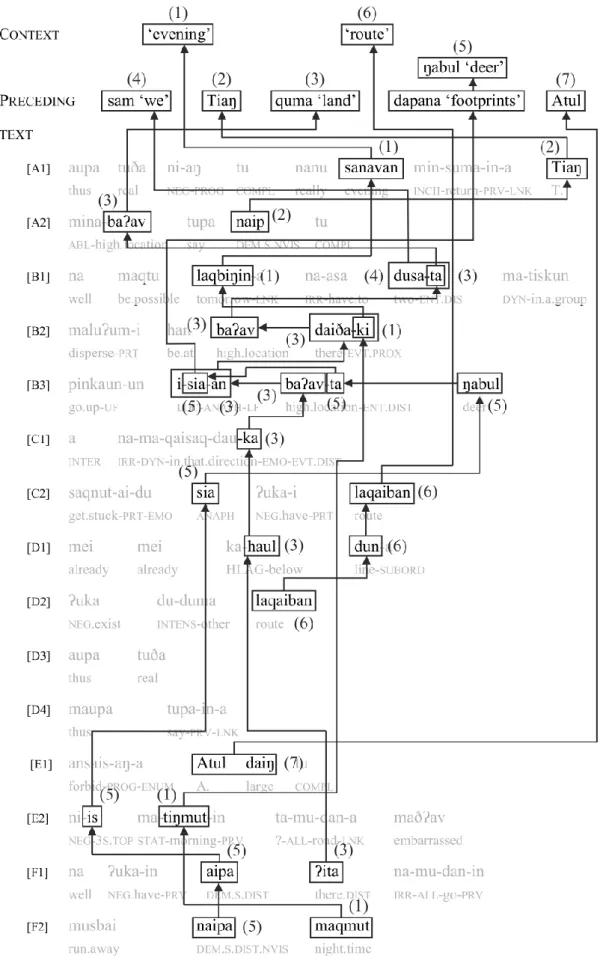
Section 4 fleshes out this hypothesis. Two case studies analyze oral narrative text segments in terms of their cohesive structure. They will confirm that a major function of Takivatan deictic forms in text is the creation of cohesive ties through phoric reference and that this function is superimposed on its primary spatial demonstrative function. Section 5 discusses the broad theoretical implications of our analysis. First, however, it is necessary to give an overview of the deictic paradigms in Takivatan Bunun that are relevant to the discussion at hand (Section 2) and to discuss various alternative hypotheses about the development of deictic functions (Section 3).
17
2. Deictic paradigms in Takivatan Bunun
Two categories of deictic paradigms are important to our discussion: spatial and phoric deictic markers. The first subsumes various sets of deictic markers that are involved in the expression of spatial deixis. Phoric deictic words are isolated forms that do not make a distance distinction, but are used purely for the expression of phoric and discourse deixis. We will here focus on the dedicated anaphoric marker sia and the expression of manner maupa ‘thus’ and their derived forms.
2.1. Spatial deixis
There are four deictic paradigms in Takivatan, altogether containing thirty-eight distinct forms: six bound demonstratives; twenty-three attested forms in a free demonstrative paradigm; six third person pronouns; and three place words. All make a tripartite distance distinction between a proximal (close to the speaker), medial (in the same area as the speaker) and distal (away from the speaker) form, indicated by the morphs -i, -un, and -a respectively. By far the most common are the six bound demonstratives, given in Table 1.5
<<TABLE 1 HERE>>
Two things are unusual about these forms: they do not exclusively attach to nominal hosts, and they distinguish an entitative and an eventive series, indicated by the morphs -t- and -k- occurring before the distance markers -i/un/a. Unlike demonstrative articles in most
languages, Takivatan bound demonstratives attach to nominal, verbal and several other types stems (though significantly, they can never occur on free demonstrative forms). Examples (2a-c) illustrate this for the proximal eventive form -ki.
(2) a. ni tu ma-naskal sadu-ki uskun-an
NEG COMP STAT-happy see-EVT.PROX together-PERSON
‘[...] so I was not happy to see my companions doing this.’ b. ma-nak-a qaliŋa-ki-a
DYN-1S.N-LNK language-EVT.PROX-LNK ma[s]ðaŋ-i sauqaissauqais-a
same-PRT move.back.and.forth-LNK
‘As for my language here, it is similarly going back and forth, […]’
c. Pian sadu-an su-ki mun-ʔiti
P. see-LF 2S.N-EVT.PROX TOWARD-here
‘Pian saw that you (here) would come here.’
The first sentence in these examples represents the most common use of this form, that is, attached to a verbal stem. A proximal form is selected here because of a deictic shift: the act of seeing expressed by sadu happened shortly after the hunting companions of the narrator committed a taboo. In 2b the same article appears on the nominal stem qaliŋa ‘language’ (the speaker is commenting on a story she just told). Finally, in example (2c) -ki appears on a second person pronoun. Note that the basic semantic function of bound demonstratives is consistent across word classes. For instance, the proximal eventive forms have the same function regardless of the category of their hosts: they all express relatively close spatial or temporal
5 Nojima (pers. comm.) correctly pointed out that eventive forms always follow hosts ending in a vowel, and that
consonant-final hosts result in these forms being realized as -i/-un/-a. This is only part of the story: entitative forms also have a strong preference for vowel-final hosts, and this indicates that they also have as allomorphs in
-i/-un/-a in environments where they -i/-un/-are preceded by conson-i/-un/-ants. A consequence is th-i/-un/-at in post-conson-i/-un/-ant-i/-un/-al environment,
the distinction between the entitative and eventive set of markers is neutralized. An additional problem is that -a and -i occur in a host of environments and could be argued to function as general linkers which connect “all elements within a domain of modification” (Kaufman 2009:201). In the absence of objective indicators to distinguish between their different functions, this is how they will be analysed here (-a will be marked ‘LNK’ and
18
proximity, be it of an event, an abstract concept, or a speech participant.
It is not really clear where this categorial non-selectivity comes from and I am not aware of bound demonstratives in other languages with a similar distribution. One possible explanation is that it is related to the non-rigid word class boundaries in Bunun dialects, a phenomenon that has been associated mainly with western Austronesian languages (Foley 1998; Gil 2000; Himmelmann 2008). When in a language in which boundaries between lexical categories are not rigid, categorial attachment restrictions for function words such as articles are less likely to determine their behavior.
The second interesting aspect of bound demonstrative forms is that they distinguish between an entitative (ENT) sub-paradigm, which is formed with a morph t and is used when the concrete,
material properties of the referent or event marked by the bound demonstrative need to be stressed, and an eventive (EVE) sub-paradigm, which is formed with k and indicates the
importance of the spatio-temporal location of a referent or event in its immediate context. Consider the difference between (3a) and (3b).
(3) a. maq-a ainak-a tama-ka
DEFIN-LNK 1S.POSS-LNK father-EVT.DIST
tu-tuða tu miqðiq daiŋʔað aipa
CV-real COMP difficult large DEM.S.DIST
‘As for my father in those days, he really had a lot of difficulties.’
b. pa-ʔuni san i-nam tama-tun tudip
CAUS.DYN-be truly POSS-1E.N father-ENT.MED that.time
‘Our dear father truly went through a lot in those days.’
In (3a), the use of a distal eventive bound forms -ka on tama ‘father’ is motivated by the importance of emphasizing the positioning of this participant in a distant temporal past. In (3b), the spatio-temporal setting of the event and its associated participants is already encoded by
tudip ‘in those days’. Consequently, there is no need to express this on the nominal stem
anymore and the entitative -tun is used. The medial form highlights the status of the father as an object of emotional affection. Another illustration of the distinction between these two bound demonstrative paradigms is to be found in Table 6 below: eventative forms all refer back to temporal or spatial expressions, while entitative forms tend to refer to concrete referential targets. Note that while eventative demonstratives are more common on verbal and adverbial elements expressing time and place, and entitative demonstratives occur more often on nominal forms, the examples illustrate that both sub-paradigms can attach to stems of any category that allows for the attachment of bound demonstratives. This indicates that the distinction between the two categories is a semantic rather than a grammatical one.
In terms of distance, the bound demonstrative paradigm makes a distinction between proximal, medial and distal forms. It is often speaker-oriented, but especially in narrative text deictic shift to one of the narrative protagonists is possible. The contrast between proximal and distal reference is illustrated in (4). The speaker explains how a group of Bunun who recently moved to the east coast from Nantou, in the Central Mountain Range, need to acquire a relocation permit. At the time of utterance, he is in Hualien County, hence the proximal forms on Kaliŋku ‘Hualien’ and the second token of pisihalun ‘make good, bring in order’. In the last clause, by contrast, Nantu gets a distal form. Note that Kaliŋku and Nantu both have entitative demonstratives, despite the fact that they are toponyms; in the narrative context, emphasis is on the actions that are to be undertaken in both locations, rather than on their spatial properties.
(4) asa pi-sihal-un itu Kaliŋku-ti
have.to CAUS.STAT-good-UF this.here K.-ENT.PROX
‘You have to put things in order here in Kaliŋku, …’
pi-sihal-un-ti
19 ‘… and when it is in order here,…’
na asa tun-han Nantu-ta
CONS have.to THROUGH-go N.-ENT.DIST
‘you have to go over there to Nantou.’
One notable metaphorical extension of the distance contrast, which is present in all spatial deictic paradigms, is the indication of emotive distance. This use is especially common for medial forms, which commonly express endearment.6 It explains why medial bound forms are
commonly used on proper names and kinship terms, for instance in (3b). We will argue in Section 3.2 that there is no strong evidence for a specialized anaphoric or discourse-deictic function for bound demonstratives.
It has been argued that bound demonstrative in other Bunun dialects are portmanteau forms that mark both deixis and case. Wu (2009:266) and Zeitoun (2000) distinguish two sets of bound demonstrative forms in Isbukun Bunun, which mark nominative and oblique noun phrases (see also Li 1997:363).
<<TABLE 2 HERE>>
In other Austronesian, it is not unusual for noun markers to combine case marking and deixis, definiteness or specificity (see for instance Reid 1978; Reid 2002). However, the Takivatan data available does not support such an analysis: individual bound demonstratives occur in a number of positions that do not correspond to a single grammatical role or case domain, and they are not in complementary distribution.
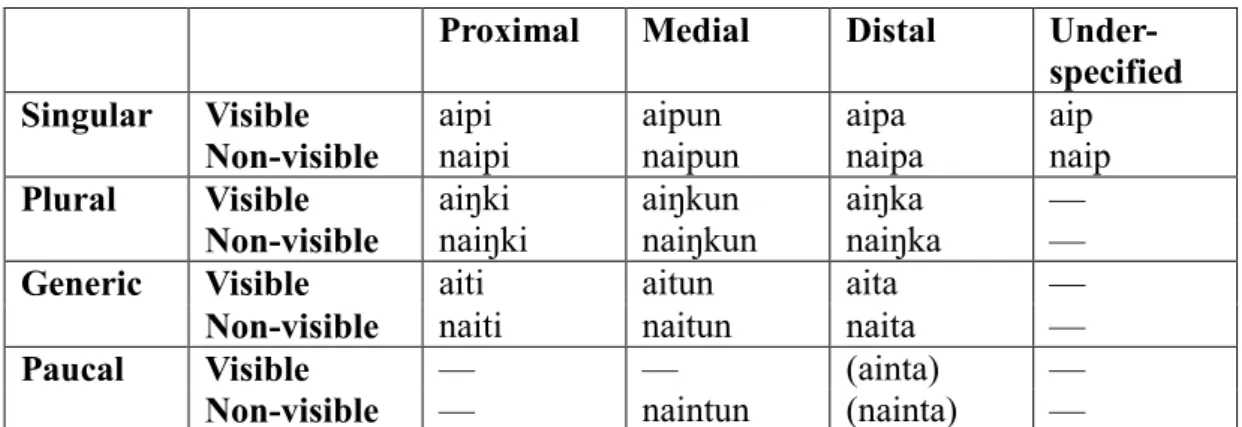
Free demonstratives form a rather bulky paradigm, represented in Table 3. They consist of a visibility marker (zero vs. n-), a root -ai-, an indicator of plurality -p/ŋk/t/nt, and a deictic element -i/un/a. Apart from occasional use in possessive constructions, these forms cannot occur in adnominal positions. Dashed cells indicate forms that have not been attested.
<<TABLE 3 HERE>>
Free demonstratives vary along three parameters: distance, visibility, and number. Distance is encoded on a three-point scale, similarly to bound demonstratives. This is illustrated in (5) for the singular visible forms, which are by far the most common of the free demonstratives in the corpus by a factor of four. In (5a), aipi ‘he (here)’ refers to a person close to the speaker. The medial form aipun in (5b) is an illustration of the delineation semantics of medial distance in Takivatan: it indicates a referent that is not close to, but still within the same delineated spatial area as the deictic centre (in this instance, in the same village). In (5c), distal aipa in the second clause is used for referring to a referent that is temporally distant from the speaker.
(5) a. siða aipi qaimaŋsuð ma-tauŋtauŋ take DEM.S.PROX thing DYN-beat
‘He (here) takes things and beats them against something else.’ b. sau-han aipun qanaqtuŋ i-ʔiti-i,
UNTIL-be.in DEM.S.MED finished LOC-here-PRT
a na, ma-sihal naupa istun-a inliskinan-i
INTER well STAT-good seemingly 3S.MED-LNK thoughts-PRT
‘When he has finished being here, his thoughts will be very happy.’
c. maq-a ainak-a tama-ka
DEFIN-LNK 1S.POSS-LNK father-EVT.DIST
tu-tuða tu miqðiq daiŋʔað aipa CV-real COMP difficult large DEM.S.DIST
‘As for my father in those days, he really had a lot of difficulties.’
20 d. na ni-in-un aip min-pantu-a
well NEG-PFV-UF DEM.S INCH-study-LNK
‘And she wasn't there anymore, she had become a student.’
Curiously, singular free demonstratives can be underspecified for distance, by simply not adding a distance suffix. This is so in (5d), where aip does not indicate any spatial or temporal distance. Such forms are relatively rare. Again there are no attestations of demonstratives that are exclusively used anaphorically, although it is clear from examples such as aipa ‘DEM.S.DIST’
in (5c) that demonstratives can have a phoric function in addition to their situational function. Rarely, forms such as aipi ‘DEM.S.PROX’ in (6) can be found where there is a discrepancy
between the real or imagined spatial or temporal distance (other village, past) and the deictic form used (proximal).
(6) a. paun aipi tu Tanta
called.UF DEM.S.PROX COMP T.
‘[In the old days, we lived in what was called our former village,] this was called Tanta.’
b. sihal-un aipi sia binanauʔað
good-UF DEM.S.PROX ANAPH wife
‘[And if the meat was good,] this [hunter] should store it well for his wife.’
Such forms could be interpreted as anaphoric deixis, but it is telling that this and similar examples involve a proximal demonstrative referring to a deictic referent that always has a strong positive connotation (a much beloved old village or a virtuous hunter). As such, these proximal forms are probably better analyzed in terms of an evaluative extension of spatial deixis, expressing endorsement or approval (De Busser 2009:462–4). This is also so for many medial forms, including bound demonstratives, which often indicate an emotional fondness towards the referent.
The second parameter of variation for free demonstratives is visibility. Non-visible forms typically indicate not simply that a referent is not visible, but that its non-visible status from the point-of-view of the deictic center is relevant to the exposition.
(7) mu-sbai naipa maqmut
TOWARD-cause.to.move DEM.S.DIST.NVIS night.time
‘… it will have run away during the night.’
An excellent illustration is the non-visible distal singular form naipa in (7).This clause is part of a longer hunting sequence that is analyzed in Section 4.2 below and naipa refers to a deer that the hunters are stalking. The form is here used, in contrast to its corresponding visible equivalent aipa ‘DEM.S.DIST.NVIS’ in the preceding clause (see (22E), to indicate that the animal
has disappeared.
The final contrast in the free demonstrative paradigm is plurality, indicated by a consonantal segment in the demonstrative stem: -p- for singular, -ŋk- for plural, -t- for collective, and -nt- for paucal reference. Singular forms (all examples above) are by far the most common, followed by plurals. An example of the latter is given in (8). The choice of a distal form here probably reflects temporal distance.
(8) nanu aiŋka liskaʔuni
really DEM.P.DIST believe
‘They really believed in it, […]’
Generic demonstratives typically describe a specific set of generic referents; they refer to a collective group of referents whose exact members are left undefined. A good example is naita in (9), which is co-referential with the inclusive plural ʔata, but whose set of members is left rather vague (a group of Bunun people that came from Banuaz).
21
(9) a naita qabas-a bunun-a
INTER DEM.GNR.DIST.NVIS in.former.times-LNK people-LNK
mainhan ʔata qabas paun tu Banuað
come.from 1I.TOPAG in.former.times be.called COMP B.
‘And in the old days those people, those Bunun, we came from a place called Banuaz.’ Only one instance of the paucal category has been attested in the corpus; it is here mentioned for completeness, but we will further ignore it.
<<TABLE 4 HERE>>
Unlike other personal pronouns (De Busser 2009:440–54; De Busser 2011:531–2) but like free demonstratives, third person personal pronouns express a three-way distance contrast and do not distinguish between different case forms. There are a number of reasons for analyzing them nevertheless as part of the pronominal paradigm. One is that the singular root is identical to the bound pronominal form *-is ‘3S.TOP’, which is now largely defunct but still occurs occasionally
in archaic constructions, such as (12c). Third person pronouns do not appear to have strong demonstrative semantics; in situations where a distance contrast needs to be expressed free (as in 7) or bound demonstratives (as in 4) are typically used. Third person pronouns typically refer to humans or animate referents.
(10) han-ʔak daiða ma-luskun inta
be.at-1S.TOP over.there DYN-together 3P.DIST
‘I am there with them together.’
As in the other spatial deictic paradigms, medial forms often have an emotive interpretation. For example, in (11) the speaker employs istun ‘3S.MED’ to refer to the writer of this article,
who was at the time living in her house as an adopted family member. (11) ma-sihal naupa istun-a inliskinan-i
STAT-good seemingly 3S.MED-LNK thoughts-PRT
‘Then his thoughts will be very happy.’
The final spatial deictic paradigm is a set of three place words, given in Table 4. Depending on the grammatical slot in which they occur they can be analyzed either as verbal, as in (2c) munʔiti ‘come here’, or adverbial elements, as in (22E1) ʔita ‘there’.
<<TABLE 5 HERE>>
2.2. Textual deixis
Under textual deixis in Takivatan, we subsume deictic elements that are used for phoric or discourse-deictic reference and do not have situational deictic uses.7 Phoric deixis (called
tracking by Himmelmann 1996 and anaphoric deixis by Diessel 1999b) keeps track of the participants in a text by pointing back, or forward, at their previous references in that text or in a shared discourse context. Discourse deixis is reference to a (usually preceding) text segment, rather than a referential expression. Most research agrees that these two functions need to be considered distinct, although they are not necessarily formally differentiated.
This is so for the anaphoric marker sia, which in all likelihood goes back to PAn pronoun *si ‘NOM’ and *ia ‘3S’ (Blust 2015; *s-ia in Ross 2006) and whose cognates in other Austronesian languages often function as personal or demonstrative pronouns. However, Takivatan sia is exclusively used for textual deictic reference. It can be used both anaphorically (as in 12b), and as a discourse deictic (12c). Grammatically, sia is very versatile: it can function as the head of a noun phrase, as a verbal predicate head, or as a nominal modifier. In (12a), it is the head of the topical argument modifying the verb mapaðnu ‘point at’. In (12b), its position and the fact
7 This terminology is in line with Lyons (1977: 667), who proposes the term ‘textual deixis’ to refer to
“[d]emonstrative pronouns and other deictic expressions [which are] used to refer to linguistic entities of various kinds (forms, parts of forms, lexemes, expressions, text-sentences, and so on).”
22
that it is modified by an irrealis marker and a directional prefix taun- ‘PERL’ indicate that it
functions as a verbal element. In (12c), siati ‘what I just recounted here’ is functioning as the only free form in a subordinate clause. Finally, in (12d) sia functions as an attributive modifier of madadaiŋʔað ‘the elders’.
(12) a. haiða makun bunun ma-makun-un, ma-paðnu-du sia have over.there people CV-over.there-UF DYN-point-EMO ANAPH
‘There is a human over there, over there! — it [the monkey] pointed with its finger.’
b. na-taun-sia-ki ma-ma-la-labas-ka hutuŋ
IRR-THROUGH-ANAPH-EVT.PROX CV-DYN-CV-abundant-EVT.DIST monkey
‘[…] well, we wanted to go to the [aforementioned place] here because there were a lot of monkeys.’
c. a sia-ti-a nitu maqtu-is nitu
INTER ANAPH-ENT.PROX-SUBORD NEG be.possible.to-3S.TOP NEG
‘And this here [what I just recounted], it cannot be otherwise [lit.: it cannot that it is not].’
d. a paqun maup[a]-in-ta sia madadaiŋʔað qabas
INTER indeed thus-PFV-ENT.DIST ANAPH elder in.former.time
‘like that it happened to the [aforementioned] elders in those days [that …]’
The second phoric deictic marker relevant to our discussion is maupa ‘thus, in such a way’, and its derived forms.8 As the English translation suggests, it could be interpreted as expressing
manner, but very often it makes sense to analyze it as a discourse-deictic marker. It is attested in a number of grammatical functions, the most important of which are the verbal head of a predicate, auxiliary verb, adverbial element. In (12d), the stem maupa ‘(it has happened) thus’ is the only element that can be interpreted as the predicate head and the presence of a perfective suffix -in suggests that it is a verbal form.
(13) a. maupa-ta madaiŋʔað tu baðbað-i Diqanin
thus-ENT.DIST elder COMP have.conversation-PRT Heaven
tu ma-sihal-aŋ ka-kaun-un
COMP STAT-good-PROG CV-eat-UF
‘And like that, the elders talked to Heaven in order to keep producing good crops.’ b. haiða inliskinan maupa-ta
have thoughts thus-ENT.DIST
‘I had thoughts like that.’
In (13a), the form occurs in initial position, is followed by the topical argument in second position, then a complementizer, and then the semantic head of the verbal clause. All of this is indicative of an auxiliary verb construction. In (13b), maupa appears in final position, a grammatical slot that is consistently filled by adverbial expressions of time, manner and place (De Busser 2013).
Interestingly, unlike situational deixis, textual deictic markers are not part of elaborate paradigms, but rather isolated forms with high grammatical versatility. They are both very common in the corpus and are semantically undifferentiated. Note also that both sia and maupa, because they have no spatial deictic functions, readily combine with bound demonstrative forms, unlike any of the freestanding spatial deictic forms (see examples above).
8 Note that maupa does not in itself express any deictic distance. A bound demonstrative marker, typically ti or
-ta, needs to be added to accomplish this: maupa-ti ‘thus-ENT.PROX > in this way’ vs. maupa-ta ‘thus-ENT.DIST > in that way’.
23
3. Functions of Spatial deixis
3.1. Typological classification
After setting the scene, we will now turn back to a description of the functional potential of deictic forms in languages around the world. There is relatively little controversy over the broad function of deixis: it “is generally understood to be the encoding of the spatiotemporal context and subjective experience of the encoder in an utterance” (Green 2006:415). This often includes person deixis, as expressed by personal pronouns, and the temporal encoding of events, as expressed by tense, aspect and modality, but in this section we will mainly focus on spatial deixis as it is encoded by demonstrative reference.
It is in the details that things become muddled. When we start talking about the classification of spatial deixis and its functional extensions, a number of issues come up:
What are the basic and derived functions of spatial deixis? How universal are they?
How are these functions diachronically related to each other?
Let’s first look at some basic classifications of functions. An early attempt was made by Fillmore (1971:40–41), who makes a basic distinction between gestural, symbolic, and anaphoric deixis.
(14) a. I want you to put it there. (gestural)
b. Is Johnny there? (symbolic)
c. I drove the car to the parking lot and left it there. (anaphoric) (Fillmore 1971:41)
Gestural deixis pertains to the immediate physical discourse context and is expected “to be accompanied by a gesture or demonstration of some sort” (Fillmore 1971:41), as illustrated in (14a). Symbolic deixis is an abstract extension of spatial deixis as pointing behavior. It is still spatially oriented, but speaker, hearer and deictic target do not need to share a physical context. In (14b), for instance, the speaker and Johnny are very likely not in the same place. Anaphoric deixis is a further abstraction in which deictic words are used for tracking referents in a text. There are problems with Fillmore’s classification. For instance, his classification of non-spatial deixis is probably underdeveloped and it is not clear what determines the boundary is between gestural and symbolic uses.9 Salient to our discussion here is that Fillmore—in line with later
research—assumes a developmental progression of deictic functions, which starts from spatial deixis and leads to the use of deictics in non-spatial, textual contexts.
Himmelmann (1996:218–32) identifies four main uses of spatial deixis:
Situational deixis subsumes deictic reference to the spatio-temporal context, and largely combines Fillmore’s gestural and symbolic uses. One of its diagnostic properties is the presence of a deictic center.
Discourse deixis is reference to “propositions or events” (1996:224) expressed in the current text.
Tracking is the use of demonstratives for keeping tab of referential expressions in a text by establishing co-referential links.
Recognitional deixis identifies a referent as belonging to the shared context of the ongoing discourse.
The examples in (15a-d) illustrate these four functions for the proximal demonstrative -ine in Biak (ISO 639-3: bhw), an Austronesian language of Indonesian Papua (van den Heuvel 2006).
9 Fillmore (1971:44) asserts that his classification is speaker-oriented, but gestural deixis appears to be equally
24 (15) a. Situational:
ro mnu Saba i-ra-ine i
at village S. 3S-seaward-this focus.marker
‘In Saba, this seaward village.’ (Dalrymple and Mofu 2015:T03.006) b. Discourse-deixis:
rari-rya fafyar an-ine i-mnai roro di-ne
such.that-so story GIV-this 3S-finish at the.place-this
‘That is the end of this story.’ (Dalrymple and Mofu 2015:T07.198) c. Tracking:
inai sko-ine sko-na snon-o ba
daughter 3PAUC-this 3PAUC-have man-FILL not
‘[Her three daughters, one called Binwan, another called Inande and another one also called Inggumi.] These three daughters did not have a brother.’ (Dalrymple and Mofu 2015:T01.011)
d. Recognitional:
ma insape insama ido Byak ko-ine
and after.that so.that then Biak 1I-this
ko-k-fawi-yo ko-kam-e ko ro iso mob oser
1I-give-know-FILL 1I-all-FILL 1I at be place one
‘And therefore we, these Biak people, could use it [the story] to know that all of us were from one place.’ (Dalrymple and Mofu 2015:T01.075)
Diessel (1999b:50–5) sees demonstratives as a complex interaction of syntactic, semantic and pragmatic functions. However, what he describes as the pragmatic functions of demonstratives is essentially identical to Himmelmann’s classification of deictic functions.10 This four-way
distinction is in fact widely accepted and will take center stage in our discussion. We follow Himmelmann’s terminology, but refer to tracking as phoric deixis (for reasons that will become clear in Section 4) and use textual deixis as a cover term for phoric and discourse deixis. Despite all similarities, there are a number of fundamental differences between how Himmelmann and Diessel interpret the relationship between these deictic functions. Two are discussed in detail by Cleary-Kemp (2007): the universality of these categories and the primacy and unmarkedness of situational use. Both are related to the presumed diachronic relationship between different deictic functions. Additionally, we will discuss how both authors view the discreteness of these functions.
The idea that deixis encompasses reference- and discourse-related functions is widely accepted, although some, for instance Dixon (2003:63–4), suggests that phoric and discourse reference should not be considered deixis, but a separate related phenomenon. There is less certainty about how common different uses are cross-linguistically. Himmelmann asserts that the four uses identified by him are “are universally attested in natural languages” (1996:206) as functions of demonstratives. Note that the assertion made in Himmelmann (1996) is not that these functions are universally present in language as distinct forms, but that they are universal functions of demonstratives. Diessel (1999b:110) is doubtful about this claim, although he does not provide clear evidence to the contrary.
As to the primacy of demonstrative functions, the common assumption is that the spatial situational use of deixis is in some sense or other primary (Fillmore 1971:70; Halliday and Hasan 1976:32), though often without being properly motivated. Diessel (1999b:110–3) attempts to do just that. He points out evidence from developmental psychology strongly suggesting that children acquire situational deictic contrasts first and that this is preceded by pointing behavior (see for instance Clark and Sengul 1978). He also argues that situational
10 There is some transparent terminological variation. Diessel (1999b:6) distinguishes exophoric, anaphoric,