On: 28 April 2014, At: 00:18 Publisher: Taylor & Francis
Informa Ltd Registered in England and Wales Registered Number: 1072954 Registered office: Mortimer House, 37-41 Mortimer Street, London W1T 3JH, UK
Liquid Crystals
Publication details, including instructions for authors and subscription information:
http://www.tandfonline.com/loi/tlct20
Synthesis and characterization of
thiophene-containing liquid crystals
Long-Hai Wu a , Yen-Chih Wang a & Chain-Shu Hsu a a
Department of Applied Chemistry, National Chiao Tung University, Hsinchu, Taiwan 30050, PR China
Published online: 06 Aug 2010.
To cite this article: Long-Hai Wu , Yen-Chih Wang & Chain-Shu Hsu (2000) Synthesis and characterization of thiophene-containing liquid crystals, Liquid Crystals, 27:11, 1503-1513, DOI: 10.1080/026782900750018672 To link to this article: http://dx.doi.org/10.1080/026782900750018672
PLEASE SCROLL DOWN FOR ARTICLE
Taylor & Francis makes every effort to ensure the accuracy of all the information (the “Content”) contained in the publications on our platform. However, Taylor & Francis, our agents, and our licensors make no representations or warranties whatsoever as to the accuracy, completeness, or suitability for any purpose of the Content. Any opinions and views expressed in this publication are the opinions and views of the authors, and are not the views of or endorsed by Taylor & Francis. The accuracy of the Content should not be relied upon and should be independently verified with primary sources of information. Taylor and Francis shall not be liable for any losses, actions, claims, proceedings, demands, costs, expenses, damages, and other liabilities whatsoever or howsoever caused arising directly or indirectly in connection with, in relation to or arising out of the use of the Content. This article may be used for research, teaching, and private study purposes. Any substantial or
systematic reproduction, redistribution, reselling, loan, sub-licensing, systematic supply, or distribution in any form to anyone is expressly forbidden. Terms & Conditions of access and use can be found at http://www.tandfonline.com/page/terms-and-conditions
Synthesis and characterization of thiophene-containing
liquid crystals
LONG-HAI WU, YEN-CHIH WANG and CHAIN-SHU HSU* Department of Applied Chemistry, National Chiao Tung University, Hsinchu,
Taiwan 30050, PR China
(Received 15 March 2000; accepted 12 May 2000)
Six series of liquid crystal materials containing a 2,5-disubstituted thiophene unit were synthesized. The liquid crystal compounds obtained were characterized by NMR, diŒerential scanning calorimetry, polarizing optical microscopy and X-ray diŒraction techniques. The properties of liquid crystalline phases were investigated as a function of spacer units, number of aromatic core rings and diŒerent terminal moieties. Cyano, methoxy and iodo groups were used as terminal groups. It is found that: (i) compounds having one thiophene ring and one phenyl ring connected by an ester group, with a length/breadth value of 2.1, exhibit no mesophase, while other compounds containing two biphenyl rings, with a length/breadth ratio of 2.7, show mesophases; (ii) the polarity of terminal groups and the exible spacer length signi cantly aŒect the thermal behaviour of these compounds; (iii) the nematic transition range of cyano-containing compounds decreases with increasing length of the exible spacer, and long alkenyloxy chains tend to facilitate the formation of the smectic phase and suppress the nematic phase in all the mesogenic compounds synthesized.
1. Introduction dipole within their structure which promotes negative
dielectric anisotropy; this eliminates the need for lateral Mesogen shape anisometry, terminal groups and exible
cyano and uoro substituents which tend to increase chain length are key variables in strategies to design
the molecular breadth and possibly the viscosity of new mesogens exhibiting a speci c type of molecular
the system. Moreover, the insertion of heteroatoms can organization in a particular temperature range [1].
strongly in uence the formation of mesophases and change There are many examples of rigid, extended chemical
considerably the polarity, polarizability and sometimes subunits in mesogens. The most common subunit used
the geometry of the molecules. Thereby the types of in synthesizing calamitic liquid crystals is the linearly
mesophase, phase transition temperatures, dielectric
con-para-substituted phenyl ring [2]. Other non-linear
stants and other properties of the mesogens may be
types subunits, such as themeta-substituted phenyl ring
in uenced [18, 19]. [3, 4], the furan ring [5], the pyrrolic ring [6] and the
In this study, we synthesized six series of thiophene-thiophene ring, have also been used in synthesizing
based liquid crystals. Their general formula is shown liquid crystals. Among them, thiophene-containing
below: compounds have attracted much attention. Over the
past decade, the in uence of thiophene ring systems on mesomorphic behaviour has been the subject of much investigation, and a great number of mesogenic compounds containing the thiophene ring have been synthesized and characterized [5–17]. The reason for
introducing a thiophene ring into mesogens is the greater where n is the number of methylene units in the
possibility with heterocyclics for the design of new alkenyloxy group, Ar is a phenyl or biphenyl group and
mesogenic molecules. Thiophene systems are generally X is an iodo, methoxy or cyano group. For simplicity,
lower melting than their 1,4-phenylene counterparts due these compounds are abbreviated asnPET-I, nPET-CN,
to reduced packing e ciency of the molecules. In addi- nPET-OMe, nBPET-I, nBPET-CN, and nBPET-OMe.
tion, thiophene-base d systems possess a strong lateral P stands for phenyl ring, BP for biphenyl group, E
for ester linking group and T for thiophene ring. The mesogenic properties of the synthesized compounds were
*Author for correspondence; e-mail: [email protected]
L iquid Crystals ISSN 0267-829 2 print/ISSN 1366-585 5 online © 2000 Taylor & Francis Ltd http://www.tandf.co.uk/journals
characterized by diŒerential scanning calorimetry (DSC), (DCC) and 4-dimethylaminopyridin e (DMAP), all from TCI Co., Ltd, were used as received without any puri-polarizing optical microscopy and X-ray diŒraction
(XRD) techniques. The eŒect of spacer length, mesogenic cation. All solvents were dried and distilled before use,
and column chromatograph y on silica gel was performed core and terminal groups on the mesomorphic behaviour
of the compounds is discussed. using Merk Kieselgel 60 (70–230 mesh ASTM).
2.2. Characterization techniques
The 1H NMR spectra of all the synthesized
com-2. Experimental
2.1. Materials pounds were recorded on a Varian 300 spectrometer (300 MHz) using CDC1
3 as solvent and
tetramethyl-Allyl bromide, hydroquinone, 4,4¾ -biphenol,
2-formyl-thiophene, 2-methoxythio phene, dicyclohexylcar bodiimide silane (TMS) as an internal standard. A Seiko/5200
Scheme.
diŒerential scanning calorimeter was used for deter- 2.3.1. 5-Iodo-2-thiophenecarbaldehyd e (1)
2-Formylthiophen e (3.6 g, 32.4 mmol) and iodine (3.84 g, mining the thermal transitions and transition enthalpies.
Heating and cooling rates were 10ßC minÕ 1. The endo- 15.1 mmol ) were dissolved in 8 ml of carbon
tetra-chloride. Periodic acid (l.4 g, 7 mmol), distilled water thermic peaks pointed downward. A Carl-Zeiss Axiophot
polarizing microscope equipped with a Mettler FP 82 (6 ml ), acetic acid (16 ml) and H
2SO4 (18N, 0.24 ml )
were added to this solution. The mixture was stirred at hot stage and a Mettler FP 80 central processor was used
to analyse thermal transitions and observe mesomorphic re ux temperature (80ßC) for 1 h and at room
temper-ature (25ß C) for another 12 h. After washing with 2%
textures. XRD measurements were performed with a
Rigaku powder diŒractometer using a nickel- ltered aqueous NaHCO
3, the organic layer was dried over
anhydrous MgSO
4and the solvent removed in a rotary
CuK
a radiation. evaporator. Puri cation was performed using ash
chromatograph y (silica gel, a mixture of 1 : 5 EtOAc/ 2.3. Synthesis
The synthetic routes for the six series of thiophene- n-hexane as eluent) to yield 6.38 g (82.4%) of yellowish
crystals. Compound 1: MS m/z 206 (M+ ). 1H NMR
containing compounds are outlined in the scheme.
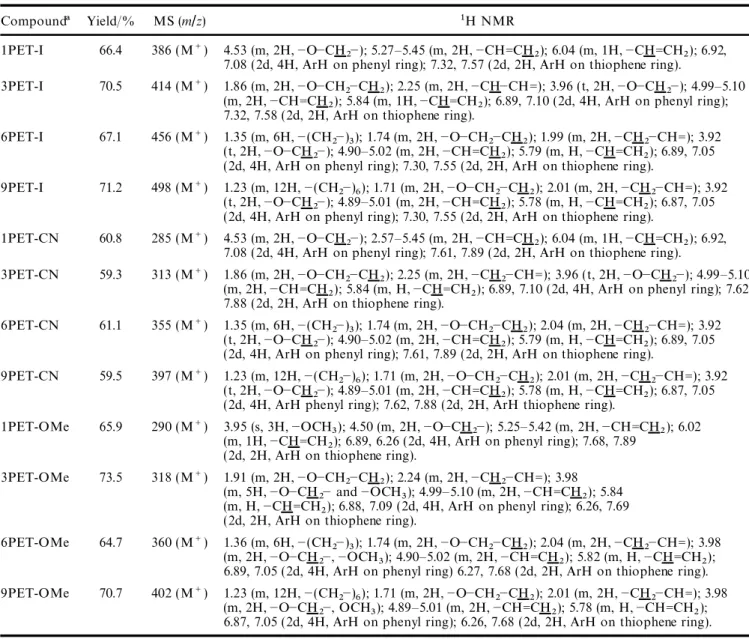
Table 1. Chemical shift d and mass spectra data of nPET-I, nPET-CN and nPET-OMe.
Compounda Yield/% MS (m/z) 1H NMR
1PET-I 66.4 386 (M+ ) 4.53 (m, 2H,± O± CH2± ); 5.27–5.45 (m, 2H,± CH5 CH2); 6.04 (m, 1H,± CH5 CH2); 6.92,
7.08 (2d, 4H, ArH on phenyl ring); 7.32, 7.57 (2d, 2H, ArH on thiophene ring).
3PET-I 70.5 414 (M+ ) 1.86 (m, 2H,± O± CH2± CH2); 2.25 (m, 2H,± CH± CH5 ); 3.96 (t, 2H,± O± CH2± ); 4.99–5.10
(m, 2H,± CH5 CH2); 5.84 (m, 1H,± CH5 CH2); 6.89, 7.10 (2d, 4H, ArH on phenyl ring);
7.32, 7.58 (2d, 2H, ArH on thiophene ring).
6PET-I 67.1 456 (M+ ) 1.35 (m, 6H,± (CH2± )3); 1.74 (m, 2H,± O± CH2± CH2); 1.99 (m, 2H,± CH2± CH5 ); 3.92
(t, 2H,± O± CH2± ); 4.90–5.02 (m, 2H,± CH5 CH2); 5.79 (m, H,± CH5 CH2); 6.89, 7.05
(2d, 4H, ArH on phenyl ring); 7.30, 7.55 (2d, 2H, ArH on thiophene ring).
9PET-I 71.2 498 (M+ ) 1.23 (m, 12H,± (CH2± )6); 1.71 (m, 2H,± O± CH2± CH2); 2.01 (m, 2H,± CH2± CH5 ); 3.92
(t, 2H,± O± CH2± ); 4.89–5.01 (m, 2H,± CH5 CH2); 5.78 (m, H,± CH5 CH2); 6.87, 7.05
(2d, 4H, ArH on phenyl ring); 7.30, 7.55 (2d, 2H, ArH on thiophene ring).
1PET-CN 60.8 285 (M+ ) 4.53 (m, 2H,± O± CH2± ); 2.57–5.45 (m, 2H,± CH5 CH2); 6.04 (m, 1H,± CH5 CH2); 6.92,
7.08 (2d, 4H, ArH on phenyl ring); 7.61, 7.89 (2d, 2H, ArH on thiophene ring).
3PET-CN 59.3 313 (M+ ) 1.86 (m, 2H,± O± CH2± CH2); 2.25 (m, 2H,± CH2± CH5 ); 3.96 (t, 2H,± O± CH2± ); 4.99–5.10
(m, 2H,± CH5 CH2); 5.84 (m, H,± CH5 CH2); 6.89, 7.10 (2d, 4H, ArH on phenyl ring); 7.62,
7.88 (2d, 2H, ArH on thiophene ring).
6PET-CN 61.1 355 (M+ ) 1.35 (m, 6H,± (CH2± )3); 1.74 (m, 2H,± O± CH2± CH2); 2.04 (m, 2H,± CH2± CH5 ); 3.92
(t, 2H,± O± CH2± ); 4.90–5.02 (m, 2H,± CH5 CH2); 5.79 (m, H,± CH5 CH2); 6.89, 7.05
(2d, 4H, ArH on phenyl ring); 7.61, 7.89 (2d, 2H, ArH on thiophene ring).
9PET-CN 59.5 397 (M+ ) 1.23 (m, 12H,± (CH2± )6); 1.71 (m, 2H,± O± CH2± CH2); 2.01 (m, 2H,± CH2± CH5 ); 3.92
(t, 2H,± O± CH2± ); 4.89–5.01 (m, 2H,± CH5 CH2); 5.78 (m, H,± CH5 CH2); 6.87, 7.05
(2d, 4H, ArH phenyl ring); 7.62, 7.88 (2d, 2H, ArH thiophene ring).
1PET-OMe 65.9 290 (M+ ) 3.95 (s, 3H,± OCH3); 4.50 (m, 2H,± O± CH2± ); 5.25–5.42 (m, 2H,± CH5 CH2 ); 6.02
(m, 1H,± CH5 CH2); 6.89, 6.26 (2d, 4H, ArH on phenyl ring); 7.68, 7.89
(2d, 2H, ArH on thiophene ring).
3PET-OMe 73.5 318 (M+ ) 1.91 (m, 2H,± O± CH2± CH2); 2.24 (m, 2H,± CH2± CH5 ); 3.98
(m, 5H,± O± CH2± and± OCH3); 4.99–5.10 (m, 2H,± CH5 CH2); 5.84
(m, H,± CH5 CH2); 6.88, 7.09 (2d, 4H, ArH on phenyl ring); 6.26, 7.69
(2d, 2H, ArH on thiophene ring).
6PET-OMe 64.7 360 (M+ ) 1.36 (m, 6H,± (CH2± )3); 1.74 (m, 2H,± O± CH2± CH2); 2.04 (m, 2H,± CH2± CH5 ); 3.98
(m, 2H,± O± CH2± ,± OCH3); 4.90–5.02 (m, 2H,± CH5 CH2); 5.82 (m, H,± CH5 CH2);
6.89, 7.05 (2d, 4H, ArH on phenyl ring) 6.27, 7.68 (2d, 2H, ArH on thiophene ring).
9PET-OMe 70.7 402 (M+ ) 1.23 (m, 12H,± (CH2± )6); 1.71 (m, 2H,± O± CH2± CH2); 2.01 (m, 2H,± CH2± CH5 ); 3.98
(m, 2H,± O± CH2± , OCH3); 4.89–5.01 (m, 2H,± CH5 CH2); 5.78 (m, H,± CH5 CH2);
6.87, 7.05 (2d, 4H, ArH on phenyl ring); 6.26, 7.68 (2d, 2H, ArH on thiophene ring). a According to scheme.
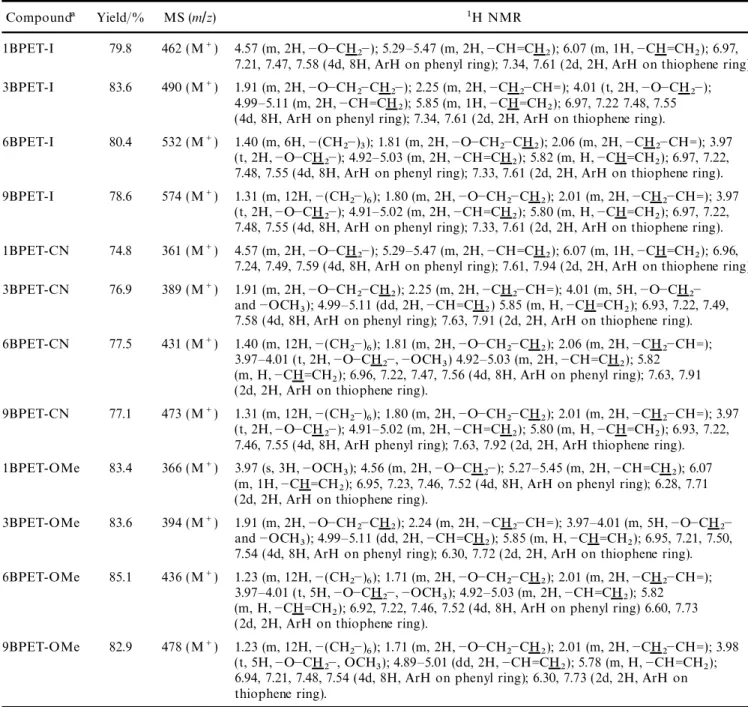
Table 2. Chemical shift d and mass spectra data of nBPET-I, nBPET-CN and nBPET-OMe.
Compounda Yield/% MS (m/z) 1H NMR
1BPET-I 79.8 462 (M+ ) 4.57 (m, 2H,± O± CH2± ); 5.29–5.47 (m, 2H,± CH5 CH2); 6.07 (m, 1H,± CH5 CH2); 6.97,
7.21, 7.47, 7.58 (4d, 8H, ArH on phenyl ring); 7.34, 7.61 (2d, 2H, ArH on thiophene ring).
3BPET-I 83.6 490 (M+ ) 1.91 (m, 2H,± O± CH2± CH2± ); 2.25 (m, 2H,± CH2± CH5 ); 4.01 (t, 2H,± O± CH2± );
4.99–5.11 (m, 2H,± CH5 CH2); 5.85 (m, 1H,± CH5 CH2); 6.97, 7.22 7.48, 7.55
(4d, 8H, ArH on phenyl ring); 7.34, 7.61 (2d, 2H, ArH on thiophene ring).
6BPET-I 80.4 532 (M+ ) 1.40 (m, 6H,± (CH2± )3); 1.81 (m, 2H,± O± CH2± CH2); 2.06 (m, 2H,± CH2± CH5 ); 3.97
(t, 2H,± O± CH2± ); 4.92–5.03 (m, 2H,± CH5 CH2); 5.82 (m, H,± CH5 CH2); 6.97, 7.22,
7.48, 7.55 (4d, 8H, ArH on phenyl ring); 7.33, 7.61 (2d, 2H, ArH on thiophene ring).
9BPET-I 78.6 574 (M+ ) 1.31 (m, 12H,± (CH2± )6); 1.80 (m, 2H,± O± CH2± CH2); 2.01 (m, 2H,± CH2± CH5 ); 3.97
(t, 2H,± O± CH2± ); 4.91–5.02 (m, 2H,± CH5 CH2); 5.80 (m, H,± CH5 CH2); 6.97, 7.22,
7.48, 7.55 (4d, 8H, ArH on phenyl ring); 7.33, 7.61 (2d, 2H, ArH on thiophene ring).
1BPET-CN 74.8 361 (M+ ) 4.57 (m, 2H,± O± CH2± ); 5.29–5.47 (m, 2H,± CH5 CH2); 6.07 (m, 1H,± CH5 CH2); 6.96,
7.24, 7.49, 7.59 (4d, 8H, ArH on phenyl ring); 7.61, 7.94 (2d, 2H, ArH on thiophene ring).
3BPET-CN 76.9 389 (M+ ) 1.91 (m, 2H,± O± CH2± CH2); 2.25 (m, 2H,± CH2± CH5 ); 4.01 (m, 5H,± O± CH2±
and± OCH3); 4.99–5.11 (dd, 2H,± CH5 CH2) 5.85 (m, H,± CH5 CH2); 6.93, 7.22, 7.49,
7.58 (4d, 8H, ArH on phenyl ring); 7.63, 7.91 (2d, 2H, ArH on thiophene ring).
6BPET-CN 77.5 431 (M+ ) 1.40 (m, 12H,± (CH2± )6); 1.81 (m, 2H,± O± CH2± CH2); 2.06 (m, 2H,± CH2± CH5 );
3.97–4.01 (t, 2H,± O± CH2± ,± OCH3) 4.92–5.03 (m, 2H,± CH5 CH2); 5.82
(m, H,± CH5 CH2); 6.96, 7.22, 7.47, 7.56 (4d, 8H, ArH on phenyl ring); 7.63, 7.91
(2d, 2H, ArH on thiophene ring).
9BPET-CN 77.1 473 (M+ ) 1.31 (m, 12H,± (CH2± )6); 1.80 (m, 2H,± O± CH2± CH2); 2.01 (m, 2H,± CH2± CH5 ); 3.97
(t, 2H,± O± CH2± ); 4.91–5.02 (m, 2H,± CH5 CH2); 5.80 (m, H,± CH5 CH2); 6.93, 7.22,
7.46, 7.55 (4d, 8H, ArH phenyl ring); 7.63, 7.92 (2d, 2H, ArH thiophene ring).
1BPET-OMe 83.4 366 (M+ ) 3.97 (s, 3H,± OCH3); 4.56 (m, 2H,± O± CH2± ); 5.27–5.45 (m, 2H,± CH5 CH2); 6.07
(m, 1H,± CH5 CH2); 6.95, 7.23, 7.46, 7.52 (4d, 8H, ArH on phenyl ring); 6.28, 7.71
(2d, 2H, ArH on thiophene ring).
3BPET-OMe 83.6 394 (M+ ) 1.91 (m, 2H,± O± CH2± CH2); 2.24 (m, 2H,± CH2± CH5 ); 3.97–4.01 (m, 5H,± O± CH2±
and± OCH3); 4.99–5.11 (dd, 2H,± CH5 CH2); 5.85 (m, H,± CH5 CH2); 6.95, 7.21, 7.50,
7.54 (4d, 8H, ArH on phenyl ring); 6.30, 7.72 (2d, 2H, ArH on thiophene ring).
6BPET-OMe 85.1 436 (M+ ) 1.23 (m, 12H,± (CH2± )6); 1.71 (m, 2H,± O± CH2± CH2); 2.01 (m, 2H,± CH2± CH5 );
3.97–4.01 (t, 5H,± O± CH2± ,± OCH3); 4.92–5.03 (m, 2H,± CH5 CH2); 5.82
(m, H,± CH5 CH2); 6.92, 7.22, 7.46, 7.52 (4d, 8H, ArH on phenyl ring) 6.60, 7.73
(2d, 2H, ArH on thiophene ring).
9BPET-OMe 82.9 478 (M+ ) 1.23 (m, 12H,± (CH2± )6); 1.71 (m, 2H,± O± CH2± CH2); 2.01 (m, 2H,± CH2± CH5 ); 3.98
(t, 5H,± O± CH2± , OCH3); 4.89–5.01 (dd, 2H,± CH5 CH2); 5.78 (m, H,± CH5 CH2);
6.94, 7.21, 7.48, 7.54 (4d, 8H, ArH on phenyl ring); 6.30, 7.73 (2d, 2H, ArH on thiophene ring).
a According to scheme.
(CDC1
3, 300 MHz) d5 7.39 (m, 2H, aromatic protons) , was added. The crude product was extracted three times
with ethyl ether and the collected ether solution was
9.77 (s, 1H,
±
CHO).dried over anhydrous MgSO
4. After removing the
solvent, the product obtained was puri ed by liquid
2.3.2. 5-Methoxy-2-thiophenecarbaldehyd e (2)
A mixture of phosphorou s oxychloride (4.6 g, 30 mmol) chromatograph y (silica gel, a mixture of 1 : 5 EtOAc/
n-hexane as eluent) to yield 3.0 g (70.4%) of greenish
and N,N-dimethylforma mide (4.3 g, 60 mmol) was stirred
at room temperature for 30 min; 2-methoxythiophen e liquid. Compound 2: MS m/z 142 (M+ ). 1H NMR
(CDCI
3, 300 MHz) d5 3.78 (s, 2H,
±
OCH3), 6.39(3.42 g, 30 mmol ) was then added slowly. After stirring
for 20 h at room temperature, the mixture was poured (d,J5 4.2 Hz, 1H, aromatic proton), 7.45 (d,J5 4.5 Hz,
1H, aromatic proton). into cold water and then 5% aqueous NaOH (50 ml)
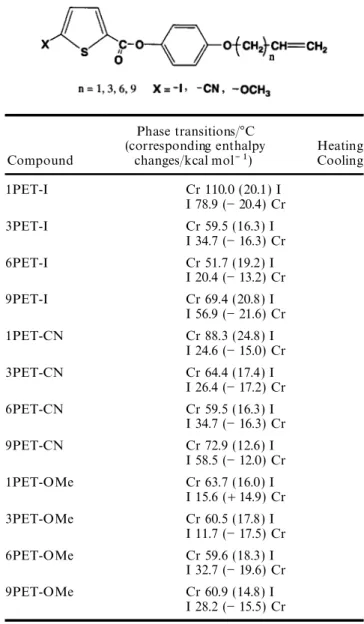
Table 3. Phase transitions and transition enthalpy changes
2.3.3. 5-Iodo-2-thiophenecarboxyli c acid (3) and
fornPET-I, nPET-CN and nPET-OMe. Cr: crystal, I: isotropic.
5-methoxy-2-thiophenecarboxyli c acid (4)
Both compounds were prepared using the same method; the synthesis of compound 3 was as follows. AgNO
3(15.0 g, 88.2 mmol ) and NaOH (7.0 g, 175 mmol)
were dissolved in water (30 ml) to give a dark syrup. To this ice-cooled syrup, 5-iodo-2-thiophenecarbaldehyd e (5.0 g, 21 mmol) were added. The resulting solution was stirred for 24 h and then acidi ed with 5% aqueous HCl
Phase transitions/ßC
to yield a yellowish precipitate. This crude product was (corresponding enthalpy Heating
recrystallized from hot water to obtain 3.9 g (72.8%) of Compound changes/kcal molÕ 1) Cooling
yellowish crystals. Compound 3: MS m/z 254 (M+ ).
1PET-I Cr 110.0 (20.1) I
1H NMR (CDC1
3, 300 MHz) d5 7.39 (d, J5 3.9 Hz, I 78.9 (Õ 20.4) Cr
1H, aromatic proton), 7.49 (d,J5 3.9 Hz, 1H, aromatic
3PET-I Cr 59.5 (16.3) I proton), 9.65 (s, 1H,
±
COOH). I 34.7 (Õ 16.3) Cr 6PET-I Cr 51.7 (19.2) I I 20.4 (Õ 13.2) Cr 2.3.4. 4-(Alkenyloxy)phenol (5–8) and 9PET-I Cr 69.4 (20.8) I 4-(alkenyloxy)biphenol (9–12) I 56.9 (Õ 21.6) CrThese compounds were prepared using the same
1PET-CN Cr 88.3 (24.8) I
method. An example for the synthesis of compound 6
I 24.6 (Õ 15.0) Cr
follows. Hydroquinon e (3.28 g, 29.8 mmol), K
2CO3(4.83 g, 3PET-CN Cr 64.4 (17.4) I
35 mmol) and KI (0.1 g, 0.6 mmol) were dissolved in 20 ml
I 26.4 (Õ 17.2) Cr
of ethanol. The solution obtained was heated to re ux
6PET-CN Cr 59.5 (16.3) I
temperature and stirred for 1 h. 5-Bromo-1-pe ntene (3.69 g,
I 34.7 (Õ 16.3) Cr
24.8 mmol) was slowly added and the reaction mixture
9PET-CN Cr 72.9 (12.6) I
heated at re ux for another 12 h. After removing the
I 58.5 (Õ 12.0) Cr
solvent under reduced pressure, the solid obtained was
1PET-OMe Cr 63.7 (16.0) I
dissolved in 100 ml of water. This solution was acidi ed
I 15.6 (1 14.9) Cr
with 6N HCl to yield a white precipitate. Further
3PET-OMe Cr 60.5 (17.8) I
puri cation was performed using liquid chromatograph y
I 11.7 (Õ 17.5) Cr
(silica gel, a 1 : 3 mixture of EtOAc/n-hexane as eluent)
6PET-OMe Cr 59.6 (18.3) I
to yield 4.6 g (87.1%) of white crystals. Compound 6:
I 32.7 (Õ 19.6) Cr MSm/z 178 (M+ ). 1H NMR (CDCI3, 300 MHz) d5 1.84 9PET-OMe Cr 60.9 (14.8) I (m, 2H,
±
O±
CH 2±
CH2), 2.19 (m, 2H,5 CH±
CH2±
), 3.88 I 28.2 (Õ 15.5) Cr (t, 2H,±
O±
CH2±
), 4.96–5.07 (m, 2H,±
CH5 CH2), 5.82 (m, 1H,±
CH5 CH 2), 6.75 (m, 4H, aromatic protons).2.3.5. 4-(Alkenyloxy)phenyl 5-iodo-2-thiophene - of dichloromethane. The resulting solution was stirred
carboxylate (nPET-I), 4-(alkenyloxy)phenyl at room temperature for 48 h and then ltered. The ltrate was evaporated under reduced pressure to give
5-methoxy-2-thiophenecarboxylat e (nPET -OMe),
4-(alkenyloxy)biphenyl 5-iodo-2-thiophene - the crude solid product. The obtained solid was puri ed by liquid chromatograph y (silica gel, a 1 : 7 mixture
carboxylate (nBPET-I) and 4-(alkenyloxy)biphenyl
5-methoxy-2-th iophenecarboxylat e (nBPET -OMe) of EtOAc/n-hexane as eluent) to yield 1.5 g (70.5%) of
white crystals. Compound 3PET-I: MS m/z 414
Four series of compounds were synthesized by esteri
-cation of compounds 2 and 4 with the corresponding (M+ ). 1H NMR (CDC13 300 MHz) d5 1.88 (m, 2H,
±
O±
CH2±
CH2±
), 2.25 (m, 2H,5 CH±
CH2±
), 3.96 (t, 2H,alcohols, 5–12. The synthesis of compound 3PET-I is
presented below.
±
O±
CH2
±
), 4.99–5.10 (m, 2H,±
CH5 CH2), 5.85 (m, 1H,±
CH5 CH2), 6.90 (d, J5 5.7 Hz, 2H, aromatic protons) ,
4-(4-Pentenyloxy )phenol (1.03 g, 5.7 mmol),
5-methoxy-2-thiophenecarbaldehyd e (1.33 g, 5.2 mmol ), dicyclo- 7.09 (d, J5 5.6 Hz, 2H, aromatic protons) , 7.32
(d,J5 3.9 Hz, 2H, aromatic protons) , 7.58 (d,J5 3.9 Hz,
hexylcarbodiimide (1.08 g, 5.2 mmol ) and
dimethyl-aminopyridine (0.64 g, 0.5 mmol ) were dissolved in 50 ml 2H, aromatic protons)
Table 4. Phase transitions and transition enthalpy changes fornBPET-I, nBPET-CN and nBPET-OMe. Cr: crystal, SmA: smectic A,
SmB: smectic B, SmE: smectic E, N: nematic, I: isotropic, (*): overlapped transitions.
Compound Transition temp./ßC (corresponding enthalpy changes/kcal molÕ 1) Heating
Cooling 1BPET-I Cr 167.7 (12.5) I I 163.2 (Õ 0.1) N 158.9 (Õ 11.9) Cr 3BPET-I Cr1147.0 (*) 157.1 (12.0) N 163.5 (0.2) I I 161.1 (Õ 0.2) N 153.6 (Õ 10.3) Cr 2138.0 (*) Cr1 6BPET-I Cr 145.7 (5.7) SmA 154.9 (3.8) I I 151.6 (Õ 2.6) SmA 141.8 (Õ 5.0 ) Cr
9BPET-I Cr 101.8 (0.6) SmE 124.4 (9.6) SmB 137.6 (1.4) SmA 153.8 (1.8) I
I 146.8 (Õ 1.9) SmA 133.6 (Õ 1.3) SmB 104.0 (Õ 1.2) SmE 84.2 (Õ 8.1 ) Cr
1BPET-CN Cr 130.9 (14.4) SmA 154.4 (1.3) N 208.0 (0.3) I
I 200.2 (Õ 0.3) N 144.6 (Õ 1.1) SmA 120.9 (Õ 14.3) Cr
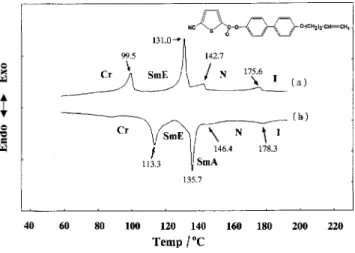
3BPET-CN Cr 113.3 (3.9) SmE 135.7 (4.1) SmA 146.4 (0.6) N 178.3 (0.6) I
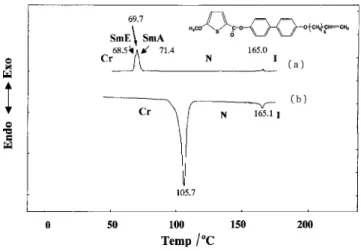
I 175.6 (Õ 0.5) N 142.7 (Õ 0.6) SmA 131.0 (Õ 4.0) SmE 99.5 (Õ 2.1) Cr 6BPET-CN Cr 112.5 (17.0) SmA 137.6 (0.7) N 169.6 (0.5) I I 165.5 (Õ 0.5) N 134.5 (Õ 0.9) SmA 114.4 (Õ 13.1) Cr 9BPET-CN Cr1117.1 (*) Cr2127.5 (22.1) SmA 155.3 (*) N 159.6 (1.1) I I 156.6 (Õ 1.1) N 152.4 (*) SmA 118.9 (Õ 16.5) Cr 2101.8 (Õ 2.3) Cr1 1BPET-OMe Cr 113.8 (17.6) N 210.9 (0.9) I I 206.1 (Õ 0.8) N 118.6 (Õ 11.2) Cr 3BPET-OMe Cr 125.0 (19.9) N 195.5 (1.0) I I 192.8 (Õ 0.9 ) N 83.4 (Õ 16.5 ) Cr 6BPET-OMe Cr 105.7 (17.3) N 165.1 (0.8) I I 165.0 (Õ 0.6) N 71.4 (*) SmB 69.7 (Õ 14.1) 68.5 (*) Cr 9BPET-OMe Cr 89.2 (22.1) N 153.2 (0.9) I I 151.9 (Õ 0.2 ) N 63.2 (Õ 0.1) SmA 56.1 (Õ 15.6) SmB (*) Cr
2.3.6. 4-(Alkenyloxy)phenyl 5-cyano-2-thiophene - HC1, 10% aqueous NaHCO3 and water before drying
over anhydrous MgSO4. After the solvent was removed
carboxylate (nPET-CN) and
4-(alkenyloxy)-biphenyl 5-cyano-2-thiophenecarboxylat e in a rotary evaporator, the crude product was puri ed by liquid chromatograph y (silica gel, a 1 : 8 mixture
(nBPET-CN)
Both series of compounds were prepared using the of EtOAc/n-hexane as eluent) to yield 0.63 g (59.3%) of
white crystals. Compound 3 PET-CN: MS m/z 389
same method. The synthesis of compound 3PET-CN is
presented below. (M+ ). 1H NMR (CDC1
3 300 MHz) d5 1.88 (m, 2H,
±
O±
CH2
±
CH2±
), 2.23 (m, 2H,5 CH±
CH2±
), 3.95 (t, 2H,4(4Pentenyloxy)phenyl 5iodo2thiophenecarboxy
-late (1.41 g, 3.4 mmol) and CuCN (0.365 g, 4.1 mmol)
±
O±
CH2
±
), 4.98–5.08 (m, 2H,±
CH5 CH2), 5.84 (m, 1H,±
CH5 CH2), 6.92 (d, J5 6.6 Hz, 2H, aromatic protons) ,
were dissolved in 15 ml ofN,N-dimethylformamide. The
resulting solution was heated to re ux temperature and 7.11 (d, J5 6.6 Hz, 2H, aromatic protons) , 7.32
(d,J5 3.9 Hz, 2H, aromatic protons) , 7.58 (d,J5 3.9 Hz,
stirred for 6 h. After cooling to room temperature,
hydrated ferric chloride (1.35 g) and conc. HC1 (0.34 ml ) 2H, aromatic protons).
Chemical shift, d, and mass spectra data of other
were added and the solution was stirred at 60ßC for
another 30 min. The reaction solution was extracted nPET-X and nBPET-X compounds are summarized in
tables 1 and 2, respectively. with CHC1
3, and the organic layer washed with 5N
3. Results and discussion Table 4 reports the thermal transitions of another
three series of compounds nBPET-I, nBPET-CN and
Table 3 lists the thermal transitions of three series of
compounds,nPET-I, nPET-CN and nPET-OMe. All these nBPET-OMe. All these nBPET-X compounds contain
a biphenyl group in their mesogenic core. The biphenyl
nPET-X compounds which contain only one phenyl
ring in their mesogenic cores show no mesophase and group increases the length/breadth value of the
meso-genic core. As can be seen from gure 1 (c), the length/
present only a melting transition on the DSC scan. This
could be due to the non-linearity of the thiophene ring. breadth value of the mesogenic core for thenBPET-X
com-pounds is 2.7. Therefore, all thesenBPET-X compounds
According to a literature report [6], the 2,5-disubstitute d
thiophene ring shows a 32ß deviation from the hard-rod show mesomorphic behaviour. Among thenBPET-I
com-pounds, 1BPET-I presents a monotropic nematic (N ) axis of the mesogenic core; this deviation causes distortion
of the mesogenic core and suppresses the formation of phase, 3BPET-I reveals an enantiotropi c nematic phase,
6BPET-I shows an enantiotropi c smectic A (SmA) phase,
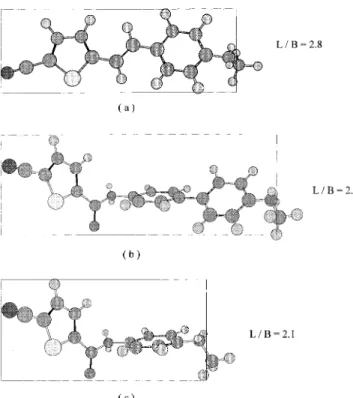
mesophases. Molecular modelling of thesenPET-X
com-pounds is presented in gure 1. For simplicity, only one while 9BPET-I reveals enantiotropi c SmA, SmB and
SmE phases. Figure 2 presents the representative DSC methylene group in the exible alkenyloxy spacer was
considered in the calculation. The length/breadth ratio thermogram s of compound 9BPET-I. The heating scan
shows a melting transition at 101.8ßC, a SmE to SmB
of the mesogenic core for these nPET-X compounds is
only 2.1, see gure 1 (a). The length/breadth ratio may transition at 124.4ß C, a SmB to SmA transition at
137.6ß C and a SmA to isotropic transition at 153.8ßC.
be too small for the formation of a mesophase. Gallardo
and Favarin [5] reported a series of thiophene-base d In the cooling scan the crystallization temperature shows
greater supercooling than the other three mesophase
compounds, viz. 2-cyano-5-(4-n-alkoxystyryl)thiophenes
which showed liquid crystalline phases. The only diŒerence transitions. Figure 3 shows the typical SmA, SmB and
SmE textures exhibited by compound 9BPET-I.
between these andnPET-X is the linking group. For the
2-cyano-5- (4-n-alkoxystyry l)thiophenes, the double bond Among thenBPET-CN compounds, 1BPET-CN shows
two enantiotropi c N and SmA phases, 3BPET-CN pre-linking group provides good linearity, and the length/
breadth ratio of the mesogenic core is 2.8, see gure 1 (b). sents enantiotropi c N, SmA, and SmE phases, while
both 6BPET-CN and 9BPET-CN exhibit enantiotropi c
This is why they show mesomorphism while nPET-X
compounds do not. N and SmA phases. Figure 4 depicts the phase transition
temperatures of nBPET-CN as a function of n. This
shows that the temperature range of mesophases is strongly in uenced by the spacer length. The nematic temperature range decreases with increasing exible spacer length, while the SmA range increases with increasing spacer length. Figure 5 depicts the DSC thermogram s
of 3BPET-CN. It exhibits a melting transition at 113.3ßC,
a SmE to SmA transition at 135.7ßC, a SmA to N
transition at 146.4ßC and a N to isotropic transition at
Figure 1. Optimized structures of (a) double bond linked
Figure 2. DSC curves of 9BPET-I: (a) rst cooling (b) second
(b) biphenyl ring-containing (c) phenyl ring containing
thiophene liquid crystals, (L/B5 Length/Breadth). heating runs.
Figure 4. Plot of phase transition temperatures ofnBPET-CN
versusn.
Figure 5. DSC curves of 3BPET-CN: (a) rst cooling
(b) second heating runs.
give the temperature-dependen t XRD patterns obtained
at 133.0, 110.0 and 30.0ßC. Figure 6 (a) shows the typical
SmA XRD pattern which displays a broad diŒraction in the wide angle region and a sharp diŒraction in the small angle region. When the temperature was lowered to
110ßC, gure 6 (b), three sharp diŒraction rings centered
at 4.35 AÊ (1 1 0 and 1 1 1 planes) 4.05 AÊ (2 0 0 and 2 0 1
planes) and 3.10 AÊ (2 0 0 and 2 0 1 planes) were observed.
This con rms the formation of a SmE phase [20]. When
the temperature was further cooled to 30ßC, gure 6 (c),
more diŒraction rings were observed in the wide angle region. This indicates the formation of a crystalline phase.
Figure 3. Optical textures of 9BPET-I at (a) 143.0ßC, (b) 120.0ßC, For the last series of compounds nBPET-OMe, both
(c) 95.0ßC (crossed polarizers, magni cationÖ 200). 1BPET-OMe and 3BPET-OMe reveal only an
enantio-tropic N phase while both 6BPET-OMe and 9BPET-OMe exhibit an enantiotropi c N phase and monotropic
178.3ßC. The cooling scan appears almost identical to
the heating scan, except that a larger supercooling is SmA and SmB phases. Figure 7 illustrates the DSC
thermogram s exhibited by 6BPET-OMe. The heating
observed for the crystallization transitions . Figures 6 (a–c)
Figure 7. DSC curves of 6BPET-OMe: (a) rst cooling,
(b) second heating runs.
SmA transition at 71.4ßC, a SmA to SmE transition at
69.7ßC and a crystallization transition at 68.5ßC. Figure 8
depicts textures of 6BPET-OMe. When a 6BPET-OMe
sample was cooled at normal cooling rate (10ß C minÕ 1),
N, SmA and SmE mesophases could be observed. On the other hand, by cooling this sample at a very slow
rate (0.1ß C minÕ 1), the focal-conic texture emerged very
slowly from the nematic schlieren texture as shown in
gure 8 (c).
The eŒect of alkenyloxy spacer length on the phase
transition temperatures of the nBPET-X compounds
is shown in gure 9. Both melting and isotropization temperatures decrease as the spacer length increases for
the three series ofnBPET-X compounds. Furthermore,
the nature of the mesophase depends on the spacer length. Those compounds containing a longer spacer tend to form an ordered smectic phase. This is because a longer spacer can stabilize the layer packing of the smectic phase.
Finally, we discuss the eŒect of the terminal group on
the mesomorphic properties of the nBPET-X
com-pounds. As can be seen from gure 9, nBPET-OMe
shows a higher melting transition and wider mesophase
range than those of nBPET-CN and nBPET-I. The
terminal group also strongly aŒects the nature of the mesophase. The experimental results demonstrate that a compound with a more polar terminal group tends to form a more ordered mesophase. From table 4, 1BPET-CN shows two enantiotropi c nematic and SmA phases, 1BPET-OMe reveals an enantiotropi c nematic phase while 1BPET-I presents only a monotropic (a)
(b)
(c)
nematic phase. This could be due to the polarity of the
Figure 6. X-ray powder diŒractograms of 3BPET-CN at
(a) 133.0ßC, (b) 110.0ßC, (c) 30.0ßC. terminal group (the polarity of the three terminal groups
increases in the following sequence: I<OMe<CN).
scan shows a melting transition at 105.7ßC and a N to 4. Conclusions
isotropic phase transition at 165.1ßC. The cooing scan Six series of thiophene-base d compound,nPET-X and
nBPET-X, with X5 I, CN and OMe, were synthesized
reveals an isotropic to N transition at 165.0ßC, a N to
Figure 9. Clearing and melting temperatures of nBPET-X
(X5 I, CN and OMe) compounds as a function ofn.
that the 2,5-disubstitute d thiophene ring shows a 32ß
deviation from the axis of mesogenic core, and the length/ breadth ratio of the mesogenic core is insu ciently
high. The other three series of compounds nBPET-X,
which contain a biphenyl ring and a thiophene ring in their mesogenic core, show mesomorphic behaviour. The nature of the mesophases formed depends on the spacer length and terminal group. Those compounds with a longer spacer tend to form ordered smectic phases. Those compounds with a more polar terminal group also have a tendency to form a more order smectic phase. The authors are grateful to the National Science Council of the Republic of China for nancial support.
References
[1] Gray, G. W. (editor), 1987, T hermotropic L iquid Crystals (John Wiley).
[2] Peter, J. C., and Michael, H., 1997, Introduction to
L iquid Crystals (London: Taylor & Francis), pp. 79–92.
[3] Demus, D., Demus, H., and Zaschke, H., 1974, Flussige
Kristalle in T abellen, Vol. I (Leipzig: VEB Desucher
Verlag fur Grundsto ndustrie).
[4] Demus, D., and Zaschke, H., 1984, Flussige Kristalle
in T abellen, Vol. II (Leipzig: VEB Verlag fur Grundsto ndustrie).
[5] Gallardo, H. F., and Favarin, I., 1993, L iq. Cryst., 13, 115.
(a)
(b)
(c)
[6] Koßmehl, G., and Hoppe, F. D., 1993, L iq. Cryst.,
Figure 8. Optical textures of 6BPET-OMe at (a) 71.4ßC,
13, 383. (b) 69.0ßC, (c) 62.0ßC (crossed polarizers, magni cationÖ 200).
[7] Tschierske, C., and Joachimi, D., 1991, L iq. Cryst., 9, 397.
[8] Melamed, D., Nuckols, C., and Fox, M. A., 1994,
and characterized. The rst three series of compounds T etrahedron L ett., 35, 8329.
nPET-X, which contain a phenyl and a thiophene ring in [9] Maertens, C., Zhang, J., Dubois, P., and Jermoe, R.,
1996,J. chem. Soc. Perkin T rans. II., 4, 713.
their mesogenic core, show no mesophase. This is because
[10] Byron, D., Matharu, A., Wilson, R., and Wright, G., [16] Kiryanov, A. A., Sampson, P., and Seed, A. J., 1999,
Mol. Cryst. liq. Cryst., 328, 237.
1995, Mol. Cryst. liq. Cryst., 265, 61.
[11] Byron, D., Komitov, L., Matharu, A., McSherry, I., [17] Matharu, A., Wilson, R., and Grover, C., 1999, Mol.
Cryst. liq. Cryst., 332, 2813.
and Wilson, R., 1996,J. mater. Chem., 6, 1871.
[12] Kijima, M., Akagi, K., and Shirakawa, H., 1997, Synth. [18] Bartulin, H. J., Zuniga, C., Ramirez, A., Muller, H.,
and Taylor, T. R., 1990, Mol. Cryst. liq. Cryst., 185,
Met., 84, 237.
[13] Seed, A. J., Hird, M., Styring, P., Gleeson, H. F., and 131.
[19] Karamysheva, L. A., Kovshev, E. J., Pavluchenko,
Molls, T., 1997,Mol. Cryst. liq. Cryst., 299, 19.
[14] Chen, S. H., Conger, M. B., Mastrangelo, J. C., A. I., Roitman, K. V., Titov, V. V. T., Torgova, S. I.,
and Grebenkin, M. F., 1981, Mol. Cryst. liq. Cryst.,
Kende, A. S., and Kim, D. U., 1998, Macromolecules,
31, 8051. 67, 241.
[20] Doucrt, J., Levelut, A. A., Lambert, M., Liebert, L., [15] Konstantinova, L. S., Rakitin, O. A., Rees, C. W.,
Souvorova, L. I., and Torroba, T., 1999, J. chem. Soc. and Strzeleck, L., 1975, J. de Phys. Colloq., 36,
C1-13.
Perkin T rans. II., 8, 1023.