Effects of EZH2 Polymorphisms onSusceptibility to and Pathological Development of Hepatocellular Carcinoma
Yung-Luen Yu1,2,3,#, Kuo-Jung Su2,#, Yi-Hsien Hsieh4, Hsiang-Lin Lee5,6, Tzy-Yen
Chen5,7, Shun-Fa Yang5,8,*
1Graduate Institute of Cancer Biology and Center for Molecular Medicine, China
Medical University, Taichung 404, Taiwan
2The Ph.D. Program for Cancer Biology and Drug Discovery, China Medical
University, Taichung 404, Taiwan
3Department of Biotechnology, Asia University, Taichung 413, Taiwan
4Institute of Biochemistry and Biotechnology, School of Medicine, Chung Shan
Medical University, Taichung, Taiwan
5Institute of Medicine, Chung Shan Medical University, Taichung, Taiwan
6Department of Surgery, Chung Shan Medical University Hospital, Taichung, Taiwan 7Department of Internal Medicine, Chung Shan Medical University Hospital,
Taichung, Taiwan
8Department of Medical Research, Chung Shan Medical University Hospital,
Taichung, Taiwan
#These authors contributed equally to the work.
*Address correspondence to: Shun-Fa Yang, Ph.D., Institute of Medicine, Chung Shan Medical University, Taichung 402, Taiwan; Tel: +886-4-24739595 ext. 34253; Fax: +886-4-24723229; E-mail: [email protected].
Competing Interests: The authors declare that no competing interests exist. Running title: EZH2 Polymorphisms in HCC
Funding:
This work was supported by the following grants: NSC99-2320-B-039-030-MY3, NSC101-2321-B-039-004, and NHRI-EX102-10245BI. The funders had no role in study design, data collection and analysis, decision to publish, or preparation of the 1 2 3 4 5 6 7 8 9 10 11 12 13 14 15 16 17 18 19 20 21 22 23 24 25 26 27 28 29 30 31 32 33
Abstract
Background: The enhancer of zeste 2 (EZH2) gene encodes the histone methyltransferase that is the catalytic component of the polycomb repressive complex-2, which initiates epigenetic silencing of genes. The expression level of
EZH2 in hepatocellular carcinoma (HCC) is highly correlated with tumor progression;
however, it has not been determined if specific EZH2 genetic variants are associated with the risk of HCC. This study investigated the potential associations of EZH2 single-nucleotide polymorphisms with HCC susceptibility and its clinicopathologic characteristics.
Methodology/Principal Findings: A total of 220 HCC patients and 552 cancer-free controls were analyzed for four EZH2 single-nucleotide polymorphisms (rs6950683, rs2302427, rs3757441, and rs41277434) using real-time PCR genotyping. After adjusting for other co-variants, the individuals carrying at least one C allele at EZH2 rs6950683 and rs3757441 had a 0.611-fold and a 0.660-fold lower risk of developing HCC than did wild-type (TT) carriers, respectively. The CCCA or CCTA haplotype among the four EZH2 sites (rs6950683, rs2302427, rs3757441, and rs41277434, respectively, was also associated with a reduced risk of HCC. Furthermore, HCC patients who carried at least one C allele at rs6950683 or rs3757441 had a higher lymph–node-metastasis risk but a lower liver-cirrhosis risk than did patients carrying the wild-type allele.
Conclusions: The rs6950683 and rs3757441 polymorphic genotypes of EZH2 might contribute to the prediction of susceptibility to and pathological development of HCC. This is the first study to provide insight into risk factors associated with EZH2 variants in carcinogenesis of HCC in Taiwan.
Keywords: Enhancer of zeste 2, hepatocellular carcinoma, single-nucleotide polymorphism 35 36 37 38 39 40 41 42 43 44 45 46 47 48 49 50 51 52 53 54 55 56 57 58 59 60
Introduction
Hepatocellular carcinoma (HCC) is one of the most common malignancies worldwide and the second leading cause of cancer-related death in Taiwan . HCC carcinogenesis is a complex multifactor and multistep process, and is associated with multiple risk factors, including chronic hepatitis B virus (HBV) or hepatitis C virus (HCV) infection, liver cirrhosis, carcinogen exposure, excessive alcohol use, and a variety of genetic factors .
The enhancer of zeste homolog 2 (EZH2) is a SET (Su(var)3-9, Enhancer-of-zeste and Trithorax) domain-containing methyltransferase that catalyzes the methylation of histone H3 to form the transcriptional repressive epigenetic marker H3K27me3. EZH2 is a subunit of the multi-enzyme complex polycomb repressive complex 2 and is involved in chromatin compaction and gene repression . Recently, EZH2 has been linked to the aggressiveness of human cancers, including lymphomas , breast cancer , and prostate cancer . Overexpression of EZH2 has been correlated with advanced stages of human cancer progression and poor prognosis . In addition, EZH2 promotes epithelial–mesenchymal transition, a process that is associated with cancer progression and metastasis .
Epidemiological studies suggest that genetic factors, including single nucleotide polymorphisms (SNPs) are important in mediating an individual’s susceptibility to many types of cancer . Several studies suggest an association between HCC risk and SNPs in certain genes. For example, specific SNPs in insulin-like growth factor 2 and 2R, plasminogen activator inhibitor, and matrix metalloproteinase 14 are HCC risk factors .
Although EZH2 contributes to the formation of many types of cancer, the association between EZH2 variants and HCC risk and prognosis has been poorly 61 62 63 64 65 66 67 68 69 70 71 72 73 74 75 76 77 78 79 80 81 82 83 84 85
investigated. We, therefore, performed a case-control study of four SNPs located in the promoter, exonic, and intronic regions of EZH2 to assess the associations between these SNPs and HCC susceptibility and clinicopathologic characteristics.
Materials and Methods
Study subjects and specimen collection
This hospital-based case-control study recruited 220 HCC patients between 2007 and 2012 at the Chung Shan Medical University Hospital, Taiwan. The diagnosis of HCC was made according to the criteria specified in the national guidelines for HCC. Specifically, liver tumors were diagnosed by histology or cytology—irrespective of -fetoprotein (AFP) titer—after computed tomography or magnetic resonance imaging data showed: (1) at least one liver mass ≥2 cm in diameter; (2) early enhancement and AFP levels ≥400 ng/ml; or (3) early arterial phase-contrast enhancement plus early venous phase-contrast washout regardless of AFP level. An additional 552 race- and ethnic group-matched non-cancer patients who entered the hospital for health check-ups were enrolled as the control group.
HCC patients were clinically staged at the time of diagnosis according to the tumor, node, metastasis (TNM) staging system of the American Joint Committee on Cancer (2002) . Liver cirrhosis was diagnosed by liver biopsy, abdominal sonography, or biochemical evidence of liver parenchymal damage with endoscopic esophageal or gastric varices. The patients’ clinicopathological characteristics, including clinical staging, tumor size, lymph-node metastasis, distant metastasis, presence of HBV surface antigen (HBsAg), reactivity with antibody against HCV (anti-HCV), liver cirrhosis, AFP, aspartate aminotransferase (AST) and alanine aminotransferase (ALT) levels, were verified by chart review. Whole blood specimens collected from the 86 87 88 89 90 91 92 93 94 95 96 97 98 99 100 101 102 103 104 105 106 107 108 109 110
controls and HCC patients were placed in tubes containing ethylenediaminetetraacetic acid (EDTA), immediately centrifuged, and stored at −80ºC. Before commencing the study, approval was obtained from the Institutional Review Board of Chung Shan Medical University Hospital and informed written consent was obtained from each individual.
Genomic DNA extraction
Genomic DNA was extracted using QIAamp DNA blood mini kit reagents (Qiagen, Valencia, CA). DNA was dissolved in TE buffer [10 mM Tris (pH 7.8), 1 mM EDTA] and then quantified by measurement of its solution’s optical density at 260 nm. Final DNA preparations were stored at −20ºC and used as templates for polymerase chain reaction (PCR).
Real-time PCR
Allelic discrimination of the EZH2 rs6950683, rs2302427, rs3757441, and rs41277434 gene polymorphisms was assessed using an ABI StepOneTM Real-Time
PCR System (Applied Biosystems), SDS v3.0 software (Applied Biosystems), and the TaqMan assay. The final volume for each reaction mixture was 5μL, containing 2.5μL TaqMan Genotyping Master Mix, 0.125μL TaqMan probes mix, and 10ng genomic DNA. The reaction conditions included an initial denaturation step at 95ºC for 10 min followed by 40 cycles at 95ºC for 15 sec and 60ºC for 1 min.
Statistical analysis
Hardy–Weinberg equilibrium was assessed using a chi-square goodness-of-fit test for biallelic markers. A Mann–Whitney U-test and a Fisher’s exact test were used to 111 112 113 114 115 116 117 118 119 120 121 122 123 124 125 126 127 128 129 130 131 132 133 134 135
compare differences of age and demographic characteristics distributions between controls and HCC patients. The odds ratios (ORs) with 95% confidence intervals (CIs) were estimated by logistic regression models. The adjusted odds ratios (AORs) with 95% CIs of the association between genotype frequencies and HCC risk as well as clinical pathological characteristics were estimated by multiple logistic regression models after controlling for other covariates. The haplotype-based analysis was using the Phase program. All p values <0.05 were considered significant. The data were analyzed using SAS statistical software (Version 9.1, 2005; SAS Institute Inc., Cary, NC).
Results
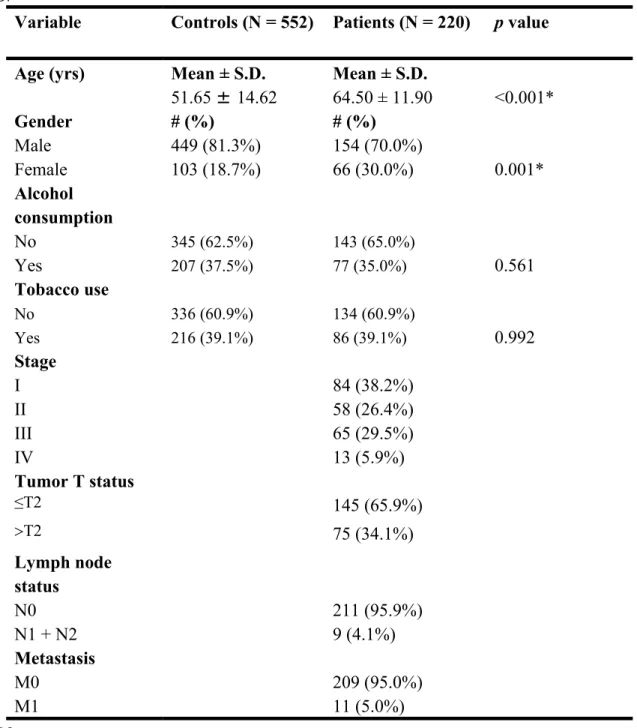
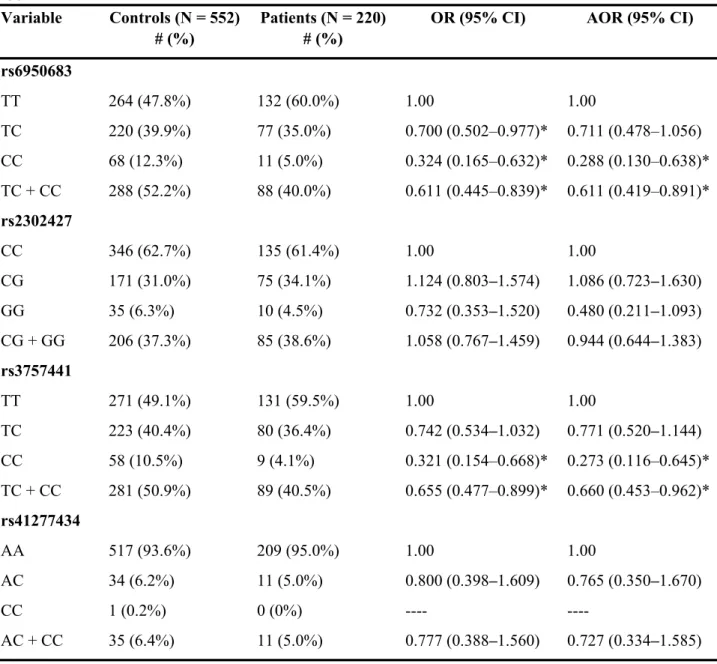
We found that 37.5% of the healthy control subjects (207 of 552) and 35% of the patients with HCC (77 of 220), consumed alcohol; 39.1% of the healthy controls (216 of 552) and 39.1% of the patients with HCC (86 of 220) smoked tobacco. No significant differences were found in the distribution of alcohol consumption (p = 0.561) and tobacco use (p = 0.992) between healthy controls and patients with HCC, whereas the age (control: 51.65 ± 14.62; HCC: 64.50 ± 11.90; p < 0.001) and gender (p = 0.001) distributions between the two groups were significantly different (Table 1). To reduce possible interference of confounding variables, AORs with 95% CIs were estimated by multiple logistic regression models after controlling for age and gender in each comparison. Table 2 shows the genotype distributions and the association between HCC and EZH2 polymorphisms. The alleles with the highest distribution frequency at EZH2 rs6950683, rs2302427, rs3757441, and rs41277434 in both HCC patients and controls were homozygous T/T, homozygous C/C, homozygous T/T, and homozygous A/A, respectively. Individuals carrying CC or TC 136 137 138 139 140 141 142 143 144 145 146 147 148 149 150 151 152 153 154 155 156 157 158 159 160
+ CC at rs6950683 showed a 0.288-fold (95% CI: 0.130–0.638) and a 0.611-fold (95% CI: 0.419–0.891) lower risk of HCC, and those carrying CC or TC + CC at rs3757441 showed a 0.273-fold (95% CI: 0.116–0.645) and a 0.660-fold (95%CI: 0.453–0.962) lower risk of HCC compared with individuals carrying the wild-type allele. Individuals with polymorphisms at rs2302427 and rs41277434 showed no reduction in HCC risk compared with wild-type individuals.
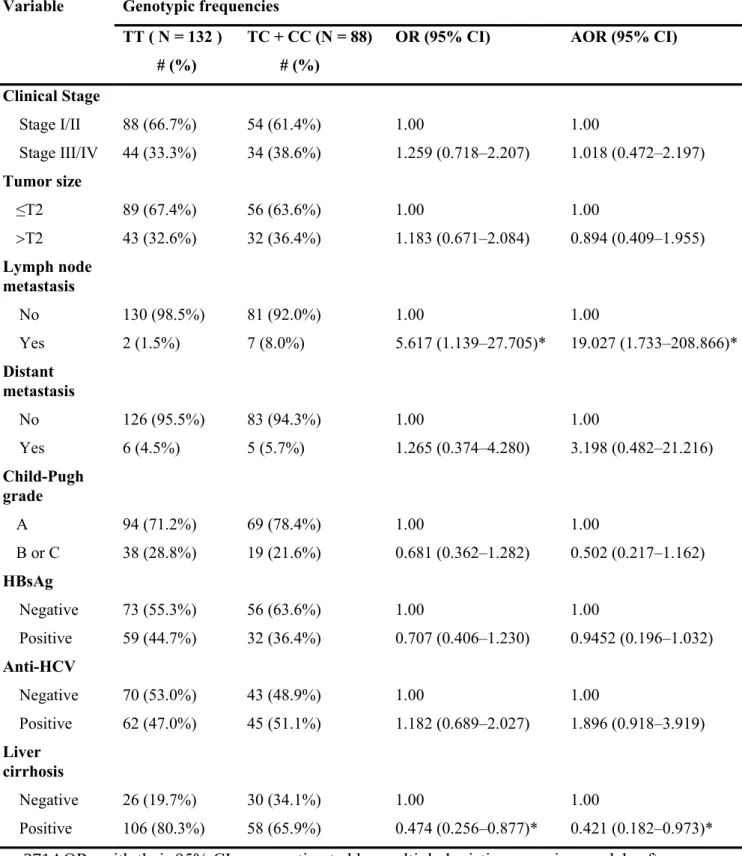
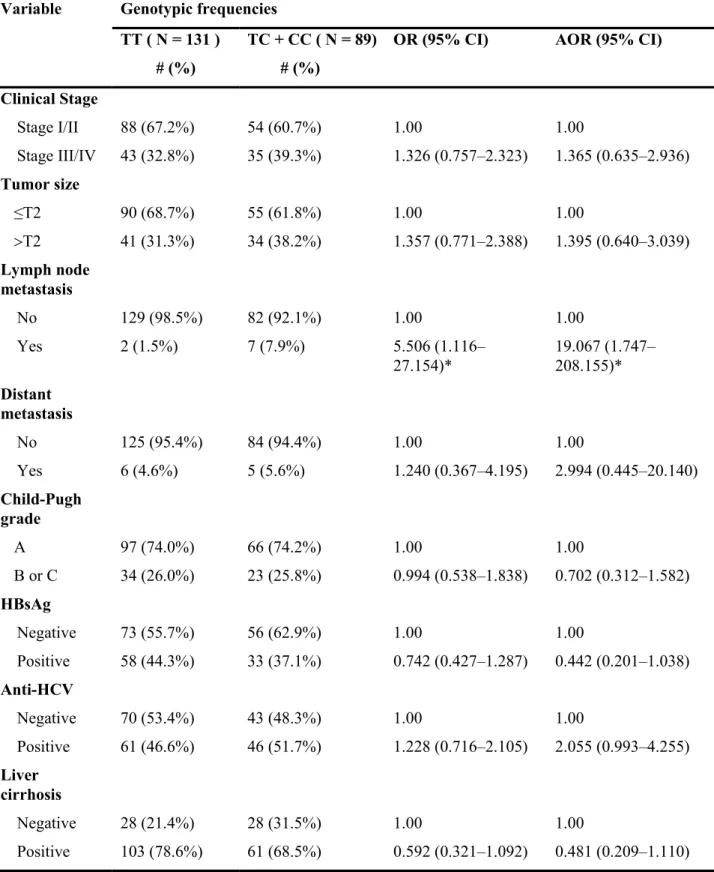
The distribution of clinical status and EZH2 genotypes in HCC patients were estimated to clarify the role of EZH2 polymorphisms in the clinicopathologic state of HCC patients. Clinical status assessments included TNM staging, primary tumor size, lymph node involvement, distant metastasis, presence of HBV or HCV, and liver cirrhosis. Compared with the wild-type genotype, patients with at least one polymorphic C allele at EZH2 rs6950683 (Table 3) or rs3757441 (Table 4) showed a 19.029-fold (95% CI: 1.733–208.866) or a 19.067-fold (95% CI: 1.747–208.155) increase in lymph-node metastasis, but a 0.421-fold (95% CI: 0.182–0.973) or a 0.481-fold (95% CI: 0.209–1.110) decrease in liver cirrhosis, respectively. No significant differences were observed between other EZH2 genotypic frequencies and any clinicopathological variable (data not shown).
AFP, AST, and ALT are common clinical pathological markers of HCC. To clarify the relationship between clinical status and the levels of these markers in HCC patients, we analyzed the association of these pathological markers with EZH2 genotypic frequencies. No significant association was found between the levels of these HCC clinical pathological markers and genotypes for any of the EZH2 SNPs in HCC patients (Table 5).
The haplotype distributions of EZH2 rs6950683, rs2302427, rs3757441, and rs41277434 were further evaluated and seven haplotypes were derived from these 161 162 163 164 165 166 167 168 169 170 171 172 173 174 175 176 177 178 179 180 181 182 183 184 185
four SNPs in our recruited individuals. The most common haplotype in the control group was TCTA (42.4%), and it was, therefore, chosen as the reference. Compared with this reference, two minor haplotypes CCCA and CCTA significantly reduced the risk of HCC by 0.573-fold (95% CI: 0.435–0.755) and 0.200-fold (95% CI: 0.046– 0.863), respectively (Table 6).
Discussion
The major etiologies for HCC in Taiwan include infection with HBV or HCV, alcohol consumption, history of liver cirrhosis, and family history of HCC . In our HCC group, however, alcohol consumption and tobacco use were not significantly different from those of healthy controls (Table 1), suggesting that these two risk factors alone do not fully explain the pathogenesis of HCC and that genetic components may play a pivotal role. This is consistent with the observations that many gene polymorphisms and somatic mutations have been associated with the preneoplastic stage of HCC .
EZH2 plays an important role in cell-cycle regulation, and its gene has emerged as a novel oncogene and putative oncological therapy target . Therefore, EZH2 polymorphisms may be associated with the development of HCC. EZH2 contains 20 exons, 19 introns, and 41 identified SNPs , and encodes two isoforms of different transcript size . In this hospital-based case-control study, four EZH2 SNPs were genotyped in 220 patients with HCC and 552 healthy controls. We observed that at least one polymorphic C allele at SNPs rs6950683 and rs3757441 is strongly associated with reduced HCC risk (Table 2). Rs3757441 is an intronic SNP, and as such may affect gene expression through several mechanisms, including changes in transcription–factor binding sites , microRNA-targeting sequences , and splicing 186 187 188 189 190 191 192 193 194 195 196 197 198 199 200 201 202 203 204 205 206 207 208 209 210
variants . Rs6950683, is located upstream of exon 1, and, therefore, may impact gene expression by affecting promoter function. Further functional studies are needed to confirm the specific mechanisms by which these EZH2 polymorphisms influence the development of HCC.
Although the functional importance of rs6950683 and rs3757441 has not been tested experimentally, it has been observed that individuals carrying C/C alleles at these two SNPs have a lower risk of lung cancer than do those carrying the T/T wild-type allele . This study provides novel information on the effects of single nucleotide polymorphisms in EZH2 on HCC susceptibility and clinicopathology, but found that HCC patients carrying rs6950683 and rs3757441 polymorphisms have a higher risk of lymph node metastasis than wild-type carriers. However, the number of individuals examined in this study was relatively small, and additional studies with more patients are needed to verify the effects of EZH2 polymorphisms on HCC that we observed and to explore the effects of these variants on the biological function of EZH2.
Although many SNPs have no direct effect on gene products, they can still be used as genetic markers to locate adjacent functional variants that contribute to disease. In addition, the contribution of SNPs to a disease-related haplotype may not be apparent when looking at individual SNPs. Therefore, haplotype analysis is sometimes advantageous over analysis of individual SNPs for detecting an association between alleles and a disease phenotype . Our haplotype analysis of the four EZH2 SNPs rs6950683, rs2302427, rs3757441, and rs41277434 revealed that the CCCA and CCTA haplotypes are associated with a lower risk of HCC (Table 6). However, it is possible that these EZH2 SNPs are linked with other functional polymorphisms and are, therefore, not directly responsible for the decreased susceptibility to HCC.
In conclusion, this is the first study to show a significant association between 211 212 213 214 215 216 217 218 219 220 221 222 223 224 225 226 227 228 229 230 231 232 233 234 235
polymorphisms in EZH2 and HCC risk. These findings suggest that the presence of a variant EZH2 allele may be a protective factor for the development of HCC and could be a useful genetic marker for predicting susceptibility to HCC.
References
1. Bosch FX, Ribes J, Cleries R, Diaz M (2005) Epidemiology of hepatocellular carcinoma. Clin Liver Dis 9: 191-211, v.
2. Department of Health RoC (2007) Health statistics: II. Vital statistics. Taipei: Department of Health.
3. Farazi PA, DePinho RA (2006) Hepatocellular carcinoma pathogenesis: from genes to environment. Nat Rev Cancer 6: 674-687.
4. Firpi RJ, Nelson DR (2006) Viral hepatitis: manifestations and management strategy. Hematology Am Soc Hematol Educ Program: 375-380.
5. Yano Y, Yamashita F, Kuwaki K, Fukumori K, Kato O, et al. (2006) Clinical features of hepatitis C virus-related hepatocellular carcinoma and their association with alpha-fetoprotein and protein induced by vitamin K absence or antagonist-II. Liver Int 26: 789-795.
6. Heyn H, Esteller M (2013) EZH2: An Epigenetic Gatekeeper Promoting Lymphomagenesis. Cancer Cell 23: 563-565.
7. Dukers DF, van Galen JC, Giroth C, Jansen P, Sewalt RG, et al. (2004) Unique polycomb gene expression pattern in Hodgkin's lymphoma and Hodgkin's lymphoma-derived cell lines. Am J Pathol 164: 873-881.
8. Kleer CG, Cao Q, Varambally S, Shen R, Ota I, et al. (2003) EZH2 is a marker of aggressive breast cancer and promotes neoplastic transformation of breast epithelial cells. Proc Natl Acad Sci U S A 100: 11606-11611.
236 237 238 239 240 241 242 243 244 245 246 247 248 249 250 251 252 253 254 255 256 257 258 259 260
9. Ren G, Baritaki S, Marathe H, Feng J, Park S, et al. (2012) Polycomb protein EZH2 regulates tumor invasion via the transcriptional repression of the metastasis suppressor RKIP in breast and prostate cancer. Cancer Res 72: 3091-3104.
10. Sauvageau M, Sauvageau G (2010) Polycomb group proteins: multi-faceted regulators of somatic stem cells and cancer. Cell Stem Cell 7: 299-313.
11. Cao Q, Yu J, Dhanasekaran SM, Kim JH, Mani RS, et al. (2008) Repression of E-cadherin by the polycomb group protein EZH2 in cancer. Oncogene 27: 7274-7284.
12. Shastry BS (2002) SNP alleles in human disease and evolution. J Hum Genet 47: 561-566.
13. Weng CJ, Hsieh YH, Tsai CM, Chu YH, Ueng KC, et al. (2010) Relationship of insulin-like growth factors system gene polymorphisms with the susceptibility and pathological development of hepatocellular carcinoma. Ann Surg Oncol 17: 1808-1815.
14. Weng CJ, Tsai CM, Chen YC, Hsieh YH, Lin CW, et al. (2010) Evaluation of the association of urokinase plasminogen activator system gene polymorphisms with susceptibility and pathological development of hepatocellular carcinoma. Ann Surg Oncol 17: 3394-3401.
15. Chen TY, Li YC, Liu YF, Tsai CM, Hsieh YH, et al. (2011) Role of MMP14 gene polymorphisms in susceptibility and pathological development to hepatocellular carcinoma. Ann Surg Oncol 18: 2348-2356.
16. Vauthey JN, Lauwers GY, Esnaola NF, Do KA, Belghiti J, et al. (2002) Simplified staging for hepatocellular carcinoma. J Clin Oncol 20: 1527-1536. 17. Lei H, Hemminki K, Altieri A, Johansson R, Enquist K, et al. (2007) Promoter 261 262 263 264 265 266 267 268 269 270 271 272 273 274 275 276 277 278 279 280 281 282 283 284 285
polymorphisms in matrix metalloproteinases and their inhibitors: few associations with breast cancer susceptibility and progression. Breast Cancer Res Treat 103: 61-69.
18. Chen CJ, Yu MW, Liaw YF (1997) Epidemiological characteristics and risk factors of hepatocellular carcinoma. J Gastroenterol Hepatol 12: S294-308. 19. Chen TH, Chen CJ, Yen MF, Lu SN, Sun CA, et al. (2002) Ultrasound screening
and risk factors for death from hepatocellular carcinoma in a high risk group in Taiwan. Int J Cancer 98: 257-261.
20. Akkiz H, Bayram S, Bekar A, Ozdil B, Akgollu E, et al. (2009) G-308A TNF-alpha polymorphism is associated with an increased risk of hepatocellular carcinoma in the Turkish population: case-control study. Cancer Epidemiol 33: 261-264.
21. Chang CC, Chen SC, Hsieh YH, Chen YC, Chen TY, et al. (2009) Stromal cell-derived factor-1 but not its receptor, CXCR4, gene variants increase susceptibility and pathological development of hepatocellular carcinoma. Clin Chem Lab Med 47: 412-418.
22. Simon JA, Lange CA (2008) Roles of the EZH2 histone methyltransferase in cancer epigenetics. Mutat Res 647: 21-29.
23. Cardoso C, Mignon C, Hetet G, Grandchamps B, Fontes M, et al. (2000) The human EZH2 gene: genomic organisation and revised mapping in 7q35 within the critical region for malignant myeloid disorders. Eur J Hum Genet 8: 174-180.
24. Yoon KA, Gil HJ, Han J, Park J, Lee JS (2010) Genetic polymorphisms in the polycomb group gene EZH2 and the risk of lung cancer. J Thorac Oncol 5: 10-16. 286 287 288 289 290 291 292 293 294 295 296 297 298 299 300 301 302 303 304 305 306 307 308 309 310
25. Shen Z, Chen L, Hao F, Wang G, Liu Y (2010) Intron-1 rs3761548 is related to the defective transcription of Foxp3 in psoriasis through abrogating E47/c-Myb binding. J Cell Mol Med 14: 226-241.
26. Zhang W, Winder T, Ning Y, Pohl A, Yang D, et al. (2011) A let-7 microRNA-binding site polymorphism in 3'-untranslated region of KRAS gene predicts response in wild-type KRAS patients with metastatic colorectal cancer treated with cetuximab monotherapy. Ann Oncol 22: 104-109.
27. Lipkin SM, Chao EC, Moreno V, Rozek LS, Rennert H, et al. (2010) Genetic variation in 3-hydroxy-3-methylglutaryl CoA reductase modifies the chemopreventive activity of statins for colorectal cancer. Cancer Prev Res (Phila) 3: 597-603.
28. Shifman S, Bronstein M, Sternfeld M, Pisante-Shalom A, Lev-Lehman E, et al. (2002) A highly significant association between a COMT haplotype and schizophrenia. Am J Hum Genet 71: 1296-1302.
311 312 313 314 315 316 317 318 319 320 321 322 323 324 325 326 327 328 329 330 331 332 333 334 335
Table 1. Demographic characteristics of controls and patients with HCC.
Variable Controls (N = 552) Patients (N = 220) p value
Age (yrs) Mean ± S.D. Mean ± S.D.
51.65 ± 14.62 64.50 ± 11.90 <0.001* Gender # (%) # (%) Male 449 (81.3%) 154 (70.0%) Female 103 (18.7%) 66 (30.0%) 0.001* Alcohol consumption No 345 (62.5%) 143 (65.0%) Yes 207 (37.5%) 77 (35.0%) 0.561 Tobacco use No 336 (60.9%) 134 (60.9%) Yes 216 (39.1%) 86 (39.1%) 0.992 Stage I 84 (38.2%) II 58 (26.4%) III 65 (29.5%) IV 13 (5.9%) Tumor T status ≤T2 145 (65.9%) T2 75 (34.1%) Lymph node status N0 211 (95.9%) N1 + N2 9 (4.1%) Metastasis M0 209 (95.0%) M1 11 (5.0%)
*, considered statistically significant. S.D., standard deviation. 336 337 338 339 340 341 342 343 344 345 346 347 348 349 350
Table 2. Distribution of EZH2 genotypes in healthy controls and patients with HCC
Variable Controls (N = 552)
# (%)
Patients (N = 220) # (%)
OR (95% CI) AOR (95% CI)
rs6950683 TT 264 (47.8%) 132 (60.0%) 1.00 1.00 TC 220 (39.9%) 77 (35.0%) 0.700 (0.502–0.977)* 0.711 (0.478–1.056) CC 68 (12.3%) 11 (5.0%) 0.324 (0.165–0.632)* 0.288 (0.130–0.638)* TC + CC 288 (52.2%) 88 (40.0%) 0.611 (0.445–0.839)* 0.611 (0.419–0.891)* rs2302427 CC 346 (62.7%) 135 (61.4%) 1.00 1.00 CG 171 (31.0%) 75 (34.1%) 1.124 (0.803–1.574) 1.086 (0.723–1.630) GG 35 (6.3%) 10 (4.5%) 0.732 (0.353–1.520) 0.480 (0.211–1.093) CG + GG 206 (37.3%) 85 (38.6%) 1.058 (0.767–1.459) 0.944 (0.644–1.383) rs3757441 TT 271 (49.1%) 131 (59.5%) 1.00 1.00 TC 223 (40.4%) 80 (36.4%) 0.742 (0.534–1.032) 0.771 (0.520–1.144) CC 58 (10.5%) 9 (4.1%) 0.321 (0.154–0.668)* 0.273 (0.116–0.645)* TC + CC 281 (50.9%) 89 (40.5%) 0.655 (0.477–0.899)* 0.660 (0.453–0.962)* rs41277434 AA 517 (93.6%) 209 (95.0%) 1.00 1.00 AC 34 (6.2%) 11 (5.0%) 0.800 (0.398–1.609) 0.765 (0.350–1.670) CC 1 (0.2%) 0 (0%) ---- ----AC + CC 35 (6.4%) 11 (5.0%) 0.777 (0.388–1.560) 0.727 (0.334–1.585)
AORs with their 95% CIs were estimated by multiple logistic regression models after controlling for age and gender. *, considered statistically significant.
351 352 353 354 355 356 357 358 359 360 361 362 363 364 365 366 367 368
Table 3. Associations of clinical status and EZH2 rs6950683 genotypic frequencies in 220 HCC patients.
Variable Genotypic frequencies
TT ( N = 132 ) TC + CC (N = 88) OR (95% CI) AOR (95% CI)
# (%) # (%) Clinical Stage Stage I/II 88 (66.7%) 54 (61.4%) 1.00 1.00 Stage III/IV 44 (33.3%) 34 (38.6%) 1.259 (0.718–2.207) 1.018 (0.472–2.197) Tumor size ≤T2 89 (67.4%) 56 (63.6%) 1.00 1.00 T2 43 (32.6%) 32 (36.4%) 1.183 (0.671–2.084) 0.894 (0.409–1.955) Lymph node metastasis No 130 (98.5%) 81 (92.0%) 1.00 1.00 Yes 2 (1.5%) 7 (8.0%) 5.617 (1.139–27.705)* 19.027 (1.733–208.866)* Distant metastasis No 126 (95.5%) 83 (94.3%) 1.00 1.00 Yes 6 (4.5%) 5 (5.7%) 1.265 (0.374–4.280) 3.198 (0.482–21.216) Child-Pugh grade A 94 (71.2%) 69 (78.4%) 1.00 1.00 B or C 38 (28.8%) 19 (21.6%) 0.681 (0.362–1.282) 0.502 (0.217–1.162) HBsAg Negative 73 (55.3%) 56 (63.6%) 1.00 1.00 Positive 59 (44.7%) 32 (36.4%) 0.707 (0.406–1.230) 0.9452 (0.196–1.032) Anti-HCV Negative 70 (53.0%) 43 (48.9%) 1.00 1.00 Positive 62 (47.0%) 45 (51.1%) 1.182 (0.689–2.027) 1.896 (0.918–3.919) Liver cirrhosis Negative 26 (19.7%) 30 (34.1%) 1.00 1.00 Positive 106 (80.3%) 58 (65.9%) 0.474 (0.256–0.877)* 0.421 (0.182–0.973)*
AORs with their 95% CIs were estimated by multiple logistic regression models after controlling for age, gender, tobacco use and alcohol consumption.
T2: multiple tumor >5 cm in the greatest dimension or tumor involving a major branch of the portal or hepatic vein(s)
*, considered statistically significant. 369 370 371 372 373 374 375 376 377
Table 4. Associations of clinical status and EZH2 rs3757441 genotypic frequencies in 220 HCC patients.
Variable Genotypic frequencies
TT ( N = 131 ) TC + CC ( N = 89) OR (95% CI) AOR (95% CI)
# (%) # (%) Clinical Stage Stage I/II 88 (67.2%) 54 (60.7%) 1.00 1.00 Stage III/IV 43 (32.8%) 35 (39.3%) 1.326 (0.757–2.323) 1.365 (0.635–2.936) Tumor size ≤T2 90 (68.7%) 55 (61.8%) 1.00 1.00 T2 41 (31.3%) 34 (38.2%) 1.357 (0.771–2.388) 1.395 (0.640–3.039) Lymph node metastasis No 129 (98.5%) 82 (92.1%) 1.00 1.00 Yes 2 (1.5%) 7 (7.9%) 5.506 (1.116– 27.154)* 19.067 (1.747– 208.155)* Distant metastasis No 125 (95.4%) 84 (94.4%) 1.00 1.00 Yes 6 (4.6%) 5 (5.6%) 1.240 (0.367–4.195) 2.994 (0.445–20.140) Child-Pugh grade A 97 (74.0%) 66 (74.2%) 1.00 1.00 B or C 34 (26.0%) 23 (25.8%) 0.994 (0.538–1.838) 0.702 (0.312–1.582) HBsAg Negative 73 (55.7%) 56 (62.9%) 1.00 1.00 Positive 58 (44.3%) 33 (37.1%) 0.742 (0.427–1.287) 0.442 (0.201–1.038) Anti-HCV Negative 70 (53.4%) 43 (48.3%) 1.00 1.00 Positive 61 (46.6%) 46 (51.7%) 1.228 (0.716–2.105) 2.055 (0.993–4.255) Liver cirrhosis Negative 28 (21.4%) 28 (31.5%) 1.00 1.00 Positive 103 (78.6%) 61 (68.5%) 0.592 (0.321–1.092) 0.481 (0.209–1.110)
The AORs with their 95% CI were estimated by multiple logistic regression models, after controlling for age, gender, tobacco use and alcohol consumption.
T2: multiple tumor more than 5 cm or tumor involving a major branch of the portal or hepatic vein(s) 378 379 380 381 382 383 384
Table 5. Association of EZH2 genotypic frequencies with HCC blood biochemistry results. Characteristic α-Fetoprotein (ng/ml) AST (IU/l) ALT (IU/l) AST/ALT ratio rs6950683 TT 2864.8 ± 1153.3 172.1 ± 30.7 152.5 ± 27.0 1.49 ± 0.12 TC/CC 5594.1 ± 2106.9 182.6 ± 37.6 142.7 ± 23.1 1.51 ± 0.12 p value 0.221 0.829 0.797 0.935 rs2302427 CC 4461.0 ± 1664.7 184.9 ± 28.5 141.5 ± 17.6 1.60 ± 0.13 CG/GG 3155.3 ± 1001.1 162.5 ± 41.7 159.7 ± 39.3 1.34 ± 0.08 p value 0.561 0.647 0.636 0.133 rs3757441 TT 2842.4 ± 1162.1 176.7 ± 31.4 159.4 ± 27.9 1.46 ± 0.12 TC/CC 5580.2 ± 2083.0 175.6 ± 36.4 132.6 ± 20.9 1.56 ± 0.13 p value 0.221 0.981 0.480 0.541 rs41277434 AA 4161.0 ± 1147.1 182.0 ± 24.9 153.2 ± 19.5 1.51 ± 0.09 AC/CC 72.61 ± 38.5 55.2 ± 16.6 60.9 ± 16.9 1.27 ± 0.18 p value 0.415 0.293 0.281 0.542
Mann-Whitney U test was used between two groups. Values presented are the mean ± standard error
386 387 388 389 390 391 392 393 394 395 396 397 398 399 400 401 402 403 404 405 406 407 408 409 410 411 412
Table 6. Distribution frequency of EZH2 haplotype in control and HCC patients Variable Controls (N = 1104) # (%) Patients (N = 440) # (%) OR (95% CI) p value rs6950683 T/C rs2302427 C/G rs3757441 T/C rs41277434 A/C T C T A 468 (42.4%) 234 (53.2%) Reference C C C A 335 (30.3%) 96 (21.8%) 0.573 (0.435–0.755) < 0.001* T G T A 240 (21.7%) 94 (21.4%) 0.783 (0.589–1.042) 0.093 T C T C 36 (3.3%) 11 (2.5%) 0.611 (0.306–1.222) 0.160 C C T A 20 (1.8%) 2 (0.5%) 0.200 (0.046–0.863) 0.017* T C C A 4 (0.4%) 2 (0.5%) 1.000 (0.182–5.499) 1.000 C G T A 1 (0.1%) 1 (0.2%) 1.665(0.151–18.425) 0.674
*, considered statistically significant. 413
414 415