High-frequency vortex response of anisotropic type-II superconductors
Chien-Jang Wu and Tseung-Yuen Tseng
Department of Electronics Engineering and Institute of Electronics, National Chiao-Tung University, Hsinchu, Taiwan, Republic of China
~Received 24 October 1995; revised manuscript received 1 February 1996!
The theory of the self-consistent treatment of vortex dynamics developed by Coffey and Clem is extended to the case of anisotropic type-II superconductors. The vortex response to a microwave electromagnetic field is theoretically investigated based on the associated complex rf magnetic permeability of anisotropic supercon-ductors. Microwave dissipation due to vortex motion is studied as a function of the temperature, dc magnetic field, and microwave frequency. Comparisons of numerical results between anisotropic and isotropic super-conductors are also given. The influence of the thin edge of superconducting platelets on the microwave properties is specifically examined as well. The extension presented provides the possible applicability in studying the high-frequency response of real anisotropic high-temperature superconducting single-crystal platelets in the mixed state.@S0163-1829~96!03725-3#
I. INTRODUCTION
Measurements of the vortex response to alternating mag-netic fields or transport currents are commonly applied to investigate the vortex dynamics in type-II superconductors. At present, there exist many experimental techniques to probe the dissipation and screening such as the vibrating-reed resonator,1,2 torsional oscillator,3 ac magnetic permeability,4and microwave surface impedance.5–8All the ac measurements can be performed by superimposing a small ac field on a large dc field. A small ac field interacts with the penetrated vortices near the surface of the specimen and deforms the vortex lattice therein, which in turn propa-gates into the interior of the superconductor. The propagation is pushed forward through vortex interactions and slowed down by pinning and viscous drag forces. Accordingly, the dissipation and shielding properties of type-II superconduct-ors are strongly dependent on the vortex dynamics. With related measurements, the models for the pinning and motion of vortices in the mixed state can be verified.4,9–11
In general, the ac response of superconductors in the mixed state includes linear and nonlinear responses. In the linear response, the induced current density is proportional to a small ac field and independent of the amplitude of the ac field. If the current density is related to the amplitude, one then speaks of a nonlinear response. In type-II superconduct-ors, the existence of vortex pinning due to impurities will generally cause a nonlinear magnetic ac response above the threshold amplitude of the driving field.11 The crossover from a linear to nonlinear response has been investigated from a unique macroscopic viewpoint by van der Beek et al. 12 The linear response in the regime of thermally assisted flux flow is better understood in terms of the resistive state13–15 and London electrodynamics, whereas the Bean critical-state model is often used in the nonlinear regime.16,17 In the thermally assisted flux flow ~TAFF! phenomenology, the thermally activated depinning of the vortex lines is incor-porated based on the extension of the Bardeen-Stephen~BS! flux flow model.18van der Beek and Kes19have successfully utilized the TAFF model to reproduce the irreversibility line
~IL! for the vortex liquid. Their ac susceptibility has been theoretically described by a dislocation-mediated flux-creep approach, which includes elastic and plastic creeps. The plas-tic creep comes from the dislocation of the flux-line latplas-tice ~FLL!, while elastic creep from elastic deformation of the FLL. In a small driving field, it is expected that the plastic creep will dominate. The high-frequency vortex response of high-temperature superconductors has also been studied based on the TAFF model reported by Yeh.20He considered a pinned Abrikosov FLL of a superconducting single crystal near the depinning threshold, and the microwave response was investigated. As discussed elsewhere, Koshelev and Vinokur21 have calculated the Campbell penetration depth and surface resistance of a pinned vortex lattice within the framework of collective pinning theory.21–23A quite distinct model in discussing the linear ac response of the viscous flux-line liquid has recently been done by Chen and Marchetti.24 To incorporate the vortex-vortex interaction to-gether with the nonlocality effect, they used the hydrody-namic model25to describe the response of a flux liquid to an ac field. Because of the existence of the nonlocality arising from the viscous forces, two different penetration depths are introduced which closely relate to the amplitude of the ac penetrating field. The hydrodynamic model is in contrast with the TAFF model, where nonlocality is rarely taken into account and only one ac penetration depth dominates the response. The response in the mixed state dominated by the two penetration depths has also been considered based on the two-mode electrodynamics approach of Sonin et al.26 Their two-mode approach encompasses the nonlocal effects arising from long-range intervortex interactions as well as the effects of FLL elasticity. More recently, Sonin and Traito27 have further considered the influence of the Bean-Livingston bar-rier on the surface impedance of a type-II superconductor. The suppression of dissipation due to this barrier was pre-dicted.
In addition to the above-described theoretical approaches, there are more treatments worthwhile mentioning. A more general analysis of the linear ac response incorporating the effects flux pinning, flux flow, and flux creep, together with
54
nonlocality in type-II superconductors, has been undertaken by Brandt28and Coffey and Clem,29–34respectively. Making use of a continuum method in the FLL, Brandt calculated the complex ac penetration depth, surface impedance, complex resistivity, and magnetic ac permeability. Accordingly, the ac response can be discussed. Based on a self-consistent treatment of vortex dynamics, Coffey and Clem undertook an exhaustive investigation of the theory of ac magnetic per-meability and surface impedance to study the high-frequency linear response of superconductors. We are here only con-cerned with the Coffey-Clem model. Applications of this phenomenological model to high-temperature superconduct-ors have been accomplished by many workers. Revenaz et al.5explained quantitatively the data of the surface resis-tance of their samples, the high-TcYBa2Cu3O72x ~YBCO! ~Y:123! films. Also, the parameters in the Coffey-Clem model such as the Labusch constant, pinning frequency, and activation energy can be experimentally determined. In the low-field and low-temperature regime, the model was used to extract the viscosity and Labusch constant, together with their dependence, on temperature by Pambinanchi et al.8 In the work of Owliaei et al.,7the microwave surface resistance of YBCO films was also well described by this model. In the field-dependent surface resistance, a crossover from the pinning-dominated regime to flux-flow regime~viscous force dominated! was found. The crossover is a consequence of the suppression of the pinning force due to the magnetic field. A similar study on another typical high-Tc system, Bi:2212
@Bi2Sr2CaCu2O8 ~BSCCO!#, was also taken by Hanaguri et al.35The magnetic-field-dependent Labusch parameter in BSCCO single crystals was reported to be similar to the conventional superconductors.
The Coffey-Clem model is developed and suitable for iso-tropic superconductors. As far as high-Tc superconductors
are concerned, the applicability in studying the ac, rf, or microwave response is restricted to the case of a perpendicu-lar field configuration. In this configuration, the magnetic field is applied perpendicularly to the main flat surfaces of both films and single-crystal platelets; namely, the field is parallel to the c axis. The vortex dynamics in this configu-ration~vortices are parallel to the c axis! is often considered as nearly isotropic because of the smaller anisotropy in the ab plane. As discussed above,5,7,8,35 all experiments were performed in this configuration. In order to avoid demagne-tization fields in single-crystal platelets in a perpendicular configuration, many workers have also investigated the same problems with an alternative, the parallel field configuration.6,36–38In the parallel field, the vortices are par-allel to the ab plane and the vortex motion is highly aniso-tropic. Hao and Clem39have theoretically studied the aniso-tropic viscous flux motion in low fields in this configuration. For the purpose of investigating the linear vortex response to ac fields in the anisotropic flux motion, the validity of Coffey-Clem model needs reconsideration or modification. Therefore, the extension from isotropic to anisotropic super-conductors in this model appears to be of importance and interest.
Our purpose in this paper is to generalize the Coffey-Clem model to be suited in the anisotropic superconductors. The linear response based on our derivations will be system-atically analyzed in the microwave regime specifically. The
possible pronounced effects of thin edges of platelets~due to anisotropy! on microwave properties will be discussed de-tailedly as well. Our results are expected to be applicable to the study of the high-frequency response for high-Tc
super-conducting single-crystal platelets especially in the parallel field configuration.
II. MODEL OF VORTEX DYNAMICS AND ITS EXTENSION
We first briefly review the Coffey-Clem model,29–34 namely, the self-consistent theory of vortex dynamics. The vortex dynamics is treated self-consistently by including the nonlocal effects arising from the coupling of the supercurrent and vortex displacements. Taking account of the response of the normal fluid, the two-fluid model in the presence of mov-ing vortices is generalized. Creep effects are described in terms of the Brownian motion in a periodic potential; thereby a dynamical complex mobility is obtained. The electrody-namics of isotropic type-II superconductors is governed by the two-fluid equation, Ohm’s law for a normal fluid, Lon-don equations, Ampe`re’s and Faraday’s laws, and the equa-tion of moequa-tion for a vortex. The theory gives the complex ac penetration depthl˜ as follows:29
l˜~v,B0,T!5
F
l2~B 0,T!2~i/2!˜dvc 2~B 0,T,v! 112il2~B0,T!/dnf 2~B 0,T,v!G
1/2 , ~1! where l(B0,T) is the magnetic-field and temperature-dependent London penetration depth,dnfis the normal-fluid skin depth defined asdnf5(2rnf/m0v)1/2. The˜dvcin Eq.~1! is the effective skin depth due to creep and vortex motion and is expressed as˜dvc5(2˜rv/m0v)1/2, with effective resis-tivity ˜rv5B0f0m˜v(v,B0,T), and the dynamic mobility is given as m˜v~v,B0,T!5 1 hF
11S
2 ivh akp1 1 I02~n!21D
21G
21 , ~2! where h is the viscous drag constant,kp the Labuschcon-stant, a5I1(n)/I0(n), I1 and I0 are the modified Bessel functions of the first kind, with argument n5U0(B,T)/ 2kBT, and U0is the activation barrier height of the potential. The flux quantum f0 and the static magnetic induction B0 inside the superconductor are related via the intervortex spacing a0as B0'f0/a0
2
. Also, the assumptions of a0being much less than the sample dimension and much greater than the displacements of vortex motion have been made in ad-vance. In the linear response theory, the displacements are typically less than 1 Å .19,20Coffey and Clem also calculated the complex penetration depth in the absence of flux creep, and their result is31
l˜~v,B0,T! 5
F
l 2~B 0,T!1@lc22~B0,T!22id22f ~B0,T,v!#21 122il2~B0,T!/dnf 2~B 0,T,v!G
1/2 . ~3! Here the pinning penetration depth40 ~Campbell penetration depth! lc and flux-flow penetration depth41 df are,lc
2[B0f0 m0kp
, d2f[2B0f0
m0hv. ~4!
Based on the key result, Eq.~1! or ~3!, the high-frequency response is able to be analyzed from the associated surface impedance or complex magnetic permeability according to the geometry to which one refers. For a semi-infinite super-conductor, we study the response through the surface imped-ance Zs5Rs1iXs, given by31
Zs5Rs1iXs5ivm0l˜~v,B0,T!. ~5! As for a slab with thickness 2c and right circular cylinder of radius c, the corresponding complex magnetic permeabilities are found to be31 m˜slab5l˜ ctanh
S
c l˜D
, ~6! and m ˜cyl52l˜ c I1~c/l˜! I0~c/l˜! , ~7! respectively.The surface impedance Zs given in the Coffey-Clem model can be described well in terms of the circuit represen-tation as analogous to the circuit represenrepresen-tation of the tradi-tional two-fluid model.42The supercarrier contribution to the impedance is represented by the kinetic inductor ls5m0l2,
the flux pinning by an inductor lf5f0B0/kp together with a
damping resistor rf5f0B0/h, and the flux creep is repre-sented by a creep resistor rc5f0B0vc/kp in series with
lf. The crossover frequency vc is defined5 as vc 5v0/@I0
2
(n)21#1/2, with v05(kp/h)I1(n)/I0(n). The complete circuit representation of Zsdue to vortex dynamics
can be seen in Ref. 42.
We now generalize the Coffey-Clem theory to anisotropic case. We consider a uniaxial anisotropic type-II supercon-ductor in the shape of a long rectangular rod whose length, width, and thickness areuzu<b, uxu<a, and uyu<c, respec-tively. The superconductor has been cooled in a dc magnetic field parallel to the z axis, producing a uniform vortices lat-tice. The microwave field zˆh0e2ivtis applied parallel to the four planes at x56a and y56c, andm0h0!B0, the static field in the interior of superconductor. This arrangement is just the usual parallel field configuration in microwave tech-nique such as in the cavity perturbation method.6Meanwhile, the sample dimensions are denoted as the crystallographic correspondences of high-Tc superconducting single-crystal
platelets. The thickness is often prepared much less than the width. We assume that the dynamic properties in the ab plane are isotropic and the length of the rectangular rod is large enough that the demagnetizing field can be neglected. By matching the boundary conditions at x56a and y56c, the field inside the sample induced by applying a microwave field can be calculated. The result is
B~x,y,t!5
(
n50 ` ~21!n2m0h0 qnF
cosS
qn a xD
cosh~kyy! cosh~kyc! 1cosS
qn c yD
cosh~kxx! cosh~kxa!G
e2ivt. ~8! Here kx,ky are expressed askx251 l˜c 21 qn2 c2 l˜a 2 l˜c 2 ~9! and ky251 l˜a 21 qn2 a2 l˜c 2 l˜a 2, ~10! where qn5(n11
2)p, n50,1,2,3, . . . . The l˜a,l˜c are
com-plex penetration depths in the a and c directions, being de-termined self-consistently. The total current density
J5xˆJx1yˆJy can be directly calculated via Ampe`re law J5m021¹3B; we have Jx5Jx0
(
n50 ` ~21!nF
c qn kycosS
qn a xD
sinh~kyy! cosh~kyc! 2sinS
qn c yD
cosh~kxx! cosh~kxa!G
e2ivt, ~11! Jy5Jy 0(
n50 ` ~21!nF
sinS
qn a xD
cosh~kyy! cosh~kyc! 2qa n kxcosS
qn x yD
sinh~kxx! cosh~kxa!G
e 2ivt, ~12! where coefficients are Jx052h0/c and Jy 052h0/a. The electric field E5xˆEx1yˆEy is easily obtained by Faraday’slaw¹3E52]B/]t, Ex5Ex0
(
n50 ` ~21!nF
c qn kycosS
qn a xD
sinh~kyy! cosh~kyc! 2sinS
qn c yD
cosh~kxx! cosh~kxa!G
e2ivt, ~13! Ey5Ey 0(
n50 ` ~21!nF
sinS
qn a xD
cosh~kyy! cosh~kyc! 2qa n kxcosS
qn c yD
sinh~kxx! cosh~kxa!G
e2ivt. ~14! The Ex0,Ey 0in Eqs.~13! and ~14! are evaluated asEx05 ivm02h0c~a2kx 21q n 2! qn42a2c2k x 2k y 2 52ivm0l˜a 22h0 c , ~15! Ey 05ivm02h0a~c 2k y 21q n 2! qn 42a2c2k x 2 ky 2 52ivm0l˜c 22h0 a . ~16! The corresponding normal-fluid current density Jn is given straightforwardly through the Ohmic relation
Jn5xˆJnx1yˆJny5sJnfE, with Jnx5snfxEx and
Jn y5snfyEy. Here we have assumed that the resistivity ten-sorsJnfis diagonal with entitiessnfx andsnfy along the x and y directions, respectively.
The induced microwave current density in Eqs. ~11! and ~12! generates a Lorentz force acting on the vortices to os-cillate back and forth near the surfaces of sample. The oscil-lation, in turn, propagates into the interior of superconductor, which is impeded by viscous drag friction together with a restoring force. The governed equation for vortex motion in anisotropic superconductor is
hJ u˙1kJpu5J3f0zˆ, ~17!
where hJ is the viscosity tensor in the absence of creep with diagonal elements hx andhy, kJp the tensor of the
re-storing force constant with components kpxandkp y, and u
the small vortex displacement deviating from its pinning site. By letting u5xˆux(x,y ,t)1yˆuy(x,y ,t)5xˆux0f (x,y )e2ivt
1yˆuy 0g(x,y )e2ivt and substituting it along with Eqs. ~11!
and~12! into Eq. ~17!, we have
ux5ux0
(
n50 ` ~21!nF
sinS
qn a xD
cosh~kyy! cosh~kyc! 2qa n kxcosS
qn c yD
sinh~kxx! cosh~kxa!G
e2ivt ~18! and uy5uy 0(
n50 ` ~21!nF
c qn kycosS
qn a xD
sinh~kyy! cosh~kyc! 2sinS
qn c yD
cosh~kxx! cosh~kxa!G
e 2ivt, ~19!where ux0 and uy 0 are given by ux05f0Jy 0/(2ivhx
1kpx) and uy 05f0Jx0/(2ivhy1kp y).
The moving vortices generate a local magnetic flux den-sity Bv52¹3(B03u), which will redistribute the current density. The nonlocal effect due to vortex motion manifests itself in the modified London equation
¹3~LJJs!52~B2Bv!. ~20!
Here the tensorLJ contains the information on the anisotropic field-dependent London penetration depths in the a and c directions,laandlc; the entities arem0la2andm0lc2, while
Js, the supercurrent density, is denoted as Js5xˆJsx1yˆJs y. Making use of Eqs. ~8!, ~18!, and ~19!, we can obtain the supercurrent density components Jsxand Jsyon the basis of
Eq. ~20!. After a lengthy calculation, we have
Jsx5Jsx0
(
n50 ` ~21!nF
c qn kycosS
qn a xD
sinh~kyy! cosh~kyt! 2sinS
qn c yD
cosh~kxx! cosh~kxa!G
e2ivt, ~21! Jsy5Jsy 0(
n50 ` ~21!nF
sinS
qn a xD
cosh~kyy! cosh~kyc! 2 a qn kxcosS
qn c yD
sinh~kxx! cosh~kxa!G
e2 jvt, ~22! where the coefficients are found asJsx05 1 m0la 2
F
2m0h0l˜a 2 c 1B0uy 0G
, Jsy 05 1 m0lc 2F
2m0h0l˜c 2 a 1B0ux0G
.The main anisotropic complex penetration depths l˜a and
l˜c, including all the physics of vortex dynamics due to
mi-crowave field, can then be obtained on the basis of the two-fluid equation J5Jn1Js. Evaluation of the x component of
the current density yields l˜a5
F
la 2 1~lcx2222id22f x !21 122ila2/d2nfyG
1/2 , ~23! where we define lcx 2 [ B0f0 m0kp y , d2f x[2f0B0 m0vhy , dnfy2 [ 2 m0vsnfx . ~24! Similarly, consideration of the y component of the current density gives l˜c5F
lc 21~l c y 2222id f y 22!21 122ilc2/d2nfxG
1/2 . ~25!Here we use the definitions lcy 2 5B0f0 m0kpx , df y 2 52f0B0 m0vhx , dnfx2 5 2 m0vdnfy. ~26! The similarity between Eqs.~23!, ~25!, and ~3! appears to be stimulated. However, some care should be taken in compar-ing these three equations. The complex penetration depth in the x direction, l˜a, is dependent on the restoring constant
kpy, viscous coefficient hy, normal-fluid conductivity
snfx, and London penetration depth la, whereas l˜c is on
kpx, hx, snfy, and lc. These dependences elucidate the
basic features of anisotropic vortex motion and can be re-garded as rules for transforming Eq. ~3! to Eqs. ~23! and ~25!.
The above derivations are accomplished under the consid-eration of no creep effect. In the case where the creep is included, the corresponding anisotropic complex penetration depthsl˜aandl˜care easily produced according to the results
of Coffey and Clem, Eqs.~1!, ~2!, as well as the transforma-tion rules described above. For example, if one makes some replacements in Eq. ~1! with l→la, dnf→dnfy, ˜dvc→˜dvcy and Eq. ~2!,h→hy, kp→kpy, a similar expression in Eq.
~1! for l˜a is readily obtainable. Similar substitutions in Eqs.
~1! and ~2! lead to l˜c.
Having obtained explicit forms of the anisotropic com-plex penetration depths given in Eqs.~23! and ~25!, the
mi-crowave response in the mixed state is therefore readily in-vestigated from the relevant effective magnetic permeability. The associated magnetic permeability m for a rectan-gular rod is m5
^
B(x, y )&
/m0h0, where^
B(x,y )&
5(2a32c)21*2c
c *
2a
a
B(x, y )dxd y . Using the spatial part in Eq. ~8! to evaluate the integration, we find
m5
(
n50 ` 2 ~n11 2! 2p2F
tanh~kyc! kyc 1 tanh~kxa! kxaG
. ~27!Before performing the numerical calculations, we wish to illustrate some special considerations to reflect the generality of our results. In theoretical studies, one usually considers a slab geometry with thickness 2c, namely, 2a→`. Then the permeability in Eq.~27! becomes
m5l˜a
ctanh
S
c l˜aD
, ~28!
which further reduces exactly to Eq.~6! if the slab is isotro-pic. Moreover, Eq. ~28! reveals that the permeability of an anisotropic slab is clearly dependent on l˜a instead of l˜c.
This is a consequence of the anisotropic property also shown in the Meissner-state response from a conventional two-fluid model43 and in the normal-state response.6 By the way, in simplifying Eq. ~27! to Eq. ~28!, the identity
(
n5odd 1 n25 p2 8has been used implicitly. If the rectangular rod considered here is an isotropic superconductor, then the permeability, in Eq. ~27!, reduces to m5
(
n50 ` 2 ~n11 2! 2p2F
tanh~k8
yc! ky c8
1 tanh~kx8
a! kx8
aG
, ~29! where kx8
5(l˜221qn 2 c22)1/2 and ky8
5(l˜221qn 2 a22)1/2. Ex-pression~29! is not the same as that of Coffey and Clem; see Ref. 31 @Eq. ~B8!#. Their permeability of an isotropic rect-angular rod is rewritten, in our notation, asm5l˜ctanh
S
c l˜D
1n(
50 ` 2 ~n11 2! 2p2 tanh~kx8
a! kx8
3l˜2a . ~30! The primary distinction between Eqs. ~29! and ~30! lies in the different boundary conditions considered in finding the magnetic induction. The boundary conditions used in the pa-per of Coffey and Clem31 are the continuity of magnetic induction only at two planes x56a and the reduction to those for a slab as a→`. Our considerations here, however, are the continuity conditions of four planes at x56a and y56c. It is thus evident that our result in expression ~29! seems more relevant to the study of the microwave response in the parallel field configurations. Our results given in Eq. ~27! for anisotropic superconductors and Eq. ~29! for the isotropic one will be applied to investigate the vortex re-sponse together with the effects of the edges of thin platelets. For related permeabilities derived from a diffusion-type equation in the Meissner and normal states, we mention the papers of Wu and Tseng44and Gough and Exon.6III. RESULTS AND DISCUSSION
We now demonstrate some numerical results and discuss those significant physics about the various vortex responses to a microwave field. The first case we consider is the iso-tropic superconducting rod whose complex permeability is given in Eq.~29!. For simplicity, it is instructive to study the vortex dynamics dominated by flux flow. That is, the normal fluid is neglected and the complex penetration depth in Eq. ~3! becomes l˜5(11i)df/2. Rearrangement of Eq.~29! as a
function of a/df and c/df reveals that m5m
8
1im9
has aminimum peak height~0.366! in the imaginary partm
9
when a/df5c/df, the square rod. In the extreme case a→`, theslab has, however, a maximum peak in value of 0.417 in m
9
. The results of m9
, m8
, and m9
/m8
as a function of c/df for these two special geometries are plotted in Fig. 1.The imaginary part m
9
conveys the microwave loss of dissi-pation, which is of vital importance in the analysis of the microwave response, whereas the real part m8
indicates the flux screening. As can be seen in Fig. 1, the dissipation is related to the sample dimensions. In slab geometry, the po-sition of the dissipation peak occurs at c/df51.13, while thesquare rod at c/df51.67, a consequence of the skin size
effect. In other words, the corresponding peak frequency of the square rod is greater than the slab. As a matter of fact, the peak frequency in the slab is the lowest and its correspond-ing peak height is, however, a maximum. The results clearly elucidate the dependence of microwave properties on geom-etry even in the isotropic superconductors. The linear re-sponse in the regime of flux flow is in fact nothing less than the resistive response ~Ohmic response! or the TAFF response.6,14,15Also, if one wishes to investigate the irrevers-ibility line15,19in the mixed states, the results here suggest some correlation with the geometry considered.
We go on to study the response of isotropic
supercon-FIG. 1. Plot of permeabilities in Eqs.~29! and ~6! as a function of c/df, in the regime of flux-flow dynamics, where l˜5(1
1i)df/2 and df is flux-flow penetration depth defined as
df
252B
ductors based on Eqs. ~29!, ~6!, ~3!, and ~1!. To numeri-cally illustrate the dissipation as a function of temperature, magnetic field, and microwave frequency, we will use the parameters on the order of those for the familiar high-Tc system YBCO. However, we do not simulate
the response for a specific sample. The parameters used in the study of Coffey and Clem31 are reused at present. These are l5l(0)@12(T/Tc)4#21/2$12@B0/Bc2(T)#%21/2, df 2 (B0,T,v) 52rn(T)B0/@m0vBc2(T)#, and dnf 2 (B0,T,v) 5dn 2/ f (B 0,T), where l(0)51400 Å , Tc591 K, Bc2(T)5Bc2(0)@12(T/Tc)2#@11(T/Tc)2#21, rn(T) 51.131028T1231026 Vm, f (B 0,T)512@12(T/Tc) 4# 3$12@B0/Bc2(T)#%, and Bc2(0)5112T. The Labusch
con-stant iskp5kp0@12(T/Tc2)2#2,kp052.13104N m22, and
activation barrier height U05U@12(T/Tc2)#3/2B021, where U50.15 eV2T and Tc2 is temperature at which
B05Bc2(T). Also we define reduced field b[B0/Bc2(0).
Figure 2 shows the imaginary parts of permeabilities as a function of reduced temperature t[T/Tc, at various reduced
fields at fixed 10 GHz, for the three different geometries considered. These results are plotted from Eqs.~29!, ~6!, and ~3!. It is interesting to observe that the dissipation peak near Tcdisappears in the thick platelet~width 5 1 mm, thickness
5 50 mm!, and the loss decreases sharply near Tc and to zero. The overall behaviors of the slab~thickness 5 5 mm! and thin platelet ~thickness 5 5mm, width5 1 mm! have essentially nothing different. The dissipation peaks are present, and losses are enhanced as a whole except at tem-perature very near Tc. The effects of a static~reduced!
mag-netic field, on the other hand, are illustrated in Fig. 2, too. By increasing the reduced field, the peak shape is broadened and the peak height is lowered for the slab or thin platelet. As for the thick platelet, the increase in field will greatly increase the loss, especially at a temperature just below Tc. The
re-sults shown in Fig. 2 are obtained under the consideration of no-flux creep effect. In the case where creep is included@Eq. ~1!#, the corresponding results are depicted in Fig. 3. Obvi-ously, the inclusion of flux creep has prominently increased the dissipationm
9
; see the scale. In the meantime, the effects of the magnetic field have some notable differences from those shown in Fig. 2. The peak broadens more when the field increases, while the height essentially does not decrease appreciably. Also, the temperature at the peak moves lower as compared with Fig. 2. From the results of Figs. 2 and 3, we deduce that whether the creep is considered or not, the microwave properties of thin platelets can be simply de-scribed by a slab with the same thickness, whereas in the thick plate, care should be taken. That is, in microwave stud-ies of isotropic superconducting thin platelets, the effect of thin edges is usually negligible. In Fig. 4, the relation of m9
vs t is again plotted at distinct frequencies at b50.01 for a slab~thickness 5 5mm!. There, the solid lines indicate the results of flux creep@Eq. ~1!#, while dashed lines the results without creep@Eq. ~3!#. The flux creep has a salient influence onm9
specifically at frequencies of 1 and 10 GHz. At higher frequencies them9
is, however, very weakly affected. These phenomena are due to the fact that the creep is detected at low frequency.5,12 At frequency f, fc5vc/2p, wherevc isthe flux-creep crossover frequency described earlier, the vor-tex dynamics is dominated by thermally activated flux creep
FIG. 2. Imaginary parts of permeabilities in Eq.~29! of a plate-let and~6! of a slab as a function of reduced temperature t[T/Tc
for a fixed frequency 10 GHz at various reduced fields
b[B0/Bc2(0)50.005, 0.1, and 0.2. The complex penetration depth
l˜ in Eq. ~3! is used in the case without flux creep. The thickness of
the slab is 2c55mm and the thick platelet has a width 2a51 mm, thickness 2c550mm, while the thin platelet has 2a51 mm and 2c55 mm. The material constants used are given in the text.
FIG. 3. Imaginary part of permeabilities in Eq.~29! of a platelet and~6! of a slab, as a function of reduced temperature t[T/Tcfor
a fixed frequency 10 GHz at various reduced fields
b[B0/Bc2(0)50.005, 0.1, and 0.2. The complex penetration depth
l˜ in Eq. ~1! is used in the case with flux creep. The thickness of the
slab is 2c55 mm and the thick platelet has a width 2a51 mm, thickness 2c550mm, while the thin platelet has 2a51 mm and 2c55 mm. The material constants used are given in the text.
so that the complex penetration depth in Eq. ~1! strongly relies on the frequency. The creep effect is usually modeled as a resistor in series with pinning inductors in a circuit rep-resentation. At a frequency well below fc, the vortices can
move freely with modified viscosityh1(kp/vc), instead of
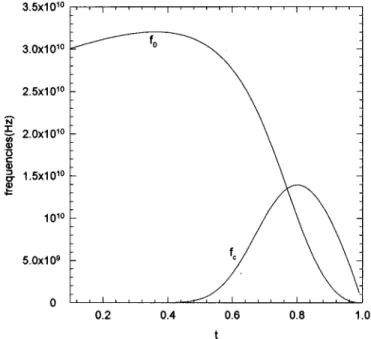
h only.42 The crossover frequency as a function of reduced temperature is shown in Fig. 5, where another characteristic frequency f05v0/2p is also given. The maximum fc is
about 14 GHz. For frequencies fc, f , f0, the vortex dy-namics is dominated by flux pinning; l˜ is then independent of frequency. If the frequency is f. f0, the vortices are not pinned at all, and the dissipation is consequently due to free viscous motion. Finally, the peak temperature in Fig. 4 in-creases with increasing frequency. Moreover, the peak even-tually disappears at 100 GHz. In Fig. 6, we show m
9
as a function of reduced static field at different temperatures. The peak is broadened more as the temperature decreases; how-ever, the peak height changes appreciably. The reduced field at the m9
peak increases with decreasing temperature.We now turn our attention to anisotropic superconductors. As an instructive illustration, we again investigate the flux-flow regime so that l˜a→(11i)df x/2 and l˜c→(1
1i)df y/2. For convenience, we define x[c/df x and
y[a/df y; then, the permeability in Eq. ~27! of an
aniso-tropic rod can be expressed as
m5
(
n50 ` 2 qn2F
tanh@A
qn2~x2/ y2!22ix2#A
qn2~x2/y2!22ix2 1tanh@A
qn 2~y2/x2!22iy2#A
qn2~y2/x2!22iy2G
. ~31! In the case of y→` (a→`), the result reduces to that of a slab described in Eq.~28! and has a dissipation peak ~0.417! at x5c/df x51.13. Equation ~31! has a minimum peak whenx5y. The condition x5y reveals that the rod is equivalently a square one, but not actually a square rod in shape. In this equivalent square rod, the dissipation peak is a minimum. All the behaviors are very similar to those given in Fig. 1. There-fore, the thin edges should be dealt with carefully. Addition-ally, the permeability in expression~31! is quite analogous to the study of Gough and Exon.6They considered the
normal-FIG. 4. Imaginary part of permeability Eq.~6! as a function of reduced temperature t5T/Tcfor the cases where creep is both
in-cluded and exin-cluded with fixed reduced field b50.01 at various microwave frequencies. The slab thickness 5mm and material con-stants are given in the text.
FIG. 5. Temperature-dependent characteristic frequencies vc
and v0 when the creep is considered. Here v05(kp/h)
I1(n)/I0(n) and vc5v0/@I0 2
(n)21#1/2 with n5U
0(B0,T)/2kBT.
Material parameters are given in the text.
FIG. 6. Plot ofm9of slab withl˜ given in Eq. ~1! vs reduced field b[B0/Bc2(0) at f510 GHz for different reduced
tempera-tures t[T/Tc50.6, 0.7, 0.8, 0.85, and 0.9. The slab thickness is 5
state response of anisotropic superconductors in the parallel field configuration. The permeability is derived from the an-isotropic magnetic flux diffusion equation. The authors pointed out the importance of thin edges on the microwave response of a platelet crystal. Our result shown in Eq. ~31! can reproduce all their discussion provided that B0→Bc2(T), the upper critical field, because as B0 ap-proaches Bc2(T), this will imply a divergent l(B0,T), which in turn makes dnf→dn5(2r/m0v)1/2 and l˜→(1
1i)dn/2, a penetration depth of the normal-state response.
As for the general consideration of vortex dynamics, one can also execute similar calculations from Eq. ~27!. How-ever, some care should be taken before the execution. In the parallel configuration, the vortex motion is anisotropic and consequently the material parameters such as Bc2(0),
viscos-ity, and London penetration are strongly dependent on the anisotropic ratio g[lc/lab5
A
mc/mab. Besides, thefield-orientation-dependent Labusch constant kp0 and anisotropic
normal-state resistivities should also be taken into account altogether, remembering that the parameters used previously in the analysis of the isotropic case are the in-plane ones. The c-axis parameters now are given as follows. The zero-temperature upper critical field Bc2(0)5112g T,
normal-state resistivity45 rc51.3/T1(3.231025) T, Labusch
con-stant38 kp052.23105 N m22, and the activation barrier
height46 U50.15g eV T. Here the anisotropic ratio g is re-ported to be 5–8 for the high-Tc superconductor YBCO.
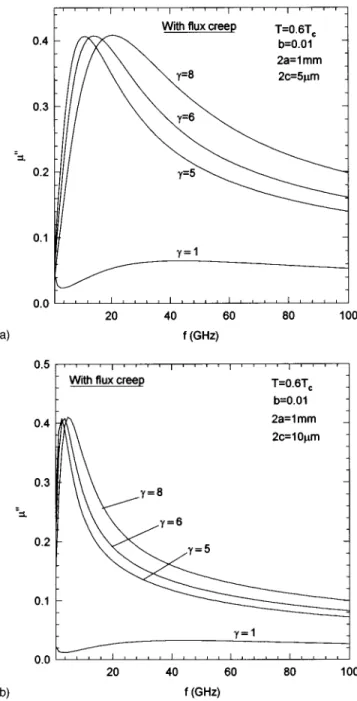
47 With these parameters, we can investigate the ac response of anisotropic flux motion. Also, one is able to tell the different of responses between anisotropic and isotropic supercon-ductors. The results with flux creep based on our generalized Coffey-Clem model are shown in Figs. 7–9 where the results of the isotropic one (g51) are given for the purpose of comparison. Figures 7~a! and 7~b! display the dependence of m
9
on reduced temperature for two thicknesses 2c55 and 10 mm of the platelet. As can be seen in Fig. 7~a!, the an-isotropy makes the m9
peak more broadened and the peak temperature is lowered considerably compared with the iso-tropic one. What is more, the peak height is also increased appreciably. In the anisotropic ones, the peak temperature decreases with increasing the anisotropy and no appreciable change in peak height is observed. In Fig. 7~b!, the inclusion of anisotropy again lowers the peak temperature, but not as large as in ~a!. The results indicate that the microwave re-sponse is strongly dependent on the material anisotropy and sample size. The magnetic field dependence of the micro-wave dissipation is shown in Fig. 8. Figure 8~a! illustrates that the anisotropy has narrowed the curve of m9
and the peak is confined around b50.01 at f 510 GHz and t50.6. As the field increases, the dissipation in the anisotropic su-perconductor is depressed much in comparison with the iso-tropic one. The same condition for a thicker platelet, 2c510mm, causes the m9
curve to be more broadened as depicted in Fig. 8~b!. Furthermore, the peak heights are de-creased appreciably with increasingg in anisotropic case in this condition. The influence of anisotropy on m9
as func-tions of reduced temperature and static field appears to be quite different. One is that the curve is broadened in Fig. 7 and the other narrowed in Fig. 8. Finally, we demonstrate the frequency-dependent m9
in Fig. 9. Apparently, theanisot-ropy has highly enhanced the microwave losses. Besides, the disappearance in them
9
peak in the isotropic superconductor now emerges in the anisotropic ones as shown in Figs. 9~a! and 9~b!. The effect of sample size on the m9
peak is also observed in these two figures. The increase in thickness of the sample makes the peak shape more sharp and the peak frequency is localized near 5 GHz.According to the Figs. 7–9, the influence of anisotropy together with sample size on the m
9
peak has been clearly elucidated so far. The results suggest the importance of an-isotropy in the analysis of the microwave response of high-temperature superconducting platelet crystals in the parallel field configuration.FIG. 7. ~a! Plot ofm9in Eq.~27! of a rectangular rod, 2a51 mm, 2c55 mm at f 510 GHz and b50.01. The material param-eters used are described in the text.~b! Plot ofm9in Eq.~27! of a rectangular rod, 2a51 mm, 2c510 mm at f 510 GHz and
IV. SUMMARY
We have extended the Coffey-Clem model to the aniso-tropic case. The idea of a self-consistent treatment of vortex dynamics as well as the anisotropic London electrodynamics establish the basis for our extension. The permeability in Eq. ~27! acts as a good candidate for the microwave response of anisotropic superconducting single crystals in the shape of platelets in the parallel field configuration. The permeability depends on the anisotropic complex penetration depths, which are determined by a self-consistent treatment of vortex dynamics. Our results in Eqs. ~23! and ~25! provide some conversion relations from isotropic to anisotropic supercon-ductors within the framework of the Coffey-Clem model. Besides, our derivations provide a possible tool for
experi-mentally determining the anisotropic properties such as vis-cosity, Labusch constant, normal-fluid resistivity, and so forth.
Numerical studies indicate some fundamental information about the vortex response to a microwave field. If the vortex dynamics is dominated by flux flow, then the response be-haves as a resistive one. Accordingly, the microwave prop-erties of platelike single crystals are highly related to the thin edges of samples for both isotropic and anisotropic super-conductors because of the skin size effect. A square rod in the isotropic case or an equivalent square rod in anisotropic superconductors gives the possible minimum peak height and the highest peak frequency. Therefore, one can prepare suitable sample dimensions to get the minimum peak and in
FIG. 8. ~a! Field-dependent imaginary part ofm in Eq. ~27! of a rectangular rod, 2a51 mm, 2c55 mm at T50.6Tc and f510
GHz. ~b! Field-dependent imaginary part of m in Eq. ~27! of a rectangular rod, 2a51 mm, 2c510mm at T50.6Tc and f510
GHz.
FIG. 9.~a! Frequency-dependent imaginary part ofm in Eq. ~27! of a rectangular rod, 2a51 mm, 2c55 mm at T50.6Tc and
b50.01. ~b! Frequency-dependent imaginary part ofm in Eq. ~27!
of a rectangular rod, 2a51 mm, 2c510 mm at T50.6Tc and
turn the anisotropic viscosity is able to be extracted. For material parameters on the order of high-temperature super-conductors, the YBCO system, the inclusion of flux creep effectively enhances the dissipation heavily and makes the peak height essentially unchanged at various static magnetic fields. The dependence of vortex dynamics on microwave frequency is also numerically illustrated to indicate the fact that the creep is detected at the low-frequency regime. At very high frequency, the dissipation peak becomes very sharp and moves closely to Tc; eventually the peak shape
vanishes. Our results specifically indicate the effects of thin edges of plates should be noted in the microwave study. To obtain the dissipation peak, it is indicated that a thin platelet would be in preference to a thick platelet. Also, the consid-eration of anisotropy makes the microwave properties of the anisotropic quite different from those of the isotropic super-conductors. It therefore reveals that the microwave response
is strongly dependent on the anisotropic vortex motion to-gether with the sample dimension.
The generality here encompasses all the isotropic results given by Coffey and Clem31previously and the special con-sideration such as the anisotropic normal-state response pro-vided by Gough and Exon.6The extension also provides the possibility of studying highly anisotropic high-Tc
supercon-ductors, the BSCCO system. In BSCCO, the creep is more pronounced because of its relatively low activation energy. Regarding the interpretation, the irreversibility line in the mixed state, the extension here gives more possible depen-dence on sample geometry, too.
ACKNOWLEDGMENT
The work is supported by the National Scientific Council through Grant No. NSC85-2112-M009-037.
1P. L. Gammel, L. F. Schneemeyer, J. V. Waszczak, and D. J.
Bishop, Phys. Rev. Lett. 61, 1666~1988!.
2S. de Brion, R. Calemczuk, and J. Y. Henery, Physica C 178, 225
~1991!.
3G. D’Anna, W. Benoit, W. Sadowski, and E. Walker, Europhys.
Lett. 20, 167~1992!.
4Ph. Seng, R. Gross, U. Baier, M. Rupp, D. Koelle, R. P.
Hue-bener, P. Schmitt, G. Saemann-Ischenko, and L. Schultz, Physica C 192, 403~1992!.
5S. Revenaz, D. E. Oates, D. Labbe-Lavigne, G. Dresselhaus, and
M. S. Dresselhaus, Phys. Rev. B 50, 1178~1994!.
6C. E. Gouch and N. J. Exon, Phys. Rev. B 50, 488~1994!. 7J. Owliaei, S. Sridhar, and J. Talvacchio, Phys. Rev. Lett. 69,
3366~1992!.
8M. S. Pambianchi, D. H. Wu, L. Ganapathi, and S. Anlage, IEEE
Trans. Appl. Supercond. AS-3, 2774~1993!.
9C. P. Bean, Rev. Mod. Phys. 2, 31~1964!.
10J. I. Gittleman and B. Rosenblum, Phys. Rev. Lett. 16, 734
~1966!.
11A. M. Campbell, J. Phys. C 2, 1492~1969!; 4, 3186 ~1971!. 12C. J. van der Beek, V. B. Geshkenbein, and V. M. Vinokur, Phys.
Rev. B 48, 3393~1993!.
13E. H. Brandt, Z. Phys. B 80, 167~1990!.
14P. H. Kes, J. Aarts, J. van den Berg, C. J. van der Beek, and J. A.
Mydosh, Supercond. Sci. Technol. 1, 242~1989!.
15V. B. Geshkenbein, V. M. Vinokur, and R. Fehrenbacher, Phys.
Rev. B 43, 3748~1991!.
16M. W. Johnson, D. H. Douglass, and M. F. Bocko, Phys. Rev. B
44, 7726~1991!.
17L. Ji, R. H. Sohn, G. C. Spalding, C. J. Lobb, and M. Tinkham,
Phys. Rev. B 40, 10 936~1989!.
18Y. B. Kim, M. J. Stephen, and W. F. Vinen, in Superconductivity,
edited by R. D. Park~Dekker, New York, 1969!, Vol. 2.
19C. J. van der Beek and P. H. Kes, Phys. Rev. B 43, 13 032~1991!. 20
N. C. Yeh, Phys. Rev. B 43, 523~1991!.
21A. E. Koshelev and V. M. Vinokur, Physica C 173, 465~1991!. 22A. I. Larkin and Yu. N. Ovchinnicov, J. Low Temp. Phys. 43,
409~1979!.
23M. V. Feigel’man and V. M. Vinokur, Phys. Rev. B 41, 8986
~1990!.
24L. W. Chen and M. C. Marchetti, Phys. Rev. B 50, 6382~1994!. 25M. C. Marchetti and D. R. Nelson, Physica C 174, 40~1991!. 26E. B. Sonin, A. K. Tagantsev, and K. B. Traito, Phys. Rev. B 46,
5830~1992!.
27E. B. Sonin and K. B. Traito, Phys. Rev. B 50, 13 547~1994!. 28E. H. Brandt, Phys. Rev. Lett. 67, 2219~1991!.
29M. W. Coffey and J. R. Clem, Phys. Rev. Lett. 67, 386~1991!. 30M. W. Coffey and J. R. Clem, IEEE Trans. Magn. MAG-27,
2136~1991!.
31M. W. Coffey and J. R. Clem, Phys. Rev. B 45, 9872~1992!. 32M. W. Coffey and J. R. Clem, Phys. Rev. B 45, 10 527~1992!. 33M. W. Coffey and J. R. Clem, Phys. Rev. B 46, 11 757~1992!. 34J. R. Clem and M. W. Coffey, J. Supercond. 5, 313~1992!. 35T. Hanaguri, Y. Iino, A. Maeda, N. Motohira, and K. Kishio,
Physica C 235, 1991~1994!.
36T. Shibauchi, H. Kitano, K. Uchinokura, A. Maeda, T. Kimura,
and K. Kishio, Phys. Rev. Lett. 72, 2263~1994!.
37K. Zhang, D. A. Bonn, S. Kamal, Ruixing Liang, D. J. Baar, W.
N. Hardy, D. Basov, and T. Timusk, Phys. Rev. Lett. 73, 2484
~1994!.
38
D. H. Wu and S. Sridhar, Phys. Rev. Lett. 65, 2074~1990!.
39
Z. Hao and J. R. Clem, IEEE Trans. Magn. MAG-27, 1086
~1991!.
40A. M. Campbell and J. E. Evetts, Critical Currents in
Supercon-ductors~Barnes & Noble, New York, 1972!.
41W. Tomasch et al., Phys. Rev. B 37, 9864~1988!.
42A. M. Portis, Electrodynamics of High-Temperature
Supercon-ductors~World Scientific, Singapore, 1993!, Chap. 9.
43T. P. Orlando and K. A. Delin, Foundations of Applied
Supercon-ductivity~Addison-Wesley, Reading, MA, 1991!.
44C. J. Wu and T. Y. Tseng, Phys. Rev. B 54, 488~1996!. 45T. Penney, S. von Molnar, D. Kaiser, F. Holtzberg, and A. W.
Kleinsasser, Phys. Rev. B 38, 2918~1988!.
46A. Freimuth, in Frontiers in Solid State Science, edited by L. C.
Gupta and M. S. Multani ~World Scientific, Singapore, 1993!, Vol. 1.
47G. J. Dolan, F. Holtzberg, C. Feild, and T. R. Dinger, Phys. Rev.