行政院國家科學委員會補助專題研究計畫成果報告
※※※※※※※※※※※※※※※※※※※※※※※※※
※
※
※ ※
※
※
※
※
※※※※※※※※※※※※※※※※※※※※※※※※※
計畫類別:
∨
個別型計畫 □整合型計畫
計畫編號:
91-2212-E-002-043
執行期間:91 年 08 月 01 日至 92 年 07 月 31 日
計畫主持人:馬劍清 教授
共同主持人:
本成果報告包括以下應繳交之附件:
□赴國外出差或研習心得報告一份
□赴大陸地區出差或研習心得報告一份
□出席國際學術會議心得報告及發表之論文各一份
□國際合作研究計畫國外研究報告書一份
執行單位:國立台灣大學機械工程學系
中
華
民
國
九
十
二
年
八
月
三
十
日
石英壓電板的振動特性分析及實驗
The Analysis and Experimental Measurement
行政院國家科學委員會專題研究計畫成果報告
計畫編號:
91-2212-E-002-043
執行期限:91 年 8 月 1 日至 92 年 7 月 31 日
主持人:馬劍清 國立台灣大學機械工程學系
計畫參與人員:
黃育熙、黃采如
一、 中文摘要
本計畫將探討應用性頗廣的壓電石英材料的振 動問題,國內近十年來也投入大量的研究人力及經費 作相關的研發工作,而大部分的研究皆僅在於純理論 及數值計算,本研究計畫將整合且有系統地包含理論 建立,數值計算以及實驗量測,針對壓電石英材料板 在低頻、中頻及高頻不同條件下作完整的探究,以便 理論、數值及實驗能互相驗證。實驗主要以電子斑點 干涉術及雷射都卜勒干涉術兩種光學實驗方法針對 壓電石英材料板作全域性的面外及面內振動模態以 及共振頻率量測,並配合阻抗分析的結果作深入之探 討,除此之外亦將應用有限元素數值計算作相關問題 的理論研究並與實驗結果作比較。二、 英文摘要
The experimental measurement of
resonant frequencies for the piezoelectric plate
is generally performed by the impedance
analysis. In this project we employ two optical
interferometry methods called the
amplitude-fluctuation electronic speckle
pattern interferometry (AF-ESPI) and the laser
Doppler vibrometer (LDV) to investigate the
vibration characteristics of piezoelectric plates
made of quartz. As compared with the film
recording and optical reconstruction
procedures used for holographic interferometry,
the full-field interferometric fringes of
AF-ESPI are produced instantly by a video
recording system. Based on the face that
clear fringe patterns measured by the AF-ESPI
method will be shown only at resonant
frequencies, both the resonant frequencies and
corresponding full-field mode shapes are
obtained experimentally at the same time. The
LDV system has the advantage of non-contact,
high resolution, and broad dynamic range is
applied to measure the frequency response of
piezoelectric plates. The out-of-plane and
in-plane vibration modes ranging from low to
high frequencies of piezoelectric plates will be
discussed in this project. The numerical finite
element calculations are also performed, and
the results will be compared with the
experimental measurements.
三、 緣由與目的
從材料科學的歷史演進可概分為結構材料演進 到功能材料,再進化到智慧型材料,智慧型材料需同 時具有感測器與致動器的功能,也是目前各國全力研 究發展的材料,而壓電材料就是具有這些功能也是最 具發展及應用潛力的智慧型材料之一。近年來壓電材 料已被廣泛地應用於精密工業及檢測設備中,例如光 學掃描器,磁碟機的尋軌微調機構,濾波器,延遲線, 超音波馬達及超音波檢測探頭等,由於壓電材料可不 需經由機構或電路,即可直接作電能與機械能之間的 轉換,因此對於壓電材料動態特性之研究將有助於其 在精密工業及微機電系統中之發展。具有壓電效應的 材料有多種;如石英(Quartz)就是一種良好的壓電材 料,而在各種壓電材料裡以壓電陶瓷的用途最為廣 泛,主要是因為它可製成任何形狀,且隨著組成的不 同有不同的特性以適合不同的應用。壓電材料的種類 有單晶類(如石英),薄膜類(如氧化鋅),聚合物(如 PVDF),陶瓷類(如鋯鈦酸鉛,PZT)等。由於許多特 性好的壓電材料本身即為強介電材料,再加上其它可石英壓電板的振動特性分析及實驗
The Analysis and Experimental Measurement
能的電光效應及光彈效應,壓電材料本身就是最具智 慧化潛力的材料,所以壓電材料的特性研究及其相關 的應用仍是目前學者的重要研究方向。 石英(Quartz)原是一種天然礦石,其成分主要為 二氧化矽結晶礦石,又稱為石英晶體,其壓電效應首 次用於電子振盪器電路中,石英晶體振盪器因其所產 生的頻率穩定度優於傳統電感器與電容器所製造的 LC 振盪器而受到重視與使用,由於天然的石英晶體 產量不符需求且本身雜質含量也影響振盪器頻率的 穩定度,因而加速了人造石英晶體製程的研究,目前 已可以人工方式製造高純度的石英晶體也已大量取 代了天然石英晶體。石英仍是目前公認具最高 Q 值的 材料,其共振頻率最窄及對溫度敏感度較低,受溫度 影響所造成的頻率飄移較小,故比其它壓電材料所製 成的振盪元件來得準確與穩定,所以目前在對頻率準 確度要求較高的通訊產品使用石英振盪元件的比率 相當高。石英產業在台灣的產值從全球來看並不大, 而大部分仍然把持在日本生產廠商手中,但隨著國內 通訊及資訊產業蓬勃發展,石英產品的內需市場規模 日漸龐大,學術界對於石英元件動態特性的探討與研 究應積極投入研究,才能對國內相關產業的提昇有所 助益。 本研究計畫主要針對國內工業之關鍵零組件石 英晶體的動態特性作深入之研究,其頻率範圍將涵蓋 低頻(數百 Hz),中頻(數萬 Hz)以及高頻(MHz)之各種 不同應用,而動態特性主要探討二維壓電板的共振頻 率 及 其 相 對 應 的 模 態 , 包 括 面 內 (In-plane) 及 面 外 (Out-of-plane)兩大類不同的振動模式,本計畫將以相 同的厚度石英晶體但不同的面積來涵蓋低、中、高不 同的頻率範圍,除了理論的研究之外,本計畫的最重 要之特色是以三種不同的實驗方法實際量測石英晶 體的動態特性,這三種實驗方法即阻抗分析,雷射都 卜勒干涉以及電子斑點干涉,這三種不同方法各有其 優缺點,其中阻抗分析是一般應用來量測壓電材料振 頻的方法,其優點是快速而方便,但其缺點在於僅能 獲知自然頻率而模態則無從得知。雷射都卜勒干涉的 量測精度可達奈米級但僅可作單點的精密位移量 測,而電子斑點干涉術是全域式的光學量測其精度為 微米級,有能力直接同時獲得振頻及模態的結果,但 其量測的面積須達平方公分以上,據初步評估低頻及 中頻的範圍是電子斑點干涉術的應用範圍,而高頻則 只能使用單點式的雷射都卜勒干涉來作量測,本研究 計畫的內容不僅只是理論的研究及探討,更包括三種 不同的實驗量測方法,故本計畫之內容廣泛而深入且 兼具學術及實用性,其相關研究論文件見參考文獻。
三、 結果與討論
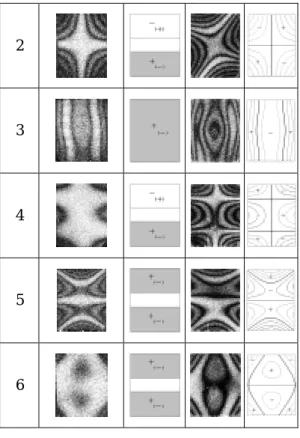
(A)試片規格與邊界條件 本文採用的試片為台灣晶技公司(TXC)生產的 AT 切面石英單晶晶體,採自其製作石英振盪器的初 期製程中,熔融的石英晶棒拉出後,第一道切割研磨 後的淨試片,由於取得試片為淨試片,因此必須鍍上 金屬電極以供導電,使得壓電晶體可藉由不同頻率電 信號輸入,達到共振之效果。實驗採用的電極批覆方 法為蒸鍍法,將試片置於蒸鍍室(chamber)並將靶材 安置妥當後,抽真空至 4 4 10 torr× − ,慢慢的將靶材加 大通過電流,使靶材可均勻的蒸鍍於試片上。 實驗量測的邊界分別為單邊固定及四邊自由的 邊界固定條件。為了達到較完美邊界固定情況,我們 以上述尺寸的石英試片,經過精密量測尺寸後,將單 邊塗佈 AB 膠緊密黏貼在夾具上,形成尺寸分別為 25.4 25.4 0.16mm× × 與 8.5 5.8 0.16mm× × 的單邊固定 邊界試片。此外,本文亦探討淨試片在三種不同電極 設計在自由邊界下的激振情形,並詳細討論之。圖 1 為三種不同尺寸與邊界的試片與新台幣 50 元的大小 比較;由左至右分別是尺寸 25.4 25.4 0.16mm× × 單邊 固 定 、 8.5 5.8 0.16mm× × 單 邊 固 定 與 石 英 試 片 33 25.4 0.16mm× × 自由邊界。另外,在實驗數據與圖 形中,AF-ESPI(1)表鍍電極試片,以輸入電訊號激振 之量測結果,AF-ESPI(2)表鍍電極試片喇叭輸出聲波 激振之對照比較情形,AF-ESPI(3)表未鍍電極之淨試 片以喇叭輸出聲波激振的實驗數據。 (B)數值分析 此部分數值分析係採用有限元素法商用分析軟 體 ABAQUS V6.2 進行共振頻率與模態振形分析計 算 , 分 別 使 用 壓 電 耦 合 ( C3D20RE ) 與 平 面 應 力 (C3D20R)兩種元素分析,其中 C3D20 表示共 20 節 點的一正方體元素,元素代號中的 R 則是表示 Reduce的內差積分運算,若選取較多的積分點,其網格(mesh) 的內差積分方程(interpolation)越高次則越逼近實際的 現象,內差積分可在數值計算上節省較多的 CPU 的 運算時間,並可避免 K 矩陣的發散,而代號 E 則是壓 電元素之考量與否,。兩種元素的計算結果分別以 FEM-1 與 FEM-2 表示之。 (C)實驗結果與討論 首 先 使 用 單 邊 固 定 邊 界 尺 寸 為 較 大 的 25.4 25.4 0.16mm× × 石英試片。實驗結果如圖2的振形 與表1的振頻所表示,在前九模態中,以電訊號輸入 試片激振的結果與聲波激振有鍍上電極及未鍍電極 兩種狀態試片,振形幾乎完全一致。且頻率的誤差除 前兩個模態以外,其餘皆在5%以內,其與有限元素的 分析情形比較亦有相同的結果,實驗與理論比較結果 相當準確。此外,在考量壓電元素與平面應力元素的 兩種分析結果的比較,可以發現在低頻的範圍,這兩 種元素的數值分析幾乎是沒有差別的,差異幾乎都在 0.01%以下。 在表2與圖3中,列出極小規格的單邊固定石英壓 電 晶 體 量 測 結 果 , 由 於 尺 寸 僅 僅 只 有 8.5 5.8 0.16mm× × ,實驗量測上相當的不容易,且機 電耦合的性質相當微小,因此實驗無法順利的以電訊 號激振出光學系統可量得的位移干涉圖形。但從尺寸 較大的石英試片的實驗結果得知,由聲波激振得到的 量測情形與利用電訊號激振的效果極為相近,因此, 此處即採用喇叭輸出聲波造成試片較大的位移以利 於實驗的觀察。不過,一般市面上看到的喇叭輸出聲 波範圍通常在人耳聽的到的20Hz~20000Hz,因此本項 實 驗 特 別 尋 找 由 SCAN-SPEAK 公 司 生 產 , 型 號 D2904/700k的高音喇叭,此喇叭宣稱其輸出功率可達 40000KHz,若由FEM模擬推論,可量測得到前六個模 態的共振現象,實際實驗的結果除第四模態無法測得 之外,其餘的振形與振頻相較於數值模擬皆有優異的 一致性,誤差值皆於2%以內。 對於 33 25.4 0.16mm× × 自由邊界的石英試片而 言,由於試片尺寸較大,預期其電訊號激振可達到較 大位移,但實際以全電極量測卻無法順利得到較多完 整的振動位移干涉圖形。圖4則顯示了在此自由邊界 的條件下,電極設計及三種電訊號給定的設計方法, 其中(+)號與(-)號分別代表給予電訊號為反相電位 的意義。在圖5與表3中列出第一至第六共振模態實驗 與有限元素數值方法的結果,並列出激振所對應的電 極形式,在圖中可以發現某些電極型式對特定模態激 振效果特別敏感,雖然有些模態用不同電極亦可激 振,但某些模態就只有單一電極形式可激振出干涉圖 形,其他形式完全無法激振出足以讓干涉系統可量測 到的位移量。因此圖5所列的激振圖形與電極形式的 對應,皆為最敏感、效果最佳的情況。 由以上三種不同邊界與尺寸的實驗量測另外可知,雖 然電訊號與聲波激振的結果幾乎相同,但在實驗的即 時觀測中,可觀察出電極激振動對於帶有扭轉變形的 模態較為敏感;相反的,聲撥激振對於帶有彎曲變形 的模態較敏感。而實驗量測到的共振頻雖與理論值亦 幾乎可以完全匹配,但在實驗中又可清楚的得知每個 模態的頻寬與位移的程度。此光學實驗量測方法的結 果,對於實際工程應用的評估,應有極大的助益。
圖表資料
表1. 尺寸 25.4 25.4 0.16mm× × 單邊固定邊界之石英 試片AF-ESPI三種實驗量測方法與數值模擬之結 果比較(誤差係指與AF-ESPI鍍電極以電激振形 式之比較) mode AF-ESPI (1) unit:Hz AF-ESPI (2) unit:Hz (Error %) AF-ESPI (3) unit:Hz (Error %) FEM-1 (Error %) FEM-2 (Error %) 203 221 219 219 1 193 (5.181) (14.508) (13.472) (13.472) 744 715 695 694 2 743 (0.135) (-3.769) (-6.460) (-6.595) 1370 1358 1357 1357 3 1355 (1.107) (0.221) (0.148) (0.148) 1860 1980 1934 1933 4 1939 (-4.074) (2.114) (-0.258) (-0.309) 2502 2402 2347 2344 5 2493 (0.361) (-3.650) (-5.856) (-5.977) 3918 3854 3847 3847 6 3755 (4.341) (2.636) (2.450) (2.450) 4489 4363 4257 4251 7 4504 (-0.333) (-3.131) (-5.484) (-5.617) 4536 4426 4354 4352 8 4535 (0.022) (-2.404) (-3.991) (-4.035)5153 4998 4919 4915 9 5150 (0.058) (-2.951) (-4.485) (-4.563) 表2. 尺寸 8.5 5.8 0.16mm× × 單邊固定邊界之石英試片 AF-ESPI實驗量測方法與數值模擬之結果比較(誤差係 指與AF-ESPI鍍電極以電激振形式之比較) MODE AF-ESPI-2 (Hz) FEM-1 (Error%) 2197 1 2183 (0.641) 9100 2 8983 (1.302) 13661 3 13570 (0.671) 29367 4 --- (---) 32119 5 32020 (0.309) 38800 6 39335 (-1.360) 表 3. 尺 寸 33 25.4 0.16mm× × 自 由 邊 界 之 石 英 試 片 AF-ESPI兩種實驗量測方法與數值模擬之結果比較 (誤差係指與AF-ESPI鍍電極以電激振形式之比較) MODE AF-ESPI (1) (Hz) AF-ESPI (2) (Error%) FEM-1 (Error%) 776 799 1 802 (-3.242) (-0.374) 962 915 2 918 (4.793) (-0.327) 1553 1487 3 1415 (9.753) (5.088) 2115 2018 4 2079 (1.732) (-2.934) 2227 2191 5 2170 (2.627) (0.968) 2474 2442 6 2545 (-2.790) (-4.047) 圖 1. 本文三種不同尺寸與邊界之石英試片 左: 25.4 25.4 0.16mm× × 單邊固定 中: 8.5 5.8 0.16mm× × 單邊固定 右: 33 25.4 0.16mm× × 自由邊界 圖 2. 尺寸 25.4 25.4 0.16mm× × 單邊固定邊界之石英 試片 AF-ESPI 三種實驗量測方法與數值模擬之結果 比較 Mode AF-ESPI (1) AF-ESPI (2) AF-ESPI (3) FEM 1 2 3 4 5 6 7 8 9
圖 3. 尺寸 8.5 5.8 0.16mm× × 單邊固定邊界之石英試 片 AF-ESPI 實驗量測方法與數值模擬之結果比較 AF-ESPI-3 FEM 1 2 3 4 5 6 圖 4. 自由邊界的條件下,石英試片之電極分佈設計 方法 圖 5. 尺寸 33 25.4 0.16mm× × 自由邊界之石英試片 AF-ESPI 兩種實驗量測方法與數值模擬之結果比較 AF-ESPI (1) Mode Experimental Electrode mode AF-ESPI (2) FEM 1 2 3 4 5 6
結論
本文使用 AF-ESPI 對於石英壓電晶體平板試件 的振動頻率與振形進行實驗量測,與有限元素數值方 法的比較結果,不論在振頻數據或是全域觀測之振 形,都有相當優異的一致性。因此,AF-ESPI 實驗技 術對於石英面外振動特性的量測,可獲得即時且準確 的結果,並可觀察試片受實際實驗條件下的激振程度 與頻寬資訊,未來期望可對石英高頻的面內振動進行 更進一步的瞭解。參考文獻
[1] Mindlin, R. D., “Anharmonic, Thickness-Twist Overtones of Thickness-Shear and Flexural Vibrations of Rectangular, AT-Cut Quartz Plates,”
Journal of the Acoustical Society of America , 42(6),
1268-1277 (1951).
[2] Mindlin, R. D., and Deresiewicz,, “Thickness-Shear and Flexural Vibrations of Rectangular Crystal
Plates,” Journal of Applied Physics, 26(12),
1435-1442 (1955).
[3] Koga, I., “Radio-Frequency Vibrations of
Rectangular AT-Cut Quartz Plates,” Journal of
Applied Physics, 34(8), 2357-2365 (1963).
[4]Mindlin, R. D., and Lee P. C. Y. “Thickness-Shear and Flexural Vibrations of Partially Plated, Crystal
Plates,” Journal of Solids Structures, 2, 125-139
(1966).
[5] Holland, R., “Contour Extensional Resonant Properties of Rectangular Piezoelectric Plates,”
IEEE Transactions on Sonics and Ultrasonics,
SU-15(2), 97-105 (1968).
[6] Tiersten, H. F., Linear Piezoelectric Plate Vibrations,
Plenum, New York (1969).
[7] Lin, M. W., Abatan, A. O. and Rogers, C. A., “Application of commercial finite element codes for the analysis of induced strain-actuated structures,” Journal of Intelligent Material Systems and Structures, 5(6), 869-875 (1994).
[8] Koyuncu, B., “The Investigation of High Frequency Vibration Modes of PZT-4 Transducers using ESPI Techniques with Reference Beam Modulation,”
Optics and Lasers in Engineering, 1(1), 37-49
(1980).
[9] Oswin, J. R., Salter, P. L., Santoyo, F. M. and Tyrer, J. R., “Electronic Speckle Pattern Interferometric Measurement of Flextensional Transducer
Vibration Patterns: in Air and Water,” Journal of
Sound and Vibration, 172(4), 433-448 (1994).
[10] Huang, C. H. and Ma, C. C, “Vibration Characteristics for piezoelectric Cylinders using Amplitude-Fluctuation Electronic Speckle Pattern
Interferometry,” AIAA Journal, 36(12), 2262-2268
(1998).
[11] Ma, C. C and Huang, C. H., “The Investigation of Three Dimensional Vibration for Rectangular Parallelepipeds by using the AF-ESPI Method,”
IEEE Transactions on Ultrasonics, Ferroelectrics and Frequency Control, 48(1), 142-153 (2001).
[12] Lin H. Y., Huang J. H., and Ma C. C., “Vibration Analysis of Materials by Piezoelectric Optical
Methods,” IEEE Transactions on Ultrasonics, and
Frequencies, and Frequency Control, 49(8),
1139-1149 (2002).
[13] Lin H. Y., Huang J. H., and Ma C. C., “Vibration Analysis of Angle-Ply Laminated Composite Plates
with an Embedded Piezoceramic Layer,” IEEE
Transactions on Ultrasonics, and Frequencies, and Frequency Control, (In Press, 2003).
[14] Yong Y.K., Stewart J. T.,and Detaint J., “Thickness-Shear Mode Shapes and Mass-Frequency Influence Surface of a Circular
and Electroded AT-Cut Quartz Resonator,” IEEE
Transactions on Ultrasonics, and Frequencies, and Frequency Control, 39(5), 609-617 (1992).
[15] Detaint J., Schwartzel J.,and Joly C., “Energy
Trapping Resonators and Interated Filters Using the
AT Cut of Quartz Like Materials,” IEEE Frequency
Control Symposium, 4, 639-647 (1992).
[16] Ishizaki A., “Three-Dimensional Analysis of Forced Vibrations of Rectangular AT-Cut Quartz Plates,”
IEEE Internal Frequency Control Symposium, 5,
942-946 (1998).
[17] Wang, W. C., Hwang, C. H. and Lin, S. Y., “Vibration Measurement by the Time-Averaged Electronic Speckle Pattern Interferometry
Methods,” Applied Optics, 35(22), 4502-4509