QTuI2
2005Quantum Electronicsand LaserScience Conference (QELS)
Terahertz
Fourier
Transform
Spectrometer
Based on
a
Low-Reflectivity Fabry-Perot Interferometer
Li-JinChen, Tzeng-Fu Kao, Hsu-HaoChang,Ja-YuLu,andChi-Kuang SunGraduate Institute ofElectro-Optical Engineering, National Taiwan University, Taipei, 10617, Taiwan Phone f886-2-23659703.FAAX:886-2-.23677467 E-mail:r929410J464n1u.edu.Atw
Abstract: A simple THz Fourier transform spectrometer is demonstrated by using a low-reflectivity Fabry-Perot Interferometer. The emission spectra of awavelength-tunable photonic transmitter excited by anoptical coherent control system aredetermined by the spectrometer. ©2005 Optical Societyof America
OCIS codes:(300.6300) Spectroscopy,Fouriertransforms; (120.2230)Fabry-Perot;
1.Introduction
With the aidof ultrashort laserpulses,terahertz(THz) technology has beendevelopedwithgreatprogress. Inpast decades, many methods were proposed for generating and detecting the THz radiation and therefore many applications become realizable such as molecular recognition and material characterization. For promoting these applications, having a simple and reliable method for measuring the spectral characteristic ofTHz waves is as
importantasdeveloping a high-power andhigh-efficiency THzemitterwith tunable wavelength. For the spectral determination of the THzradiation, Fourier transform spectroscopybasedon aMichelson Interferometer andTHz
time-domain spectroscopy(THz-TDS) basedonphotoconductive (PC) and electro-optic (EO) samplingarethemost
commonly used methods. However, the construction of the previousspectral characterization setup is complicated becauseoftheinvisibility oftheTHz wavesandthelongalignmentdistance. Inaddition,thesetupofTHz-TDSalso
has the disadvantage ofimmovability,not tomention that THz-TDSrequires another intensive femtosecond optical pulse. Hence, a transmitted Fabry-Perot interferometer (FPI) which can be easily
aligned.
with a visible light isproposedtoperformthe spectral analysis [1]. Taking the advantages of its compact size andmovability, the Fabry Perot based spectrometer may be very attractive for many applications. But the complexity of spectrum reconstruction rises duetotheinterferences ofmultiple beams. Inthis paper,weproposeasimple Fouriertransform spectrometer basedon aFabry-Perot interferometer which has themerit ofabove methods. Foreliminatingtheeffect ofmultiple beam interference,alow-reflectivityFabry-Perot spectrometer is adopted. Inthecaseof lowreflectivity, it willbe shown that the interference is similartothe two-beam interference. So the spectrumcanbe reconstructed bytakinga Fouriertransform, whichisjustthe same as theone-sidedFourier transform spectrometer. Byutilizing thissimple spectrometer, theemission spectra ofahigh-power andhigh-efficiency THzphotonic transmitter [2,3] excitedbyanoptical coherentcontrol systemaredetermined[4]. Wewill showthat thecentralwavelength ofthe THzradiationfromthephotonic transmitter is tunable by changingthedelayofcoherent controlsystem.Combining this tunable radiation source with the simple spectrometer, a powerful THz spectral sensing system suitable for manyapplicationsis thusdemonstrated.
2. Theoryandsimulation results
Consideran idealFPI consists oftwoparallel reflectingsurfaces. Ifthetwosurfacesare identical and each hasan
intensity reflection coefficient R, the power transmissionthrough the device for different spacingisgivenby Pout(d)=|Pin(f)T(d,f)df,
(I)
where
T(d,f)
=1,(2)
I+Hsin2(
2)fnd
cos ( c H 4R (3)(a
-R)wand Pi.l is thepowerspectrum oftheincidentwave,nis the refractiveindexof medium betweentwo
surfaces,
disthespacing ofthe twosurfaces, cis thespeedoflightinvacuum, 0 is theanglefrom normalincident,andfis the frequencyofradiation.Sincethe incidentwave canbetakenas acombination of variousfrequencycomponents
QTuI2
withdifferent amplitudes,wemay first considerawavewithsingle frequencyfoforsimplicity.Foreliminating the effect ofmultiple-beaminterference,wechooseapairof low reflective surfaces.When theintensity reflectivity Ris very low so that H<< 1, equation (1) canberewritten as follows.
I+H;
_____d_
_2I-Hsin'(2rLondcosO=
H H4rfcndcosO
l+5f2(2,nfnd
cos)
0c
2 2 cc
From(4) we can observe that thetransmitted power will approximateto aone-sided cosine functionwiththe amplitude of ((H/2) andadc valueof (1-H/2). Both amplitudesareaffectedbyHonly. By removing the dc value, we can retrieve a cosine waveformin the distance domain similar to the originalwaveform in the time domain. Comparing the distance domainsignal with the time domain signal,thefrequencyoftheformer is 2ncos0Ictimes ofthelatter.Furthermore, since the cosine function isan evenfimction which should besymmetrical about y-axis, we may mirror the one-sided signalabout y-axis by letting Pout(-d) =Pout(d).Inthisway,the spectrum canbe reconstructed by taking a Fouriertransform ofPout and scaling the frequency axis by multiplyingavalue ofc /2ncos
0.So there isaperfect mapping betweenoriginal frequency and reconstructedfrequency.Thealgorithmweadopt hereis the same as the ordinary Fourier transform spectroscopy. The resolution ofthis spectroscopy is limited by the maximum spacing FPI can separate.
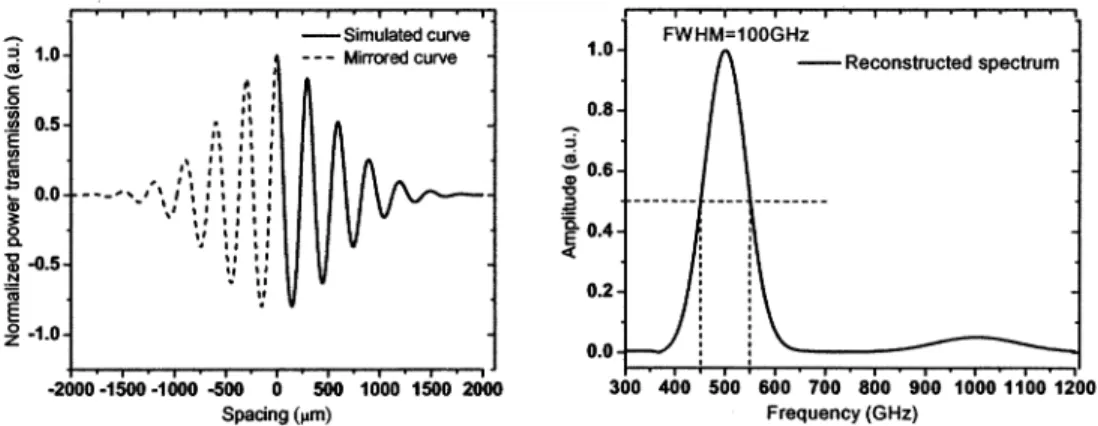
-Simulatedcurve FWHM=IOOGHz
a1.0 -Mirroredcurve 1.0 - Reconstructedspectrum
co 0 rA ~ ~ ~ ~ a0.8-.e 0.5 * E scoln0h.6qecyai-ymltpyn co 1n 0.0 ---0 cL55'8' 0.4-reosr ctd o 0.2s 0-1.0 0.0
.2000.4506'4600'.40l
0 0 001020 300 400 500 600 700 800 900 100 1100l1200i spacing(jim) Frequency (GHz)Fig.1(a)Normalized powertransmission ofaGaussian THzpulsewith centralfrequencyof 500 GHz and FWHMof
t00GHzforvariousspacingdafterremovingthedcvalue(solid line)when R=li0.The mirroredcurveisshownin
dashed line.(b)ReconstructedspectrumfromthefuilltraceplottedinFig.1(a) by takingtheFouriertransformand
scalingthefrequencyaxisbymultiplyingccos012n.
Fig.
1(a)
showsthe simulated power transmission forvariousspacing
d afterremoving
the dc value whenR=10%.The incidentwaveis assumedtobeaGaussian
pulse
withaFWHMofI100GHzandacentralfrequency
of500 GHz. The spectrum reconstructed
by
ouralgorithm
is shown inFig.
1(b).
It can be observed that the reconstructed powerspectrum restoresthe Gaussianpeak
locatedat 500GHz with aFWHM of100GHz,
which isthesame asthesimulated incidentwave.
Unfortunately,
thecurverisesupslightly
nearI1THz.
Thisharmnonic
comesfrom the interference between the wave transmitted
directly
and the wave transmitted after two bounces. As the reflection coefficient R increases, theharmonics become larger. Since the magnitude ratio of the second bounce tothe first bouncewave is
R2,
the effect of harmonic is reduced byusing surfaces of low reflectivity. Therefore, it is importanttokeep Rsufficiently smalltoavoidtheinfluence ofthe harmonics for broadbandTHzanalysis. Ontheotherhand,with aknowreflectivity value, itispossibleto removethe undesiredharmonic effect through a simple numerical algorithm.
3. Experimentalresults
Recently, we have demonstrated a edge-coupled membrane photonic transmitter based on a high
bandwidth-efficiencyproduct MSM traveling-wave photodetector and aco-planar-waveguide fed slot antenna [2,3]. Becauseof itshigh power conversion efficiency, the photonic transmitter is suitable for many applications. For utilizing it as a narrow bandTHzemitter,anoptical coherent control systemisusedto tune thecentral frequency of emission. This system has beenpreviously demonstrated tohave the capability to control the radiation frequency [4]. In order to
further characterize the radiation spectra, the simple Fourier transform spectrometer based on a low-reflectivity
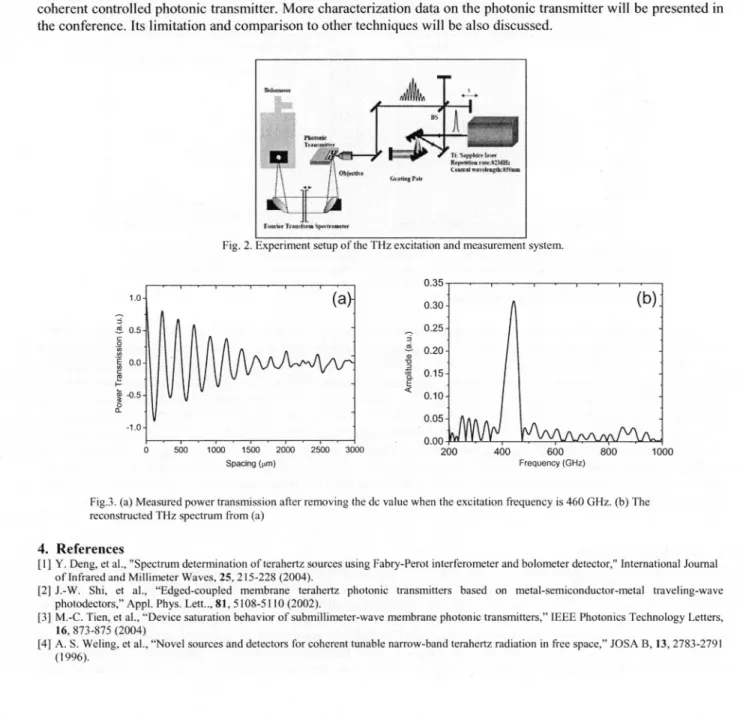
Fabry-Perot interferometer is constructed. Fig. 2 shows the experiment setup of our THz excitation and
QTuI2
measurement system. Togenerate the opticalexcitationpulses witha fixed beatfrequency, an 1OOfsoptical pulse withacentralwavelengthof 850nm fromaTi:sapphirelaserwasfirststretchedto alinearchirp pulse of 8.7 ps by a grating pair. Then,aMichelson interferometerwasusedto tunethebeatfrequency by controlling the relative delay oftwoarms. The radiated THzwave wascollectedbytwoparabolic mirrors and the Fourier transform spectrometer
waslocated between them. The Fourier transform spectrometerwasmade oftwosapphire backed metal meshesas
the partialreflective mirrors.Thereflectivity ofeachmirror at theTHzwavelength is controlledtobe-10%.As the spacing betweentwomirrorschanged, transmitted power detectedbythe bolometerchangedtoo. Fig. 3 showsthe
measuredTHz powerfor differentmirror spacing and the reconstructed radiation whentheoptical beating frequency
was tuned to 460GHz. ThemeasuredTHz spectrumshowsapeak radiationfrequency - 442GHzwhich is closeto the excitation frequency of the photonic transmitter andthe FWHMof the radiation is -50GHz. Theexperimental result reveals that the radiation from the photonic transmitter is also quasi-CW, following ourexpectation. This combinedsystem withthesimpleTHzspectrometer andtheoptically coherent controlled photonic transmitterthus
provideus areliable THzcharacterization tool forfuture spectroscopic applications.
Inconclusion,wehavedemonstrateda simple Fourier transform spectrometer basedon alowreflectivityFPI
for spectral measurement. The spectrometer successfully characterizes the emission spectrum of an optically coherent controlled photonictransmitter. Morecharacterization dataonthephotonic transmitter will be presented in theconference. Its limitation and comparison to other techniqueswillbe also discussed.
Fig.2Eem suxa
Fig.2.Experimentsetupof the THz excitation andmeasurementsystem.
rd
0~
i.2
Spacing(pnm) Frequency (GHz)600
Fig.3. (a) Measured powertransmission after removingthedc value when the excitation frequency is 460 GHz. (b) The reconstructed THz spectrumfrom (a)
4. References
[1]Y. Deng, et al., "Spectrumdetermination ofterahertz sources using Fabry-Perot interferometer and bolometer detector,"InternationalJoumal
of Infraredand Millimeter Waves,25, 215-228 (2004).
[2]J.-W. Shi, et al., "Edged-coupled membrane terahertz photonic transmitters based on metal-semiconductor-metal traveling-wave photodectors,"Appi. Phys. Lent.., 81,5108-5110 (2002).
[3] M.-C. Tien, et al., "Device saturation behavior ofsubmillimeter-wave membrane photonictransmitters," IEEE Photonics Technology Letters, 16, 873-875 (2004)
[4] A. S.Weling, et al., "Novel sources and detectors for coherent tunable narrow-band terahertz radiation in free space," JOSA B, 13, 2783-2791
(1996).