
瑞典商伊萊克斯集團策略變革與發展之研究
85
0
0
全文
(2)
(3) 謝. 詞. 隨著論文口試順利結束,兩年研究所生涯也將劃下句點,心情是激動卻也充滿感 恩的,一直很擔心自己能否在研究所二上時赴瑞典交換學生一學期,回國仍順利 完成論文,如期畢業,因而更加鞭策、督促自己。. 然而,此本論文的完成,首先衷心感謝恩師---方至民教授的指導與鼓勵,整整 將近一年以來,從出國交換前研究方向的確定、研究對象的選取、觀念架構的建 立,到返國後論文的撰寫與接近完稿時給予最為寶貴、懇切的建議,使得本論文 得以完成。此外也感謝黃北豪教授、黃振聰教授、蔡憲唐教授在口試時給予指導 與建議,使學生裨益良多。. 感謝瑞典伊萊克斯集團瑞典總部 Anders Edholm 經理,人資部經理 Ingrid Skoglund, 公司歷史學家 David Leidenborg 給予訪談機會,使得本研究得以順利進行,讓瑞 典交換學生生涯更添色彩。此外,在瑞典唸書時的同學,研究室的夥伴,育銓、 心薇、宜珮、純慧、雅方、孟宇、愷中,大家互相討論、分享、幫忙,讓我在論 文撰寫期間,不感到孤單,特別是好友育銓,常撥冗與我討論、給予建議、鼓勵, 很珍惜這段時間與你們相處的日子,預祝各位未來都有很好的發展。. 最後,感謝我親愛的爸媽、家人無所求的付出與鼓勵、尤其是我的女友—小霈, 在我撰寫論文期間心情低潮、沮喪、心煩意亂的時候,給與最溫暖的支持與加油。. 兩年的研究學習,論文的完成,同儕間的互相砥礪,使我著實成長不少,更對事 情有更深的執著與堅持,然而,若無週遭人的幫忙,亦無法成事。即將踏出校園, 我將帶著感恩的心與認真執著的態度,邁向未來。.
(4) 摘. 要. 本研究主要是針對全球最大家電製造商--瑞典商伊萊克斯集團,以個案研究的方 式研究其近一世紀經營歷程之策略變革與發展,將其經營活動演化歷程歸納出一 階段性模型,同時探討與分析導致其發生變革之內、外生因素,並以所歸納出之 「組織策略變革能耐模型」評估個案公司變革之能耐。本論文之研究議題如下: 一、變革如何發生?由誰主導? 二、為何會選擇某一特定策略以因應變革?變革策略由誰制定? 三、執行變革之策略為何?策略執行過程如何完成? 四、描述與評估每次變革之能耐。 本研究乃針對上述研究問題提出回應,並衍伸出管理上之意涵;本研究之結論在 管理上之意涵主要有三: 一、階段與階段之間高度的路徑相依(Path dependence) 二、營運/產業環境對於模型構面的影響是模型運作的主要(外在)驅動力 三、階段性領導人為模型運作中,影響變革程序(change process)之主要內在驅 動力。.
(5) Abstract The purpose of this research is to use a conceptual model to analyze the capacity for strategic change and then apply the model to assess the change capacity in Electrolux’s three major strategic changes. Through applying the model of capacity for change to analyze the change process of Electrolux, the author will research into the following problems: • Why was the change initiated? By whom? • Why was the specific strategy (the content of change) chosen? Who formulated it? • What was the strategy for implementing the change (the process)? How was the implementation process conducted? • Characterizing and evaluating the capacity for change in the case company. After analyzing the strategic change and development of the Electrolux Group, the author found out the answers of the research problems and developed three major management implications, which are stated as follows: (1) High path dependence between stages After reviewing the development of Electrolux from longitudinal perspective, the author found that Electrolux development processes from stage to stage are characterized by high path dependence. The Group strives to build competitive advantages and realize the intended strategy in each stage in order to respond to the impacts resulted from the changes of external environment. Only competitive advantages and intended strategy of the current stage are built and realized will the company initiate a new strategy and proceed to next stage. Therefore, the shift into the next stage is influenced by two factors, namely, the realization of the stage-oriented intended strategy and the building of competitive advantages. Highly Path dependence from stage to stage characterizes the Electrolux’s development stage model (see Figure 4.2). (2) Operating/industry environment factors serve as the main driving forces behind change After analyzing the development of Electrolux Group (see chapter 5), the author found environment factors serves as the main driving forces behind each change. In order to effectively respond to the impacts resulted from the environment changes and find a niche to grow, the organization has to closely monitor the environment changes. Only by recognizing the impacts resulted from environmental changes can organization decide the direction of corporate strategy and then evaluate whether the resources and.
(6) capabilities the organization possesses can generate competitive advantage so as to realize intended strategy. (3) Leadership strongly impact the formation of change process As suggested in chapter 2.4, four internal factors i.e. leadership, structure, resources and capabilities, and culture would affect the change process (see Figure 2.2). After analyzing these internal factors affecting the change process of Electrolux, the author found that leadership serves as the main internal driving force in each change period. Though Electrolux’s three major changes were mainly initiated by the external environment, the change process could not be implemented and the realized strategy could not be attained without the strategic leader who can clearly recognize and effectively react to the environment changes and adopt new strategic actions to realize the intended strategy in the end..
(7) Table of Contents List of Figures ............................................................................................................ iii List of Tables .............................................................................................................. iii 1. Introduction ..............................................................................................................1 1.1 Background and Motivation ..............................................................................1 1.2 Problem and Purpose ........................................................................................2 1.3 Disposition of the thesis ...................................................................................3 2 Literature Review and Conceptual Model ...............................................................4 2.1 Disposition of the literature review ...................................................................4 2.2 Organizational Change ......................................................................................4 2.3 Influential forces behind change........................................................................5 2.3.1 Environment ..........................................................................................6 2.3.2 Management fashion...............................................................................8 2.3.3 Leadership ..............................................................................................9 2.3.4 Resources and capabilities..................................................................... 11 2.3.5 Culture..................................................................................................12 2.3.6 Structure...............................................................................................13 2.4 Conceptual model ...........................................................................................14 2.4.1 Major forces behind strategic change -- model......................................15 2.4.2 Capacity for Organizational Change—model........................................16 3. Methodology ...........................................................................................................19 3.1 Choice of Method-Qualitative and Case Study Approach................................19 3.1.1 Qualitative approach .............................................................................19 3.1.2 Case study approach .............................................................................20 3.2 Selection of interviewees.................................................................................21 3.3 Interviews........................................................................................................22 3.4 The process of interviews ...............................................................................22 3.5 Collection of Second-hand Information..........................................................23 4. Electrolux ................................................................................................................24 4.1 Stage I: Emerging Strategy--Building the Global Company..............................25 4.2 Stage II: Diversification and M&A...................................................................30 4.3 Stage III: Focus on core business.....................................................................33 4.4 Stage IV: Brand, design and product development...........................................35 5. The Driving Forces and Capacity for change ......................................................37 5.1 Driving Forces of the First Strategic Change...................................................37 5.1.1 Environment ........................................................................................37 5.1.2 Management fashion.............................................................................40 5.1.3 Leadership ............................................................................................40 i.
(8) 5.1.4 Resources and Capabilities ....................................................................42 5.1.5 Structure...............................................................................................43 5.1.6 Culture..................................................................................................45 5.2 Driving Forces of the Second Strategic Change...............................................47 5.2.1 Environment ........................................................................................47 5.2.2 Management fashion.............................................................................48 5.2.3 Leadership ............................................................................................49 5.2.4 Resources and Capabilities ....................................................................51 5.2.5 Structure and Culture............................................................................52 5.3 Driving Forces of the Third Strategic Change .................................................56 5.3.1 Environment ........................................................................................56 5.3.2 Leadership ............................................................................................58 5.3.3 Resources and Capabilities ....................................................................60 5.4 Capacity for change .........................................................................................63 5.4.1 Evaluation ............................................................................................63 5.4.1.1 The capacity for change of the first change (1967~1989)...........63 5.4.1.2 The capacity for change of the second change (1990~2002)......64 5.4.1.3 The capacity for change of the third change (2002~till now) .....65 6. Conclusion ........................................................................................................68 6.1 Answers of the problems presented in chapter 1.2 ..................................68 6.2 Management Implication .........................................................................70 6.3 Limitation................................................................................................72 References...................................................................................................................74. ii.
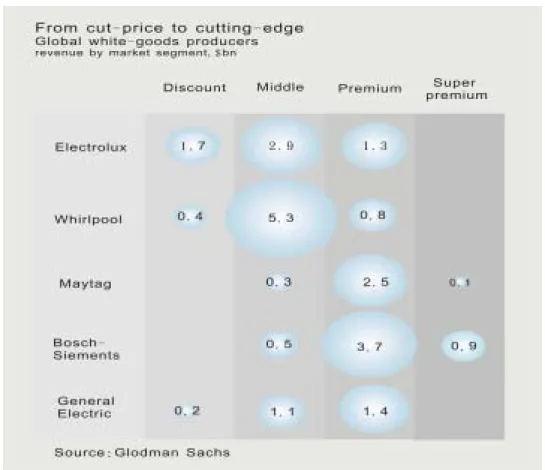
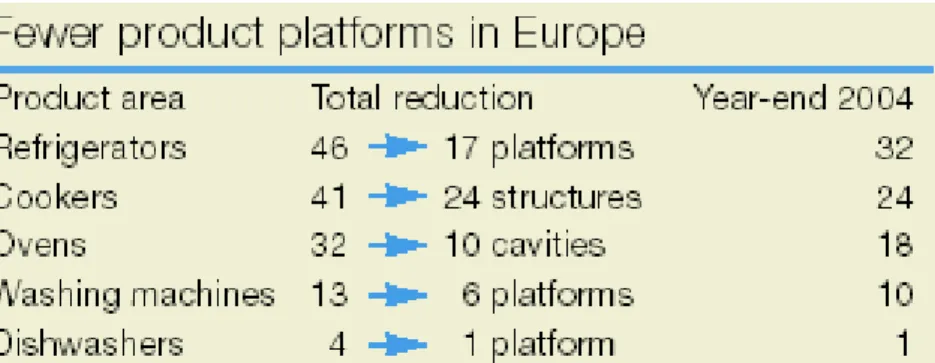
(9) List of Figures Figure 2.1 Types of Organizational Change ....................................................................5 Figure 2.2 Major forces behind strategic change--model................................................15 Figure 2.3 Capacity for Organizational Change--model .................................................17 Figure 4.2 Electrolux's development stage model. .........................................................25 Figure5.1 Electrolux Company Structure in 1990 ..........................................................44 Figure5.2 Electrolux Company Structure in 1997 ..........................................................53 Figure5.3 Electrolux Company Structure in 2000 ..........................................................54 Figure 5.4 A survey of consumers’ buying habit............................................................57 Figure 5.6 From cut-price to cutting-edge .....................................................................61 Figure 5.7 The reduction of product platforms in Europe ............................................66 Figure 5.8 Electrolux R&D as percentage of net sales...................................................66 Figure 5.9 The Electrolux brand’s shares of Group sales...............................................67 List of Tables Table 2.1 the role of strategist in different configurations .............................................10 Table 2.2 three types of leadership ................................................................................ 11 Table 2.3 Comparison of Barney’s and Grant’s points of view about RBV ...................12 Table 3.1 List of interviewees........................................................................................21 Table 4.1 History Timeline of Stage I ...........................................................................27 Table 4.2 History Timeline of Stage II ..........................................................................31 Table 4.3 History Timeline of Stage III.........................................................................34 Table 4.4 History Timeline of Stage IV.........................................................................36. iii.
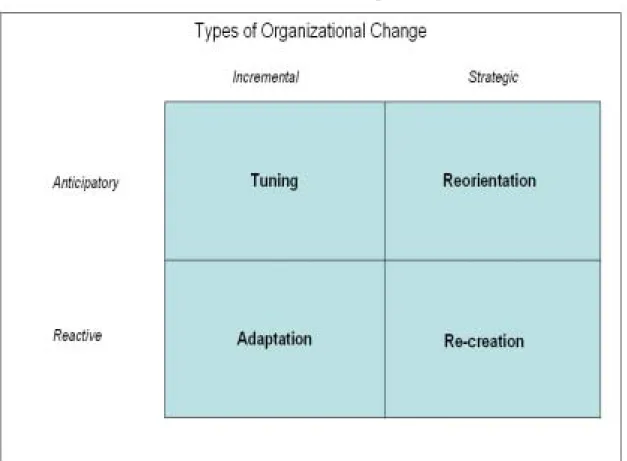
(10) 1. Introduction This chapter introduces the subject of the thesis; it begins with a background and motivation description of the contextual factors which lead to the choice of subject for the thesis. This line of argument is concluded in the formulation of the problem and purpose of the study. Finally, an outline is made for the disposition of the thesis.. 1.1 Background and Motivation According to Kirkbride, Pinnington and Ward (2001) globalization, or the integration of business activities across geographical and organizational boundaries, creates freedom for companies. It makes it possible to buy, produce, distribute, conceive, design and sell products and services with maximum benefit to the firm, without taking into account the consequences for individual geographic locations or organizational units. A multinational firm can be more flexible and thus, better at adapting to a changing market situation, and at seizing new opportunities. This is because it can consider all existing options independent of geographical locations, and choose alternatives that seem best in an economic long-range perspective. An increasing amount of companies in today’s world of business becomes multinational (Daniels, 2003). McDonald and Burton (2002) propose that this increase is due to development in technology which reduces distances between national markets, and leads to the creation of global markets as the principal arena of competition for larger companies. To successfully participate in the exchange on these markets, companies must adopt a global perspective on all of their activities. This creates progressively larger organizations with global cultures and mindsets (Kirkbride, Pinnington & Ward, 2001). Sweden, one of Europe’s most backward and poor countries, went through an economic metamorphosis during the century between 1890 and 1980. The GNP rose by an average of 2.5% per year to make the country one of the richest in the world. Only Japan was comparable with a similar growth (Gurt, 2001). Referring to Britton (2003) the evolution of Sweden from a poor, backward agrarian country to a modern industrialized nation in the space of only half a century is internationally classified as economic miracle. The outstanding export success of Sweden industry during the 20th century made possible the creation of the famous Swedish welfare state. With fewer than nine million inhabitants and located in the freezing Scandinavia, Sweden is an insignificant market in macroeconomic terms. In spite of those deficiencies, Sweden still has more multinational corporations per capita than almost 1.
(11) any other country. IKEA, Absolute Vodka, Volvo, Saab, Ericsson, Electrolux, ABB, AstraZeneca, Pharmacia, Atlas Copco and SKF are only a few of these companies (Britton, 2003). The author found out that Electrolux Group, the Swedish-based multinational corporation, is the world’s largest producer of appliances and equipment for kitchen, cleaning and outdoor use, such as refrigerators, cookers, washing machines, chainsaws, lawn movers and garden tractors. Electrolux is also one of the largest producers in the world of similar equipment for professional users (Electrolux Annual Report, 2003). However, the people of Taiwan are not familiar with this successful white goods giant and till now there are no related publications on the “Strategic Change and Development of the Electrolux Group” in Taiwan. Obviously, Electrolux is a corporation worthy of research. With the opportunity to study in Jönköping University, Sweden as an exchange student in fall 2004, the author fortunately takes advantage of this rare chance to collect data/information related to Electrolux and to interview Anders Edholm, Vice President of Communication and Ingrid Skoglund, Human Resource Director and David Leidenborg, Company Historian, so as to ensure the accuracy of the research. The author wishes the outcome of the research/thesis can help people of Taiwan to become more familiar with the strategic change and development of this successful Swedish-based transnational corporation.. 1.2 Problem and Purpose As suggested in the background, Electrolux, the world’s largest producer of household appliances, is the corporation worthy of research. It is necessary to further investigate the strategic change processes of the company and the factors/forces influencing the formation and implementation of the change processes. However, defining strategic change is more complicated than might initially be perceived. One should not be fooled to believe that it is simply the ability to realize intended strategies, as this definition would underemphasize the importance of emergent strategies and overemphasize the importance and ability of management to foresee and plan for change. The author stresses the need for a more balanced understanding of strategic change, taking into account forces outside the control of management. The purpose of this paper is to use a conceptual model to analyze the capacity for strategic change and then apply the model to assess the change capacity in Electrolux’s three major strategic changes. Through applying the model of capacity for change to analyze the change process of Electrolux, the author will research into the following 2.
(12) problems: • Why was the change initiated? By whom? • Why was the specific strategy (the content of change) chosen? Who formulated it? • What was the strategy for implementing the change (the process)? How was the implementation process conducted? • Characterizing and evaluating the capacity for change in the case company.. 1.3 Disposition of the thesis The objective of this thesis is to examine and analyze the strategic change process of the Swedish-based multinational company—Electrolux Group. This is done in the following steps. In the chapter following the introduction, the frame of reference, the theoretical frameworks underlying the theories of strategic change are explored and the capacity for change model will also be introduced. In the chapter on Methodology, the methodological choices are motivated and the design of the study is worked out and presented. Then, in the chapter of Electrolux, the empirical finding of the development stage model and the history timelines, which are chronological events of Electrolux Group, are introduced and presented. After Electrolux chapter, the author will present, elaborate and analyze the factors/forces behind the three major strategic changes of the case company in the chapter The driving forces and capacity for change. Conclusion is the final chapter of the thesis and it includes a discussion of the results of the study as well as suggestions for further research.. 3.
(13) 2 Literature Review and Conceptual Model The literature review introduces the theories which were used as foundation for development of the study and for analysis of the data collected. The aim of the study is to present the capacity for organizational change model, which will be basis to evaluate the capacity for change of Electrolux Group.. 2.1 Disposition of the literature review This chapter begins with an introduction of the theory of organizational change presented by Nadler and Tushman. Then, a theoretical framework of the major forces behind change will be presented before developing the conceptual model. Initially, a presentation of each of the influential forces identified as affecting the degree of an organization’s capacity for change will be discussed. Two external forces – environment and management fashion – and four internal forces – leadership, resources/capabilities, structure and culture – will be described. After reviewing the forces/factors behind the strategic change, “major forces behind strategic change – model” will be developed and presented. Finally, as the concluding part of describing “major forces behind strategic change – model”, the capacity for organizational change model will be presented. The model shows linkage between intended and realized change, incremental and strategic change, and which will be the theoretical platform for characterizing and evaluating the capacity for change of Electrolux Group.. 2.2 Organizational Change As Nadler and Tushman (1989) discuss, there are different dimensions of organizational change or reorientation. The first of the two dimensions used, discusses the range or the extent of the conducted organizational change. This dimension of extent divides organizational change into incremental and strategic change. The first type of change within this dimension, the incremental, is concerned with how the change is limited to subunits and separate systems of the organization and hence not changing the entire organization. What is described as incremental change is emphasizing the individual mechanisms, with its goal of maintaining or regaining congruence. Incremental change is completed within the organizational template and within the present sets of organizational strategies and components. By other means, it does not address any fundamental changes for the organization. The later type of change within the first dimension, labelled strategic change, addresses the whole organization, including the strategy making process. The changes which are performed in a strategic change are frame breaking, i.e. not in line with the current template and therefore obliterating the pattern of congruence, meanwhile supporting the organization to develop completely new configurations. The strategic change reshapes 4.
(14) and bends or in extreme cases even breaks the organizational frame completely. Nadler and Tushman (1989) state that the second dimension to consider concerning organizational change is the position of change in relation to key external events. By this, the two authors state reactive versus anticipatory change as the two typologies. The change defined as reactive, is a clear response to an event or series of events occurring within the external environment, whereas the latter is covering a proactive stance towards the environment and its dynamics. The discussion of Nadler and Tushman (1989) results in the two dimensional matrix presented below.. Figure 2.1 Types of Organizational Change (Nadler & Tushman, 1989).. 2.3 Influential forces behind change Before the different factors influencing the capacity for change are discussed, the author would like to stress how all influencing forces can be interpreted as either restraining or driving forces, wherefore, this should be taken into consideration when reading the following part. A restraining force is something that is limiting the process of change, whereas a driving force is something that is having a controlling influence on the change and 5.
(15) hence enhancing the change process. The influencing forces are divided into six parts; environment, management fashion, leadership, culture, structure and resources and capabilities. This distinction into internal and external forces has been made in order to make the understanding of what actually influences the capacity for change more comprehensive. The distinction is also in accordance with Melin’s (1989) “Field-of-forces metaphor” where Melin seeks to distinguish the internal and external forces but also the strategic forces of interacting. However, whilst Melin’s model of 1989 purely seeks to describe the forces in the fields, the author aims to be able to see how these factors or forces influence the company’s ability to change. Each category of influential forces, is to be seen as a incorporation of a series factors constituting each force, of which only a small number can be discussed in this paper. Therefore the chapters discussing each influential force are by no means exclusive or exhaustive.. 2.3.1 Environment External factors are factors that the company cannot control and has to adapt to. The organisation should continuously adapt to the environment and monitor it. There are different analyses concerning external factors. The author chooses PESTLE and Porter’s five forces as they are complementary. The first analysis deals with factors which are not usually linked to the firm. The second analysis focuses on external factors which often interact with the firm activity. All these trends are not acting separately but interact between each others. According to Kotler (2003) six external forces can impact the firms’ activity. PESTLE analysis Political-legal: This element is composed of laws, government agencies, pressure groups that influence and limit various organisations and individuals. Sometimes these laws also create new opportunities for businesses. Legislation is important for businesses as it might protect them from unfair competition. It can offer companies opportunities as well as threats if the legislation requires big changes inside the company. Economic: Markets require purchasing power. The purchasing power in an economy depends on current income, prices, savings, debts and credit availability. They must also pay close attention on consumer-spending patterns. Social-cultural: Society shapes our beliefs, values and norms. People absorb a worldview that defines their relationship to themselves, others, organisations, society, nature and to 6.
(16) the universe. The company has to take this into account as it helps to define and understand its customers, its prospects and customer changes. Hence, the firm can prevent certain behaviour and adapt to changes. Furthermore, people make up the markets. The firm has to take care of different factors according to target: Size, growth rate of population in cities, regions, nations, age distribution and ethnic mix, educational level, households’ patterns, regional characteristics and movements. Technological: It is one of the most dramatic forces shaping people live. Every new technology is a force for “creative destruction”. The economy growth rate is affected by how many major new technologies are discovered. New technologies also create major long run consequences that are not always foreseeable. The marketer should monitor the following trends in technology: the pace of change, the opportunities for innovation, varying R&D budgets and increased regulation. Technological changes might change the market positioning of a company dramatically. Environmental: Deterioration of the natural environment is a major global concern that companies has to take into consideration as it has been of growing importance for customers and taken into consideration in legislation and government taxes. New regulations affect certain cities very hard. There are four trends in the natural environment: shortage of raw materials, the increased cost of energy, increased pollution level and the changing role of governments. When doing the analysis of the macro environment the history should be considered – if one only monitors present-day aspects an adequate analysis cannot be attained. It is also essential to acknowledge that the affecting forces within the framework of PESTEL intervene with each other and cannot be analyzed independently (Johnson & Scholes, 2002). Porter’s five forces The Five Forces Model by Porter is used in order to “identify the sources of competition in an industry” (Johnson & Scholes, 2002). The Model recognizes five major forces that have an effect on industry competitiveness. The forces are competitive rivalry, the threat of potential entrants, buying power, supplier power and the threat of substitutes. The main issues for the firms are to find a relevant position within the industry and manage the forces appropriately in order to be profitable. Kotler (2003) summarise Porter’s five forces in its eleventh edition as follows:. 7.
(17) Threat of intense segment rivalry (industry competitors): There are different kinds of threats. Indeed, the competitors can be numerous, strong or aggressive. The market can be stable or declining, plant capacity additions can be done in large steps, fixed costs can be high, exit barriers might be high and competitors can also have high stake in staying in the segment. These engender price wars, advertising battles and new product introductions. Threat of new entrants: If barriers to entry are high and exit barriers are low it might attracts new entrants. Threat of substitutes: There is a danger if actual or potential substitutes for the product appear because it places a limit on prices and profits. Threat of buyers growing bargaining power: There is a threat if the buyers possess as strong or growing bargaining power. This occurs when they are more concentrated or organized, when the product represents significant fraction of the buyer’s costs, when it’s undifferentiated, when buyer’s switching costs are low and when the buyers are price sensitive. Threat of suppliers growing bargaining power: Suppliers bargaining power is high when; they are able to raise prices, reduce quantity to quantity supplied, are concentrated or organised, there exist few substitutes, the costs of switching products are high and when the supplied products are an important input.. 2.3.2 Management fashion Zucker (1998) states that managerial action is often based on fashion rather than on true programs of change (cited in Carson et. al., 2000). Many current and previously popular concepts within the strategy field such as core competences, reengineering and vision can be seen as management fashions (Carson et. al., 2000; Fink, 2003; Clark, 2004). Drucker and Davenport (1997) label managers’ appetite for new fashion as “fashion consciousness” while Carson et. al. (2000) wonder whether this should be seen as an attempt to outsource critical thinking. Carson et. al. (2000) define management fashions in the following terms: (1) subject to social contagion, (2) are or perceived to be innovative, rational and functional, (3) are aimed at encouraging better organizational performance, (4) are motivated by a desire either to remedy some existing operational deficiency or to prospectively capitalize on opportunities for improvement, and (5) are considered to be of transitory value, as 8.
(18) there is no conclusive research showing its efficiency. Adopting management fashion is a way for organizations to signal that they are progressive, committed to change and dealing with their past (Nohria & Berkley, 1994 cited in Carson et. al., 2000). Even though management fads have become broader in their scope and more complex to implement, their life time has actually decreased as managers want to embrace new concepts earlier. The reason is psychological. As environmental pressure increases, a temporal disorientation might cause people to overestimate elapsed time, make quicker decisions and favor change over continuity. Hence, the shorter fashion life time (Carson et. al., 2000). Even though management fashions cannot consistently produce positive results or even be directly inefficient and wasteful (Abrahamson, 1999), managers continuously adopt new ones to “fix the problems”. When fashions are flawed, managers tend to become more risk seeking and adopt more transformational and radical fashions (McGill & Slocum, 1993 cited in Carson et. al., 2000). The author believes that management fashion will act as both an enabler and constraint for organizational change. Institutional pressure forces organizations to adapt to new fashion, but also makes it difficult to implement change not in line with the prevailing fashion. However, the prevailing fashion might not represent the kind of change necessary considering the external environment and strategic drift might occur. Management therefore needs to find a balance between following and fighting the fashion.. 2.3.3 Leadership Mintzberg and Waters (1983) argue that in order to initiate the conceptual strategic change the strategist’s mind-set must be altered before a change can occur. Furthermore, the ability to unfreeze the mind or recognize a change necessity is stressed in order to make a change happen and then refreeze it after implementation. Organizations ought to have a strategist with an appropriate mind-set in relation to the organizational setting. Scholars suggest three main configurations for the strategist (see Table 2.1). First, if an organization encompasses a simple structure the strategist’s mind as a concept attainer is the most appropriate – one leader that devises and conceives corporate strategy. Second, if the setting is a machine bureaucracy the mind-set of a 9.
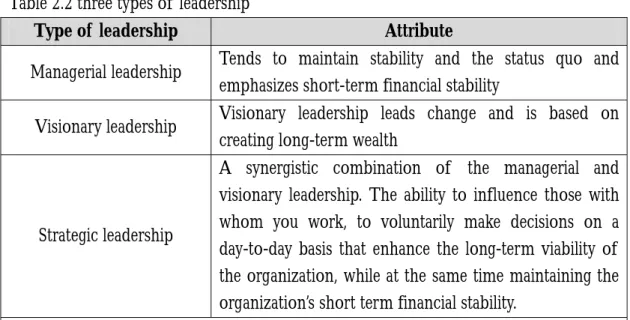
(19) planner is the most relevant – planning or implementing an already pursued strategy. The last configuration in a setting of complex adhocracy emphasizes the fact that “every man is a strategist” (Mintzberg and Waters, 1983) while strategist is perceived as a pattern recognizer (Mintzberg and Waters, 1983). Table 2.1 the role of strategist in different configurations The role of the strategist in three different configurations Configuration. The role of the strategist. Simple structure. Concept attainer. Machine Bureaucracy. planner. Adhocracy. Pattern recognizer Source: the mind of strategists (Mintzberg & Water, 1983). According to Hellgren & Melin (1993) there is a necessity to focus on a leader or strategist’s way of thinking in order to comprehend strategic change processes at a profound level. The strategist’s way of thinking reflects the leader’s life experience and personality – which constitute the way the leader thinks. Furthermore, it comprises reasonably stable assumptions, values, and thoughts regarding the leadership role. Hellgren & Melin (1993) claim that the way of thinking is relatively difficult to change since it is highly dependant on the setting. A leader with an established way of thinking who works in an environment with values as stable as his or hers will find it hard to initiate radical change. However, the degree of power the leader has is also important – if the power is high enough the leader can to some extent neglect the established values and environment and pursue his or her way of thinking (Hellgren & Melin, 1993). Rowe (2001) identifies three forms of leadership and their effects on performance: managerial, visionary and strategic. Managerial leadership tends to maintain stability and the status quo, whereas visionary leadership leads change. But strategic leadership is the most powerful. He defines strategic leadership as the ability to influence those with whom you work, to voluntarily make decisions on a day-to-day basis that enhance the long-term viability of the organization, while at the same time maintaining the organization’s short term financial stability. Rowe’s study, based on theory and anecdotal evidence, shows that strategic leadership has a dramatic effect on a company’s performance, greater than managerial and visionary combined. He argues that strategic leadership is something more powerful a synergistic combination of the managerial and visionary leadership (Rowe, 2001).. 10.
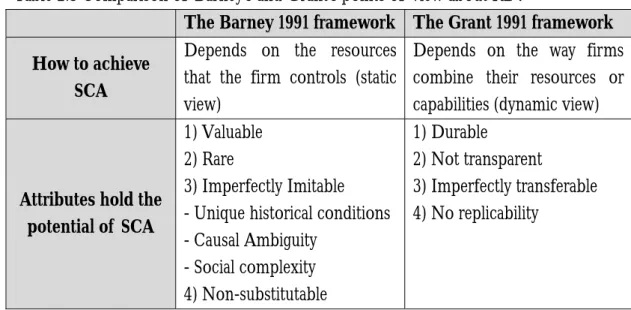
(20) Table 2.2 three types of leadership Type of leadership. Attribute. Managerial leadership. Tends to maintain stability and the status quo and emphasizes short-term financial stability. Visionary leadership. Visionary leadership leads change and is based on creating long-term wealth. Strategic leadership. A synergistic combination of the managerial and visionary leadership. The ability to influence those with whom you work, to voluntarily make decisions on a day-to-day basis that enhance the long-term viability of the organization, while at the same time maintaining the organization’s short term financial stability.. Source: Creating wealth in organisations: The role of strategic leadership (Rowe, 2001). 2.3.4 Resources and capabilities The resources a firm can control are physical, human, financial and intellectual capital. The resources can be categorized as inadequate, threshold and unique. The inadequate resources do not adequately meet the needed level of performance standards. The threshold resources are the resources needed to stay in business while the unique ones create competitive advantage and are intricate to imitate (Johnson & Scholes, 2002). The resource based view has a focal point on the intrinsic aspects of a firm and views the aggregated firms as heterogeneous regarding the resources and capabilities they control in contrast to the environmental extrinsic view of resource homogeneity within the industry. The resource based view can be seen as an “inside-out” (Connor, 2002) method in supporting the development and management of an adequate strategy. There are different views regarding how the resources may support a sustainable competitive advantage. Barney (1991) argues that a sustainable competitive advantage can be attained if a firm controls adequate resources. However, according to Grant (1991) the essential part is the way in which the firms combine their resources and acknowledged capabilities in order to create a sustainable competitive advantage. Furthermore, Prahalad & Hamel (1990) argue that core competences are the resources or competences a firm controls which create or support sustainable competitive advantage. A prerequisite regarding the potential of creating a sustainable competitive advantage is that the resources encompass certain features. According to Barney’s (1991) static view 11.
(21) resources should be valuable, rare, imperfectly imitable, and non-substitutable. Grant (1991) has a dynamic view and stresses the necessity that capabilities and resources are durable, not transparent, imperfectly transferable, and non-replicable. Table 2.3 Comparison of Barney’s and Grant’s points of view about RBV The Barney 1991 framework The Grant 1991 framework How to achieve SCA. Attributes hold the potential of SCA. Depends on the resources Depends on the way firms that the firm controls (static combine their resources or view) capabilities (dynamic view) 1) Valuable 2) Rare 3) Imperfectly Imitable - Unique historical conditions - Causal Ambiguity - Social complexity 4) Non-substitutable. 1) Durable 2) Not transparent 3) Imperfectly transferable 4) No replicability. 2.3.5 Culture One of the forces that influence organization’s capacity for change is culture. Numerous attempts have been made to identify this organizational phenomenon and its impact on the changes an organization is undergoing. Though depending on the trends among scholars and general changes the definitions of corporate culture vary, the most frequent explanation is that of ‘shared philosophies, ideologies, values, assumptions, beliefs, expectations, attitudes and norms that knit a community together’ (Kilmann, Saxton, & Serpa, 1985). Mintzberg and Westley (1992) refer to culture as the broadest conceptual level encompassing influential factors in the strategic change processes. Despite the variety of definitions, most of the authors agree that culture is a collective phenomenon that has to be viewed as part of the organizational totality: corporate culture can not be changed or altered separately from the rest of organization and is dependant on an integrative and systematic approach towards all organizational components. Kilman, Saxton, and Serpa (1985) clearly state that corporate culture can not be dictated and imposed as a top-bottom process by the top managers. Nonetheless, managers play a pivotal role in culture formation, transmission of values, acceptable ways of thinking and behaving in an organization. According to Schein (1992) managers play an essential role of ‘culture embedding mechanisms’: they continuously measure and monitor, react to and interpret environmental and internal changes. Finally, as Barney (1991) claims, culture is also one of the valuable, rare and hard to imitate resources around which a company may attempt to build its sustainable 12.
(22) competitive advantage. Yet the most important aspect of culture with regards to organizational change depends on the level of its direction, pervasiveness, and strength, as defined by Kilmann, Saxton, and Serpa(1985). Direction refers to culture’s ability to influence members’ behavior and guide them towards accomplishment of organizational goals; pervasiveness depends on the degree of embeddedness of shared values among the members, while strength indicates the level to which culture can affect the employees. The degree of the enumerated factors as well as their fit with organizational structure and strategy influences culture’s impact as a hindering or driving force behind organizational change, its pace and degree. Therefore, it is important to have a change-oriented culture and managers that can draw the lines for the guiding behavior among organization’s members and as a result enhance capacity for change. Finally, it is impossible to change culture without making adjustments to organizational structure, its systems and programs, goals and visions (Minzberg & Westley, 1992).. 2.3.6 Structure Another important factor, perhaps not driving change in itself but allowing it to flow more or less smoothly, is the organisational structure. Structure is the conceptual and functional framework of an organisation, as well as the configuration of its resources (Hall & Saias, 1980). In other words this can be viewed as external (macro) and internal (micro) structure. Researchers argue about whether strategy follows structure or vice versa. The most common view is the one proposed by Chandler (1962) stating that the environment and the resources of the organisation influences the strategy which in turn determines the organisational structure. In the article Strategy Follows Structure by Hall and Saias (1980) the Chandler (1962) model of change is reviewed. Among other things the authors highlight; unless structure follows strategy, inefficient results will occur. However they also argue that strategy grows out of structure and in turn may lead to its modification (Hall & Saias, 1980). This reversed view that strategy follows structure is brought up by authors on the topic in the Melin (1989) Field of Force article. From a strategic choice viewpoint it is here mentioned that certain strategy is evolving from inside the organisation and is consequently partly a result of the existing structure. As above mentioned the discussion about whether strategy drives structure or vice versa could go on and on. Suffice it to say that there is a reciprocal relationship between the two. As Mintzberg (cited in Amburgey & Dacin, 1994) states, strategy and structure do follow one another as the left foot follow the right- but they do not have equal strides. 13.
(23) Bureaucratic structures can be reasons as to why some strategies plans fail. For example when there are inconsistencies between operational and strategic plans or when the rigidity of structure does not allow for important alterations in the implication processes. Amburgey and Dacin (1994) further mention that strategic perceptions are conditioned by structure. Hall and Saias (1980) also highlights how elements of structural characteristics act like a filter and by paying greater or lesser attention to incoming information determines what the organisation is able to see. When information is interesting it is transmitted to other elements of the structure. At the same time and on the contrary if information gatekeepers judge the information to be irrelevant for the organisation there will be a halt in the information flow. If an organisation has experienced success in the past it might be inclined to act according to these past achievements even though the present and future events demand change of structure and activities. Research indicate that decentralized structures tend to respond rapidly to events, whilst bureaucratic structures restrict the information flow and limits the ability to pick up on relevant information that otherwise would initiate change (Hall & Saias, 1980).. 2.4 Conceptual model Based on the influential forces described above, the author has developed a “major forces behind strategic change – model” and a “capacity for organizational change—model” to explain an organization’s capacity for change (Figure 2.2 & Figure 2.3).. 14.
(24) Figure 2.2 Major forces behind strategic change--model. 2.4.1 Major forces behind strategic change -- model It is necessary to elaborate each element of the model so as to make sense the figure and make the readers comprehend it. The argumentation of the intended and realized degree of change combining with the influential forces will be stated as follows: Organizational change has been defined by numerous scholars and categorized in several ways. One way to look upon this work is to asses the level of consensus between initial state, end state and the intention those in between. Organizational change can be characterized as a continuous adaptation or a radical change process (Nadler & Tushman, 1989; Melin & Hellgren, 1994), or according to Mintzberg and Westley (1992) as a system of moving cycles. Davenport (1993) chooses to examine change using the pace of change as one dimension. Periods where the pace of change is high Davenport refers to as process innovation, whereas periods with a lower pace of change are referred to as process improvements. A model that captures the capacity for change as a process will hence find it difficult to define the initial and end point of a particular change process. As a solution, the suggested model introduces two reference points, the intended and the realized degree of change, which in retrospective can be considered as start and end of a set of organizational change processes. The model advocates that the realized degree of change is dependent on the organization’s capacity for change under influence of external and internal factors. It also argues that the congruence between the intended and realized degree of change will be an indicator for the capacity for change of the organization. The term degree of change refers to the direction and the extent of the change concerning the organization and its counterparts. High congruence, i.e. a high similarity in direction and extent of intended and realized change, is interpreted as a sufficient capacity for change. Low congruence, i.e. a low similarity in direction and extent of intended and realized change, is interpreted as insufficient capacity for change. The outcome of the totality of the change process is then related to the initial intent and becomes the realized change, determined and influenced by the capacity for change. As already argued, the amount of congruence is influenced by external and internal factors, which were described in more detail in chapter 2.3. The Major forces behind strategic change - model (Figure 2.2) takes into account four internal and two external forces that represent driving and restraining forces, which are exerted upon and in the 15.
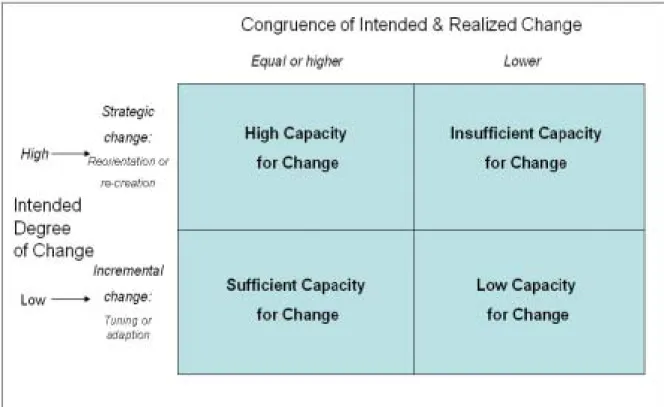
(25) interplay with the organization, of the capacity for change. All factors are interrelated and affect each other in direct or indirect ways. For instance, leadership might be affected by management fashion but management fashion might also be affected by outstanding leadership which in turn might affect the environment. The internal factors; resources, leadership, structure and culture will to a varying degree increase the organization’s acceptance for change and affect the strategic change process while management fashion and environment will to a varying degree act as external stimuli for change and influence organization’s strategic change process as well. The capacity for change will depend on how they interplay.. 2.4.2 Capacity for Organizational Change—model Strategic change should not be perceived as a simple, linear and static process, but rather an ambiguous, iterative interplay between internal and external forces of varying strength both enabling and constraining the change. Even though this view makes it more difficult for both researchers and practitioners to isolate and understand the effect of individual forces, the simplification of the real phenomena cannot be made to a degree where one looses sight of reality. To assess the capacity for organizational change we need to determine how the influential forces influence the capability. In order to explicitly explain the capacity for organizational change and to be clear about the underlying perspectives and beliefs, the author proposes a “capacity for organizational change—model” (Figure 2.3), which is a two dimensional typology describing the linkage of intended and realized change, and incremental and strategic change.. 16.
(26) Figure 2.3 The Capacity for Organizational Change -- model The first dimension of the typology presented, reflects upon the degree or level of change. The previous discussion on different types of changes explained by Nadler & Tushman (1989) is here integrated and two types of organizational change, strategic and incremental, are distinguished. The authors encourage the readers to keep in mind that a strategic change refers to a change affecting the company in a fundamental way, whilst an incremental change satisfies with concerning specific parts or subsystems. The second dimension of the typology regards the congruence of the intended and the realized change of the company. The congruence refers to the extent of resemblance and correspondence between the degree of intended change, strategic or incremental, and the actual outcome, the degree of realized change. The mathematical meaning of congruence is hence not demanded, a softer interpretation is to be undertaken. The congruence of intended and realized is determined primarily by the interplaying of the influential external/internal forces i.e. resources, the culture, the leadership, the environment and management fashion. The reasoning is as follows: If competitive advantage will depend on the current resources they will constitute an enabling factor, but if the strategic change will change the basis for competitive advantage and new resources and capabilities need to be developed, resources might act 17.
(27) as a constrain for change. The culture has to be “in-line” with the change effort, meaning that values, norms and beliefs should not be threatened by change in order for the culture to be an enabling factor. Clearly, the more radical a change effort is, the larger the risk of culture being a constraining factor. Leadership might be a strongly constraining or enabling factor. As the leaders way of thinking has shown consistency over time and strong influence over resources, culture and strategic action, the capacity for change will be highly influenced by leadership. When both management fashion and the environment encourage change, the external stimuli are obviously high. This will often occur in the late stage of any change process, when the need for change is evident. However, management fashion might be lagging behind environment and thus act as a constraining force for change. The author’s typology results in four views on the capacity for change when the two dimensions are combined. The upper-left corner symbolizes an organization that manages to fulfill or even extend the initially intended degree of change. This implies that the corporation through effectively identifying, taking into account the influential forces and acting upon them reaches the aspired end state of the cyclical processes of change. The capacity of change is hence high. The upper-right corner is the result of an intended strategic change where the resulted degree of change is lower than it was initially expected to be. In this case the corporation has failed in responding and interacting with the influential forces. As a result, the capacity for change is insufficient for the intended strategic change. Moving on to the lower-left corner the intended organizational change is of an incremental character and the realized degree of change is equal or higher than the intended incremental change. This implies that the capacity for change of the organization is at least sufficient for the change in question. The capacity can thereby also exceed the change demanded by the corporation. The fourth result, namely the lower-right corner, symbolizes a situation which no company would see as advantageous to be in. It represents an organization that is so stable and unable to respond to dynamics of the environment and the industry, which the capacity for change is even so low that an incremental change cannot be carried out. Thus, it is an understatement to say other than the capacity for change is low. As a concluding part of the presentation of the Capacity for Organizational Change –model, the readers have been presented with the intention and extension of the suggested model. As emphasized previously, it is all a question about continuous processes affected by influential external/internal forces, which either drive or restrain the organizational change.. 18.
(28) 3. Methodology The chapter describes the chosen method and why it is relevant for the study. The interviewees are also presented. Finally, the data collection process is being described.. 3.1 Choice of Method-Qualitative and Case Study Approach In the thesis, the author has been chosen to use a qualitative approach and case study approach. Therefore, the characteristics of these approaches must be presented.. 3.1.1 Qualitative approach According to Denzin and Lincoln (1994) qualitative research is multi-method in focus, involving an interpretive, naturalistic approach to its subject matter. This means that qualitative researchers study things in their natural settings, attempting to make sense of or interpret phenomena in terms of the meanings people bring to them. Qualitative research involves the studied use and collection of a variety of empirical materials case study, personal experience, introspective, life story interview, observational, historical, interactional, and visual texts-that describe routine and problematic moments and meaning in individuals' lives. Cresswell (1994) also defines the Qualitative research is an inquiry process of understanding based on distinct methodological traditions of inquiry that explore a social or human problem. The researcher builds a complex, holistic picture, analyzes words, reports detailed views of informants, and conducts the study in a natural setting. Hussey and Hussey (1997) describe the qualitative approach as subjective and suggest that taking this perspective implies that the researcher examines and reflects on apprehensions of individuals to gain an understanding of human and social activities. Quantitative approaches conversely, are of objective nature. Studies employing this approach, measures phenomena through the collection of numerical data which are analyzed by statistical methods. To exemplify this, Easterby-Smith, Thorpe and Lowe (2002) propose that the distinguishing feature of qualitative interviews is the objective to gain an understanding of the perceptions held by interviewees on certain issues, or in relation to situations unstructured by the researcher. Quantitative interviews comparatively, are characterized by their high degree of structure, and by that questions should be precisely formulated and tested for validity in advance. Often, there are a pre-set number of expected answers to questions contained in a qualitative interview so that responses can be coded and analyzed by statistical methods. In the study of the thesis, what should be studied empirically are the perspectives held by members of the core group of a company. Since apprehensions are hard to measure 19.
(29) quantitatively (through utilization of methods used within natural science) it is seemed feasible to employ a qualitative approach. In relation to notions presented above, the aim as well as the context of this study, supports the adaptation of a qualitative approach.. 3.1.2 Case study approach According to Yin (1989) case studies aim to seek answers on questions of how and why type. Further, a case approach entails an empirical enquiry that places a contemporary phenomenon and the context are rarely clearly evident and where multiple sources of evidence may be utilized. This approach has been widely used in the social sciences, not only for exploratory purposes, but also for descriptive as well as explanatory reasons. These thoughts are corresponded by Gilliam’s (2001) definition of a case. He states that a case is a unit of human activity which is embedded in the real world. It has to be studied in its current context, so that the boundaries between the perceived phenomenon and the context are hard to draw. The advantages of conducting a case study are that it facilitates to view the organization from the inside out to get the true view of the activities within the organization, and to get the perspective of the people involved (Gilliam. 2001). In order to obtain relevant information, Maxwell (1996) suggests that purposeful sampling should be used, meaning that interviews only should be conducted with persons who have a certain position within the company, or possess information that no one else within the company does. Marshall and Rossman (1999) refer to this as elite interviewing. Elites are the people who are influential, well-informed and possess expertise knowledge of the research area. The reasons for choosing an approach that aims to respond to how and why a phenomenon has occurred are quite obvious. The author are interested in finding out how Electrolux looked like before the changes, what it looks like after the changes, and how it is intended to look like in the future. Besides, there are several reasons why such an approach is appropriate in this study. Firstly, the definitions of strategy, change, and perceived influences on change are too broad and simultaneously too complex for reliance on self-reported data collected using structured questionnaires. It is the researcher’s understanding of these concepts that must be in focus. Since communicating this understanding to others is difficult and time consuming, the researcher must be involved, “hands on”, both in data collection and in data analysis. The case study approach that employed here certainly permits for this. Secondly, in order to acquire the sort of data needed to answer the research questions and to ensure that these data are adequately comprehensive, several types of 20.
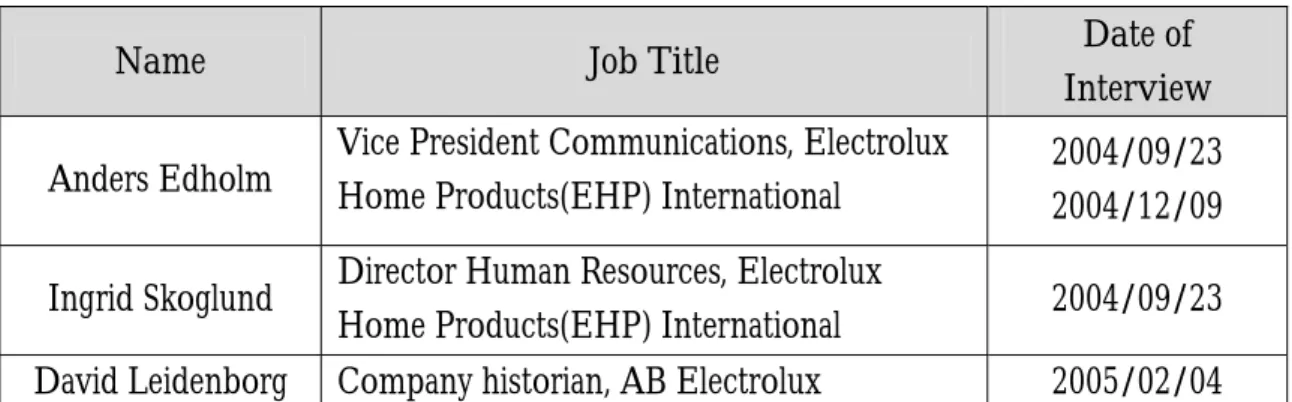
(30) data sources may have to be utilized in regard to the case company, especially considering the extended periods of time involved. Thirdly, this research project is concerned with various perceived influences on change. Perceptions with respect to both the internal and the external context in which change occurs must be taken into consideration for any real understanding of change to be generated (see e.g. Melin & Hellgren, 1994). In case study approach, this type of contextual approach is in focus.. 3.2 Selection of interviewees The design of the sampling process used for selecting interviewees could be described as a combination of judgmental and convenience sampling. Williams (1997) as well as Hussey and Hussey (1997) propose that a judgmental is obtained through the selection of typical or representative elements in a population. Maxwell (1996) and Marshall & Rossman (1999) suggest that purposeful sampling and elite interviewing should be used in order to obtain relevant information. The criteria for selection are determined by the researcher in conjunction with, or based on the suggestions made by these experts. On this instance, contacts were made with individuals at the management levels of Electrolux Group. The author assumes these individuals are knowledgeable about the strategic change and development of the company. With the assumption as a foundation, several potential interviewees were then contacted either directly through directly or through their secretaries. Occasionally, the prospective interviewees referred to other individuals who in their opinions would have a better background or knowledge to answer this type of questions. Therefore, the original list of potential respondents where slightly revised during the process of making initial contact with prospective research subjects. The complete list of interviewees is presented below. Table 3.1 List of interviewees Name. Job Title. Date of Interview. Anders Edholm. Vice President Communications, Electrolux Home Products(EHP) International. 2004/09/23 2004/12/09. Ingrid Skoglund. Director Human Resources, Electrolux Home Products(EHP) International. 2004/09/23. Company historian, AB Electrolux. 2005/02/04. David Leidenborg. The above table shows the three individuals interviewed and the dates when the interviews were conducted. As is suggested by their job titles, they all have either high positions within the product divisions/group staffs or well-informed knowledge 21.
(31) pertains to the research. This implies they could be the Elites who are influential, well-informed and possess expertise knowledge of the research area (Marshall and Rossman, 1999).. 3.3 Interviews According to Alvesson and Deetz (2000, p. 194) most qualitative studies have an objective to examine the perceptions, ideas, and thoughts of a group of individuals, and this is hard to do without talking to them. Therefore, “the most common qualitative method is the loosely structured interview.” The method is difficult to handle, but useful or even indispensable for obtaining information and perceptions of people existing in the context of interest. This perspective is supported by Hussey and Hussey (1997, p.158) they propose that “despite their advantages” interviews are often time consuming, costly and can be hard to record and analyze, they make it possible to obtain deepened knowledge on complex issues. Further, they often provide a higher degree of confidentiality than regular questionnaires. To be able to identify and analyze the strategic changes of Electrolux Group as well as forces behind the changes, there is a need to get access to individuals in the high management levels within the company. As suggested by Alvesson and Deetz (2000) and Easterby-Smith, Thorpe and Lowe (2002) a distinctive feature of management research is that managers are extremely busy people. Therefore, the cost of their time has to be considered in the development of a study. “Short interview, fitted into busy schedules, are likely to be much more feasible than unstructured observations and discussions which can take a lot of time”. (Easterby-Smith, Thorpe & Lowe, 2002, p.8) This notion constituted the basis for the development of questions, as well as the interview format, for the study.. 3.4 The process of interviews During the summer of 2004, the author started the pre-study and the research began. Meanwhile, the current case company and topic were selected after discussions with the adviser of master thesis. Those discussions were done before the author set off to Jönköping, Sweden in summer 2004. The first step of the data collection after arriving Sweden was to establish contact with Mats Dahlin, the Host Company Coordinator of Jönköping International Business School. Mr. Dahlin provided the contact information of the managers in Norrahammar, Electrolux Compact Appliance; he thought these 22.
(32) contacts might be helpful for the research. However, the managers in Norrahammar, Electrolux Compact Appliance, recommended the author to contact managers in the headquarters of Electrolux since managers in the high management level would be knowledgeable with the strategy-related issues about the Group. Finally, due to the purpose of the study, the interviewees mentioned above (chapter 3.2) were selected, and they were contacted via e-mail. The initially e-mails contained information about the study and what at the same is aimed to investigate. After initial e-mail and phone contact were made, the questionnaires, based on the information/data from the pre-study, were e-mailed to the interviewees on beforehand so that the interviewees could prepare themselves for the interviews. This procedure was repeated for each of the interviews. The formats of interviews were either face to face interviews or phone interviews. Besides, the interviewees had the option of answering the questions in writing and emailing them back if that were of more convenience to them. During the interviews, a digital recorder was used. The author asked for approval from interviewees for usage before the interviews started. The digital recorder is considered to be a complement to the interviewer, and not a substitute, throughout the interviews (Yin, 1989). The recorded files were transcribed directly after the interview. After the interviews, the author organized the answers taken during the interview and e-mail back to interviewee to make sure the accuracy of the answers taken and avoid any misunderstandings.. 3.5 Collection of Second-hand Information Before leaving to Sweden, the author collected information from library of National Sun Yat-Sen University and asked information from Electrolux subsidiary in Taiwan. Additional internal and external company information was gathered while the author was in Sweden. With the help of Anita Christiansson, Executive Assistant of Professional Outdoor Products Electrolux, the author gained access to the corporate annual reports which are not available on the Internet. The external information/data were gathered from library of Jönköping International Business School and the Electrolux corporate homepage.. 23.
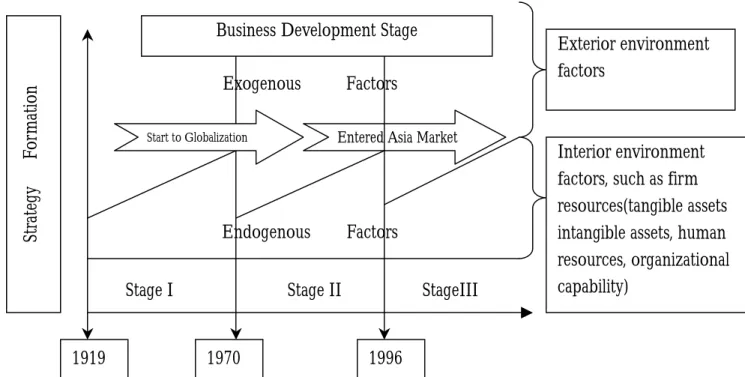
(33) 4. Electrolux The aim of this chapter is to propose The Electrolux development stage model, which indicates three major strategic changes and four development strategies of the Electrolux Group. The stage model will be the basis for the analysis in the following chapter. Brief introduction of the company as well as history timeline1of each stage will be presented. The origin of Electrolux, founded in 1919, can be traced back to the introduction of the vacuum cleaner, the invention of the absorption refrigerator and a marketing genius named Axel Wenner-Gren. Today, with sales of SEK 120.7 billion, Electrolux is the world’s largest producer of appliances and equipment for kitchen, cleaning and outdoor use, such as refrigerators, cookers, washing machines, chainsaws, lawn mowers and garden tractors. Electrolux is also one of the largest producers in the world of similar equipment for professional users (Electrolux Annual Report, 2004). Electrolux is focusing on three business segments: household appliances, professional appliances and outdoor products (Electrolux Corporate Homepage, 2004). The author proposed a tentative Electrolux's development stage model (Figure 4.1) before conducting interview with managers of Electrolux Group. After reviewing the development history and interviewing Anders Edholm, Vice President of Communication and Ingrid Skoglund, Human Resource Director, the tentative Electrolux's development stage model (Figure 4.1) was revised to the Group’s development stage model (Figure 4.2), which precisely depicts the development of the Group.. 1 The history timeline is retrieved from Electrolux website (www.electrolux.com) and Electrolux Annual Reports and organized by the author.. 24.
(34) Business Development Stage Formation. Exogenous. Strategy. Factors Entered Asia Market. Start to Globalization. Endogenous Stage I. 1919. Exterior environment factors. Factors. Stage II. 1970. StageIII. Interior environment factors, such as firm resources(tangible assets intangible assets, human resources, organizational capability). 1996. Figure 4.1 Tentative Electrolux's development stage model. Figure 4.2 Electrolux's development stage model.. 4.1 Stage I: Emerging Strategy--Building the Global Company In 1912, the company started the business by inventing the world’s first vacuum cleaner and direct sales through salesman was the way to sell the products. The world’s first absorption refrigerator was also launched in 1925. The first stage was the first major 25.
(35) invention and marketing innovation (A. Edholm, personal communication, 2004-09-23), that is, Electrolux was the first company to market a consumer friendly vacuum cleaner and refrigerator at that time. Gurt (2001) indicates that in 1920’s, many companies tried to make refrigerators but a very good solution had not yet been found. A lot of compressor driven refrigerators were being produced, but they were expensive, clumsy, noisy and unreliable. Especially in the hot American summers the need for preserving food in suitably low temperatures was a factor that urged industrialists to find a solution. The most common way to keep food cool was to use ice boxes, and funnily enough Sweden exported ice blocks for these for a long time. In 1925, Electrolux purchases Arctic, a refrigerator-manufacturing company, and launches the first absorption refrigerator, the "D-fridge", which solves the problem of storing fresh food at home. The absorption refrigerator when it was presented to the world in the 1920’s really was a world sensation (Gurt, 2001). Right from the start, the Electrolux became an international company. After WWI, the firm contracted sales agents in Germany, England, and France. In 1926, the first foreign manufacturing facility for vacuum cleaners was started in Berlin. A year later, the international expansion was followed by investments in factories in England and France. The primary purpose was to produce vacuum cleaners, but as time passed refrigerators were added to the program. By 1928, the firm had annual sales of SEK 70 million, five operating factories, some 20 subsidiaries, and 350 offices throughout the world. As the 1930s approached, the firm entered the large North America market, and in 1931 a manufacturing facility for vacuum cleaners was completed in Connecticut. Although WWII slowed down the rate of expansion, Electrolux managed to establish additional factories in New Zealand and Australia in the early 1940s (Ridderstråle, 1996). In this period, the company set up plants for production in a number of countries all around the world, most of which in Europe. Referring to D. Leidenborg (personal communication, 2005-02-04), though it is very hard to connect “emerging strategy” of stage I to Axel Wenner-Gren, the founder of Electrolux, the strategy of stage I should be defined “emerging strategy-building a global company” since Axel Wenner-Gren was very focusing on building this company global. He set up subsidiaries in as many countries as possible to approach consumers through direct sales selling which he thought the easiest way of influencing a human being is by speaking directly to him/her.. 26.
(36) Table 4.1 History Timeline of Stage I History Timeline of Stage I (1910~1967) Year. Descriptions of Events. 1901. AB Lux, Stockholm, is established. The company launches the Lux lamp - a kerosene lamp for outdoor use - which proves to be a tremendous sales success. The lamp is also used in lighthouses all over the world.. 1908. Lux moves to a plant at Lilla Essingen in Stockholm. The company feels the competition from electric lighting and looks for new products.. 1910. Elektromekaniska is established in Stockholm. 1912. Collaboration between Lux and Axel Wenner-Gren begins. The first vacuum cleaner, the Lux 1, is produced at Lilla Essingen. Axel Wenner-Gren becomes the agent for Lux in Germany, United Kingdom and France. Home sales begin in Sweden. The salesmen, who pull the heavy machines through the streets on hand-carts, must arrange a demonstration time when the housewife can promise that her husband/breadwinner will be home to approve the investment. 1915. Axel Wenner-Gren sets up the sales company Svenska Elektron (later Finans AB Svetro). The method of home demonstration and hire purchase becomes increasingly well-established and proves a great success.. 1917. On October 30, 1917, Elektron (In which Axel Wenner.Gren owns a large interest) purchases all the shares of Elektromekaniska. Wenner-Gren is elected member of the board of Elektromekaniska and likewise, Sven Carlstedt joins the board of Elektron.. 1918. Elektron and Lux sign a cooperative agreement for the following: (1)Lux is to take over operations of Svenska Elektron, increasing its share capital from SEK 3 million to SEK 4 million. (2)Svenska Elektron, which had previously bought Elektromekaniska, is to buy 49% of the shares of AB Lux. Wenner-Gren and Carlstedt are elected to the board of Lux. Wenner-Gren is appointed VD and Carlstedt is appointed technical director.. 1919. On August 1, an agreement is reached between AB Lux and Svenska Elektron AB (in which Wenner-Gren is the dominating owner) giving Elektron the sole sales rights to AB Lux vacuum cleaners. The agreement, which is valid through 1929, obligates Elektron to buy its vacuum cleaners from Lux and show Lux the manufacturer on all the vacuum cleaners. At the Annual General Meeting on August 29, Elektromekaniska AB (wholly owned by Wenner-Gren-dominated 27.
數據
+7
相關文件
Cowell, The Jātaka, or Stories of the Buddha's Former Births, Book XXII, pp.
• When a system undergoes any chemical or physical change, the accompanying change in internal energy, ΔE, is the sum of the heat added to or liberated from the system, q, and the
Students are expected to explain the effects of change in demand and/or change in supply on equilibrium price and quantity, with the aid of diagram(s). Consumer and producer
Teachers may consider the school’s aims and conditions or even the language environment to select the most appropriate approach according to students’ need and ability; or develop
Wang, Solving pseudomonotone variational inequalities and pseudocon- vex optimization problems using the projection neural network, IEEE Transactions on Neural Networks 17
It is intended in this project to integrate the similar curricula in the Architecture and Construction Engineering departments to better yet simpler ones and to create also a new
Define instead the imaginary.. potential, magnetic field, lattice…) Dirac-BdG Hamiltonian:. with small, and matrix
Consistent with the negative price of systematic volatility risk found by the option pricing studies, we see lower average raw returns, CAPM alphas, and FF-3 alphas with higher
