Ultraviolet GaN-based microdisk laser with AlN/AlGaN distributed Bragg reflector
Cheng-Chang Chen, M. H. Shih, Yi-Chun Yang, and Hao-Chung Kuo
Citation: Applied Physics Letters 96, 151115 (2010); doi: 10.1063/1.3399781
View online: http://dx.doi.org/10.1063/1.3399781
View Table of Contents: http://scitation.aip.org/content/aip/journal/apl/96/15?ver=pdfcov Published by the AIP Publishing
Articles you may be interested in
Lasing properties of non-polar GaN quantum dots in cubic aluminum nitride microdisk cavities Appl. Phys. Lett. 103, 021107 (2013); 10.1063/1.4813408
Lasing in GaN microdisks pivoted on Si
Appl. Phys. Lett. 89, 211101 (2006); 10.1063/1.2392673
Fabrication and performance of blue GaN-based vertical-cavity surface emitting laser employing AlN GaN and Ta 2 O 5 SiO 2 distributed Bragg reflector
Appl. Phys. Lett. 87, 081105 (2005); 10.1063/1.2032598 Photonic molecule laser composed of GaInAsP microdisks Appl. Phys. Lett. 86, 041112 (2005); 10.1063/1.1855388
Highly reflective distributed Bragg reflectors using a deeply etched semiconductor/air grating for InGaN/GaN laser diodes
Appl. Phys. Lett. 82, 4426 (2003); 10.1063/1.1586992
This article is copyrighted as indicated in the article. Reuse of AIP content is subject to the terms at: http://scitation.aip.org/termsconditions. Downloaded to IP: 140.113.38.11 On: Wed, 30 Apr 2014 08:34:46
Ultraviolet GaN-based microdisk laser with AlN/AlGaN distributed
Bragg reflector
Cheng-Chang Chen,1M. H. Shih,1,2,a兲 Yi-Chun Yang,2and Hao-Chung Kuo1
1Department of Photonic, Institute of Electro-Optical Engineering, National Chiao Tung University, Hsinchu 300, Taiwan
2Research Center for Applied Sciences (RCAS), Academia Sinica, Taipei 11529, Taiwan
共Received 1 February 2010; accepted 19 March 2010; published online 16 April 2010兲
We demonstrated a 4.7 m GaN-based microdisk laser with 25-pair AlN/AlGaN distributed Bragg reflector in ultraviolet range without undercut or deeply-etching procedures. The distributed Bragg reflector provides a high reflectivity of 85%, and selects lasing mode around 375 nm wavelength. Under optical pumping conditions, the lasing action was observed with a low threshold power density of 0.03 kW/cm2. We also characterized the whispering gallery mode profiles of the
microdisk with finite-different time-domain simulation. © 2010 American Institute of Physics. 关doi:10.1063/1.3399781兴
In recent years, GaN-based materials have been attracted a lot of attention for applications due to the large direct band gap and the promising potential for the optoelectronic de-vices, including light emitting diodes 共LEDs兲 and laser diodes.1–5The high reflectivity GaN-based distributed Bragg reflector 共DBR兲 is one of key elements for GaN optical de-vices such as resonant cavity light-emitting diodes6 and vertical-cavity surface-emitting lasers.7,8To extend the appli-cations of GaN-based lasers/LEDs into UV region, there are many studies related to the UV GaN-based DBR.9–14 Blue-light microdisk lasers have also been reported in GaN-based suspended membranes formed by photoelectrochemical etching.4,5,15In this paper, we demonstrated a UV GaN-based microdisk laser in AlN/AlGaN DBR platform without chemi-cal undercut process. This type GaN laser not only simplifies the fabrication procedures but also benefits electrically pumped scheme and thermal conduction of the compact la-sers. To achieve a good vertical confinement, an AlN/AlGaN UV DBR structure was designed on the bottom of the micro-disk cavity. It can be acted as a mirror to reflect light from the bottom area and a lower refractive index layer to control guided modes.
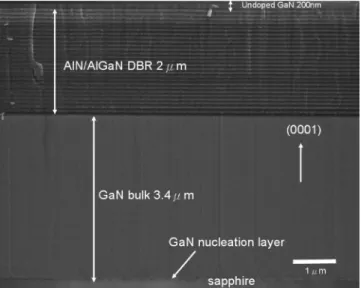
GaN microdisk cavities were implanted in an ultraviolet GaN-based AlN/AlGaN DBR structure. AlN/AlGaN DBR structure was grown by a low pressure metal-organic chemi-cal vapor deposition system. A 3.4 m thick undoped GaN was first grown on a C-plane共0001兲 sapphire substrate. Then 25-pair AlN/Al0.2Ga0.8N structure was grown at 900 ° C,
fol-lowed by a 200 nm undoped GaN gain layer on the top of epitaxial structure. The cross-section SEM image of UV DBR was shown in Fig.1. The growth details were reported in our previous works.16,17A 300 nm silicon nitride layer and a 300 nm polymethylmethacrylate 共PMMA兲 layer were de-posited on the top of GaN wafer as the masks during the processes. Microdisk patterns were defined on the PMMA layer by electron beam lithography. The patterns were then transferred into the DBR layer by reactive ion etching with CHF3/O2 mixture and inductive coupled plasma etching
with Cl2/Ar mixture.
The illustration of a microdisk on the AlN/AlGaN DBR structure is shown in Fig. 2共a兲. Figure 2共b兲 is a top-view SEM image of a microdisk array, and Fig. 2共c兲is the mag-nified image of a microdisk from an angle-view. The size of fabricated microdisk is approximately 4.7 m in diameter. Its etch depth was about 500 nm, which includes 200 nm undoped GaN and 300 nm DBR layers was decided by the vertical profile of whispering gallery modes. Chemical un-dercut or deeply etching steps are unnecessary for this GaN microdisk because of good vertical confinement from DBR structure, compare to GaN microdisk cavity without DBR.4,5,18
To understand optical properties of AlN/AlGaN DBR structure, the reflectivity was characterized. The UV DBR structure is designed for the UV wavelength around 370 nm. The thickness of AlN and AlGaN layers are 45 and 42 nm decided by the formula dAlN=/4nAlN and dAlGaN
=/4nAlGaN. Here nAlN and nAlGaN are refractive indices of
AlN and AlGaN which are 2.03 and 2.19, respectively. The dashed curve in Fig.3 is the simulated reflectivity spectrum from transmission matrix method for the UV DBR. The solid
a兲Electronic mail: [email protected]. FIG. 1. A SEM image of UV DBR from cross-section view. The totalthickness of 25-pairs AlN/AlGaN is about 2 m.
APPLIED PHYSICS LETTERS 96, 151115共2010兲
0003-6951/2010/96共15兲/151115/3/$30.00 96, 151115-1 © 2010 American Institute of Physics
This article is copyrighted as indicated in the article. Reuse of AIP content is subject to the terms at: http://scitation.aip.org/termsconditions. Downloaded to IP: 140.113.38.11 On: Wed, 30 Apr 2014 08:34:46
curve in Fig. 3 is the measured spectrum with a normal in-cident light from 300 to 440 nm wavelength. The DBR has the highest reflectivity of 85% at 375 nm wavelength with 15 nm stop-band width.
The fabricated GaN-based microdisk cavities were then optically pumped by using a frequency-tripled Nd: YVO4 355 nm pulsed laser with a pulse width of 0.5 ns and a repetition rate of 1 kHz. The normal incident beam has a spot size of 50 m which can cover the whole microdisk. The light emission from the device was collected by a 15⫻ ob-jective lens through a multimode fiber, and coupled into a spectrometer with the charge-coupled device detectors.
Figure4共a兲shows the measured PL spectrum from non-pattern area of the UV DBR sample. The gain peak of the undoped GaN is located around 360 nm wavelength. The lasing action of the GaN microdisk cavity on the DBR struc-ture was observed during the characterization. Figure 4共b兲 shows the measured spectra from a 4.7 m microdisk cavity below共red兲 and above 共black兲 threshold. There are four reso-nant modes in the spectrum which are labeled with mode A, B, C, and D. Two lasing modes共mode A and mode B兲 were observed at 377 nm and 379 nm wavelength. Figure 4共c兲 shows the light-in light-out 共L-L兲 curves of mode A 共black兲 and mode B 共red兲. Their threshold power densities are 0.03 kW/cm2and 0.043 kW/cm2, respectively. By
estimat-ing the ratio of wavelength to linewidth 共/⌬兲 around
transparency, the quality factors 共Q兲 of mode A and B are approximately 400 and 320. The Q value could be raised by increasing the etching depth and smoothing the sidewall of the GaN microdisk cavity.
To understand more details of lasing modes, the finite-difference time-domain method 共FDTD兲 with the effective index was used to perform the simulation for this 4.7 m microdisk. Figure 4共d兲 provides the comparison between simulation and measurement. The blue curve is the measured spectrum, and the red curve is the simulated spectrum from FDTD. The four resonant modes共mode A, B, C, and D兲 are all match well to high response modes from the simulation. Top two figures of Fig.4共d兲 are calculated Hzmode profiles
of lasing modes at 377 and 379 nm wavelength. Two lasing modes, mode A and mode B were verified to be the first-order and third-first-order whispering-gallery modes 共WGM兲 from FDTD calculated mode profiles. Since the higher-order whispering-gallery mode usually has a lower Q value, the mode B has a higher threshold which is observed from the L-L curves in Fig. 4共c兲.
In the GaN-based microdisk cavity, the UV DBR plays an important role to select the lasing wavelength region. The gain peak of the GaN without the DBR is around 360 nm wavelength, however the lasing and resonant modes are around 377 nm wavelength. This 17 nm difference in wave-length is attributed to the reflection of the UV DBR mirror. The region of resonant mode also agrees to the bandwidth of DBR reflectivity spectrum in Fig.3. This DBR effect in the GaN expitaxial structure had been observed in our previous works.17We should note that the reflectivity spectrum is
usu-FIG. 2. 共Color online兲 共a兲 Schematic structure of a GaN-based microdisk with AlN/AlGaN DBR.共b兲 A SEM image of a GaN microdisk array with diameters of 7, 4.7, and 3 m.共c兲 A magnified SEM image of a 4.7 m GaN microdisk from an angle-view.
FIG. 3.共Color online兲 Calculated 共dashed兲 and measured 共solid兲 reflectivity spectra of the UV DBR with 25-pairs AlN/AlGaN.
FIG. 4.共Color online兲 共a兲 PL spectrum of undoped GaN on the top layer. 共b兲 Measured spectra from a microdisk laser below and above threshold. Lasing wavelengths of the microdisk are 377 and 379 nm.共c兲 The light-in light-out curve共L-L curve兲 from the microdisk laser. 共d兲 Comparison of FDTD simu-lation共red兲 and measurement 共blue兲. Top two inset figures are calculated Hz mode profiles of mode A and B.
151115-2 Chen et al. Appl. Phys. Lett. 96, 151115共2010兲
This article is copyrighted as indicated in the article. Reuse of AIP content is subject to the terms at: http://scitation.aip.org/termsconditions. Downloaded to IP: 140.113.38.11 On: Wed, 30 Apr 2014 08:34:46
ally calculated by considering a single plane wave with an incident angle in transmission matrix method. However, WGM modes contain many different wavevectors. The re-flectivity of the DBR should be considered comprehensively with all possible incident angles of optical mode. But the vertical incident component still dominates due to small size of WGM modes. The UV DBR also reduces number of reso-nant modes in a microdisk because of its bandwidth. The mode reduction decreases energy waste on nonlasing modes. Therefore a high efficient GaN laser can be expected. For future applications, the cavity with DBR structure opens a possibility to select wavelength for lasers.
In summary, we had demonstrated a compact GaN-based microdisk laser with UV AlN/AlGaN DBR structure. Two lasing modes were observed at 377 and 379 nm wavelength with low thresholds of 0.03 and 0.043 kW/cm2. This DBR
structure has strong advantages in simplifying fabrication and tuning lasing wavelength.
The authors are grateful to the support by Center for Nano Science and Technology of NCTU and the National Science Council of the Republic of China, Taiwan under Contract No. NSC 96-2628-E009-017-MY3.
1S. Nakamura, M. Senoh, N. Iwasa, and S. Nagahama,Jpn. J. Appl. Phys. 34, L797共1995兲.
2S. Nakamura, T. Mukai, and M. Senoh,Appl. Phys. Lett.64, 1687共1994兲. 3S. Nakamura, S. Pearton, and G. Fasol, The Blue Laser Diode: The
Com-plete Story共Springer, Berlin, 2000兲.
4E. D. Haberer, R. Sharma, C. Meier, A. R. Stonas, S. Nakamura, S. P.
DenBaars, and E. L. Hu,Appl. Phys. Lett. 85, 5179共2004兲.
5A. C. Tamboli, E. D. Haberer, R. Sharma, K. H. Lee, S. Nakamura, and E.
L. Hu,Nat. Photonics 1, 61共2006兲.
6M. Diagne, Y. He, H. Zhou, E. Makarona, A. V. Nurmikko, J. Han, K. E.
Waldrip, J. J. Figiel, T. Takeuchi, and M. Krames,Appl. Phys. Lett. 79,
3720共2001兲.
7T. C. Lu, S. W. Chen, L. F. Lin, T. T. Kao, C. C. Kao, P. Yu, H. C. Kuo,
S. C. Wang, and S. Fan,Appl. Phys. Lett. 92, 011129共2008兲.
8T. C. Lu, C. C. Kao, H. C. Kuo, G. S. Huang, and S. C. Wang,Appl. Phys.
Lett. 92, 141102共2008兲.
9C. G. Moe, Y. Wu, J. Piprek, S. Keller, J. S. Speck, S. P. DenBaars, and D.
Emerson,Phys. Status Solidi A 203, 1915共2006兲.
10Z. L. Xie, R. Zhang, B. Liua, X. L. Ji, L. Li, C. X. Liu, R. L. Jiang, H. M.
Gong, H. Zhao, P. Han, Y. Shi, and Y. D. Zheng,J. Cryst. Growth 298,
691共2007兲.
11T. Jeong, H. H. Lee, S. H. Park, J. H. Baek, and J. K. Lee,Jpn. J. Appl.
Phys. 47, 8811共2008兲.
12E. Feltin, J. F. Carlin, J. Dorsaz, G. Christmann, R. Butte, M. Laugt, M.
Llegems, and N. Grandjean,Appl. Phys. Lett. 88, 051108共2006兲. 13O. Mitrofanov, S. Schmult, M. J. Manfra, T. Siegrist, N. G. Weimann, A.
M. Sergent, and R. J. Molnar,Appl. Phys. Lett. 88, 171101共2006兲. 14A. Bhattacharyya, S. Iyer, E. Iliopoulos, A. V. Sampath, J. Cabalu, T. D.
Moustakas, and I. Friel,J. Vac. Sci. Technol. B 20, 1229共2002兲. 15E. D. Haberer, C. Meier, R. Sharma, A. R. Stonas, S. P. DenBaars, S.
Nakamura, and E. L. Hu,Phys. Status Solidi C 2, 2845共2005兲. 16G. S. Huang, T. C. Lu, H. H. Yao, H. C. Kuo, S. C. Wang, C. W. Lin, and
L. Chang,Appl. Phys. Lett. 88, 061904共2006兲.
17J. R. Chen, S. C. Ling, C. T. Hung, T. S. Ko, T. C. Lu, H. C. Kuo, and S.
C. Wang,J. Cryst. Growth 310, 4871共2008兲.
18A. C. Tamboli, M. C. Schmidt, A. Hirai, S. P. DenBaars, and E. L. Hu,J.
Electrochem. Soc. 156, H767共2009兲.
151115-3 Chen et al. Appl. Phys. Lett. 96, 151115共2010兲
This article is copyrighted as indicated in the article. Reuse of AIP content is subject to the terms at: http://scitation.aip.org/termsconditions. Downloaded to IP: 140.113.38.11 On: Wed, 30 Apr 2014 08:34:46