A
Study on Blends
of
liquid Crystalline Copolyesters
with Polycarbonate.
II.
Transesterification Control
KUNC-HWA WEI* and KOE-FU SU
Institute of Materials Science and Engineering, National Chiao Tung University, Hsinchu, Taiwan, Republic of China
SYNOPSIS
The inhibited and catalyzed ester exchange (transesterification) during melt blending of poly(bispheno1-A carbonate) (PC) and liquid crystalline poly(oxybenz0ate-co-ethylene
terephthalate) (POB-PET 40/60; P46) was investigated with differential scanning calo- rimetry. It was found that the ester exchange between P46 and PC was effectively inhibited for a 20% P46 blend at 240°C, as further confirmed by nuclear magnetic spectroscopy. When the blending temperature and P46 concentration increased, only the transesterifi- cation between the PET segment in P46 and PC took place under inhibition. The mor- phology of the blends was analyzed with scanning electron microscopy and displayed a disconnected interface between P46 and PC under inhibition. Conversely, the transester- ification took place between the POB segment in P46 and PC when a catalyst was added.
0 1996 John Wiley & Sons, Inc.
I N TRO D U CTI
0
N
Liquid crystalline polymer ( LCP ) blends have been studied extensively in recent years.',* The motivation was first to use the high-tensile modulus of the LCPs in the solid state to reinforce the matrix polymers. Second, the low viscosity of the LCPs can reduce the overall viscosity of the blend and is a good pro- cessing aid. In general, blending several percent to about 20% of LCP with matrix polymers would give the two mentioned advantages without incurring the high cost of the LCP.
The homogeneity of polymer blends depends on the compatibility or the interaction between poly- mers. The degree of interaction between two poly- mers is best described by the free energy of mixing,
AG, which contains enthalpic
( A H )
and entropic( A S ) contributions. For a blend to be a single phase,
the necessary condition is AG c 0. The entropy terms are usually small, and the enthalpy terms dominate the free energy of mixing in polymer blends. In general, the favorable (exothermic) heat of mixing resulted from some interaction between
* To whom correspondence should be addressed.
Journal of Applied Polymer Science, Vol. 59, 787-796 (1996)
0 1996 John Wiley & Sons, Inc. CCC OOZl-8995/96/050787-10
the polymers. The introduction of interacting groups by chemical modification of a polymer or by copo- lymerization can result in a negative contribution to the enthalpy of mixing.
The enthalpy of mixing rigid-rod LCPs with a flexible-coil polymer was mostly positive. Conse- quently, phase separation of the LCP blend occurred during processing, where high stress and high tem- perature e ~ i s t e d . ~ Introducing some kind of inter- action between these two dissimilar polymers is necessary to improve the compatibility of the two polymers. The previous work by our group4 was concerned with the compatibility by the transester- ification between polycarbonate ( P C ) and liquid crystalline poly ( oxybenzoate- co-ethylene tereph- thalate) (POB-PET) of composition 40/60, de- noted as P46. The main result was that for blends containing more than 20% P46 the compatibility between the two polymers increased with the ester exchange reaction. As transesterification continues,
the blends convert first to block copolymers and, finally, to random copolymer^.^ When the blends are in the form of random copolymers, the benefits of adding LCP to the matrix will be lost. To have some transesterification between the liquid crystal- line copolyester and the matrix polymer without losing the liquid crystalline characteristics becomes 787
788 WE1 AND SU
191.5t"C
an important research goal. This work was intended to control the transesterification by using catalysts or inhibitors. The ideal situation is that the ester exchange reaction can be stopped at the point where mostly the PET segment was reacted with PC (for compatibility) and without proceeding to the POB segment (for liquid crystalline). In this way, the liquid crystalline characteristics of the P46 blend will be retained.
EXPERIMENTAL
Materials
Liquid crystalline poly ( oxybenzoate- co-ethylene terephthalate) (POB-PET) was synthesized by adding p -acetoxybenzoic acid monomers to poly (ethylene terephthalate) ( P E T ) following the method described in the literature.6 The intrinsic viscosity of the P E T used in the synthesis was 0.6 dL/g. The p-acetoxybenzoic acid monomer was purchased from Shang Hu Corp. The composition of POB-PET was 40/60, and it was termed P46. P46 exhibited birefringence when it was heated up to 300°C and then cooled down. Polycarbonate ( P C ) was obtained from the Shin Kwang Corp. The num- ber-average molecular weight of the PC was 17,000. The chemical structures of P46 and PC are shown in Figure 1.
Methods
The powder of the liquid crystalline P46 and PC pellets was dried at 110°C under vacuum for 8 h prior to the mixing. Thirty grams of the mixtures of P46 and PC in different weight ratios were put into a Brabender mixer. To study the effect of the inhibition, three sets of experiments of different composition were carried out: 20, 30, and 40% P46 in the matrix of PC. Triphenyl phosphate and tetrabutylorthotitane (TBOT)
,
both 0.5% by weight, were used as an inhibitor and a catalyst, respectively, for controlling the ester exchange be- tween PC and P46. They were added to the mixture separately and dispersed with a spatula for 10 min. Then, the mixture was put into a Brabender. The speed of the roller blade was 50 rpm. The blending temperatures were set a t 240, 250, and 260°C.The thermal analysis of the blends was carried out with a DuPont 2910 differential scanning calo- rimeter (DSC)
.
The samples were heated up from 30 to 220°C at a heating rate of 20°C per min and were maintained at 220°C for 1 min. Then, the sam- ples were quenched down to 0°C with liquid nitro- gen. The samples were heated again from 0 to 300°C at the same heating rate. The DSC curves of the samples were taken the second time when the sam- ples were heated up a t the heating rate of 20°C per min. For the chemical structure analysis, the blends were dissolved in deuterated chloroform for 4 h;0
Figure 1
PC and P46 at a heating rate of 2OoC per min.
BLENDS OF LC COPOLYESTERS WITH PC. I1 789 m
z
2
.1
m w E POB block G O M I N S O M I N 4 O M I N 3 0 H I N 20MIN i O M I N 7'I 1'I 50 100 150 200 250 300 3 T e m p e r a t u r e ("C) 0 Figure 2after being mixed for different times a t 240°C.
The differential scanning calorimetry curves of the blend containing 20% P46
then, the undissolved particles were filtered with a syringe filter. Tetramethylsilane was added to the solution as an internal reference standard, and the liquid mixture was put in a nuclear magnetic reso- nance ( N M R ) tube. A Varian Fourier transformed NMR (unity-300) was used for this study. For the morphology analysis, the blends were put in the DSC and heated at a heating rate of 40°C per min to 22O"C, remaining at 220°C for 1 min and air-cooled to room temperature. The samples were taken out of the DSC and quenched in liquid nitrogen. Then, the samples were fractured and coated with 10 nm- thick gold for scanning electron microscopy study. The trace of the residual catalyst was analyzed with a wavelength dispersive spectrometer ( WDS) , Mi- crospec WDS 3 pc, attached to a Hitachi S-2500 scanning electron microscopy.
RESULTS AND DISCUSSION
The chemical structures and the DSC curves of PC and P46 are shown in Figure 1. The glass transition temperatures are 141°C for the PC and 52.5"C for P46, respectively. Two melting peaks appeared for the P46 case. The one a t 191.56"C represents the diluted melting point of the POB block in P46. The other one a t 236.73"C is the melting point of the
P E T block in P46. The P46 is, therefore, a block copolymer. In Figure 2, the DSC curves of different blending times of the 20% P46 blend a t 240°C are shown. The glass transition temperature ( T , ) of the PC and P46 decreased with blending time from 126.65"C a t 10 min to 122.93"C a t 60 min. The de- crease of the Tg might be due to a partial plastizing and a partial ester exchange effect, as explained in our previous article! The melting peak of the PET block disappeared, and that of the POB block, after 60 min. When triphenylphosphate was added to the blend, the Tg of the blend decreased less with the
blending time.
Additionally, the melting peaks of PET and POB were preserved with time, as shown in Figure 3. As the concentration of P46 in the blend increased to 30% and the blending temperature increased to 26OoC, the T, of the blend decreased dramatically to 108.83"C at 60 min blending time, as shown in Figure 4. In Figure 4, both the melting peaks of P E T and POB almost totally disappeared after 60 min. In the case of inhibited blend, the T, of the 30% P46 blend was retained around 123°C throughout the 60 min, as in Figure 5. In Figure 5, the melting peak of the PET block disappeared, and the melting peak of the POB block still existed after 60 min. This is an interesting effect in that the triphenyl- phosphate inhibited the ester exchange between the
790 WE1 AND SU B O N N 30MIN 1OHIN I I I , 50 100 150 200 250 300 3 T e m p e r a t u r e ("GI Figure 3
and 0.5% triphenylphosphate after being mixed for different times a t 240°C.
The differential scanning calorimetry curves of the blend containing 20% P46
II\ BOMIN SOMIN 4 0 H I N 3OHIN . 20MIN I 1 50 100 150 200 250 300 9 T e m p e r a t u r e ("13 0 Figure 4
after being mixed for different times at 260°C.
BLENDS OF LC COPOLYESTERS WITH PC. I1 791
-
60HIN JOMIN DHIN r r I I I I 0 50 100 150 200 250 300 3 Tamperature (-1 io Figure 5and 0.5% triphenylphosphate after being mixed for different times a t 260°C.
The differential scanning calorimetry curves of the blend containing 30% P46
m z
B
2
m9
\ 6OMIN 5 O M I N 40MIN 30HIN EOMIN I r 8 7 50 100 150 200 250 300 T e m p e r a t u r e ("C) 0 Figure 6after being mixed for different times a t 250°C.
792 WE1 AND SU
PC and the POB block more than that between the PC and the PET block in P46. In Figure 6, the TB of the 20% P46 blend decreased to 119.75"C after 60 min a t 250°C. Moreover, the melting peak of the
P E T block disappeared and the melting peak of the
POB block remained. When the catalyst was added
to the mixture, the
Tg
of the blend decreased just a little faster than that in the case of the blend without adding the catalyst, as in Figure 7. Also, the melting peak of the POB block disappeared, and the melting peak of the PET block remained. This is contrary to the case of the inhibited blend.The micrographs of 20% P46 blends from scan-
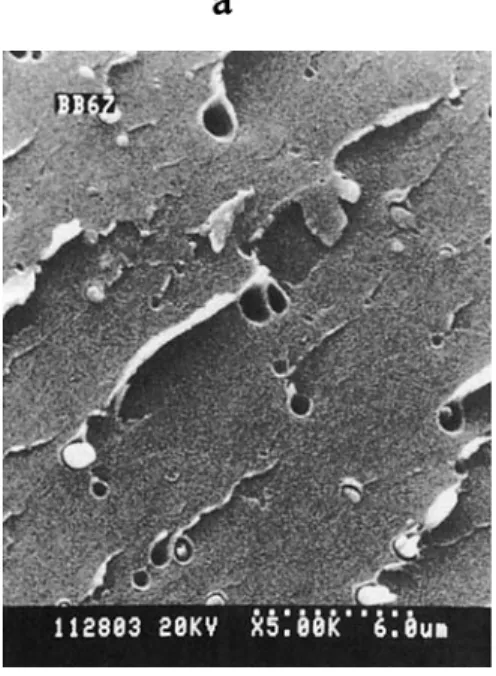
ning electron microscopy study are shown in Figure 8. In Figure 8 ( a ) , it is shown that after 60 min mix-
ing at 260°C there were only a few 0.5 micron drop-
lets left. On the contrary, there were quite a few 1
micron droplets left in the case of the inhibited blend under the same blending conditions, as shown in Figure 8( b )
.
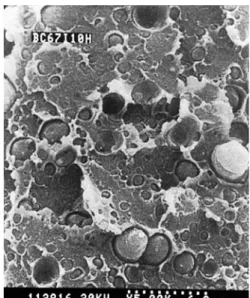
For the 30% P46 blend, droplets of lessthan 1 micron appeared after 40 min at 260°C. In
the inhibited case, there were P46 droplets larger
than 2.5 microns and the droplets seemed discon-
nected from the PC matrix, as shown in Figure 8 ( c ) and ( d )
.
As the blending time increased, the 30% P46 blend became more homogeneous. In the inhib-ited case, there were still 1.5 micron droplets left.
The same blend morphology trend can be observed
for longer blending times and higher P46 concen-
tration in the blend, as in Figure 9. After being mixed
a t 260°C for 60 min, there were only a few 1 micron
droplets left in both the 30 and 40% P46 blend, as
shown in Figure 9 ( a ) and ( c ) , whereas, the inhibited
blends displayed distinctively two phases with 1.5
micron P46 droplets dispersed in the PC matrix.
Further evidence on the effect of inhibition can be found in the nuclear magnetic resonance (NMR)
study. Figure 10 ( a )
-
( c ) represents the 13C-NMRspectra of PC, the 20% P46 blend with inhibition,
and the 20% P46 blend, respectively. The ethylene
peak from the PET block appeared a t 63 ppm and
the ester peak from P46 appeared at 165 ppm clearly
for the case of 20% P46 blend, as in Figure 10 ( c )
.
This is an indication that the ester exchange took place and the two functional groups were attached to the PC molecule. For the inhibited case, in Figure 10 ( b )
,
the two peaks are much smaller. Therefore, the inhibitor, triphenylphosphate, was effective in the case of the 20% P46 blend.As mentioned in the l i t e r a t ~ r e , ~ there were re- sidual catalysts such as the titanium compound or Sb203 left after the polymerization of PET. A wavelength dispersive spectrometer ( WDS ) anal- ysis on the PET used in the synthesis of P46 was
carried out. There was about 0.064% Sb metal
found in the PET. A possible explanation on the
5 0 100 150 200 250 300 3!
T e m p e r a t u r e ('C)
0
Figure 7
and 0.5% TBOT after being mixed for different times at 250°C.
a
BLENDS OF LC COPOLYESTERS WITH PC. I1 793
b
d
C
Figure 8 SEM micrographs of (a) 20% P46 blend mixed at 260°C for 60 min, (b) inhibited 20% P46 blend mixed at 260'C for 60 min, (c) 30% P46 blend mixed a t 26OoC for 40 min, and (d) inhibited 30% P46 blend mixed a t 260°C for 40 min.
selective inhibition of the ester exchange between in the P E T segment. While in POB segment, the the POB-PET and the PC was as follows: First, phosphate remained. Therefore, the ester ex- one assumed that the phosphate inhibitor was change took place between the P E T segment and dispersed homogeneously in the blend. Then, the the PC first. In the case of the catalyzed blend, phosphate reacted with the residual catalyst Sb203 the concentration of TBOT in the POB segment,
794 WE1 AND SU
a
C
b
d
Figure 9 SEM micrographs of (a) 30% P46 blend mixed at 260°C for 60 min, (b) inhibited 30% P46 blend mixed at 260°C for 60 min, (c) 40% P46 blend mixed at 260°C for 60 min, and (d) inhibited 40% P46 blend mixed at 26OOC for 60 min.
0.5%, was higher than that of the Sb203 already existing in PET segment. Therefore, the ester ex- change took place first between the POB segment and PC.
CONCLUSION
The transesterification between P46 and PC in a 20% P46 blend at 240°C was effectively inhibited
BLENDS OF LC COPOLYESTERS WITH PC. I1 795
i
796 WE1 AND SU
by adding the phosphate compound. When both the blending temperature and the P46 concentration
increased, only the ester exchange between the PET
segment in P46 and PC took place. Conversely, only
the transesterification between the POB segment in P46 and PC took place when the tinate compound
was added as the catalyst. The selective ester ex- change between P46 and PC resulted from the con-
centration difference between the residual catalyst from polymerization and the inhibitor or the catalyst used in this study,
The authors appreciate the financial support provided by
the National Science Council through Project NSC83-
0405-E009-009. We also thank Mr. H. J. Jang and Mr. W. J. Hwang for the help in the SEM work.
REFERENCES
1. G. Kiss, Polym. Eng. Sci., 2 7 , 4 1 0 (1987).
2. A. Kolhi, N. Chung, and R. A. Weiss, Polym. Eng.
Sci., 2 9 , 5 7 3 (1989).
3. P. Tang, J. A. Reimer, and M. M. Denn, Macromol-
ecules, 26,4269 ( 1993).
4. K. F. Su and K. H. Wei, J . Appl. Polym. Sci., 6 6 , 79
(1995).
5. R. S. Porter and L. H. Wang, Polymer, 33, 2019
( 1992).
6. T. H. Thinn, J. Y. Chen, and C. C. Lin, J. Appl. Polym. Sci., 47,1233 (1993).
7. A. Golovoy, M. F. Cheung, K. R. Carduner, and M. J.
Rokosz, Polym. Eng. Sci., 29,1226-1231 ( 1989).
Received June 16, 1995 Accepted July 22, 1995