Whittaker function approach to determine the impurity energy levels of coated
quantum dots
Ming-Chieh Lin and Der-San Chuu
Citation: Journal of Applied Physics 90, 2886 (2001); doi: 10.1063/1.1397282 View online: http://dx.doi.org/10.1063/1.1397282
View Table of Contents: http://scitation.aip.org/content/aip/journal/jap/90/6?ver=pdfcov Published by the AIP Publishing
Articles you may be interested in
Effects of electric field and shape on the ground state energy of an exciton bound to an ionized donor impurity in ellipsoidal quantum dots
J. Appl. Phys. 114, 194301 (2013); 10.1063/1.4831664
The inter-sublevel optical properties of a spherical quantum dot-quantum well with and without a donor impurity J. Appl. Phys. 112, 053717 (2012); 10.1063/1.4751483
The electronic properties of a core/shell/well/shell spherical quantum dot with and without a hydrogenic impurity J. Appl. Phys. 111, 083702 (2012); 10.1063/1.3702874
Binding energy of a hydrogenic donor impurity in a rectangular parallelepiped-shaped quantum dot: Quantum confinement and Stark effects
J. Appl. Phys. 101, 093716 (2007); 10.1063/1.2734097
Binding energy of impurity states in spherical quantum dots with parabolic confinement J. Appl. Phys. 83, 3089 (1998); 10.1063/1.367065
Whittaker function approach to determine the impurity energy levels
of coated quantum dots
Ming-Chieh Lin and Der-San Chuua)
Department of Electrophysics, National Chiao Tung University, Hsinchu, Taiwan 30050, Republic of China 共Received 20 March 2001; accepted for publication 26 June 2001兲
The electronic structure of a hydrogenic impurity atom located at the center of a multilayer coated quantum dot共CQD兲 is investigated. The electronic eigenstates of the CQD system are expressed in terms of the geometry and the material parameters by solving the Schro¨dinger equations analytically. Image potential effects are ignored and the effective mass approximation is employed. The ground state energy is found to be strongly influenced by the shell thickness and confined potential. In contrast to previous work, our eigenfunctions are expressed in terms of the Whittaker functions in any region, no matter where the energy levels are, i.e., whether they are higher or lower than the potential barriers. Our approach is simpler and has general significance, e.g., the bound state eigenenergies of any n-layered quantum dot can be easily determined by directly solving just ‘‘one’’(2n⫺2)-rank secular determinant equation instead of solving 2n equations. One can also easily and quickly determine whether a system has bound states by using the Whittaker function approach. © 2001 American Institute of Physics. 关DOI: 10.1063/1.1397282兴
I. INTRODUCTION
In recent years, due to the advancement of modern crystal-growth techniques, it has been possible to fabricate various quasilow-dimensional structures of semiconductors such as quasitwo-dimensional quantum wells 共QWs兲, quasione-dimensional quantum well wires 共QWWs兲 and quasizero-dimensional quantum dots共QDs兲. These structures are obtained when the spatial dimensions of the conventional structures are reduced to those comparable to or less than the de Broglie wavelength of the carriers. For QDs, the ultimate goal is an artificial atom whose properties can be controlled well through the material parameters and geometry.1 Re-cently, the electronic structures of the quantum dot, espe-cially the donor states, acceptor states, and excitons, have received much attention. As a result of their possible appli-cations in microelectronic devices, the quantum structures have been the subject of extensive theoretical and experi-mental research.
Much theoretical work has been devoted to the study of the properties of electronic states in various confining sys-tems. Bastard2reported the first calculation for binding ener-gies of hydrogenic impurities in QWs. In his calculation, the binding energy of a hydrogenic impurity was found to vary with the position of the impurity and with the thickness of the well. Brown and Spector3and Weber et al.4reported cal-culations of binding energies and density of impurity states in GaAs⫺共Ga,Al兲As QWWs as a function of the radius of the structure. Zhu, Xiong and Gu5 considered the hydrogenic donor states in a spherical quantum dot of GaAs⫺AlxGa1⫺xAs. They reported that the binding energy for the ground state of a donor at the center of a quantum dot is strongly dependent on the dimensionality and barrier height. In previous work, the impurity states in quantum dots
and quantum wires for the infinite potential confinement,6the Whittaker functions and Coulomb wave functions for the impurity eigenfunctions of the quantum dot were obtained for different energy ranges. The calculated result showed that the ground state energy of the impurity approaches the cor-rect limit of the three-dimensional hydrogen atom as the ra-dius of the quantum dot becomes very large.
Recently, it has proven possible to fabricate multilayer quantum dots which are composed of different semiconduc-tor materials in each layer. In analogy to quantum well struc-tures, they have been named quantum dot quantum wells,7–9 or, simply, a coated quantum dots共CQDs兲. An extended the-oretical approach for calculating the 1s – 1s electronic tran-sition in spherical layered semiconductor quantum dots was presented by Schooss et al.10Their calculations were carried out for the quantum dot quantum well CdS/HgS/CdS and compared to recently available experiment results. In their approach, a linear combination of the spherical Bessel and Neumann functions for the electron eigenfunctions of the CQD was assumed in regions where the energy level is lower than the potential barrier (E⬍V), and a linear combination of the two Hankel functions was proposed in regions where the energy level is higher than the potential barrier 共E⬎V兲. In the present study, we investigate the electronic struc-ture of a hydrogenic impurity atom located at the center of a quasizero-dimensional CQD. Our model is constructed as a dot made of one kind of semiconductor material surrounded by a layer of another kind and then embedded into a different bulk material. It is obvious that the coated quantum dot will be equivalent to the simple quantum dot if the confinement potential in the shell is equal to that in the bulk共outside the shell兲. The geometrical shape of the coated quantum dot is chosen as spherical, because it is easier to solve. In the CQD system, we solve the Schro¨dinger equations analytically, and obtain the electronic eigenstates as functions of the geometry and the material parameters theoretically. Image potential
ef-a兲Corresponding author; electronic mail: [email protected]
2886
0021-8979/2001/90(6)/2886/6/$18.00 © 2001 American Institute of Physics
fects in our system are ignored11and the effective mass ap-proximation is employed although it is not always perfect.12 In our treatment, the eigenfunctions are always expressed in terms of Whittaker functions only, no matter where the en-ergy levels are, i.e., whether they are higher or lower than the potential barriers. After employing the boundary conditions, the eigenenergies are obtained by solving ‘‘one’’ four-rank secular determinant equation, although imaginary numbers might appear during the calculation. When we deal with bound states, the imaginary part of the energy E approaches zero automatically. The numerical result of the ground state energy is presented in the present work for illustration. We must emphasize here that our treatment is simpler than those of previous works in which it was assumed that a different form of eigenfunction exists in different energy regions. Conventionally, we must choose one of two wave functions corresponding to E⬍V and E⬎V in each layer, i.e., 2n equa-tions for a n-layered quantum dot.3–5,10,13On the other hand, by using the Whittaker function approach, one can study
n-layered quantum dots by directly solving only ‘‘one’’(2n
⫺2)-rank secular determinant equation instead of 2n
equa-tions.
II. FORMULATION
In this work, the system of a coated quantum dot with a hydrogenic impurity located at the center of the CQD is in-vestigated. We deal with the bound state of the coated quan-tum dot which is like the quanquan-tum dot but with an additional layer embedded into a bulk material and each layer corre-sponds to one kind of material. The potential inside the dot is assumed to be zero (V1⫽0), and inside the shell (a⭐r ⭐b) it is V2, while outside the shell (r⬎b) it is V3. One should refer to Fig. 1 for a schematic view of the cross sec-tion of the coated quantum dot. The Hamiltonian of the sys-tem we considered can be written as
H⫽⫺ ប 2 2䉮 2⫺Ze 2 ⑀r ⫹V共r兲, 共1兲
whereis the effective mass,⑀is the dielectric constant,Z is the atomic number and
V共r兲⫽
再
V1 for r⭐a,
V2 for a⭐r⭐b,
V3 for r⭓b.
共2兲 The Schro¨dinger equation can be expressed as
冉
⫺ ប 2 2䉮 2⫺Ze 2 ⑀r ⫹V共r兲冊
⌿共r,,兲⫽E⌿共r,,兲. 共3兲In spherical coordinates, the Schro¨dinger equation can be expressed as ⫺ ប 2 2
冋
2 r2⫹ 2 r r⫹ 1 r2 sin 冉
sin 冊
⫹ 1 r2 sin2 2 2册
⌿共r,,兲 ⫺Ze 2 ⑀r ⌿共r,,兲⫹V共r兲⌿共r,,兲⫽E⌿共r,,兲, 共4兲where V(r) is defined in Eq. 共2兲. We can solve Eq. 共4兲 by separating the variables. Let ⌿(r,,)⫽R(r)⌰()⌽(), where ⌰() is the associated Legendre polynomial and ⌽()⫽eim; m is an integer. The differential equation for the radial function R(r) can be written as
⫺ ប 2 2
冉
d2 dr2⫹ 2 r d dr⫹ L共L⫹1兲 r2冊
R共r兲⫺ Ze2 ⑀r R共r兲 ⫹V共r兲R共r兲⫽ER共r兲, 共5兲where L is 0 or a positive integer and V(r) is defined in Eq. 共2兲.
A. Inside the dot„rËa…
We use R1(r)to denote the wave function of the radial part in this region. Define
␣1 2⫽⫺81共E⫺V1兲 ប2 ; 1⫽ 21Ze2 ប2⑀ 1␣1 ; 共6兲
and let⫽␣1r, then Eq.共5兲 can be expressed as
d2R1共兲 d2 ⫹ 2 dR1共兲 d ⫹
冋
⫺ 1 4⫹ 1 ⫹ 1 4⫺共L⫹ 1 2兲 2 2册
R1共兲 ⫽0. 共7兲To eliminate the term dR1()/d, we let R1()⫽⫺11(). Equation共7兲 then becomes
d21共兲 d2 ⫹
冋
⫺ 1 4⫹ 1 ⫹ 1 4⫺共
L⫹ 1 2兲
2 2册
1共兲⫽0, 共8兲which is the Whittaker equation. The solutions of the above differential equation can be found in many mathematical handbooks. The following two solutions satisfy Eq.共8兲
F
1,L共兲⫽e
⫺ 共/2兲L⫹1F共L⫹1⫺1,2L⫹2,兲, 共9兲
FIG. 1. Schematic of the cross section and the confinement potential of the coated quantum dot.
2887
J. Appl. Phys., Vol. 90, No. 6, 15 September 2001 M.-C. Lin and D.-S. Chuu
where F共a,b,c兲⫽1⫹a bc⫹ a共a⫹1兲 b共b⫹1兲 c2 2!⫹•••⫽k
兺
⫽0 ⬁ 共a兲 k 共b兲k ck k!.The other solution is
G 1,L共兲⫽e ⫺ 共/2兲L⫹1U共L⫹1⫺ 1,2L⫹2,兲, 共10兲 where U共a,b,c兲⫽ 共⫺1兲 2L⫹2 共2L⫹1兲!⌫共a⫺b⫹1兲
冉
k兺
⫽0 ⬁ 共a兲 k 共b兲k ck k! ⫻关lnc⫹共a⫹k兲⫺共b⫹k兲⫺共k⫹1兲兴 ⫹⌫共b⫺1兲⌫共b兲⌫共a⫺b⫹1兲 ⌫共a兲共⫺1兲2L⫹2 ⫻兺
r⫽0 b⫺2 共a⫺b⫹1兲r 共2⫺b兲r cr⫺2L⫺1 r!冊
;⌫(x) is the gamma function and(a)⫽ d ln ⌫(a)/da is the digamma function. The lnin Eq.共10兲 will cause the wave function to diverge at r⬃0. Therefore we must drop
G
1,L(), so that the wave function of the radial part in the
core can be represented as
R1共␣1r兲⫽C11e⫺ 共␣1r/2兲共␣1r兲LF共L⫹1⫺1,2L⫹2,␣1r兲, 共11兲 where C11 is the normalization constant.
B. Inside the shell„aÏrÏb…
We use R2(r) to denote the wave function of the radial part in this region. Define
␣2 2⫽⫺82共E⫺V2兲 ប2 ; 2⫽ 22Ze2 ប2⑀ 2␣2 . 共12兲
Likewise, we can write the wave function as
R2共␣2r兲⫽C21e⫺ 共␣2r/2兲共␣ 2r兲 LF共L⫹1⫺ 2,2L⫹2,␣2r兲 ⫹C22e⫺ 共␣2r/2兲共␣ 2r兲LU共L⫹1⫺2,2L⫹2,␣2r兲, 共13兲 where C21andC22are normalization constants.
C. Outside the shell„rÐb…
We use R3(r) to denote the wave function of the radial part in this region. Define
␣3 2⫽⫺83共E⫺V3兲 ប2 ; 3⫽ 23Ze2 ប2⑀ 3␣3 . 共14兲
Likewise, we can write the wave function as
R3共␣3r兲⫽C31e⫺ 共␣3r/2兲共␣
3r兲LF共L⫹1⫺3,2L⫹2,␣3r兲 ⫹C32e⫺ 共␣3r/2兲共␣
3r兲LU共L⫹1⫺3,2L⫹2,␣3r兲, 共15兲
where C31 and C32are normalization constants, but the first term has to be dropped because it contains the e⫺ (␣3r/2)F
term which approaches e
␣3r
2 since r→⬁ is divergent, so we must put C31⫽0.
D. At the boundary„rÄa,rÄb…
Since the wave function and its derivative should be continuous at the boundary共s兲, the boundary conditions yield the following equations:
冦
R1共␣1a兲⫽R2共␣2a兲, R1⬘共␣1a兲 1 ⫽ R2⬘共␣2a兲 2 , R2共␣2b兲⫽R3共␣3b兲, R2⬘共␣2b兲 2 ⫽R3⬘共␣3b兲 3 . 共16兲The above equations become
冉
⫺R11 R21 R22 0 ⫺R11⬘ 1 R21⬘ 2 R22⬘ 2 0 0 R21 R22 ⫺R32 0 R21⬘ 2 R22⬘ 2 ⫺R32⬘ 3冊
冉
C11 C21 C22 C32冊
⫽0. 共17兲For a nontrivial solution to exist, the determinant of the co-efficients must vanish, which implies
再冋
␣32 ␣23冉
⫺1 2⫹ U3b⬘ U3b冊
⫹1 2册
U2b⫺U2b⬘冎
⫻再
F2a⬘ ⫺冋
␣12 ␣21冉
⫺12⫹F1a⬘ F1a冊
⫹ 1 2册
F2a冎
⫽再冋
␣12 ␣21冉
⫺12⫹F1a⬘ F1a冊
⫹ 1 2册
U2a⫺U2a⬘冎
⫻再
F2b⬘ ⫺冋
␣32 ␣23冉
⫺ 1 2⫹ U3b⬘ U3b冊
⫹ 1 2册
F2b冎
, 共18兲 where F1a⫽F共L⫹1⫺1,2L⫹2,␣1a兲; U2a⫽U共L⫹1⫺2,2L⫹2,␣2a兲; F2a⫽F共L⫹1⫺2,2L⫹2,␣2a兲; U2b⫽U共L⫹1⫺2,2L⫹2,␣2b兲; F2b⫽F共L⫹1⫺2,2L⫹2,␣2b兲; U3b⫽U共L⫹1⫺3,2L⫹2,␣3b兲;Eq. 共18兲 is used to yield the eigenenergy E.
III. RESULTS AND DISCUSSION
We have calculated the ground state energy of an elec-tron confined in a coated quantum dot with a hydrogenic
impurity located at the center. The confinement potential is zero (V1⫽0) inside the core, V2in the shell, and V3outside the shell. In this work, the length and the energy are ex-pressed in terms of the effective Bohr radius a0*
⫽⑀ប2/Ze2 and the effective Rydberg Ry⫽Ze2/2⑀a 0
*. In order to realize how the geometry and confined potential affect the eigenenergy, we assume the dielectric constant cor-responding to each layer is approximately equal to one an-other, and so is the effective mass, i.e., ⑀1⬃⑀2⬃⑀3 and1 ⬃2⬃3. When the confinement potential V2 in the shell is equal to V3 outside the shell (V2⫽V3⫽V), our system is reduced to the case of the quantum dot again. For the case of the quantum dot, as the dot radius approaches⬁, the impu-rity located at the center of the coated quantum dot behaves like a free hydrogenic atom and the ground state energy ap-proaches⫺1 Ry. When the dot radius decreases, the ground state energy of the electron gradually increases. As the dot radius is reduced more and more, the confinement effect pushes the ground state energy of the electron to become larger and larger. Finally, the electron cannot be bound inside the dot and thus becomes a free hydrogenic atom again. This makes the ground state energy of the electron approach (V
⫺1) Ry. Figure 2 shows our calculated ground state energy of the electron inside the coated quantum dot with an impu-rity for V⫽(10,20, and 30兲 Ry and b⫽10a0*. From Fig. 2, one can see that the ground state energy approaches the cor-rect limits. Furthermore, steeper curves are obtained for higher confinement potential. The ground state energy is equal to zero at different dot radii when the potential barrier is different. Figure 3 shows that the ground state energy is equal to zero at larger dot radius (a*) if the potential barrier is higher. We can compare these results with our previous work.6In the previous work, the ground state energy became negative when the dot radius was larger than 1.833a0* for an infinite potential barrier. In this work, the ground state en-ergy equals zero at dot radius of 1.833 01a0* when the po-tential barrier V is equal to 10 000 Ry. For V⫽10 Ry, a*
⫽1.609 55a0*.
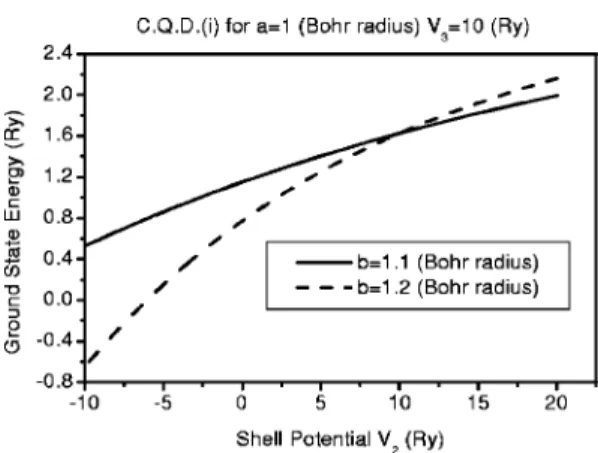
Now, let us consider the case of V2⫽V3. Figure 4 pre-sents our calculated ground state energy versus V2 of the electron inside the coated quantum dot with an impurity lo-cated at the center for V3⫽10 Ry, a⫽1a0* and b ⫽(1.1,1.2)a0*, i.e., the shell thickness is equal to 0.1 and 0.2
a0*,respectively. One can see from Fig.4 that the ground FIG. 2. Ground state energy of the electron bound inside the coated
quan-tum dot with an impurity located at the center for V⫽(10,20,30) Ry and
b⫽10 a0*共the effective Bohr radius兲.
FIG. 3. Ground state energy of the electron bound inside the coated quan-tum dot with an impurity located at the center equal to zero at different dot radii when the potential barrier is different. The ground state energy equals zero at larger dot radius (a*) if the potential barrier is higher.
FIG. 4. Ground state energy vs V2of the electron inside the coated quantum
dot with an impurity located at the center for V3⫽10 Ry, a⫽1a0* and b
⫽(1.1,1.2)a0*, i.e., the shell thickness is equal to 0.1 and 0.2a0*,
respec-tively.
FIG. 5. Ground state energy vs V3of the electron inside the coated quantum
dot with an impurity located at the center for V2⫽10 Ry, a⫽1 a0*and b
⫽(1.1,1.2,1.3,1.4,1.5)a0*, i.e., the shell thickness is equal to 0.1,0.2,0.3,0.4
and 0.5a0*, respectively.
2889
J. Appl. Phys., Vol. 90, No. 6, 15 September 2001 M.-C. Lin and D.-S. Chuu
state energy increases when the shell potential V2 increases (V2⭓V3). When the shell potential decreases (V2⭐V3), the ground state energy also decreases. Furthermore, steeper curves are obtained for thicker shells. Figure 5 presents our calculated ground state energy versus V3 of the electron in-side the coated quantum dot with an impurity located at the center for V2⫽10 Ry, a⫽1 a0* and b⫽(1.1,1.2,1.3, 1.4,1.5)a0*, i.e., the shell thickness is equal to 0.1,0.2,0.3,0.4 and 0.5 a0*,respectively. One can see from Fig. 5 that the ground state energy increases when the bulk potential in-creases for V3⭓V2. When the bulk potential decreases, the ground state energy also decreases for V3⭐V2. Furthermore, larger slope curves are obtained for thinner shells. Figures 4 and 5 also show that the ground state energy is strongly influenced by the shell thickness. In the case of V3⭐V2, the eigenvalues are found to become complex numbers when the bulk potential V3 is lowered enough. This implies that there are no bound states in this situation. Thus, we can easily and quickly determine whether a system has bound states by the Whittaker function approach.
The energy difference⌬E due to Coulomb interaction is defined as the ground state energy of an electron alone inside the coated quantum dot minus the ground state energy of an electron inside the coated quantum dot with an impurity. And
the ground state energy of an electron alone inside the coated quantum dot can be easily obtained by putting the parameter equal to zero. Figure 6 shows the energy difference ⌬E with V2⫽V3⫽V⫽(10,20, and 30兲 Ry and b⫽10a0*. From Fig. 6, one can see that the energy difference⌬E approaches the correct limits as the dot radius approaches⬁ or zero. In this case, the impurity located at the center of the coated quantum dot behaves like a free hydrogenic atom and the energy difference⌬E approaches 1 Ry, the binding energy of a free hydrogenic atom. Furthermore, one can see larger⌬E for steeper curves with higher confinement potential. The peak occurs at smaller dot radius for higher potential barri-ers.
Still, for the case of V2⫽V3, Fig. 7 presents our calcu-lated⌬E for V3⫽10 Ry, a⫽1a0*and b⫽2 a0*, i.e., the shell thickness is equal to 1a0*. Figure 8 presents a similar situa-tion for b⫽(1.1,1.2)a0* , i.e., the shell thickness is equal to 0.1 and 0.2a0*, respectively. One can see from Figs. 7 and 8 that the energy difference ⌬E increases when the shell po-tential V2 increases (V2⭓V3). When the shell potential de-creases (V2⭐V3), the energy difference⌬E also decreases. Furthermore, one can see steeper curves can be obtained for thicker shells. Figure 9 presents the energy difference⌬E vs
V3 for V2⫽10 Ry, a⫽1 a0* and b FIG. 6. Energy difference ⌬E with V2⫽V3⫽V⫽(10,20,30) Ry and b
⫽10 a0*.
FIG. 7. Energy difference⌬E for V3⫽10 Ry, a⫽1a0*and b⫽2a0*, i.e., the
shell thickness is equal to 1a0*.
FIG. 8. Energy difference⌬E for b⫽(1.1,1.2)a0*, i.e., the shell thickness is
equal to 0.1 and 0.2a0*, respectively.
FIG. 9. Energy difference⌬E vs V3of the impurity located at the center of
the coated quantum dot for V2⫽10 Ry, a⫽1a0* and b
⫽(1.1,1.2,1.3,1.4,1.5)a0*, i.e., the shell thickness is equal to 0.1,0.2,0.3,0.4
and 0.5a0*, respectively.
⫽(1.1,1.2,1.3,1.4,1.5)a0*, i.e., the shell thickness is equal to 0.1,0.2,0.3,0.4 and 0.5a0*, respectively. One can see from Fig. 9 that the energy difference⌬E increases when the bulk potential V3 increases (V3⭓V2). When the bulk potential decreases (V3⭐V2), the energy difference ⌬E also de-creases. One can also see steeper curves for thinner shells. So, the energy difference ⌬E is strongly influenced by the shell thickness.
IV. CONCLUSION
In this study, we have investigated the electronic struc-tures in a quasilow dimensional multilayer quantum system, the coated quantum dot. In the CQD system, we can solve the Schro¨dinger equations for a hydrogenic impurity analyti-cally, and obtain the electronic eigenstates as functions of the geometry and the material parameters theoretically via the Whittaker function approach. All the eigenfunctions can be expressed in terms of Whittaker functions, and it does not matter whether the energy levels are higher or lower than the potential barriers although there are imaginary numbers in the latter case. For numerical calculations, we have only cal-culated the ground state energy for illustration purposes. It is shown that the ground state energy of the coated quantum dot is strongly influenced by the shell thickness and confined potential. In the case of V3⭐V2, the eigenvalues become complex numbers when the bulk potential V3 is lowered enough. This implies that there are no bound states in this situation. We can easily and quickly determine whether a
system has bound states by the Whittaker function approach. We must emphasize again here that the Whittaker function method is a simpler approach with which to deal with multilayer quantum dots and it has general significance. One can study electronic structures of n-layered quantum dots by directly solving just ‘‘one’’(2n⫺2)-rank secular determinant equation instead of by solving 2n equations.
V. ACKNOWLEDGEMENT
This work was partially supported by the National Sci-ence Council, Taiwan, under Grant No. NSC 89-2112-M-009-065.
1
Z. Xiao, J. Zhu, and F. He, J. Appl. Phys. 79, 12共1996兲.
2
G. Bastard, Phys. Rev. B 24, 4714共1981兲.
3J. Brown and H. N. Spector, J. Appl. Phys. 59, 1179共1986兲.
4G. Weber, P. A. Schulz, and L. E. Oliveira, Phys. Rev. B 38, 2179共1988兲;
Mater. Sci. Forum 38–41, 1415共1989兲.
5
J. L. Zhu, J. J. Xiong, and B. L. Gu, Phys. Rev. B 41, 6001共1990兲.
6D. S. Chuu, C. M. Hsiao, and W. N. Mei, Phys. Rev. B 46, 3898共1992兲. 7A. Eychmuller, A. Mews, H. Weller, Chem. Phys. Lett. 208, 59共1993兲. 8A. Eychmuller, T. Vossmeyer, A. Mews, and H. Weller, J. Lumin. 58, 223
共1994兲.
9
A. Mews, A. Eychmuller, M. Giersig, D. Schooss, and H. Weller, J. Phys. Chem. 98, 934共1994兲.
10D. Schooss, A. Mews, A. Eychmuller, and H. Weller, Phys. Rev. B 49,
17 072共1994兲.
11
F. Stern and S. Das Sarma, Phys. Rev. B 30, 840共1984兲.
12
S. V. Nair, L. M. Ramaniah, and K. C. Rustagi, Phys. Rev. B 45, 5969
共1992兲.
13C. C. Yang, L. C. Liu, and S. H. Chang, Phys. Rev. B 58, 1954共1998兲.
2891
J. Appl. Phys., Vol. 90, No. 6, 15 September 2001 M.-C. Lin and D.-S. Chuu