Text Coherence
,
Reading
Abili仰,
and Children's
Sc
ientific
Understanding·
Chi-Shun Lien
Center for Teacher Education& Institute ofCurriculwn Studies National Chung Cheng University
The purposes of this study were(I)to examine whether principles of revision that improve the coherence of text,which have been used successfully on texts for advanced readers,can also be used in revising young readers' texts; (2) to investigate whether the principles used to revise history texts can be applied to scientific texts and (3) to look at the interaction between text coherence and reading ability. Two authentic scientific texts (on diabetes and on pain) were revised according to four revision principles, providing argument-overlap, making implicit concepts explicit, changing order ofs叫tences and paragraphs. and adding macro叫ructure to the text. Ninety-one 6th_grade students were divided into low-ability and high-ability groups and randomly assigned to read either the original texts or the revised texts. Participants' comprehension was measured by free recall, questions assessing knowledge of the textbase (which assessed a shallow level of comprehension),and inference questions (which assessed a deep level of comprehension). Results indicated that young readers' comprehension was superior when the coherent version of the texts was read. High-ability readers perfonned better than low-ability readers. A significant interaction between text coherence and reading ability emerged on the inference questions for one of the texts. That尬,low-ability readers' perfonnance on the inference questions was better when the text was coherent,whereas high ability readers' perfonnance was not improved by making the text coherent. Thus the text coherence a叮ected the deep comprehension level of these low吋ility readers. This finding is discussed in tenns of its educational implications.
KEY
WORDS: reading ability,
reading comprehension,
text coherence*本研究承蒙林tit華教授、曾 I,.村教授、昌平,此,芬教恨、I!來J}~右;教惚之協助».附1"@~月潛在岳之建ri義,將此致謝。亨、I 本文有任何指教,歡迎來的與木火之1'1 信聯繫 Email:[email protected]
Many students find scientific texts particularlydi血cultto understand. Why do they have difficulties? Is the nature of scientific texts different from narrative or other expository texts? Perhaps the most important reason is that scientific texts usually involve new, dense concepts with which readers are unfamiliar (Barton
,
Heidema,
& Jordan,
2002). Scientific texts involve complex mechanisms with multiple components,
attributes of components,
and relations between components (Graesser,
Leon &Otero,2002).The language in the texts is usually different from students' daily experience. Students have
di血cultyin assimilating the new information into their own knowledge structure. Hence
,
it is not easy for students to construct a meaningful mental representation. These problems are especially serious for young students with little reading ability and scientific knowledge.Students typically begin to learn from text at the fourth grade. At this time
,
young students read both narrative and expository texts. Most teachers and educators believe that students at this age are already capable of acquiring new information by reading expository texts. However,many students still fail to understand expository texts because they do not possess competence in understanding unfamiliar text features,
such as unfamiliar vocabulary,
difficult concepts and complex organization. They cannot process the incoming written information,
retrieve background knowledge,
and hold both in working memory and produce useful inferences for understanding the text. This lack of competence brings about difficulties of understanding expository texts. Thus,
several practical questions have emerged: Does reading ability account for the failure of understanding expository texts? Are competent readers more capable of handling expository texts,
especially scientific texts? If,
unfortunately,
many young students are not able to process scientific texts,how can we improve the texts and students' understanding?Scientific Texts and Historical Texts
Early research on text comprehension focused on narrative texts
,
especially historical texts that are easy to comprehend. The content usually includes the setting,
actions,
events,
and goals which are very familiar in our daily life (e.g. Bower,
Black,
& Turner,
1979; Mandler & Johnson,
1977; Rumelhart,
1975)
,
and actions and events are described in temporal order. In addition,
in terms oftext structure,
these historical texts do not have sophisticated literary forms (usually cause-effect style) so that readers are easy to use their schema to predict what will happen next.In contrast
,
scientific texts are far more complicated. Generally speaking,
scientific text can be defined as the text that involves science,
mathematics,
engineering,
and technology.There are academic textbooks,
scientific journal articles,
technical manuals,
and information brochures for the public (Goldman& Bisanz,
2002; Graesser,
Leon,
& Otero,
2002).The material conveys new knowledge about science.The content of scientific texts is usually extremely complicated and hard to understand at a deep level.Most readers with little background knowledge or immature reading skill feel challenging reading scientific texts and easily give up learning. In addition,
the text structure of scientific texts varies from text to text. The text structure may be cause/effect,
compare/contrast,
problem/solution,
or descriptive style. Thus,
it is necessary to conduct more studies on scientific texts in order to improve children's scientific learning.Text Coherence and Text Comprehension
The quality of instructional texts has long been a concern to professionals in many areas of educational research and practice (Chall & Conard
,
1991; Chambliss,
2002). Text coherence plays an important role for the process of text comprehension.Text coherence is usually defined as“
the degree towhich the concepts,ideas and relations in a text are explicit and interconnected" (Graesser,McNamara,
&Louwer凹,2003; McNamara & Kintsch,1996; O'Reilly & McNamara,2007)." 而e writing found in textbooks is often loosely organized and incoherent and requires some domain-specific information and text structure that readers do not know (Chambliss, 1994). Beck,McKeown, & Gromoll (1989) found that many social studies texts usually present too much information with too little explanation
,
as well as loose connections among sentences or paragraphs. These disjointed and incoherent texts impede comprehension and force readers to form disconnected and incoherent representation oftext.Many studies have shown that readers' comprehension can be promoted by using specific principles to improve text coherence (Beck, McKeown, Sina甘a, & Loxterman, 1991; Britton & Gulgoz, 1991; Lehman& Schraw,2002; Linderholm et aI.,2000; Vidal-Abarca,Martinez, & Gilabert,2000).Therefore,
another question has been raised: is there any way that we can rewrite or re-organize the text and make it more comprehensible? Ifthere are some principles that can beadopted,的 itfeasible to use them in order to improve young students' comprehension?
Reading Ability and Text Comprehension
Reading ability also has a large impact on text comprehension; it is generally expected to be related to how readers process and learn from text.In order to comprehend a text,readers need to develop some basic skills such as letter identification, word decoding and inference skill, and they also require sufficient domain knowledge. Skilled readers comprehend more information from text because they have better word representation (e.g., Perfetti, 1985), make more accurate inferences (e.g., Oakhill, 1993; Oakhill & Yuill,1996),and use more strategies (e.g.,Baker & Brown,1984; Magliano & Millis,2004). In addition,readers who have more background knowledge about the text understand better and learn more from text (e.g.,Brandsford& Johnson,1972; Shapiro,2004). However,young readers sometimes do not develop proficient skills and do not possess sufficient knowledge to process a text
,
so that they are unable to retrieve the meaning from text. The problem is more serious when these less-skilled young readers encounter unfamiliar concepts in scientific texts. Thus,we want to see how readers with different levels of ability comprehend difficult scientific texts.The Purposes ofThis Study
There are three purposes to this study. First,we want to know whether revision principles that have been successfully used on texts for advanced readers can also be adopted for revising young readers' texts. Several studies (e.g., Britton & Gulgoz, 1991; Linderholm et 訓, 2000; McNamara & Kintsch, 1996; Vidal-Abarca et al 刊 2000)have shown that rewriting a text and making it coherent can benefit advanced readers' comprehension. Readers who read a revised text have better comprehension than those who read an original text.Specifically,these readers have a better memory and an accurate mental representation of the text. These studies have shown that using systematic revision principles can successfully improve a text and benefit readers' comprehension.
However, most researchers have been more interested in advanced readers in high school (e. 忌,
Boscolo & Mason, 2003; Vidal-Abarca et aI., 2000; McNamara, Kintsch, Song缸, & Kintsch, 1996; Gilabert,Martinez, & Vidal-Abraca,2005),or college (e.g.,Britton& Gulgoz,1991;Linderholm et aI.,
2000; McNamara& Kintsch
,
1996; O'Reilly& McNamara,
2007) than in elementary school.Only two studies (i.e.,Beck etal門 1991;McNamara et aI.,1996) have been conducted with students at the fourth to sixth grade level. We examined whether the revision principles have an impact on young readers' comprehension.Second,the most commonly used domain for revision studies has been history (e.g. Beck et al.,1991; Britton & Gulgoz, 1991; Linderholm et aI., 2000; Vidal-Abarca et aI., 2000). Very few studies (e.g. Boscolo & Mason,2003; McNamara et aI., 1996; O'Reilly & McNamara,2007) have focused on the scientific domain. We want to investigate whether the principles used in history texts can be also applied to scientific texts. Scientific texts often involve more domain-specific knowledge and are much harder to comprehend than texts whose content comes from other domains.
Third
,
we looked at the interaction of text coherence and reading ability. Linderholm et al.(2000) examined the interaction effects of text coherence, text difficulty and reading ability. Recall and comprehension measures indicated that both more- and less-skilled college students benefited from revision,
but only in a difficult text condition. More- and less-skilled readers were roughly equivalent both on the original text and on its revised version when the texts were easy.The present study followed up on Linderholm et al.'s findings,examining text coherence and reading ability in young children. The reading level of the experimental materials in this study was anchored at a higher grade level (i.e.,seventh grade) than the grade level of the participants (i.e. sixth grade). Two scientific texts of different length and concept complexity were used.
The following section reviews the processes involved in reading comprehension,as well as factors that influence comprehension, such as text coherence and reading ability. Studies focused on the improvement oftext will be reviewed as well.
The Process
0/
Reading ComprehensionThere is general acceptance in the field ofreading that reading is a complex
,
interactive process (e.g.,
Kintsch, 1998; Just & Carpenter, 1987). Readers construct meaning by combining textual information with their background knowledge to create a mental representation of the text. At each point during reading
,
the reader tries to make sense of the information explicitly stated in the current sentence by connecting it with associated concepts in background knowledge and other related concepts from preceding sentences (Kintsch,1988; Kintsch& van Dijk,1978; van den Broek,1990).The connection of information between sentences and the integration of relevant background knowledge with the textual information are generated by various types of inferences. Take the following sentences as an example,
(1) The waitress dropped the cup.
(2) The girl's finger bled.
To understand these two sentences,the reader has to comprehend thatthe waitress is referred to as thegirl. 而 isis called"r,φrentialinference" (Kintsch
,
1998). In the same sense,
background knowledge is also necessary: If a reader cannot make acausal inference to connect sentence(l)and (2),he or she may fail to understand why the girl's finger bled. Most ofthe time,
authentic texts are not as simple as the example mentioned above. Sometimes inferences need to be generated (e.g.,
a bridge inference) because related concepts for understanding the text are spread across distant sentences or across several paragraphs. Readers must hold these concepts in their working memory and carry them over several sentences in order to link related concepts. Once readers are satisfied with their understanding of the sentence,they will move on to next sentence until they reach the end ofthe text.The Levels o/Text Comprehension
From a theoretical point of view,the common sense notion ofcomprehension is not sufficient to explain to what degree a reader understands a text. For example
,
it is very obvious that recognizing aword is different from recalling story details and interpreting a story theme. In text comprehension theory,
three levels of comprehension have been identified (van Dijk & Kintsch
,
1983).The first level of text comprehension is thesu吃facecode,which represents the exact wordings and phrases in the text.Decoding and recognizing syntax of clauses can be considered as part of this level of text comprehension.The second level of text comprehension is thetextbase,which contains explicit text propositions that preserve the meaning
,
but not the exact wording and phrases ofthe text. To construct the textbase, readers need syntactic and semantic knowledge. Sometimes the textbase includes a few inferences that establish local text coherence. One of the obvious examples of textbase comprehension is text recall.Textbase comprehension is usually considered a shallow level of comprehension.The third level is the situation model; this is the content or microworld of the text, which corresponds to a deeper level of comprehension (Graesser,Millis,&Zwa凹, 1997; Kintsch, 1994). Texts usually describe a real or fictional situation in the world. Readers have to integrate the textbase information with their own background knowledge in order to construct a situation model. The integration of textual information and background knowledge usually require e自orts such as bridge inferences, elaboration inferences, and problem-solving skills, so that a useful and coherent situation model can be constructed. Because the process of comprehending the situation model is more demanding than the other two levels of comprehension (i. e., surface code and textbase),the situation model is considered to be a deep level of comprehension orlearning from text. Building up an accurate textbase and situation model is the ultimate goal of reading comprehension.
It is not always easy for a reader to form a textbase and situation model. Two major sources influence readers' comprehension (Britton, Woodward, & Binkley, 1993; van den Broek & Kremer,
2000) - reading ability and text factors.
Reading Ability Affects Text Comprehension
Reading ability has been shown to have a large impact on text comprehension. Reading ability can be defined as the cognitive capacities (e.g.,attention,memory,and inference skills) and knowledge (e.g.,
vocabulary,domain knowledge,and reading strategies) for comprehending a text (Britton,Gulgoz, &
Glynn
,
1993; RAND,
2002; van den Broek & Krem缸" 2000). Because readers differ in their cognitive capacities and knowledge,readers may process,interpret,and recall the same text in very different ways (van den Broek,Young,Tzeng,& Linderholm, 1999). For example,high-ability readers acquire more information from text because they have better word-decoding skills (Perfetti,1985). Readers who know how to use strategies during reading can comprehend a text better than those who do not use any (Baker & Brown, 1984; Magliano & Millis,2004; Oakhill & Yuill,1996). Skilled readers have been shown to have better inference skills and can generate more accurate inferences than less-skilled readers (Oakhill,1984; Oakhill, 1993). People who have high reading ability typically demonstrate that they can consistently process text successfully by performance on some form of assessment,such as reading a passage and answering comprehension questions. People who have high reading ability generally display superior academic performance in many domains.
However,possessing good reading skill does not always lead to successful comprehension on a deep level. Reading ability is comprised of two central components,reading skill and background knowledge,
according to Kintsch's (\988) Construction-Integration model.Readers have to retrieve their background knowledge from memory and use it to make various types of inferences for constructing a coherent mental representation (McNamara etal叫 1996;Graesser,Singer,& Trabrasso,1994; Magliano,Trabasso,
& Graesser
,
1999). Background knowledgea仟ectstext comprehension; this was widely explored in the 1970s and 1980s (Anderson& Pearson 1984). Good readers usually have rich and densely interconnected knowledge stored in memory,
so that they can retrieve requisite information easily and immediately for comprehension (Ericsson & Kintsch, 1995). Poor readers may fail to understand implicit or incoherentsentences because they cannot establish essential inferences to connect the infonnation in the text with relevant background knowledge.
In sum, reading ability is an influential factor that affects reading comprehension. Individual difference in reading skills and background knowledge may generate different text comprehension even when reading the same text.High ability readers usually have more advantage than low ability readers in constructing a useful mental representation of a text.
Text Factors
In.月uenceText Comprehension
甘lereare twom句 ortext factors that influence text comprehension- text content and textstrucωreo
Text content includes facts and concepts
,
i.e. the infonnation that the author wants to convey to readers. Familiarity of content (Bartlett, 1932; Bransford & Johnson, 1972) and number of referential/causal connections (van den Broek et aI., 1999) affect the difficulty of the text. Readers can easily understand the text with familiar content because they can use their pre-existing knowledge to assimilate infonnation from the text. That is,
they can use their schemas to bridge the gaps when there is something that the author did not express clearly. Similarly,when the text is familiar, it is much easier to make fewer inferences to connect infonnation that is spread across different sentences or paragraphs.Text structure also influences comprehension. Sometimes the same infonnation can be conveyed in very different ways
,
some ofwhich are more user-friendly than others. Auser-仕iendlytext,
which means a text with a well-written structure,
usually reduces the cognitive load and the need for inference-making during reading. A number of studies have shown that improving text structure can benefit readers' comprehension (e.g.,Cook & Mayer,1988; Meyer,Brandt,& Bluth,1980; Lorch & Lorch,1996).Coherence and Text Comprehension
Recently
,
more and more evidence has shown that text coherence plays a key role in comprehension (Britton & Gulgoz,1991; McNamara et aI.,1996;Linderholm et aI.,2000; O'Reilly & McNamara,2007; Sanders & Noordman,2000; Vidal-Abarca et aI.,2000). The notion of text coherence can be defined as“
how well the parts of the text stick together (Mey仗, 2003, p. 208)" or“
the degree to which textpropositions are interconnected in the reader's mental representation of the text (McNamara & Kintsch
,
1996,p. 254)." A text that helps the reader to fonn a coherent mental representation is called a coherent text.
As discussed above
,
reading comprehension is constructed on the basis of integration of written infonnation and readers' background knowledge. A coherent text can provide a user-仕iendly 甜ucωrethat allows readers to identify the relationships between ideas in the texts and make necessary connections among them. Graesser et al.(2003) asserted that a text is detennined to be coherent when the ideas hang together in a meaningful and organized manner. With a coherent text,readers may not need to make a lot of inferences in order to capture the relation among ideas. At the other end of the continuum
,
a non-coherent text has many coherence breaks,and readers require background knowledge to fix them. In order to comprehend such a text,readers need to make additional efforts and to make various types of inferences to repair the breaks. Britton et al.(1993,
p. 20) stressed that“if a text calls for the reader to do a lot of extra mental work to create a good mental representation,
many readers will fail to do the work or do it wrong and so their representation will be poor."The coherence relations of a text are at two levels
,
the local and the global. Local coherence is achieved when a sentence can be connected to previous sentences in working memory. Global coherence is achieved when a sentence can be connected to main ideas of other paragraphs,that is,to an idea that isno longer maintained in working memory. Readers usually attempt to sustain coherence on both the local and the global level during reading (see Graesser et aI., 1997; Graesser et aI., 1994). Good readers will detect the inconsistencies in the text when there is contradiction at the local and globallevel. For example,
a passage that starts out by describing the ways to prevent global warming but ends up promoting increasing gasoline consumption is contradictory. Normally, an engaged reader would not be able to achieve global coherence of that text because of the contradiction. Similarly, readers will notice incoherence at local level. For instance,“The waitress dropped a cup. The girl's finger bled badly." Because there is no explicit statement that the girl mentioned in the second sentence is the waitress and that the girl's finger was hurt by the broken cup,the reader has to generate referential and causal inferences to bridge the local coherence break. Thus,it is essential that writers provide sufficient devices in the text to build up the coherence relations,especially in texts designed for people with limited reading ability.
In sum,a coherent text is better organized than a less-coherent text,and it is easier to comprehend.
Re過ders are more likely to construct a meaningful and useful mental representation of such a text and achieve better comprehension ofboth the textbase and the situation model.
Different Text Revision Approaches can Improve Comprehension
Many research studies have focused on improving text quality to enhance students' comprehension and learning. Two approaches to improve text quality,in order to make texts more comprehensible,are described here.
Traditional Approaches of Text Revision. Readability has been an important concern for cognitive
psychologists and educators for many years. Researchers have attempted to improve text comprehension in a variety of ways. Several studies successfully have shown that texts that were rewritten by professional writers could improve readers' comprehension (Britton et aI., 1993; Britton, Van Dusen,
Gulgoz
,
& Glynn,
1989). Some researchers have revised text by using readability formulas that assess text difficulty by calculatingword 仕equencyand sentence length; they rewrote the text,using different vocabulary and shorter sentences,
to adjust the text difficulty (Davison,
1984; Duffy etal 叫 1989).Others have used writing experts' intuition as a basis for text revision (Britton et aI.,1989; Graves et aI.,1991).However, these approaches have been criticized. It is obvious that readability formulas do not account for complex linguistic text structure. A readability formula cannot reliably provide guidelines for revising text (Kintsch & Vipond
,
1979). Similarly,
writing experts' suggestions based on their intuition are ambiguous and hard to follow (Sawyer, 1991).A Cognitive Theory of Text Revision. Cognitive theory sees reading as a complex process,one that
depends on reader characteristics and text properties (Dole,Duffy,Roehl仗,& Pearson,1991). Because of their dissatisfaction with readability formulas and experts' intuitions,cognitive scientists have worked to revise text via systematicprinciples 仕omcognitive theory.
For example, Beck and her colleagues began to identify the problems in text and to revise them according to cognitive theory by focusing on how reader characteristics and text properties interact (Beck et aI., 1991). They chose four short and problematic passages about American Revolution 仕om a fifth-grade social studies textbook and revised them according to several rules, such as “clarifying," “elaborating,"“explaining and providing motivation for important information" and“making connections explicit."Forty-five fourth- and 40 fifth- graders were assigned to read either original or revised passages.
text, which were “argument overlap,"“given-new," and “making concepts explicit."四ley repaired coherence breaks in an ambiguous history text about Vietnam War and produced a principled version using the three principles.They also produced a heuristic version (by adding subtitles,highlighting,etc.). One hundred seventy undergraduates were tested on free recall
,
factual questions and inference questions.The results showed that participants who read the principled version or the heuristic version performed better on the free recall and the inference questions than those who the read original version. As they had predicted
,
there was no difference among the 3 groups on the multiple-choice factual questions because participants only had to recognize theanswer 企ommultiple-choice questions. In addition,the knowledge structure of the author of the original text and of seven subject-matter experts was measured by calculating the statistical distance among concepts presented in the text. Their knowledge structure was compared to the knowledge structure of the participants who read the principled version. The result showed that those participants,
the author of the original text,
and the seven experts shared a similar pattern ofknowledge structure.Itwas concluded that the revision aided comprehension.Another study
,
conducted by Vidal-Abarca et al. (2000),
was also derived from Kintsch's theory and was further motivated by narrative comprehension theory (Trabasso,Secco,& van den Broek,1984).Thepu中oseofthe study was to compare two approaches for improving instructional text.The authors created three versions of a Russian revolution text for eighth graders. 甘lefirst version was revised by reducing the reader's inferential activity by increasing argument-overlap. In the second version, additional information was inserted to trigger causal inferences.The third version was a combination ofthe first two.
The authors predicted that argument-overlap changes would not produce positive effects at deep level of
understandi嗯, but that the causal constructionist changes would affect this level.
on
the other hand,theargument-overlap changes would benefit text recall,but causal constructionist change would not. The results showed that students who read the causal constructionist version performed better on inferential questions than those who read the argument.overlap version. H
Effects on Comprehensionω Functionofthe Interaction ofText Coherence and Reading
Ability
Comprehension as a Function of 是xt Coherence and Background Knowledge. Some researchers
have been interested in the interaction between text and reader. Their studies examined how text coherence interacts with reader abili紗, including background knowledge (Boscolo & Mason, 2003; Gilabert etal 叫別的;McNamara et aI.,1996; McNamara & Kintsch,1996) and reading skill (Linderholm et al.2000; O'Reilly & McNamara
,
2007).McNamara et al.(1996) revised a text concerning heart disease,writing a maximum coherent and a minimum coherent version,to investigate the interaction of text coherence and background knowledge.
The authors found that readers who have little knowledge about the text content answer more inference questions correctly when reading highly coherent text
,
whereas high knowledge readers answer moreinference questions correctly when reading low coherent text. However,this interaction effect did not show up on a recall (textbase) measure. McNamara et aI. called this counterintuitive result a
“
reverse cohesion effect" (O'Reilly & McNamara,
2007) and explained that it happened because less-coherent text made high-knowledge readers actively process at a deep level of comprehension. High-coherent text,
on the other hand,led to passive processing.Other studies did not show such an interaction between text coherence and background knowledge. For example,McKeown,Beck,Sinatra,and Loxterman(1992) found main effects ofboth text coherence and background knowledge
,
but no interaction. Similarly,
Gilabert et aI.(2005) found that their explicit version of texts improved the performance of both low and high knowledge readers,
but again there was no interaction between text coherence and background knowledge. The same finding was also reported in Boscolo andMason 冶 (2003) s側身.However
,
two recent studies present new findings concerning the interaction between text coherence and background knowledge. Kamalski, Sanders and Lentz (2008) manipulated two types of text,informative and persuasive
,
to investigate the interaction between text coherence and background knowledge. In their first experiment,they found an interaction effect such that low knowledge readers benefited from reading a coherent text,whereas high knowledge readers benefited equally after reading either a coherent or a less-coherentversion. 甘le reverse 吃fleetas found by McNamara et aI.(1996) was found only in the third experiment that they performed,
in which they improved their methodology by using movie clips to control background knowledge and by administering a sorting task to measure comprehension. However,the effect was limited to informative text only.O'Reilly and McNamara (2007) investigated whether comprehension skill affects the interaction between text coherence and background knowledge. Participants' comprehension skill was measured by a standardized reading comprehension test(i 丸 Nelson-Dennytest) and a questionnaire that was designed to measure knowledge of metacognitive reading strategies.The results indicated that skilled readers with high background knowledge benefited from reading a highly coherenttext.甘le “reversecohesion effect" was restricted to less-skilled readers wit
studies have found no interaction (Boscolo
&Mason
,2003; Gilabert et泣,2005; McKeown et aI.,1992),that is,that the text coherence benefits all readers equally (Linderholm et aI.,2000).
There are three questions that have not been completely answered by previous studies. First
,
do young children benefit as much as older readers do from text revision? Previous studies have shown that making a text coherent via text revision can improve readers' comprehension at the high school or college level,
but there is little evidence about the effects of text revision for younger children.There are many differences between advanced readers and young readers that might lead to a different answer for young readers.Second
,
can the principles that have been used in history texts also be applied to scientific texts? Most of the revision studies used short,problematic historytexts. 甘lereare differences between history texts and scientific texts. For example,temporal order,goals of the protagonist, and causal relations characterize and affect the comprehension of history text, whereas argument repetition and concept complexity affect comprehension of scientific texts. We want to examine whether the principles that were used in revising history texts can be applied to authentic scientific texts.Third
,
the findings of previous studies on the interaction of text coherence and reading ability are not consistent. The reverse cohesion 究辦ct, that only readers with low background knowledge benefit仕omcoherent texts were found by McNamara (McNamara etal刊 1996;McNamara & Kintsch,1996),but has not been found in other studies. For example
,
Boscolo & Mason (2003) and McKeown et al. (1992) found no interaction between background knowledge. Also Linderholm et al.(2000) found no interaction between reading skill and text coherence.TheStu吵
In order to answer the preceding questions,this study investigated whether revision principles used in previous studies can be successfully applied to revise children's scientificte刻,and whether children's comprehension can be improved by text revision. Four principles
,
(I) argument-overlap,
(2) making concepts explicit,(3) adding connectives,and (4) inserting macro-structure,were used to rewrite two scientifictexts 仕oma seventh-grade textbook.In addition
,
we investigated the effects of text revision on different levels of comprehension (i.e.,
shallow and deep comprehension). Participants' comprehension was measured by two different tasks: a
仕ee re臼II task and a comprehension task. In the free recall task,participants were encouraged to write down as much text information as they could remember after they read a text. The recall protocols reflected how much information that participants learned from the texts. The comprehension task consisted of 16 short answer questions, which probed participants' shallow comprehension (questions concerning the textbase) and deep comprehension (inference questions).
This study also examined whether text coherence interacts with reading ability.When children read difficult texts
,
does text coherence benefit high-ability and low-ability children's comprehension equally,
or does it benefit only one end of the reading ability continuum? In other words,if reading revised texts improves all readers' comprehension,there is no interaction between text coherence and reading ability. On the other hand
,
if only high ability or only low ability children improve their comprehension by reading revised texts,
text coherence does interact with reading ability.Participants
Method
Four regular intact classes (100 six-grade students) were recruited from a public school in Taipei City,Taiwan. Most of the participants came from middle-class families and used Mandarin as their first language. Nine of the students were diagnosed as having learning and reading difficulties; they participated in the study
,
but their data were eliminated from the analysis,
and the final sample consisted of 91 students. All participants received a pencil and an eraser as remuneration for three 45-minute sessIOns.Material
Original 是'xt. Two scientific texts were chosen from a seventh-grade biological textbook (Kang Hsuan,2006). One of the texts was entitled “What is diabetes?" and the other text was entitled“The feeling ofpain." 甘le length of the diabetes and pain texts was 548 and 348 Chinese characters,
respectively. According to Ging's (1994) Chinese readability scale,the readability level for thediabetes text was at the 6.68 grade level and for thepain text,the 5.44 grade level. In terms of text structure both texts can be classified as having a descriptive format. Each text was shown on one page,double spaced.
Two texts were chosen (instead only one) for two reasons. First
,
because of children's limited cognitive and attention capacity,
these participants were not able to read a long text all at once. Giving one short text at a time,to reduce children's cognitive load,is a more effective way to measure these children's comprehension. Second,
two texts of different length and conceptual density may help to determine the impact of text difficulty. Although both texts were adopted from 7th-grade textbook,the diabetes text was harder than the pain text. We can compare the effects of text cohesion and reading ability on the two texts in order to see the influence oftext difficulty.Revised Text. The two scientific texts were revised according to the following principles adapted from previous studies (e.g., Beck et aI., 1991; Britton & Gulgoz, 1991; Linderholm et aI., 2000; McNamara et aI., 1996). Some examples were listed at Appendix A.
I. Provide the argument-overlap: Whenever a particular concept appeared in the text,the same term was used for it. Pronouns were replaced with noun phrases when the referent was potentially ambiguous. In addition,the relations among sentences were revised to improve local coherence. Namely,each sentence and its preceding sentence had a closely conceptual connection,after revision. By doing this,a mental representation of the textbase would be easier to build up for future retrieval.
2. Make implicit concepts explicit: Some ambiguous sentences were rewritten in direct and explicit format,to reduce the need for inference-making and to make it easier to build up a useful textbase representation.
3. Change the order of sentences and paragraphs: The order of some sentences and paragraphs was changed,to achieve a better semantic and global coherence.
To ensure that the revised versions were more coherent than the original ones,ten middle-school science teachers were asked to rate the readability of both versions of the texts according to a nine-item Likert-scale questionnaire that was rewritten 命om Lehman and Schr酬's (2002) study. The teachers agreed that the revised texts were more coherent than the original ones on both local and global level,1(9) = 2.37,p <.05,d=.5forthe diabetes text andt(9)
=
2.71,p <.05,d= 1.14 forthe pain text.Design and procedure
The design was a two by two (original text vs. revised text and high ability vs. low ability) factorial design with background knowledge as a covariate. The dependent variables werea 命ee-recall measure and a comprehension measure (including textbase and inference questions). Participants recalled the texts and answered the posttest questions immediately after they read the texts.
The experiment was conducted in the students' classroom during three weekly sessions. In the first session, all participants were administered the Chinese Reading Difficulty Diagnostic 是'st and the Chinese Reading Comprehension Test.This session took approximately 50 minutes.
In the second session (the second week)
,
all participants were given a brief instruction about how to perform the tasks. They were given a booklet,which included a sample text,a filler task,a free-recall sheet and three short-answer questions. The researcher led participants through every experimental task and ensured that all participants understood how to perform each of them. After this instruction,participants were administered the background knowledge assessment. This session took about 50 mmutes.
In the third session (the third week),participants were divided into high-ability and the low-ability groups according to a median split of their scores ofthe Chinese Reading Comprehension Test. Students in each ability group were randomly assigned to read either the original or the revised texts without time
limitation. 甘】esequence ofthe experimental tasks was as follows: (a) text reading
,
(b) filler task,
(c) text recall,(d) posttest questions. Students finished all the tasks in 40 minutes to one hour.Then participants repeated thefo叮 experimentaltasks one day later for the second text.Measures
Reading Difficulty Diagnostic Test. In the first session
,
the Chinese Reading Difficulty Diagnostic Test (Ko,
1999) was administered to all participants (i.e.,
100 students). 甘】is test consisted of 20 multiple-choice questions that examined 3rd to 6th graders' basic Chinese syntax and sentence understanding. TheCronbachαvaluesrange from .75 to .86. Students whose scores were lower than 15 were considered as having reading disabilities (i.e.,
9 participants),
and their data were eliminated命omanalysis. Thus the final sample consisted of91 students.
Reading Comprehension Test. The Chinese Reading Comprehension Test (Su & Lin, 1992) was developed to assess passage comprehension. It included 5 short narrative and 5 expository passages,
followed by 5 multiple-choice questions for each passage (total n
=
50), based on Gagn 忌 's reading comprehension model. The Cronbachαreliabilitywas .82. This test was used for distinguishing high reading ability(M=
35.35,
SD=
3.68) from low reading ability children(M=
23.41,
SD=
4.19) by using the median score (i.e.,
29 points). High-ability readers had significantly higher scores on the reading comprehension test than did low-ability readers,F(I, 的)=
207.89,MSE=3174.坊 , p<.01 ,可2=
.7.Background Knowledge Assessment. This assessment was developed by the researcher. Itincluded
15 甘ue-and -false questions and 15 multiple-choice questions
,
to examine pre-existing background knowledgedi仟erenc郎, between the groups. All 30 questions were related to health and body function.Examples of these questions are "A normal human:S bo砂 temperature usual砂 rangesfrom 36 to 37 degree centigrade. True or False. " Or “The human nervous system includes the brain, the spinal cord and the . (1) nerves (2) skeleton (3) blood (4) endocrine" All questions were finished in 15 mmutes.
Filler Task. The filler task consisted of five addition and five multiplication questions.This task was administered to participants after they finished reading each experimental text,in order to prevent them from rehearsing. This task was finished in 3 minutes.
Free recall. Participants were asked to "write down as much as you can remember about the text" and given enough time to write down what they remembered.The recall protocols were scored against a list of idea units 企om the original text. Two raters scored the recall protocols independently. The inter-rater reliability was r
=
.94,p <.01,for one class out ofthe four,for the diabetes text,and r=
.95,p<叭, for another one of the four classes, for the pain text. Any inconsistent results were solved by discussion.
Posttest Questions.The posttest questions consisted of9 short-answer questions for the diabetes text and 7 short-answer questions for the pain text,which were developed by the researcher.These questions were classified into two different types: (a) textbase questions that examined children's memory of textual information in the original text (iιshallow comprehension),的 inference questions that required some types ofinference-making and reasoning (i.e.,deep comprehension). Examples oftextbase and inference questions are listed below:
“
Write down three obvious symptoms of diabetes." (Textbase question)“
If a diabetic stops eating sugar,will his diabetes be cured?" (Inference question)“
Write down the functions ofpain." (Textbase question)“
John scalded his hand. He felt less pain after a while.Why did this happen?"(Inference question)There were 5 textbase questions and 4 inference questions for the diabetes text,and 3 textbase questions and 4 inference questions for the pain text.
Scoring of Posttest Questions. A scoring template was established for each po甜的t question. Because the level of difficulty was such that the texts and questions would be challenging for participants of this age level,their responses were scored according to a relatively lenient criterion. In other words,
the scorer gave partial credit to participant
Results
General Descriptive Statistics
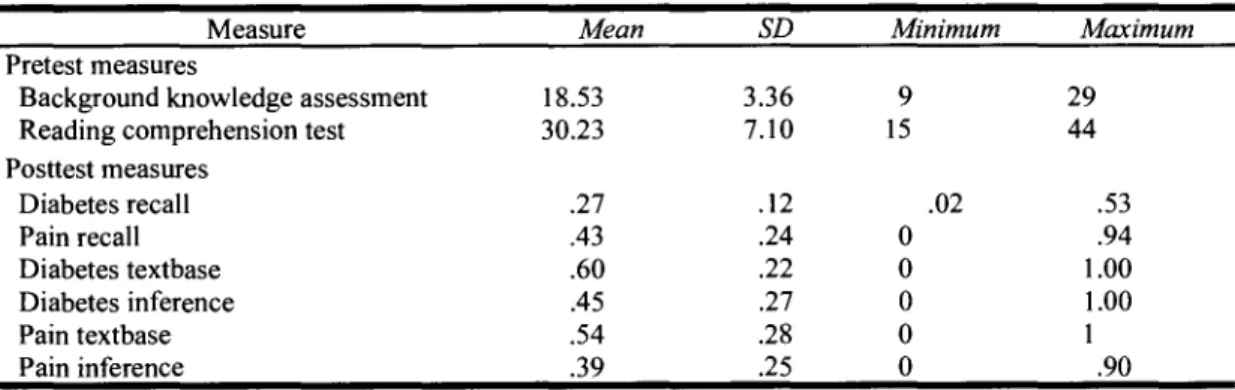
Table 1 presents the means and standard deviation as well as the minimum and maximum scores for each of the individual difference measures and the dependent measures. Table 2 presents correlation between the measures. The correlation between the background knowledge assessment and the reading comprehension test indicate that the background knowledge measure was highly correlated with the reading comprehension measure(r= 肘 , p<.OI). 而isresult is to be expected because performance on a comprehension test involves knowledge use. However,the background knowledge measure correlated
with only one dependent measure, the free recall of the diabetes text, r = .36, p < .0 1.甘lese
non-significant results were also expected because the background knowledge assessment measured general science knowledge and did not target the content of the two experimental texts. In addition
,
the correlations betw臼n the reading comprehension test and the dependent measures showed that reading ability significantly correlated with all dependentmeasures. 甘ledependent measures were also correlated among themselves.Moreover
,
Table 2 also presents the construct validity of dependent measures in terms of Multitrait-Multimethod approach. For convergent validi紗, there were high correlations between two recall measures (i.e.,r = .72) and between the recall and textbase measure (e.g叫 correlation between diabetes recall and diabetes textbase,
r= .65).on
the other hand,
Table 2 also shows discriminant validity of posttestmeasures. 甘lere were low correlations between the recall and inference measures because these measures accessed different constructs in reading. For example,the correlation between pain recall and diabetes inference was low(r= .39). In sum,
the results indicate that all posttest measures serve asvalid tools for access different levels ofreading comprehension.
Table I Means and standard deviations as well as the minimum and maximum scores that students received on all measures
Measure Mean SD Minimum Maximum
Pretest measures
Background knowledge assessment 18.53 3.36 9 29
Reading comprehension test 30.23 7.10 15 44
Posttest measures Diabetes recall .27 .12 .02 .53 Pain recall .43 .24 O .94 Diabetes textbase .60 .22 O 1.00 Diabetes inference .45 .27 O 1.00 Pain textbase .54 .28 O Pain inference .39 .25 O .90
Note. All posttest measures are presented in proportion of correct scores.
Table 2 Correlations among all measures
2 3 4 5 6 7 Pretest measures I. Background knowledge 2. Reading comprehension .43** Posttest measures 3. Diabetes recall .19 .27** 4. Pain recall .16 .36** .72** 5. Diabetes textbase .36** .43** .65** .54** 6. Diabetes inference .16 .22* .54** .39** .57** 7. Pain textbase .19 .33** .52** .53** .52** .49** 8. Pain inference .19 .37** .45** .50** .52** .47** .63** *p<.05' **p<.01
Background Knowledge Assessment
Participants were divided into high-ability and low-ability groups and then randomly assigned to read either original texts or revised texts. Thus,there were four experimental conditions(i.e叫 low-ability
and original text,low-ability and revised text,high-ability and original text,and high-ability and revised
text).ηIe means on the test of background knowledge for each condition were compared. The results showed that there was a significantdi仔erenceamong conditions,F(3,87)
=
5.04,p<.0I,r/
=
.15 .The group of high-ability participants who read original texts(M=
20.泣 , SD=
3.02) performed better than the other three groups (M=
16.泊 , SD=
3.24 for the low-ability,original text group; M=
17.62,SD = 3.19 for the low ability,revised text group;M=
18.70,SD=
3.18 for the high-ability,revised text group) on the background knowledge assessment. There was no significant difference among the other three groups.Thus,
the scores of the background knowledge measure were used as a covariate in our analyses in order to adjust the posttest means.The Multivariate
Ana加isA multivariate analysis of covariance (MANCOYA) including the two between-subjects variables of text coherence (original version and revised version) and reading ability(low ability and high ability) was performed on the dependent measures,which included free recall,textbase questions,inference questions for both the diabetes and the pain text (i.e., a total of 6 dependent measures). The scores on the background knowledge assessment served as a covariate.
The MANCOYA revealed that there was a significant main effect oftext coherence, F(6,75)= 4.34,
p < .01 ,可2
=
.258. There was also a main effect on reading ability, F(6,75)=
2.38,p <.05,r/
=
.160.There was marginal significant interaction between text coherence and reading ability, F(6,75)= 2.07,p
= .067. The result is shown in Table 3.
Table 3
Multivariate
ana加isofcovariance for
j的 recall,posttest questions
Source F(6.751 p η?
Background knowledge 1.664 .142 .117
Text coherence (A) 4.343** .001 .258
Reading ability (B) 2.388* .036 .160
AxB 2.067 .067 .142
可<.05 , **p<.01
For a deeper analysis of the observedeff凹的,separate analyses were then conducted for each of the three dependent measures for each text.
Free Recall
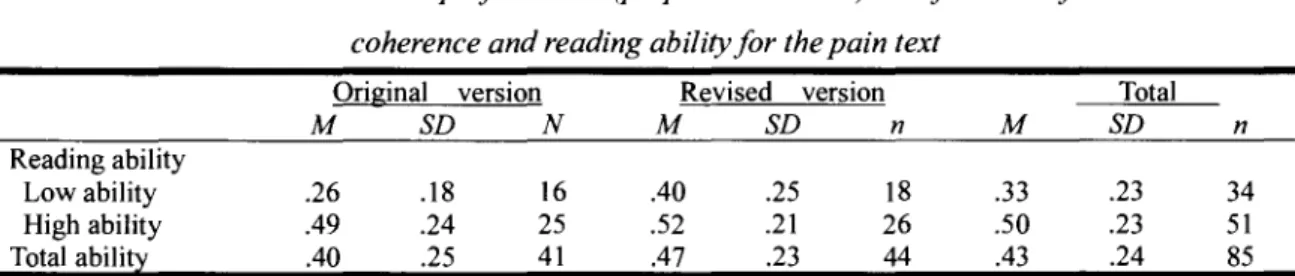
Participants' scores on the free recall test are expressed in proportion of correct idea units. The means and standard deviations for each text are shown in Table 4 (diabetes text) and Table 5 (pain text). Univariate analyses were performed on each text separately. An analysis of covariance (ANCOYA) of the results on the diabetes text revealed that there was a significant main effect oftext coherence,F(l,80)
=
4.30,MSE=
.0兒, p<.05 ,可2=
.05. Participants who read the revised diabetes text(M=.凹, SD=.13)there was no main effect of reading ability [F(l, 80) = 1.08,MSE = .02,p = .30],and there was no interaction between text coherence and reading ability[F(1,80) =.肘 , MSE=.001,p = .82].
Table 4
Free-recall
pe份rmance(proportion correct) as a function
of的tcoherence and reading ability for the diabetes text
Original version Revised version Total
M SD n M SD n M SD n
Reading ability
Lowability .22 .14 16 .26 .12 18 .24
.13
34High ability .26 .09 25 .31 .13 26 .28 .11 51
Total ability .24 .11 41 .29 .13 44 .27 .12 85
An analysis of covariance ofthe results on the pain text revealed a significant main effect ofreading abili秒, F(I,80) = 9.20,MSE = .47,p < .01,
r/
= .10. High ability participants(M= .50,SD = .2月 recalled more idea units than low ability participants (M = .33,
SD = .23). However,
there was no significant main effect of text coherence [1刑, 80) = 3.17, MSE = .16,p = .0呵, and no interaction between text coherence and reading ability[Pi肘, 80)=1.14,MSE=.06,p =.2月.Table 5
Free-recall
pe祕rmance(proportion correct) as afunction oftext
coherence and reading ability for the pain text
Original version Revised version Total
M SD N M SD n M SD n
Reading ability
Lowability .26 .18 16 .40 .25 18 .33 .23 34
High ability .49 .24 25 .52 .21 26 .50 .23 51
To叫 abil 缸 .40 .25 41 .47 .23 44 .43 .24 85
In sum,there was a tendency for participants who read the coherent (i.e.,revised version) texts to recall more idea units than those who read the less coherent texts. The benefit of text coherence was reliable on the diabetes text although not on the pain text.甘le significant effect on the diabetes text supports previous studies (Beck et aI., 1991; Britton & Gulgoz, 1991; Gilabert et aI., 2005; Boscolo&
Mason, 2003), which showed that coherent texts improve readers' memory for text. However, the non-significant result on the pain text
,
which indicated that text memory was not improved by reading more coherent text,
is consistent with Vidal-Abarca et al.'s (2000) and Liderholm et al.'s (2000) studies.In addition
,
high-ability readers performed better than low-ability readers on the recall measure only on the pain text.However,there was no interaction between text coherence and reading ability for either text. This non-significant result supports Liderholm et al.'s (2000) studies,indicating that both low-and high-ability readers benefited equally from more coherent texts.Posttest Questions
The pos位est questions were divided into textbase questions and inference questions in order to investigate different levels of comprehension. All analyses were conducted on proportion of correct scores.
Posttest
,Textbase Questions
For the results on textbase questions of the two texts,the means and standard deviations of the scores (proportion of correct scores) are listed in Table 6 (diabetes text) and Table 7 (pain text). An ANCOVA was conducted separately on each text. For the diabetes text,there was no e能ct of text coherence,F(I,80)
=
2.凹, MSE=
9.63,P=
.13. However,there was a significant effect of reading ability, F(l ,80)=
4.51,MSE=
18.94, P < .05,可2=
.05. High ability participants (M=
.67,SD=
.19) performed better than low ability participants(M=
.54,SD=
.20) on the textbase questions. There was no interaction between text coherence and reading ability,F(I,80)= .004,p = .95.Table 6
Performance on textbase questions as afunction oftext
coherence and reading ability for the diabetes text
Original version Revised version Total
M SD n M SD n M SD n
Reading ability
Lowability .50 .17 16 .57 .23 18 .54 .20 34
High ability .66 .18 25 .69 .20 26 .67 .19 51
Total ability .60 .19 41 .64 .22 44 .62 .21 85
For the pain text,there was a significant main effect oftext coherence, F(l ,80)
=
7.嗯 , MSE= 16.紗,p <.05,可2
=
.09. Participants who read the revised pain text(M=
.64,SD=
.25) performed better than those who read the original pain text (M=
.49,SD=
.25).There was a also significant main effect of reading ability for the pain text,F(I,80)=
5.43,MSE=
II 泣, p<.05,可2=
.06. High ability participants (M=
.64,SD=
.24) performed better than low ability participants (M=
.46,SD=
.26) on the textbase questions. No significant interaction between text coherence and reading ability was found for the paintext,叭叭, 80)
=
.006,p=
.94.In sum,participants obtained higher scores on these textbase questions and thereby benefited from the coherent text. This advantage was significant for those who read the revised version of one of the texts,the pain text. This finding was consistent with previous studies (McNamara et aI., 1996),which showed that text coherence facilitates readers' textbase comprehension. Additionally, high-ability participants significantly outperformed low ability participants on the textbase questions on both the diabetes and the pain texts.This result supported previous studies (e.g.,Brown,1982; Linderholm et aI.,
2000; Oakhill & Yuill,1996; Perfetti, 1985; O'Reilly & McNamara,2007). However,the interaction of text coherence and reading ability was not significant.The non-significant result was consistent with the results of Linderholm et aI.'s (2000) study.
Table 7 Pe祕rmance
on textbase questions as afunction oftext
coherence and reading ability for the pain text
Original version Revised version Total
M SD n M SD n M SD n
Reading ability
Lowability .40 .27 16 .53 .23 16 .46 .26 32
High ability .56 .22 22 .70 .25 26
.64
.24 48Posttest
,Inference Questions
For the inference questions
,
the means and standard deviations are shown in Table 8 (diabetes text) and Table 9 (pain text). For the diabetes text (Table 8),there was significant effect of text coherence,F(I,80) = 7.51,MSE= 49.29,P<.01,
rl
= .09. Participants who read the revised version(M=.54,SD= .28)。utperformed those who read the original version(M=.39,SD
=
.23). However,there was no main effect ofreading ability,F(I,80) = 1訓 ,MSE= 12.35,P = .17 and no interaction between text coherence and reading ability,F(I, 80)=
.52,MSE= .34, p=
.47.Table 8
Performance on
i收rencequestions as afunction oftext
coherence and reading ability for the diabetes text
Original version Revised version Total
M SD n M SD n M SD n
Reading ability
Lowability .34 .25 16 .46 .29 18 .40 .27 34
High ability .42 .23 25 .60 .27 26 .50 .27 51
Totalabili且 .39 .23 41 .54 .28 44 .47 .27 85
For the pain text (Table 9),there was a significant interaction between text coherence and reading 2 n n T _1-".' ....
ability,F(I, 80) =6.呵 ,MSE= 29.23,P< .的, η= .08. Low ability participants who read the revised version of the pain text(M
=
.51,SD=
.23) answered more inference questions than those who read the original version(M=
.16,
SD=
.15),
whereas high abilitypa前icipantswho read the revised version(M= .51,SD= .25) did not perform better than those who read the original version(M=.42,SD= .17). In addition,there a significant main effect of text coherence,F( 1,80)
=
24.03,MSE=
102.98,P< 肘, 4 = .23. Participants who read the revised version(M= .51,SD = .24) outperformed those who read the original version(M=
.32,
SD=
.20) on the inference questions. There was also a significant main effect of reading ability,F(I, 80) = 5.23,MSE=22.的,p <.05,rl
= .06. High ability participants(M=.46,SD = .22) outperformed low ability participants(M= .34,SD= .26) on the inference questions when reading the pain text.Table 9 Pe吃formance
on
i欣rence qu臼tionsas a function oftext
coherence and reading ability for the pain text
Original version Revised version Total
M SD n M SD n M SD n
Reading ability
Lowability .16 .15 16 .51 .23 18 .34 .26 34
High ability .42 .17 25 .51 .25 26 .46 .22 51
Total ability .32 .20 41 .51 .24 44 .41 .24 85
In sum
,
the results showed that deep comprehension (as measured by the inference questions) was a function of the interaction of text coherence and reading ability. That is,
low ability readers' deep comprehension (i.e叫 scores on the inference questions) was improved by reading the coherent text,whereas high ability readers' deep comprehension was not improved. This conclusion is based on the significant interaction effect found in the pain text. The results on the pain text indicated that it was the low ability participants who gained from the coherent version ofthe text.
Discussion
This study had three purposes. First, we examined whether revision principles that have been
su囚的sfullyused on texts for advanced readers can also be used for revising young readers' texts. Second,
we investigated whether the principles used in history texts can be also applied to scientific texts.Third,
we examined the interaction between text coherence and reading ability. Two authentic scientific texts were taken from a 7th-grade biology textbook and revised according to four revision principles. Ninety-one 6th-grade students from four regular intact classes were divided into low-ability and high-ability groups and randomly assigned to read either the original texts or the revised texts. Participants' comprehension was measured by free recall
,
questions focused on the textbase,
and inference questions. Results indicated that the comprehension of young readers was improved when they read the coherent version of texts. High-ability readers performed better than low-ability readers. An interaction between text coherence and reading ability emerged on the inference questions for the pain text. That 尬, low-ability readers' deep comprehension (i.e., scores on the inference questions) was improved by reading the coherent text, whereas high ability readers' deep comprehension was not improved.Comprehension as a Function ofText Coherence
Two main purposes of this study were to examine the effect of text coherence on (I) children's comprehension and (2) scientific texts. There were significant main effects of text coherence on most of the measures for both texts. In addition,the results clearly showed that scientific texts can be improved by the use of revision principles.The texts that were used in this study included incomplete descriptions and implicit concepts.Itwas not easy for students to understand and remember the content.By applying the revision principles (i.e., providing argument-overlaps, making implicit concepts more explicit,
changing the order ofsentenc的 andparagraphs. and adding macro-structurl的), the text quality was
improved and the texts became easier to understand. Children who read the revised version of texts performed significantly better than those who read the original version of the texts. The improvement of comprehension appeared not only at the shallow level (textbase questions) but also at the deep level (inference questions).These results provide evidence about how to revise children 's scientific texts.
The results of this study expanded on previous studies (e.g.,Beck et aI., 1991; Britton& Gu1goz,
1991; Linderholm et aI., 2000; McNamara etal叫 1996; Vidal-Abarca et 泣,2000) designed to improve the comprehension ofhistorical texts by adults and older students.
Comprehension as a Function ofReading ability
It is clear from the research literature that high-ability participants outperform low-ability participants on comprehension measures (e.g., Baker & Brown, 1984; Oakhill, 1993; Perfetti, 1985; Shapiro, 2004). Our results showed that high-ability participants performed consistently better than low-ability participants on the measures for the pain text. The findings were convergent with the results of Linderholm et a l.這 (2000) study, which showed that high-skilled college students performed better than low-skilled peers when reading a difficult text.
However, a significant e任ect of reading ability emerged only on the textbase questions for the diabetes text.One possible explanation is that the diabetes text was more difficult than the pain text.The diabetes text contained more idea units and more difficult concepts than did the pain text,and the text
may have been too difficult for these young readers tounderstand. 而 us,although there was a tendency for high-ability readers to perform better than low-ability readers on the free recall and posttest inference questions,the effect ofreading ability was not significant on those measures.
Comprehension as a Function ofInteraction between Text Coherence and Reading Ability
The other purpose of this study was to examine the interaction between text coherence and reading ability. There was no interaction between text coherence and reading on most measures. The results indicated that text coherence was of equal benefit to readers at both high and low reading ability. This finding supported Linderholm et aI.'s (2000) stu旬" which indicated that high and low ability students improved their comprehension equally when they read coherent texts.
However, there was a significant interaction between text coherence and reading ability on the posttest inference questions for the pain text. That 的, low-ability readers' deep comprehension was improved when they read the coherent text,whereas high ability readers' deep comprehension was not improved. Why did this significant interaction of text coherence and reading ability appear on the inference questions for the pain text?
One possible explanation is that the revised pain text provided an effective
“
scaffold" that helped low-ability readers comprehend better. That is,
the difficulty level of the revised pain text,
which was from a 7th-grade biology textbook that was above the participants' reading level,was appropriate for the low-ability participants. The revised version clarified implicit concepts and repaired coherence breaks,
and fewer inferences had to be generated while reading. The low-ability readers may have had sufficient cognitive resources to process the textbase information in the revised text, integrate it with their background knowledge
,
and then construct a meaningful mental representation.on
the other hand,
the high-ability readers may not have needed the supplemental information provided by the revised version.They may have already been capable of comprehending the original text
,
so that the additional suppo前from the revised version did not lead to a significant difference on the deep comprehension measure for the high-ability readers.This finding is particularly meaningful for its educational implications.
Moreover,the
“
reverse
cohesion 吃tfect"did not emerge in the present study. Some previous studies (e.g.,Kamalski et aI.,2008; McNamara et al叫 1996; McNamara & Kintsch, 1996) indicated that high knowledge readers performed better when they read the incoherent text.Our findings did not support the counter-intuitive "reverse cohesion effect."Inconsistent Results between the Diabetes Text and the Pain Text
Often researchers use only one text in a study. In the present study,we chose two authentic scientific texts from a 7th-grade textbook
,
so that we could examine whether there were similar effects across the two texts. If we could obtain similar results from both texts,the evidence would be more solid than results drawn from only a single text.However
,
there were inconsistent main effects of text coherence in the two texts,
and also inconsistent effects of reading ability. Why did the two texts generate inconsistent results?One possible explanation is that the difficulty level of the pain text was more appropriate to the reading level of our participants than was the difficulty level of the diabetes text. Although both texts were chosen from a 7th-grade textbook,
the diabetes text was more difficult than the pain text. There were 46 idea units in the diabetes text as opposed to 17 idea units in the pain text.In addition,
the diabetes text contained more unfamiliar terminology than the pain text.Participants recalled only about 27 percent of idea units for the diabetes text,
as compared to 43 percent for the pain text.Another possible explanation is that the difference between the origin and the revised version ofthe pain text was much greater than that ofthe diabetes text.According to the readability ofboth versions of texts rating from ten science teachers, there was a greater coherence difference between origin and revised version for the pain text (d= 1.41), whereas there was less coherence difference between two versions for the diabetes text(d=.5).
Implications
The poor quality of texts of scientific textbooks is a common complaint among educators.Itis not surprising that children have difficulty understanding them. As the results of this study demonstrate,
improving text coherence appears to be advantageous to young readers. There are several important implications for educators and textbook writers.
For educators,the results suggest that it is important to choose considerate instructional texts for younger students. An instructional text should be written in explicit,direct language that does not require inference-making,so that cognitive load is reduced. In addition,a good text should also contain a clear and concise indication of its macrostructure
,
including subheadings or topic sentences. The macrostructure represents the global structure of a text(Kints吭, 1998) and cues the most important ideas from the text,which may trigger young readers' background knowledge and encourage them to process the text positively (Kintsch & van Dijk,1978).Moreover,it is also important for educators to take account of young children's reading ability when choosing scientific instructional texts. As we know,scientific texts usually contain novel information or explain complicated and challenging concepts. When young readers encounter unfamiliar scientific content
,
they usually do not have sufficient background knowledge related to the text. Moreover,
their reading skills are usually not highly proficient. These young readers simply cannot absorb the information from the text and construct a useful mental representation.Thus,teachers and other educators should be aware of the difficulty of the language and the content of a text,and choose appropriate texts that match young readers' ability.The interaction of text coherence and reading ability that was found on the posttest inference questions for the pain text is particularly meaningful for its educational implications.The results showed that low-ability young readers' deep comprehension as measured by the inference questions can be improved by reading well-organized,considerate texts. Indeed,low-ability students do need additional assistance when they learn new material. Coherent texts provide explicit information that reduces cognitive load and provides a"scaffold" for comprehension (Vygotsky, 1963). Low-ability students may be the ones who benefit most from coherent text; they m